






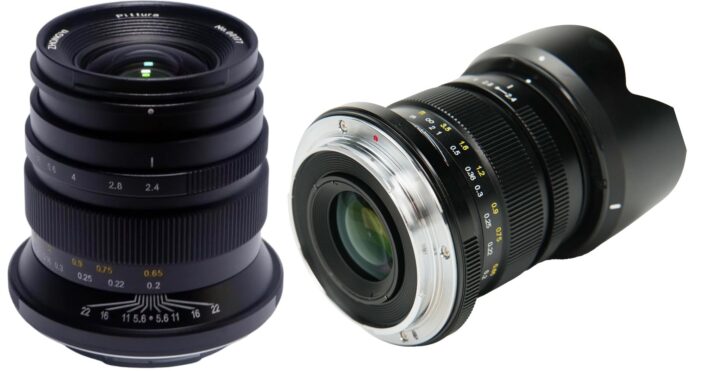
The Mitakon Zhongyi Optics Pittura 30 mm f/2.4 is available since early August at other stores like Mitakon and Aliexpress.
Now you can get it also at Amazon here and BHphoto here.
- Mitakon Zhongyi Optics Pittura 30 mm f/2.4
BHphoto / Amazon / Adorama / Mitakon / Aliexpress
Key Features
- Medium Format | f/2.4 to f/22
- 24mm (Full-Frame Equivalent)
- Light and Compact Wide-Angle Lens
- Manual Focus Design | 7.9″ Min. Focus
- Clicked Aperture Ring
- Durable All-Metal Construction
Fujiinon GF alternatives with autofocus:
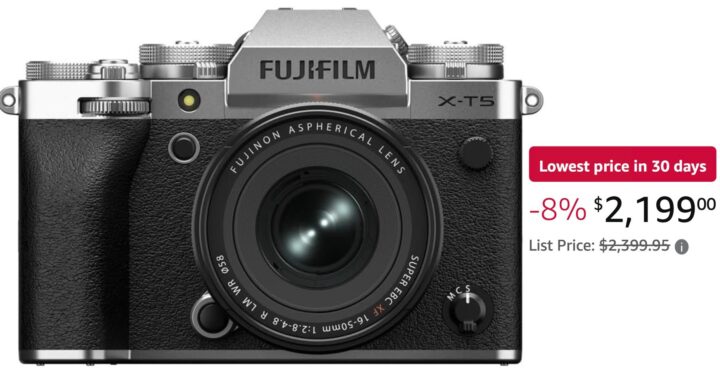
I have been asked how long the current $200 rebate on the Fujfilm X-T5 with XF16-50 will last.
Stores are not giving any indication but to my knowledge the deal will end November 1. (thanks to the new anonymous source for this info)
You can get the deal at Amazon US here.
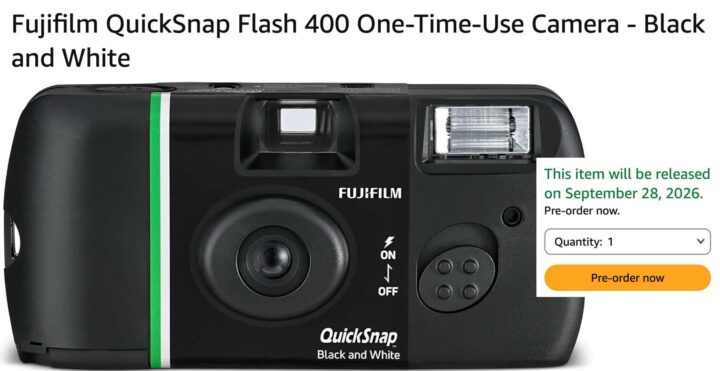
The Fujifilm QuickSnap 400 Black and White camera can now be preordered at Amazon here.
The QuickSnap 400 BW was announced back in July along with the Fujifilm QuickSnap Active Waterproof camera.

→ Join Now: Fujifilm X-T Shooters Group
Canon, Sony and Nikon offer a feature that Fujifilm does not have – nor I hope will ever have for the reasons I’ll explain below.
But I regularly get emails from fellow FR-readers asking me to press Fujifilm to implement this feature especially on the upcoming Fujifilm X-T6.
The feature in short: when you shut down your camera, the shutter closes and “protects” your sensor from dust when you change lenses. They call this “sensor shield”.
In my opinion its a fancy name for a potentially dangerous feature.
But let’s start with the latest email I got about this from FR-reader Malcom.
One feature I would spend good money for is a sensor protection shutter – a robust screen that prevents dust and dirt getting on the sensor when I change lenses (e.g. Nikon Z9) I don’t think I’ve ever seen it in a list of requests poll though. I’ve had several instances when this problem has happened, sometimes I notice it, sometimes it’s only when I view the images on computer screen that I see the persistent marks on every image. I’d love this feature. Am I the only one? Too late for the X-T6 but maybe for its successor?”
Malcom’s wish is to launch a survey, so I’ll do that.
But I will also quickly explain why I will vote for not having this feature. As I explained 4 years ago in this article:
- Camera makers already protect the sensor with a layer of strong, solid glass
- The shutter is made of razor-thin metal curtains with fine overlapping blades, built to move at extreme speeds
- Changing lenses with the shutter exposed puts the most fragile part of the camera at risk
- Hiding the shutter inside the body and leaving only the sturdy glass exposed makes more sense
- Exposing the fragile part to protect the sturdy part is counterintuitive to me
I don’t like the idea of dust particles getting stuck between those ultra-thin and blazing fast moving metal blades.
Now, some argue dust on the shutter is better, since it won’t show up in images and an air blower can remove it later. But in my experience, dirt can stick so firmly that a blower won’t get it off. In those cases, you need sensor swabs. I don’t know you, but I’m comfortable swabbing the protective glass, but I’d never touch the shutter with a swab.
But I promised a survey, so let’s just do it. There might be something I be missing and that makes the shutter shield the better option. If so, feel free to let me know in the comments below.
Important distinction – read before voting:
Most cameras use the mechanical shutter to cover the sensor. But the Nikon Z9/Z8 has no mechanical shutter, so it uses a dedicated protective shield, which reviewers describe as more robust than a normal shutter curtain. I’ll make this distinction in the survey, but personally I still see no need for one.
Also, implementing a more robust, protective-only shutter would almost certainly require a camera without a conventional mechanical shutter, meaning you’d have to accept shooting exclusively with the electronic shutter. For both technical and cost reasons, I doubt any camera manufacturer will ever implement a dual-shutter system featuring both a conventional mechanical shutter and a separate protective shutter. So, if you’re asking for a sturdy protective shutter, you’re essentially also asking for an electronic-shutter-only camera.
[poll id=”579″]

For a few hours only you can save $110 on the Lexar 128GB UHS-II SD-card at BHphoto.