







image courtesy: focus numerique
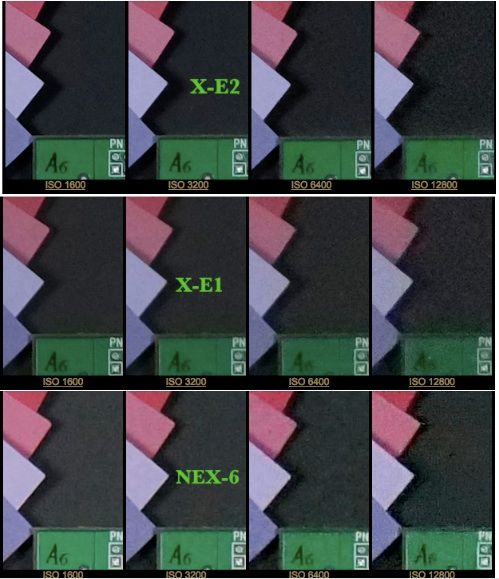
1) Same sensor (apart from the phase detection pixels on the X-E2) but different results? I’ve read some reviews that said that the ISO performance of the X-E2 is a little better than on the X-E1. Now focus-numerique posted its ISO comparison here (translation). We could expect better JPEG’s, given the newer and powerful EXR II processor on the X-E2. But download the RAW files at focus-numerique and let yourself go to some pixel peeping!
“Overall in 6400, the images are still usable, which is remarkable for a APS-C sensor. At this ISO, Fujifilm with its X-E2 dominates the competition. Pushing a little more sensitivity, the images are degraded, but again, the X-Trans sensor coupled to the processor works miracles and easily outperforms other APS-C models.”
2) “My Fuji X-E2 – Just Perfect!” at markhilliardatelier here: “Yesterday I took it out to shoot shrimp boats in North Carolina and have to tell you that the camera just blew me away. It is such a major upgrade over the X-E1 that I cannot believe that they came from the same company!”
3) boxedlight first shots with the X-E2 here: “Do I prefer the X-E2 to my X-Pro 1? Absolutely!”
X-E2
USA: AmazonUS / BHphoto / Adorama / DigitalRev / Pictureline / EUROPE: wexphotographicUK / DigitalRev / Fotomundus24 GER / PCHstore / AmazonDE (via DR)
feel free to use one of the shoplinks above if you think the X-E2 is the camera that meets your needs and you want to purchase it. This blog will get a small commission. It won’t cost you a penny more on your camera… but it will keep this site running. Thanks.
27 Responses
Some people claim, that Fuji-ISO does not represent the standard ISO, that e.g. Canikon ISO 2000 is displayed as ISO 3200 on a Fuji cam. Is that true??
yes it is
long story…..
yes, it’s true only from 200 to 1600 iso, above the situations it’s different.
(but it’s the same for canon/nikon/pentas, each brand have its iso “scale” above 1600 🙂
but..Avoid non-full-stop ISOs, non full stop are “software/interpolation”
ISO is supposed to be a standard…and I think the standard as for film only goes up to 1600…so anything higher than that is made up by each of the companies…fuji , sony canon nikon…etc….but I have used the X-E2 shooting on the streets at night at ISO 4000 and getting very nice quality images using the zeiss 32 1.8
ISO is a standard, calibration are not standard.
in my experience i can measure a difference between .5 e .66 EV when comparing my XP1 to a canon 6D (i have both)
According to DP Review test of X-E1
http://www.dpreview.com/reviews/fujifilm-x-e1/15
“By our tests, the X-E1’s measured sensitivities are about 1/3 to 1/2 stop lower than marked, which is unusual for a modern camera. This means that for any given light level, shutter speed and aperture on the X-E1 has to use a higher ISO to get an image of the same brightness as an accurately-rated camera.”
But, seems to me that in X-Trans II sensor (x100s) this issue was “fixed”
http://www.dpreview.com/reviews/fujifilm-x100s/11
“By our tests, the X100S’s measured sensitivities are within 1/6EV of indicated, which is within the tolerance allowed by the ISO specification. In other words, ISO 100 indicated = ISO 100. Interestingly, when we looked at the X-Pro 1 and X-E1, we found that their measured ISO sensitivities are about 1/3 to 1/2 stop lower than marked.”
Question is – if X-E2 behaves like X-E1 or X100s in terms of ISO accuracy? Looking forward for reviews.
From the article X-E2 seems to be cleaner, but also image looks darker than X-E1 image… also might be case of stronger, but more accurate noise reduction.
I’m quite skeptical about this test, seems to be that X-E2 behaves better, than Canon 6D which is one of the “cleanest” FF in the market!
« image looks darker than X-E1 image…»
Are you kidding me? Or maybe you’re blind? Or maybe you watching only black areas? Come on! Look at other areas, and you’ll see, that X-E2 even lighter! It’s simple: pictures from X-E2 have better blacks and generally better contrast, than X-E1.
P.S. I hate that FUJIFILM cheeting with ISO.
Hold on, why are you so aggressive?
Yes, I’m looking in dark areas, because noise is mostly and easily prominent there.
Anyway I’m looking forward for some independent user reviews before jumping to conclusions… many says that noise reduction in x100s (same sensor as X-E2) is way too strong even when set to -2.
I compared the X-E1 and X-E2 raw files from focus-numerique (iso200) in Lightroom, and the X-E2 is brighter indeed, but was shot at 1/4 instead of 1/8. 😐 Don’t know how reliable their lighting is though, and one was shot at 35mm with the 18-55 while the new one at 18mm, both at F5.6, but the corners are not very good this time around .. i though the 18-55 was better than that. Maybe it’s slightly misfocused or shaken or whatever, probably a different copy at least.
Also, blacks in jpeg’s are indeed darker since the new processor in the x100s, now in the X-E2 as well. But of course you can adjust it all. 🙂
according to dpreview the x100s with x-trans II sensor is only about 1/6 stop off.
Fuji is at it again with the ISO. Look at the NEX-6 ISO6400 image exif vs fuji X-E2. 1/250 for NEX6 and 1/140 for Fuji. They are clearly over rating the ISO figures by large amounts to make the comparisons look more favorable.
Having said that, the Fuji 12,800 image is 1/280s and WOW it looks SOOO much better than the ISO6400 image of the NEX6.
Interesting… But if X-E1 and X-E2 both cheat with ISO, wouldn’t they both show better images than NEX6?
It looks like the XE1 was metering the same shutter speed as the NEX at ISO6400 and most other ISO’s as well whereas the XE2 was nearly a stop slower. I am confused. No idea what is going on. Strikes me that something funny is going on though with the test results. Perhaps it is something that the fuji does behind the scenes, like dynamic range expansion.And my mistake, the XE2 was still rating the best part of a stop slower at ISO800. Something funny going on here.
hope fuji finally make it right with the XE2
It appears that at ISO800 the shutter, aperture and ISO combinations are even between NEX and X-E2. At ISO1600 and above, the Fuji seems to be around 2/3 of a stop slower shutter speed. Same as before. Very misleading.
And how many reviewer is falling for it. Dpreview sometimes measure right values but doesn’t seem to understand how it affects to image comparisons. Comparing images should be done at same shutter speed and aperture and measured iso.
…yes iso cheating and the colors of fuji at high iso are off comparing the nex and oly ep5…they are washed out!
the colors I get with the X-E2 at high ISO are anything but washed out…I find them to be perfect sooc…that is my experience…but I have only been using the camera for 5 days now.
And same exposure histogram too… because each camera metering is different, NEX tends to underexpose by 1/3-2/3 stop while my X-E1 tends to overexpose by 1/3.
My EV dial is on -2/3 as a normal, “well lit scene” fixture on my X-P1. One of the first things I do with a new camera is test it against a meter (either Luna Pro or Minolta IV) just to get a sense of where it falls in the spectrum. I’m looking at the “suggested” EV, not necessarily what I think gives the best exposure.
Although I generally just do this at lower ISO, where I tend to do most of my shooting. Fuji was no better or worse than my experiences with the Canon, Lumix, and Sony cameras I’ve owned in this regard. What strikes me as odd is that the ISO sensitivity curve might change as ISO moves up. Easy enough to test for—I’ll pay more attention to just how many stops I gain when going from 200 to 1600. (3 should be exact if all is in order.)
These guys should stop using their brainless methodics and follow approach used here: http://www.dpreview.com/forums/thread/3509778
yes, that’s consistent with my findings.. .5/.66 stop less sensitive (taking about XE1/XP1, never used a XE2) than declared.. at least compared to a canon 6D
After reading the two photographers posts about the xe2 I still wonder just how practical the -2 model is for an upgrade from the -1 series. Both commenters unabashedly and heavily processed the photo examples. Both rave about how clearly superior the 2 model is but it’s just not convincing insofar as IQ goes. What I see a lot are photo examples that could come from EITHER model if one is simply going to process raw files.
As for the high-ISO stuff….3200 is usable and occasionally 6400 from EITHER camera, but again–the -2 model isn’t blowing the xe1 away here and any deficiency in noise can be mitigated in post.
Those with the xe1 model have to consider whether the true cost of an upgrade is really warranted. A used xe1 in the US now goes for $500-$600 with the xe2 retail at $1000. Are there $1400-$1500 in improvements between models? I don’t see it myself. Yeah, faster EVF refresh and PDAF focus and improved processor are swell, but worth the cost? I enjoy the reviews….if nothing else to affirm or disclaim the hype.
Yeah, I freshly remember the first reviews of the X-E2 and how they agreed that there wasn’t really any immediate reason to ditch the X-E1 just yet. Well, it seems the hype from the PR branch of Fuji has been turned up a notch and a half. Because the X-E1 now goes for a paltry $500-$600 somebody has to try and convince those prospective buyers to rather go buy the X-E2!
IMOH, wait for the Spring and the camera buds it will bring! 🙂
Boxedlight,
I am glad I clicked on your link. I really like your pictures…well done.
Admin, remember the XE-2 has 14-bit RAW. That + other minor tweaks can definitively make the difference for the ISO. Also thinking it’s just the same identical sensor it’s an assumption, it could be a small rev. up.
Just my 2 cents on the mystery.