







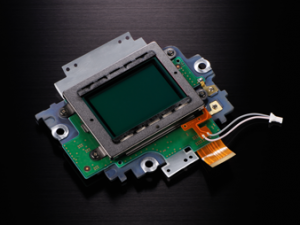
The Sony 36 megapixel sensor used by the Nikon D800 (and D800E).
Peter from Nikonrumors compared the Nikon D600 (with Sony 24MP sensor) and the Nikon D800E (with Sony 36MP) sensor. I thought it would be interesting to link to it because we may have a high end FF model from Sony which sues the same 36MP sensor. TO be honest I don’t see that much difference in noise and resolution between the two cameras. Of course we have tot ake into the account thet the image form the D800E has been downsampled but I would have expected to see more detail on that crop…
P.S.: Sensorgen posted the D800 data.
41 Responses
DxOmark has also tested both these sensors, and they are so close that they are probably impossible to tell apart.
This shows once more that 99% of us don’t need megapixels increase. We already reached the sweet spot on FF cameras at 24MPix. They should instead work on DR, low light performances and so on. I really am not looking forward to work on 36mpix raw files.
I’ll correct that statement for you. “This shows once more that YOU don’t need megapixels increase.”
Did you know that 99.9% of statistics are made up?
Okay, Frank, I bite. Tell us the use cases and why they are relevant for more than 1% of photographers.
You have completely missed the point.
Three use cases (and one bonus):
Other things equal, Hgher MP allows me to use a fixed prime and then crop, rather than having to use a zoom with a lower MP count sensor.
Higher MP gives me more post processing options (filter/NR effects can be more subtle, because the effect has smaller pixels to work with).
Higher MP makes full use of my lenses, rather than making the camera the bottleneck. Lenses are more expensive than the camera, and I’d prefer that the lenses were the limiting factor.
Bonus use case: it allows me to see my technical mistakes more clearly so that increasing MP forces my technical ability to increase. This is especially the case with lighting and exposure: get it wrong and a high MP sensor will simply use the extra pixels to show up your poor exposure decisions.
Given that in the end the work is displayed with a certain resolution, only your first point is a valid use case. But even then: How many MPs survive the toolchain to the final product for 99% of photographers? For me personally, I create 2000×1000 pixel images for the digital album. This means a lot of cropping range even with current sensors.
And then, physics defines a limit (Airy disks) which is already reached with current pixel densities.
I do more downsizing than cropping. But I like the idea of having high resolution picture so that I can crop if I have to. Besides, as reported by DxO, there is no significant difference between 24 and 36. So I totally welcome high MP camera.
Well, just suppose I happen to be in the 1%. You think there should be no camera available for me to use?
Very soon, 99% of photos will be shot on phones. Only 1% of photos will need interchangeable lenses. So, Sony should not make interchangeable-lens cameras?
My opinion is that the sensor should have higher resolution than the best lenses at their best (diffraction-limited) apertures. The lens should always be the limiting factor, not the sensor (or the film).
The biggest improvement would come from multilayer sensors, provided the snags that we see in the Foveon can be overcome. Given multilayer, then my guess is that around 5000×7000 pixels will cover most uses.
Above that, taking several shots and stitching may be unavoidable.
Well I take it that you didn’t have had doublespreads printed on magazines with a 600 grid. Nor do you print fine-art prints with sizes of DIN A1. And of course you haven’t got an shooting on advertising products. So then, yes, it’s not for you. It works tremendously fine for me, after beeing stucked to 12MP for a couple of years – 36MP is another world!
The heart wants what the heart wants.
The day I will start to see wedding photographers shoving around 36+ mpix cameras I’ll say he’s right.
People went on about 16mpix not being required and 12mpix is all that people really need. Earlier, people said 6mpix was perfectly fine and all that people really needed, nobody really needed 10mpix.
Soon it’ll be 36mpix and people don’t need 48mpix. You are just a continuation of what some people have been saying about every increase in mpix for years.
I still read in a current textbook of mine that 6MP is enough. 16MP is equivalent to old non-digital film resolution. So I don’t share the impression that photographers are longing for even higher resolutions. They are longing for lower and lower noise instead. Funny enough, my 1000€ camera has 24MP, and Nikon’s flagship only 16MP.
@Torsten: exactly! That’s the point! They like to ignore the fact that cameras like D4 or 1DX don’t even consider moving beyond 18mpix. According to what is said here, those cameras should give tremendous soft and poor images. Facts do say quite the opposite. Nevertheless, I hope Sony produces a 40mpix and more cameras, so that I can start having fun reading comments of people here not buying it ’cause it doesn’t deliver at high ISOs. That’s how it would end, I could bet a house on that.
@ Torsten:
And your 1k camnera can outresolve both flagship cameras with similar quality glass. The point of the lower resolution is mostly speed (and possibly file handling if you have to go through hundreds of consecutive hight speed frames).
emopunk +1
gosh… Frank… if you want resolution, buy the Sigma DP1M or DP2M. else, there is no reason to favor the uselessly large files over their 24M or 16M alternatives. have you seen the pixel-level comparison between D800E and a DP2M? god oh god, that is what I call sharpness and detail. the 36MP camera looks like an interpolated 12MP shot (which it actually is…:> compared to the Foveon of the Sigma…
so, NO, WE DON’T NEED NO MORE MEGAPIXELS!
(we need more sharpness and REAL resolution, not that blown up crap by bayer interpolation)
No YOU don’t need more mpix. Stop telling everyone else that THEY don’t need extra mpix.
Stop telling other people what THEY want.
frank, I agree with you this time.
But Frank, aren’t you the one that is always telling other posters that are hoping to see Sony do something different or make a product better to STOP being part of this blog (leave) and to purchase some other camera.
So now you are saying what?
Oh……………
You are telling others to stop telling other people what THEY want!
You do that all of the time don’t you Frank?
There is a difference between suggesting and telling. Here we have people TELLING us that most people don’t need more mpix based on THEIR requirements. That’s just naive.
If however I said that I want Sony to put a Nikon badge on their cameras, I would fully expect people to suggest that I swap to Nikon as that matches my requirements right NOW.
How about this…. Most people don’t fully utilize the mega pixels they have currently available to them. So based on that Most people don’t need more megapixels. I am not telling people what they need based on my own opinion, just stating that based on the fact that most people don’t use the full resolution of the camera… Most people post their images at 70% quality super compressed for WEB USE, there are a few people that actually still print 4×6 and 8X10. I would say that people who crop in the Image or Print Posters or Bill boards are in the minority… And the Cropping in is usually done to make a small subject larger… So wouldn’t a larger lens have the same effect even with less RESOLUTION??? in Theory.
I do agree that People will get what they want for their own reasons. MP is to cameras what MHz is to Computers or 3G to 4G and screen size on Smart Phones and it is what SELLS…. to Be quite honest Most people buy the next greatest camera hoping that it some how will magically improve their images, but truth be told… A camera is just a tool and if one fails to learn to use their tools properly what’s the point in upgrading….
Canon, Nikon and Sony are in it to SELL cameras so they come out with and upgrade their line up a few times a year.. WHY??? TO GET PEOPLE TO BUY THEM
Sigma Foveon image is something else in terms of pixel resolution and detail.
A $5000 SLR+lense combo can’t beat a $1000 DP2M in good light. It is just not very good in low light situations, and slow.
Why on earth would you expect a noticable difference between the 36MP & 24MP images when downsampled to the same size. Given a common level of technology, that’s pretty well exactly what you’d expect given that the spatial frequency is down-sampled (which will improve DR etc.). For too long people have been simplistically repeating the mantra that high MP counts necessarily mean worse noise and DR performance. Certainly at a “per pixel” basis that’s true, but for a common level of sensor technology and standardised output the important factor is the total area collecting light.
Of course it will never be precisely the same – the bayer matrix sampling and interpolation my give the higher MP sensor some minor advantage (as it’s done before the downsizing), the proportion of sensor area given over to the photodiodes might be a little higher on the lower MP sensor. Higher data rates on the higher MP sensor might cause more noise, but this is all a bit speculative. The results appear to be, when measured at common output size, very similar, which is what the theory predicts.
Of course radically different sensors (like that on the D4) may be able to improve on results at high ISOs, but from the results so far, it compromises ultimate performance at base ISO.
Now we miss someone to say that they need 100mpix to crop. I imagine them shooting a landscape with a WA lens and then cropping a BIF out of it. 😀
More megapixels is nice as it makes images razor sharp and you can crop a small portion of the image and its still very usable.
However, this much never come at the expense of noise performance. At the moment, I might find the lack of a clean output at ISO 400 for my NEX-7 a little disappointing. Yes, its usable up to ISO 1600 when you use the entire image but when you do cropping, the noise gets bad!
Put in another way:
At lower ISO the higher resolution supports more cropping!
/E
True true… but low noise at high ISO is a good option to have. Makes it really nice to crank up the ISO in order to allow for really fast shutter speeds with small apertures (Good DOF) to capture fast action (e.g. sports) in good light!
Interesting article here, where the test confirm that there is little to none difference in Hi-ISO noise.
http://www.sonyalpharumors.com/new-sony-24-mp-sensor-gets-dxomarked-via-d600-test/#comments
🙂
/E
Sad… Non of these sensors hit the market in a Sony body yet…
Adobe just updated Lightroom 4.2 and Camera Raw 7.2. Thank goodness that the original Sony A99 RAW files look way better and actually sharp under LR4 and Bridge.
Once you updated, you can download the RAWs for yourself:
http://fil.io/FL82vTNAM/Sony%20A99%20raw%20photos%20and%20footage
When is the a99 likely to be tested/rated??
Indeed it is wrong approach to downsample higher res camera image. To correctly compare, it is necessary to upsample lower res image.
Also agree, that from Bayer sensor we get interpolated image, it is not true 24Mpix. I would say we could get sharp 8Mpix image.
Not quite. There’s still 24MP of *luminance* information. If you’d shoot a 24MP image in black and white, you should end up with more visible detail than a foveon 8x3MP sensor in B&W, provided the lens isn’t a limiting factor of course.
It’s the colour information where Foveon sensors gain back ground. But also at a cost: colour errors and noise, because the bottom layer gets the least amount of light and the processing to get anywhere near an accurate colour palette is much more demanding.
Hello there are a few Spelling Mistakes in this write up.Just wanted to point out.
Peter from Nikonrumors compared the Nikon D600 (with Sony 24MP sensor) and the Nikon D800E (with Sony 36MP) sensor. I thought it would be interesting to link to it because we may have a high end FF model from Sony which {{sues}} USES the same 36MP sensor. TO be honest I don’t see that much difference in noise and resolution between the two cameras. Of course we have (tot) {ake} into the account {thet}} the image form the D800E has been downsampled but I would have expected to see more detail on that crop… Mistakes Happen.
Ok,….big deal. 24mp and 36mp sensors have a very similar output. What people are not taking into consideration is this;
Shooting 36mp images makes me “feel” better. Pixel peepers will show test after test that there is very little actual resolution increase in 36mp. So what! My clients don’t know that. I tell them that they are getting “36 million pixel” images from my camera and they say “wow…thats amazing!!”
To all you pixel peepers out there…can you please just “go with the industy flow”. Stop trying to rain on our party with your zoom and crop tests and facts.
Give me 36mp now! In fact…I want 48mp to be honest. I don’t care if it looks the same as 24mp either. Cmon guys….you gotta admit….having a “48mp” mark on the side of my camera looks pretty friggin COOL!!….right? For those that aren’t impressed with that than I say…”screw off”
Cliff. 😉
Just upscale your images in photoshop. Your clients will never know and you’d never have to buy another camera!
lol
The cake example is not a very relevant example 🙂
The D600 should be a bit better at high ISO and the D800 better on resolution. A dark landscape would have ben more relevant for comparison.
Both produce excellent IQ!
More pixels are good for large prints and gives freedom to crop. A photogrpher that want to make a twoside magazine thing requires the 36mpix for sufficient quality.
A correctly downsampled origining from many pixels will look better than same thing from fewer pixel. I can easy see that on my Adobe RGB screen. On a laptop or ipad is another thing.
Now we soon have the 46 mpix Canon……….
Kylberg, your statement “A photogrpher that want to make a twoside magazine thing requires the 36mpix for sufficient quality” is just factually incorrect.
My work is regularly published in magazines, and much of those photos were done with my 12mpix a700. I am currently using an a77 and a580, and all three cameras have MORE than enough resolution for magazines, as well as 20×30 poster prints.
It sounds like you don’t know a thing about printing.
36mpix is great, and there are plenty of photographers who will get plenty of use out of the d800. Personally, I have found that 24mpix really is the sweet spot for my business. I can shoot headshots a bit more loosely and still have plenty of resolution to crop in and keep superb eyelash detail for even the largest prints.
No I am sure you must be wrong. I am sure that all pictures published in magazines ’till now started from a res of 36 and more Mpix. How couldn’t you realize before? Open your eyes! /sarcasm