








Unit price in USD
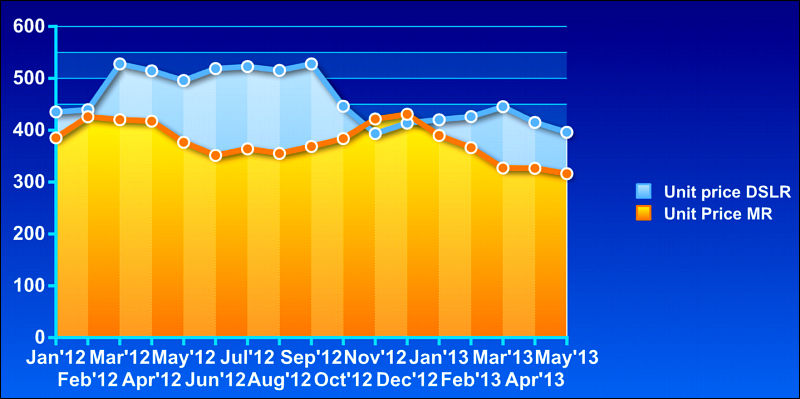
Vitaly from Personal View (Click here) posted more graphs showing unit prices of DSLR and Mirrorlesscameras. As you can see from the graph on top Mirrorless cameras average price seems to be slightly cheaper but you have also to consider that there are many expensive (FF for example) DSLR cameras rising the average level. The important thing to know is that Mirrorless camera shipments from Japan to oversea seem to stuck and not grow anymore. I don’t know yet what Panasonic and Olympus manager have in their mind to push the MFT system. The only thing I keep hearing from managers is that they want to move more towards the higher end market.
Let’s see…
92 Responses
It is quite difficult for an average user to understand all the important differences between the DSLR and Mirrorless technologies. They may not even care.
No, mirror less is not the same in IQ as the DSLR, and it probably won’t be for a while. But in terms of size, it beats DSLR.
They should come up with some kind of a standard scale system, similar to what they use on household appliances around the world (like on the fridges or air conditioners).
People could then see that a DSLR can make A+++ quality images, while a Mirrorless is just A. But then a point and shoot would be just be just C or D.
Then interns of portability, the Mirrorless would be a B, and the DSLR an E or F.
Something like this might help people to make the right choice, without understanding too much about photography.
What do you mean mirrorless is not the same image quality as DSLR? The only difference is the DSLR only has influences to degrade the image I.e. mirror shock and a calibrated guess at sharp focus! A DSLR is not magic in fact quite the reverse. A one trick pony ready for the knackers yard!
Mirrorless and DSLR IQ are not the same.
I don’t think we should argue about this.
With that said, I own a Mirrorless and I love it.
When I bought it, I wanted a small size, but good IQ camera. I am happy with my purchasing decision. But I see that with a DSLR system, I could stretch the IQ further. Larger sensors will have better quality images, especially at higher ISOs (low light situations). DR is also better…
But again, I don’t want to start another debate over Mirrorless and DSLR quality.
I think we need to prove more information for buyers, so that they could make a more educated decision when purchasing a new camera. DSLRs are great. But I think they are way too much camera for many people purchasing them.
There are many types of DSLR. Are you referring to full frame?
Also not all DSLR are the same. APSC sensors from different brand perform differently, so do not just DSLR as one whole product.
Do you really think that APS-C DSLR has better sensor? Look at this:
http://www.dxomark.com/index.php/Cameras/Compare-Camera-Sensors/Compare-cameras-side-by-side/(appareil1)/870%7C0/(brand)/Canon/(appareil2)/842%7C0/(brand2)/Panasonic
There is no magic in APS-C. There two features that I lack for professional shooting in Panasonic GH3: remote control over USB for precise work and 3D tracking. Canons have horrible 3D tracking, so let say that ONLY DSLR advantage is USB remote. But it has nothing to do with camera IQ, to be clear. WB and other stuff is just perfect.
I am not talking about sensor size differences. A mirrorless camera of the same size sensor as the equivalent DSLR can not have inferior image quality. Quite the reverse due to the reasons stated. A mirrorless D800 would have precise focus off the sensor, better metering, exposure feedback prior to capture and no issues with a wopping great mechanical slap shaking the body prior to capture. To not understand this is pure ignorance!
> A mirrorless camera of the same size sensor as the equivalent DSLR can not have inferior image quality.
Sure it can. It doesn’t have to, but it can. We’ve seen example after example where Pentax or Nikon got better image quality off the same sensor than did Sony. The camera companies mostly license code in their imaging ASIC, and they license different code and also have differing abilities to optimize what that code gives them. But even at the raw level there are differences. Modern sensors are “tunable” to a certain degree. How you set gain and other parameters will make some difference to the data the sensor produces.
Since this is an m4/3 site, I also fail to understand your argument. The m4/3 sensor IS smaller than an APS/DX sensor, so there will be a difference in data obtained under the same controlled circumstances. The debate has long been whether that difference is meaningful. I’d argue that it isn’t, at least at reasonable ISO values.
> A mirrorless D800 would have precise focus off the sensor,
For a static subject, yes, for a moving subject no.
> better metering,
Doubtful. Nikon has long had the most sophisticated metering system, which involves color analysis, pattern analysis, and more. The reason to get this information from a secondary sensor is simple: speed and parallel data. When you try to use an imaging sensor “for everything,” you have competing mechanisms that want to use the same data, and the pipeline in most imaging ASICs is single channel. In the case of Nikon’s EXPEED, it’s not a parallel processing chip, nor can it support multiples of the chip to provide parallel processing. The color information in Nikon’s metering system is actually used in conjunction with the focusing information, too. Historically, the faster the CPU used alongside the EXPEED engine, the better the metering and focus integrate.
I’m sure that one could design a more parallel system using just an imaging sensor, but you’d need a faster, more sophisticated ASIC than Nikon is currently using.
> exposure feedback prior to capture
This has actually been one of my biggest complaints about Nikon DSLRs for some time. The film-based F5 back in the mid-90’s had real time exposure feedback from the exposure sensor, though you had to jump through hoops to get it. Over time, Nikon has removed access to that data for some reason. Nor do they use it themselves for a real-time exposure feedback system. Why, I have no idea, though I suspect it gets down to processing time and they punted on it. But the data is there. It’s just not being exposed to the user.
> and no issues with a wopping great mechanical slap shaking the body prior to capture.
Yes and no. DSLRs also tend to have more mass. With my equipment I can measure “shake at exposure.” We have some mirrorless shutters that are causing as much vibration during exposure as most DSLRs have. Indeed, when you look at the “ringing” of the mirror mechanism, it’s generally not only damped quickly, but appears to be timed around the shutter opening on modern designs.
I’d also point out that a lot of people are making the mistake of using less support for their mirrorless cameras. Those travel tripods fully extended tend to amplify vibration of the mirrorless shutter. The laws of physics still apply: you need mass and rigidity to dampen vibrations caused by shutters, not light rickety legs.
But getting back to the main point, the real issue is “perceived image quality achieved by most users.” This isn’t just about sensor. It’s about how the camera maker implemented the sensor and renders images, and it’s also about how a consumer operates a camera. I wish I had time to do a little experiment, because I think it would be interesting. Take a mirrorless camera and a low-end DSLR. Set them to basically All Automatic. Hand them to 100+ n-selection from mass population folk and give them three or four photographic “tasks” to accomplish. Then compare the results they got. My hypothesis is that the DSLR would win this challenge. That’s mostly because the Canikon DSLRs have a huge heritage from which they’ve drawn. They’re relatively “tuned” to exactly that task (at least at the low end).
Obviously, you can extend that experiment by then doing the same thing with professional photographers, but after making sure they understood how to control the cameras. My hypothesis for that would be that there would be little difference in results between the mirrorless and DSLR cameras.
>Sure it can. It doesn’t have to, but it can. We’ve seen example after example where Pentax or Nikon got better image quality off the same sensor than did Sony. The camera companies mostly license code in their imaging ASIC, and they license different code and also have differing abilities to optimize what that code gives them. But even at the raw level there are differences. Modern sensors are “tunable” to a certain degree. How you set gain and other parameters will make some difference to the data the sensor produces.
That is based on the manufacturers choice rather than a technical limitation. The light hits the sensor and processing of choice begins.
>Since this is an m4/3 site, I also fail to understand your argument. The m4/3 sensor IS smaller than an APS/DX sensor, so there will be a difference in data obtained under the same controlled circumstances. The debate has long been whether that difference is meaningful. I’d argue that it isn’t, at least at reasonable ISO values.
That is not what I was getting at. The op seemed to suggest that any DSLR of any sensor size is by definition capable of producing better image quality than a mirrorless theoretical equivalent.
> A mirrorless D800 would have precise focus off the sensor,
For a static subject, yes, for a moving subject no.
So far. This and EVF are the last “essentials” DSLR users are hanging on to.
>Doubtful. Nikon has long had the most sophisticated metering system, which involves color analysis, pattern analysis, and more. The reason to get this information from a secondary sensor is simple: speed and parallel data. When you try to use an imaging sensor “for everything,” you have competing mechanisms that want to use the same data, and the pipeline in most imaging ASICs is single channel. In the case of Nikon’s EXPEED, it’s not a parallel processing chip, nor can it support multiples of the chip to provide parallel processing. The color information in Nikon’s metering system is actually used in conjunction with the focusing information, too. Historically, the faster the CPU used alongside the EXPEED engine, the better the metering and focus integrate.
This state of the art estimation has become obsolete over night. Live histogram/warnings give you all the information you need prior to capture with consistent reliability.
>Yes and no. DSLRs also tend to have more mass. With my equipment I can measure “shake at exposure.” We have some mirrorless shutters that are causing as much vibration during exposure as most DSLRs have. Indeed, when you look at the “ringing” of the mirror mechanism, it’s generally not only damped quickly, but appears to be timed around the shutter opening on modern designs.
I agree that some mirrorless cameras also suffer from resonance but this is still better than shutter and mirror resonance. Certain models are already moving closer to fully electronic shutters without too many issues.
A DSLR is like asking a stranger to carry out your instructions and going back later hoping they may have followed your orders.
>> The color information in Nikon’s metering system is actually used in conjunction with the focusing information, too. Historically, the faster the CPU used alongside the EXPEED engine, the better the metering and focus integrate.
> This state of the art estimation has become obsolete over night. Live histogram/warnings give you all the information you need prior to capture with consistent reliability.
Non-sequitor to what I wrote. But I would also point out that Live View/Histogram warnings in all current cameras are based upon the internal JPEG rendering engine, not raw data. Miss a setting and your warnings are wrong for raw shooters.
I have found the Jpeg based info inline with the RAW with virtually no adjustment required for ETTR.
You state that exposure compensation is required for the focus point with most Nikon cameras and then suggest that if exposure compensation is needed the meter got it wrong?
If I look at a sunset my eyes adjust for the brightness I would expect the camera to do the same. My Olympus cameras do. The live view gives instant preview without wasting time chimping and repeating the shot until it’s right.
Not what Raw Digger would tell you, most likely. As I’ve reported on my site, I’ve have seen situations where the red channel is two stops off from where the JPEG-based histograms tell you it is. This is actually a common occurrence for me in Red Rock territory and in Patagonia sunrises. It’s one of the reasons why several of us built and documented UniWB solutions back in the early digital days, and still use them despite no support from manufacturers on this issue.
@Thom Hogan
Erm a big no, Nikon does not have better metering than micro four thirds, time and time again I have seen Nikon wedding shooters mess up the basic of shots which is grooms party (usually wearing black or dark grey in front of a dark background, the amount of times I have seen this simple shots ballsed up (over exposed) by Nikon’s metering is unreal!!! A mft user would be using live view and adjust exposure compensation accordingly.
“Take a mirrorless camera and a low-end DSLR. Set them to basically All Automatic. Hand them to 100+ n-selection from mass population folk and give them three or four photographic “tasks” to accomplish. Then compare the results they got. My hypothesis is that the DSLR would win this challenge.” no way, micro four thirds iauto mode and user interface in the hands of ordinary consumer walks all over a DSLR in that kind of challenge< i have met untold ordinary people who can't use their DSLRs.
In other news USA keeps printing more money to show temporary small increase in retail sales and increases the amount of people employed in McJobs and unsecure temporary jobs.
> time and time again I have seen Nikon wedding shooters mess up the basic of shots which is grooms party (usually wearing black or dark grey in front of a dark background, the amount of times I have seen this simple shots ballsed up (over exposed) by Nikon’s metering is unreal!!!
I suspect you’re referring to shooters with the non-pro Nikons, which as I’ve pointed out time and time again, overweight what’s under the currently used focus sensor. If it’s the black of the groom’s suit, you’ll get overexposure, if it’s the white of the bride’s dress, you’ll get underexposure on all models up through the D7100/D600. But part of this discussion has to be how well the photographer actually knows how their equipment works. There are plenty of us Nikon shooters who have no problems with exposure, ever.
But using a single type of shooting to judge accuracy of a meter is problematic in and of itself. The Olympus meters, for example, virtually always default to silhouette in sunset situations, for example. Those of us who shoot landscapes are constantly changing from the default behavior of the Olympus/Panasonic cameras to get what we want (though I also know that if I want silhouette I can just accept the default setting).
I’ve long advocated that a photographer has to understand what his equipment does and doesn’t do. Not a single product is perfect, and there are dozens of decisions being made by a good photographer, so a camera on all automatic is bound to get some of those wrong. Your anecdotal evidence could be very simply explained by photographers who don’t know their gear well enough.
> A mft user would be using live view and adjust exposure compensation accordingly.
If you’re “adjusting exposure” the meter got it wrong ;~) Wasn’t that my point?
> “Take a mirrorless camera and a low-end DSLR. Set them to basically All Automatic. Hand them to 100+ n-selection from mass population folk and give them three or four photographic “tasks” to accomplish. Then compare the results they got. My hypothesis is that the DSLR would win this challenge.” no way, micro four thirds iauto mode and user interface in the hands of ordinary consumer walks all over a DSLR in that kind of challenge In other news USA keeps printing more money to show temporary small increase in retail sales and increases the amount of people employed in McJobs and unsecure temporary jobs.
You might want to do some fact checking. The US no longer reports M3, the broadest statement of monetary supply across the economy. But those that do still track it show that it has been contracting since mid-2009 in the US. The whole M1, M2, M3 debate is actually a very central one in debates between economists. Pools of different specific types of money have very different trajectories. M1 was negative from 2005 through 2009 while M2 was basically flat. From that time, M1 grew fast except during 2010, while M2 has been negative to more mildly positive.
M3 includes large time deposits, institutional money market funds, short-term repurchase and other larger liquid assets. You really need to see that number in conjunction with the M1/M2 numbers to fully understand how much “money” is in the full economy.
Your country, by the way, no longer publishes it’s M0 number, which is the closest to our M1. I suspect you were trying to imply that the US “monetary supply” is rising faster than the UK “monetary supply” and this is the reason why the US market is…well…you’re inconsistent in what you think the US market is doing, so I’m not sure what you’re trying to say. But a simpler method would be just to point out that US economy is not currently in recession, but neither is the UK. Our GDP growth is higher than yours, and we’ve moved more quickly back to where the economy was before the Great Recession while your’s hasn’t. But still, I’m not entirely sure what your point would be here. MY point was that US DSLR sales are off by large double digit percentages this year, which is the opposite direction of the overall economy here.
If the need to use exposure compensation means the meter got it wrong, then the Nikon meters in the cameras you mention do get it wrong for the bride/groom situations, but in the end its more about knowing what your camera is doing in a situation.
I’d argue that a camera that actually shows you what it intends to do is in the end a lot better then one that at best lets you make an educated guess.
@Thom Hogan
re: Lousy Nikon metering
…nope they were shooting Nikon D3’s, one occasion 2 news reporters turned up univited at one of my weddings not only were they being a nuisance but their published photos were over exposed! I also video a lot of weddings so I see how Nikon wedding photographers work and their results. Nikon DSLRs only get simple metering right 1 st time (not that you get a 2nd opportunity for some shots) whether they are the Pro or consumer DSLRs.
A micro four thirds camera you’d be adjusting the shot as and/or before you take it 🙂
…nope metering is part of your composition so most people use live view to see where the camera brings them and then compose to meter from there.
You make it sound like the D800 sounds like a Pentax 67 when the mirror gets moving.
As a frequent user of both a D800 and an E-M5, the D800 is much easier to hold steady due to its increased mass and the shutter / mirror makes a wonderfully solid, quick sound when making an exposure. It is one of my favorite things about the D800 and makes for a camera that captures incredible resolution even hand held. The way people talk around here, you’d think the only sharp pictures made with a big honkin’ mirrored DSLR were made with a 25 lb tripod on a wind-less day.
If it wasn’t for its great IBS, I suspect the E-M5 would be more difficult to hold steady at similar shutter speeds. Luckily, it isn’t something we have to worry about. It amazes me the quality of images that come from such a tiny package.
IQ is the same from an APS-C DSLR and an APS-C mirrorless
IQ is the same from an FF DSLR and an FF mirrorless
Some mirrorless cameras have smaller sensors, but that has nothing to do with the mirror.
Have a Panasonic GH2 and love it, mostly for video.
Biggest disadvantage of mirrorless cameras IMHO is in shooting fast action stills. Low refresh rate of VF makes moving images in the VF jerky and hard to compose. In this case, I have to shoot video + hit the shutter release to get a smooth VF image, which is a work-around.
DSLR VF image is direct view, so it doesn’t have the refresh rate problem. OTOH, when shooting video with a DSLR, the optical viewfinder doesn’t work at all.
If all I shot was stills, I would probably choose to use a DSLR.
Unfortunately, in the US market, big often equates with “better” or “professional” or “Now I am serious.” This is constantly reinforced by marketing companies, and Nikon and Canon dominate camera advertising and dominate shelf space in the big box, mass-market stores. Therefore, I think we will not see much of a shift away from the DSLR mindset for many years. Sorry micro 3/4 users, but just try to think like a common consumer. Also, remember the social condition: “Oh oh, the Joneses have a big Nikon so they must be serious photographers.”
Prove it.
IQ difference is on the sensor size, not mirrorless or DSLR.
Sony RX1 is mirrorless and its IQ is pretty on par with A99 or 5D3.
On the other hand, MFT cameras IQ still behind APS-C cameras. Quite obvious for me on the DR and color accuracy side (lets ignore the high ISO here, as I don’t mind comparing at low ISO). Some scientific test shows OMD having high rating over some Canon’s weak performing APS-C cameras, but I don’t buy it. I viewed many real-life pictures shot by people around the world from the internet, and I may conclude that pictures shot with APS-C looks more natural than pictures shot with MFT cameras.
You don’t know what you’re talking about. I own both m43 and APS-C cameras – mirrorless and dSLRs. You cannot tell the difference between any of these cameras IQ-wise if you are a decent photographer. I speak from experience. Thom Hogan doesn’t get it either.
Can you please show me? Just shot a picture outdoor under sunlight that contains bright sky and a house with a MFT and a APS-C camera with standard or natural picture profile in RAW format. Do not color grade them, just simply convert them into jpg and post the original jpg for us to download and compare. Thank you!
fyi, I’ll definitely buy MFT if the IQ on par simply because of their size and weight.
Funny, you make a broad claim based on pictures from people all over the world, and when people say their experience doesn’t match yours, you ask them to show the ‘proof’, yet I’d think you’ll first have to demonstrate your own claim.
Regardless, a smaller sensor and fewer bits of color data do result in a lower iq, but the difference is for most practical purposes irrelevant when compared to aps-c, and if it isn’t for you, there is still enough choice left in larger formats, go pick one.
I’m sorry if I give wrong impression. Both my English and my expression are not so well.
As I don’t have both MFT and APS-C cameras (that’s why I wish a good-for-my-need camera may born), I can’t do the comparison test myself. However, here’s the test by DxOmark. I’m choosing the US$200-US$300 cheaper mid-grade APS-C camera, the Nikon D5200 to compare with the best in class MFT cameras GH3 and OMD. Both color depth and Dynamic Range test numbers showed obvious differences among them.
http://www.dxomark.com/index.php/Cameras/Compare-Camera-Sensors/Compare-cameras-side-by-side/(appareil1)/850%7C0/(brand)/Nikon/(appareil2)/842%7C0/(brand2)/Panasonic/(appareil3)/793%7C0/(brand3)/Olympus
Once again, I want to emphasize that my frustration is why a 60% smaller MFT sensor unable to produce similar IQ with a APS-C sensor camera with 50% more resolution? Since pixal size has been close to each other, why can’t achieve the same IQ? I wish more people could report this frustration to the MFT producers such as Olympus and Panasonic, so that they know what we want (I did write to them before). And not like many people happily accept the reduce in IQ for MFT camera. And in the end I wish to buy MFT camera because both the camera and lenses are smaller and lighter with pro-grade built quality (such as weather sealed, fast OIS lens etc.) Investment on lenses can be double (if not triple) the price of the camera. So I can’t just “buy one first then wait for the perfect camera to come in future”. I need to choose the system/format carefully for future expansion. I was so happy when GH3 launched since its feature set are so rich and fits my needs. However, I was disappointed of its IQ mainly because of its lack of DR. From few hundreds photos shot by people around the world that I viewed on flickr, I can’t find any that was able to capture a comfortable picture under bright sunlight. The sky was always looks too bright until clouds were hardly seen, and the objects on lands (such as houses or trees or cars or people) were just so dark and losing details in shadows. When I switched over to watch photos shot with D5200 or NEX-6, the DR was so much better and photos looking so much more comfortable to the eyes. It’s so obvious.
@kok, I know there is a difference one can measure, the question is if it matters for real world pictures. That depends a lot on the subject matter and how a picture will be used.
So we agree that you can measure a difference, but what you said is that you have seen lots of pictures and from that conclude that aps-c always give more natural colors. That is what I doubt, and what I asked you to show. A highly synthetic test by dxomark has its uses but doesn’t demonstrate your claim.
If I pick a few photos and show them to you, will you satisfy? Guess not since you may argue again that the reason being those are badly shot photos on MFT cameras. So it doesn’t make sense for me to pick the photos. Unless any of us here who have a “not too old” APS-C camera and the best MFT cameras such as OMD or GH3, he or she can do a direct test shoot at the same time same spot. That will tell the difference. Anyway, thanks for your time to further discuss this here. Discussion is always a good thing.
btw, the writer of this blog just posted something amazing regarding some big improvement on upcoming new sensors for MFT cameras through Sony-Olympus tied up. I am excited to see a better MFT sensor soon. As Sony has been one of the best sensor maker who had made some of the best sensors for Nikon and other companies.
@kok, no a few examples won’t demonstrate your claim either because those won’t show its consistantly true, but, those may show you are looking at a specific kind of pictures.
The issue is that a system capable of 12 stops dr and using a somewhat sane tone curve for mapping intensity to color values produces results that cannot be printed without significant loss in both. What is more, it can’t even be displayed without loss on almost all existing display systems.
What all that dr and color data does is give you much more room for manipulation during pp. Its far from useless, but simply cannot show in the consistent way that you claim, and I’m curious as tlo what kind of pictures you are looking at that show this so consistently. I can think of a few.
Then why is it that when I post comparisons on forums using 43s apsc and ff and dare people to tell them apart the people who actually try cant?
Show me the link please, I’d love to take a look. You didn’t color grade them and they were shot with similar picture profile right? Thank you!
Most people don’t do much printing, and when they do it is 8X10. They don’t need the APS-C sensor, a M43 or smaller is just fine. I have a Micro 4/3 and I find it just right for my needs.
If I hadn’t gotten injured, I’d probably have a DSLR. I am very happy with the lighter Mirrorless camera. I just got back from a 4 hour walk with my Oly strapped to my right hand. I need a beer.
Higher end market = less market share.
@Easy
Point and shots have less margin, less relevance nowadays, more fickle customers and also probably worse cash flow.
Not so easy. Indeed, one of the things that is studied in depth in most MBA programs.
Elasticity of demand comes into play. Make more sophisticated, higher-priced products and the number you sell drops. Indeed for high-end cameras, there seems to be a fairly limited market size.
Canon and Nikon make most of their money (in cameras at least) from the DSLRs that sell in the US$500-1000 range. There are a number of reasons for that. One is that they prove out technologies at the high end (US$5000+ cameras) and then refine, simplify, repackage, and duplicate them out in lower end products. The R&D costs are already mostly recovered, even from the limited high-end sales.
The problem with everyone deciding to go high end is that you have the same number of companies fighting over a smaller pond. Someone’s margins are going to get hit badly because they can’t all win at the that game. Now, you could argue that it will be Canon and Nikon whose margins will be hit. Sure, but they’ve got higher margins to begin with, so they’ll just use price to hammer the competition if need be.
I predict that nothing will change other than all the camera companies will shrink in unit sales.
That pond is getting bigger my friend.
The compact camera “pond” is shrinking >30% year to year
The mirrorless camera “pond” is shrinking this year
The DSLR camera “pond” is shrinking this year
Where exactly is the growth you refer to?
The pond for enthusiast cameras is getting bigger as more people get into photography.
Completely wrong, and too simplistic. Sooner or later any market gets saturated, and the “enthusiast camera” market will never reach the same size as the current total camera market. In other words, the pond as a whole is shrinking, even if (and it’s a big if) the enthusiast part of the pond is expanding.
Do you really think that the low-end camera market will be completely replaced by new enthusiasts? Hasn’t the enthusiast market always been a small niche of rather constant size? Why would we suddenly see hordes of new enthusiasts in these times, when most people are happy with the images they get from their smartphones?
SLR sell better than mirrorless as well. “FF” SLR are a very small portion of total. I think mirrorless is too much “boiling soap on a nail” iterations rather than actual improvements.
As enthusiast of course mirrorless are smaller and lighter, but rather more then less expensive. Take the Nikon D3200: Lessser camera than the Oly OMD E5 of course. But the IQ is better. Lens choice huge (but no fixed wide angle lenses). Cost is 40% though….
The core of a system is lens(es)/sensor/processor. Here key mirrorless players have lessser R&D budgets compared to the big elephants.
If you want a high end mirrorless system for enthusiast purposes it will be more expensive than a SLR system. (EM5orGH3/12mm/25mm/macro/75mm/2 top class zooms)
My personal hope is that m43 sensors must be further developed: On the APS-C/FF side there will be a new generation of sensors in 2014. What can m43 do? I believe that lenses like the Oly 75/1.8 outperforms the current best m43 sensors. Room for an increase of resolution and per pixel quality here. ( Also Fuji would need a 24 mpix X-trans sensor. It would decrease problems with RAW conversion.)
>>Here key mirrorless players have lessser R&D budgets compared to the big elephants.<<
I think Sony can compete here, both as a camera maker and as a supplier of sensor tech.
“Take the Nikon D3200: Lessser camera than the Oly OMD E5 of course. But the IQ is better.”
Huh?????
The D3200 has the same crappy Sony 24MP sensor as a bunch of other recent cameras. The only thing it has going for it is more pixels.
The older NEX-5N’s 16MP sensor wipes floor with it in literally every image comparison (where “wipes floor” means “has 1/3-2/3 EV advantage in literally everything”). Just check the sample images taken by the cameras.
Admin – why would you trust these graphs, Vitaly does not even say where he has sourced the data from. It’s one thing to post a link and another to blindly believe that the graphs are accurate and based upon sound data.
I know you are not a *journalist* in the traditional sense but at least try and apply some sort of filter on what you post here.
LOL. Data come from CIPA. And I referenced were I got the data, it is just not first topic, hence it does not have direct reference 🙂
🙂
So maybe you should reference the data source…this is basic high school shit, if you reference data in a graph you either supply or link to the data.
I agree: being a Journalist is v. different from crying wolf. Data should be checked and rechecked – alarmism always a bad counselor.
If admin is worried by his ‘sales’ he’d do better to open a Smart Phone section. After all they are mirrorless too 🙂
Sometimes I think that we are lucky that cameras still exist, most now are in the process of forgetting them. And it is amazing that you still see gearheads wrangling about the last tiny feature when the carpet is being drawn from under their feet.
However they are just trends: remeber that when jeans and T shirts conquered the world, there was an opposite move to mass high fashion. It might happen again.
Vitaly likes to post graphs that purport to show trends but do not show the complete range of data (not this example, though). When the full range of data is shown his trends look more like random walks.
I’d dispute that, having run enough regression analysis’ against the CIPA data. It’s not random walks.
The only real problem with the CIPA data is that it isn’t detailed enough. Until they broke out mirrorless sales we couldn’t tell for sure what was happening between mirrorless and DSLRs, for example. Likewise, we can’t tell for sure what’s happening in compacts right now, nor do we know what the mix is between APS and full frame in DSLRs from the CIPA data. Part of the problem, of course, is that this is a limited data set, and if they broke out many more categories, we’d be able to reverse engineer most company’s actual data from it. Case in point, if full frame DSLRs were broken out, we could get a pretty good handle on everyone from just the little other data we know. After all, there are only two strong players there and only three meaningful players. So even one external data source correlated against the CIPA data would be revealing. The whole for CIPA was to anonymize the industry data so that companies could INTERNALLY compare against it. The only company that consistently provides information externally against CIPA is Nikon, which does so for compacts, interchangeable lens cameras (mirrorless and DSLR grouped together), and lenses. Canon sometimes releases such information when it looks favorable to them. Most of the rest don’t.
Referencing. Here! on 43 rumors!
The only references used here are Dxo and look at the crap they get, no not worth referencing.
All of this graphs base on that cipa reports, and are analysed as if these were a trusted market research, which they are not.
You can’t analyse a market by looking at the shipping specs. That’s just ignoring the market itself. Nobody knows if the shipped cameras are sold, or at what price. You don’t see how the customer know about mirror less- are the most sold cameras entry level/upgrades or is that just the perception? I think the most money can be made with down graders which change due to size-and buy a whole system and not a body and a kit lens. So FF might be the total wrong way to go due to size.
A proper analysed piece of crap, maybe deliver a lot of data, but in the end it’s just crap… Same with all this graphs: you can’t read anything out of those, because the conclusions that are drawn here, are not in that data.
The problem is that CIPA is the only reliable, public source of data on camera sales. As I’ve pointed out before, it tends to be a lagging indicator, and this year is a very good example of that. The CIPA forecasts made in late fall of last year were for fairly hefty increases in interchangeable lens camera sales and less of a fall in compact camera sales than the previous year. As the shipment numbers are starting to prove out, the industry has rethought that estimate and is producing to far lower numbers than they predicted.
If you have access to the (expensive) NPD data, which tracks cash register sales, you actually get a bleaker picture for the last few months. Interchangeable lens camera sales have been down >20% year-to-year for many months (including May, just released). If you think that those 2%, then 4% rebates by Amazon, B&H, et.al. were because of the goodness of their hearts, think again: they’re attempting to use price to get their inventory turns back up to where they were. The reason they need to do that is because sales volume is down.
Why haven’t the Japanese companies lowered prices more? The yen depreciation, basically. They’re trying to micromanage the situation. They’ve got inventory in the US, for example, but it was costed when the yen was higher, so if they sell it now they get more yen back, a big plus that makes up for some declining sales. But I don’t know how long they can sustain their current practices. By my numbers, they’re still overshipping to demand, so ultimately we’re going to see markdowns.
I dont mind what admin posts,but when certain topics(like this one) get so much response and discussions, i wonder, are we photographers or….? 😉
After reading the Admin’s previous “Vitaly” post, and now this, it feels like a “the sky is falling” message. Olympus users are more than a bit used to this over the years 🙂 .
Yes, smartphones have caused a seismic shift in the market, not only to compacts but to low-end mirrorless and likely DSLR sales as well. This is only logical, most people not being photographers but only interested in having the ability to grab a photo now and then of family, friends, maybe some vacation scenery. Gone is the casual photographer.
And enthusiasts in developed economies already have capable digital cameras, be they high-end compacts, mirrorless or DSLR’s. These are well-built and don’t break, so where’s the incentive to continue buying marginally improved products? Camera companies with large catalogs of lenses have a nice hedge on this maturing market. Panasonic and Olympus are best positioned here of mirrorless, but thin on fairly priced HG quality lenses. But their lenses keep on coming, so this will change.
In the end, manufacturers will adjust or leave the market. This is why the interest here, we all want to have picked a “winner” from a manufacturer that will be around to support our system.
In time (5 years?) mirrorless in one form or another will come to dominate due to its greater mechanical simplicity/resultant lower manufacturing cost. Combine this with the Asian market continuing to grow, and we’re now in an awkward interim period. So the sky is not falling, Chicken Little, but it is a bit overcast.
The “we’ll sell it in Asia” (or emerging markets) strategy was well in play for at least five years now. It’s not working. For the same reason you can’t sell coal power plants and wired phones in Africa: technology skipping. Lower cost smartphones will be the camera of choice for most of the people in those markets. Not only can they not afford two devices to do the same thing, but the smartphone is their computer, as well.
That doesn’t mean that you can’t sell some high-end cameras into markets like China. You can, just as you can in the US or Europe. The problem is that those are smaller customer sets.
You really have to look at the full set of numbers to see what happened. Film camera sales peaked a far lower level than digital cameras did. Indeed, the rapid growth in digital attracted players back into the game. It was the “rising tide floats all boats” theory. The problem is that a graph of the digital version of the camera market looks very much like the graph of the film camera market, only taller and less wide. In both cases, the peak came just about when a less costly and more convenient source came roaring upwards in sales: disposable cameras in film, smartphones in digital.
Biggest manufacturers advantage is that they ignore advices of “smart” guys ala Thom. It is like mutual agreement. Thoms of this world make serious face and write “serious” big posts. And managers laugh loudly.
I was wondering if Olympus and Panasonic even had a marketing/sales department for North America. Apparently they do, it’s a small kiosk somewhere near Times Square that they share with a pretzel vendor.
BINGO! I have become so frustrated because of a total lack of Olympus support that I’m having second thoughts about having sold my Nikon equipment. Olympus took four months to get the E-M5 to market. Months later to get a battery, and now they’re touting a beautiful black 17mm f1.8 for only $499! Oh, it won’t be available until September…maybe. Olympus may have a world reputation for glass but their consumer support sucks. You don’t have to be a marketing expert to understand the underlying message in admin’s graph.
The real reason mirrorless (esp. M43) does poorly – HORRENDOUS SUPPLY CHAIN (and pricing). Not image quality (yes, sports autofocus is a small issue…)
Best Buy, Costco, etc. are where many folks buy cameras (and online).
a. How well placed and shown to consumers are these?
b. How long between announced and available?
c. Why aren’t these shown to consumers who do searches for SLR or DSLR? To many folks that = “good” or “semi-pro” – but only often one only gets CaNikon results.
d. Why is good glass waaaay overpriced? I own the nice oly 45 1.8. But a 1.8 from nikon is about $200 cheaper. m43 should be cheaper (smaller coverage area required for the smaller sensor).
Using cliche terminology – one needs to get at the “influencers” = salespersons at stores. They rarely suggest m43.
RT
@Vitaliy
+1
Canon is laughing while sales and profits drop
Fujifilm is laughing while making a loss
Nikon is laughing while sales and profits drop
Olympus is laughing while making a loss
Panasonic is laughing while making a loss
Ricoh is laughing while making a loss
Samsung is laughing while making a loss
Sony is laughing while not making a profit
Leica doesn’t laugh, and actually listens to pros, analysts, commentators, and users
See any problems with that? ;~)
I appreciate v. much themes of History of Economy, because trends indeed tend to repeat themselves.
I don’t really worry about the disappeareance of Oly or Panny, in case Chinese Kodak will come and collect the pieces.
I have a more cultural worry. With the advent of the Smart Phone people will fatally forget the fundamentals of photography, like the triangle of exposure, the laws of perspective, etc, so they won’t even feel the need of physical cameras. So demand can only drop.
Small companies are the most exposed, whatever they do. If O & P were producing dSLR they might be even harder hit.
What the heck. You got a huge amount Canon Ms that were shipped before last christmas. That’s it. They have had a ridiculous price – and that’s all about the graph. Post that at CanonRumors…
Mirrorless especially mFT really need cutting edge sensor badly , ISO & DR although improve in OMD & GH3 but I only can consider that is 2012 acheivement ,
what about 2013 ?
The joint partnership in sensors development between Fuji&Pana was a brilliant move , can’t wait to see the outcome from them respectively .
Kylberg is back , where have you been for so long ?
Time to push again for the dream camera .
Maybe the basic answer it’s the most obvious one. Why make it more complicated than what it is. The advantages enabled by the mirror less technology aren’t enough to justify an advantage of sorts (manufacturing cost, features, etc.) compared with DSLRs, the mainstream technology of today.
as simple as this. Imho the #1 benefit of m4/3 (for me) is smaller lenses, and this isn’t inherent in the mirror less innards, but just a shorter FL/ sensor size.
sure, mirrorless provides some advantages but mostly are marginal, nice bells & whistles compared to the mainstream offering, at least as seen by end users. If mirrorless cameras were somehow revolutionary even with a smaller Marketing budget you’ll see a much wider adoption?
what do you guys think,
could it be it? If that is so, then the game is to compete on other areas. Mirrorlrss is just one of many parameters, not the driving one.
it’s like having turbos on traditional engines, when they came out on civil transportation 20 or so years ago.. Good improvement but not decisive alone to distance mainstream technology on the market and in the eyes of mainstream users.
my 2c, just “pour parler”.. And you’re right, I know, I should be out taking pics..
thanks
Keep in mind that statistics on mirrorless include more than just Panasonic and Olympus. You also have Fuji, making higher end and more expensive cameras. Then you have the mirrorless offerings from Canon, Nikon, and Sony – which people are probably more familiar with. And we shouldn’t forget Pentax, either. 🙂
Digital is a strange world. The main difference between smartphones and cameras is that the latter have interchangeable lenses. And yet there are people who maintain that digital correction can replace, at least in part lenses.
So what would prevent 5 years from now to have not only mirrorless, but also lensless cameras? A prototype already exists, not to mention adaptive optics. Will you consider it still a camera?
That is why I say I am grateful that cameras still exists. dSLR, the bigger ones might be swept away even more suddenly, by the next digital wave.
The day of worrying about camera image quality and camera gear in general is over. The masses don’t care because they use iphones. The people that do enjoy photography as an art don’t care and don’t expect new gear to improve their skills at this point in history. So what if your format goes down the crapper. Are you upset that the company will go out of business and people will be out of work or are you upset that your ego has taken a hit because what you claimed was going to be the next thing since sliced bread ended up failing. The truth is that most of the people on these forums probably don’t respect photography as an art. They just go out and take snapshots of vacations etc. and claim that their photos are awesome because it was taken with a camera they claim is dazzling. They walk around and take uninspiring photos with this lens and that lens and this bokeh and this sensor…blah, blah, blah. get over it. Things succeed and things don’t succeed. Some of the best photos in history are shitty, blurry, grainy and were taken at the turn of the century. We are all spoiled by the technology today and yet it’s still not enough. If your photography sucks…it sucks. Has nothing to do with the camera. Size of the camera doesn’t matter..if it’s heavy, if it’s light, if it’s two feet long, if it’s two inches long, if it’s purple, red , yellow….don’t matter. And another thing. If their was no internet would half of the people on these sites realize their camera and it’s image quality is better or worse. Most people read all this crap from strangers in cyber la-la land whom we’ve never met and think it was chiseled in stone by a photo god. Sheesh…rant over.
+ 1 000 000!
Most people here aren’t really worried about photography anyways, if they were why would they bother about camera sales and graphs?
Go out and take photos instead….
One reason for popularity of DSLRS (particularly Nikon & Canon) is their reputation for lens selection and quality, established with film cameras over the past 50+ years.
Many users of Canon & Nikon DSLRS point to the fact that they have so many great OEM lenses, new & old, to choose from. That selling point influenced them to choose their particular DSLR, even if they never get around to buying additional lenses. A lot of these people who tell me about the great selection of legacy lenses don’t even know what a crop factor is.
As other posters have pointed out, many will choose a DSLR because of the brand name on it and that it’s bigger & more ‘professional’. It’s a status thing.
RE micro 4/3, a major drawback is the lack of reasonably priced wide aperture normal and wide angle lenses. Due to the 2x crop factor there are no inexpensive legacy lenses to fill this need either. The expense of a good f1.8 or faster normal lens offsets the reasonable price of the rest of the system.
> As other posters have pointed out, many will choose a DSLR because of the brand name on it and that it’s bigger & more ‘professional’. It’s a status thing.
True. I know log time photographers that have no idea that Panny, Fuji, Oly or Sony already make good cameras. Their minds are tied to Canon/Nikon.
And I think that was a VERY bad idea from Panasonic to use the brand “Lumix” for their m4/3 line – the brand is tied to very bad cheap cameras (the TZ1 was the first P&S from them that gained some respect). Olympus have done better, getting the name and the style of old beloved cameras from their past.
Brand is everything in consumer market.
have you herd about metabone?
Sorry for my english.
Those charts lacks of “events”, I mean when a camera was released, etc. For example, last important Sony mirrorless release was some time ago, and Sony is a giant in terms of publicity.
Samsung’s comercial posted a few days ago can help explain some reasons of the lack of success of mirrorless against traditional dslr. Being a GH2 user as an amateur photgraper and filmaker, I don’t understand why most of my friends (all of them) only think about Canon for the same use, and lots of them want to go FF with the new “affordable” 6d while still waiting for a decent video autofocus from canon.
In spanish (at least in argentina) we have a phrase: “más vale malo conocido que bueno por conocer”. (Google translate: “known evil is better than an unknown good”.
I love my GH2, it’s smaller and lighter than for example a 60d and has better video (with or without Vitaly, but thanks a lot!) and its “complete” (I mean a “classic” camera with EVF and flash). But when you put your hands in a 60d (or 7d, d7000 or whatever) you feel god because is big, strong and you grab it with your whole hand (maybe I’m gay? well, everybody should know that cameras, like cars, are very falic, and Sontag said -imo very accurate- that cameras are like guns). But then I remember: I don’t want to carry a big and heavy camera with a big and heavy lens and that with my camera I can do all the work as good as with any other camera (or even better), that EVF is great, tilting screen with fast AF is glorious, etc., etc,. etc,.
Long life to mirrorless!!!
These graphs only include Made in Japan cameras? I don’t think a camera Made in China would count on statistcs of “Camera Shipments from Japan”…
Another thing, the average price drop can reflect that there was no major announcements of high-end Mirrorless this year, not even close to what happened from the end of 2011 until the end of 2012.
Higher end. More affordable. Semi-pro. Why can’t they just frickin make up their minds?
Honestly- I think the sweet spot for Pro/Semi Pro and Compact Video will be a Mirrorless DX (APS-C NikonDX/Pentax/Sony)
It will come eventually and M43 will remain for point and shoot compacts.
this is all very boring , just give us followers on M4/3 rumours what we actually want to hear , NEWS ON NEW OMD PRO OR ON NEW ZUIKO FAST ZOOMS , OR ADMIT YOU KNOW NOTHING AND ARE FILLING SPACE WITH B********KS
+1 🙂
Past March 2013, I see that the DSLR Market had a huge drop, Mirror Less too… but not quite so big!
Right!?
I think mirror less will beat and stay on top in the last quarter of the year, lets see what happens! 🙂
the RX1 has set the stage , FF gets smaller and will steal M43 thunder , or olympus, panasonic get bigger sensor and join the FF party
Olympus and Panasonic do need to join FF, but the m43 should not be abandoned.
If Pana and Oly should also release full frame cameras is one thing, but the rx1 setting the stage? What Sony did there can be done with a 35ish mm lens, but even a short tele for portraits would become large, and focal length and especially arperture set physical limits to how small this can become, so technology won’t provide an easy way out of that.
I already own a (film) ‘full frame’ slr that is only a bit larger then an e-m5, making the body smaller wasn’t and still isn’t the problem, making lenses small is.
Well at least Thom attempts a prediction: that selling the whole production of mirrorless to Asia or to Africa won’t happen.
OTH the US market seems tied to C&N dSLR. More geographical analysis is needed. I remeber that the UK doubled last year sales of mirrorless – so some Photographic culture might be at work.
Don’t forget the number of Photography Museums in the West carrying over tradition.
Unfortunately sites like this and DPR tend to be too gear biaised, but once you are prepared to pay 1000 $ a camera you must have a good motivation. If you don’t do money with it even more.
In a way this is what Retro is about, pointing to a time where there were real cameras operated with shared principles of photography. So at some point there might be a Renaissance, mirrorless not being worst placed than dSLR. Watch how street shooting is developing again in sites like S. Huff’s.
What is important in the end is people doing good photography, and companies promoting it. Leica has survived an Olynpus might be tempted to go the same way, its prestige reflecting on endoscopes, that is the main business.
If you look at Vitaly’s data source you can see he is very selective about what he puts in the graphs: http://www.cipa.jp/english/data/pdf/d-201305_e.pdf
Refer to columns with “4)*” as heading, this is a percentage comparison to the same reporting period one year ago. If you use previous month you have too much interference by seasonal data (i.e. end of financial year would mean more business purchases, therefore more DSLR, xmas would increase sales of consumer oriented camera’s, etc.)
You will see that all interchangeable lens camera’s, DSLR or Mirrorless are experiencing a slump except in Japan, where unit volumes are increasing.
Market share wise of course mirrorless has far less, this will continue to be the case for quite some time. Camera’s are not mobile phones that we throw away every year, you invest in a system (lens’ + body) for more than a decade, and are not likely to change systems arbitrarily.
I know that posting ALARMIST posts like Vitaly and admin have done will get them more activity on their sites so it must be tempting for them to dramatise as much as possible. But everyone should just chill. Mirrorless camera’s wont “die”, the very fact that Schneider, Zeiss, BMD, Metabones and more are investing into new products for mirrorless cameras tells us that they see a bright future for mirrorless camera’s – somehow I trust their insights more than i would Vitaly and his selective graphs.
Indeed, what is fascinating about m4/3 and unique is that it is the only non-denominational format, for lack of better words. You can imagine O & P going busted and yet others going on making bodies and lenses, like Chinese Kodak, Black Magic, or even Ricoh, making a m4/3 module. Sony OC is also strong on the horizon, Oly could become a sub-brand as Pentax to Ricoh.
That is because I believe that people read these pieces of information, because they worry they bet on a good horse. But one must realise that this format is a headless one, and so not easy to appraise. Lensmakers, as noted above, seem to believe differently: that the format has a future, and a solid entrenchment, probably in Japan, but also in some dragons.
The internet makes people skittish, most newcomers are not brand faithful, and yet they want reassurance. That is why Rumors sites (who isn’t nowadays) must be v. careful not to be alarmist.A good year can offset a bad year, and reciprocally, what is important is that the whole shebang, m4/3 carries on, opening new applications all the time, like ti has done till now.
People buy mirrorless if they are cheep, even if they are crap and called Canon or Nikon. The company I buy my cameras from have a list of the best sellning ILC:s. On second place is the EOS M, but of course it now only cost 1/3 of the introduction price.
Don’t care about that graphic ,m4/3 need more fast pankake ,quality zoom and better and better sensor.
This discussion is sooooo important…
I’ve bought my last DSLR 2 years ago, Nikon D5100. I still use it, but 80% of the time I usually take my Pen E-P1 with me instead. I will never buy another DSLR in my lifetime again. m43 is so much more versatile when size and weight is a factor. m43 image quality and bokeh is “good enough”. IMO, these days, the sensor doesn’t matter as much as what lenses you are using. A good prime lens gives your picture a certain character you can never get with any zoom, and the m43 lineup is rich with good prime lenses.
If one has a look at this curve, one could only argue that mirrorless is reaching a plateau. Half of the Japanese market – not bad.
http://www.dpreview.com/forums/post/51772010
Perhaps it matters more where it goes from here – but isn’t it always so?
Photographers shouldn’t be playing ecomomists, least the fail the trending…
@Thom Hogan
a good read for you… http://www.growingbusiness.co.uk/big-board-little-board-what-s-the-difference.html
Interesting to follow the (same) arguments all over. Apart from sensor technology, the lenses and lens choices
are more crucial, imho.
There are definite arguments which make FF the choice of most professionals, one of which is
the depth of view (a FF 50mm/1.4 would translate to a 25mm/0.7 in MFT for the same view angle. So getting very
fast primes is very difficult if you are on a low budget, otherwise very expensive. See http://www.luminous-landscape.com/reviews/cameras/olympus_om_d_e_m5_review.shtml for an overview of very good lenses for the Olympus,
and remember to scale the aperture to see what this would mean for FF. An other point is wide angle lenses. Due to the small build of MFT lenses these are more difficult to construct (lens curvature)).
It’s possible to get nice bokeh with MFT, too, but it’s more difficult. Nevertheless, many professionals recognized
that apart from studio shots or sports, a MFT makes up a very nice backup system, due to its low weight and excellent image quality for many situations. For most users however, my guess is that MFT seems to fulfill their needs perfectly.
As always, it boils down to what suits your needs best.