








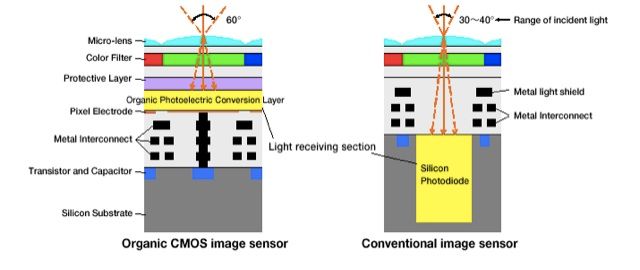
I have been told by a Panasonic source that we will still have to wait 2-3 years before the organic sensor developed by Panasonic and Fuji will make his way into a real mass production camera. At least for 2016 don’t expect anything fancy new on Panasonic sensors (no organic no foveon or so). The GH5 will have a classic Bayer sensor and bring certainly have major improvements in terms of image quality
Reminder: Fuji-Panasonic announcement (article here on 43rumors).
—
For sources: Sources can send me anonymous info at 43rumors@gmail.com (create a fake gmail account) or via contact form you see on the right sidebar. Thanks!
For readers: Don’t miss any news. Join our group on facebook and follow our tweets.
Rumors classification explained (FT= FourThirds):
FT1=1-20% chance the rumor is correct
FT2=21-40% chance the rumor is correct
FT3=41-60% chance the rumor is correct
FT4=61-80% chance the rumor is correct
FT5=81-99% chance the rumor is correct
110 Responses
Yun is about to cry…?
It’s worse than that…we may need to get out The Paddles and resuscitate him! 🙂
Unless you want it quiet here… 😉
No big deal .
That is according to my plan .
GX9 should be the first camera to debut that sensor & I’m the one to get it .
Ha! So you have an evil plan already! 😉
GX9 will be another huge embarrassment like GX8. People should stop reading your useless prediction and wait for GX10 instead.
Pass the hankies… ?
Yun,how long can you wait?
My GX7 still working pretty well .
What you want me to buy ?
Fujifilm XT1, but I would tell you to wait for the XPRO2. Aside from lack of touch screens and ibis, the IQ and lenses will open your eyes.
Yes .
XPRO 2 for me .
Thats it, Ian selling my em1, 12-40, 40-150pro, 45, fl50 and go to system that have lens and where I dont have to always wait for something normal to get out, like telephoto zoom or new sensor ever 3y ect – going to buy D750, 16-35 f/4, 70-200 f/4, 50 1.8, Sigma 150-600 or Nikon 200-500
Good riddance!
OK, let us know what you get for them on your last post!
Who cares? You seem to bitch a lot so I’m sure you won’t be missed. Adios.
LMAO… well have fun hauling that kit around. Genius move 4 sure!
LOL… Nikon D750 has a very fresh sensor… let me guess… 3 years old? But this is not the issue here. More serious stuff. Make sure, your new camera is OK:
http://www.digitaltrends.com/photography/more-trouble-for-nikons-d750-as-company-reveals-shutter-problem/
Lenses? 16-35 f/4… make sure it is also OK:
http://forum.luminous-landscape.com/index.php?topic=72609.0
200-500?
http://nikonrumors.com/2015/10/06/some-nikkor-200-500mm-f5-6e-ed-vr-lenses-have-af-issue-must-be-sent-back-to-nikon-for-service.aspx/
And don’t forget to check if installed firmware in your new camera does not block your Sigma lens to work properly 😉
p.s. Nikkor 50 1.8 has a terrible focus shift. If you don’t care, may sell you my one 😉
By the time this comes out, Sony will have a fully developed lens lineup and FF bodies costing less than my EM1.
This is not good news for M43. The size and weight advantages continue but “16 mp is enough” will be hard to market when the norm becomes 36.
You are right .
That’s why Pana need to hurry up on the this tech .
I think you’re all going to be disappointed if you’re expecting huge IQ gains for the organic sensor.
There may be some benefits but even if it is 100% efficient (which it won’t be) you’ll only gain a stop increase in noise performance.
I suspect many of the benefits will relate more to production costs once the technology has been perfected.
That’s great that you’re able to list some technical specs of a sensor that’s still in development.
He’s just listing technology limits.
Seems fair.
Yeah, but no one really knows what the technological limits are at this point, especially with an unseen, untested thing like the organic sensor.
Jeff, without stacking or any other multisampling technique, the limit is, and will always be 100% efficiency, independent of sensor technology. Today’s sensor efficiency is around 50%, so tempusername’s post is undebatable.
I thought the organic sensor was less about overall noise performance and more about dynamic range.
But that’s not the main promise of the organic sensor.
The single most significant thing here is huge increase in saturation level of individual photosites. Hence the promise of dynamic range that’s well outside current gen sensors.
Another important aspect is increasing the range of angles that the light can be registered by a photosite. This should make a pretty big difference when using uber fast lenses, like f/0.95. Currently, most of them offer very little advantage in terms of light gathering, due to significant light fall-off.
Good timing for the launch of DMC GX9 .
Pana should target & make full use of it .
More incentive for Panasonic to make a version of the FF Leica SL
I’ve noticed they always give this “2-3 years” figure for any technology when they actually have no idea when it’s going to be ready.
The exact timing is 2 years time if everything according to plan .
Is just Admin don’t want to bet on it but Yun will .
2 years time or DMC GX9 .
Maybe, but you just don’t know what sensor will be inside.
Exception for fusion reactors – that’s always “40 years” =:-)
And what about “micro color splitter” technology? It is feasible, right? I dont think that the fate/future of m4/3 is bound to organic sensors. There are many ways…
“The GH5 will have a classic Bayer sensor and bring certainly have major improvements in terms of image quality”
With a color-filter array, Bayer or not, it certainly WILL NOT bring any “major improvements n terms of image quality”. 20mpix vs 16mpix, not even worth mentioning.
m43, TODAY, should sell double-RX100Mk4 sensor. 40mpix, stacked BSI and everything. Now THAT would sell.
That would be a pretty impressive sensor…
It would. As it is, even the 20mpix IMX269 is meh, with competition at 24mpix since 2011.
Wouldn’t it basically have the same overall noise performance as the 1″ though at that point?
Not at all.
It would have the same per-pixel noise performance, but it’s still twice the area, so once you downscaled to a normal output resolution for display or print (say, 12-16MP) then the grain would be just half the size of the 1″ sensor’s at the same output size.
Just like the A7R’s output is actually better than the A7S’s in terms of noise and dynamic range until you hit about ISO 12800…
In the mean time, just slap on a BSI 24MP sensor from Sony as an interim solution. Ignite the mFT buzz once again!
And with a new BSI sensor, move on to true 14bit RAW pls.
Sony only offers 20mpix 4/3 sensor, and FSI at that. At least it has decent readout speed, for full-sensor 4k or 1080p video. All m43 cameras should have been on that for a year, Pana at least has overpriced GX8 (maybe because Sony has them by the balls after Pana spun off their own factories and charges too much for it).
You know for a fact that the GX8 has a sony sensor?
You’re just making things up, it’s laughable. 🙂
I bet it is IMX269. Who else?
Sony has a sensor for sale…. does not mean it’s in the GX8.
I think it’s not yet confirmed what sensor it uses.
from TPSCo. Would fit the MP (21,77MP)
Panasonic’s site says it is 20.3 sensor.
http://www.panasonic.com/uk/consumer/cameras-camcorders/lumix-g-compact-system-cameras/dmc-gx8.html
Care to post a link to the TPSCo’s 20.77mpix sensor?
the GX8 has a 21.77mpix sensor, where only 20.3mpix are used.
The TPSCo sensor has 21.95mpix.
(can’t find the official listing, but heres a hint https://www.tpsemico.com/technology#tab_cis)
Where is any hint abut 20mpix sensor there?
Pany live mos sensor,continue develop from GX7’s image sensor
99.9% it is IMX269.
Sony does take in orders for custom sensors fab, Oly & Panny just have to fulfill a minimum quantity, and that is easy.
Its not going to be expensive if they stick to Sony original sensor design. Just have to tweak a little to accommodate 24MP in a 43 size, the BSI & stack & copper interconnects remain the same.
Fast to market, min R&D, sounds like a good interim strategy. Bring on the EM1 mk2, EM5 mk3, EM10 mk3 & a GX8 special edition.
24mpix would require different pixel design. And at present LVDS 12-channel interface of IMX269, would lose ability of full-sensor readout in 16:9 crop @30fps which IMX269 has (and GX8 uses for 4k video). The new sensor would require 16-bit LVDS or SLVS-EC with higher clock. Translation – a new sensor. Not to mention that 4/3″ FSI sensor at 24mpix would start to lose light on Sony’s 180nm process and would benefit from BSI. Not critical, but would not hurt in this day and age.
And basically, it is 2015. It should just be double RX100Mk4’s sensor. Why waste double silicon if you get the same resolution as Nikon 1 and RX100?
If it’s anything to learn from this is DON”T INVEST IN M43 LENSES.
I love my gh4’s but let’s face it, it’s just a matter of time before Canon and Nikon decide to flood the market with mirrorless Full frame sensors.
lol, so what?
The advantage of M43 lenses is the SIZE!
Smaller and lighter.
Full Frame lenses are way bigger and heavier, no matter how small some full frame mirrorless cams will become in the futures.
The lenses stay big and heavy.
I’m not in M43 because of the Camera size, I’m in the system because of it’s great and light lenses.
Bunk. FF lenses can be as small as small M43 lenses, case in point:
Sony Zeiss FE 35/2.8 is the same size as the (darker*) Olympus 17/1.8.
Zeiss Loxia 50/2 is the same size as the (darker*) PanaLeica 25/1.4
(*darker in terms of absolute, not relative light)
The FF needs to get in more ‘absolute light’ to light up the whole sensor area, yes. So …. darker? Which one?
I saw the absolute light and it means nothing.
No, it doesn’t need more ‘absolute light’
FF 3200 ISO = m43 800 ISO == same amount of light = same noise level
Where did the aperture go?
ISO 800 on m4/3 is ISO 800 on FF. SUNNY 16 rule doesn’t change because sensor size. Neither does your sensor parts receive different amount of photons based its total size.
Sunny 16 does change xD
do you shoot f/16 on m43? 1″ cameras?
Pentax Q doesn’t even allow to go narrower than f/8
On other hand, large format shooters typically use about f/64
Hows that 3+lbs. Sony 70-200 f4 working out for you versus the Panasonic 35-100 f2.8?
Sure, you can cherrypick examples. The Nocticron comes to mind as well. But I think the list of FF lenses as small or smaller than equivalent M43 lenses would be much shorter than FF lenses larger than M43 lenses.
And by the way, I don’t buy lenses as an investment. I buy it because photography is my hobby. They do not appreciate, unlike real-estate, bonds, or stocks.
You should say, in terms of relative, not absolute light.
F/1.8 s brighter in absolute and relative terms to f/2.8 or f/2 (transmission per design).
I believe you only look the aperture diameter and believe that because it is larger it is then brighter, without understanding that it transmits same density light regardless of aperture diameter.
-STOP.
Right. And they will magically perform perfectly from the start? And they will cost the same as m43 cameras? And these systems will obviously have all the lenses available?
You know that Canon and Nikon have 0 native mirroless lenses?
If they make the switch to mirrorless(and they will have to do so sooner or later) they have to make a huge and thick adapter to even make the current lenses usable on mirrorless systems.
You haven’t heard of the 1 Nikkor lenses?
http://www.europe-nikon.com/en_GB/products/category_pages/lenses/category_1Nikkor.page?
I won’t comment on Canon here.
Canon also has the EOS. But the EOS system is horrible, and the Nikon 1 system(nice but very limited) is not going to replace anything.
Why you think they would miniaturized their bodies?
They would keep bodies intact, remove the mirror and prism, make a big EVF panel and call the day. Battery would be bigger and more space for CPU heat dissemination and RAM.
The camera would be like current ones but with just mirror removed and continue selling their mirrorless cameras.
And at that day Canon/Nikon shooters turn on their heels and praise EVF!
You see, that would not be possible unless they are going to compensate somehow for the “air”/space that is now in the mirror housing. You can not just leave it out without some consequences.They need are very thick adapter ór the focal length is going to change ór the camera has to be very thick.
Except then you are still carrying around huge FF lenses, which most folks seem to forget. It’s not just the size of the body, it’s the size of the lenses too. Sony has mirrorless but they still have large / heavy glass on the front.
That’s correct. No one should invest in camera gear. They do not appreciate in price.
Yes please don’t! I can then buy the couple other lenses off for cheap price and few extra bodies of E-M1 so I am prepared to have it for next 20 years….
Yeah, why don’t you knock yourself out with the tons of 43 lenses that Olympus are still trying to sell for full price… have fun!
I think my actual em1 has alredy enough i.q. to compete whith aps-c and in some cases with f.f. cameras (and it is 2 year’s old)!!! with the mark ii i’m sure olympus will push one or two step ahead i.q with some innovation (bsi, 14 bit raw ,hand held high resolution or some others secret choise).m4/3 is a very good system but young and will be developed in the right way…
keep calm guys , continue to invest in quality lens and trust in pana- oly enginiers…
(sorry about my english)
hi everibody…
E-M1 has 24 stops exposure range, it allows to capture in direct sunlight the deepest shadows and almost full sun circle in clear sky (Sun has 86EV) but limitation comes when sun is behind white clouds shining trough, working as huge diffusser, but so does every camera out there, even the 8×10 THE Full Frame.
The BSI has not proofen to improve anything in 1″ sensors (where the benefit should be) or on the Crop Sensor (Sony A7r II) or between that (Samsung NX1) and better technology is Panasonic SmartFSI that improves quality or Olympus R&D sensor.
12bit vs 14bit is as well non-existing difference on Sony sensors in Sony cameras and in Nikon cameras (non-existing 11+3bit compression). 10bit and 12bit has a difference.
And E-M1 beats many 35mm sensors and even ones like in Sony A7 line.
Beats them how? In more noise at lower iso’s? Because the M43 sensor sucks when it comes to noise and DR, compared to APS-C and FF sensors. Only APS-C sensor M43 is even close to is the old Canon ones! The EM1 isn’t beating ANY 35mm sensor. Where’s the link?
When the organic sensor comes, it gives not big differences to the new lowlight technic like the a7sII. Take a look in the technic details from the a7sii the link below . The light angele from the diode ist bigger than the conventional bayer diode. And the diode is shorter than the conventional. (Both benefits from the organic sensor technic years ago). The Me20F-SH from Canon has newer technic in the sensor, too.
Conclusion: When the organic sensor comes, has this technology not big benefits to the then actual bayer sensor technic…..
I think this technology It will never catch on!
http://www.sony.jp/ichigan/products/ILCE-7SM2/feature_1.html
Currently it looks like this organic sensor technology could double the dynamic range compared to the current sensor technologies, so this could make a BIG difference when it finally becomes available in an actual product, especially for low-light work.
To this opinion there are different views in the internet. Do you have a link to a statement (double the dynamic range) in addition from Fuji?
-10dB means the signal is doubled or halved, in electricity, sound and light.
1,2x times more = 20% more, so it is 120% compared to previous 100%.
And today m4/3 16Mpix sensors are capable to almost 24 stops exposure range.
Dynamic Range != Exposure Range. Dynamic Range = Signal Noise ratio, and the noise improves dynamic range but not exposure range.
I have the 120% from a message in a forum, when it’s only 20% the distance more lesser to the actual CMOS technic . The problem is: fuji don’t tell facts about the organic sensor, who simply oneself to allow compare with the CMOS technic.
Graphene (carbon exhibit A) is far more difficult than the Fuji organic scheme (carbon exhibit B). If and when either one arrives they will both still use Bayer filters. The current direction with the A7 line is to put a stacked, BSI sensor (conventional silicon) in every camera. Everybody seems to forget that BSI photosites are the same as regular CMOS and CCD. The difference is that each photosite can take a larger percentage of the cell because a great deal of non-optical circuitry is taken off the surface and moved to the layer below. That is why the A7RII does not suffer a loss of sensitivity or dynamic range—the photosites are still very large. The other thing everybody seems to miss is that BSI and stacked sensors are just now coming to the crop sensor formats. Full Frame has it and One Inch has it. APS-C and FourThirds are next. Although we will get a few incremental bumps in resolution without a drop in ISO performance, we are going to continue to have four tiers. Full Frame with decent ISO 6400, Crop (APS-C and FourThirds) with decent ISO 3200, One Inch with decent ISO 1600, and the small sensors that peter out at ISO 400. The resolution adjustments will remain as they are in order to insure the ISO performance in these brackets. APS-C will have higher file resolution than FourThirds for the time being, no loss, because dynamic range and print resolution are what matters. You are free to pay for whatever you like. It is okay to be enthused about Full Frame and One Inch at the same time. It is not okay to be enthused about phone pictures. They are terrible.
And you forget that the “Full Frame” is The Crop Format.
A sensor is a neuter, since it is a thing, not a living being with a male or female gender. A sensor will make “its way” not “his way into a production camera.”
I wonder how long it will take for Panasonic to release their own version of the Leica SL. What an incredible business opportunity.
One probably stomped by Leica contract terms.
This. And probably the fact that the SL is not 100% made by Panasonic.
Even a fixed lens FF like the Q would be great. But with a 35, 40 or 50mm!
no new sensor on 2016,but they want improve CAF on video,readout and may they announce new R-Pixel Pdaf.
http://egami.blog.so-net.ne.jp/2015-09-18
others,i think venus engine was not enough for 4K60P that it will change.
I jumped ship from DSLRs clear back in 2008 when switching to Micro Four Thirds. They haven’t let me down and now I’m invested in the format about 9-10 lenses! 😉
Maybe you should visit Fuji rumors & have a look on photos taken with
X trans sensors seriously .
I’m pretty sure you will impress with the rich DR & Color from Fuji that m43 failed
to compete in this imaging segment .
Time to jump again ? .
Dear God, I wish you’d jump.
Yun is an ill dreamer and he is just acting. He firmly believes Pana&Oly are reading his comments and rethinking their plans. Oh god, how pathetic.
The self troll…. lol… idi ot…
Time to jump yun and start trolling fuji guys…. lol… mor on…
Please Yun, jump already…if you jump to high be careful and always use a parachute for safety reasons. 😉
You mean the over saturated rendering on a Sony sensor. Skip.
Pushing the saturation bar too much to the right, a rather popular thing I see with Fuji shooters, doesn’t mean it has inherently rich color
Who has to do that? I just need to shoot in Velvia. That’s it, no editing, no fuss.
Do it yun, come join the side with better IQ and DR, with comparable lens sizes, or even smaller when it comes to primes. Look at the responses you got. Not one respectable comment. Leave the boys with their toys.
I’m having fun with film, using my Q and Sigmas dpQuattro cameras for work and my current m43 gear because it’s like a Swiss knife. The sky is not going to fall, as someone thinks..
I spent a day with the Q and it was heaven. Except for one annoying thing:
Changing the aperture is not immediately reflected in the viewfinder. The numbers indicating aperture setting and the image exposure both require a half shutter press to update. Exposure in the EVF could be a choice but the delayed numbers seemed like a miss.
Forgivable regardless owing to overall handling, size, weight, build and IQ, all of which were amazing.
There are minor annoying things in the Q, for example I’d like the AE/AF button to work with just one press instead of having to keep it held down, or more option available for the fn button, but these can be “fixed” with a software update, and would make the camera perfect.
I just checked: changing aperture on the lens will display the changing iso and shutter speed.
Still you need to half press the shutter to see live view with the set aperture. (Also Sigma does the same on Quattro cameras)
Some wonderful electronic technologies, for one reason or another, never seen the light of day. Sometimes it is cost, sometimes patents, sometimes lack of cooperation between companies. sometimes competition. Will evaluate it when it appears. In the meantime, keep shooting.
That’s ridiculous. I’ve had my organic cereal for years now and yet I’m still waiting on this sensor. Shame shame.
“range of incident angles of 60 degrees, efficiently utilizing light entering at an angle for faithful color reproduction with no color mixing. It also gives greater flexibility in lens designs, facilitating the reduction of overall camera size.”
For all the talk on IQ, this may very well be the killer feature or organic sensor. Smaller, faster, cheaper zooms made possible
I would love a Lumix FF with the availability of new Panasonic/Olympus FF lenses…Heaven.
But they should be able to make the Micro Color Splitter work.
And if they can implement similar tech to Sony’s stacked design with copper wiring, these things together could make a significant difference in performance already.
It’s official. I think I could shoot a whole wedding with M43. Even low light up until 1600. You know, looking at my A7II files- I don’t see much difference between that and the EP5 I have. I know I know- I’m crazy- but I’m telling you that numbers do sometimes lie. For one thing, Olympus does a better job at how the noise is rendered. I’m convinced- I’m so going to try this. Just need a someone to practice on.