









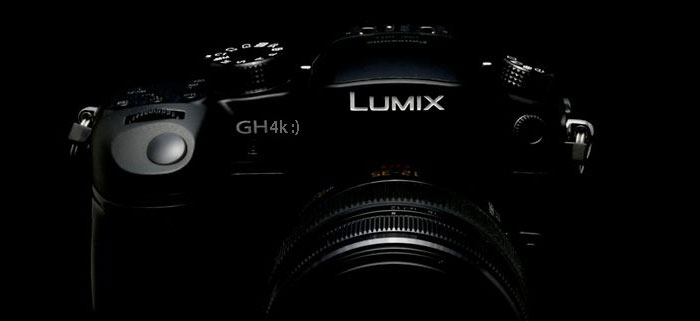
Let’s drop the bomb:
According to two highly trusted sources Panasonic will launch a new High End Micro Four Thirds camera that can record 4K video. The camera will be in Stores by 2014. The model is placed above the current [shoplink 33624]Panasonic GH3[/shoplink]. It will not(!) replace it and it will cost much more than the GH3!
I hope to get full specs confirmations soon. But Panasonic is definitely moving towards the professional market with their cameras and lenses. And they want to do it by focusing on one aspect. Top video and photo hybrid quality performance!
P.S.: Stay tuned on 43rumors!
—
For sources: Sources can send me anonymous info at 43rumors@gmail.com (create a fake gmail account) or via contact form you see on the right sidebar. Thanks!
For readers: Don’t miss any news. Join our group on facebook and follow our tweets.
Rumors classification explained (FT= FourThirds):
FT1=1-20% chance the rumor is correct
FT2=21-40% chance the rumor is correct
FT3=41-60% chance the rumor is correct
FT4=61-80% chance the rumor is correct
FT5=81-99% chance the rumor is correct
224 Responses
MUCH more than GH3? :(((
What the hell is 4K video? (Still Shooter here :-))
‘4K’ is the width of the video image. Traditional is about 2K (1920 @ 1080p). So basically you’ll get still resolution (4x more than normal) for video.
WHOA!
Does anyone care about 4K? It is only marketing to sell the next big thing. Most cameras that claim to offer 1080p aren’t really offering true 1080p, but an equivalent of an upscaled 360p-480p. Only a few cameras get close to true 1080p right now.
I doubt that more than 1% of the world population is ever seeing true 1080p content on their TVs.
4K will never happen. It is inconvenient and unnecessary. The eye resolution is about 2-3 MP (of true pixels). For most people a DIVX low quality version of a DVD is good enough (that is something like a 240p stream).
Do you remember Super Audio CD? So 4K is the same thing, but for video.
I thought the same until I saw a 4K tv in person.
It’s not about quality. If you had the chance to hear a Super Audio CD with high quality equipment in an appropriate room and after a lossy 128Kbps MP3 version of the same music you would have been impressed by how much better SACD was.
But did it matter?
thats no true…
I listened to pinck floyd remastered on DVD audio (form memory I think its 196khz 48bit) anyway this was on £100,000 system… and guess what – a “crappy” modern produced 128kbs MP3 sounded waay better… because the production and recording were vastly superior…
So upshot is MP3 is less a problem than the best recording kit avalible in the 70s was…
Yes, if you try to listen on Super Audio CD the recordings from Django Reinhardt they will sound like crap, no matter how much they try to “remaster” them.
But you hit the nail in the head. In order to hear the difference between a 128kbps mp3 and a Super Audio CD, you need first a great quality source recording (recorded for SACD, obviously. Otherwise it would be like upscaling a DVD to 4K). Then a great equipment and then a great room especially prepared for listening to it. THEN you will see how big the difference is.
But in the real world, when you are in your car, with the engine roaring, the wind hitting the windshield and the tires the asphalt, and your wife telling you some story, would you notice the difference? No. And even less if the source is crappy in the first place.
This is what happens with 4K. No one will care. People watched the original Youtube videos -from years ago- for hours and didn’t care about the really crappy quality. Do you think those people need -or want- something better than what 1080p can offer?
Very familliar! A bit like the pixel peepers who analyse the very carefully light controlled test shots to decide what to buy. Then go out in the sun and rain and shade, light and dark and take photos. In reality the highly controlled shots are irrelevant. The special lighting is not carried around. For the majority the light we get is what we get, just make the most of it.
Um….I say listen to your Pink Floyd (yawn) on vinyl. Why mess with this junk???
http://www.engadget.com/2013/10/23/japan-display-4k-tablet-lcd/
When I can “upgrade” my ears (degraded by age, noise and FWIW many forms of music), then maybe I’d hear a difference. Until then, I wouldn’t really know.
its not about output, its about input, I shoot 1080p and output to 720p because I like the latitude in post. Shooting 4k and outputting to 1080p gives you huge latitude to crop and color correct.
A 4K workflow to output 1080p? That’s a very high price to pay. Get good quality 1080p shots in the first place and you’ll save a lot of time and money.
4K might work out for Hollywood. For movie theaters (where you are generally closer to the screen that the normal viewing distance would be considered). But not for consumers and homes.
everyone ends up cropping a little 🙂 and so many would like 4 k or 2.5 so you have the ability!
a 16mp still camera to publish on the web? why not just have 2mp and get better shots…
+1
” Most cameras that claim to offer 1080p aren’t really offering true 1080p, but an equivalent of an upscaled 360p-480p. Only a few cameras get close to true 1080p right now.”
That´s total bullshit. If you can´t see the difference between 480p and 1080p then either your monitor is defective or your eyes.
And while 4k may seem like a marketing gimmick it will make sense in the future. Surely not every device recording 4k will give usable output but GHx is no crap.
It’s like looking thru a window !!!!
Breathtaking.
It depends on whether you want true 4K or the 4K marketed to consumers.
Will be my GH2 replacement!!
Not mine.
I have the same necessity for 4K as I do for weather sealing, ie: ZERO.
I’m very happy though, as my bases are covered by the G6/GX7 pair.
Now yes I run the ball.
We have a small Samsung note 3, in 3 months will become old and will cost much less than the current approximately 600 Euros, because it will come out another one. And the technology advances in mobile devices.
Now that Panasonic has run convinced, finally, to advance, they propose something VERY expensive, just because there will be the 4k resolution?
PRORES WANTED, WE WANT THE RAW. WHERE THE FUCK ARE THEY?
(ALSO: MTF SENSOR is a big MATCH. Now that Full Frame goes on even on mirrorless, they MUST keep price LOW. BUT! There’s a but…it’s a good thing for who has many and expensive mft lens).
End for now.
Seriously kid, take your meds.
Well, you will be the perfect consumer who buy everything and would be happy.
I know Marketing, that’s it.
And you are the type of moron who cries conspiracy and injustice whenever a product he wants is too expensive for him…
You are a tinfoil wearing, entitled immature wanker, get out of your mom’s basement, get a job…
Man, you really have to be watched by some good doctor.
It they can do something more with same price, they should, for theyselves but also for us. The BlackMagic tried something in this way with the Pocket.
Everyone then will take his choice.
Do you ever wonder why you don’t have any friends?
AHHAHAHAHHAHAHHAHAHHASHUTUPIHAVETHEMHAHAHHAHAHAHAHAHAHAHAHAHMAYBEYOUDONTAHAHAHHAHAH.
As I said get a job, or some modicum of education, maybe you’ll start getting an idea how a company works and that progress comes from investment in R&D, financed by profits…
Despite what you might think, cameras are low volume items with relatively high R&D costs, meaning that unless you want to have a highly profitable branch footing the R&D bill, you have to sell with fairly high margins.
Considering the market has proven the margin level on the M4/3 market was somewhat adequate despite the protestation of some vocal FF-trolls and deadbeats, there is no reason to lower prices.
You also have to consider market segmentation and the expected sales volume.
Even at €100 a high end specialized video camera is a low volume item because it appeals to a very niche market, it’s also a market with relatively limited competition and a very high entry price.
Even at twice the price of a GH3, it will be far more affordable than most alternatives.
So can you explain to me how and why Panasonic should use a ridiculously low price when it’s an economic aberration to do so ?
Just because some unemployed idiotic kid on the internet is frustrated of not being able to afford it ?
Ok , let’s talk like civilized people .
The ibis of omd EM5 is extraordinary. However, the omd is a camera old enough , and if it were not for the problems that the firmware ( rather than physical production costs ) , would exceed the level of gh3 , which costs more. Here: € 700 vs € 1000 . This is the first point , which is not much interest me.
The second point is the quality of the format : less compression = less work for developers. It would be really difficult so much to offer it , or maybe do not want to provide it, The ProRes or raw ? Maybe they have video cameras ( you know, classic video -cameras ) that must sell at a price even higher than , that maybe something is missing as well ?
Third point : competition, referring to its size . The bmpcc is a large room, which suffers from some problems, sold at a cost of about 850 euro here from where I write. They are young, they arrived, and they are trying to do something, to outperform the market, although niche .
The fourth point is the most important: A group of fans , the boys of Eos , they pulled out from the raw machine where it was not expected. They even agginuto video mode if not there. So , what do you want me to explain more ?
So the question is not IF I could buy a camera like that. The fact is that I do not throw the money , just to play.
some mistake with the transletor (that i use to go faster). Room states for “camera”, size states for “format”. Sorry. Owned myself.
1. It was argued many times that there is no reason not to provide uncompressed video on the enthusiast cameras from all major manufacturers)rather than their ridiculous fear to lose customers at high margin segments. Thanks BM will force these big Japanese guys to revise these fears.
2. Putting high quality video on prosumer cameras creates new markets (the success of Canon Mk I and GH2 just showed this) and finally brings profits within the existing segments.
You are a wise and pleasant boy, exactly the type Panasonic needs to sell their toys. I am sorry for your mom.
Why don’t you chime in with a way to make it happen rather than 100 ways to stop it being talked about…
Sure flag up potential issues but the way you talk its amazing anything gets done in this world… how do you propose to forwards the situation?
Your attitude makes me think you might be in line for a bank directorship… seems you have the right heart for it.
Why don’t I, because I’m not an entitled man-child wanting everything NOW and for next to nothing, I just know that incremental change makes it so that what you want immediately and would be risky (and thus expensive) now, will be what we have as a baseline in 3 years time.
Are you in THAT urgent need of these features (come on, as it stands 4K is as useless as 3D, do I really need to be able to spot every pimple on an actor’s skin)?
There is also something escaping me, apparently you know that some other manufacturers are offering products catering to your needs, why do you need these to be satisfied, specifically, by a Panasonic product ?
If Canon has a product ticking more of your need boxes, then buy it instead…
If it’s Sony, buy a fucking Sony…
Why does it have to come from Panasonic, are you a fanboy ?
Sorry why do we even bother with 12Mpix who NEEDS it? we coaul all live with 3-4Mpix…
By your logic – panasoic are doing it perfictly – its the most anyone could ever hope for… and you idea of a new model is not changing things that make your life a pain?
Sorry but as a consumer this is just lame…
Oh, because people who print in very large sizes, or want to crop their images for composition (or because of lacking a long enough lens at the moment a photographic opportunity arises) quite benefit from a higher resolution imaging sensor. Those are things done by many amateur photographers and pros alike. That is totally different from 4K video because the presentation of 12mp image data is simply quite practical and available to everyone with a few (litteraly) dollars to spare. 4K presentation however is only available in cinemas and to those who can spend many thousands on appropriate display equipment.
So.. one has a practical use today, available to most users. The other may have a practical use in the future but certainly not today.
And indeed, there are upper limits to what is useful, depending a bit on the situation and application. Very few people need the 36mp that a D800 gets you (please read carefully, very few is NOT the same as none), and those who do get to pay a premium.
+1
You have friends… what you say it true –
Its about time we get 4k – can you belive the mobile phone market beat the camera market to 4k video – shows how backwards thingking and conservative the camera market is… filled with way too many people who try to resist change… what we need it more people screaming for more technology…. not the if you want video go get a video camera lot… that is so luddite.
Ram these cameras full of all technolgy you can fit! – wifi, usb ports, ethernet ports, trigger inputs, mic in, headphones out, RAW out, All HD + 4k… all electronic tools known to man (HDR, panorama, image stacking)… What the hell even allow them to just do high quality audio recording… why not? – just open them up allready… stop trying to define segments and just give the consumer the best you can for a set price!
Dear God, you people are brainless…
Ok, let’s imagine Panasonic makes a fully featured camera, no expense spared… oops, now that costs €3k…
So, they’ll remove and remove and get a €2k version with less features… still too high for some, so they’ll make €1k version…
Hey wait, segmentation is back…
Segmentation exist not only to optimize profits but also to serve different segments of the market.
Some people are not interested in video features in their still camera and are not willing to pay more to get a camera with features they don’t use, so it’s a choice of having two products and getting more sales, or having only one and losing sales.
What creates market segments is less a conspiracy to trick consumers and more the result of the large diversity of consumers, their needs or wants.
Some of us want video, some can’t abide it, some of us want viewfinders, some don’t care, some of us want compacity, others want large grips, some of us want affordable, others want quality whatever the cost, some of us want retro-styled, others a modern look.
That’s why manufacturers segment their offers, because offering one size fits all is a recipe for commercial failure unless you have a monopoly.
What an arrogant tool you are. Get down from your lofty perch before somebody does it for you!
What a powerful demonstration, such compelling arguments ! You, sir, truly master the art of refuting one’s arguments.
Ditto for you knobhead.
Thing is they have video/most abilitys in cheep stuff – they just dissable it… it does not mean they developed video just for the GH3 and then and went and developed another vidoe format for the GX7 and then again for the LX5 etc etc… it is not technological cost limmitations – some things are – like faster processing better screens etc but not the ability to implement stuff!
Wow, you do know for a fact that the whole hardware is identical ? Where have you seen that ?
Even using the same sensor, the difference in supporting electronics, bandwidth, speed, heat dissipation ability make things different enough to justify disabling features that are still, theoretically, possible.
Part of it is artificial to justify lower prices (or push consumers toward the higher margin model), but part of it is also to be able to skip on validation with inferior hardware that may or may not work up to the specification.
What’s better, to offer a potentially half-baked, crippled functionality, or to disable it, or cripple it partially to ensure that what is offered just works.
The same happens with CPUs, lower frequency parts are often exactly the same as higher ones, except limited by firmware.
Part of that is because the yield makes it so part of the parts can not reliably operate at the higher specs, so they are sold as a lower part… The other part is that manufacturers know that the market wouldn’t absorb all high end parts, making up for losses, instead by deciding to cripple part of the output, they get to satisfy the market at all price ranges, in the right quantities and thus optimize profits without sacrificing the low volume, high margin part of the market.
Some numbers to help you understand.
Image that for every 100 products, only 70 manage to qualify for full specs, 30 still work but at reduced specs.
The market is able and willing to absorb 10 high end parts versus 90 low end parts.
The part costs 200 to produce and can be sold at 300 or 500.
So, you produce 100 pieces, at a cost of 20.000.
You try to sell your 70 good parts at full price, you only sell 10 for 5.000.
You sell the 30 defective parts as lower specced ones, you sell all 30 for 9.000.
You have a large unsold inventory and you haven’t even covered your production costs yet.
Let’s try it another way…
You sell 10 of the good parts at full price, you make 5.000.
You sell the defective parts and 60 of the good parts as lower specced ones, you sell all 90 for 27.000.
Congratulations, you have sold everything and made a profit.
Now, let’s say you think that it is dishonest, let’s try it another way shall we ?
Let’s sell all of our higher specced products at the price of the lower ones, that makes us 70 units at 300, for a total of 21.000.
But we can’t sell the crippled parts at the same price or at a loss can we ? So we are forced to recreate segmentation, let’s sell them at 250, for a total of 7.500…
Wait, we have made less money, and we may not sell them all anyway because we are perceived by the consumers as a cheap manufacturer and part of the market insist on buying only the latest, priciest items and we lose part of the market over a stupid reason (of course they are not rational, but who cares, their irrationality now helps a competitor’s bottom line).
Are you starting to get it ?
Thanks for taking time to write such a detailed response.
nice writeup…
Yes and no… look at olympus – they pritty much have identical core from EPL1 to EP3 We all know it… the additions are mostly FW and a few exo HW swops.
I feel the much larger unit sales from a more desirable base product would far exceed the loss from the premium market…
Build it and they will come…
Have to say your attitude sucks – I guess you wife don’t eh…
I am afraid you did not understand how this technology works.
Implementing RAW files costs nothing. The RAW format is already there, but the producer wants us to get only the compressed format in order to force us to buy expensive video cameras. As easy as that. It’s called “crippling” and it’s pure Japanese marketing (and social) style…
Actually RAW costs…
Because you need far more bandwidth and buffer along the whole recording chain, meaning you have more file operations and have to process them faster than with compressed files, so what you have gained in bypassing compression, you lose on moving a whole lot more bits around, with far higher requirements than before, meaning you start to have different, better hardware to handle that, that it will heat up a bit more etc… all that to end up with files so large that the majority of your customers won’t even be able to handle them, what’s the point ?
Designing any product is an exercise in compromises, you may disagree with the trade-offs made by certain products, but be assured they usually have very good reasons to exist.
Your information about the bandwidths is a bit out of the date.
1) BMC is capable of RAW for just under 1K€.
2) Hacked Mark III with Magic Lantern is capable of 14 bit RAW for nothing.
– the technology is already there.
PS about Japane marketing you are trying to justify all day: if you do not cannibalize yourself, somebody other will do this (C)…
There is nothing specifically japanese about it, that’s what all profitable companies not in a situation of monopoly (and sometimes even these) have been doing for at least the past 60 (if not 90) years.
If your fairyland approach to R&D, pricing and features was economically viable and efficient, every company out there would be practicing it, there’s a reason companies operate the way they do, a reason people whose job it has been for decades do things the way they do, they didn’t just wake up one day and decide it was the way to go.
Yes, it’s not perfect and some companies overdo artificial segmentation of their product lines, but the approach you and some others defend has proven to have a very small success rate (of course the rewards in case of success are great look at how Apple redefined and appropriated smartphones and tablets, making everyone believe they created the concept).
Now, concerning the RAW situation…
If those cameras were using the same electronics I would understand your argument, but as it stands, it’s utterly irrational.
Just because a Fiat 500 is an italian car and a Ferrari is also an italian car able to reach 300km/h, should the Fiat also be able to reach that speed ?
What kind of logic is that ?
Seriously, some of you have your head so far up your asses about real life and how companies work that it’s almost scary.
0. You always turn the discussion to the different “philosophical” directions and always fail to reply on this specific example: hacked Mark III – it is capable of RAW right now. Heat is not an issue b.t.w.:
“Is heat an issue? Well I don’t know yet – I haven’t shot with it for long enough or in a hot enough place. The card and camera are warmer than normal, but that is to be expected considering the huge data rates generated by raw. I don’t know what – if any – implications for camera life this hack will have, but the sensor is always doing a raw video output in live view mode so sensor heat shouldn’t be any more of an issue than it was with ALL-I H.264 video.”
http://www.eoshd.com/content/10324/big-news-hands-on-with-continuous-raw-recording-on-canon-5d-mark-iii
Please reply to this example.
1. In all my comments about uncompressed RAW I refer to the last generation of cameras. Of course for the generation before GH3 it hardly possible. However, at that time (before GH3) there was the same problem: compression level, compete set of frame rates etc.
E.g. even not having PAL/NTSC frame rates in one camera (!) – WTF is that if not “marketing” ???
Please rationalize me why there is STILL no 1080@24p/25p on OM-E1 by anything rather than the same “marketing” ? Isn’t it an example of “special relations” between Panasonic and Olympus (the “open” Japanese market, isn’t it ?)?
2. Japanese mentality (aka “conservative” and “collectivist”) does influence the Japanese marketing – that’s perfectly normal (for any culture) and has many records in recent history.
3. We know very little about how “open” and “competitive” the Japanese market really is, about the cartel agreements between the major players, the role of yakuza and so on. Have you just forgotten the recent scandal Woodford vs Olymupus, have you seen any serious penalties then:
http://en.wikipedia.org/wiki/Olympus_scandal
?
PS I catch myself on the thought that I just repeat the arguments of EOSHD about the restrictions and Japanese marketing in the mirrorless video world, I guess you can go to his forum and continue the debates there – it will be more substantial as video is not really my profile.
@ZZVISUAL
“Please rationalize me why there is STILL no 1080@24p/25p on OM-E1 by anything rather than the same “marketing” ? Isn’t it an example of “special relations” between Panasonic and Olympus (the “open” Japanese market, isn’t it ?)?””
Any kind of sane marketing by Olympus would want to have 24/25p because it helps selling the product.
It MAY BE a joint strategy between Panasonic and Olympus, or something entirely different, but marketing it isn’t, and arguing it is merely shows you have absolutely no bloody clue about what marketing is.
@YAA
1. “It MAY BE a joint strategy between Panasonic and Olympus, or something entirely different, but marketing it isn’t, and arguing it is merely shows you have absolutely no bloody clue about what marketing is.”
Haven’t you noticed my sarcasm about the insane Panasonic/Olympus marketing by constantly putting the word “marketing” in quotations ?
2. “Any kind of sane marketing by Olympus would want to have 24/25p because it helps selling the product.”
The same logics applies to RAW (for both still and photo), higher bitrates, wider color space etc. But it seems they do not want to sell products very well (or better than others). There are many hypotheses for that but it’s a separate theme…
@ZZVISUAL
The arguments for supporting especially 25p are totally different from those for supporting RAW video out.
The first addresses a basic consumer level issue, being the reduction of ‘flicker’ issues due to the power cycle being 50hz in much of the world. Something that a serious videographer can often work around with help of manual shutter control and understanding of the issue, but not something you can expect the average consumer to work around, especially not when manual control is somewhat limited.
Hence, 25p support, while having some relevance for the ‘pro’ videographer, is especially relevant to the general consumer.
RAW video out however has very little relevance to the average consumer, but it does for more serious videographers.
Simply doesn’t compare as the primary relevance of both options is in very different segments of the market.
25p support does not undercut any other product ranges, especially not in Olympus’ case, as they simply do not have any ‘pro video’ products. Olympus doesn’t have a direct marketing incentive for this, but may have agreements about this (in which case they did get something in return for it, and until we exactly know what, its impossible to judge if that is a good deal for them and their customers)
In Panasonic’s case however RAW support does undercut their upmarket video products.
Neither company is in the position to be a disruptive force in the market, high-risk specialized companies like Black Magic are, but guess what, they didn’t exactly manage to put everything in their cameras either. You do get RAW video out, but how about anywhere decent still images? See, its a specialized device aimed at videographers, and an attempt to disrupt the market for such equipment, from a company that has nothing to lose by disrupting the market.
@ YAA
The arguments of not supporting RAW (or, let’s forget about RAW for the moment – the greater range of the bitrates/wider color spaces e.g. on GH2/GH3) one the one hand, and the lack of PAL/NTSC in one camera (e.g. on GH2/OMD) on the other hand, lay in the same plane.
Because these cameras’ market segments are overlapping: pro/semi pro still photographers, video enthusiasts and advanced consumers.
Both cases demonstrate the neglect of a large fraction of each part of the audience, but from the different perspectives.
@ZZVISUAL
I’d rather argue that both result in not satisfying the needs of a part of the market with a specific device, but that doesn’t make the motivations the same.
Neglect would mean they simply aren’t considering those parts of the market or are consciously ignoring them, which might be true for Olympus and support for framerates other then 30p (might be, but doesn’t have to be). Olympus doesn’t have another potentially high-margin segment to protect here, so simply underestimating the relevance seems like a plausible and even likely explanation, whereas market segmentation isn’t a very plausible one.
In case of Panasonic I’m pretty confident that their motivation is more in the direction of quite considering those parts of the market but hoping to sell additional devices to those customers, and that isn’t exactly a case of neglect, rather the opposite. It may be misguided, but thats not the same thing.
Either way, if you are serious enough about video to want high bitrate codecs or raw video out, make your money talk (BM has some nice options if you want to stay with m4/3), and especially Panasonic will eventually take note, as this goes at the expense of the segment they want to protect.
I guess you are paying a lot of effort to rationalize the very often cannibalistic “marketing” of these big guys. For me this (as both video consumer/enthusiast in one face) this psychoanalysis is not interesting.
What is important is by fact the following:
1. Olympus does not give 24/25 fps to the OMD users (apparently because of the relations with Panasonic/Sony or whoever) and lose many (in favor of Panaosonic/Sony ).
2. Panasonic did not not provide PAL/NTSC support in one GH2 camera (a consumer feature which absence is hardly to rationalize), neither higher bitrates what it is technically capable and for free (as the Vitaly hacks showed). In the first case the potential buyers could go to another mirrorless brand, period. In the 2nd case perhaps Panasonic thought that these people will buy AF100, but they did not, owing to the fact it costs 4K$ – not quite the same as 1K$ – again lost many potential customers.
3. You can extend this list with multiple examples (no clean HDMI on Mkr II – they did not want to compete with CS500 not produced at that time, or what ? etc. )
@ZZVISUAL
Interestingly, many successful companies do such things, its not far fetched to assume there is some kind of relation between the 2 things.
Sadly for us as a consumer, that means we don’t get it all at once or for the lowest possible price, but typically the alternatives don’t get us much at all in the slightly longer run.
@YAA
You are right, many do that: it often called “vendor lock-in” etc., but it is also true that when there is an open competition on the market it is much more difficult to achieve. There are many segments in the electronics market (TV/monitors, hard drives, smartphones, even PC ) where we can see the liberalization is working and it would be impossible to imagine that a vendor limits one line of products in favor of another when it is economically/technically possible not to do so. Concerning Olympus, their self-restrictive policy in the OMD line is really odd owing to the fact that they have been and still are on the brink of bankruptcy…
And I agree with you on the last point: it is annoying that due to the Japanese monopoly of the camera’s market (with all stuff we r discussing) you cannot go to another vendor if one does not satisfy you – really Japanese vendor’ lock-in :(.
Who is brainless here? Give us a laugh twitty.
It’s post like yours that are making me think I should just buy a Sigma SD1 Merril and never look at the equipment forums again.
Or even better, my OM film cameras.
The computer geeks have taken over the photography world unfortunately.
Unfortunatly being computer geek is more and more essential as computers do everthing, including running your camera, mostly because they are better and cheaper!
Its called progress… guess what it aint gonna stop… so…
try to take some pictures with an blackmagic… do you understand everybody want a camera capable Photo and video both?
Just ignore the little wanker and he’ll go leave and go back to playing Candy Crush on his iPad.
I agree, I’d rather have 12-bit (or higher) RAW than 4K. But, the problem with RAW is that, I believe, they have to use a cropped portion of the sensor, so unless they produce a camera with a lower resolution sensor, then they have to window it down and you get a huge crop factor.
The ultimate would be a camera with 4096 × 3072 resolution (4×3, 12.5 MP) that could be windowed down for video to 4096 x 2304 for 16:9 or whatever else you wanted, and then let it record in RAW. The benefit of going back to 12.5 megapixel is that the pixels would be slightly larger, hopefully providing better dynamic range.
I would be all over a camera like that and forever forget my dreams of owning a RED.
Good point, but the problem is technically solved:
http://www.eoshd.com/content/10324/big-news-hands-on-with-continuous-raw-recording-on-canon-5d-mark-iii
I was thinking this was on the cards…
1. I hope they provide at least 12 bit RAW for 1080 before going to 4K with mediocre AVCHD.
2. I hope they finally provide 14 bit uncompressed for stills – the time has came.
3. I hope they will stay with articulated screens (rather than tilted) on top their models.
a small correction: not AVCHD anymore but AVC
If they do Raw at 1080p and Avchd at 4k, i’m going really crazy, cause they find the perfect excuse to make the 4k res. and the raw (only at 1080p) be EXPENSIVE.
Actually, uncompressed video is not an excuse for high prices since it requires less processor power than encoding (pocket BMC is just an example). What they have to do is to provide a good bandwidth to write on local memory, or even on some external accessory unit with HDD.
Good.
So, it’s the 4k res. the excuse to make the price fly high? Cause yes, there’s the pocket by BlackMagic, who teached how to do things in a way (not in the other one, bad distribution, some problems, etc).
If it is so, i don’t want 4k res.
You should be taking your medication
The Asylum on that way, bro!
I’m thinking he uses translate software?
I can undersatnd what he said – you are just rude and had nothing to add… and knowone thought your comment was witty, clever or new…
It is not only BMC – their example could be not entirely representative since they do not offer anything except a 1K RAW brick for 1K$ (no AF, no EVF, little control).
What is more representative for the RAW demand form big brands is Magic Lantern on Canon Mk III: it shows that RAW 2K
costs NOTHING and it is feasible already at EXISTING technology level.
correction: 2K RAW for 1K$
No Raw-video shooter in the world uses AF, and there is all the controls you need. Shutter angle and ISO should always be 800 and the white balance is irelevant when shooting raw.
But an EVF would have been the iceing on the cake.
2 Mr L:
“No Raw-video shooter in the world uses AF, and there is all the controls you need. Shutter angle and ISO should always be 800 and the white balance is irelevant when shooting raw.”
1. I mentioned these futures which BMC lacks just to show that its net cost is basically the cost of the sensor, the circuit and processor (not that powerful by the way). So 1000$ is not necessary the lowest bound of the full featured camera with RAW. However, again, many cameras of the last generation are capable of RAW video – just their product management does not want to give it to the enthusiasts’ market.
2. Towards autofocus and RAW – sure Captain (Obvious) – no one does that because there is no one camera on the market doing that. Once it is available, there is no reason not to use it.
Ok I guess you dont know much about video.
There are several RAW video cameras on the market with AF.
But the fact remains, NO Raw video shooter would ever use AF. No video shooter on any camera video or DSLR would ever use AF if they arent totally worthless at shooting video. AF is for when you pass a camera to someone that dont know how a camera works or for total amateurs, and they cant edit raw anyway.
There is no camera in the world with a working AF good enough for pros, prosumers or hobby shooters.
This is a fact.
At this very second – but implementing an AF mount does not mean AF can’t get better…
I very much doubt AF will stay worse than human operation for long… definaly room for it as a tool on any camera.
Would not be supprised if CDAF became quick enough to deal with AF very well – and even do the face follow or car follow or object track or whatever…
Just out of interest don’t sports pros use AF? – F1, moto GP etc..?
All these arguments about no “RAW with AF” are based on the fact that RAW video is quite a new phenomenon – esp. in the price range under 10K$. So there are simply no cameras in this segment capable of reliable CD AF tracing, comparable to the (CD)AF on the latest M43 cams.
It is pretty well known how it is difficult to focus manually with the large sensor cameras and fast lenses – even for the stills.
Once there is a RELIABLE CD/AF tracing technology there is no reason not to use it in video – whatever encoding is used.
I am a still photographer, but I shoot a lot for fun and I do know that face detection CF AF of Panasonic is working pretty pretty well in the video mode – it does not matter what encoding system is used. So why not to use it with the RAW shooting in those situations when one cannot focus manually anyways ? More choice is always better than less choice.
Anyways, my initial comment was about economical feasibility of RAW on prosumer cameras – not about the AF with RAW.
Still do not see the relation between the RAW shooting and AF. There is the relation between the reliability of the CD/AF in the video/tracing mode, but the situation is going better and better (so there is even PD AF on sensor), at some point it will be quite usable. And this point will be when the major players of DSLR/mirrorless will provide RAW.
Correction: the BMPCC has AF
Good to remember, but not up to the usable level so far (what one would not expect from the company just began form scatch ):
http://philipbloom.net/2013/08/27/pocketcamera/
🙂
Anyways, it just corroborates an obvious message that there is nothing but weird “marketing strategies” not to give RAW video on the latest cameras like GH3, OMD-E1 etc.
Once again, there is no usable AF on any camera.
I find face detection on Panasonic G/GH line quite usable (of course not 100% cases owning it is CD-based AF) but far more useful than one can achieve manually with bright glass for the moving people. If it will work with RAW in future why not to resort to it in some cases ? And what if there will be a sort of the sensor phase detection AF on the new generation of cameras ?
AF works on Panasonic cameras so well because it is assisted by the touchscreen tipping. I do not know whether there is such an option on the high end RAW cameras. I am sure if the next Panasonic cameras will have RAW there is no reason not to use this kind of focusing in many cases.
AF doesn’t get used on movie sets anyway, so the existence of AF or not hardly matters.
You are right that not compressing video saves on processing, but it also means the entire chain has to support the full bandwidth of uncompressed video, which tends to be more expensive then the extra processing required for compression.
As a matter of fact, that is why compression exists to begin with.
Simplistic reasoning, ignoring aspects that are unwelcome for your argument is a very good way to end up at the wrong conclusions.
mmm no – storage was the reason for commpression… you need the bandwidth to read RAW before you can compress it!
In the old days they did not have the CPU to compress realtime – so they ran full uncompressed video! The old paintbox, henry & harriet machines worked this way.
mind you 4k uncompressed is about 823MB a sec! Actualy quite reachable for modern PCs RAM chips and graphics bus to deliver… but you gonna need the mother of HD to keep this data rate going! RAID of 8 to 10 drives or so I guess to keep up this transfure rate!
For mobile devices its not so fast but samsungs new mobile RAM is running at 266MB/s get a quad pipe in there and you have 4k RAW… at consumer device prices!
Could even have RAID SD cards – bank of 50 cheep SD cards – lol 🙂 – could be an extrenal cheep recorder!
The barriers are not technological…
i prefer cheap recorded rather than sheep recorder, it’s more transportable and easier to feed 🙂
Sure, an external recorder (e.g. in the battery grip) is a solution. I wrote about it in the above comment.
Actually, both storage AND bandwidth are the reasons for compression to exist.
Sure, I do aware there are relations between the bandwidth and required processing power for compressed/uncompressed videos. My main point is that at present technological level several cameras pro/prosumer are capable in doing that from the hardware perspective:
http://en.wikipedia.org/wiki/Uncompressed_video
– a resent example is Mark III with Magic Lantern. The main reason we still do not have access to these features is a very weird vision of “marketing” by the Japanese product managers.
@YAA
“Simplistic reasoning, ignoring aspects that are unwelcome for your argument is a very good way to end up at the wrong conclusions.”
Thanks for methodological lesson, but the fact that Japanese companies in the photo-video enthusiast’s market very often/always give less features than it is technically possible and even do not cost anything (like clean HDMI for uncompressed video) does not need the tricks you described to be obvious.
On the marketing point of view, 4k is much more seller than 14bit raw, on a web site, you can put a big 4K to attract people. Articuled screen is on the second place in a short list. Tilt screen is always welcome, but articulated is better, but now, since there is wifi, you can use your smartphone as a screen. I hope there is an accessory you put on the flash hotshoe with a grip to hold the phone, or i can use Google glass or a smartwatch 🙂
2 Gabriel:
1. I do not see a marketing contradiction between the 14 (or at least 12) bit 2K RAW vs. 4K AVC: technologically, if they can do the former they can do the latter (in terms of the bandwidth), so why restrict the market ?
2. Articulated screen is an order of magnitude more universal than the tilt one: with the tilt one you are always bound to the eye level shooting if the framing is vertical. It is not a critical issue for video but it is for stills. Framing with WiFi devices is of course possible in this case but is awkward, not secrete for the shooting subject (unless there is an assistant), esp. if you need need speed.
Why do you want the two extra bits? It’s only noice there anyway!
Hopefully by that time Olympus will realise that PAL region existing and will initiate an internal feasibility study on the possibility that its users use the video mode. 🙂
Yep – and finally they will release a OMD V1, with “V” for video!
What is needed is not expensive 4K, but excellent 2K (or 2.5K) RAW on M43 sensor.
Certainly should not be overlooked!
if they do 4k they should also have a switch for 2.5k!
I want improved low light and pro res option in the next GH – MUCH more than I want 4k.
If they have Olympus’s five axis stabilisation, it will be mine…
I want Prores 1080p 60FPS and IBIS. All I need and ask since years
Olympus has 5 axis IBIS
Black magic pocket has Prores
GH3 has 1080p 60FPS
Why not in one body ? seriously..
Quote
Both of you will understand the day you learned something about running a business.
Yeh build products that the people want, dont just hope marketing can push it on the masses – you will understand the day you learned something about not being a condecending…
Jim, the camera YOU want is not the camera Yaa wants, which in turn is not the camera I want, which in turn is not the camera my neighbour wants.
Manufacturers try to find combinations that hit the price and feature range of the maximum number of people, sometimes that will be the sweet spot for you, sometimes it won’t, that doesn’t mean they are incompetent or have nefarious purposes pushing crap to people who don’t want/need it, they aren’t putting a gun to your head to force you to buy.
Instead Jimmyboy, you could start your own company, go manufacture the perfect camera for a ‘fair’ price, sell it, and see how long you last.
We’ll await the results, keep us posted.
Don’t think so – But I’ll gladly lead product development at panasonics camera devision… and there would be a camera produced that would push the definition and use of a camera into somthing far more usefull and configurable, somthing that would bring together all the aspects of panasonics imaging expertise into a single device… obviously with modular development to allow the camera to be built up (pro) or cut back (cheap) but it will be based on the same imaging and processing core… just get better grips, batts, screens, etc etc… – sonys lens cap wifi android camrea is starting to get the idea… think new technology not what you know…
Its kinda what Olympus do – there is very little IQ/ability diffrence form their top of range to bottom of range… mostly ergonomics, case/buttons, weather proof, screens, VFs… they don’t falsly cripple their bottom of the range stuff… its just a pitty they don’t have a monster size electronics, fabrication, video & and programming dept to add in the mix…
I appreciate what Olympus does, as you can get the top image quality from the cheapest ‘new’ m4/3 cameras from them.
But last time I checked, the 2 most successful players on the market do something entirely different, so it isn’t like its bringing in customers in droves, actually, for much of the market it seems a bit of a handicap because there is too little product differentiation.
And eh, since you are so keen to blame marketing and management for everything, obviously you have to demonstrate that you are better at those things as well, else its all just idle talk. So no jimmyboy, head development won’t at all demonstrate that you actually know anything at all about running a business or at the very least about selling products to consumers. Of course your posts so far already paint a clear picture, but who knows, maybe you CAN prove you are right… awaiting the news about your successful camera company and its products.
I’ve met a few too many junior developers who think they know it all and management, marketing and sales are just stupid. Don’t worry, for most people this goes away once they gain some actual experience in a real world position in a real world company, and till then, concentrate on what you actually do know, and try to learn a thing or 2 from those with experience in other areas.
Dude – I’m having a hard time trying to reply to you…
Obviously I don’t have to demonstarte or prove my marketing skills. Who do you think you are Lord Suger – this an episode of the aprentise?
What is your problem – in a camera roumor site talking about the latest releases and technology it is perfictly reasonable to vent desires for direction.. collectively the consumer might be listened to… (although I should’nt hold my breath, eh yaa?) What the hell are you defending?
Oh and er, you got some sand stuck in you vagina… sort it out – it is not very becoming.
The problem here is that you make all kinds of claims as to how Olympus and Panasonic alike should be running their business, blaming management and marketing for everything you consider wrong, but refuse to demonstrate that your ideas actually work and refuse to accept that in fact almost all successful companies do NOT run their business in the way you suggest. Hence it is totally fair to demand that you demonstrate that what you says works. Calling your bluff it is called.
Additionally you are being extremely loudmouthed about it, and act condescending towards anyone who doesn’t happen to agree with your view of the future.
That Jim is the problem.
Fine, you help develop your fantastic camera, except the software teams informs you that apparently they won’t be ready in time, which is a problem because if you don’t exert your option on your super rare parts for your EVF NOW, you know the competition will take them and the next time you’ll be able to have them is in 6 month time, if ever, and procuring another model will require design and engineering changes, meanwhile there has been a delay in the production of your top of the line batteries because of an incident at the production plant, oh, and by the way, the yield on your bleeding edge sensor is atrocious, they are expected to cost at least thrice as expected for at least the next 4 month.
By the time you manage to get all your balls where you want them, you’re a year late, over-budget and have a product over-priced and no longer using anything bleeding or even cutting edge.
Congratulations, you just fucked up.
Reason the programmers can’t get it done in time was because management/marketing gave them a false deadline and one that was unrealistic… poor management mate..
Modular – will help, you can wriggle out of things like supply issues a bit easier – but what you speak of is no diffrent to how it currently is, yes there is shit to sort, its not magic… your not that special – what I speak of is yes mostly programming and CUP stuff, yes will take a bit – but this is a core back bone OS of all furture imaging products – worth a little time to get it right, yes… but don’t tell me it can’t be done, when mobile phone makers are pushing so much more than camera makers – its mostly desire to not change partly because of fear of new market… I think with mirroless we are going the right way but the resistance is huge!
No jim, you are having a very big mouth full of how evil and stupid marketing and management are, so you’ll have to prove that your approach for those specific things work.
You don’t want to? How surprising.
Look, you missed the argument… the argument is that your idea has far too many moving parts, you’d juggle far too many balls, far too many consequences for each and every failure and delay, there’s a good reason why most manufacturers have an incremental approach (it’s an easy way to manage risk) and most ideas to restart from scratch end up as costly failures.
You of course have the option of having multiple teams working on the same part to guarantee against one’s failure, but that means doubling your R&D budget without the guarantee it will produce anything worth the cost at all, or work on the same budget and risk that will produce no result because each team will not have the required budget.
Thinking everything will be alright and that in the end, you’ll get exactly where you want is nice, and you will, in a fashion; The trouble is, there’s such a thing as costs, budgets, real world deadlines and competition… By the time you sort everything out you’ll have eaten your budget several times over, your competition will be ahead of you, your costs would be too high to be competitive on price and your competition will have sold thousands of units while you were busy polishing your expensive perfect turd.
Worse, the money you’d have poured into that project would not necessarily benefit the rest of your product line and would deprive them of R&D, meaning you might actually endanger more products than the one you are working on.
And I’m not even telling you about corporate and share-holders regularly asking were the money went and when returns on that investment can be expected.
You clearly have little first-hand experience actively participating in or leading a large scale multi-disciplinarian project, or maybe just as a simple worker ant on the edge of things, believe me, it’s not that simple otherwise everyone would be doing it on a regular basis.
Just like in politics, the idea of a revolution is seducing, in practice it’s only a recipe for costly disaster.
The thing is, im not asking for ever so much – just the sensible addition or tightning of some parts of the camera in a mannor that is very reasonable in this day and age – are you saying it is perfictly reasonable that phones beat camera to 4k video, or that the GO-PRO is doing full HD and 120fps and 240fps – cameras are/have been too camera-eeyy
A HUGE desirability factor (and probably MUCH bigger sales + cred in pro circles) is gained by the GH and the 5D series cameras, especialy in the film/video world 80% because of the hacking that has been done that clearly demonstartes these machines are time, and time again falsly limmited by manufacture… same for epson printers that requir “£££ service” for no reason… I software patch mine 🙂
Its not beyond – unless you work at panasonic?? (fair game if you do – respect) I don’t know what you are defending? By your rational how would you include a new feature – what would you decide to add? how would you decide? and do you not think these things are reasonable – they are not startreck stuff – they ARE heavily demanded – they are things that would make a diffrence that would make panasonic or XXX stand out from the now not so sleepy gorila that is SONY… its not so much that they have gone in with a FF – its that they are not affraid to give you some proper tech – they don’t shy away from the computer side of things… or shit like 25p OLYMPUS???
Adi….I want I want I want…..
Were you a spoilt BRAT as a kid?? Mummy and Daddy buy you a Range Rover at 18? Feckwit.
Please note all you video guys who have been most very visitant that video does not put up the price of MY stills camera.
It will cost you more. And the GH3 stays as a joint effort camera.
Now you better fork out. You boxed yourselves into a corner. Did you not?
At least I don’t have to pay for YOUR video any more, you can pay for your own. Well done Pany Hooray.
+!
come on its not like compacts suddenly became expencive when they added video… the ones that did it well got cred for it!
So you want a Bentley for 250 pounds because that’s what a Mini cost in 1965! After all a Bentley is only a small annual progression from a Mini. The annual cost differential being so small its irrelevant. Right.
no, no I don’t want a car? I want video like my compact has?
Great news! Even for us mortals who wouldn’t make 4k videos for a very long time if ever. It is very important for us that panasonic is pushing video performance to the limits – pros will be converting to MFT will make more and more manufacturers to come and make better lenses, etc. for us as well.
Plus I am missing the ‘video’ voice here in this forum.
https://medium.com/the-videographer/b883b5787104
It’s a shame Panasonic doesn’t continues to evolve the AG-Af100 in the same way as the GH3. The AF100 is the best camera I’ve worked with when it comes to ergonomics and shooting. Connect a microphone and just go – everything is there. I invested in a GH3 to get the better codec, but I don’t seem to get around to using it more than as a back-up camera as long as I’ve got mine AF100. But I fear I have to give up that struggle – the AF100 is lagging too far behind… Bloody shame it is!
Maybe this is an AG camera.. I don’t think they’ll add another G-line beyond the GH after adding the GM1 on the low-end.
I hope this is a DSLR style camera and not some kind of upgraded AG style camera. Sorry Anders I’m hoping for the exact opposite of you.
🙂
Why not both.
Minus the ageing tech, the AG is a much better featured video camera though, I’ll give you that. The issue is that it doesn’t exactly fit in my small shoulder bag.
It will be a ‘transformer’ camera – can transform from DSLR to AG to rangefinder style. 🙂
This is great – already a camera are getting critized that are only rumored.
Aw, look, in the picture the logo has a smiley face… GH4k 🙂
Anyway, yes, good news. Loving the hoots of derision about the high price – seriously folks, this stuff isn’t zero-cost to implement, particularly when you’re leading the field.
I think they’d really be best off making this a no-compromise 4k raw camcorder……..
I need 1080p at 120fps
I need 720P at 240fps.
Hopefully it include both!
“Panasonic is definitely moving towards the professional market with their cameras and lenses”
REALLY????!!!!! You mean with their plastics bodies and the poor build quality ? Zero tracking capability? zero weathersealed lenses ( 12-35 & 35-100 are NOT weathersealed!) ? How can you put “pro” and panasonic in the same sentence.
So you think arri alexas and red epics are pro because they track and are weather sealed? I hereby present you with the stupidest comment award
This is going to be a larger, camcorder style video camera. Like the AG-AF100 camera. So not very useful for the enthusiast amateur market, where the GH3 resides.
An improved evf and sd card door would be on the list of improvments over 4k
Wow SD card door? thats it! not feeling the 4k vibe i guess 🙂
Amazingly, some people care about getting the basics right before drooling over a video format for which ptoper playback equipment is not in common use yet.
I think alot more would pick 4k over an SD card cover… like whos had SD cards dropping out or failing because of the door quality on any camera??
No I think 4k would be a better advancement… but hay play with the SD card door all you want…
Yes you think that, and you again fail to understand the concept of getting the basics right first.
One is a few cents in material cost and a little bit of design, the other one is a gimmick that increases both processing and bandwidth requirements that has no practical use yet for the very large majority of the people. A must-have a few years from now? Possibly, but not too long ago, everyone needed ‘3D’, and while there are more 3D tv sets now then a few years ago, its not yet approaching critical mass to the point that it makes sense to produce most things in 3D for now. Big budget projects (just in case), or projects that would especially benefit from 3D? sure. The actual bread and butter of videographers? Not at all for now.
The ‘must have’ part in those things is just marketing hype.
But hey, clueless people do buy things based on biggest feature list with biggest numbers and wouldn’t even know, let alone care about things being done properly.
What is this get the basics right?
The basics are right (they have been for some time)!
The last “basics” brakethrough was the new gen sensores for m43 – this was the thing that kept them hot… they bridged the IQ gap.
3D would be best supproted by simply having camera sync ports (and while they are inserted you allow a pass thorough loop to join multiple cameras, tiny cost) MASSSIVE world of possibilties… nothing fancy or mega CPU just a lead and a bunch of cameras. did not need to do much – 3D lens was to limmiting design idea, sync ports coud be used for lots and lots of things…
But I guess your a glass if half empty kind of guy…
Getting the basics right… like.. ensuring that a card door for a supposedly weather-sealed camera is actually weather-sealed?
Ensuring the same for their so called weather-sealed lenses?
Geez – if card door is a problems – we can forget anythiong else…
So look forwards to the new GH4 – with better card door. Its goona sell like hot cakes I can feel it…
No jim, I’m not saying we can forget everything else, I’m saying they should fix basic issues before going on adding things that for now are pretty much irrelevant still (they may become relevant in the future, and it may be good to already have them before that time, but that doesn’t change that the basics should have been addressed before going into non-basic things).
Oh, and please stop putting words into the mouths of others. Saying that they should address the basics first does in no way imply they should just forget everything else, that is just total bullshit and a telltale kind of ‘argument’.
h i g h e r f r a m e r a t e s ! ! ! 120 fps minimum, 240 ok, 480 would be banger.. at full hd, no need for 4k… cant believe the fs700 is the only high frame rate camcorder under 10k – am i the only 1 starving for it? so much more than for higher resolution…
Im not, Super slowmotion was popular about four years ago when twixtor entered the scene. It has had a little revival now when over crank is getting cheaper. But now with the Gopro and iP5s in every mans hand I give it 1 year before super slowmo is as over used and boring like supe SDOF is today.
Then I will be so glad that I didnt buy a super expensive camera.
FYI IMO the best camera for video out there right now if I weigh in size, price, functunality and IQ is the C100.
Therefor, if this is a AG type camera with a better codec, mabey raw, prores or a log and a tad smaller (more like the c100), Then I might have a BMCC for sale.
sure, c100 is a really nice cam, no doubt. prefer my (companys) c300 though, some people (like me) depend on broadcast quality 🙂
anyhow – twixtor did an amazing thing – still its a software solution. with 2 very big downsides – first, its software, can never be as good as real super slomo. second – its takes some time to do it propperly. in my job, time is money. we produce about 30 min of tv docs each week – all shot and edited by me. so absolutely no time to do propper twixtor work.
superslomo is out of date? maybe for you. our station asks a lot for it. often we use the fs700, but the 8 sec limit and no sound recording is a bummer… i really hope to convince my boss to get the arri amira :)for me privatly? i shoot snow and skateboard stuff – i really like to go slow there – not with software, but with hardware – and dont want to spend a fortune on it.ana – hear me! give me high frame rates!!!! 🙂
+1
Slow mo is about seeing what we can’t – and some think cameras should not be progressed this way?
Slow mo is not a trend… thats like saying colour is just a trend… slowmo is a usefull imaging tool.
Try Twixtering falling rain… not gonna work!
Not every video needs to show falling rain 🙂
Color is allso a trend, two years ago everything was Punchy today its the flatter look thats in. In another year it might be something ells, I remember the “green era” following the Matrix with horror 🙂
colour is not a trend – ok how its used might be – but on the whole colour is a good thing to capture – you can throw it away after if required…
I here you but I still think Im right. Super slowmo is today used way to much. Like the other guy said. Its to show what we cant se, but do we need to se everything, all the time?
The c300 is nice, its what we have at where I work to, but the c100 is imo better if you weigh in price, size and function. With a cheap Ninja you are golden for broadcast.
point taken – c100 with ninja is a bang for the buck. still, since we have the c300 i doubt we will be switching 🙂 plus its again another tool, means more space in the bag (we travel alot)cable connection which can break….
your absolutely right when you say not every video needs to show rainsdrops falling – but some do! you deliver what your client asks! and for the last years our clients ask for shallow dof and slomos! and im not talking bout raindrops, can be hunderd of other things… last time i needed it was on a doc about cricket fighting – hell yeah you want to go slomo there! the fs700 combined with the 100mm macro from canon produced amazing slomos of these little animals!)and since my boss doenst want to buy the fs700, the amira aint out yet (and he will probably laugh at me when i suppose to buy a 30-40k body), i myself dont have the cash atm to get a fs700 – please pana, provide some fullHD high frame rates!!!
No I never meant anybody should switch from the C300 to c100, I meant more whats the best deal if money is an issue for lets say a freelance videographer or the documentary enthusiast.
Slowmo has its place for sure and we will soon se alot of it on youtube coming from the iP5s, mabey a reaction to that is that time lapses will be fun again.
OMG it’s got 25p, it’s a real pro camera!!!!
Hahahahahahha Renovatio you make me laugh. I am marketing manager and have a MSc in Marketing and probably know ten times more than you on marketing, market and consumers.
So for you this is a candy world where every company is perfect and make perfect product ?
You don’t know what you are talking about budy
Yeah adi, it’s a question of money. If they do a 1080p camera with ProRes, that cost less than this one, would be perfect. I bet they don’t, right?
Anyway even me, here, it’s the President Of United States. Yes, you’re Steve Jobs. And that’s a nice rich intelligent people’s party, all together.
Yawn, another self promoter of self importance….get a life muppet
No no – fear it, he has an MSc in marketing…
Surely this rumour relates to the Panasonic 4K varicam and not a hybrid stills camera? http://www.eoshd.com/content/11189/panasonic-consumer-market-will-lead-4k
Matt, I suspect you’re possibly right.
> “I have been given some exciting information about the future of the GH-line. But I can’t say anything about it yet. Stay tuned to 43rumors in 2-3 weeks time.”
Hmmm… haven’t read anything here since then relevant to the GH-line? I wonder what it was?? :-/
Yes!!!! I’m saving my pennies now.
Old story. At the IBC2013 in september, Luc Bara from Panasonic Europe that they WANT to do a GHx with “more pro features” and 4K.
Not sure it’ll be this year or next year.
Panasonic doesn’t want RAW. They use their own codecs but they are not aiming for RAW, even for the pro cameras. So don’t expect it at all in the GHx.
But 4K for prosumer market is way too early : no affordable 4K monitors or TV, no portable HEVC encoding chip. A lot of things are missing today for a complete 4K market.
If you want to produce video today, just use a GH3 or any FULL HD device. 😉
4K is coming sooner rather than later. Better to have it now in my opinion, that way videos will be future proof for the next 5-10 years.I can always downsample to 1080 for now, but once 4K is everywhere I will be able to re-encode my videos for that format. Kind of like having 1080p camcorder when everyone else was still recording and viewing VHS.
Don’t want or care for prores… I’d like to see 120fps 1080 or 2K, 4K and better DR before anything codec related.
Let’s see, you don’t want ProRes but want better Dynamic Range.
Facepalm.
+1
You don’t need prores to get better DR.. facepalm.
My first response was an orgasmic YEEESSSSS!!!
But then:
> “The model is placed above the current Panasonic GH3. It will not(!) replace it and it will cost much more than the GH3!”
Damn, that model placement within Panasonic’s range is a bit disappointing.
Oh well, what I’m really hoping for anyway is a GH5 that does ProRes @ 1080, or similar.
lots of hate on 4k here for some reason, nope you’re not going to see 4k Television as soon as panasonic wants you to think you will but 4k means a lot of workspace for effect work at the 1080 mark.
It’s a tool guys, it’s just not the hammer that you seem to want, it’s a wrench.
Even if it has better video than the E-M1, Panasonic lenses are a little behind the Olympus ones. So for stills the E-M1 will be a better system and for video this new camera. Hovewer if the body will cost like the A7 body then I wish them Good Luck!
What lenses are you talking about? The two softest m43s lenses are both from olympus. The sharpest pro zooms are both from pana, as well as the sharpest super zoom, and the sharpest kit lens. The only truly great lens is the 75mm.
http://www.dxomark.com/Reviews/Best-lenses-for-your-Olympus-OMD-E-M5-Panasonic-Lumix-DMC-GH3/Best-performing-prime-lenses-for-the-OM-D-E-M5-and-GH3
and
http://www.dxomark.com/Reviews/Best-lenses-for-your-Olympus-OMD-E-M5-Panasonic-Lumix-DMC-GH3/Best-performing-zoom-lenses-for-the-OM-D-E-M5-and-GH3
Olympus has the best primes and Panasonic the best zooms but that’s before the new PRO line from Olympus which will outperform all Panasonic zooms. Panasonic will have only the best kit lenses but kit lenses are always budget oriented.
The fact that the 17 1.8 is so high on that list makes that a joke. Oh wait, those scores are atvtheir optimal resolution, so that means stopped down to f4 or even further. Go back there and look at the scores for all of them wide open. Whole different story now right? What use is a fast prime you have to stop down to get a decently sharp photo?
Same goes for the olympus “pro” upcoming lenses, even their own chart on the 12-40 is lower than the panasonic 12-35. At f2.8 theyre not that good, You most likely have to stop them down too.
“The fact that the 17 1.8 is so high on that list makes that a joke.”
Indeed, anything that isn’t saying Panasonic tops the charts is a joke…
“Oh wait, those scores are atvtheir optimal resolution, so that means stopped down to f4 or even further. Go back there and look at the scores for all of them wide open. Whole different story now right?”
Not really. The best lenses at their best, and Panasonic doesn’t top the charts. Wide-open? Some of the Panasonic lenses certainly do better when only looking at sharpness according to MTF charts (hint, there is a bit more to lens performance then that)
“What use is a fast prime you have to stop down to get a decently sharp photo?”
None of those charts says you have to stop them down to get a decently sharp photo, all of them say that stopping down to around f/4-f/5.6 gets you a sharper photo, for the Olympus and Panasonic lenses alike.
No True Homer, if your point was that typically the Panasonic lenses perform better wide-open then you are quite right, but from that one cannot draw the conclusions you just did, and actually looking at overall performance, the opposite of what you suggest is true according to those charts.
Using fast primes wide-open is done for many reasons, fast shutter speeds and shallow DOF being 2 of them. The one you obviously failed to consider is that many people, including some well known posters on this site with the pictures to make their point, use fast primes wide open because of the rendering and ‘character’ of those lenses. Curiously, that ‘character’ is a direct function of desirable optical imperfections. Perfection doesn’t automatically make for pleasant rendering.
Others use primes because of the bit of extra quality it can get them, and when trying to squeeze the best quality out of a camera + lens, using it at the best performing aperture (if light and DOF requirements allow) is quite the thing to do. That those primes also happen to be fast is nice, but not why they are being used in that case.
But hey, I suppose all that doesn’t fit your argument.
For me,
If it is a GH4 its only interesting as a c-cam or for stills.
If it is a new AG with log, prores or raw and a bit better ergonomics, I will preorder it as fast as I can.
I love that companies like Canon, Sony, BMD, and hopefully Panasonic make more large chip cameras without stills funktion.
A 4k capable camera would suggest they would also improve sensor read-out speed. Hopefully this technology filters down to the lower end models as this would improve the existing electronic shutter and get us closer to the global shutter.
Three letters: RAW
I could care less about 4K.
Give me 1080p or 2.5K RAW and I will buy the pricy camera. Anyone who has ever worked with RAW in photography or videography can not imagine life without it.
Hopefully Panasonic gets this soon or the Black Magic Pocket/Cinema Camera will be taking market share away from them.
The Blackmagic Pocket Cameras Raw is out for the beta testers already and the first frames have appeard, so they better hurry up.
One of them allso states that the Pocket Cams Raw is nicer then on the BMCC, so they allso need to make it good.
2k is more then enough for me, I don’t like the filesize of 4k : too high.I don’t want to wait hours to upload a video.Makes editing even more hardware demanding. Plus that most viewers don’t have a tv or monitor capable of 4k video
You’ll have to have quite the personal computer to edit that kind of video.
What sensor will Panasonic use? One with around 8MP or will it be one that can also be used for stills? Will it be a new sensor? Will it be the organic one? Will it have the micro color splitter?
Considering that Sony may also launch a 4K camera but probably a FF one, Panasonic needs to think about that a bit. How much will this 4 cost? With Speed Booster it can become a Super 35, that will be interesting.
Until 4K goes mainstream with my clients, I’m not really interested in higher resolution. However, it is very likely the processing power for 120-240 fps at Full HD will be there and that would be extremely useful for the kinds of projects I produce. The FS700 already has this but Sony color just seems lackluster, I prefer Panasonic colors. If this comes in around $3-4K it could compete with Blackmagic 4K (although probably 4:2:2 rather than Raw) and greatly undercut the FS700.
That isnice and well, but I hope the next G7 will have GX7 IQ for still, preferable MultiAspect ratio. PDAF is now mandatory and needs to work like the OMD E-M1. EVF of the GX7 but bigger and 4/3 aspect ratio when needed, 16:9 when needed etc.Could be charged at 900 euro or so. Everything else: liek GX7.
Make the same thing, but weathersealed and 2,5 K video and call that one the GH5 and may be add 7 fps shooting in PDAF with C-AF. Then it would be state of the art again.
Good to hear. I wonder what this news means for the successor of the AF-100? Is it still on the back burner?
remove the AF- line,replace by HYBRID camera.
😉
This is interesting but not relevant to me as an amateur and neophyte stills shooter. Video does not hold much interest at this point. As long as the stills shooter is not short changed in the compromises Panasonic must make with its cameras that try to do both. I would be interested in a GH3 or 4 (or 5) when it arrives, but for the stills side of things.
GoPro from 2012 already shoots 4k (at 15fps) and 2.5k at 24fps, but I much prefer 1080p (24,30,60fps).
4k is too large unless you’re making a film to be projected at a cinema, but 4k could be very useful for cropping in post. Shoot master shots in 4k and everything else in 1080p. The later one could crop out close ups out of the master shot if necessary (*master shot is when the whole scene is visible). Having a 4k camera can actually eliminate necessity for filmig with multiple cameras (an interview for example)
+1
Go-pro out gunning the GH3 for video possiblities… go figure!
There is nothing to ‘go figure’ one is a video system the other a stills camera. The reality being there are reasonable people out in the world that recognise such and don’t try to make one the same as the other. Cars for people Trucks for dirt. Don’t try to combine them other than in a small casual way, like a ute. Any more it becomes neither.
Tell it to Rangerover… who started a world wide trend for manufatures to make car trucks…
Actually they were made by the Rover car company who made the the Land Rover. A bit like a Ute I mentioned above. But designed to carry people in the back facing each other, or anything else that was needed to be carried round. Note, long lengths of timber tended to take the front wheels off the road, (on the SWB) not good when turning.
It was in the 1960s that a Basingstoke company started putting V8 engines in Land Rovers and startling people when they took off at the lights. The bodies may even have had the RR suspension system, I don’t know. Same company did a lot of work on the Imp engine as well.
The Range Rover was really an up market Land Rover, more advanced by a long way yes but still an upmarket Land Rover. It has since lost its ability to carry ‘dirt’ and is now more at home with a row of wine casks across the rear. So you are back to horses for courses. Work horse = Land Rover. Play in comfort = Range Rover.
Two separate vehicles. Just like still cameras and video cameras.
Here 2 separate forms of moving as an aside.
http://www.harwoods.uk.com/landrover/news-events/rrsspitfirechallenge
Yes. you can put a merlin in a car and Bristol made a car that flew but as for a combo. No
Why seperate stills form video – there is so much cross over that it is wastfull to build 2 devices? There is no (minimal) detrement to having video onboard…
Cameras should capture images, I mean the oly pulling 10fps with shutter is already getting into the relm of choppy short video… just move it that little bit further.
I could be crying no flash shoe, because I don’t need it?
You answered your own question when you mentioned Range Rover. They share common heritage, both 4 wheel drive, conceptuality the same initially both having solid chassis and front engine, the LR having leaf suspension and the newer RR having coil springs. The RR being an upmarket version of the LR. but they divided away from their joint function to become entirely separate vehicles, the division getting wider as the years passed. It is now very difficult to see that the RR was originally just an upmarket LR to sell to the gentleman farmer rather than the farmer.
It would be impossible to make one vehicle do both roles now a days. So why try to make a camera do everything. I like video in my camera, its a nice thing to have. But making it a full blown up market video beast is entirely different. That should be seperate.
I also think that many who want up market video have no idea of the ins and outs of technology, hardware and firmware interaction or marketing or development costs. As proof just look at the cost of a RED camera.
Fantastic news! Please, please, don’t make it without 5 axis IBIS from Olympus! And, Olympus falls further behind in video…
Too bad it has to cost so much more than the GH3. I agree with others that 2k Raw at this point would be preferable, even more so in a GH3 successor.
Adding 4K, if not RAW, is a no brainer for any AG-AF replacement, if that is the said camera due in 2014.
2.5k prores
Back to multi aspect, 12mp max.
Hi. I am PANASTAR and with name like that, when I talk, you’d better listen.
I see that all my criticisms has shamed Panasonic into announcing the 4K edition of their GH3.
I am happy.
Now, we need this to happen pronto. I shoot porn. I love porn. I need porn. I need 4K porn.
GH4K is actually a good name for the first 4k m4/3 camera.
4K is primarily for theatrical release. There is a real push for 4K consumer televisions, but it remains to be seen how quickly that is going to see real market penetration. Then there is the problem that everyone is from HQ media such as Blu-Ray towards subscription and even online sources, meaning that 4K highly compressed is going to look worse than 720p with reasonable compression.
So going back to theatrical release – that means professionals, who timecode facilities, modular body or at least accessories, high bitrate or even RAW recording or clean uncompressed outputs for external recorders, you know, people who work with lighting crews, grip / electric, sound crews, art dept… etc.. even on the indie level, were talking about an expensive camera (with respect to consumer camera prices, but cheap compared to cine), not something for people to shoot their kids in the back yard or at the beach (raises hand).
The 2nd part of my meandering thoughts… why would professionals need 4K mFT? If you were a pro DP, you’d choose any of the standard Super35 or even newer FF options out there. Back in the days of 8mm and 16mm, the industry moved up to S35 in order to escape technical limitations like film grain and enjoy the depth of field advantages provided by (back then relatively) fast glass and increased film size. I always felt 16mm was sort of the natural sweet spot for size, maneuverability, and given modern technology that provides digital sensors without grain / resolving power limitations and glass that is even faster and cheaper, I do feel that mFT does provide a relevant option for filmmaking, thus 4K. The real issue, though, is that FF cine cameras are coming down in size and price too. There’s a lot more people that have collections of EF or PL glass out there than mFT and new glass is coming that is even cheaper and higher performance (Schneider FF Xenon Primes for e.g.) Thus, the position of mFT and 4K is a very questionable one, in my opinion. The only market Panasonic can hope to capture is the indie micro-crew productions, the traditional market for the GH crowd, in my opinion. As such, GH style or modular “cube” body, HDMI/SDI output for monitor/EVF or even external recorder, timecode I/O, microphone/line input, headphone output, under $4K dollars. They should really make it easy for people to attach manual focus primes that they already own, adapt to, or come out with a new series of cheap, small, light, fast primes, color matched, cinestyle geared / sized, with manual only focus, and manual continuous aperture control. No touch screens, no wasted energy on a lot of auto-focus capabilities, heck, even no built in EVF and LCD would be brave, as you can cable and attach those where needed for film production.
Apple shipping 4k MacPro in December with 4k HDMI spec announced today – Philip Bloom finally bought a $1000 39″4k TV a couple of days ago after owning a Canon 1DC 4k camera for 2 years. 4k is now for consumers and for filmmakers. We won’t be owning 2k Prores TVs or watching raw on our iPads soon.
Perhaps it make sense to note that in the area of displaying there is similar issue: increase in the resolution without increase in the color representation. Only few monitors are capable in going beyond sRGB.
The megapixel race moved from stills to video and displays…
HDR monitors oh yeh 😀
High Color Depth monitors
Japanese companies would never give you something closer to complete. Improvement in each new model is so little, it purposely for milk out money many times from the same buyer in a short period of several years. It is responsible for all the US debt.
F’the Japanese. That’s why Samsung implemented 4K in the Note 3. Samsung and Korea will leapfrog the Japanese with their silly trickle out the tech scam.
F’you. Release the tech or you country will do down the tubes.
Invasion of the Koreans. I Love Kimchi!
It is true that Japanese always (often) afraid to open their products for customers (i.e. to create ecosystem, in fact from all brands on the photo/video market M43 is closest to being an “ecosystem”) but it is silly to think that Japanese (with their similar debt) are responsible for the US debt. It is the banker controlled governments and supernational structures like IMF, BIS, World bank are responsible for the worldwide debt.
To the person who says the US are in debt due to the Japanese although jokingly ; ~ Do understand that the camera and car market is smaller than 0.01% of our oil industry alone. We the US are in debt cos we do not wanna invest to make cameras or cars or trickle out anything new that does not have a missile payload attached to it sadly or we give it to china.
4k would be great, I’m so happy I’ve joined the Micro 4/3 brand this year… here’s hoping that this new panasonic flagship camera will also be able to do 100fps 🙂
So many idiots…with so much spare time to waste!
4k is a superb and natural evolution of 1080p. End of fucking story…