









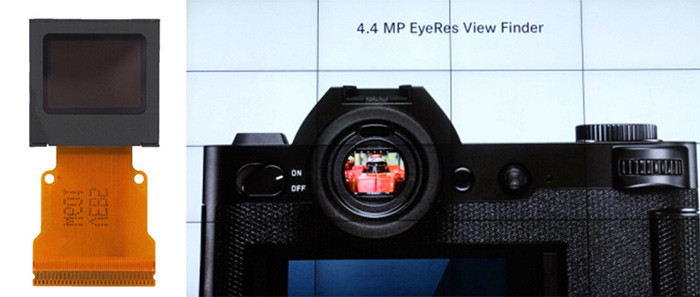
As reported on Mirrorlessrumors Epson started the mass production of their new 4.4 MP electronic viewfinder. While officially not confirmed the new Epson EVF should be used by the Leica SL. It’s highly likely that both Olympus and Panasonic will sue the same EVF on some of their future MFT cameras. Maybe on the E-M1II and GH5?
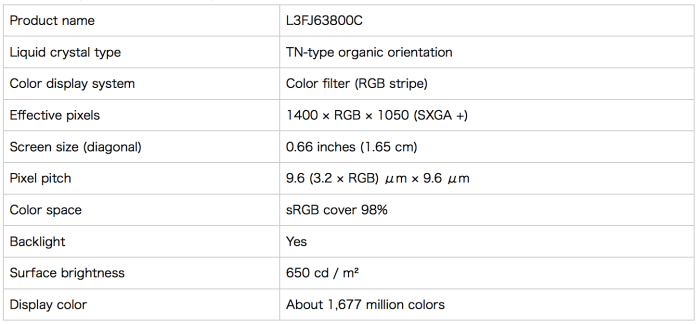
The new Epson EVF is the highest resolution EVF ever used by a camera. And here is the full spec table posted by Epson Japan:
31 Responses
Both Olympus and Panasonic will sue the EVF from Espon? Shit, OP, get your things straight.
Man, do lawyers have to ruin everything? 😉
Will sue Espon. Op has deleted my comment but didn’t bother to fix the typos.
I’m pretty sure it’s not that they’ll “sue” Epson, but that they’ll “use” the EVF. Well, that’s wishful thinking, really.
We’re joking about admin’s typos. — Or I am, anyway.
with a little spell-checking and proof-reading this post might be better than worse
E-M1 II will use that or even better one.
Olympus partner (Epson) presented that next to Olympus booth at 2014 CP+. But no news (or rumor) site covered that.
I wonder that EVF that will do to battery life. It may need its own dedicated battery.
Solar panels!
You can kiss your low-light photography goodbye, then. 🙂
ESPON – for cable sports news photography.
ESPORN
Funny Friday is it?
4.4 is 2420 dots wide, more is better. Enough to convince manual focus, OVF crowd?
2.7 is 1920 dots wide,
2.3 is 1774 dots wide
1.4 is 1386 dots wide
Error in the post — it should be 4.4 million dots, not 4.4 “megapixels”. One of several errors what with the EVF coming from both Espon and Epson… and with Panasonic and Olympus suing the EVF. 😉
Since “dots” in the EVF is counting R, G, & B separately, the figures always sound more inflated. A 2.4 million dot EVF, for instance, is only XGA res (1024×768) = 786432 pixels, but x3 for RGB = 2.36 million
Same thing here
1400×1050 = 1470000 * 3 = 4.41 million
I wonder if evf lag time is a cpu and I/O logic related or strictly depends on evf refresh rate from manufacturer (Epson). Fuji for instance says that there is only 5ms lag (the X-T1). How did they achieve that? Did they have much advanced EVF 2 years ago than Epson? Or is it just due to much more powerful CPU/logic? The E-M1/EM5II’s lag time is 29ms/16ms.
EVF lag time and refresh rate are different measurements. Lag time is the time it takes to get shown while the refresh rate is how quickly it refreshes what is shown. I would guess the electronics and processing in both the EVF and the image processor comes into play.
This is not a 4,41 MP viewfinder but a 4,41 dot one. The actual resolution of 1,47 MP!
4,41 million dots divided by 3 (R, G & B colors) = 1,47 MPixels, 1400×1050 resolution.
If you look carefully the manufacturer info, it says:
1400 x RGB x 1050
So 1400 times red times green times blue times 1050.
In a width there is 1400 red, 1400 green and 1400 blue pixels aka dots.
In height there is 1050 red, 1050 green and 1050 blue pixels aka dots.
What is a pixel? It is a single color emitting diode. It can be group of three sub-pixels or it can bre multicolor individually.
This is pure BS, it’s very clear the viewfinder was misleadingly advertised as 4,4 Mpixels instead of 4,4 Mdots (sub pixels).
You are very wrong, a pixel it’s not a single color emitting diode!
A dot is a sub pixel and has nothing to do with resolution but with the color of that whole pixel. In a screen the pixel is formed by a group of 3 even 4 different color light emitting dots.
Should we now start counting sub pixels in our TV screens, monitor etc?
They all still use the obsolete dot designation cause it sounds cooler.
This is still not even Full HD
I guess they should be embarrassed about it…
***BACKLIGHT | YES?!!!!***
Do you mean this is NOT an OLED display? GX8 has an OLED one.
It also says it’s a TN type LCD panel. So Backlight = yes seems logic.
In this case the GX8 / X-T1 EVF is still better overall.
Nope. The GX8 has bad colors and impossible use with polarization sunglasses.
A good TN panel has higher color reproduction than best IPS panel and more natural color as than OLED. It just need a good backlighting.
OLED has a wider gamut than LCD. Human vision has a wider gamut than LCD also. IPS only has a more ‘natural’ (sic) fit to the limited sRGB colour space, which is unnatural compared to reality. OLEDs have gained a bad reputation for colour fidelity thanks to Samsung exploiting the larger colour gamut of OLED to produce punchy colours on their phones, thinking it would help sales. Mostly it has just attracted criticism versus the well calibrated iPhone IPS displays. For a couple of years now Android has allowed for display profiles and Samsung OLED phones have had a well calibrated profile which results in very natural colour reproduction if a user chooses it.
The E-M5 had an OLED rear screen and I loved it and really miss it on my E-M1 in comparison.
Have you ever tried manually focusing in astrophotography or other really dark scenes? LCD viewfinders are completely useless because the bleed-through from the backlight swamps stars and such making focusing impossible without employing magnified view. Even then, you have to find a really bright star to be able to manage as most stars are dimmer than the backlight bleed.
I would love for the E-M1 II to have both an OLED viewfinder and Rear display – LCDs are not up to the job.
OLED also has a much faster response time than LCD.
It will be in the NEW PENN!!!! 🙂
na it wont
Olympus use Epson EVF panels, but I don’t think Panasonic have in any of theirs?
Panasonic still uses their color tearing model…
Still no Full HD.
Is this even a little bit bigger than the current one?
Hi, i’m a casual/amateur photographer, just pitching in a few thoughts. I went to my local camera store to see the Leica SL viewfinder in person. I figured all the hype is worth the trip 🙂 My initial experience:
1) When you pick up that baby, and peer into the viewfinder, it hits you right away…. the colors are off! It’s like old CCTV footage, white-washed and poorly white-balanced. Composition with physical forms is easy, but color composition requires taking a picture and viewing the result on the back display, which has essentially realistic colors. I have to admit I was disappointed. I thought the future of EVFs was already past this! I don’t know what kind of pictures I’m getting, and the need to check the final picture and colors on the back screen messes up the flow. Maybe it can perform better in natural light, I don’t know.
2) It’s physically huge. In fact you have to move your eye around the viewfinder to see into the corners. The experience is immersive!
3) pixels are tiny, and I couldn’t perceive any graininess in the image even though I tried to look reeeeeaally close. Really this is excellent. A future full HD display might have advantages like better rendering of fine textures and sharpness, if such things are visible at this scale, but you will go far with this.