







image courtesy: chromasoft
Fuji X-photographers finally have more software options to process their X-Trans RAW files. That’s great. Now the question is, which one is the best option for your needs?
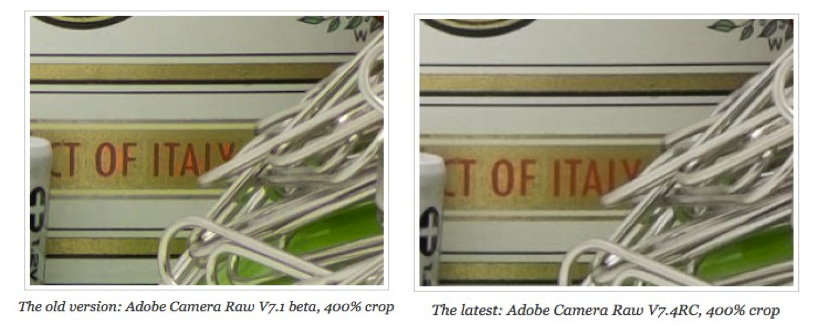
Sandy (chromasoft) compared ACR7.4/LR 4.4 RC, Silkypix, C1 and AccuRaw (you may know that AccuRaw is Sandy’s product). As other reviews already pointed out, he says that Adobe considerably improved its products. On his site you can see comparison images with the old version of Adobe Camera Raw. Here just a some PROS and CONS of ACR7.4/LR 4.4 RC:
“Compared to the previous generation, the new Adobe algorithm has much less obvious chroma smearing, so it certainly is much improved. Taking a closer look, where previously the smearing was really bright and intrusive, in the new version the smearing is a lot less bright. However, there’s actually more smeared pixels – in effect, the smearing now has a wider radius. In addition, the image is noticeably softer than the previous version.”
And what about Capture One, Silkypix and AccuRaw? Read the whole comparison here!
From the conclusions:
“Firstly, Adobe’s products, even in the new LR 4.4RC/ACR7.4 form, still don’t stack up. Although much improved over the previous generation, they still have excessive chroma smearing relative to image resolution. If you were to select a raw processor purely on the basis of getting the maximum out of your X-Trans based camera, Lightroom wouldn’t be it. […] with the new raw developers, the difference between a conventional sensor and a X-Trans sensor is small enough to get lost in differences in lens performance, etc. There are now enough good raw developers that most users will be able to find one that works for them.
At the end of the post you can read also his thoughts about the X-Trans technology. While many praise the new Fuji-sensor (technology of the year according to imaging resource), here is Sandy’s point of view:
“It’s ten months since I first blogged about the X-Trans processor, and so far it’s delivered nothing to justify the “greater resolution than conventional sensors” hype. Finally, the really big losers are the many camera “reviewers” out there that uncritically repeated Fuji’s claims about the X-Trans sensor’s greater resolution. To their credit, some reviewers did raise warning flags – Sean Reid and Thom Hogan to mention two, but they were the exceptions. So next time you read a camera review, here’s a suggestion – take look at what they wrote about the X-Pro when it was introduced, and judge accordingly.”
In response to chromasofts article, read the one at soundimageplus here.
“Well there may be be some reviews out there like that and I’ll take the writer at his word, but I certainly haven’t seen any. I’ve talked about how good I think the X-Trans image quality is, seen as a whole package including ISO performance, clean results etc., but I’m not sure resolution is part of this.”
38 Responses
Would have been nice if she had included the original jpg from in-camera on this post. It’s located in one of the other posts.
Here is the in-camera jpeg:
http://2.bp.blogspot.com/–VB-MPDhsuk/T7K2K5k5_YI/AAAAAAAAASo/2Yu8VCAUE7U/s1600/FujiXProX4.jpg
To me, the Adobe release candidate comes closest. It looks a little softer, but I would interested to seeing how closely it matches with some sharpening and contrast.
http://4.bp.blogspot.com/-7E-GcMfe-vs/UTH-puypzxI/AAAAAAAAAVw/f-QKXT1Ui94/s1600/XProLR44RCx4.jpg
I disagree that AccuRaw is the most accurate. The colors are more saturated and there are more pixelated artifacts.
http://1.bp.blogspot.com/-3111UHfUBvU/UNy5_o70rlI/AAAAAAAAAVg/Bq8gJMIhcqY/s1600/XProARSX4.jpg
Do conversion ‘problems’ At 400% really matter to anyone who actually uses the camera to take photos? They certainly don’t to me.
Zack Arias summed it up best in his X100s review: “Mmmm. Yes. I see. Hmmmmm. It IS perfectly obvious that the third millionth pixel from the left shows signs of herpes.”
I downloaded Fuji X files and did post processing in LR 4.4RC:
The files were very easy to improve using tailored sharpening settings. Crispness and detail comes out great.
Then I went on and ordered an E-X1. Hope to recieve it next few days. It will be my “street camera”.
Pixel peeping is just a small fun thing to do in sites dedicated to photography, I agree. The Fuji X cameras are great for many other things. But let’s face it: It’s Fuji itself who is asking for trouble with their stupid marketing about the superior resolution of the X-Trans sensor. It is simply mathematically false, so why don’t they promote the other good features and shut their mouth about resolution? Don’t blame the people who pixel peep to prove them wrong. Blame Fuji for marketing lies.
I don’t think it’s so important, but I do wish that the next X cameras would bring back a Bayer color filter array instead. It would solve some problems (resolution being the smallest one) and make the cameras better overall. But I repeat, it’s not a big deal.
So the D800E doesn’t resolve better than the D800? Losing the AA filter is useless with regards to improving sensor resolution, and you can “mathematically” prove it? Really? Please, go on and elaborate about this, I recommend a Nikon user forum as a platform, the users there will certainly love to hear about this. 🙂
Removing the AA filter does improve resolution. So that compensates for the loss of resolution of using the X-trans sensor. Overall, the X-trans sensor without AA filter resolves a bit less detail than a normal bayer filter with a weak AA filter. As I said, no big deal and not worth quarreling about it. But if there are these kind of discussions, Fuji is to blame for their marketing.
The math is simple: If you’d have a 1×1 color filter, you’d get perfect detail (for the amount of pixels, of course) without any guessing. This is how the Foveon filter works. The Bayer filter is 2×2, so it needs 4 pixels to get the 3 basic colors information. Then with a rather complex algorithm it guesses the color of each individual filter. The X-trans filter has a 6×6 array, so it has to guess a lot more the real color of each individual pixel. You need a lot more complex algorithm, and yet you get less accurate results. Yes, it is mathematically correct, ask the guys who implement those algorithms, they will explain you in all the detail you want.
Personally I don’t care much. For me the biggest problems of the X-trans filter is not the small loss of resolution, but the complexity of demosaic’ing which requires more processing power (or slower cameras with the same processor, slower refresh rate in the EVF, etc…), new algorithms in raw converters which have taken more than a year and they are not still quite there, and generally an unnecessary complication to solve a problem as “huge” as moiré. Not worth, IMHO.
Nothing of this makes the X cameras bad, of course. They are great. For many, many reasons. But not for the better resolution of the X-trans filter as Fuji insists.
So the resolution measurements and results on DPR are all wrong? Did you tell them to correct them?
Yes, those measurements you refer to are most likely wrong. They are measured with straight lines in black and white. In that case, the demosaic’ing algorithm has a very easy job to do, so there the lack of AA filter makes the difference.
Today imaging-resource.com published an X-E1 review. When they compare side by side the images with other cameras at base ISO, they say:
With the E-M5 (also 16 MP, 4/3 sensor, weak AA filter:
“The E-M5 is incredibly sharp here at base ISO, obviously outperforming the X-E1 in most respects, especially in the detail of the fabric threads. The Olympus applies much stronger default sharpening, though.”
With the GH3 (same as E-M5 sensor specs):
“The GH3 shows slightly more detail in the first two images, but far outshines the X-E1 in the rendering of fine detail across all 3 fabric swatches.”
With the K-5ii (APS-C, 16 MP, no AA filter):
“The K-5 II pumps the yellows in the mosaic and the magenta in the lower pink swatch beyond what is actually on the target. The detail and sharpness are better, but the colors are just too overprocessed.”
Rico, I refuse to further discuss the resolution thing. It’s mostly irrelevant. The X-trans sensor has enough resolution (just a bit less than bayer sensors). I’m only saying that it’s Fuji themselves who asked for trouble with their marketing.
Small correction, the Pentax K-5 II does have AA filter. It’s the K-5 IIs that doesn’t have it and will have even better resolution.
Milan, so you say not only that is Fuji not telling the truth, but also all of DPR’s resolution tests for 100s of different cameras they have performed over several years are wrong and, in consequence, meaningless.This is interesting, as none of the 1000s of experts and millions of readers (except you) seems to have caught and challenged that fundamental flaw in DPR’s testing methodology.
Yes, I’m saying that Fuji is not saying the truth. They are selling the X-trans filter as a quantum leap in resolution, rivaling FF sensors with more megapixels. That is simply false. Take a look at this comparison of real life shots and come back with your opinion, please:
http://www.stevehuffphoto.com/2013/03/21/crazy-comparison-leica-m-sony-rx1-and-fuji-x100s/
About DPReview, no, I’m not saying their test in invalid for all the 1000s of cameras they tested. I just say that it is flawed in the very specific case of the X-trans sensor for some specific reasons. Could you please find some real world or just studio shots that reveal such advantage in resolution over similar (16MP, ~APS-C) sensors? Just look at DPReviews own studio shots. No advantage in resolution whatsoever. NONE. Actually, probably a bit worse than, say, an Olympus E-M5.
DPR’s resolution test was black ink on white paper. The nature of the x-trans sensor is that it’s weaker with blue and red subjects. It’s just physics, if you have fewer red and blue photosites, you lose some acuity in those channels.
That doesn’t means the Fuji cameras are bad, I own an X-E1 myself. It’s fantastic, but the sensor itself isn’t leaps and bounds better than the best. At the end of the day, I care about the picture, not a single pixel flaw at 400% zoom. That said, the x-trans sensor itself isn’t a clean winner over every other crop sensor. The handling, build quality, fun factor are.
Ninja, yep, resolution tests to be made with b&w lines, and dpreview has been performing this standard test for years with all their cameras. So obviously, camera makers try to tweak their cameras to look good in those standard tests. They are also not lying when they claim product features that this standard test confirms.
You can of course challenge the validity of the testing method, but you’d have to take it up with DPR. However, it’s clear that the large majority of users and experts (and camera makers) appear to be perfectly okay with this methodology.
I also quoted above the comments from imaging-resource.com, but it seems they don’t count as experts for you.
I guess that in the end we can all agree:
– Resolution is mostly on par (IMO a bit worse, but no big deal. We are pixel peeping just for fun).
– Fuji cameras are great for many reasons, including great sensor performance, build, ergonomics, optics, simplicity, aesthetics, white balance, exposure, colors, etc…
– Fuji’s marketing regarding resolution is just that: marketing. The X-trans sensor is not far superior in resolution to Bayer sensors and on par with FF ones with higher megapixel count. No way. Not even close. (Except maybe in those test charts with straight black lines).
Milan, I’m sorry to say, but I am not that interested in just “comments” from experts, I’d rather like to see and follow their samples and methodology. That’s the only way to compare different tests from different experts (that appear to lead to different conclusions). That’s why I linked to DPR and their resolution testing charts instead of just quoting their conclusions.
Everybody has an opinion, but I’d rather like to see the facts that those opinions are based on. I want to able to come to the same conclusion or to disagree based on such facts, not based on others repeating third-party opinions they have read. I am not a fan being told what to believe or not to believe, I’d like to be able to come to my own judgement based on the original facts or data.
Those were comments that I quoted, but the images were there on the site to check them.
I really don’t know why it is so difficult to agree on something that is quite obvious. I also posted an image below that you didn’t comment on (from imaging-resource.com). But since you seem to prefer DPReview, here’s another one from the studio shots, comparing the X-Pro1 and the OM-D E-M5, both in JPEG and Capture One conversion:
http://img189.imageshack.us/img189/622/comparisonf.png
Feel free to post some other shots to prove your point that is not based on just straight lines.
If you still don’t agree that Fuji’s claims of great superiority in resolution of the X-Trans sensor over Bayer ones are marketing bullshit, ok. I can’t do anymore to convince you. So we’ll have to just agree to disagree.
…so Rico, where are the “real” picture that show the better resolution of x – sensor compared with bayer sensor????
We are waiting….why you don’t comment the picture Milan posted???
Actually as far as I have read the X-Trans sensor is actually roughly equal to a bayer sensor in luminance resolution (determined by the green pixel sites that are actually slightly more common in X-trans) but that is traded for a bit less color accuracy.
In the end the discussion will never be fully resolved because you never have exactly the same sensor with the same lens but different color sites to really compare.
This is a reader’s post in Steve Huff site, After playing with some fuji x files I have the same feeling about this sensor:
“I would like to add some comments based on having owned two X100 and lately an X-E1, which I sold when I was delivered the M but used alongside the M9 and MM.
First: noise. It is easy to see that the X100s (or, better, the x-trans 16 mpix sensor) shows little or no noise at 1600 and 3200 iso. But, according to an Italian magazine which put the x-pro 1 to the bench, the nominal vs measured iso values for the x-trans 16 mpix sensor are as follows:
1600 iso = 987 iso measured
3200 iso = 1470 iso measured
6400 iso = 1870 iso measured
According to the above, when the camera is set to, say, 3200 iso, it captures an underexposed 1470 iso shot which is then given back brightness by the in-camera electronics. So, at 3200 iso the sensor delivers “1470 iso noise” (or close to that, given the “curve lift” performed in-camera) and at 3200 iso the sensor delivers “1870 iso noise”. It is still a very good result in terms of “final shot noise”, but it is also true that almost any modern camera is able to deliver noise free 1470 iso photos.
The side effect of the above is the “digital look”, which is the second issue and you mention that as well. The “underexposure + plus curve lifting + nr” performed by the camera at almost any iso level gave my x-e1 pictures an unpleasant digital look which I fully recognise in the x100s samples you posted within your review, with colors often overall “brownish”, not fully realistic and lacking the separation you can find in other camera’s output.
The software lift performed on native files has in my view another side effect: Lightroom in my experience is not properly able to “reverse engineer” the x-e1 files, in the sense that sliders movements have subtly different effects compared to what I would get with other cameras’ files (I use LR since version 1 with all the cameras I own and owned).
Over the last two years I owned two x100, one “first batch” and the other “late”, an x-pro1 for a very limited time and an x-e1 for 5 months. After having reviewed respective image quality, I concluded that the x100 delivered the best files by far and large.
Maybe this new x100s will be better, but if it is anything similar from the x-e1 I believe that for the price of less speed the old x100 is still the better bet.”
The sensor pattern 2×2 or 6×6 probably does not have much impact on the colours assigned to each pixel – in-fact more pixels may result in less “guessing” because the sample is larger. And likely, where there is significant change in a 6×6 area then a different “guessing” algorithm is used.
The resolution of an individual pixel is unchanged.
The problem with an AA filter, which X-trans does not have, is that it “blurs” the incoming image such that pixel level resolution cannot be achieved.
Still, the Foveon sensor does solve this problem as well as the colour “guessing”. And yes, so does the Leica Monochrom … by definition 😉
No, the larger sample (as you put it) is worse for guessing. Because you have to guess the color of 1 pixel based on 36 pixels that are getting information from 36 DIFFERENT areas with DIFFERENT colors. The guessing is VERY complicated and never very accurate. When you have to guess from less pixels from a smaller area, it’s easier and more accurate. Ask the guys who write the algorithms, they will confirm it.
But ok, enough of this stupid discussion. It doesn’t matter. Resolution is not very different, and mostly irrelevant for 99.9% of the cases.
Compare the resolution chart examples on DPR for the X-E1 and the D800E:
http://www.dpreview.com/reviews/fujifilm-x-e1/16
http://www.dpreview.com/reviews/nikon-d800-d800e/21
Judge for yourself which sensor/processing guessed the color of the black lines better.
Yes, Rico, the X-trans sensor is pretty good with moiré. That’s actually it’s raison d’être, suppressing moiré. It basically behaves like a bayer sensor with a rather strong AA filter when it comes to both moiré suppressing and resolution.
I don’t know what u are measuring it against, but from my experience, though just shooting jpeg in store, the images are very sharp. If you are basing this off converting the files in ACR, the results are misleading, as ACR does a poor job in converting the files. I am hoping Fuji is smart enough to provide their one raw converter or in-camera TIFF to put these issues to rest…
@Milan – I had a Canon 7D, sold it and got a Fuji X-Pro 1. I used to use the Canon with good-to-great lenses – 85 1.8, 70-200 2.8 IS MK I, 85 1.2, 100 2.8 macro etc. It never, ever, got close to what the Fuji gives me with either the 35 1.4 or the 18-55. Never.
Why can’t you just trust your eyes? I agree that the X-trans sensor is not MILES ahead, but it is significantly ahead of the Bayer type. Significantly. You really don’t need to pixel-peep.
Very interesting.
A while ago, I ‘developped’ some Fuji X100 raw sample images with Silkypix V5.0 and it finally convinced me to buy a XTRANS sensor, a Fujifilm X20, it suits my taste and my needs.
Indeed, the Fuji sensor has no Anti Alisaing filter and without much of processing, the images are sharp and lovable. It reminds of the ‘late Leica DMR’, a Reflex system, digital for the Leica Reflex R8/R9. A great sensor but fragile.
Of course, I’m a big fan of Silkypix, used since 2007 with a Leica Digilux 3 sensor. It’s a very capable software, it is not as popular as Adobe but it does a great job. Mac vs PC kind of War, eh?
Agreed with Zak Arias when he says that Fujifilm has taken over the myth of the Leica pinacle….
I always blow up my images to 400%, and if they are not sharp at 400% I delete them, because I hate it when an image is not sharp at 400%. It totaly ruins the image.
Those X-trans sensors sure are crappy……..
My opinion is that this poor reviewer completely forgot what photography is all about.
Everybody has their own taste and style…… but this is taking pixel peeping to a new extreme…..
I got X-E1. and recently got X100s. I am “VERY” happy with both of them. I didn’t buy the cameras because of X-Trans sensor any other marketing “catch”. I bought them because these cameras have “feel” to it. They brought back something many missed from modern cameras. They feel good in my hands and give me the control I need. I tried them before purchase and I felt very comfortable with them. They make me want to go out and shoot and that is what it is all about. How does the photo look at 100%? Do you feel any emotion looking at it? Does it move you in some way? Isn’t that what photography is about? Pixelppeping any file be it from Fuji, Nikon, Canon or any other brand doesn’t bring out the emotion in me, thus I do not care about it. There is no perfect camera in the world. Never will be. Just embrace what you have and go out and take some photographs.
Both programs are nub and dont do the x-tranny sensor justice.
Same old, same old…the raw conversion issues will not be resolved until Fuji provid e it’s own raw conversion software or in camera TIFF. This does not just pertain to Fuji, though the issue for them may be more pronounced. The fact is ACR does not convert files well in general. I am currently a Canon user, and ACR does poor job with those files, and I have heard the same for Nikon as well. I have gotten around the issue by using Canon’s DPP for the conversion, saving the file as a 16-bit TIFF, and then processing in ACR/ Photoshop, and the results are significantly better. Thus, don’t expect Adobe to ever accurately convert the files, as they don’t do it well in general. Like other camera makers, Fuji needs to provide a simple, yet effective, converter, as they are the only ones that know the precise algorithms to convert the files accurately…in-camera tiff would be a great solution too…
So basically my understanding is that the new LR 4.4 is still a release candidate, meaning that it is not a full fledged update? Is this normal and does it change? Frankly since the update, the images look way better but softer until tweaked and I’ve had no real issues. I do think Silkypix looks better for some of my photos but I just hate the software. Whatever, either way the files end up looking great anyways.
I fully agree with most of what’s written in the chromasoft report. The Fuji’s are very good cameras and deliver stunning results. But their non-Bayer array and the lack of AA filtering doesn’t really help with that. It is mostly a marketing bubble.
In my tests I found the resolution of the X-E1 slightly below (!) a Canon EOS 600d – 18 mpixels with AA filter and Bayersensor. The results are on my website.
So about improving resolution by removing alias filters: That is urban ledgend. You can’ do it.
What really happens is, you improve contrast. Most automized resolution tests (software) are using contrast curves (slanted edge frequency response) and report the resolution at a given contrast limit, for example at 10%.
This value is certainly improved by removing the AA filter. And so you see higher reported resolutions in many test reports.
But in reality, you can improve the contrast of the low-contrast areas also in software. This is often called ‘clarity’ in RAW converters. It will get you a similar result as removing the AA filter. Only without the moire 🙂 When you visually examine the number of resolved lines (and don’t care about contrast) there is no increase by removing the AA flter.
I have to agree, though, that colored aliasing artifacts are very limited in the X-trans sensor. So Fuji’s decision to leave out the AA filter doesn’t seem to have the same amount of negative consequences as in bayer sensor cameras.
DPR has a standardized resolution test, based on visual control. Their result was pretty clear:
“Like the X-Pro1 the X-E1 shows visibly higher resolution in this chart test than a conventional 16MP Bayer-type camera such as the Nikon D7000, or even the Sony NEX-6 (which has a particularly weak AA filter). In fact, in terms of resolution the Fujifilm is very close indeed to the 24MP Sony NEX-7 or the Sigma SD1, which uses a 15MP Foveon X3 sensor to record full color information at every pixel, and therefore (like the X-E1) uses no AA filter.”
See http://www.dpreview.com/reviews/fujifilm-x-e1/16
Since many of you seem to know better, please write to dpreview and tell them that they got it all wrong and that their test is without merit. But be prepared to prove it.
I tested the Fuji X-Pro1 with the 35mm by taking a few portrait shots in store and compared the Jpeg at home to a similar shot taken with my Canon 35mm f/1.4L and I found the Fuji to be much sharper straight out of camera. So, I believe the results found by dpreview, as the files were very sharp with details.
There is no doubt, however, that Fuji should provide either in-camera TIFF or its own RAW converter for the initial conversion, as ACR (and possibly any other third-party) does not do a great job at converting any files, including my Canon files. While Photoshop or Lightroom are fantastic for editing purposes, ACR is not optimal for converting files ~ the camera maker’s software normally, if not always, does a better job, as they have the precise algorithms to convert the file accurately.
So, hopefully, when I get my X-Pro 1s or X-E1s when either of them come out, they will provide in-camera TIFF or their own converter. If not, I will likely use Silkypix for the conversion, assuming it is better than ACR…
ACR does a better job converting Sony files that Sony’s own converter, according to yesterday’s NEX 6 review on DPR. LR/ACR is also terrific with the classic X100. Personally, I have no problem with LR 4.4RC, it’s now my standard X-Trans converter. And I am supposed to be quite good at mastering Silkypix. As for AccuRaw: great demosaicing, but that’s about it. I bought it, anyway, because I use and compare all RAW converters that do X-Tans (plus several that don’t).
Here is an image of imaging-resource.com comparing the Fuji X-E1 and the Olympus E-PL5. They are JPEGs out of camera. The raw files are available in the site. If you want to play with them and post your results, you’re welcome:
http://img35.imageshack.us/img35/7234/comparisonq.jpg
My conclusion? It doesn’t matter. We are wasting time. I’d just like Fuji to stop telling things that are not true and concentrate on telling things that are true about their great cameras. That’s my whole point. If you don’t agree and you think that Fuji should continue to push the superiority in resolution of the X-trans sensor, ok. Let’s just have a different opinion.
I have read Sandy’s post several weeks ago (it’s from March 2nd), so it’s funny that it took almost a month to show up here. I like Sandy and his work, I beta tested AccuRaw, and I bought it as soon as it became available in the app store. He deserves our support, so go ahead and get your copy, too. Its X-Trans demosaicing is very good, but you may find the software challenging when it comes to actually process RAWs that need work with highlights, shadows. For me, it’s more like a proof of concept, not a RAW converter I could use for my actual daily photography. But as I said: go check it out, judge for yourself.
In his comparison, Sandy fine-tunes AccruRaw (as in using different demosaicing settings), but not the other programs. Does he even mention the important “Demosaic Sharp” slider in Silkypix? I don’t think so. You know how important this slider can be if you have read my column on Silkypix and Fuji Colors. Is he even using the latest version 5, or is it Silkypix 3 aka RAW File Converter EX?
Anyway, who would blame him given he is basically reviewing his own software against the competition. What were the chances of him concluding that not AccuRaw, but a competing program turns out the best results? And what are “best results”, anyway? Is it pixels from a studio sample compared at 400%, or is it also something else that matters? What about real, living pictures? Try those in different RAW converters, and you may once again come to different (and subjective) conclusions. But as I said, I have bought AccuRaw (and also every other Mac-compatible RAW converter with X-Trans support), and so should you. Try it, use it, see the results and feel how it handles. Draw your own conclusions based on your real-life files.
I’ve written the article almost one month ago, but then the X100S and X20 reviews/news/stock status grabbed all my attention, and I missed to post it. Sry for posting a bit later than I should. whoops