







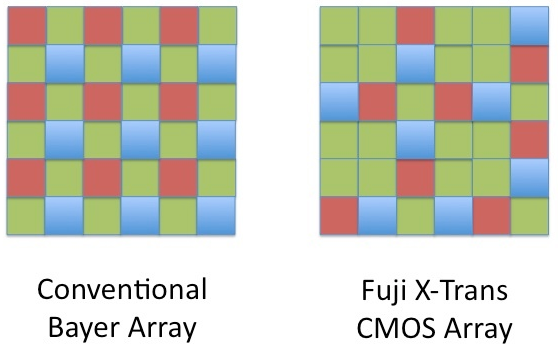
The Yin & Yang, the good and the bad, of the X-Trans sensor, goes into the next round.
Now, we all know about the benefits of this technology… but occasionally also critics circulate on the web. Sometimes these critics turn out to be unfair (for example the “Ghosting Issue” where X-Trans was accused to create, rarely, red dots / artifacts when shooting against the sun… it turned out to be an issue with all mirrorless cameras) but what about the “false details” issue raised by Zachery on his google+ account? Is this another “unfair criticism” or not?
Now here is what I’ve found until now on the web:
The problem
1) In his post here Zachery says: “The fact is, the X-trans sensor design utterly fails at its implied capability: It does not produce better details than a 16mp sensor with an anti-aliasing filter. It just produces wrong details. And this is best case. If you were to take this same image except use green lines, it would just be a blurry smudgefest due to the blocks of 2×2 green pixels on the X-Trans “semi-random” color filter array. And to add insult to injury, this sensor design does not entirely prevent moiré, which was the entire impetus behind a 3×3 semi-random color filter array.”
The reactions
1) Donovan sent me his post about this issue via FR-twitter: “The false detail does seem to be a real thing, but from what I can tell, it isn’t going to appear in much real-world photography. This building image has to be on the bad end of the spectrum, and I haven’t noticed anything like this at all in other images, and I’m just shy of having created 5,000 images on X-Trans sensors. For me, it’s an acceptable trade-off for the kind of shooting I do, and all the benefits the sensor brings. If you’re a heavy-duty architectural shooter, you might want to give this some consideration, but this is truly the only time I’ve noticed this behaviour.” Read more on his website.
2) And here is soundimageplus answer to this issue: “Now it’s easy to just say that this is all the result of some pixel-peeping nerd taking things to far. But then from time to time, I’m a pixel-peeping nerd too. It IS important to be critical of what we see, and if there are faults and / or things that could / should be improved then we need to say so […] But it’s important to put these things in context. […] For me and what I shoot, the Fuji X-Trans sensor gives me a lot of what I want, fulfills my ‘vision’ and gives me something close to what I wanted to capture when I pressed the shutter. And it does this a way that I find more appealing than many other camera / sensor combinations.”
3) And, when there is something wrong with Fuji cameras, you can also check out photosfujiscanttake here and his sarcastic answer to Zachery’s post.
4) Frank did a bit of pixel peeping and wrote me this email: “look at the DPreview new test scene at the floor of the black and white painting (left middle) where the small dog is. You see the diagonal stripes going just in the wrong direction (compare with Phase One IQ180). Canon, Nikon and Sony, even the new A7 seem to have the same problem. So if this is the same problem, it might not be caused by the X-Trans sensor? Have fun with pixel-peeping. Here is the link for the DPreview site. The zoom window is already located on the right painting. Tear down this zoom window a bit to the floor (below the tripod) of this painting and you see the diagonal lines directing in the wrong direction. That’s not only true for the X-M1 but also the NEX-6 and the EOS 100D. Select Phase One IQ180 in one window and you see how it should look like. A lot of cameras have problems with these diagonal lines even the new 24 megapixel Sony A7 has big problems. So there seems to be no specific reason to worry about the X-Trans sensor.”
Now what is your experience? Did you ever noticed this issue? Feel free to drop a comment.
74 Responses
Posts like the one mentioned here are sad and funny at the same time, because it’s easy to see the same effect with Bayer sensors, you only have to use a subject where the lines have a different angle. In these cases, the Bayer lines will look terrible and the X-Trans lines will look okay.Results also look different depending on which RAW converter one uses, because different converters use different demosaicking methods. I remember a comparison between NEX and Fuji with angles lines, where the NEX looked “steppy” and the Fuji looked smooth, all due to the angle being a different one. Really not much to report here, if you don’t want demosaicking artifacts, use a Foveon camera (I certainly love my Merrill), but then again, Foveon has other issues.
Btw, X-Trans is of course 6×6, not the 3×3 wrongly claimed in the article. Quite embarrassing if you ask me. 😉
…And film has its issues, too.
But I’d like to see a photographer who shoots regular patterns and resolution charts for a living. Not folks from DPreview and the like, of course.
Better yet, I’d like to see a client walking in my studio one day, asking me to do a scientific reproduction of a diffraction grid. That’ll make me believe!
But then Bayer WITH AA filter will not have those issues and will preserve about as much detail as X-Trans without AA.
No. We already know that the X-M1 renders better detail than the X-A1.
See http://www.dpreview.com/reviews/image-comparison?attr18=daylight&attr13_0=fujifilm_xa1&attr13_1=fujifilm_xm1&attr13_2=fujifilm_xpro1&attr13_3=fujifilm_xe2&attr15_0=jpeg&attr15_1=jpeg&attr15_2=jpeg&attr15_3=jpeg&attr16_0=200&attr16_1=200&attr16_2=200&attr16_3=200&normalization=full&widget=1&x=0.6504242934287119&y=0.09247514390371521 for a quick resolution comparison.
Btw, look here: http://www.dpreview.com/reviews/image-comparison?attr18=daylight&attr13_0=fujifilm_xa1&attr13_1=fujifilm_xm1&attr13_2=fujifilm_xpro1&attr13_3=fujifilm_xe2&attr15_0=raw&attr15_1=raw&attr15_2=raw&attr15_3=raw&attr16_0=200&attr16_1=200&attr16_2=200&attr16_3=200&normalization=full&widget=1&x=0.6504242934287119&y=0.09247514390371521
See how “Bayer” introduces false colors where “X-Trans” renders the lines clearly? Shall I write an X-Pert Corner blog claiming that “Bayer is a doomed technology”, because it obviously renders inferior results with Adobe Lightroom in a particular part of a test image? 😉 Hey, maybe it makes me famous…
Fuji will soon drop X-Trans I am sure. All it does is add noise reduction to RAWs and JPEGs and makes life difficult for RAW shooters who wish to bring back those details in Lightroom etc.
It really is no better or worse than any other APSC or dare I say even modern m43 sensors when you add noise reduction to their RAWs.
They should return to the X100 sensor and be done with it.
If anything, Adobe is applying more basic luminance NR to X-Trans RAWs on import. Obviously, all those RAW comparisons should not be performed with ACR, but with a very basic RAW converter that doesn’t do any lens corrections (Adobe always corrects using metadata, you can’t even switch it off), doesn’t do any basic sharpening and doesn’t do any basic NR. But even then, different demoasicking will lead to very different results, that’s why Iridient offers this “soft look” option, which is a different demosaicking method that is considered less “aggressive” and will lead to a softer looking image. So if a RAW converter uses a more aggressive algorithm for Bayer and a less aggressive one for X-Trans, the results will look different. And vice versa. In the end, you will always compare RAW converters and RAW algorithms, you will not compare cameras, sensors or CFAs.
Fuji hit a sweet spot with the original X100 …
However, they have a history of wanting to produce odd (unconventional) sensor arrays – remember the SuperCCD HR and SuperCCD SR attempts?
I doubt the X-trans will be dropped in the near future – but I also wish Fuji would stop trying to re-invent the wheel … if only by moving the spokes into a different pattern!
Harebare
I agree that change for the sake of change is folly, but in the same breath it is very difficult to improve things by doing them the same way you always have… So where is the line in the sand, the point of diminishing return? I certainly lack the expertise to say, and as this is a new frontier, I would imagine very few are able to say with certainty.
I hope they stay with the X-Trans, but I hope they work closer with Raw developers like Adobe and the rest to really optimize output, otherwise we teh users are left holding brilliant, but sub-optimal files… 🙁
I already get better (more detailed) results out of Adobe than with the built-in converter, so I guess Fuji has already told Adobe everything they know.
Hey Rico 🙂
I still find that Capture One beats LR5 for detail (mostly with greens), and I read that many prefer Iridient over LR5 due to detail rendering as well. I tried Iridient, and although I found the RAW conversion was excellent, there wasn’t enough of a difference to my eye that justified the additional work compared to using just C1.
Just my opinion, but I think that Fuji could make a greater effort to work with the Software folk to ensure we get the most value from their cameras, especially the X-Trans units.
I actually want to directly disagree with with this. Without deviation from the norm, progress is not possible.
That said, I have an original x100 and although I do enjoy the fact that I can convert using ACR without worrying (more than usual, anyhow) that there might be a better demosaicing algorithm out there, what I love about Fuji as a company is that they are trying to push things. I found the EXR sensor in the x10 fascinating, and I think the X-trans is valuable for the advancement of the industry. It adds to the knowledge pool that all of the sensor designer/engineer types can draw from as we move forward.
Cast out the Bayer, I say! Onwards and upwards! Give up what we have for the chance to be better! Carry that ash up the mountain like Zarathustra! /Nietzschean rant
True. Demosaicing is always tricky. The only solution that will always work is lowpass filter that smudges everything.
Otherwise you need assumptions to mix your colors from neighboring pixels. Of course you could fix specific false details with different assumptions but then you would be wrong in other cases.
Bayer demosaicing is simpler and much more investigated than the x-trans pattern. But is built on assumtions no less that might fail eventually. If you want you can always set something up that won’t work.
As rico said, if you want no demosaicing artifacts what so ever, get yourself a Foveon sensor or a monochrome. 😉
jim the worm — is that true? i have the xe2 and a closet full of canon lenses and bodies, which i use 95% of the time. but i’m tired of carrying SO MUCH WEIGHT and am finding that the xe2 along with my 14 and 35, and soon, 23, are a pleasure. will my clients hate me now because of the x-trans? have i jumped on a bandwagon?
Switch it to the new Nikon DF which is a full-frame 16mp sensor. Hmmm… Fuji seems to hold up pretty damn well…
http://www.dpreview.com/reviews/image-comparison/fullscreen?attr18=daylight&attr13_0=nikon_df&attr13_1=sony_a7&attr13_2=pentax_k50&attr13_3=fujifilm_xe2&attr15_0=jpeg&attr15_1=jpeg&attr15_2=jpeg&attr15_3=jpeg&attr16_0=100&attr16_1=100&attr16_2=100&attr16_3=100&normalization=full&widget=41&x=0.7186308068459658&y=0.568122270742358
yes, even if ACR isn’t a good choice for X-trans. but DF (D4) sensor it’s not the best sensor if you look in resolution.
try to compare XE1/2 to a A7r.
sony really shine in resolution.
One can surely speculate that the actual reason why Nikon put their D4 sensor into the Df (instead of a state-of-the-art ISOless Sony sensor like in the D600 or D800) is that Nikon still had plenty of D4 sensors on stock any needed to find a way to “recycle” them instead of just writing them off. Genius. 🙂
It’s only genius if the camera sells.
It will sell to the fans (and there are plenty of Nikon fans), the price is pretty high given that’s it’s a repacked D600 with D4 sensor, so I guess Nikon will make a profit with it.
lol.. may be 🙂
for sure sony has some great sensor..
if they learn how to make a camera for a photographer and not for a geek it will be a master piece 🙂
i dont like DF, it seem a strange mix between old look and modern/button interface.. not sure will sell very well.
i am really looking to the new rumored fuji camera, hoping in some great hybrid viewfinder (i am dreaming a mixed optical reflex and EVF finder using a fixed semi reflective mirror)
the biggest problem with fuji imho are all these deals..
destroying 2nd hand market and reducing the value of the cameras and lenses..
actually XP1 is still the top and the only “pro” camera, still in production and cost half the price i bought 12months ago..
if i want to sell my fuji stuff (12 months old) may be i can ask 40% of the initial price.
my canon material 3 years old still keep 60/70% of initial value
and this really make me think twice before buying other fuji lenses..
I am pretty sure that X-Pro1 production stopped in Q3 2012. Since then, Fuji tries to clear the stock, and the price decreases simply show their increasing desperation. Obviously, they are selling the remaining stock at a big loss.
rico, i think you are right..
anyway i am curious to see the next model, hope they will put some really new on the table, like it was with the XP1, and not just catching up with XE2/X100S.
i am in the market for a second body, and this time it must be really really interesting to spend 5/600$ more than the XE2
Since I got the X100s, I shot about 10K frames with it, using it daily. In the end of the day, I end up applying some grain to the images and I am totally happy with the results.
The xtrans sensor, yes, it does produce weird pixel arrangements, but I never managed to notice them when printed… in contrast, I had very upsetting moments when I noticed Bayer’s systematic noise in dark plain backgrounds when printing large. This never happened with the fuji sensor.
People talk about pictures they observe on a screen. Whoever wants to comment on sensor capabilities should print first and talk later.
i think you are right..
anyway i am curious to see the next model, hope they will put some really new on the table, like it was with the XP1, and not just catching up with XE2/X100S.
i am in the market for a second body, and this time it must be really really interesting to spend 5/600$ more than the XE2
I personally like the look and feel of the images I get from my x-e1, even if some of the detail is false. Who cares? I am not using this camera for scientific imaging, so whether detail is real or not is totally irrelevant, and it’s my perception that counts. And I perceive sharp images with good color and low noise. Great.
Also, I think it’s kind of hilarious how many people on the internet like to play engineer and discuss one component along the incredibly complex image formation pipeline as if that one variable is make-or-break (sensor size, filter array, etc.). Absolutely every design decision involves trade-offs and compromises. Great design is about making the right trade-offs for a given applications. So find the camera that involves the right trade-offs for you.
And at the end of the day, if the image looks good–after all, human perception is the basis for much of imaging science–that’s what counts. So if a camera produces false detail that bothers you, don’t use it. If it looks good to you, then use it.
The problem is that it’s not the camera, it’s the specific demosacking algorithm (1) of a specific RAW converter (2) in conjunction with a specific (test) subject (3). Change any of these three variables (but keep the camera), and your results will look quite different. Basically, by selecting the right 1,2,3 combo, I can make look pretty much every modern camera either great or bad.
Of course, everybody who participates in such discussions should already know this. That’s why I am so amazed that “expert tests” like these are given any credibility by linking to them in forums and, even worse, featuring them on sites like Fujirumors. I honestly don’t get it.
Right. That’s what is saying: the entire pipeline is so complicated that it’s absurd to blame a single element as the sole source of an issue.
Also, as an apples-to-apples comparison, I decided to compare the fuji to other 16mp apsc cameras, and none of them deal with that portion of the test scene well. Interestingly, the worst of the four I compared (nex-6, sony a57, x-a1, and x-e2) was the X-a1, which supports my point that you can’t blame the issues solely on the choice of filter array. Obviously the processing and AA filter of the sony cameras suppresses aliasing artifacts much better than the x-a1, despite the three of them using the same CFA.
http://www.dpreview.com/reviews/image-comparison/fullscreen?attr18=daylight&attr13_0=fujifilm_xa1&attr13_1=sony_slta57&attr13_2=sony_nex6&attr13_3=fujifilm_xe2&attr15_0=jpeg&attr15_1=jpeg&attr15_2=jpeg&attr15_3=jpeg&attr16_0=200&attr16_1=200&attr16_2=200&attr16_3=200&normalization=full&widget=41&x=0.6024449877750612&y=0.6062636562272397
Indeed, every camera IS a RAW converter, and the internal Sony converter works differently from the internal Fujifilm converter. Of course, use another test scene, and Fuji may handle that one better.
personally I didn’t worry for a second about the false details
But I got worried feedback from readers via email and twitter about this “issue”. Therefore I decided to “ask FR-readers what they think about it”… and it seems that most of you agree: don’t worry, be happy, and enjoy the advantages of the X-Trans sensor… that’s good to know now. I think that those worried readers feel much better now thanks to all your feedback.
But why are readers worrying? These sensors have been around for more than 20 months, there are 1000s over 1000s of images to view online, plus 1000s of users who have used these cameras for all kinds of applications, including plenty of professionals.
I really don’t get it, it’s supposed to be about photography (real images of the real world). It’s not about pixel peeping at tiny parts of studio samples at 200% or 400%. You could just as well worry all the time about Bayer, about Foveon or about any RAW converter. However, only sensor designers and RAW converter developers have a real reason to worry about such things. It’s their job.
The “job” of us users is to take pictures. So look at your own images or the real-world samples of other photographers with Fuji cameras (preferably those who know what they are doing) and let their work inspire and motivate you to get to a similar level using similar equipment. That way, if your results don’t look as good as theirs, you can at least be sure that the camera is not to blame, it’s only you. 😉
I agree with you… we are in pixel peeping territory.
Honestly, I was really tempted to write: “dear readers, if you are not a pixel peeper, then don’t read this post”… or I also thought to write something like this: “maybe X-Trans can, in rare occasions and under certain circumstances, create false details, but I’ve read that at the Sony A7r Bayer sensor without AA filter can create, in some occasions, moire… does this mean that both sensors are crappy?”
But at the end I wanted to keep this post as objective as possible. So I simply linked to all the feedback I’ve found on the web about this issue and did not express my personal opinion.
Anyway, I think I’m one of the few rumor sites featuring regulary so called “X-shooter zones”… and as I wrote in the last X-shooter zone: “Sale numbers, black friday, reviews, rumors, deals… at the end of the whole story there are persons with an X-series camera in their hands and who enjoy to take photographs with it.” You’re right Rico, taking pictures, that’s our job… or at least hobby for me 😉
I was a nay-sayer of X-Trans when it was announced, believed there to be far too much guess work that would result in flatter images. I also wasn’t keen on the reduction of red/blue photo-sites but noise and colour reproduction certainly aren’t weaknesses. However comparing the X100 to the X100s… I still prefer the images coming from the bayer sensor, more “pop.”
With more AA-less cameras to judge, I don’t think that the AAF is the dirge that it’s made out to be. A with the MP counts that we have today and weak AAFs, I think that the raison d’être for the X-Trans is non-existant but… R&D money has been spent, demosaicing algorithms have caught up, no point complaining now.
Foveon I think shows that it’s the CFA that reduces resolution but Fuji have proved that even a 6×6 array can still produce highly detailed images so logic be damned and choice is good.
P.S, I miss CCDs 🙂
Now that’s something to get riled up about, real discernible differences to IQ. Shame that Kodak never delivered a truly modern CCD…
Indeed, CCD has a great look. I still love my Fuji S100fs with its Super CCD 2/3″ sensor. Amazing sharpness. But only up to ISO 400. CCD still has a place in medium format cameras, as high-ISO isn’t the issue in the studio. That’s why there aren’t any CMOS medium sensors available.
One also has to remember that there is a difference between interpolated “Details” and interpolated “Color” and its up to the software algorithm to decide how to treat all this data.
While “color” data is based on the 6×6 pattern, the “details” can be interpolated from lower pixel count regardless of the colour filter of the pixels.
That is why we have such differences between raw converters. the data is there, but interpolation can have a huge effect in the x-trans case.
The x-trans does not create false data. it creates data. different data than what was common up till now, and most “false” info comes from the software.
My own subjective evaluation of the x-trans sensor is that it does not create MORE details, but it can create FINER details from the same resolution. So for most common uses, the image look FINER – not sharper.
As for video, it seems that in low resolution, there isn’t enough data to work with and even fuji’s own algorithm can’t handle the data properly. Moire can be considered a feature on the x cameras video 🙂
I agree, and I would pick an X-A1 over an X-M1 for video any day.
I use capture one for the conversion, and I am very happy with the results. I have shot side-by-side with a friend who is using a D600, and I have compared the images, and despite the theoretical advantage of the D600s full frame, higher resolution sensor, I couldn’t see much of a difference. I actually prefer the Fuji files, though that is likely due to the lack of an AA filter. If I pixel peep, both Bayer and X-trans look like crap, in my opinion. Why would I want to zoom in 200%?
I’m going strong on my 40,000 image with my X-E1 since Feb of 2013 and I find that:
A: It is absolutely Sharp and Clear. I’m not going to stand here and say that it’s better than my D800, but I will say that my D800 only has about 18,000 actuations and I had it since March 2012 (a full year earlier than the X-E1) So guess which one I reach for for just about any shooting.
B: Using Iridient Developer has proven to be a Godsend for bringing out all the details in a raw file. I use LR5.x for ingesting and storage, but ID for my raw X file processing.
C: There will always be folks out there who will go out of their way to make a product look great, or bad. So I have learned to take everything with a grain of salt. Laugh it off and move on.
Great site BTW
Jorge
True. All real world X-Trans images have false detail. More so than Bayer sensors.
But even so my X-Trans images still look fantastic. Crisp and with excellent colors.
Click here to see a direct comparison of the same studio sample with Silkypix 5: http://farm3.staticflickr.com/2858/11191283695_9837f038cc_o.png
Left: X-M1, right: X-A1. Or was it vice vera? I forgot, but the “false X-Trans detail” should be obvious. Or maybe not?
So here we see Fuji bayer or Silkypix converter fail? Try to find any converter that can do these false detail on A7R
how about something with the same resolution?
Yes, this seems to be a resolution issue rather than an X-trans issue.
He he) We all know the truth 😉
I’d agree with Zachery’s overall point. Sarcastic answers to him don’t answer the real problem – Fuji claimed some things about their sensor and in the end it simply didn’t deliver. This obviously doesn’t make any of Fuji’s camera bad, but it certainly begs the question what was the point?
If I remember correctly Fuji claimed high ISO performance of FF cameras of that time (I believe it was 5DMK2 on their slides). They also claimed that by using new CFA they could remove OLPF without introduction of moire. Another claim was, due to removal of OLPF, increased resolution.
“we developed the X-Trans CMOS Sensor which has an image quality surpassing those of 35mm full frame sensor single lens reflex cameras, despite being an APS-C size”. That is currently on their website, so they opened the door, not sure what that guy from photosfujiscanttake is so sarcastic about. As to FF cameras of that time, the D800 and 5D3 were launched pretty much at the same time.
Given that I don’t see the benefit of the X-trans compared to a regular 16MP sensor, it does strike me as a marketing move, more than anything else. And it put early adopters through a rather long period of raw conversion issues. I certainly don’t get the point of it.
I Generally have no issue with moiré and my X Trans pictures are – if AF did lock – sharper than those from my old Nex and my DSLRs. Detail howe er is NOT on par with the 5dII.
All in all the X-Trans is abit better in overall IQ. However fuji should soon come with an update to the sensor. It is now almost 2 years old and after the X-Pro 1 all following cameras had the same sensor, except for the PDAF extension. And the X-A1.
But it’s time to move on and show some real evolution…
Because the xtrans does deliver. He is using an adobe raw converter, not something like capture one.
You are really saying that the X-trans surpasses current FF sensors?
It is obvious that a 16 MP full-frame sensor with AA filter doesn’t resolve as many lines as a 16 MP APS-C sensor w/o AA filter, so the claim is certainly valid in this regard. It’s more complicated when it comes to comparing noise levels and S/N ratios. Fuji’s own charts show advantages for the full-frame cameras at some ISO levels and advantages for the X-Trans sensor at others. Of course one could suspect that the entire “inflated ISO” thing has its origin in these internal charts. Fuji might have needed some artificial ISO advantage to back up their claims with standardized measurements. Who knows? I don’t. But speculation is fun. However, it’s also utterly useless, because it doesn’t change anything and won’t improve my image results at all. 🙁 What DOES improve my results is understanding exactly how the sensor, the camera, the processing and certain features work, as this can really help unleashing the potential of a certain camera/firmware. So if you want better IQ, you should understand how an ISOless sensor works, understand how analog and digital amplification/push work hand in hand to generate brighter exposures, understand how the DR function works and how it interacts with analog and digital signal amplification/push, and you should use this knowledge devise a strategy on how to practically expose certain scenes to get the best possible results.
FYI — that “ghosting” issue mentioned in the post. That doesn’t occur on every mirrorless camera. I’ve seen it on the Oly EPL2, but I tested the XM1 against some other mirrorless cams. Saw this immediately on the XM1, but not the others, under the same conditions for each cam. The EPL2 shows it can occur on bayer sensors, but it does not happen on “every mirrorless” camera.
This seems to another farfetched technical analysis of non practical valeu. When olympus continued with the 4/3 sensor size from the DSLR to PEN, the same kind of things where said (of coarse then about the oly sensors and size and not Xtrans). The sensors would never be as good as the big brands canon and nikon. Well look now, Sony produces and designs the nikon sensors and people complain about the canon ones for lacking behind. Olympus found there solution in sony sensors, nevertheless it has shown the 4/3 size is as good as the competition. The main point is, that old fashioned and uninventive thinking now shows to loose ground. Sony needed time and investment as a company in the larger sensor (dslr and csc) industry to become one of the main suppliers with the best quality. Fuji’s x-trans technology (applied in the fuji csc system) only exists for 2,5 years. Give them the time and investments to evolve the sensors and technology (also the new organic sensors) and lets see what happens. Every camera brand and sensor (within certain criteria as costs etc) have there downsides. Fuji has introduced a unique system and way of thinking with the X-range. The benefits completely overway this error (that i have not noticed jet, and believe me I am a pixelpieper..). The peers of the X camera’s, being the first with this kind of clasic design, build and design quality, options, image quality and firmware service make it unique and a total joy to work with. Sticking to this kind of detailed technical downsides of such a relative new technology as a real reason not to use a system is just narrow-minded.
Less than 2 years, actually.
Well offcoarse less then 2 years on the market but the research and development stage also takes time. That however makes it even more remarkeble what fuji achieved ;).
Yep, at the 2-year anniversary next February, there will be 6 APS-C X-Mount bodies and 16 native APS-C X-Mount AF lenses (either available or announced).
Agreed ~ and I have not had any issues with the X-Trans sensor either. People spend too much time looking for excuses, when they should spend the time more wisely, perhaps learning how to take better photos.
Anybody who still at this point compares xtrans using Adobe raw conversions deserves the clueless label. I understand those who use adobe software would have a workflow issue on xtrans. That would be a fair point.
The rest is nonsense. That doesn’t mean xtrans is perfect and will not have any artifacts in all situations (like Bayer) but doesn’t mean there aren’t gain for the tradeoffs.
Fuji doesn’t get a pass on this.
In order to be commercially viable, Fuji needs to do everything it can to make life easy for its customers, and that includes processing after the shot. A wide variety of people can’t afford the investment for licensing or training for new software. Therefore, a product to be viable needs to be somewhat adaptable to the most widely used digital imaging software.
The fact that customers get blamed- such as calling people clueless when they’re forced to switch to accommodate the manufacturer of a consumer product- is exactly backwards.
Blaming the customers is a non starter. It won’t help Fuji attain profitability. We constantly hear that Fuji is so different, that they listen to customers. Pretty sure customers have not been demanding convoluted processing with one-off raw convertors just to try to get what the company has been promising consumers all along.
I don’t care what kind of x-arrays or trans-sensors Fuji uses, as long as they’re good. But for the company to survive, they better figure out a way to make things easy for the general consumer to use in a sensible way. Their competitors certainly do. (Except of course for the wonderful Sigma DP Merrills, but then we’re talking really really niche).
Well, Sigma is about to introduce their own line of Foveon system cameras and lenses, and so is Leica (with Bayer, as usual). I expect both systems to be APS-C sized.
Strangely, the vast majority of FR readers voted for X-Trans over Bayer in a recent poll, so customer satisfaction seems to be better than some may want to make you think. That said, Fuji has a bunch of Bayer cameras, and they will offer more Bayer models in the future.
Btw, IF Fuji goes 35mm, it’s not clear whether the rumored “X200” will be Bayer or X-Trans. With increasing sensor resolutions and a clear trend to omit the AA filter no matter what, X-Trans loses much of its appeal.
If Sigma can improve the ISO performance with its Fovean sensors, there upcoming MILC could be great. While it will have less depth of field control than FF, the detail will give the A7r a run for its money ~ perhaps it will be even better. They have a lot of work cut out for them though, as the DP Merrills apparently have very slow AF and poor battery life.
I admire both Fuji and Sigma for trying something different; and, if the Fovean sensor had as good ISO performance as the X-Trans sensor, it would likely be the best on the market.
“The fact that customers get blamed- such as calling people clueless when they’re forced to switch to accommodate the manufacturer of a consumer product- is exactly backwards.”
I am not calling customers clueless. I am calling someone doing a sensor comparison (hardly the so called “average customer”) like this clueless.
There’s a difference.
I for one applaud Fuji (and Sigma) for walking a different road. If you want otherwise there are plenty Bayer sensor camera to choose from.
I have nothing constructive to add to all the points already made. Just wanted to see my name added to the discussion
I would like to add that I prefer the X trans sensor BECAUSE of its shortcomings. I welcome the wrong details produced by the semi-random pixel array and the odd swirly-esque grain – only apparent when over sharpened -because this is exactly what lends the image a unique look and an advantage when shooting portraits, beauty, people, anything with skin really. Even hair, when shot with the X trans sensor, looks more natural, more the way we see it with the bare eye. Colors are great and the random array does help keep moire in check on clothing, even though I came across it once. I really don’t need or want the biting sharpness I can get these days for every shot. Of course I wouldn’t use it as a pro camera for architecture or even landscape, but people photography, it is magic!
As a professional, do u think the X-Trans sensor has limitations for architecture and landscape photography? I am just curious, as I am not sure.
Yes, mainly because once you hand over the material to the client the inherent shortcomings can be magnified during post since the Xtrans files require a slightly modified workflow. I like the film look and some clients do too, but I wouldn’t want those Xtrans files in the hands of a crop happy art director.
Personally, I haven’t had any issues shooting architecture in nyc and even landscapes, but if you are very critical the foliage smear can- doesn’t have to- but can be noticeable.
You know what else produces false details?
Film.
In spades.
And what’s Film’s market share now 🙂
kidding…
Every Sensor other than Foveon require interpolation to create the image. No matter Bayer or X-Trans. These sensors are re-creating the scene by interpolating pixels at 2×2 or 3×3.
Check this poor performance of Sony & Nikon sensors. In 99% of comparisons Fuji wins.
http://www.dpreview.com/reviews/image-comparison/fullscreen?attr18=daylight&attr13_0=nikon_d800&attr13_1=sony_a7&attr13_2=sony_a7r&attr13_3=fujifilm_xe2&attr15_0=jpeg&attr15_1=jpeg&attr15_2=jpeg&attr15_3=jpeg&attr16_0=800&attr16_1=800&attr16_2=800&attr16_3=800&normalization=full&widget=41&x=0.3831128377835772&y=0.07423237609945942
“False Details are Better Than False Colours”
Tanks to the XTrans, Fuji gathered a lot of users who consider 100% pixel peeping and even raw shooting unimportant.
I find it extremely refreshing to see people who focus on photography instead of futility.
But then, I have a question (tongue in cheek) : why make ultra sharp lens ?
:p
This is my reply to the original article. Bottom line, I think this will be a tradeoff for time to come. Larger photocells give us the great high ISO performance, but cause this type of issue more easily. It relates to the nyquist limit of resolving detail…
[original reply]
Interesting article and premise. I might suggest that one item left out by DPReview and your theory is the photocell size on the sensor. Keep in mind that larger mega-pixel sensors do not mean more detail. However, smaller photocells mean smaller detail can be resolved. As an example, think of a checkerboard sized photocell resolving a line from a pencil. There will be large blocks, but no real line to see. However, smaller blocks like graph paper might show a line at much better resolution than a checkerboard and 8 1/2 x 11 inches is smaller than a standard sized checkerboard. Now carry this to a sensor size. Full-frame, APS-C and 4/3 size sensors can have the same photocell size and would get the same diagonal line resolution.
However, everything comes at a price. The smaller the photocell, the less light is captured and the more noise is present at higher ISO’s. So while extremely large photocells could have no noise present in an ISO 12,800 image, the resolution would be substandard. It’s a tradeoff.
I’d like to see comparisons of similar photocell sized camera sensors with the same diagonal line test at varying ISO’s (100, 200, 800, 1600, 6400, 12,800). Then we could see the processor at work and determine how the X-Trans sensor stacks up against equivalent sensors. Nice work!