







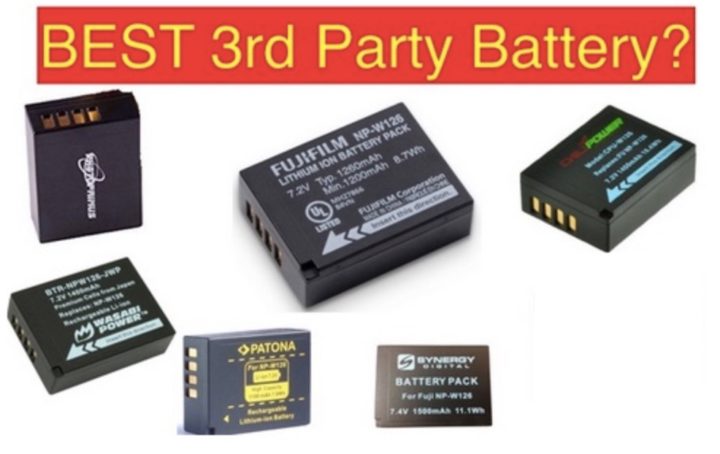
There are many cheap alternatives to the original Fujifilm NP-W126 battery… but which one is the best between the following ones?
Photoprimus, 1300 mAh
Extreme Wolf, 1250 mAh
Patona, 1100 mAh
Synergy Digital, 1500 mAh
ChiliPower, 1350 mAh
Original Fujifilm, 1260 mAh
The French site tirages-pro tested them all, and their conclusion is (google translated):
“In general, the announced capacity values are fetched and widely inflated. More than 30% error, some almost fall announced capacities of fraud.
In batteries tested, only Patona branded batteries and original batteries Fuji stand out and respect the advertised capacity.
So, the choice is simple. Either we research the best capacity/price and only Patona tested batteries meet this criterion. Either the capacity is favored without looking at the price and in this case, the Fuji batteries are the right option.”
Patona batteries: AmazonUS (for X100 series) / AmazonDE / AmazonUK (for X100 series) / AmazonITA / AmazonFRA / AmazonESP
You might be missing the Wasabi 1400 mAh batteries and the Watson 1120 mAh battery in this list. These batteries are very popular in America, but are not sold in Europe, at least not under this name. I believe (but please correct me if I’m wrong) that Wasabi and Patona are made by the same manufacturer, so the quality of the product should be the same. [UPDATE: You can find Wasabi batteries also in Europe]
Of course there are even more batteries on the market. Feel free to share your experience in the comments. I’m very happy with my Patona’s.
49 Responses
I use the ChiliPower and I agree with this article, they don’t last as long as Fuji.
But for less than 20€, I got 2 batteries and a charger.
Still a bargain…
I had ChiliPower and they were really really bad. Not even 10% of the original Fuji battery. Now wonder they were so cheap. The Watson which cost $20 something for single battery is working out better.
got the Patona and couldnt be happier about it
I have been using Wasabi batteries with all my cameras pretty much since Wasabis were first introduced. I am pretty happy with them and they seem to last as long as the OEM batteries. Right now I use them with the X-T1, X-T10 and X-Pro1 and never had a problem. Great bargain for two batteries and a charger.
Indeed, I’m in Europe and I also bought a Wasabi adapter in my own country. Nice adapter came with it, including a 12V adapter cable for in-car charging. Runtime on Wasabis is pretty much equal to Fuji original in my perception, even though I did not measure.
I have the cool adapter. It is also available in EU configuration. It really saves place in my bag. Great idea!
In Germany I can recommend the Quenox third-party batteries (the house-brand of EnjoyYourCamera). They seem to use pretty high-quality cells and last like the Fuji-Originals.
I use Chinese T6 Power accus in cameras for ten years, and was always satisfied with them. Also their NP-W126 alternative is very good, with nearly the same capacity as the original (you can do maybe twenty more images with the Fuji product). And as the original is ridiculously expensive here, I can get four T6 for the price of one Fuji – 55€ for the original, that´s totally crazy, the T6 costs only 12€ with 98% performance.
I have a few PATONA’s and OTB’s from ebay Germany, they work as expected. Only minus, the flash recharge time with XT-1
I use one of Phottix for over a year and it works just fine – can’t spot difference from Fuji’s one.
I’m using VHBW batteries off of Amazon with my X100. One of the four I ordered was defective, but the seller quickly sent a replacement without me having to send the broken one back, and so far the good ones are working well for me.
Capacity of third party batteries not being anywhere close to what it says on the label is unfortunately normal, the situation is even worse with the power banks for phones and tablets.
I really wish Fujifilm just shipped the cameras with two or three batteries in the box and also made the charger accept two batteries by default. Otherwise you can’t charge enough batteries for one day without getting up in the middle of the night. I believe Sony are already shipping their cameras with two batteries included.
I’d never even consider buying the originals as they are so incredibly overpriced. It was the same with the metal filter adapter/hood for the X100. Almost impossible to get here in Europe at the time and incredibly expensive, especially considering that this is an essential accessory that one would expect to come in the box. As Chinese knockoffs are increasing in quality (sometimes even adding functionality like the Meike battery grips for Nikon with builtin intervalometers or the Yongnuo flash system with the built-in radio control), it will become harder for first-party companies to keep up those ridiculous prices where they are expecting us to pay a 2000% markup on a cheap battery or metal ring.
I’ve used 3 Patona for my x100s and 2 for my X-T1. I don’t see any difference and am more than happy with them. They’re also dirt cheap (and had free shipping) from a German eBay seller.
just ordered 2 Patona’s based on the good feedback and the article. $10 each, seems good.
The test results aren’t surprising, but they’re also not very useful in identifying “good” third-party brands. And neither are friends’ experiences, forum comments, or personal experience. Even if you had a great experience the last time you bought a GoodBrand battery, the NEXT GoodBrand battery you buy may have been assembled by a different OEM, and/or contain cells and circuit boards from different wholesale suppliers. The eBay vendor himself may not know who made the inner components.
And reduced capacity isn’t the only possible problem. I’ve got three Olympus-knockoff batteries that have to go to the recycler, because they swelled up enough to make it impossible to put them into the camera. Sure, they were a “great deal” when I bought them, but now? Not so much.
I had the same experience, but only with those three Olympus cheapos and I’ve been buying third party batteries for about as long as I owned cameras (which is… quite a while :-)). I think the problem is compounded by the extremely snug fit provided by my OM-D’s battery compartment.
About 6 months ago, I replaced the bulgy specimens with a couple of Patona’s which also served my well for my Fuji cameras. So far, so good.
If a brand or a vendor has a reasonable number of reviews on eBay or Amazon, then you should be able to see whether those batteries are of consistently good quality, or whether quality varies over time.
Sure, the inherent randomness of subjective amateur reviews interacting with the inherent randomness of unknown third-party components and assemblers is bound to result in a valid statistical measure of quality… :-0
I haven’t quite understood if you are making a serious point or a joke. But my point is simply that, if reviews are consistently positive over time, then that is evidence against there being “inherent randomness” in the quality of the product.
Of course reviews are subjective and only a small minority of people will review a product on Amazon – so the data is very noisy. If there is a clear pattern in the data (e.g. overwhelmingly positive reviews) in spite of the noise, then that should give you confidence that the pattern reflects reality.
Daniel Kahneman discusses this fallacy in his book “Thinking, Fast and Slow.” It’s true that there is a “law of large numbers,” which says that a sufficiently large statistical sample will give a reasonably accurate representation of the whole data set. However, Kahneman points out that most people — including trained statisticians who should know better — are perceptually biased to make decisions as if there were a “law of small numbers,” treating small samples as if they were just as representative as large ones.
That’s what’s happening here. The universe of third-party batteries — assembled by various contractors with different degrees of skill, from components from multiple vendors with different levels of quality — is large and highly variable. The “test” mentioned in the original posting sampled only a tiny sample of these; the subjective comments of Amazon reviewers represent a different but still tiny sample. To believe that either of these samples will give a good prediction of an individual purchaser’s experience is, well, just a belief.
Another way of looking at this is to note (as many commenters have) that manufacturer-brand batteries (which likely also are made by third-party OEMs) are much more expensive than independent-brand ones. Part of what you’re paying for in that price tag is statistical quality control… so the large price difference suggests that the rejection rate must be higher.
Pick your fantasy and choose your adventure…
No, there’s no cognitive fallacy here – we’re simply disagreeing about the facts. I don’t know anything about the structure of the battery production industry, so I believe you that at least some suppliers produce batteries of variable quality. And if so, I agree that testing one example from different suppliers (as discussed in the original post) won’t provide much useful information.
Where I disagree with you is that the numbers of Amazon reviewers are always “tiny”. It does not matter that only a tiny proportion of those who have bought batteries write reviews: it is important only that there is a reasonably large *number* of reviews (at least in the hundreds), spread out over time. I’m not sure if I can post a link to Amazon here, but if Disqus allows it, here is an example: http://www.amazon.co.uk/gp/product/B007VPL61Y There are 220 reviews for that battery, spread over three years, and 214 of those reviews are very positive. (I am not one of the reviewers, though I have also purchased two of these batteries – on the basis of the consistently positive reviews – and found them to be good.) Of course the reviews are subjective: no doubt some reviewers are biased and some are crazy. But it doesn’t seem likely that they would almost all be biased in the same direction (i.e. biased towards liking the battery). The record of consistently positive reviews seems to indicate that this particular supplier has in fact supplied batteries of consistently good quality over time. So I think this is pretty strong evidence that your contention about third-party suppliers having little or no quality control does not apply in this case. That was all I was trying to say.
As to your third paragraph: of course the retail price depends not only on production costs, but also on consumers’ willingness to pay. If many people are worried about the risk of purchasing third-party batteries (partly on the basis of the stern warnings in their camera manual, but also encouraged by posts like yours) then they will be willing to pay more for Fuji-branded batteries. Some economists would also suspect some “signalling” in setting these prices: if the Fuji-branded batteries are sold at a much higher price than third-party batteries, some potential purchasers may think that in itself indicates that they are better quality.
Wasabi all the way, even better than the genuine one that came with the x-t1
My X-T1, as did my X-E1 Live and Die by the Wasabi as do I. I LOVE them. They act Exactly like the originals. Fit perfectly in the compartment. I’ve had three of the seven batteries I own going back to March 2013 and they still hold a charge and work perfectly. They are really the only ones I will purchase for me X-T1
I have good experiences with spare batteries manufactured by Hähnel. Quite surprised that this is not one of the tested brands.
I’ve only tried the Watson and Wasabi batteries here in the US as far as non-Fuji batteries go. To me, I’d say the Wasabi seem to last a little longer than the Watson batteries. If I had t estimate, I’d say the Wasabi batteries are about 85 to 90% of the Fuji batteries as far as number of shots per battery goes.
When I bought my X-T1 a yr ago I got a second battery from Calumet and it has an orange square on the bottom edge, its never been as good as the one that came with the camera but has the same logo, numbers on it.
If you have any Apple laptop or earlier USB chargers that have the removable plug, that plug works with the Fuji battery charger just fine and you can save yourself the $6.
I usually get DSTE batteries from Aliexpress, they’re really good quality and value, never had a problem with them. Patona is my second choice.
eh, none of them can be purchased in Poland :/
I use Newell brand for my x-pro1 and it works great.
Ive been using the Ex-pro white series for nearly a year and have found it to last longer than the fuji original.
Ex-Pro Ultra White Series 7.2V/1260mAh Replacement Battery for Fujifilm NP-W126 https://www.amazon.co.uk/dp/B00EXP4Z9U/ref=cm_sw_r_awd_v06nwbGE72FDD
I am charging my Fujifilm battery with the Wasabi charger. Simply because it goes straight in the wall.
To me, 6′ cable is totally useless. I was so upset, I threw it away the second saw it. I must say, the 2 prong adapter is what Fuji should do.
Sorry Fujifilm, but I like simple and practical things… The charger design is not your best design so far.
Fuji film didn’t design any of their batteries or chargers (they would better do as a native chemical company). No, they just buy them from Panasonic. And though I respect Panasonic/Sanyo for their competent batteries this type was not the best choice. Take f.i. Nikon’s lithium EN-EL15 – not so very different in form factor – has about 50% more power, extra ‘juice’ that would be very welcome in such a power-hungry EVF-concept. The charger as such is really the least of my concern, Nikon’s and Canon’s very own are really not better but their batteries are a lot stronger and that counts. We can say that is the price to pay to go more compact, but what is ‘compact and lightweight’ worth if you have to fill your bag with a few additional batteries and even a charger, just in case of?
I never understood why some people get so emotional about charger cables. I often have multiple devices connected to a power strip and generally can’t fit two chargers in adjacent sockets. Or I have a wall socket behind a sofa or some other hard to reach spot.
So I actually prefer using cables for those reasons. If prongs had been included, I’d just borrow a cable from another device. Getting upset because my specific, personal needs haven’t been catered to doesn’t make sense to me.
Some people dislike clutter and dust collectors. That’s all there is. A large power strip is the way to go.
Not quite sure how a large power strip beats a cable in terms of clutter and dust collection.
Do they also do a 3 prong design (Australia)? I’m also curious as to how the 2 prong works in practice – when I line it up with the power socket as it looks in the diagram, it seems to cover the switch and overlap the neighbouring socket. Maybe that’s just an AU thing? To be honest, I don’t mind the cable, but something smaller for travel is always welcome.
The biggest fraud are the prices at which all these camera-brands – not only Fujifilm – sell their own, native batteries. The entire third party battery market wouldn’t even exist if the prices were kept between a bit more affordable limits. Fuji’s ‘own’ batteries are just made by Panasonic and are really no space technology but very simple batteries used for a lot of different purposes. I’m using Jupio-batteries for already many years, never had one complaint, they seem to last at least as long as the native Fuji’s. Also in manufacturing, they look in the smallest detail completely identical to the original ones and are only sold by 100% reliable, renown camera shops in Europe – according to me it’s just a matter of labeling but @ half the price. Going cheaper would worry me a bit – at the end, losing a camera because of cheaper batteries would be a pity.
I’ve been using Ansmann and Pearstone in my X-Pro for three years, never noticed any problems. Strangely enough, the least reliable battery has been the one that came with the camera. Much as I would love to but Fuji stock the prices are just outrageously high compared to the more recognised third party batteries.
I’ve had 4 Wasabis. All failed within 6 months by swelling until they no longer fit into my XT1. In fact, one swelled while it was still inside the XT1 and I had great trouble trying to remove it. Beware!
Apple’s world travel kit works like the adapter here, but has plugs for every country.
Will that Apple adaptor kit interface with the Fuji charger?
Yes, it will. I used it Europe and it worked perfectly.
Interesting test.
Very happy with two of Amazon’s MaximalPower batteries myself.
in germany patona has the charger + two batts for jsut under 25€ or so. the charger comes with an aditional car charger and a micro-usb charging slot, so you can use any phone charger to charge your batts which means for vacation no need for cable. but it feels like the charger needs longer to charge. btw: if you sell the original charger and buy the pantona set instead you have to batts for free, as its worth a lot 🙂
i used pantona with my samsung cameras as well and can say they are solid.
EZOPower batteries fried my XT1. Twice. I will never use third party batteries again.
Never had a problem with the Wasabis. Been using them for years.
I bought 4 Wasabi 1400 mAh batteries to use alongside the OEM FujiFilm battery for my X-M1 on an 8-day hiking/camping trip. Before going on the trip, I cycled all batteries a few times in a hobby battery charger to make sure they were ok and to gauge capacity. The results from my tests were that the Wasabi batteries were roughly 80% of the capacity of the OEM FujiFilm battery, and nowhere near the marked 1400 mAh rating on the battery.
FujiFilm: 1175 to 1178 mAh
Wasabi #1: 948 to 950 mAh
Wasabi #2: 910 to 930 mAh
Wasabi #3: 950 to 957 mAh
Wasabi #4: 914 to 945 mAh
Canon managed to make their LP-E6n battery with ~3.5% more capacity and marketed it as a huge improvement, without making it any bigger. So I guess if you want more shots out of your batteries they need to be bigger. My original Fuji batteries [NP W126] weigh in at 48g, my Chilipower at 46g and my Expro at 52g with the latter being a much better performer than the former & on par with the original.