






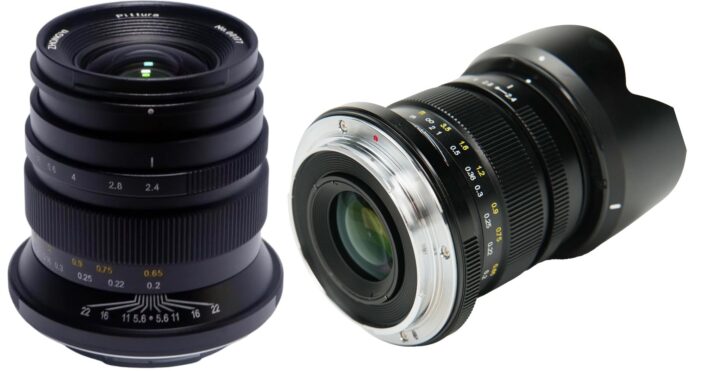


One of their current lenses for mirrorless MFT and E-mount systems is the 19mm f/2.8.
CEO Kazuto Yamaki said at DSLRmagazine (google translation here) that the mirrorless system camera market will grow further. And he promised Sigma will expand their offer of lenses for those systems.
“[google translated] I’m pretty sure the market for CSC will grow in the future, do not know how, but we have the belief that we must support as many possible systems and already have a few goals for this segment and we would expand that product line. “
Will there also be some Fuji lenses? Officially Sigma is still denying upcoming X-mount lenses. Maybe they should take a look at the Fujifilm X-T1 sales figures and they would see that Fuji isn’t that super-small niche anymore.
New products are likely to be announced in February at the CP+ show. Fingers crossed to get some “cheap” but still good high quality lenses also for Fuji. Do not forget that Sigma can also make superb lenses like the 50mm ART which is almost as good as the 4 times as expensive Zeiss Otus. Just to say that, on paper, Sigma could match the Fuji X lens optical quality.
35 Responses
18-35 f/1.8 in XF mount, please. I’ll take two, thank you.
three.
Resized for mirroless. Important!
It won’t get any smaller. It’s that size because of the large aperture necessary to make it somewhat comparable to FF DOF. Mirrorless isn’t magic. It’s only smaller because lenses are either slower, or, like Leica, lack AF, and are not built around wide-angle designs designed to meet FF staples.
Those are not the only options. The mirror can in fact get in the way of lens design, especially with wideangle lenses that require a retrofocus design because of it. Only the front element ‘needs’ to be that big, the rest of it can be redesigned.
I think you’ll find that there are no meaningful differences between similar speed lenses (on the same format) whether mirrorless or non mirrorless. It comes from AF and electronics. Yes, sometimes wide angle lenses on SLR cameras tend to be large, but that has more to do with their design than with the mirror.
Newer Leica wide angle lenses are massive, too. Still, lacking AF and other electronics, as well as using tight helicoids (as do older SLR lenses) overall lens size is small.
There are no equivalent lenses in today’s mirrorless world that are any smaller than their equivalents on larger sensor FF cameras, AF and other electronics notwithstanding.
Pancake lenses like the 27/2,8 equate to something like 42-45mm f/4 lenses. Already Nikkor and Tessar 45/2,8 for SLRs are roughly as small, but offer effectively wider DOF.
The excellent X-mount 18/2 is the only exception. It is tiny and light. And I wish there were more lenses like it that gave real advantage to the format. All other lenses are around the same size (as their equivalents), often the same weight, and almost always much more expensive.
Sure i know the internets thinks the difference is way bigger than it is. But one can’t deny that taking away this honestly quite huge a limitation, at least opens up a lot more possibilities that simply weren’t an option before. Surely that must make the lens design team very happy. The only thing holding them back now is the public’s (twisted) perception of how big lenses for Mirrorless ‘should’ be. Beside that, with the mirror gone their only limit is their imagination. You made it sound like it doesn’t matter at all, but i was just saying it *can* matter a great lot. No need to overcompensate for the internets overestimation by denying any benefits completely. 😉
In many cases though, as you know, size is mostly a choice. Indeed the 18/2 is an exception, because Fuji usually chooses quality over compactness, while the 18/2 obviously suffers from its compactness. But it seems that was a one time mistake, just look at the 90/2 that is bigger than some 85/1.4. And the 27/2.8, well that one is just slow. ^.^
And imho, the X100 could really use a floating element or something. Sometimes i’m not happy at all with the performance. They were held back by what they believed was the size the market would accept. Personally i’m ready for a X100R with a better lens, even if it remains F2, or preferably so.
It’s a great lens, but a bit too large for me. I think you’re more a man than me. You can quote that.
Here I am with my typical Nikon portrait glass: http://cs319231.vk.me/v319231372/2c99/Lel9mgePBOY.jpg
…no, 18-35/1.8 isn’t that large after all.
Definitely more man than me.
To paraphrase:
They are “pretty sure” mirrorless will grow, although they can’t see how. But they might as well support as many systems as possible if there is money to be made. Although, no, they will not offer Fuji lenses, which, based on their prior statement, they don’t see the demand for.
Kind of a non-committal statement overall.
Sigma always makes this type of statement. A few months before releasing the new 30mm f1.4, they said they didn’t plan any aps-c lens.
It would be great if Tamron, Tokina and Voigtlaender could join the party. A large ecosystem would make Fuji cameras even more attractive.
If they can make Art lenses specifically designed for mirrorless cameras, that would be great. I wouldn’t hold my breath, as it will likely be another year or so.
Unless Fuji designs its own Raw converter, I am not sure if I will be buying anything new for Fuji cameras anyways…
Never heard so much nonsense.
There are plenty of good RAW converters on the market.
But if you don’t want to buy anything from Fuji because of a RAW converter, what do you do on a rumour site? Just to troll?
There are plenty of ok raw converters available, but not optimal. If they are good enough for you, that is fine. They aren’t good enough for me to buy more into the system.
My X-Pro 1 is still a very nice camera, and I am heavily invested in lenses. However, I am not going to deny that it is crippled by suboptimal raw conversion options, which I believe fuji should resolve on its own.
If not, I will just use it for those shots where it shines, as I have been lately.
The X -Trans sensor is a 3-year -old technology, 49 fous point was good 3 years ago..not now (see nx1, a6000, etc).
Unfortunately I agree. Now, this may be a very stupid question, but what is stopping a Mirrorless Camera manufacturer from having the same type of AF system as a DSLR? If not this good, then what is stopping them having PDAF across the whole sensor?
Quote from DPReview on the a6000:
“If there’s one area that makes the a6000 stand out from the crowd, it’s the camera’s improved AF system. While the 25-point contrast detect part of the system remains the same, the number of phase-detect points has increased from 99 to 179 since the NEX-6. All of those extra phase detect points give you a much wider coverage area: roughly 92% of the frame, compared to around 50%. The benefit? A wider area that lets phase detection autofocus do what it does best: track moving subjects.”
179?! Fuji has 9 !
I have a bad feeling that in the near future fujfilm will not produce anything that is superior to its competitors (I talk about aps-c sensor).
http://translate.google.com/translate?sl=auto&tl=en&js=n&prev=_t&hl=en&ie=UTF-8&u=http%3A%2F%2Fegami.blog.so-net.ne.jp%2F2013-06-17
yep am very tempted to get one to complement my x-e2. it’s at least clean to 1600iso though not as clean as the fuji to 6400iso. sony tends to mush up their jpgs. but for daylight sports stuff dat awesome AF is a necessary improvement over any fuji.
On the first question: not having a mirror is stopping them. On the second: Only R&D time and money. Wait for it. 😉
Edit: not sure, but maybe vignetting might also be an issue with phase detect at the borders/corners of the sensor.
Number of AF points is a very tech- driven way of looking at a camera. The sony a6000 may have as many af points as you want, I’d never exchange it for a Fuji X. Exactly because Sony cameras are much less photographic, much more tech gadgets, and because no manufacturer gets color as right as Fuji.
Its not nonense – there a re a lot of people getting fed up with using RAW convertors that are ‘ok’ just to get by. Whilst ID is very good for MAC users, there is a real void for Windows users. I want the same quality that I used to get for my Nikon Files but on my Fuji files. Anything less is ‘making do’.
It’s not just converters, it’s converters that integrate with great workflows. Currently, using Fujifilm XTRANS cameras means that you have to slow your workflow _way_ down in order to use them at maximum output quality.
We know there are great converters. It’s just that there’s more to RAW than just conversion. If Iridient output could be had in LightRoom, ho ho ho. What a life. But currently, it necessitates export/import, and not working with the original file in a library programme.
That is a problem.
imho sales of fujfilm continue to decline ( as shown by the financial statements ) and the absence of new ( and innovative ) models is not positive…close to Christmas. My x-t1 is awesome..but I hope to see rumors about x-pro2 (or x-e3) ..soon
What’s the point of Fuji designing its own RAW converter? It would be like Boeing making its own engines. There are industry standard RAW converters out there (C1Pro, ACR), and anything else – no matter how good – is simply the preserve of schlubs and wannabes.
Personally, I think C1Pro is more than up to the task, and the camera and converter are better at resolution than most people are at picture-taking.
But hey, I’m not a bad workman, so I don’t need to blame my tools.
Nobody is blaming the camera, mister great. The issue is that the in-camera converter is better than all others, from my testing anyways. So, personally, if I spend my hard earned money on this camera system, with a unique sensor, I would like to get the most out of it.
Capture One is fine, but the in-camera converter with minor adjustments in Capture One is better.
And, from what I have seen, usually when someone tells others that he or she is good or great at something, they aren’t really that good.
By the way, I use DP Merrills as well, and Sigma provides its own converter. As a result, the image quality is exceptional at lower ISO settings.
And, I am only expressing how I feel. If you disagree, that is fine. I personally don’t care what you use.
Wow, I wish I had your eyes! To my standard issue human eyes, C1Pro is more than good enough.
60mm 2.8 sigma …. is what i wait.
i think i’d prefer how Sony had it with their original alpha line – having whatever focal lengths from Sony/G lenses, and Zeiss lenses filling in the gaps instead of having the same focal lengths twice. fujinon glass are already excellent.
Well, sigmas decision to stay out of fuji so far is hardly based on market share, that would be a very narrowminded and shallow analysis. There are, however, other obvious topics they have to consider.
1. Will they sell enough of the lenses they want to sell to make money?
2. Will the sigma lenses come out good enough compared to the fuji lenses?
Sigma no longer want to the image of “good enough for a sweet price”. The whole art series and 1.8 zoom shows they are going for the “best performing auto focus lens” image. The old sigma was really a lot more suited for the fuji market with good glass for a fair price, sometimes at the expense of overall quality and compatibility issues. There is no competition at all on that level on fuji x with af. Tamron or tokina might fill that spot, who knows.
Just have a look at the zeiss/cosina effort. Yes, they sold quite a few lenses in the beginning when the fuji options were limitet. Maybe even fuji payed them to fill the gaps. It didnt do any good for the zeiss brand though. The whole point of buying a zeiss is to get better optical quality than the cameramaker can offer. So much better that it makes up for a higher price tag and lack of af.
If sigma were to enter the fuji x market in a way that would strengthen the brand image they are aiming towards, they would have to make better glass than fuji does. Compare the reviews of the art product line with those of the fuji x primes. Yes, the lenses get good, even amazing press coverage, but the reviewers of the fuji lenses are more or less astonished that it is even possible to make such aps-c glass.
If they are smart at the sigma marketing division, they will tell the company to wait. At least until fujifilm stops being everyones favourite pet.
any art series lens for fuji would more than suffice
They can only make lenses if Fuji gives them access to the lens protocol. The Zeiss lenses are much better suited for the sony line, where they fill gaps or increase the quality. Also the design harmonizes much better with the clean nex-bodies.
Fuji “used” Zeiss to increase the impression of a high quality camera system, while Zeiss probably profited from the X-users more used to high prices for glass….
Not having other manufacturers producing cheaper AF-lenses is one of the big advantages for Fuji and I think they will hold on to this for a while, before they open up the mount for Sigma and the likes.
And just like that, a rumor is created.
Bring on the 70mm Macro and the 180mm Macro in Xmount Sigma with autofocus enabled. That would give me everything I need and fill some big gaps in the Fuji lens lineup. And please no one start preaching to me that I need some other focal length and that autofocus isn’t important for the macro I do.