







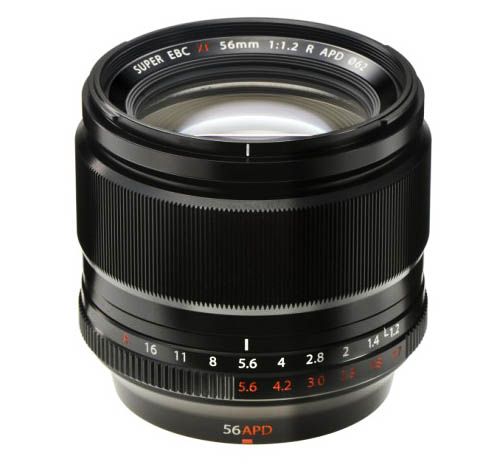
After the first images of the X100T here, our buddy of digicame-info is leaking also the first images of the XF 56mm f/1.2 APD (yep, it’s not a fake ;-)), and the XF 50-140 f/2.8 WR lens… including some specs.
XF 56mm f/1.2 APD:
– Apodizing filter is mounted, delivering beautiful blur smooth
– Filter diameter of 62mm
– Price is about $ 1,450
XF 50-140 f/2.8 WR:
ALL THE SPECS & PRICE at Adorama
Lens Configuration 23 elements in 16 groups
(includes 5 extra low dispersion elements and 1 super extra low dispersion element)
Focal Length f=50 – 140mm
35mm Format Equivalent 76-213mm
Angle of View 31.7°-11.6°
Max. Aperture F2.8
Min. Aperture F22
Number of Blades 7 (rounded diaphragm opening)
Step Size 1/3 EV (19 steps)
Focus Range Normal: 1.0m to infinity (whole zoom position)
Macro: 1.0m to 3m (whole zoom position)
Max. Magnification 0.12x (telephoto)
Filter Size 72mm
Diameter x Length 3.3 x 6.9″ (82.9 x 175.9mm)
Weight 2.2 lbs (995g)
THE DEALS
– XF 14mm (save $100 – price $799): BHphoto / AmazonUS / Adorama / Pictureline
– XF 23mm (save $100 – price $799) BHphoto / AmazonUS / Adorama / Pictureline
– XF 35mm (save $100 – price $499) BHphoto / AmazonUS / Adorama / Pictureline

102 Responses
hmm i hope to see a 35mm update next.. 35mm APD? 🙂
me too!!
Exactly! Fuji should upgrade their 35 asap (revise optical design, improve focus speed & accuracy, … )
I don’t think there’s much to revise in the optical design of the 35. It’s just a bit ‘first generation’ in terms of focus speed. Remake it in the style of the 14mm and 23mm with the pull-down focus ring for manual focusers, and give it some of the 23mm speed and accuracy in the process. And make it quieter, too.
The current 35mm is a lot faster on the X-T1. As are all the first three XF lenses.
There’s a tendency to dismiss the 18mm and 60mm in the light of newer models, and now the 35mm is in the cross-hairs. I still get a lot of use out of these lenses (the 18mm is small, fast, and great for environmental work, the 60 is a super-sharp lightweight lens, especially where close-up detail shots are needed). They have their idiosyncrasies and quirks, but working round quirks is part of the Fuji ‘thing’.
I think the pull-down focus ring was a one off. I have the 14mm, and it can be a pain when you put it on without realising it’s in MF mode, when the camera is in AF mode. It’s a nice mechanism to be sure, but I’m not sure it’s worth the extra cost involved in making it that way, and all the lenses since that one don’t have it, so it’s a bit odd when you use it now 🙁
i love the 23mm MF push-pull toggle… Only mistake is the dof scale is next useless.
I agree totally. A new and faster 35mm. The APD is not so important to me. I think the 35mm already has a beautiful bokeh.
I would like to see a 35 f/1 with a similar design to the 56mm and maybe an APD option.
This is indeed a strange update. I think this “new” 56mm is the first major misstep for Fuji’s lens releases so far. It makes little sense to release this lens right now. Such insignificant changes to a recently released and universally praised lens. I personally would have liked a WR version of any of their prime lenses much more.
Still no comment saying that the 56 APD rumor is utter BS?
Be nice to see the 50-140 sitting next to the 55-200 for comparison.
From the specs, the length of the 50-140 as it stands is almost exactly the same as the 55-200 when zoomed out to 200mm. It weighs almost as much as two 55-200s and it’s about a centimetre (a little under half an inch) wider than the 56mm. So, it’s big, heavy, and expensive.
It also has an aperture ring! I didn’t expect that, but I wasn’t following the story closely. That’s a nice touch for so ‘pro’ a lens.
An APD filter option on the 56mm is both great, and odd, in equal measure IMO. It’s a really excellent option, but isn’t it the kind of thing a company does to ‘top off’ the range? It’s the sort of prestige, specialist lens a company makes when it has long telephotos, tilt-shift, and macro lenses in place. The great thing here is it shows Fuji is clearly intent on building a lens system as deep as it is wide, and means there will be some exciting additional lenses on the roadmap.
They do have a macro lens, the 60mm, admittedly not 1:1, but the crop factor negates that to some extent. I think it is probably much easier to slightly modify the existing 56mm lens than to develop a whole new lens, so I doubt it has distracted them significantly from completing the line up.
I’d call the 60mm a close-focus lens, rather than a macro proper, but irrespective I use it regularly because it meets specific needs and is extremely sharp. I also don’t think making an apodising filter lens is a distraction, but it’s odd to make so specialist a lens this early in the development of the lens family. I would expect such a lens to emerge after the development of long telephotos and tilt/shifts.
Maybe one of their optical engineers just thought it would be a cool thing to do, made a prototype, and the results were impressive enough for them to make it into a product? Seems like they will have a good profit margin on it!
That actually sounds like a strangely credible scenario. Fuji seems to make some lenses just because they can. Or maybe to be different. Kind of refreshing. If it works out as a business strategy, I don’t know.
one can dream
So it looks like from the picture that the maximum aperture in APD mode is 1.7?
The aperture is f1.2 (so same DOF) but there is light loss due to the filter so it’s a bit darker.
But that would imply that either the entire lens is marked in t-stops, or the APD markings are some weird kind of f-stop-equivalent?!
It seems from f5.6 onwards the aperture is small enough not to be effected by the vignette of the APD filter.
If the last number is 1.7 that means only 0.5 stop loss compared to minolta’s 1.5 stop loss of light?
1.2 to 1.7 should be 1 stop
Apodisation explained really well. And as a bonus, how to modify your Helios 44m to have an APD filter 😀 haha.
http://www.4photos.de/camera-diy/Apodization-Filter.html
The conclusion of that article (thank you for the link!) is quite remarkable: “In my opinon apodisation filtering could be interesting for some images. But there is still the majority of images for which it doesn´t helps.”
Hence the high price tag, it’s a specialist lens for portrait photographers. I’d imagine Fuji’s results will be a bit better than what you’d get with an old lens with a bit of developed film stuck behind the rear element too 😉
Why is that remarkable? It’s a specialized feature for a specialized lens. FR readers are acting as if apodization is just some pixie dust they’ve been cheated out of, upset without understanding what it is or used for.
Well… I was and I am perfectly calm! It seems that you are the one over excited, certainly not me!
… and by all means I’m not the author of that article, who probably is right in believing that apodization is not the only (and most effective) way to pleasing bokeh. Did anyone say Zeiss?
Thanks. Just wondering if Fuji could be creating a filter with an LCD?
Thanks for the info on APD. 🙂
XF 50-140 f/2.8 = 995g (
A constant aperture f/2.8 zoom is never going to be lightweight, or cheap. It requires a lot of big and heavy glass elements.
And as sensor resolution goes up the lenses become more complex and heavier. 23 elements!
Not for me, but I guess this lens is necessary in a complete system.
70-200/2.8 stabilized full frame lens weights approximately 1.5 kilo, no matter who makes it. This 1.5x crop lens is approx. 1.5x lighter.
Don’t forget that the xf50-140mm f2.8 is comparable with a common full frame 70-200mm f4, infact it has exactly the same weight and dimensions.
…and price. But there’s a difference: it’s a f/2.8 lens for all practical reasons, except DOF.
f2.8 is not f4? The Canon can be and is used on crop bodies.
In terms of depth of field a f2.8 lens on a FF became a f4 on an aps-c and vice versa in terms of dimensions and weight a f2.8 lens for aps-c is the same as a f4 lens for FF.
Let’s try to compare dimensions between XF56 and Canon EF 85mm f1.8 for example. They are very similar. The same is for XF50-140 f2.8 and Canon 70-200 f4.
There is more to photography than DOF. What sensor size should I set my flash meter to?
But this is a 50-140mm that has to cover only an APS-C sensor area, not a 70-200mm FF lens. No way this can’t be made smaller and lighter.
But it is both smaller, lighter and cheaper. Approximately 1.5x so.
Want to reduce weight, size and cost even more? Lose WR, OIS and/or speed.
You are still comparing it to a FF 75-200/2.8 lens. Try to compare it with the Pentax DA* 50-135/2.8 APS-C lens for example that has also IS and is WR and you’ll know what I mean.
Not familiar with the Pentax offering, but let’s see the specs online… What do we have? It’s 310 grams lighter, all right, but does not feature OIS and a tripod collar. It’s made of plastic and, I believe, has a plastic mount.
Like I said, if you want to make it lighter, get ready for sacrifices.
I stand corrected. The Pentax lenses don’t have IS due to the IBIS the Pentax bodies offer. Still, I can’t believe that the lens has to be 310 grams heavier, 8% larger in diameter and 43mm longer only to incorporate IS.
It’s a macho thing.
It HAS to be, by Japanese law.
For a true comparison you have to compare it to a 50-140/2.8 aps-c lens designed for a flange distance of about 18mm. And then you also have to compare the image quality. Size and weight are two specs that, while very important in day to day use, say nothing about the quality of a glass.
It didn’t disturb you that the OP was using DSLR lenses dimensions to prove that the Fuji lens has to be that huge. But when I bring up a different example suddenly the flange distance becomes a vital factor? We can compare to Leica FF lenses where the difference in flange distance is not that big if you prefer.
Exactly!
Nikon 70-200/2.8 VRII = 1540g
This is why I no longer have the Nikon 🙂
Do your math right. 50-140 f2.8 APS-C is equivalent to 75-210 f4.2 FF-lens. Typical 70-200 f4 FF-lenses weight 700-850g. So Fuji is 20-40% heavier than equivalent FF-lenses!
How do you calculate the f/4.2 from the f/2.8…what is the math?
2,8 x 1,5 (aps-c crop factor) = 4,2
So if my lightmeter gives me an f-stop reading of F2.8 I have to dial 4.2 in my camera if I use an APSC sensor?!
What an bullshit that spread over the internet thanks to some photo amateurs!
On every camera in the world and on every lightmeter F2,8 ist 2.8 is 2.8.
There is no “math” behind that!
Don`t mix up F-Stops with a bokeh comparison which I think you tried to state out.
Calm down!! 2,8 with regard to light ,but 4,2 with regard to dof. Kenko was writing about dof.
Kenko was suggesting that the 50-140 should be compared to an f/4 lens in terms of weight. DOF doesn’t weigh anything. Glass does though.
But only because the ISO standard doesn’t apply well to digital sensors and the companies cheat. This is the real reason for more noise in a smaller sensor.
lol. 2.8 is 2.8, get that through your bokeh addicted brain.
Mounted….fixed or removable??? Means that you can remove the APD filter in order to have a common 56 1.2 with its sharpness/full light gathering capabilities of 1.2???
I’m interested in this question too…..anyone or @Fujirumors/Admin….is it just a common 56 1.2 with attached APD filter which could be removed???
Looks like the standard aperture and APD-settings are fixed. So no way to adjust them separately.
Most likely fixed like in the Sony STF 135mm lens with apodization filter.
This why I love fuji , I have screaming that why no one just Apodize (a little , exactly like the 56 f1.2 adp) a fast lens to get much better bokeh (I am no bokeh-lover , I just hate it when things get busy). Now If they do a 35 f1.0 that would be legendary…
Make your own 😉
I work on DIY apodization lenses, because I found the Sony STF 135 to expensive, for some images too long, and for some things too slow.
Yesterday I worked on a cheap 50mm f/1.4 lens, but not yet finished.
Does anybody have an idea what is on this red “XF …” mark? Just a line or does it say something?
Or maybe ZF?…
I guess it says “XF zoom” just like on the mockups, but in red/white.
Sorry Y… the new 56mm has 3YP… serial number https://www.flickr.com/photos/nathanelsonphoto/12493204874/in/photostream/
Maybe the rumor about a FF Y system it’s true
This image was shot with an xcam so aps-c (from nathan elson) not a leaked images from an upcoming y series with ff sensor…personally dont believe fuji will release a ff cam soon esp. no interchangeable their ceo stated in a recent interview…..
Maybe the line under the XF tag says “professional or weather resistant or sealed” with regard to the pro tele zoom there could be one of these words completley being named under the xf as you see that there is a longer word mentioned……just guessing….
What does the APD stand for on the 56mm f/1.2 lens?
Have a look at the image and the ring with the red figures that seems to be called “anodizing filter”. I guess APD comes from there.
It stands for “Apodizing (filter)”. The nearest element to the aperture blades (iris) produces a vignetting-effect like on the image so the out of focus objects borders gets darker. It leads to more blur background.
The vignetting effect is only in the unsharp areas visible. Only the bokeh is vignetted! So the blur size probably looks smaller, cause it is very dark at the edges. But this results in very creamy bokeh – much better than normal lenses.
The Sony STF 135mm/2.8 [4.5] lens is very popular for this – for portrait work and flowers for example.
I have DIY made some apodization filter, sometimes they work great.
http://www.4photos.de/camera-diy/Apodization-Filter.html
ADMIN what happened to the deleted article? http://www.fujirumors.com/hot-worlds-first-images-shot-new-super-bokeh-xf-56mm-f1-2-apd-lens-now-online/
i’m assuming the guy who took the photos requested a takedown.
Rrrright, like it’s not in a Google cache already.
Reminds me of the photo of male strippers that I took once at the wedding I’ve been working on (that’s right, male strippers at the wedding)… When I published that photo on my Facebook page and other social networks, everyone was cool about it. But the second I put it on my website, I received a call from the very angry manager of these strippers. He said that boys will have big problems at school because of that photo being on my website, and requested an immediate takedown.
Aha. Strippers. At the wedding. Expecting privacy.
Same here.
If he doesn’t remove the images from his own server, all people need are the links…
And a text to go with the images: http://webcache.googleusercontent.com/search?q=cache:http://www.fujirumors.com/hot-worlds-first-images-shot-new-super-bokeh-xf-56mm-f1-2-apd-lens-now-online/
You missed the updated of the update, which is not in the cache, where I changed that sentece
Ok, young padawan, my Internet powers exercise let me… here, this I found in RSS cache:
[UPDATE: I removed the images for now. Nathan wrote me that it should remain unreleased work.]
Warmer?
touché
There.
http://www.nathanelson.com/media/original/FUJI%20XF56mm%20APD-001.jpg
http://www.nathanelson.com/media/original/FUJI%20XF56mm%20APD-003.jpg
http://www.nathanelson.com/media/original/FUJI%20XF56mm%20APD-004.jpg
http://www.nathanelson.com/media/original/FUJI%20XF56mm%20APD-005.jpg
http://www.nathanelson.com/media/original/FUJI%20XF56mm%20APD-012-3.jpg
Cheers.
I’ve removed the post… and I have good reasons for that. Please pardon me if, this time, I can’t say more.
Just need to see the lens hood on that 50-140 now, and for a more local place to put it up for preorder!
It’s prob gonna look like the one on the 14mm f2.8.
probably, but I still want to see it to complete these leaks. I know we won’t see any sample images until it’s released, but I suspect they’ll look fantastic, so I’m just curious about how it’ll look.
And NO xpro 2 what a bummer ;(
Is it just me or does the “XF” on the 56 APD look kind of strange? Maybe I’ve just been staring for too long.
I wonder why there is a Lens Roadmap.
Not to let you know which lenses won’t be released. 😉
Is it a legal contract between Fuji and the public?
I don’t think so, I didn’t sign anything.
You didn’t, and neither did I, but Fuji did by publishing the Lens Roadmap. It’s an implied consent.
any chance of a XF16-35mm f1.8 lens?
Weren’t sigma rumored to be bringing their A lenses to mirrorless at photokina? It seems like a no-brainer for them to bring that 18-35 to X cameras
I have a littlebit of a mixed feeling about the new 56mm.
Already owning the excellent 56mm I feel a little betrayed even though I shouldn’t really.
Its not about the fact that my lens now has less value its more that I didn’t have the choice to make the decision myself. Especially because the 56mm was on the roadmap but this 56mm APD lens wasn’t.
Why on earth do they need to release an already perfect lens with another even better lens while Fuji still has a roadmap to fullfil?
The APD-lens is not better or worse than the standard 56. It will probably have smoother bokeh but at the loss of 1 stop of light wide open. Totally different products.
Here you can see the 50-140 on the right. In the middle the 55-200 and on the left the new to come 16-55mm F2.8. For me -for what i know now- the 50-140 is way to big/heavy with is 1 kg weight and expensive too (about 1.5k$). For me now the 50-200 mm is the sweet spot for tele use.
Well, here is the image again, sorry for that, I was to impatient in uploading. It seems I can’t remove it now.
Actually the 50-140mm has got bigger since it was first
shown. The original mock up had 67mm filter size, which has been increased to
72mm.
Is the length of the 50-140 constant or will it extend while zooming?
I spent a lot of time in denial with the 56 APD lens, this was before I took the time to learn what it was.
Everyone who has stated it before is correct, it is a very specialty lens, it’s something that only shows it’s benefits in very particular situations, and will only be useful in the hands of someone who knows what they are doing. I will eventually add the APD lens to my collection, alongside my regular 56, but because it’s such a specialty lens, I will almost choose the regular 56 first.