








Fuji’s annual report is online here.
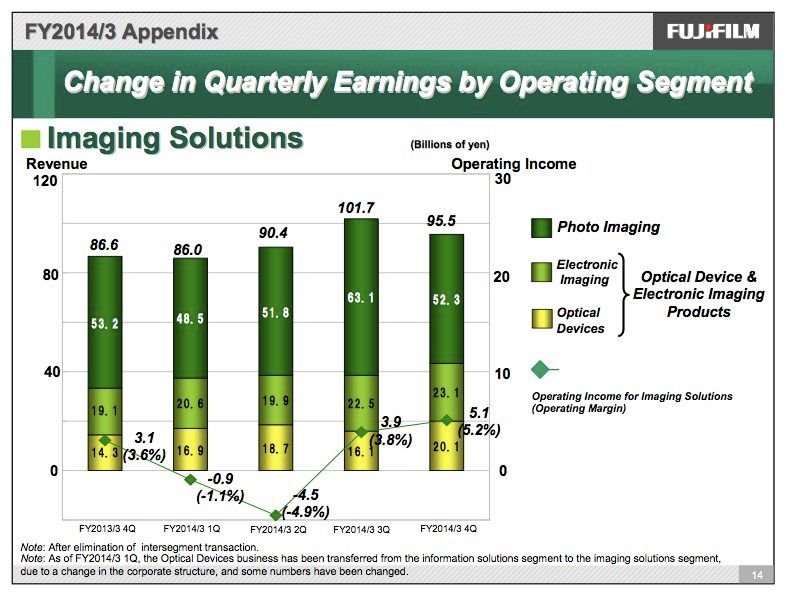
As you can see from the diagram above, Fuji’s imaging division is partitioned in 3 fields: 1) the photo imaging business, 2) electronic imaging field (compact digital cameras), 3) optical device field.
_ _ _
The Good News
The good news is that, overall, the imaging division is making profits… and it’s especially fiel 1 (photo imaging) and field 3 (optical device) that are leading Fuji’s imaging division out of the operational loss.
“In the Imaging Solutions segment, consolidated revenue amounted to ¥373.6 billion, up 8.0% from the previous fiscal year. Such factors as the expanded sales of camera modules for use in smartphones led to the consolidated revenue increase.
Operating profit amounted to ¥3.6 billion, due to strong sales in the photo imaging business, such as instant cameras, cost reductions and other factors.
Robust sales were seen in the optical devices field, owing to the large sales increase in camera modules for smartphones as well as strong sales of TV camera lenses.
Revenue increased and the segment turned into profitability, reflecting such factors as the strong sales in the photo imaging business (mainly instant cameras), the falling yen exchange rate, and fixed-cost reductions […] the sales of instant cameras and films increased substantially ([shoplink 17593]Instax mini 90[/shoplink] and [shoplink 23847]Instax Share SP-1 printer[/shoplink])”
The Bad News
And what about the compact digital cameras (field 2: electronic imaging field)? Well, it’s still the weak spot of the imaging segment.
In fact, the electronic imaging field is still suffering, because the “popularity of smartphones has been causing demand for compact digital cameras to decline“. So, although the sales of the premium X-series cameras are increasing, the overall revenue is declining. However, Fuji expects the sales to of X-series cameras to grow in future.
“Sales in the optical device and electronic imaging products business increased, because sales in the optical device field were strong while sales of compact digital cameras decreased.
In the electronic imaging field, the sales of premium interchangeable-lens-type cameras, such as the FUJIFILM X-E2, which was launched in November 2013, and the FUJIFILM X-T1, which was launched in February 2014 were strong, but a decrease in overall demand for compact digital cameras, reflecting the spread of smartphones, caused the overall revenue to decline. Fujifilm is working to expand sales centering on interchangeable-lens-type cameras, increasing the product lineup in the X Series of premium cameras that leverage Fujifilm’s exclusive technologies and, XF Lens Series, interchangeable lens systems.
Although the market for compact digital cameras is shrinking, demand for high-quality photographs is growing. Our X-Series of high-end digital cameras that concentrates on image quality, operational sense and texture is particularly beloved of photography aficionados. […] we expect the market for digital cameras with interchangeable lenses to grow”
The moral of the story? Drop the entry level segment and give us the X-PRO2 / X200 🙂
18 Responses
At least Fuji are making money out of cameraphones, that will not be true for all compact cameras makers who are seeing declines.
Canon has even abandoned the low-end compact camera market. I bet we’ll see more of this in the future. The upside is that Fujifilm is doing well in the competition against DSLR’s! Should still be quite a market to fight for there.
Love you moral 🙂
How is this possible, i bought the Fujifilm XF1 twice now on discount, one for mom and one for grandma, that must have made them huge amounts of revenue. 😉
Some people think anything that moves on it’s own is a great feature. Manual zoom in compact is totally under-appreciated. 😉
Always a great moment when you hand your ~1k$ camera to an amateur and he asks: “Where do I push to zoom?”
XF1 is a great example that a good product is not enough. You need consumers who recognize it when they see it.
Very true, that’s why they have me. 😉 The implementation of it is a bit quirky though, the X10/20 is better but it also doesn’t collapse all the way down like a compact ‘should’. They like the manual zoom, but the main reason was the surprisingly adequate EXR/Auto mode which delivers superb JPGs with Fujicolors and good DR straight out of camera without hassle (in all kinds of crazy lighting conditions).
“although the sales of the premium X-series cameras are increasing” I missed this claim in their report.
What I did see was “Among the X-series, the sales of premium interchangeable lens cameras proceeded smoothly,” which is kind of a weasel way of saying not much at all. I saw future-talk about the X, but missed any real claims about today’s sales performance.
A big takeaway: year over year, revenue for the electronic imaging division (digital cameras) is down from 92 to 86.1 billion yen. This is a loss of 7% from the previous year. So their revenues are still on a downward trend for digital camera sales.
The trend away from compact cameras has been in effect for some time, not sure why this is still a big factor to them
The other big takeaway- FILM sales are up and have been helping prop up the optical division. So it’s nice that film sales are carrying the digital camera division.
Naturally they will make claims that the X series will increase in the future. All corporations make such claims for the future, so the results will have to speak for themselves.
This is good not in the sense that they showed great success in digital cameras, but in the sense that they didn’t lose by a real lot either. This is hopeful.
Photo Imaging, which should include film and instax is not really growing. Sure, Instax probably is but all the other films are probably still in decline, which is why more and more are discontinued.
The Electronic Imaging section is not really in decline. That is a success if you consider Fujis lineup of cameras a year or two ago, you will find hardly anything but compacts. The X-System is still quite new and not very much known to consumers.
Fuji started their own interchangeable lens system only two years ago. Now they produce lenses for their own cameras, which is why they moved the optical devices from information solutions to the imaging solutions, I guess. And there you see a very stable growth, maybe due to the XF lenses.
That is how I would interpret it, but such statistics are easily over-analyzed. I guess you can pretty much read into this whatever you want.
Are the XF lenses coming under Optical Devices? My understanding was that Optical Devices are OEM parts. It makes no sense to have half a system in one group and half in the other since generally the sale of one (lens) is subsidizing the other (body).
“It makes no sense to have half a system in one group and half in the
other (…).”
I suppose this is exactly why it was moved from information to imaging solutions.
Electronic Imaging is most certainly in decline since revenue is down since last year. That’s the definition of decline. What I think is that the decline is not that big a one, so there is still hope.
If by “very stable growth” you mean a definite decline in growth- what most call a loss- I agree.
On the other hand, you claim film is in decline, but Fuji disagrees: “In the photo imaging business, sales of instant cameras and films increased substantially.”
It does not matter if they started selling lenses two years ago or 10 years ago. A loss is a loss, and shareholders are not shareholders to lose money. If their products are not very well known by consumers that is not the fault of the consumer, it’s not the consumer’s fault if the marketing message is not successful.
I’m heartened that the loss was minor. The next year however must show a definite profit for the X line, or I fear for its future. And I think Fuji is taking the right step by starting to lower the effective sales price of its cameras… but lens prices are also too high.
“Electronic Imaging is most certainly in decline since revenue is down since last year. That’s the definition of decline.”
If you look at the whole fiscal year, yes. But given the short cycles in the digital camera business today, this is pretty long term. If you look at the 4th quarters 2014 is actually increased compared to 2013. So it depends on how exactly you interpolate.
The “stable growth” statement at the end was related to the optical devices section I referred to at the end. Maybe I should have made that more clear. And indeed there is a 30% increase in revenue from Q4/2013 to Q4/2014.
“On the other hand, you claim film is in decline”
As you said, Fuji claims the sales of instant cameras and films have increased. To me this sounds like instant cameras and instant films sales – the instax system if you will – have increased. And I don’t doubt that. Just look at the bestsellers in camera & photo of
amazon.com.
I think the sales of other films are in decline because
there were several announcements in the last year for price increases and discontinuation of several lines of film like provia, neopan 400 or fp-3000b, because of a global decline in demand. Also revenue in Q4/2013
was higher than in Q4/2014, despite the success of the instax system.
“It does not matter if they started selling lenses two years ago or 10 years ago.”
Fujifilm is selling lenses since the 1940s but they haven’t sold cameras that would take their own lenses in a while. That’s all I was saying.
And I don’t blame the consumer for anything, he is the king after all. 😉 What I meant was it takes some time to build a reputation.
As can be seen in the report, the imaging solutions was already profitable in 2014 and I guess it will also be in 2015. I am not afraid. 😉
well, actually there are 3 PDF files you can download, and in one of these Fuji said that the sales are “strong” for “premium interchangeable-lens-type cameras”. In the other two reports they say “smoothly”
The problem, according to Fuji, is the compact camera market, which is taken over by smartphones (the Finepix and entry level cameras).
In fact, the premium X-lines seems to be a success, as Fuji expects it to grow and will continue to invest into it.
Right, I saw “strong” and “smoothly,” and dismissed them as words that were almost deliberately non-specific and certainly non-quantitative. If the X sales were actually increasing, I’m assuming they would have been motivated to come out and explicitly say so.
How could the word “Strong” be non-specific?
Then you assume… isn’t THAT non-specific?
Fuji will do fine. Photographers have trust with Fuji and Fuji most of the time returns the favor.
Are you sure? A lot of MLIC photographers DON’t chose Fuji (but Sony, Olympus, Pentax, Panasonic, Leica,…) and don’t even have the slightest bit of trust. Some with a profound and very bad experience suffering from the first wave of buggy, querky and even poorly performing X-series cameras. This still casts a shadow over the entire X-range and I’m having a serious concern that – if it’s true that Fuji has a slight success in their sales – this may be a very temporary phenomenon, good numbers very that will be very vulnarable to other market tendencies (f.i. FF, higher resolution, more advanced sensor design) and unavoidable future bear markets. Take a look at the bright history of Fujifilm, in camera-production they have always been a niche-market.manufacturer with not the best fame to abandon their believers & buyers.
Most Japanese camera makers will report better numbers this year, perhaps all, simply because of the currency intervention. But if a division can’t turn a profit in those conditions then its not so good – the wind is blowing in the right direction for profit … its really NICE that the film and print element is so strong. I just ran a roll of film though an old rangefinder and I’m hooked – cost is 25€ per roll including prints and a CD. Much cheaper than a Leica Monochrom … Fuji take note, hole in the market for a digital monochrome needs filling 🙂
This is the currency chart showing the intervention:
http://finance.yahoo.com/q/bc?s=USDJPY=X&t=5y&l=on&z=l&q=l&c=
Ok, fine. Is there any news on the X30?