








image courtesy: National Geografic
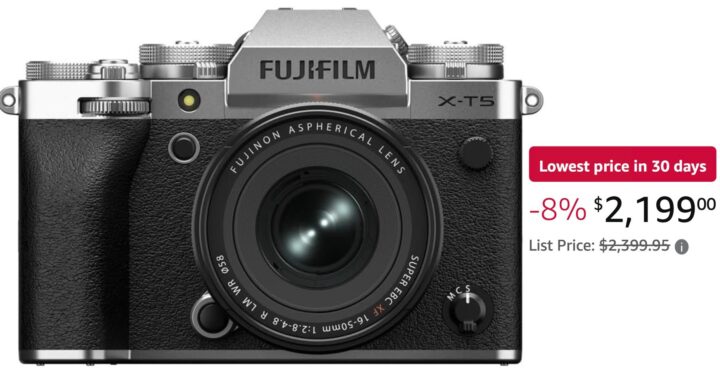
The Jury is in: National Geografic chose the Top 10 Compact Cameras for Travelers… and their lists starts with the Fujifilm X-T1 and Fujifilm X-E2:
Fujifilm X-T1: “This camera is quick—its autofocus is quick, its image review is quick, and it shoots tons of pictures in a row without hanging up. Now I can leave the bigger DSLR cameras at home without a second thought.”
Fujifilm X-E2: “I love the X-E1 [precursor to the X-E2]. I love how portable it is, and the lens quality is outstanding. But the picture is the big thing—the images are really strong. I’m amazed at how little I have to correct them on the computer. Usually I shoot in RAW, but these Fujifilm cameras produce amazing JPEGs straight out of the camera.”
Also included in the list: [shoplink 24784]Panasonic GH4[/shoplink] / [shoplink 16816 ebay]Panasonic GX7[/shoplink] / [shoplink 22210]Sony A6000[/shoplink] / [shoplink 19559]Sony A7[/shoplink] / Olympus TG-3 / [shoplink 17516]Olympus OM-D E-M1[/shoplink] / [shoplink 13349]Ricoh GR[/shoplink] / Sony DSC-RX10 /
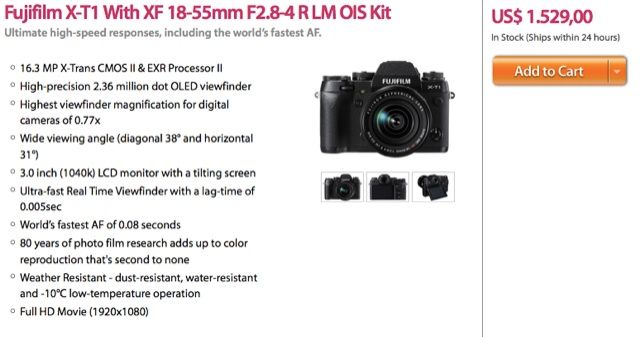
X-T1 Deal
I remind you that DigitalRev has a very good price on the X-T1. The kit comes for $ 1,529 (save $168) and the body for $1.179 (save $109). Free shipping & one year warranty included + no duty and tax for the shipment to US (DigitalRev covers the costs). So the price listed on their store will be the final price you’ll pay.
65 Responses
Well I’ve bought six of the ten and still have five including the top two. As someone who earns his living travelling around and shooting pictures, with a lot of walking included I can testify that they are excellent and a much better option than the heavy SLRs / DSLR’s and Medium Format outfits I used to carry around. (Plus lenses + Tripods of course)
These days I don’t look much beyond my X-T1 and 18-135mm lens. One hell of a travel kit.
What if CanNikon starts a new APSC mirrorless system and slowly make a transition out of their big & heavy entry-level dslrs? i think is time for Fujifilm to go Full Frame mirrorless now. Is no longer a question of choice anymore. If not, Fuji will be neglected in the market again soon. 2nd point, Fuji need to improve the focus performance, fast and accurate (i.e. efficient phase & contrast focusing technology) to as good as dslrs. Summary:- something 1) compact, light, full frame 2) fast and accurate focus. Hope Fuji is listening. If Canikon is making a move, Fuji gotta plan it’s next move or be sidelined again.
Yes of course! The answer (as always) is full frame! Hail full frame! Killer of dragons and master of all!
I made that mistake once — buying a Sony NEX7 — by the specs. Never again ! 🙂
Did that with the Nikon 1 V1 – I thought 1″ sensor – Cool – very fast AF – Super cool – Reality check : above 400 ISO beurk (if I may say so 🙂 .) Glad I bought it new at a good price for travel (was originally more or less same as the X-T1 in price). Conclusion: I am not sure now if I still got the battery charger 🙂
A pointless comment because you didn’t give a single thing that you didn’t like about the NEX7. Besides, we’re talking about the A7 series, not the old NEX. These Sonys are everything Fuji should have been, but they picked the wrong sensor size. The fujis are too low resolution, too incompatible with raw processors and poor at foliage and skin. You can spot a Fuji photo easily because it looks waxy. Meanwhile, Sony went and did the impossible, put a real sensor into a tiny body with a great interface, great EVF and you can use any lens from their wonderful 55mm to Leica with an adaptor. Sony, unlike Fuji, even got the focus peaking right. I really really want to like the Fuji. When I look at my fuji cameras they look so damn cool, but when you want the best image, the Sony delivers by a huge margin. It’s not just spec numbers, it’s real world.
The NEX7 had excellent IQ, resolution and grip. I hated the menus. I hated the “tri-navi” controls that were unlike any other NEX in the line. I hated the non standard hot shoe. I hated the lens lineup (or lack thereof). I hated that it was billed as a “hybrid” camera, then discovered that it overheats after 6-8 minutes of continuous shooting. And I hated how Sony never acknowledged that issue, which was rampant. I look at the A7 lineup and am similarly tempted. Then I read about u acknowledged shutter shock complaints. The canon blast shutter sound. The lack of lenses. I watch Sony split focus between A mount, E mount and FE mount. And the so called “full frame bokeh advantage” evaporates when the focus is on smaller, slower glass. And how they can release a second lineup of those cell phone lenses before fixing all of their other gaps couldn’t be more customer hostile. I’m sure the A7 cameras are great in the studio and for landscape work. Sony’s sensors are great. If they meet your needs, great. Seriously. But I don’t trust Sony to follow through on a complete lens lineup, firmware updates and sticking to a lineup for the long haul.
Contrast that with Fuji. The cameras keep getting better and better. They don’t just look good. They’re great to use. And their lens roadmap is public. It is smart. And they keep delivering.
I hope Sony keep innovating. And I hope that they eventually put together a great comprehensive lineup. But they’ve got a long way to go. Competition is good.
As I understand it, if one valued the weight of the lenses, the Fuji would do pretty well in comparison to the FF Sony.
there’s no place for nostalgia. The better wins and customers aim for the best on the market. Anyway changing a system is always a pain..
I can’t accept the argument that x100t would be too expensive if it was FF by giving Sony as example..stupid to compare interchangeable system with x100…
well given the small number of lenses available at the moment, comparing the A7 with the x100t is quite a fair comparison, similar cost, similar size, with one huge difference, the Sony has a far better sensor. I love the x100, its small size, the images are decent, the leaf shutter is great for flash photography, but photography gear comes down to one thing. The combination of lens and sensor and fuji only has one of those covered. Their lenses are great, they always have been since the Fujinons on the GW690 etc, but the sensor is too small and fails on foliage and skin. The Sony has a great sensor and (very few) great lenses so there’s really no comparison, except when size really really counts.
Nikon should have put out a digital version of FM2, but ended up with the buttugly and BIG Df. I’ve had several FF cameras, and don’t miss them in any way. Different people, different needs. Let’s see a more compact medium format instead, and just skip FF. I don’t see CaNikon coming up with something like the X-T1 and glass like 56 1.2, 23 1.4 and 16 1.4 anytime soon. All in the same compact size and quality… I doubt it!
whether or not the Df is ugly or cool is just a matter of taste, but regardless of its looks or bulk it is a full frame camera with a great sensor and a lens line up that puts Fuji to shame. The image quality in the Df far exceeds anything the little sensor can deliver in the fuji. It’s just physics.
Like I said, Nikon should have made a compact FM2 sized body, with matching high quality glass. If you want a compact FF, there’s always Sony. People have different needs, and for most, the X-T1 is more than you’ll ever need. You just don’t seem to get it. By the way, medium format is the way to go. I guess it could crap all over those tiny FF sensors?
Per CanonRumors site, 2014 was Canon’s year of the lens. With 10 or more lenses to be released in 2014. Right. Based on that, how many years do you think it will take Canon to catch-up with Fuji if Canon was to make all new lenses for a Canon mirror-less FF body. Fuji should just keep doing what they are doing. If anything, Fuji should go directly to MF and skip FF altogether.
In the citation X-E1 is prised, not X-E2 at all. I can understand it because X-E1 delivers better image quality compared to X-E2. So, is someone trying to put more charm to criticized X-E2 for its worse image quality to make it more atractive for potential buyers? Tricky move.
Oh, then I should maybe change it with the excerpt, where they say that the X-E2 IQ rivals the one of FF cameras
Just a note that X-E1 is praised in the citation for great IQ and “amazing JPEGs straight out of the camera”, not X-E2 cam which JPEGs differs quite much due to different sensor and JPEG engine that brings some serious issues. And this is a true, X-E1 produces amazing JPEGs straight of the camera, but not that great with X-E2.
yes, it’s true. In fact they say don’t say anything X-E2 specific. Jpeg’s are awesome also on the X-E2… but skin tones at high ISO should definitely be improved.
I love love love the XE1-2, but how can a camera without weather sealing be “best” for travel? Especially by NatGeo standards.
lol
that’s a good point
I keep saying that, so why not repeat myself once again?… “Weather sealing” is a marketing gimmick, and a dangerous one. It takes much longer for the “sealed” gear to unfog, yet all the flying crap (checkpoint: Holi dye) gets inside just as easily.
There’s a psychological factor, too. For most users, having a “weather sealed” equipment results in neglect of the most basic safety rules (same as with casual cyclists wearing helmets – they tend to use their “protected” heads instead of brakes).
Reality check: compare water damage insurance cost of non-WS vs WS camera gear.
I read Roger’s blog too. But it **can** be more than marketing and it could be backed by warranty. 🙂
Oh, my experience with Holi dye is firsthand, not just from Roger’s fabulous blog 🙂 Also I have a firsthand experience of using “sealed” Canikon gear in extreme conditions, all the way from Arctic to Antarctic, including rainforests, sandstorms and occasional war zones (don’t do the latter anymore)).
Frankly, I’ve never seen water damage (or mold, or dust) covered by warranty. Did you?
Okay. Okay. It’s psychological. You think even the rubber gaskets do nothing? I just want to walk in rain and snow, not a war zone 😉
Any “weather sealing” are not intended for casually walking in rain and snow (reality check: existence of rain covers for supposedly “sealed” gear), it’s more of an insurance policy. If you suddenly find yourself subjected to ALS challenge, your gear might have a chance if it is sealed. Just a chance, not guarantee.
For example, in the “digital era” I had 2 incidents when my cameras were totally submerged in water. First one involved 135mm prime and Minolta Dynax 7, both non-WS. Both lens and a camera died instantly (cost of repair dangerously close to the price of new item = dead). Second occasion involved 70-200/2.8L IS and Canon 1Dm3, both WS. Both required minor repairs, but survived.
Basically, your WS gear won’t be “rainproof” or “snow proof”. More of a “splash resistant”. So if you’re intentionally going for a walk in the rain, at least put a plastic bag and some gaff tape over your gear 🙂
ooops I used mine x-pro1 under..the rain +/-…no problem 😉
http://goo.gl/z7aAQG
Same here. It’s just not intended use, that’s all. Last winter I’ve shot all day long outside at the temperatures of -38C, and had zero problems (except pretty bad LCD lags, which was expected) with my X-cameras (X-E2 and X100s at the time).
yes yes, we all know you’re opinion on weather sealing by now. Clearly it doesn’t work for you, but the rest of us don’t have anywhere near the same problems as you.
Until the day where you do have an issue. His point is clear: Weather sealing is not weather proof, so it is probably safer to still be careful; I don’t see anything wrong with that.
this was as a wedding photographer??? haha! seriously please stop with all the bs.
you use the phrase “wedding photographer” as some sort of insult. I am not sure this helps putting your point across. (What is your point btw ?)
you forgot “weddings” haha 🙂 says it all
Ok, I have to admit, Ratty Mouse was more entertaining than this Markov generator.
He’s probably a hidden offspring of Ratty Mouse. You know the kind the whole family knows about but never mention 🙂
From seeing Holi dye in pictures it looks to me as a very very fine powder; may be too fine to be effectively filtered out by any gasket routinely put in the ws of our cameras. There is I believe no denying that WS improves the situation with the occasional splash of water (not salted preferably) and some level of not too fine dust, but I take your point as “it is not reason enough to be careless and stop thinking” : ie carry on protecting your gear.
I had to take photos of cement factory with my x-e1, 18-55 and panohood. My equipment was completely covered with super fine dust..
5 months after my gear works as new one!
If I were you, I’d send it in for CLA service, just in case. Concrete dust is quite abrasive. In forensics, it is known for removing friction ridges (read “fingerprints”) from the human fingers )
I didn’t know that by the time, but tried not to zoom, later I hoovered carefully.. Maybe now is too late? Anyway it works awesome
In most of the US, “to hoover” usually means blackmail, so I guess you live in the UK or Australia? 🙂
Pro tip: if you know for sure that you’re going into the environment that is harmful to your camera… rent that camera! Renting a Fuji X gear is super cheap and saves you from a lot of heartache.
Hmm. I know I run in strange circles, but I’ve never heard of “to hoover” as a way of saying “to blackmail.” What I have heard of is “to hoover” as a way of saying “sucking up,” as in “that construction boondoggle hoovered up money that would have been better spent on a park.”
Frankly, back in the States, I’ve never heard “to hoover” in any context outside maybe some TV shows, so that’s definitely not used in “my” circles. My guess is, both “hoovering money” and “blackmail” meanings are somehow related to J. Edgar Hoover, not to a brand of vacuum cleaners.
I’m Bulgarian immigrant in France 😉 , so mercy please
English is my second language too, so I was not picking on you, just trying to clarify that “hoovering” for myself 🙂
re “hoover” – no. It doesn’t mean anything of the sort.
that’s not a pro-tip, but a douche tip.
That’s awesome and encouraging. Thanks!
no. wrong as usual. and the point about a psychological factor is also complete crap.
Sure troll, if you say so. I’ll pray for ya. Whatever.
please don’t waste your time with that crap. Typical wedding photographer.
If you had any valid points other people might have agreed with you, but did you notice they didn’t? Its also not a matter of opinion, yours or mine, it’s engineering. Weather sealing is an engineering problem, one that manufacturers solve to varying degrees of success, but that doesn’t take away from the value of sealing. Nobody is saying you can take your camera swimming.
https://youtu.be/Eo61t5fH6Qw
Let me quote Roger Cicala from Lensrentals for you:
“It’s better than no weather sealing, certainly. And some (but not all) ‘weather sealed’ lenses also have internal gaskets around barrel joints and other added bits seals. But I haven’t seen one manufacturer yet tell us exactly what weather their lens is sealed against. Snow?
Rain? Sunshine? Wind? Well, it can’t be wind because the lenses we spend the most time taking dust out of are mostly ‘weather sealed’.
It’s very different with different manufacturers. You can assume whatever you like, but when you send your lens in for repair, ‘weather sealed’ still means ‘the warranty doesn’t cover water damage’. The truth is, terms like Professional Grade and Weather Resistant are
nearly as vague as ‘innovative technology’ and ‘stylish design’.”
Source: http://www.lensrentals.com/blog/2013/12/assumptions-expectations-and-plastic-mounts
That makes sense. Especially with the cyclist example.
Wasn’t there some heat problems because of too well sealed camera bodies somewhere somewhen in the past (don’t know which manufacturer that was)?
I for my part prefer non-WS gear because of lower cost and better ergonomics (eg. mushy weatherseale’d buttons).
http://www.youtube.com/watch?v=Eo61t5fH6Qw
Pentax’s “weather sealing” is legendary. Thanks for sharing this illustration.
@trentontalbot:disqus offers smart and sensible advice: MOST manufacturers claim “weather sealing” without backing it up with warranty and are not explicit in defining coverage.
BUT>>>
That doesn’t invalidate the desire that MANY of us have for true ruggedization backed by a company willing to put it in the warranty, do it right, and then stand behind it.
If Nikon AW1 and various “tough” compacts can go to the beach, the snow and the driving rain, why can’t higher end CSCs with some clever engineering, as @hnriot points out?
I don’t understand why so many rush to say something CAN’T be done simply because to date, it hasn’t been done. That alone should be all the more motivation for doing it.
Canikon did similar demos ever since they’ve started the “environmental sealing” craze. There is a very simple way to test your own belief in this “sealing”:
– How much would you pay for these cameras in “mint” cosmetic condition if you knew they were subjected to this very test?…
Now, there are all sorts of ways to certify cameras and lenses as weather, water or dust resistant. Most common are IPX and MIL-SPEC. None of the “sealed” SLRs or lenses have been certified as conforming to any of these standards, ever. Not even the modest IPX-1.
All the more reason to be the first to carry that certification! 🙂
I’m not arguing that marketing claims today are what I want. I want a real, ruggedized, X cam. The X100 seemed like the perfect opportunity, as it doesn’t need to change lenses.
Totally agree. IPX7 or IPX8 certified camera sounds terrific. But it seems that I’ll have to settle for an underwater housing )
Now if only Pentax would make that camera in a small, rangefinder style body with hybrid VF and matching 35mm prime… 🙂
It’s simple really, don’t get your camera soaked. If it’s really heavy rain put it in a bag, or go take pictures indoors!
“Don’t take the picture” really isn’t a good plan, but being safe with a cover is good advice.
Last trip to India I faced some dampness issues with my Zeiss 12 mm on an X-PRO1 camera. Black lateral stripes that disappeared some time after leaving the humid (very humid) spot. 🙁 Last summer I bought – again – a FFrame Nikon… thta I sold three motnths later. Great camera. A pain in the,, to carry it with the rest of my equipment.
Hahah, love the headline. The list doesn’t rank the cameras.
Not only does NatGeo NOT rank these two models as the top two travel cameras, the actual unranked list is top COMPACT travel cameras.
Like most lists published on the web, they are just click-through bait, in the hopes of exposing you to more ads. The lists themselves are meaningless things a journalism major intern can throw together. Just pick the most expensive semi-small model from each vendor.
The copy also says that we, National Geographic, don’t actually USE any of these cameras for our magazine, what we use are full frame cameras.
With a Fuji X-Pro 1 I won and lost the National Geographic World Photo 2012 contest http://goo.gl/9sakVZ . I have have been using FujiX, since the very first X-100 appeared. I added an X-PRO1 and recently bought an XT-1… BTW, sold my 5D equipment long time ago. More and more PROS are and will be using mirorless cameras. The resistance is more a question of loyalty and tradition… The results that you get with a present Fuji X camera are more than acceptable for any professional magazine… be it National Geographic BTW..