








Recently Fujifilm published how Fujifilm’s imaging division just keeps booming stronger than ever.
As usual, during the presentation of the fiscal results, there was a Q&A session and one particular answer might be worth a mention.
One person asked how Fujifilm’s Imaging segment could post such strong operating results in the January–March quarter, given that he doesn’t see the overall camera market as particularly robust. He specifically flagged that the full-frame segment looked weaker, while growth seemed concentrated in entry-level and compact cameras — a space he suspected was benefiting Fujifilm. His follow-up concern was competitive: if compact, entry-level cameras are where the growth is, what stops rivals from crowding into that same space and eroding Fujifilm’s advantage?
Yamamoto, General Manager of Imaging Business Division, says that the ways consumers enjoy photography and video continues to diversify, and this trend is actually supporting market expansion.
According to him, Fujifilm’s long-standing focus on APS-C, combined with its film simulation technology, distinctive color reproduction, and lens expertise, has enabled the company to grow faster than the overall market.
He argues that this advantage goes far beyond making smaller cameras. It is the result of more than a decade of brand building, product development, and close engagement with users through events and direct interaction worldwide—strengths that competitors cannot easily replicate.
As demand for premium cameras continues to grow, he believes Fujifilm is well positioned to further strengthen its unique market position.
My Take
Fujifilm colors are awesome.
It’s not just me saying it. We have featured professional sports photographer Andrea Cimini a few times on FujiRumors. He switched to Sony for the better autofocus for his high-end sport photography. But after the switch he said that indeed Fujifilm colors are superior and he now needs about twice the time to edit his files. I guess if Fujifilm would have never messed up the autofocus with the infamous April 2024 firmware update, he’d still be an X shooter.
- This is Why Fujifilm Colors are So Amazing: Turning Color Science into Art
- The Fujifilm Paradox – The Most Loved Colors with The Worst Accuracy?
Lens Technology
Especially with their newest models, Fujifilm figured out several ways to decrease size of their lenses. The best expression of this miniaturization process is the Fujinon GF500mmF5.6, which is astonishingly small for a lens that covers a sensor about 70% fuller than Full Frame.
On the other hand, APS-C allows for smaller lens design.
Fujifilm recently disclosed a survey of future lens possibilities, showing a Fujinon XF 18-50mm f/1.4 which is half the weight of the Canon RF 28-70mm f/2.0L and still up to 24% lighter than the Sony FE 28-70mm f/2.0.
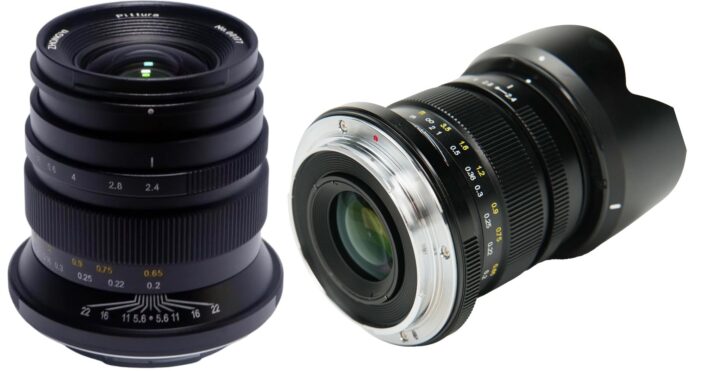
But what I love of Fujinon lenses – and what holds me from using third party lenses that much – is the consistent and beautiful color rendition across the XF lens range. Don’t get me wrong, I love(d) some of my third party glass. But for example, I sold my Samyang 12mmF2 because Velvia & Co just didn’t look like Velvia & Co on my Fujinon lenses. In fact, I replaced the Samyang with the XF10-24mmF4.
Close Engagement with Users
Other brands tend to focus more on reaching influencers than directly engaging their customers.
You could argue this is simply smarter marketing: invite creators to events like Sony Kando & Co, and that “hospitality” often translates into positive coverage and reviews on YouTube later on.
And make no mistake: Fujifilm fell to the temptation of pleasing influencers rather than customers, too. But luckily that was just a short excursion.
Things are different now. Fujifilm hosts lots of Fujikina events all over the globe. FujiKina’s are community-focused gatherings centered on photography experiences, exhibitions, and hands-on workshops. They’re designed to connect directly with end users and photographers through interaction and education, rather than influencer-driven promotion.
And I don’t know any other brand that so consistently invest in customer-facing events at this scale and frequency.
Another nice example are the various Fujifilm House of Photography shops located in several cities and expanding to more locations.
I had the opportunity to visit my first Fujifilm House of Photography in London recently – of course incognito with my family – and it was just amazing. It’s more than just a shop where you buy gear. For example, the House of Photography in London had a huge wall upstairs dedicated to the theme “Life is…” in which you could bring an image that, in your eyes, fits the theme – no matter with which camera brand it was taken – and they’d print and exhibit it for you for free – see the image here.

Ultimately, Fujifilm has a massive photographic history. And they honor it until this day by keeping photography at the center of their identity—through film simulation culture, community-driven events, and by shaping products around different photographic needs and working styles—rather than repeating a single camera concept—offering a diverse lineup of tools tailored to different ways of seeing and shooting.
Q&A Transcript
Okazaki [Q]: My second question is about the Imaging. The segment again performed very strongly in the January-March quarter, and performance on an operational basis was much stronger than your previous assumptions. I do not believe the overall camera market itself is particularly strong, so I would appreciate your explanation of what is driving this performance.
My impression is that while the full-frame segment appears somewhat weaker, entry-level models and compact cameras are performing well, which may be benefiting Fujifilm. At the same time, how do you view the risk of competitors strengthening their presence in this area and intensifying competition?
Yamamoto [A]: This is Yamamoto from the Imaging business.
As you pointed out, the digital camera market remains strong. The ways consumers enjoy photography and video continue to diversify, and this trend is supporting market expansion.
One of our key strengths has been our long-standing focus on the APS-C (Advanced Photo System type-C) format, which enables compact and lightweight camera bodies, along with our film simulation technology that delivers distinctive color reproduction and our lens technology. These strengths differentiate us in the market, and demand for our products is growing at a pace that exceeds overall market growth. As a result, our market positioning and presence continue to strengthen.
Regarding your question about competitors potentially pursuing similar strategies, this is not simply a matter of making products smaller or more compact. What we offer in terms of product design and color reproduction reflects more than a decade of brand building and product value development. These are strengths that cannot easily be replicated in a short period of time. We also place significant emphasis on communication with users. We host many events and create numerous customer touchpoints, and I also regularly visit overseas markets myself. We believe we are providing experiential value to our customers.
For these reasons, we believe we can continue strengthening our unique positioning as the market expands and demand for premium products continues to grow.