







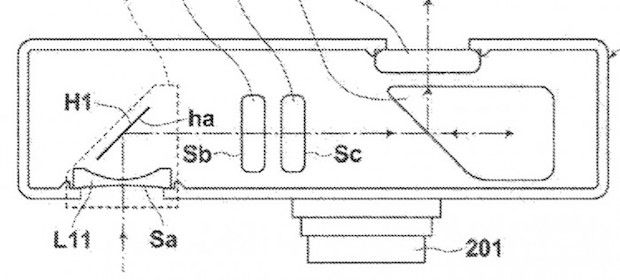
This is one of the (many) Fujifilm patents you can check out at freepatentsonline here (PDF file here). It was published back in April (04/29/2014), Filing Date or the Patent: 01/02/2014
It seems to be an evolution of the “Real-image zoom viewfinder” already present in the X20 viewfinder. There is plenty of technical stuff to read at freepatentsonline, but petapixel sums it up saying that “the viewfinder would be able to optically zoom in synchronization with the varying focal length of a zoom lens.” And, at least looking at the image of the patent, this viewfinder should find its way into future compact Fuji Point&Shoot cameras.
But what’s the advantage of this specific “real-image viewfinder” compared to the one of the X20 (which delivers 85% coverage and a 20° horizontal apparent field of view)? Well, I do not know, and it must be hidden somewhere in the very complicated description of the patent.
So will maybe the X30 feature an upgraded “real-image zoom optical viewfinder”? That’s the question I’ll now send directly to our sources 😉
But it’s good to see that Fuji continues to work on the OVF technology. It’s definitely a good news for OVF lovers. However, no OVF in the world will give you the possibility to see in real-time how your final shot will be (WYSIWYG), which is very useful, especially when you have to act fast and there is not the time to take a shot, check the result on the LCD, change the exposure, take another shot, check the image again, make adjustments and so on. With an EVF you look through the viewfinder, turn the dial, see immediately the result in the EVF… and “click“.
But what do you think? Do you prefer the EVF or the OVF? 2 alternatives, one answer. And feel free to list your PROS and CONS for a OVF or EVF in the comments.
Oh, and I know, a hybrid viewfinder would make us all happy. So, dear Fuji, don’t forget it in the X-PRO2 🙂
[poll id=”49”]
And just for fun. Here is how Fuji explains the “real-image zoom viewfinder“. It’s all one sentence, so be concentrated:
“A real-image zoom viewfinder substantially consisting of, in order from an object side, a variable-magnification objective lens system having a positive refractive power, an erect optical system, and an eyepiece lens system having a positive refractive power, wherein the variable-magnification objective lens system substantially consisting of, in order from the object side, a first lens group that includes a first lens having a negative refractive power and a reflective member arranged in this order from the object side and is fixed during magnification change, a second lens group that has a positive refractive power and is moved during magnification change, and a third lens group that has a positive refractive power and is moved during magnification change, the erect optical system has at least one reflective surface for converting an inverted image formed by the variable-magnification objective lens system into an erect image and is fixed during magnification change, the eyepiece lens system has a positive refractive power and is fixed during magnification change, and conditional expressions (1), (2A) and (3) below are satisfied at the same time:
1.5<U2/U1<3.0 (1),
1.76≦|f2/f1|<2.0 (2A) and
1.0<f3/f2<5.0 (3), where U1 is a distance from an object-side lens surface of the first lens to a most object-side lens surface in the second lens group along an optical axis in a state where zoom setting is set at a telephoto end, U2 is a difference between the distance from the object-side lens surface of the first lens to the most object-side lens surface in the second lens group along the optical axis in a state where the zoom setting is set at the telephoto end and a distance from the object-side lens surface of the first lens to a most image-side lens surface in the third lens group along the optical axis in a state where the zoom setting is set at a wide-angle end, f1 is a focal length of the first lens group, f2 is a focal length of the second lens group, and f3 is a focal length of the third lens group.”
via freepatentsonline / photographybay / petapixel
21 Responses
Patent for application in X30 or X100z?
Speaking of VF type: EVF for sure, that’s the future – I think EVFs are maturing in terms of resolution, lag, and color accuracy. A few more years of improvements and for all practical purposes EVFs will match OVFs. From there it will be just a matter of preference, but it would be very hard to say “I need OVF because with EVF I can not…..”
For all practical casual purposes, yes. EVFs, as good as they may seem to be are a LONG way away from seeing shadow detail, from seeing highlight detail, from not stammering, from not constantly adjusting exposure unlike OVFs. The experience is completely different than the eye. If they can act like the eye (or an OVF) and show all the detail with NO LAG, we are there. Not to mention, finding a WB-free image is impossible from an EVF. OVFs, as good or bad as they are, have myriad advantages that most people never bother to look at. They are all about how many points or FPS and forget there is so much more to how we see that the EVF simply can’t match.
That isn’t going to happen in a few years.
EVFs have plenty of advantages too. It is already a question of preference.
I certainly won’t deny that. I use EVF and LCD far more often than OVF, but only because I work in a dark room and all I need to do is line things up perfectly. As soon as I move from scenes that go dark and light, or have to see details with my eye and not trust the sensor, EVFs fail most certainly.
Getting an ‘about right’ exposure is what EVFs are great for. Indispensable, I would say. But I use them only because I have to. I wish every mirrorless camera worked like the X100s.
What details do you want to see, that you can’t trust the sensor? How are you going to shoot those details, hmm… not with the sensor, but with your eye?)) Sorry can you explain, I don’t get it.
In EVF what you see is what you get, so no, not “about right” but precisely the exposure you will get.. In OVF no matter how we like it, we just see the scene through the glass and have no idea what the exposure, or color, or framing etc. would actually be.
What I’m trying to say is that OVF, as a tool, is outdated. Yes it’s look is more pleasant, but that’s about it. I’d say if one wants to look through OVF – use glasses, if you’re taking photos use EVF, which is essentially a live feed of photos you may take.
ipecaca,
I mean precisely what I said. When looking through an EVF, you seen an approximate idea of what you are shooting. You do get real-time exposure preview, but that’s it. As long as your eyes are good, you miss detail, miss shadows, miss highlights, miss movement (that can’t be caught by 50 or 60fps).
I think it an immensely helpful tool. I told you, I use it every day. The X100/Pro OVF, however doesn’t need to give perfect exposure. When you know what you want to shoot, you shoot. In dark places, the EVF stutters, or when using non-native glass stopped down even slightly in dwindling light, it stutters. Amp noise jumps up, colours go wonky.
You must preview the image through a white-balanced image set to the WB of your camera. Sure, that can be nice, but it gives you a different idea of what you are shooting.
Fujifilm did a wonderful by including an OVF in two of their mirrorless cameras. Without it I would be using something else precisely because of the trouble with EVFs.
There is nothing in and OVF to be outdated. It is what it is. An EVF, on the other hand, can be slow (X-pro 1), chuggy (X-Pro 1), low res (X-Pro 1), poor colours (X100s), gain-happy (X-T1) etc. and so on. Every year, new EVFs make older EVFs look old, ancient, or outdated.
Again, I appreciate them. You can turn your brain off, not even think about exposure, compensation or anything and rely on WSIWYG. That’s great. But there is a place for box OVF and EVF.
Again, Ok you miss shadows and highlights in contrasty conditions in EVF, but doesn’t that mean that you loose those in the final shot as well? What I’m trying to say is in this sense OVF is misguiding, cause your eyes are better than the camera sensor and the shadow/highlight you see in OVF won’t be in the picture. For composition rangefinder-type OVF with wider image coverage and framelines is great, that’s true.
Also, how do you confirm through OVF if autofocus worked well for the shot, especially in dim lighting? Manual focus – forget it.
Hello again ipecaca,
I suppose you are one of the people that wish the X100s and X-Pro 1 did away with the OVF. If so, then there is nothing for us to discuss. You have your mind made up. I’ve given reasonable arguments FOR the EVF and against it. You obviously just don’t like OVFs for whatever reason.
I have vertigo. EVF stuttering stresses my inner ear and I get sick. Low light high amping causes the EVF to lose detail, and drop frames at eye level, and focusing is hard. As I said, EVF has its many purposes, but it simply cannot replace an OVF in every situation, nor in fact, in many for people like me, that have vertigo, that rely on clear optics in the dark, and that can’t work with jittery displays.
Obviously manual focus isn’t confirmable through Fujifilm’s OVF because there is neither coupling no PiP overlay (which would be great). As for AF, I get to know my camera, know where it can’t focus and where it can. It’s the same thing for the EVF. Since the EVF is still too low resolution to tell at an eyeball if something is perfectly in focus (it lacks the contrast/colour/whatever else) to do this without magnification aids, I’m not bothered by minute differences.
Regarding your thoughts about losing highlights and shadows. Of course. I don’t think anyone here or anywhere on the gear heard part of the net would think the EVF represents the final image. And thank god it doesn’t. We use the EVF like we use the OVF, as an approximation tool. The OVF works to frame, and with the right instrumentation, can focus via TTL or other system. I wouldn’t have purchased the X-pro 1 or the X100s if either one had lacked an OVF.
I do like the hybrid viewfinder developend by fujifilm and I do think it’s one of the greatest features developed in the recent years amongst on sensor phase detection and foveon sensor. Having shot hundreds of rolls on film rangefinders I cannot appreciate this VF more.
All I’m saying is that EVFs can and are replacing OVFs and from mow on it’s a matter of personal preference wich one to choose. Having both is just awesome.
Talking about shadows and highlights, I look at my monitor with the left eye and at the image review in EVF with the right eye – try this, where the highlights are clipped in the EVF they are clipped on the monitor. Overall exposure is off by half stop, but I can live with that. And live histogram overlayed in the EVF – what else would anybody want? I’ll throw away the OVF just for that if I will have to, personally.
Personally, i find that the OVF shows you only one of the hundreds of different versions of that photo you could possibly take. It has a certain exposure and white balance setting applied and often does not show you the details outside of the dynamic range of the sensor/EVF that you might actually want to focus on or at least include in your image by adjusting your exposure settings. If I wanted to get a similarly comprehensive idea of my scene with an OVF, I’d have to cycle through a whole bunch of settings first until I’ve seen what is possible with an image or take my eye away from the viewfinder. With an EVF, it’s one look. Besides, as soon as you are using studio flash, especially with very low ambient, the exposure preview becomes rather meaningless and even a hinderance (on some cameras it cannot be switched off, leaving you with a dark preview frame, which is neither nice nor useful).
Don’t get me wrong, I use the EVF on my X100 on a daily basis (and not just because the AF is much better than in OVF mode), and I’m not arguing against EVFs and their usefulness at all, but I do think you lose something that an EVF does not give you. Not to mention that today’s OVFs still have issues with lag, frame rate, dynamic range and so on, but those will surely be fixed in a matter of a few years.
Confirming focus is indeed an issue with plain OVFs like the one on the X100 (though one could argue that you couldn’t do it with film either). OVFs currently work a lot better on real rangefinders and SLRs. Though maybe at some point Fuji’s hybrid viewfinder system could include focus peaking overlays in EVF mode. Theoretically, they should be able to do an analysis of the live view/OVF signal to determine depths of each pixel and thus compute the offset for the viewfinder and line up the live view peak overlay with the OVF. Or, there is always the possibility that they come out with an actual rangefinder system for their hybrid viewfinders, which would be beyond amazing.
I’d always rather use an OVF, especially if I could let’s say see 15% more than framelines. For example I zoom this viewfinder to 35mm, and I can see 24mm window with 35mm framelines. This would be perfect for me.
I agree, while i love that a OVF is easy on the eyes and shows the image outside the framelines, allowing easy composition, i do not like the guesswork of the framing, exposure, depth of field, and the exact focus point(!), plus the additional features that the X-T1 delivers like the dual-view with magnified image, focus peaking, etc. and the huge magnification size of the EVF in general. Almost like using a classic OM-1, big bright VF in a small body. It used to be very different, but EVF is the clear winner for me today, it simply gets the job done with the most control and confidence.
To me this looks more like a viewfinder for the x-pro line. Rather complex and expensive for a point and shoot. I did not read the whole patent but it looks like it could be easily upgraded into a hybrid viewfinder. Maybe you could even include a true (mechanical or digital) rangefinder functionality… just dreamin. 😉
But you never know if/when patents make it into products.
Guys, does the X10 not already have a optical-zoom OVF? And the X20 even with digital info overlay, small step to make it a full Hybrid. 😉
yes, I’ve updated the post in order to be clearer.
Mmm,
I don’t understand that way, mirrorless cameras was a revolution because simplified the system and skip the mirror (complex system), and now they are going to build an even more complex system????
A “real-image zoom optical viewfinder” is not the same that every DSLR in the market already have???
IMHO
That is one way to look at it. The other would be, that a mirrorless system allows for a shorter flange distance and simpler wideangle optics and a thinner body, just like film rangefinder bodies.
The Viewfinder is a different matter. More options are always nice. 🙂
I wouldn’t remove the hybrid VF from my x100 and use it all the time. The OVF on my X10 is not quite as useful. It’s small and inaccurate (although admittedly a lot bigger than it’s competitor’s OVFs). Better than nothing, but I think I’d prefer a decent high resolution EVF in the X30.
…it is not necesary to zoom the OVF, just give us precise framing lines (according to the zoom)…,
It is necessary for longer lenses. At some point those framing lines are just too small.
I’ve been thinking about the X10, X20 and X30? I wish it were wider than 28. In fact, while the current wide to portrait range is great for general consumers, I bet lots of enthusiasts would prefer a super wide to “normal” view. 16-35mm 2.8, perhaps. Anyone agree?