







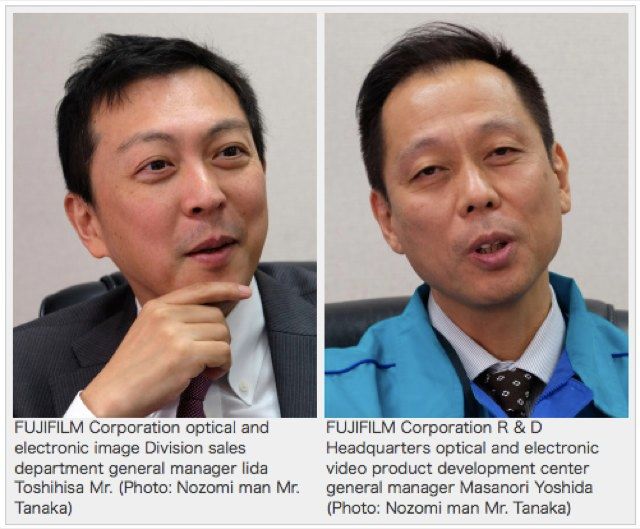
Interview at dc.watch (translation) with Fuji Manager Mr. Iida Toshihisa. If there is any Japanese reader who can translate / summarize the interview better, please feel free to do it in the comments down below.
From the interview
TRANSLATION BY ANTOINE (THANKS)
Q: Photo and Camera, which is most important?
As a camera maker, our dream is to make the camera as close as the human eye as possible (reproduce the impression we get from our eyes). The photo is both what remains and what records, so it’s the role of the camera to do so.
Whatever happens the image quality is the most important part, but not the only important one: it is necessary to reflect what the photographer likes and what he feels.
Q: When planning and developping a camera, what is important?
Cameras are tools to take pictures. It’s very important to have a small, light and easy to use camera to enable the photography and image quality in a pleasing way.
When we plan a camera, of course we are considering the cost, but more than that, the features are a heavy topic. We want to create a product which value will be understood by the customer.
Q: What is the appeal of ILCs?
They have a lot of advantages. By using multiple variations of lenses, they can enlarge the possible expressions of the environment. You ca also enjoy the different tastes and representations of the different lenses.
Q: What are the comparative appeals of DSLRs and mirrorless cameras?
DSLRs have for themselves the OVF, speed, large choice of lenses and battery llife. But we have decided not to take that path, to avoid limitations in the future.
Mirrorless cameras benefit from the ease of use of EVF, focus peaking [or focus accuracy, not too sure…], small size and weight, many automated functions, higher quality design possibilities of the lenses due to the shorter flange distance (especially wide angles and primes).
In addition, the absence of mirror make the camera quieter and avoids mirror shock, which is better for image quality.
Q: How can the ILCs evolve further from here?
For the DSLR, the FF models are going toward higher quality and the APS-C are going toward faster speed, isn’t it? But it feels like there is a lack of real incentive for these DSLR customers to change.
Mirrorless are getting toward speeds beyond what DSLRs can achieve. With faster sensor reading speeds, we are going to improve operation speed (responsiveness?) too. And together with that, we are willing to improve further the quality of the EVF.
The lens line-up is getting larger. We need to continue improving the photo part, but listening to customers we know that we also need to work on the 4K of 8K video too.
Q: Is there a chance that we see a completely new type of camera in the future?
We can never say no, but it’s rather a progressive process [many transition steps]. On case we can mention is the 3D cameras. But we believe any camera that goes away from the essence of cameras (a tool to take pictures) cannot sustain long.
By the way, at the Photokina 2014 we presented our new concept Swing Cam. It’s a fixed lens camera for security use, including a technology of image detection to automatically track and take a picture. It’s an automated camera taking picture by itself!
Q: The cameras life-cycle is getting longer, isn’t it? are you going to expand the firmware update and parts exchange service?
Yes, the cycle is getting longer. We want to create devices that you can use longer.
The firmware updates will continue. And we want to experiment with parts exchange. For example, there are people who want lock buttons and people who don’t. I don’t think more frequent models changes would benefit anyone, clients, makers, retailers.
Q: Are you going to increase the sensor size or the resolution?
A larger sensor is certainly allowing higher image quality, but not everything gets better with size. The camera and lenses get larger, heavier, more expensive and the AF gets slower.
Of course, there are some niche areas where you the image quality goes first even if it means larger gear, higher cost and slower speed. But overall, the smaller, lighter systems with high image quality are getting mainstream.
The resolution is going to be increased. With the increase of pixels, the performance becomes a concern, but innovation is bringing the solution to that. But the lenses having also a limited resolution, we are going to reach a maximum. We consider that 25Mpx is that maximum for APS-C. With the current technology aailable, it doesn’t make much sense to go higher.
Q: Regarding the sensor, what new features are you considering?
Fast reading speed. The reading speed should be as high as possible. If we can increase that speed, it opens a lot of new possibilities. Then we also tend toward higher sensitivity. It becomes a global electronic shutter without rolling effect.
Especially for mirrorless, the phase detection AF is an important feature. With contrast detect, whatever happens you need a wobling movement and there are lenses that can’t handle that properly. Phase detect AF is a solution.
Q: In the future, are you going to release a completely new sensor type?
We will continue to develop our X-trans sensor. We put our efforts in increasing the sensor’s resolution.
There is a normal chance of issuing a new sensor. For example there are talks of an organic sensor, but that is still way ahead of us.
Q: If the image processing technology were to improve, what dream would you like to realize?
I think the image processing technology still needs to improve. Getting closer to the human ey is still a big dream and image processing may be able to help realizing it. Especially regarding the dynamic range.
Then, being able to get the photographer’s habits and intention from the information in the pixels would be great. Even speaking of the big data about the photographer, we could envision cameras that learn to read the intention of the photographer. A camera that would take the picture exactly as the photographer envisionned it, that would be an accomplishment.
Q: Is it a good thing to use active image processing?
Yes, I think so. Maybe it will allow to capture images the human eye cannot. High sensitivity or night-vision cameras, or removal of the haze or heat distortion at long distance are examples.
Or else, the increase of stereoscopic effect, or the color rendition [gammut?] increase are other examples of how the usage of image processing could open possibilities.
Q: You are considering moving to the electronic shutter in the future. What are the advantages over mecanical shutter?
Yes this is a possibility. It depends largely on the evolution of sensors. When possible, the advantages would be higher speed, higher burst-modes and silence. That’s because the electronic shutter fixes the inconvenients of the mecanical shutter. It would also benefit the camera size.
Q: Are you considering changing the OIS to electronic?
Changing OIS to electronic stabilization would inevitably degrade the image quality, so it would be difficult to consider on a large sensor.
Q: Since last year, the sales of DSLR are decreasing. Why do you think this is happening?
Simply put, the mirrorless cameras innovation and the strengthening of the lenses had a impact. The DSLR market has reached maturity and the lack of innovation is probably a reason too.
The Canon EOS 7D markII is one example of potential development axis. It pushes the apeal of APS-C to it’s maximum.
Q: What is the reason behind the increasing sales of mirrorless?
Camera usability expectations have clearly changed, in my opinion.
Q: How do you forecast the compact cameras market will evolve?
Except for cameras having a clear specialty, they will disappear.Probably the waterproof cameras, action cams, superzooms, large sensor types will survive.
Q: Do cameras need video functions?
Yes. We consider all cameras require video functionalities. But the X-Trans sensor was developped for still imaging, not video. This is why we focused our efforts on still imaging for the X-series. But we are getting this strong request from many customers, so we are putting more efforts into teh video functionalities.
Q: What are the key points you are considering when developing a new lens?
Image quality. Deliver the best quality through the optics is number one priority. Our approach is not to rely on image processing, but to put everything possible into the steps of optical design. Provide a great autofocus and OIS is also key.
Lenses are one piece of the tool and it is important to improve the sensations and operation for the user, even if then keeping size and weight under control is difficult.
Q: Can we expect the lenses features and quality to improve?
Lenses are an analog technology and I don’t think they would make a big sudden jump.
Through special glass, coating and aspherical designs, the quality and performance will improve progressively. This will go on while keeping the size and weight under control.
Q: Is it good to use intensively the image processing for the correction of the lens aberations and rendition?
For us it’s no. When you rely on image processing, the quality is degraded. It’s different from the fact to have small and light lenses.
Naturally, if you focus first on having a good lens and sensor even before the lights comes in, then at the end you should get good results.
Q: How do you think the memory cards will evolve from now? Do you think the wireless and cloud innovations will make the memory cards unnecessary?
Memory cards should tend toward faster speed and higher capacity, no? I don’t think they will disappear. Physical cards need also better security. Cloud services can be used as backup so I think they will increase in the future.
Q: How will the relationship between smartphone and camera evovle in the future?
We have to increase the relationship between the two devices, both during and after the shot.
Q: What do you think of a 35mm FF X-series camera?
We are now focusing on APS-C cameras. We are researching FF cameras too, but at the moment there is no plan to release a FF camera.
Q: What do you think of cameras with fixed lens and FF or medium format sensor?
We receive requests from customers regarding a medium format camera. However, we think currently the X-series format and operation are best. We still need to figure out if a larger and heavier camera would be really acceptable for the customers.
For fixed lens cameras, the size, weight, features and cost factors are even more important than for ILCs. A medium format fixed lens camera would be large and expensive, and the demand will surely be extremely limited.
Q: So far, only the X-T1 is using UHS-II memory cards. Are you planning to expand to other models?
We are considering only according to each camera specificities and target usage.
Q: Do you think it is necessary to have dual slots?
Yes we recognize that. We received this request from customers and we want to implement it as soon as possible.
Q: What do you think of M43 and 1-inch sensor cameras?
We believe the APS-C format is the best for ILC. It’s still a possibility for integrated cameras [bridge?] but the size, cost and features need to be taken into consideration.
Q: You implemented the wifi in cameras, but what about the GPS?
GPS is posing a problem with battery drain and it also takes time to get a location. It would mean a GPS always on like the smartphones and the affinity with the camera would need to be studied, but it would indeed open some new way of usage.
Translated by FR-reader John (thanks)
X-Trans: “We intend to further develop the X-Trans sensor. We are working to improve that sensor’s resolving efficiency. There is ample potential for a new sensor to come out. For example, there is talk of an organic sensor, but that’s still well ahead of us.”
full-frame and medium-format ain’t happening. And for video, they say they made X-Trans mostly for stills, not for video, but they say that due to a strong desire by the customer they intend to put proactive effort into development of video shooting (that doesn’t mean anything will happen yet, bit of Japanese ‘we’ll work on it one day’ talk). He does mention that there is a necessity to support 4K and even 8K, but pie in the sky.
Also, translation is off on 25MP – he says they feel it is likely that 25MP is the limit for APS-C.
Google translation
– X-Trans development: “We’re going to also develop the future X-Trans sensor. We focus on improving the efficiency of the resolution sensor. I will have to fully come possibility that out a new sensor. For example, although there is also a story of organic type, I’ll still be ahead.” [better translation needed.. any help from a Japanese FR-reader?]
– Full Frame: “This is where you have to concentrate on APS-C-format camera. For full size-format and we have to study as a future possibility, but plans of camera using a large size sensor is not for now.”
– Medium Format: “we believe the sense of size and mobility of today’s X series and we’re the best. When it becomes heavier larger than this, it is whether able to accept customers, please consider it as during the study. […] When it comes to lens fixed medium format camera of even greater, because the price is also high, demand will become extremely niche. “
– Sensor: high-speed readout function + global electronic shutter with no rolling distortion.
– Replace the mechanical shutter with the electronic shutter?: “There will be as a possibility. But is largely due to the evolution of the sensor. If that happens, ultra-high-speed shutter, high-speed continuous shooting, is noise reduction. The shortcomings of the mechanical shutter I’ll be resolved by becoming the electronic shutter. Also would contribute to the miniaturization of the camera.”
– Evolution of image processing technology: “That is closer to the human eye in a big dream, image processing technology I think than willing to allow it. Specifically, these are the expansion of the dynamic range.” […] the application range of image processing is widely, and I think that the various possibilities to make use of it spreads.”
– More Megapixel, but there is also the resolution limit of the lenses. “We believe that if 25 million pixels is not a limit in the APS-C size.”
– Dual SD-card slot: “we would like to support as soon as possible“
– Video: “There is also a strong demand of the customers so I’m going to go now put the emphasis on actively movie shooting.”
128 Responses
Will get you something a little better translation-wise shortly.
I asked Shashinka (写真家) here at work but said he is busy and that maybe later he can translate. Since Kenji is native japanese I would assume he vollenteer.
X-Trans: “We intend to further develop the X-Trans sensor. We are working to improve that sensor’s resolving efficiency. There is ample potential for a new sensor to come out. For example, there is talk of an organic sensor, but that’s still well ahead of us.”
As for the rest, I have to walk out the door (6:15pm here in Yokohama and a dinner thing) but suffice it to say full-frame and medium-format ain’t happening. And for video, they say they made X-Trans mostly for stills, not for video, but they say that due to a strong desire by the customer they intend to put proactive effort into development of video shooting (that doesn’t mean anything will happen yet, bit of Japanese ‘we’ll work on it one day’ talk). He does mention that there is a necessity to support 4K and even 8K, but pie in the sky.
That’s sort of how I read it. My kanji ain’t great. The video seems typical japanese non-committal in that we’ll get on that some day. It’s pretty much the same thing that Fuji had been saying for the last couple of years.
Very non-committal indeed – and translation is part of what I do for a living so don’t feel too bad.
Also, translation is off on 25MP – he says they feel it is likely that 25MP is the limit for APS-C.
…just like merely a decade ago many industry’s experts felt that 12MP is the limit for FF.
I think he’s referring to the interaction of the lenses and sensors. There’s not a lot of apsc lenses that are sharp enough to justify a 24mp sensor. Not that Dxo is gospel, but the sharpest lens they’ve tested on an a6000 was resolving ~13mpx. Fuji’s lenses are sharper than sony’s but definitely not enough to go further than 24. If you want to go to higher pixel counts, then lenses will be bigger than even the 23 and 56 are, with more expensive glass and coatings and tighter, costlier tolerances. Samsung might be selling a 28mp sensor but that’s just blurring across 4 more megapixels than the current sonys. I’d be surprised if there’s a lens on the planet that makes use of it, let alone Samsung’s lineup.
When Canon 1Ds, the very first one, came out, there was a lot of talk about how it’s nearly impossible to design a lens that would resolve such a humongous amount of megapixels, twelve!… Let’s stick to what works best, people said. Let’s shoot portaits in 6MP and a high-speed reportage in 4MP. No need for the higher pixel count. After all, at 12MP so many lenses are soft!…
And since those days, lenses have gotten sharper, but they’ve also gotten proportionally larger and more expensive. Are you cool with paying $4k for your kit lens and leaving dynamic range and high-iso performance on the table just for a higher number? Our current crop of aps lenses are not small and literally none of them are 24+ mp lenses.
Sorry for scaring away your unicorns and fairies, but have you seen Zeiss Otus lately? That’s exactly what you might describe as a “$4K kit lens” – a modest 50/1.4 with the price tag of exactly $4K. The future stares you right in the face.
That’s literally what i mean. Otus’ are not exactly a reasonable choice
I think, the biggest issue for higher MP is mostly the pixel density of the sensor. That’s one of the reasons why FF matters.
Just for Fuji, it’s a choice, seems they feel it is “easier” and “safer” to deal with APSC than FF.
Good luck to them, let’s see how they can do a obviously better job for X-Pro2 with their APSC X-Trans, after such a long time.
If you think that the new Samsung that is WOWing the word is actually a 28mp sensor, you see that he is late even on what has already happened out there.
Thanks for the translation! Anything about an X-Pro 2 in there at all?
Maybe that: – Dual SD-card slot: “we would like to support as soon as possible“
so next year we will get a X-pro 2 with the sensor from the Sony A6000 and Xtrans Color Layout.
I hope there will be other improvements over the current sensor (DR, Low Light etc). Especially I’d like to see base ISO of 100 or even below (what Pentax did with the IMX071 in the K5ii(s) )
Yes, I agree. And, they need to support it with their own raw converter. If not, Fuji is pretty stupid.
Yes, because every working photographer’s dream is to add one more tool to their workflow. We all know how great software camera companies write, right? :~)
For the conversion, it is important. Adobe does a crappy job at converting raw files in general, including Canon and Nikon files. So, it is very unlikely that they will ever do a good job for Fuji files.
It is all about more choices. You are free, if you don’t want to change your workflow then stick to it. No one is forcing you:p
I agree with d, obviously a good converter from Fuji will be great for some of us who want to dig the full potential out of these beautiful X-Trans pictures.
But honestly I don’t have think this is going happen.anyway. Fuji is a good company but not that capable or resourceful.
So in other words, nothing new, the same old stuff
Dream on hexx. 😉
We shall see Dirk. I’m not the one who jumps on every new thing out there, that’s why I haven’t switched from X-Pro1, after all it’s all the same sensor when it comes to results, isn’t it?
But after using high mp cameras it’s really really hard to go to low 16mp world (I own sigma dp2m and 33mp medium format digital back) and would like to see Fuji to release again something fresh, new and ‘revolutionary’ in a way the’ve done it with first X100 (still have it although it suffers from SAB) or X-Pro1.
So yes, I’ll dream on as you suggest, but wouldn’t mind switching to something else if there’s enough for me to switch (i’m not a brand-addict, don’t care what i use really as long as it handles well)
Don’t take that too seriously and remember the CaNikon prospects are just rumors so far.
I am not really lusting for more resolution but I won’t try to talk you out
of it. I get why people like it and I know you can make good use of it.
I think I’d be happy with an X-Pro2 with an electronic rangefinder as in the X100t and the performance increase of the recent cameras. That would be all I need to replace my X-E1. But I can wait, because it is still serving me well.
But that does not mean I won’t be the first to pre-order it. 😉
yes, that’s the point i tried to make. like your x-e1, my x-pro1 serves me really well for what i use it for but so far i haven’t seen anything from fuji that would make me want to upgrade as there was no real upgrade from x-1/x-pro1 yet, at least not the one that would deliver better IQ.
High megapixels is pointless without lenses that can resolve that high of a megapixel count center to corner. And, with a full frame sensor, at what aperture will diffraction set in with 46 megapixels? People may struggle to get sharp shots, as diffraction may set in before the optimal aperture.
A 1:1 sensor is the solution, but it is apparent that they are sticking with Bayer sensors for the time being. So, the same mushy details for 2015. And, while the X-Trans sensor is not optimal, and there are advantages to full frame, I don’t see much of a difference in image quality coming from the A7 series. And, if Sony keeps compressing their raw files, what is the point?
That Mamiya 6/7 rumour has about as much chance to become true as an X-Pro 2 with an organic sensor. It would be exciting though. That is what the 50mp camera should be, not full frame.
high resolution can be achieved also by different sensor tech, we’ve seen it with foveon sensors. my good old little merrill provides almost as much resolution (note i say almost 😉 ) as my medium format back that houses 33mp CCD and that merrill has 15mp sensor
That is what I am saying. I use the DP Merrills too. And, I think the 1:1 Fovean sensor is far better than any Bayer sensor at lower ISO settings. The megapixel race in Bayer sensors is in part due to the weakness of Bayer sensors – they don’t resolve at their stated resolution, due to interpolation. So, they are compensating.
oh well, had high hopes for quattro and not quite sure i like it. i returned mine and decided to keep dp2m, there’s just something in the merrill line that quattro doesn’t deliver (micro contrast? roundness? not sure, the images from merrill looked better to me – personal preference)
I agree. The Quattro is a step in the wrong direction, in my opinion.
So if they don’t play the “mega-pixels are everything” game then they are doomed?
Sorry, there is a reason that I switched from my 5DIII with a FF and much higher MP to Fuji.
I’ve printed Fuji files HUGE and they look beautiful….so much for endless MP.
nope, what i’m saying is that it doesn’t look like they’ve got anything ‘special’ up the sleeve. after all since introduction of x-pro1, all new bodies they release use the same sensor, don’t they? it’s just different coat around the same heart.
why not try something new?
Well, if the XP2 has a 24mp sensor with even a little bit of DR and high ISO performance over the current 16mp sensors, that in itself will be a significant improvement. Add in a more powerful processor; all the tech being used in cameras like the latest iteration of the X-T1; plus a few new features we haven’t seen yet … and I think that’ll be just fine until we get the next breakthrough in sensor tech.
And that’s what I fully expect we’ll see from the XP2.
What company in their right mind, in a highly competitive market would reveal all their aces in one hand?
Remember when the x100 first came out? Nobody was expecting it and took everybody by suprise. The point being is, no news doesn’t necessarily mean no news. It’s just you don’t need to know it yet.
I switched from 5DII, but have to say now I am attracted by Sony mirrorless.
It is not like Fuji is the only one makes good compact mirrorless.
Actually I don’t think this APSC can handle much more MP well enough. If you ask me, I will say let’s just push the pixel quality based on this 16 MP. It will be more sexier than a lousy 24 MP.
But, another 16 MP for sure won’t be enough to persuade non Fuji users to trust Fuji has better image quality, which was a Fuji trademark previously. But now look at the Sony sensors (12 MP with super good low light performance, or high MP with great resolution, etc. You do have a lot of choices. Choices!!! ), you have to admit things are changing.
At least Fuji should try a FF X100T. I am sure that will be a beast, good looking, nice tech, awesome image quality, 24 MP will be more than enough and per pixel quality will be for sure better than even this 16 MP APSC.
Don’t they say they are aiming at high end, enthusiast market?
Yes, all gearheads should panic and hide, Fuji’s story is over!!!
Meanwhile, photographers will enjoy the great ergonomics, superb lenses and peerless consistency across the whole lens range. And Fuji’s colour reproduction. And the firmware updates. The magnificent viewfinder technologies. You know, all those things that you think are far less important than megapixel numbers 😉
LOL it sounds like if other companies don’t produce good enough products, maybe that’s why most of the photographers out there are using Fuji’s cameras – oh wait, they don’t.
Fuji’s colour reproduction – that’s a bit lame argument in digital photography where you can bend raw data to whatever look you desire, isn’t it?
There are things you can’t go even on RAW without fiddling with the raw converter’s camera calibration. It also helps that it’s better from the start, even with a RAW file… I finally stopped tweaking the reds to make them look no-so-fucked-up like I had to on my Canons.
true that but fuji’s colour is only curve applied to raw data in jpeg output. i like to profile my cams (for ACR) or use C1 which comes with profiles for supported cams/lenses
hexx, you really don’t use the system, do you? While not 100% identical to in-camera processing, ACR has implemented Fuji film colour profiles since version 8.4.
http://www.dpreview.com/articles/4246991885/adobe-update-adds-fujifilm-color-profiles-to-camera-raw-and-lightroom
Actually I do and am one of the early adopters of both X100 and X-Pro1 (when they became available in the UK) and been using LR since first beta but when PhaseOne introduced C1 v7 I switched.
Once you start to use more than 1 system you will want consistency and the best way to achieve that is by profiling your cameras – this is easy for ACR based workflow with xRite Passport but not for C1 because there’s no way (haven’t found it yet) to use Passport to create custom profiles.
You know, it isn’t about lovely JPEGs. Once you have more systems, you choose for given scene and expected result the best one but the output should be consistent.
Fuji’s not going mainstream. They are building a nice niche, for those who value quality, consistency, and yes, even style. And they are doing really well. Overall, Fuji is a very healthy company, and it’s imaging division has reached break-even point after only 4 years of new product development. That’s a very decent result.
Fuji’s winning the hearts and minds of many pro photographers around the world. I only bought the x100t 3 weeks ago, and I’m already planning on selling my d800 and Nikkor lenses when the X-Pro2 materializes, for a variety of reasons you would probably not understand.
By the way – are you a photographer? Amateur, enthusiast or pro I don’t care, but I would really like to see your portfolio or flickr.
And that’s the reason why many of us like Fuji cameras, there’s no denying 😉 but for that very reason, as a niche player, (my guess) the niche would be as large as there was with the introduction of X series. And could grow larger like with X series.
Mirrorless MF has had always some place, in studio and in the field. The most studios in film days had a beast on a tripod (rb67, hassleblad, contax…) and a hand-holdable camera (mamiya 6/7, rollei, makina, fuji…) – and that’s the gap Fuji could explore and fill. There’s no digital camera like that and MF isn’t that alien to Fuji, considering their film cameras.
I agree. I was hoping they were planning to introduce a medium format, rangefinder-like mirrorless camera instead of a full frame one, as that would be a much bigger leap in image quality. However, it seems they are very conservative.
Do you believe they will release a MF when they don’t even have anything for FF yet?
Fuji wants high-end now, but, at the same time they think high-end means niche so they won’t do it.
Strange.
While they are doing well, they could grow little out of the niche by making some plebian lenses. While I enjoy my 56 1.2, a 56 1.8 would be great to take for the family camping trip. I understand the need for pro glass to get people to try/convert, but I would think making consumer level f stop glass would be parallel to the pro development and help sell some more bodies with more glass (while slightly less margins I’m sure).
They probably will. They already make some zooms for that market. Most casual shooters want zooms anyway.
Doing really well? LOL. You DO Know that Fujifilm’s marketshare is LESS than 2% right? That means 98 our of 100 photographers use cameras made by anyone BUT Fujifilm. 2% marketshare, that’s it. Don’t believe me? Check CIPA’s numbers. Fujifilm is almost dead last.
What did I just say about going mainstream? What really matters is sustainability. Launching a brand new line of cameras/lenses/accessories is a very heavy investment, breaking-even in 4 years is pretty good.
Fuji’s market share is in the high-end, they are far more pro oriented than SONY for example. Sony sells shitloads of NEX-3/5s with kit lenses, but you can bet the proportion of people buying additional lenses is marginal compared to Fuji. Fuji’s overall market share might be small but it’s already sustainable, and they are building a remarkable reputation among pro photographers.
What is your point? Market share is not a measure of success. Apple has been in business since the 70’s and has a global market share for computers of about 6%. They still make more money of each one (margin) than PC makers do. And they sold about 6 million last year, which more than allows for economies of scale.
With a handle like The TRUTH, you should try harder.
Consistency explained:
1. exposure ring lacks half or third stops, so you must use the unlabelled back dial.
2. Some lenses have aperture rings
3. Some lenses do not have aperture rings
4. Some cameras have threaded remotes, some do not
5. Some lenses have distance scales, some do not
6. Some lenses have full focus stops, some do not
8. Some lenses can be turned left or right to focus, some can not
9. Interface buttons change every iteration
The list goes on and on.
As far as consistency is concerned, X only provides good glass. Interface and all handling elements are as anchorless or more so than any other camera maker out there.
It’s probably good _not_ to pay so much attention to rumours. It’s fair to criticise Fujifilm’s failings in certain areas, but comparing them to pure conjecture, is recipe for disaster.
Based on this, the long wait for the X-Pro 2 may not have been worth it. I don’t think the A6000 sensor with the X-Trans colour filter will be much better.
Depends. If it uses the A6000 sensor but is able to even slightly improve DR and high ISO performance (even by a half-stop) over beyond the best of what we have today in APS-C, partially through the addition of a much more powerful image processor, then the XP2 could offer some significant IQ improvements over the current X cameras.
Don’t discount the importance of the image processor to the performance of a sensor.
But I don’t expect a quantum leap forward yet. That’s probably gonna have to wait for the XP3.
The lack of AA filter will give it a nice boost. Good upgrade for current Fuji shooters, marginally better than Sony’s offering for the sensor. IMHO, 24Mpx with the Sony lenses is chasing diminishing returns. I think we’ll see the Fuji lenses shine at 24Mpx in comparison.
I still doubt their choice of upgrading the X-Pro 2 first. I guess the optical viewfinder sets it apart but is it really useful with the gorgeous viewfinder on the xt-1 and wide range of focal length that’s not available.
Actually, I’m very happy Fuji is providing incremental hardware updates and great firmware updates on cameras with great ergonomics which keep improving, rather than just shoving the latest sensor with ever higher megapixels in a body with so many menus you need a degree to operate the thing. Plus they have the lenses to match.
I don’t want a big, heavy, FF or MF body and lenses, been there, done that, very happy with my X-T1, and really looking forward to an X-Pro 2 early next year – incrementally improved, ERF. That’ll keep me very happy for a good few years photography.
If only APS-C offered any advantages in size to FF. It does’t. The only advantage X offers is that it lacks a mirror box. It’s not sensor size that determines everything.
But I’m happy that we have cameras now that are the same size as old film SLRs.
Size and weight are the advantages. Lenses can be smaller as they’re not covering the same image circle. Not saying I’m totally against Fuji FF, but really what’s the point? Not sure what you’re gaining except splitting their focus into two lines – Sony have done that and frankly it’s a mess – poor lens choice for FF A7 series and lack of focus on their APS-C line now.
Size: no advantages VS other mirrorless cameras with larger sensors. None at all. It’s all about the mirror box and Nikon’s kludgy design. Leica’s current M is one of their largest yet and it is made of brass. The M9 was only 100 grams heavier than the X-Pro 1 and made much, much better. It sensor was 2,25x the size.
Fujfilm make nice APS-C cameras which offer no size advantages compared to mirrorless FF cameras.
The advantage is in system size, not camera size. See my post above correcting your misinformed analysis of lens size scaling with sensor size
I saw your post and answered. Again, no advantage at all.
Despite ample evidence to the contrary, you won’t convince this guy. Smallest FF camera + 55mm F/1.8 vs Fuji equivalent (FoV, DoF 1/3 difference):
http://camerasize.com/compact/#520.408,487.395,ha,t
Sony: 755gr Fuji: 627gr.
That’s not the limit imposed by the sensor size. It’s the size Sony chose. They could have made the A7r smaller. Pick up a film camera. Get used to the feel.
Then think: does a camera need to be smaller than this? Does it need to be bigger? Your conclusion is as good as Sony’s, or Fujifilm’s designs. They design what they want to design. If they had wanted it to be smaller, or larger, they could have done that.
Sure FF lenses are so huge, just take a look at the big and heavy FF on the left with small and light on the right: http://leicarumors.com/wp-content/uploads/2012/04/Leica-M9-vs-Fuji-X-Pro1.jpg
Haha, yes but that’s not comparing like for like. The Leica is about 6X the price for the body alone, and probably about 3x the price for the lens. It’s also practically unusable for any focal lengths over 90mm and under 28, unless you start cludging about with accessory viewfinders, etc. Arguably, the sensor tech isn’t as good as Fuji, too, even at that price. I shoot an M6, and adore Leica’s film bodies, but wouldn’t spend hard earned cash on an M9, I genuinely prefer fuji now for digital capture. Can’t wait for X-Pro 2.
If you compare something around the same price range, it’d be Sony’s A7 range. Having just held an A7ii + 55mm 1.8 the other day, I can tell you it feels a lot chunkier and heavier in hand than my X-T1 + 35mm 1.4. Don’t even look at how huge Sony’s 70-200 f/4 is…
Pretty sure this was a conversation about size.
Seems relevant. If you’ve pushed the large sensor in the smaller body but sacrificed everything else on the way, how is that a win? Surely for the claim to be valid, you would need full frame sensor with smaller everything and better IQ to take advantage of the larger sensor.
No, you just need the same size cameras and lenses as APS-C cameras to prove the point. And that has been done since the dawn of 35mm photography. Even Nikon’s giant dSLRs use lenses that are the same size as their equivalents in APS-C land.
They are only larger when you compare the same focal length/speed, and ignore the field of view, e.g., 35/1,4 on APS-C and 35/1,4 on FF. But those are two completely different FOVs, and not equivalent.
An equivalent Nikon film SLR and lenses was no larger than a Fujifilm X. All you have to do is put the two side by side. APS-C offers no advantages except price. And even so, APS-C mirrorless cameras are more expensive than their dSLR counterparts. They are smaller though. But again, that isn’t because dSLRs by nature are big; it is because Nikon and Canon and Pentax design big cameras designed to do everything rather than a couple of things really well.
Purpose-driven-design is completely lost on all Japanese camera makers. That should change. I think that Fujifilm could change that, but with every iteration, I am convinced that they aren’t looking so much at who they want as customers, or how they want their cameras to be shot, but at how much of the market they want.
And Canon and Nikon are even more lost.
James is comparing FOV, and in any case your analysis of lens size is misinformed. When you compare size by FOV the size difference between APS-C and FF is even larger than comparison by focal length.
A 200 mm on APS-C is equivalent to a 300mm on FF. Correct me please if I’m wrong, but at a given max aperture 200mm lenses are almost always smaller than 300mm.
You cannot compare size across manual focus lenses to AF lenses unless you fully discount the value of AF.
Absolutely you can. A 200mm lens always is a 200mm lens. If you call it 300mm equivalent, you also have to unpack the f-stop in equivalent terms. In every instance, there is no size advantage to smaller sensors unless you completely ignore equivalence. Then, in every instance, APS-C and smaller sensors will show size advantages. In which case, I give you the iPhone, a tiny sensor with a fast f/2,2 lens. By the same token, it holds the same benefits against larger sensors.
But, in equivalent terms, it is practically diffraction-limited, returns a long DOF similar to something along the tune of f/16.
I will say it again: if you use equivalent terms, there are NO advantages in size for smaller sensor systems vs. larger sensor systems. The only size advantages come from what sort of body it is: SLR, flangless mirrorless back, mirrorless flanged camera.
Of course, if you compare a medium format digital mirrorless camera like the Alpa cameras, the cameras are large but the lenses are compact. In equivalent terms, no small sensor camera today comes near offering the same image. And any size gains via small sensor bodies are null.
If the argument is: APS-C is better than FF 35mm, you might as well go m43, or better yet, 1″, or smaller. Ignore equivalence and there is no end to the tiny size the sensor can get.
Yeah, because Leica M lenses aren’t autofocus. Thus, they don’t require the electronics, AF drivers, and stabilizers that necessitate an external cowling that significantly increases the size of the lens.
And Nikon F cameras were that size, or smaller, for years. The point is: the camera doesn’t have to be big. Nor do the lenses.
Also, the M lenses are much smaller than their equivalents in XF mount. Add AF circuitry, cheapen the production value with electronics, and voila! XF.
the M9 has to make some huge sacrifices (edge sharpness) using those old rangefinder lenses. They tried offset microlenses and different mocrolense designes.
If you build (leica Fuji and every other new system) a digital Camera body and design lenses for it, those need to be image side (close to) telecentric.
They need better headshots. Currently, both of them look high. “Fear and loathing in Tokyo”.
You are jealous Mr Talbot, because you know you want some drugs too.
Drugs, no. Some camera company to run, maybe.
Looks like I’m a niche client 😉
But I completely understand that there is not much $ in niche product ((
Wish the X100T was weather-sealed :-/
Kicking the can further down the road…
X-Trans development:
Q:
How likely would we see a new and structurally-different sensor from the current gen?
A:
We will continue developing the X-Trans sensor. Our main focus now is to improve the resolution. It’s very possible that this “new sensor” will come out someday. There have been discussions on organic sensor, but there is a long way to go.
(Let me know if you want me to translate other ones!)
can you please translate the rest. Thanks
yes, please the images have a rubbed out look them and need lots of sharpening.
A giant leap in sensor tech (organic) or an X100 style medium format camera seemed like opportunities for Fuji to jump way out in front of the pack. I hope they keep releasing great glass and much improved bodies, but the X100T is almost fully realized (except for weather sealing), XE3 should also be nearly perfect, XT1 is already very mature. Plateaus are boring but they’re so far beyond good enough that squeezing out Kaizen improvements is going to get harder and harder from here on without those things that are not coming soon. 🙂
Where’s the XPro2?!?!?!?
I’m no Sony fan but if they deliver on the A7000, A9, RX2, a rangefinder esque MF, and some good E mount lenses, they are going to be hard to beat.
The X100T still has a broken interface: half stop exposures must be selected via a separate dial, a function only Fujifilm X cameras have. Every other manufacturer has a single dial to control a single function of exposure or aperture. This needs to be fixed.
The X100T still does not have GPS for geotagging built in, which is pretty much the main complaint from people using it for travel or location scouting. Completely agree about weather sealing as well.
I haven’t used a T yet, so I’m also not sure if the new model has rear-curtain flash sync yet and if it supports using the viewfinder and display like a DSLR (i.e. finder for shooting, monitor for menu and image review – having the ISO and regular menu pop up in the EVF is really annoying on the X100). Another glaring omission is the lack of a dedicated ISO dial, that one is losing me a lot of photos. I know the X series is primarily aimed at stills photography, but especially in documentary and journalistic environments, video is another weak point (just look at what the Blackmagic Pocket can do in terms of quality and features at a similar size).
Still, I agree, the X series is getting quite mature now. One or two more camera generations and we will have cameras that are so good that we can entirely concentrate on the photos and not be distracted all the time by the various idiosyncrasies caused by mirrorless technology still being in its infancy.
Remember that giant leaps are easier to ask for them to mass produce… I am sure Fuji would love to release an organic sensor camera with superior DR and noise, the fact that noone has done anything outside conventional Bayer sensors (except the only mildly successful Foveon) shows that so far it is not yet feasable.
as for your MF rangefinder style camera: No doubt that Fuji could build it, with a sensor like the Sony MF sensor, but they probably know that the market is just too small to make profits. It is an almost dying market.
Medium format is the likely alternative if organic isn’t near. I think Sony will do a tiny RX style MF camera with a fixed lens. It will be costly and flawed but also revolutionary. I was hoping that Fuji would do it because I like their approach to controls, design and miniaturization. I don’t think it is a dying market so much as one that hasn’t really launched yet because nobody has tried to bring the mirrorless ethos to it yet. Previous attempts have seen it in the old, large, film studio camera mode. What is needed is a smaller, Mamiya 7 style street camera.
Forget about medium format x100, that is not going to happen. A proper FF x100 can at least be something we can afford. And with X-Trans (with proper post process), the image quality will be a little bit better than other FF sensors.
With a FF fixed lens body, It’s possible to have a bigger EVF than x100 because the body can be bigger, might be as big as or slightly bigger than X-Pro1. Still quite acceptable. That actually means combine the best parts of XT1 and x100.
Forget about FF from Fuji. That’s what will not happen. It isn’t enough of an improvement from APSC. 🙂
All this ends up sounding like is we can all forget about seeing a long-overdue update (not refresh) to the XPRO-1. So over this company.
So tell me who’s going to win the Superbowl this season. I got a bet to be made.
Point is, you don’t know WHAT fuji has planned.
So feel free to leave the boards that are causing you so much distress that they’re something you need to be “over”. I know something else you can get over…..
To those talking about Fuji’s small market share: There is no way a manufacturer can leap to something like 10% market share. Have you ever seen a photography beginner buy a camera? There are two people who influence them:
1st: Incompetent idiots at superstores who think DSLRs with kit zooms are the best for beginners (and only CaNikon).
2nd: Photographers/friends who take good photos. The beginner will just buy a cheap body from the same manufacturer (so usually CaNikon).
So to gain any relevant market share you need to win the pros. When people start seeing more pro photographers who ditch DSLRs for Fuji cameras only then will Fuji gain market share. And right now Fuji is the best at converting pros (Arias and Hobby being two of the more famous but also someone like Brenizer who enjoys co-shooting with a Fuji). It seems to me that Fuji is the only one who is causing many to actually sell their DSLR system rather than just using the mirrorless as a freetime, travel or second system.
Give it time, you’ll see Fuji’s time will come.
won’t happen. if pros start heading towards mirrorless then Canon and Nikon will build mirrorless.
I love the way fuji cameras look and the lenses are sweet, but if you look at photos taken with the equivalently priced full frame sony A-whatever you just can’t go back to fuji. As much as I want to love the X100s/t the photos just don’t come close. The 55mm FE on an A7 makes such bitingly sharp photos with none of the messy smoothing or foliage nonsense the fujis have, just good clean raw files (even compressed they beat the hell out of anything from fuji)
Fuji will remain a niche player, think of them as feature incubators for the big boys. Good ideas that get market tested by Fuji will be absorbed into the product range of canon and nikon (both using the sensors from Sony). Even sony will remain a niche because really all their bodies do is advertise just how fantastic their sensors are, then Canon and Nikon put them in their bodies so the pros can leverage their investments in lenses. The only time a pro will switch (and I don’t mean wedding hacks) is when those old lenses they have spent so much on just don’t cut it on the 36mp sensors their new body comes with. When the resolution reaches a point that the glass can’t keep up the pros consider their options, but they will always go with there the best systems are. Fuji cameras just aren’t up to what pros need. They can’t even focus in a studio’s low light reliably. Basic stuff like that prevents pros from switching.
Fuji is for people who either don’t care too much about the results, but just love to take photos (nothing wrong with that) or for people that have never seen a photo taken on a proper sensor. I’m not knocking Fuji – there has always been a place for this type of company, think Kia in cars. They made some killer MF rangefinders in their day, and they sure know how to make lenses, but they keep making bad choices about the internals and miss the basic needs of photographers beyond aesthetics and retro styling, thinks like focus speed and not ruining a perfectly good sensor. If they’d left that sony sensor alone instead of inventing their own unprocessable pattern it would have been a better camera range. They’ll get it with time and we’ll likely see new cameras in 2015/16 with better sensors, but they have locked themselves into the obsolete APS-C sensor size with their lens range. We’ll see that size get less and less popular over the next couple of years just like the half-frame cameras of yesteryear. Leica got it, they started out with the smaller sensor but as they figured out how to make it work they quickly understood the market.
Too long to reply to all of your stuff, but there is lots of wrong in your posting. I have – as others – shot with FF dslrs for years before switching to Fuji, also with Sony A7, nothing in this system makes me want to switch, specially not the results. If you have a problem with sharpness and mushy resolution in Fuji files, the problem is behind the camera.
LOL! Spoken like a true, rabid drooling fan boy. Keep slobbing Fujifilm’s knob.
A7s, A7ii, they are much better than A7. But A7 is really a low-end FF, as cheap as some of the APSC mirrorlesses, you can’t expect too much from a body like that.
“Fuji is for people who either don’t care too much about the results, but just love to take photos (nothing wrong with that) or for people that have never seen a photo taken on a proper sensor.”
Yes, unlike you, Zack Arias or David Hobbes don’t care about results, and they’ve never seen a full frame photo (just those cheap RAWs coming out of their PhaseOne systems I guess).
So care to show us YOUR portfolio? Just so we know how you measure up against those folks 😉
Arias is a paid shill, just like Hobby. Both will hawk anyone who sends them a check.
Well said. Fujifilm is for fan boys who enjoy slobbing Fujifilm’s knob instead of photography.
You are 100% correct.
“…think Kia in cars…” CaNikon are moving more in the speed of Lada, then…
“They’ll get it with time and we’ll likely see new cameras in 2015/16 with better sensors, but they have locked themselves into the obsolete APS-C sensor size with their lens range.”
FF is the format likely to become obsolete as sensor technology improves. The lenses are too big and costly. The focusing is slower because there’s more glass to move. We’ll have APS-C sensors in a few years that are better than the current Sony FF sensors. How much more image quality do you need? As you said, the image quality for the Sony FF is astounding. Now imagine that on APS-C – it’s inevitable. The sensor readout will get faster, the phase detect AF will get faster. There’s just not going to be a need for FF, and some very serious downsides. Fuji seems to understand the long game and is holding steady on APS-C while Sony just does whatever makes sense in the moment.
See, a while ago people were crying that 36 MP is way too much and Nikon has gone crazy. Now sometimes you get the impression everything under 24 MP is considered barely usable. Funny thing is, a majority of our photos are viewed on the internet (and only there) with a resolution between 1.3 MP (13″ Macbook Air) and 3.7 MP (regular 27″ iMac). The highest resolution display right now would be the 5K iMac with 14.7 MP which is still less than a Fuji 16 MP sensor.
So resolution can’t be the problem for Fuji though I’m sure some would like a new 24 MP sensor. But that will come soon.
What else could be the great problem with Fuji’s image quality? The high ISO noise? Well, not really. No D4S for sure but better than even the D700 which for many years served plenty of photographers well. And only had 12 MP…
So it must be the dynamic range, right? Oh, doesn’t seem like it. The colors? Oh no, that was what people loved the most about Fuji.
What photographers need depends. We’re not all wildlife or sports shooters. And let’s be honest: it’s not the sports shooters who are influencing their friends to buy a certain camera. It’s the wedding and portrait photographers mainly because that’s what normal people photograph. And those photographers don’t need incredible AF speed. They need good high ISO and affordable primes mainly. And they love cameras that don’t intimidate their subjects…
Time will tell who’s right. In my book APS-C is the future because it is the best compromise between size, price, image quality and shallow DOF. The biggest problem with APS-C has been the size of the viewfinder. Since we’re eventually moving to EVFs that difference is now irrelevant.
“Fuji is for people who either don’t care too much about the results, but just love to take photos (nothing wrong with that) or for people that have never seen a photo taken on a proper sensor. ”
Really? There are quite a few pros, including myself, who use these cameras and get superb results from them. They care passionately about quality, but also they know how to use these cameras to get the best out of them.
I came from D700s to XT-1s and haven’t sacrificed any image quality at all.
Completely agree. And the word of pros tend to have a ripple effect. I know several local magazine staff, including MF swinging pros that use Fuji as a secondary system. Of course this is anecdotal evidence, and so is my story (I’m already planning to sell my d800 + lenses once the X-Pro2 materializes).
Sony’s getting some traction among videographers, and is big in the mirrorless consumer market, selling NEX bodies with kit lenses mostly in the $300-600 range. Of course they have more market share. But among pros and serious amateurs, those people who try to build systems (buying additional lenses, accessories) Fuji is well represented.
Fujifilm, after FIVE years has LESS than 2% market share. Don’t believe me? Look at CIPA’s numbers. They speak volumes.
Fujifilm has been a crushing failure at making cameras. Now less than 5% of revenue and 99.9% of profits come from NON digital cameras at Fujifilm.
That is the truth.
It sounds like you really care…
The truth…the truth……
X100 launch date feb 2011 – 4 years
XPRO1 launched January 2012 – 3 years
Market shares (Japan) 5%
Get your facts straight
Well time is actually the problem. Fuji is running out of time. Sony will work even harder in 2015 to produce more FE lenses, more high-end bodies, IBIS or better than A6000 AF,
The thing is there are also famous people/photographer/reviewer who prefer and recommend Sony.
Fuji is not the only company could benefit from more time, and obvioulsy not the most efficient one any way.
Sony has a history of building terrible products and getting a few things right every now and then. See what sticks.
Fuji has a history of building great products and is right now making itself some friends by updating firmware and listening to photographers wishes (unlike CaNikon).
I’m not saying that Sony won’t be a relevant player in the future, I believe they will be. But that doesn’t mean Fuji can’t also do well.
I like the A7 markII, which seems a pretty good product, but the FE lens line-up is just terrible… Zooms look pretty bad and primes (although very good) are so few…
And the roadmap is looking very poor.
All the enthusiasts users are actually using canikon lenses or others with converters, which makes the whole point of the A7 a bit stupid, I think.
Fuji seems much more reliable!
Do you still remember what it was like when xpro1 got released? Reliable? If so Fuji would had sold more xpro1 than had to release xe1 very soon.
Yes of course, but we can’t compare… Now Fuji has a good line-up and nice road map.
It doesn’t guarantee at all that Sony will do the same great job at building up their lenses quickly.
Personally, I hope they keep things tight. Most sprawling businesses lose direction. Even ‘small’ as they are, Fujifilm as a company do a lot of weird things that have NOTHING to do with film, or photography.
I hope they can fix the egregious design errors in the X series and continue on in the vein introduced with the X-Pro 1 and picked up in the X-T1. Fixing the interface should be a primary concern. I’m surprised they left the exposure wheel at full stops so that one has to use a back dial afterward.
Errors like that, and the general problematic ergonomic layout and feel of buttons need to be addressed. Then the poorly build battery/interface doors, the battery that can be inserted any which way, the drive/exposure dials that turn by themselves. Those fixed and I’d have nothing to complain about.
Here is the translation for the first half of the interview (takes time, so I’ll do the rest a bit later…)
Q: Photo and Camera, which is most important?
As a camera maker, our dream is to make the camera as close as the human eye as possible (reproduce the impression we get from our eyes). The photo is both what remains and what records, so it’s the role of the camera to do so.
Whatever happens the image quality is the most important part, but not the only important one: it is necessary to reflect what the photographer likes and what he feels.
Q: When planning and developping a camera, what is important?
Cameras are tools to take pictures. It’s very important to have a small, light and easy to use camera to enable the photography and image quality in a pleasing way.
When we plan a camera, of course we are considering the cost, but more than that, the features are a heavy topic. We want to create a product which value will be understood by the customer.
Q: What is the appeal of ILCs?
They have a lot of advantages. By using multiple variations of lenses, they can enlarge the possible expressions of the environment. You ca also enjoy the different tastes and representations of the different lenses.
Q: What are the comparative appeals of DSLRs and mirrorless cameras?
DSLRs have for themselves the OVF, speed, large choice of lenses and battery llife. But we have decided not to take that path, to avoid limitations in the future.
Mirrorless cameras benefit from the ease of use of EVF, focus peaking [or focus accuracy, not too sure…], small size and weight, many automated functions, higher quality design possibilities of the lenses due to the shorter flange distance (especially wide angles and primes).
In addition, the absence of mirror make the camera quieter and avoids mirror shock, which is better for image quality.
Q: How can the ILCs evolve further from here?
For the DSLR, the FF models are going toward higher quality and the APS-C are going toward faster speed, isn’t it? But it feels like there is a lack of real incentive for these DSLR customers to change.
Mirrorless are getting toward speeds beyond what DSLRs can achieve. With faster sensor reading speeds, we are going to improve operation speed (responsiveness?) too. And together with that, we are willing to improve further the quality of the EVF.
The lens line-up is getting larger. We need to continue improving the photo part, but listening to customers we know that we also need to work on the 4K of 8K video too.
Q: Is there a chance that we see a completely new type of camera in the future?
We can never say no, but it’s rather a progressive process [many transition steps]. On case we can mention is the 3D cameras. But we believe any camera that goes away from the essence of cameras (a tool to take pictures) cannot sustain long.
By the way, at the Photokina 2014 we presented our new concept Swing Cam. It’s a fixed lens camera for security use, including a technology of image detection to automatically track and take a picture. It’s an automated camera taking picture by itself!
Q: The cameras life-cycle is getting longer, isn’t it? are you going to expand the firmware update and parts exchange service?
Yes, the cycle is getting longer. We want to create devices that you can use longer.
The firmware updates will continue. And we want to experiment with parts exchange. For example, there are people who want lock buttons and people who don’t. I don’t think more frequent models changes would benefit anyone, clients, makers, retailers.
Q: Are you going to increase the sensor size or the resolution?
A larger sensor is certainly allowing higher image quality, but not everything gets better with size. The camera and lenses get larger, heavier, more expensive and the AF gets slower.
Of course, there are some niche areas where you the image quality goes first even if it means larger gear, higher cost and slower speed. But overall, the smaller, lighter systems with high image quality are getting mainstream.
The resolution is going to be increased. With the increase of pixels, the performance becomes a concern, but innovation is bringing the solution to that. But the lenses having also a limited resolution, we are going to reach a maximum. We consider that 25Mpx is that maximum for APS-C. With the current technology aailable, it doesn’t make much sense to go higher.
Q: Regarding the sensor, what new features are you considering?
Fast reading speed. The reading speed should be as high as possible. If we can increase that speed, it opens a lot of new possibilities. Then we also tend toward higher sensitivity. It becomes a global electronic shutter without rolling effect.
Especially for mirrorless, the phase detection AF is an important feature. With contrast detect, whatever happens you need a wobling movement and there are lenses that can’t handle that properly. Phase detect AF is a solution.
Q: In the future, are you going to release a completely new sensor type?
We will continue to develop our X-trans sensor. We put our efforts in increasing the sensor’s resolution.
There is a normal chance of issuing a new sensor. For example there are talks of an organic sensor, but that is still way ahead of us.
Q: If the image processing technology were to improve, what dream would you like to realize?
I think the image processing technology still needs to improve. Getting closer to the human ey is still a big dream and image processing may be able to help realizing it. Especially regarding the dynamic range.
Then, being able to get the photographer’s habits and intention from the information in the pixels would be great. Even speaking of the big data about the photographer, we could envision cameras that learn to read the intention of the photographer. A camera that would take the picture exactly as the photographer envisionned it, that would be an accomplishment.
Still 9 questions left, but that’ll wait until tomorrow! Cheers…
Q: Is it a good thing to use active image processing?
Yes, I think so. Maybe it will allow to capture images the human eye cannot. High sensitivity or night-vision cameras, or removal of the haze or heat distortion at long distance are examples.
Or else, the increase of stereoscopic effect, or the color rendition [gammut?] increase are other examples of how the usage of image processing could open possibilities.
Q: You are considering moving to the electronic shutter in the future. What are the advantages over mecanical shutter?
Yes this is a possibility. It depends largely on the evolution of sensors. When possible, the advantages would be higher speed, higher burst-modes and silence. That’s because the electronic shutter fixes the inconvenients of the mecanical shutter. It would also benefit the camera size.
Q: Are you considering changing the OIS to electronic?
Changing OIS to electronic stabilization would inevitably degrade the image quality, so it would be difficult to consider on a large sensor.
Q: Since last year, the sales of DSLR are decreasing. Why do you think this is happening?
Simply put, the mirrorless cameras innovation and the strengthening of the lenses had a impact. The DSLR market has reached maturity and the lack of innovation is probably a reason too.
The Canon EOS 7D markII is one example of potential development axis. It pushes the apeal of APS-C to it’s maximum.
Q: What is the reason behind the increasing sales of mirrorless?
Camera usability expectations have clearly changed, in my opinion.
Q: How do you forecast the compact cameras market will evolve?
Except for cameras having a clear specialty, they will disappear.Probably the waterproof cameras, action cams, superzooms, large sensor types will survive.
Q: Do cameras need video functions?
Yes. We consider all cameras require video functionalities. But the X-Trans sensor was developped for still imaging, not video. This is why we focused our efforts on still imaging for the X-series. But we are getting this strong request from many customers, so we are putting more efforts into teh video functionalities.
Q: What are the key points you are considering when developing a new lens?
Image quality. Deliver the best quality through the optics is number one priority. Our approach is not to rely on image processing, but to put everything possible into the steps of optical design. Provide a great autofocus and OIS is also key.
Lenses are one piece of the tool and it is important to improve the sensations and operation for the user, even if then keeping size and weight under control is difficult.
Q: Can we expect the lenses features and quality to improve?
Lenses are an analog technology and I don’t think they would make a big sudden jump.
Through special glass, coating and aspherical designs, the quality and performance will improve progressively. This will go on while keeping the size and weight under control.
Thanks a lot for your translation, Antoine.
Wow, what a service, thank you for your excellent translation, unlike the numerous haters here I like Fuji’s approach to photography, they are one of the rare companies who have always cared about DR.
DSLRs are monsters that are bound to dissappear slowly, future is mirrorless…
after couple mounts i can say i m more happy with fuji x100s jpegs then with canon 6D .. and what interesting i have got more sharp and better focus images from x100s … but when 6D focus right and i hold it steady detail and sharpens is better then fuji… detail mainly … i hope for at least 24-25mpx x sensor its more then 1/2 of 16mpx i m sure diffrent, between 6D full frame and fujifilm, will be minor .. i hope and if this gonna happend i m selling my canon and all glasses …. i dont care about size of senzor, i care about image quality,size and control of camera and …feeling, speed is not that much important for me … i want more detail in fuji files thats it
And here is the last part.
Q: Is it good to use intensively the image processing for the correction of the lens aberations and rendition?
For us it’s no. When you rely on image processing, the quality is degraded. It’s different from the fact to have small and light lenses.
Naturally, if you focus first on having a good lens and sensor even before the lights comes in, then at the end you should get good results.
Q: How do you think the memory cards will evolve from now? Do you think the wireless and cloud innovations will make the memory cards unnecessary?
Memory cards should tend toward faster speed and higher capacity, no? I don’t think they will disappear. Physical cards need also better security. Cloud services can be used as backup so I think they will increase in the future.
Q: How will the relationship between smartphone and camera evovle in the future?
We have to increase the relationship between the two devices, both during and after the shot.
Q: What do you think of a 35mm FF X-series camera?
We are now focusing on APS-C cameras. We are researching FF cameras too, but at the moment there is no plan to release a FF camera.
Q: What do you think of cameras with fixed lens and FF or medium format sensor?
We receive requests from customers regarding a medium format camera. However, we think currently the X-series format and operation are best. We still need to figure out if a larger and heavier camera would be really acceptable for the customers.
For fixed lens cameras, the size, weight, features and cost factors are even more important than for ILCs. A medium format fixed lens camera would be large and expensive, and the demand will surely be extremely limited.
Q: So far, only the X-T1 is using UHS-II memory cards. Are you planning to expand to other models?
We are considering only according to each camera specificities and target usage.
Q: Do you think it is necessary to have dual slots?
Yes we recognize that. We received this request from customers and we want to implement it as soon as possible.
Q: What do you think of M43 and 1-inch sensor cameras?
We believe the APS-C format is the best for ILC. It’s still a possibility for integrated cameras [bridge?] but the size, cost and features need to be taken into consideration.
Q: You implemented the wifi in cameras, but what about the GPS?
GPS is posing a problem with battery drain and it also takes time to get a location. It would mean a GPS always on like the smartphones and the affinity with the camera would need to be studied, but it would indeed open some new way of usage.
Surprised there are no likes on your post. Thank you.
Thanks, I was a bit late noticing the post, so many people must have missed it. Anyway I enjoyed doing it ☺
Hi mr Masanori Yoshida, Thanks for all, but now that you have make all the big lenses, can you make the small lenses too? I mean small size lenses, like a short tele-zoom 55-105 2.8-4 OIS. This will be the best companion for the 18-55 2.8-4 OIS, the ideal when you want travel ligth.
Full Frame: “This is where you have to concentrate on APS-C-format camera. For full size-format and we have to study as a future possibility, but plans of camera using a large size sensor is not for now.”
Listen Fuji, just make a FF Leica knockoff for $2500 with an organic. You don’t need to make any lenses for it if you don’t want to. Enuf M lenses out there.
Put a 24 to 28 organic sensor in the crop X. The 16 falls apart when pushed.
If you want to make a m43 that has a manual shutter dial, do that as well. My Oly have excellent IQ but it is a pain to adjust.