







image courtesy: heraldcorp (translation)
Hasta la vista, OIS. The XF 16-55 won’t have it.
THE TWEET
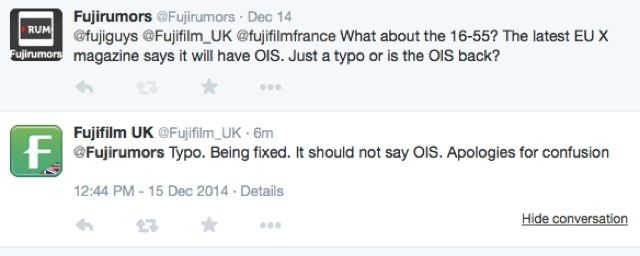
NO OIS 1: After the 16-55 with OIS at the Fuji magazine, I’ve contacted FujifilmUK/FRA and the Fuji Guys via twitter and asked for a clarification. Just now I’ve received the answer from FujiUK (thanks). It’s just a typo, the OIS was removed from the magazine. They also said:
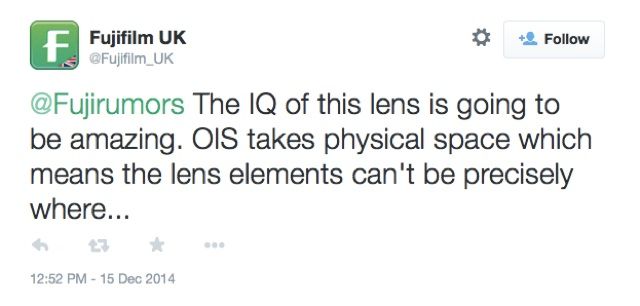
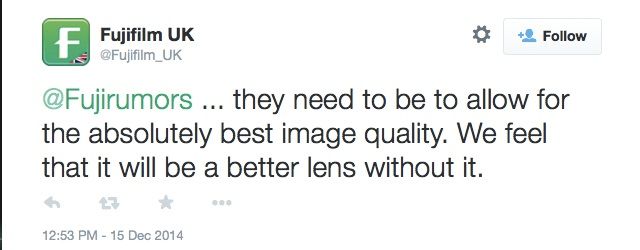
“The IQ of this lens is going to be amazing. OIS takes physical space which means the lens elements can’t be precisely where they need to be to allow for the absolute best image quality. We feel that it will be a better lens without it.“
My advice to Fuji: make an X-PRO2 with IBIS, and you could still sell plenty of these lenses. But for now, I’m afraid no OIS will be a deal breaker for many.
THE SHOWROOM
NO OIS 2: FR-reader Antoine was at the Fuji showroom in Tokyo and said that the mockup of the 16-55 f2.8 is not OIS, neither on the tag nor on the lens itself.
THE INTERVIEW
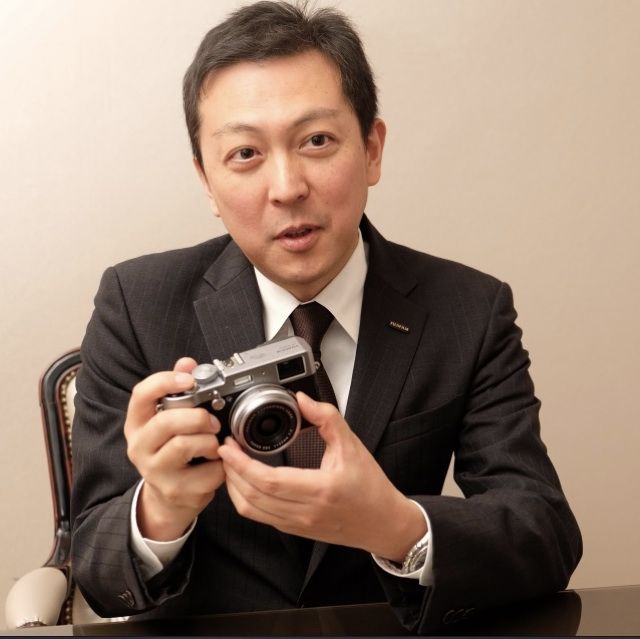
NO OIS 3: Korean interview (dated 12.12.2014) at heraldcorp (translation) with Fuji manager Hisashi Toshi. The journalist didn’t ask Mr. Hisashi Toshi about the OIS, but you can see a mock-up of the lens… no OIS marking on it.
THE PRICE: The XF 16-55mmF2.8 will cost around 120,000 yen ($1,010). This would make it the most expensive lens in Japan after the XF 50-140 (164,000 yen = $1,381) and XF56mm APD (160,000 yen = $1,347). src – Amazon Japan
“In the first half of next year, the flagship product? ‘ ASPHERICAL LENS FUJINON Nano-GI XF 16-55mm. Fujifilm released as a lens technology-intensive products will launch later this year. The price is based on the 120,000 japanese yen in Japan.”
In Europe the price could be of €1.049 (see artencraft)
THE FUTURE: Mr. Hisashi Toshi also said that the future is High End Mirrorless. Seems like actioncamerarumors was right when they said Fuji will ditch the entry level segment… finally, focus on high-end X-series cameras, everything else is just distraction.
PRICE IN EUROPE

203 Responses
Great! Now ship it already 😉
Btw the european price is 1149 € (someone spotted a belgian shop already taking preorders a few days ago here in the comments)
really? missed that… do you have the link?
http://www.artencraft.be/nl/fuji-xf-16-55mm-f28—voor-x-serie-211524
thanks, updated the post
At least a weight went off my chest, right now! It’s clear, then. No OIS – well, I hope this lens should have that amazing IQ (there is no excuse now) and the size will be acceptable, as long as we all said “good-bye OIS”. Together with the X-Pro2 it would be a stunner! Can’t wait to see it in action!
With shutter speeds from 1/24 sec to 1/83 sec and up to ensure sharp images, it will be just fine!
It will be “just” fine for 1000 lines for people with stable hands and still photos only, not for modern 4000-line pictures and not for video.
Considering the aps-c 16mp sensor Sebastian is right. If it was a 30mp+ ff sensor then it would have been a problem…for stills sharpness. When shooting the Nikon D810 it’s advisable to shoot at double the speed of the rule of thumb (i.e. 1/100 sec @ 50mm instead of 1/50 sec) or use a tripod :-). For video, any stabilization system is more than welcome.
Even 16mpix has much more resolution than 1 mpix this rule of thumb is made for. And it is not like future cameras are not going to have even more resolution.
OK, haul a tripod with you as your stabilization. The rest of the market prefers A7II and Olympus, or at least stabilized lenses.
Unless Fuji introduces a good IBIS cameras with this lens, they are done.
People declare Fuji are done after each new product announcement that isn’t perfectly tailored to their personal whims and desires. It gets old.
Sony has poor marketing. First they went with the A7 the Nikon way: stabilized zooms and non-stabilized primes – this is ok (Canon’s new aproach is even better – almost all new lenses, primes or zooms are stabilized…even the next 24-70 f2.8L will sport IS). Then they’ve changed their mind (that’s very common for them) and added IBIS. Now people will use OIS zooms on IBIS bodies…that’s stupid IMO.
ok so :
Sony :
IBIS body + IS lens = double stabilization
Fuji & this zoom :
no-ibis + no-IS = zero stabilization
Tell me who has poor maketing ?
And… many Sony users still use an older body than A7ii, maybe they’ll find usefull a new prime with IS…
I hope next iteration of Fuji will have IBIS…
Double stabilization…you’re kidding right? Using a stabilized lens on an IBIS body works like that: if the lens stabilization is better then the IBIS goes off and vice versa. So you pay more for a stabilized lens (a couple of hundreds $ more) and IBIS will outperform and turn off the lens stabilization if the IBIS is better…That’s insane!
3 axis stabilization with a lens with IS. Even if IBIS swtiched off, it’d be better than stabilization of Fuji + 16-55 (=none)…
“So you pay more for a stabilized lens”
Given the price indicated above, you will be paying plenty for a non-stabilizaed lens.
They have poor product planning, not marketing. True that.
“Unless Fuji introduces a good IBIS cameras with this lens, they are done.”
BA-HAHAHAHAHA!
You’re funny.
Rangefinder style cameras like the X-Pro1/2 or X-E1/2 are well ballanced by primes or smaller zooms like the 18-55 f2.8-4 OIS/55-200 f3.5-4.8 OIS. The larger zooms like this 16-55 f2.8 and the 50-140 f2.8 OIS are primary intended for slr style WR cameras like the X-T1 and future iterations.
The OVF is even useless with this large 2.8 lenses.
Regarding the size, I saw the mockup and it’s definitely not a small lens… but I agree, if the IQ is as good as they say, this will be my kit lens when I buy a new Fuji camera!
I’m ok without OIS it’s a fast lens, the
18-55 has OIS if you need it. In saying that this lenses IQ needs to be Prime
like at 2.8 to justify the decision. So time will tell, people lobe the 56 and
it doesn’t have OIS either.
Good point, Adam!
Exactly, is there a single optically stabilised 50-55mm prime lens on the market? It’s certainly not common if there is.
Not yet, but next year it will be: the Canon 50 f1.8 IS. Canon’s new prime non-L lineup (24 f2.8, 28 f2.8 and 35 f2) is stabilized.
Well that need some reason for people to replace their perfectly good old 50mm lenses 😉
Canon’s 50 f1.4 and f1.8 have poor IQ on the newer bodies like the 6D/5D mk III and they are also 20+ years old (film lenses). So IS is not the main reason. Older lenses tend to have poor IQ on high resolution bodies. The Sigma Art f1.4 is great if your’re not concerned about bokeh and wide open sharpness. For that purpose there is the 50 f1.2L but that’s a very expensive prime…
I’ve was a Nikon shooter so can’t speak to Canon, the 50 Gs are pretty decent though.
Yep, very good IQ but those are new lenses…
Yes and without stabilisation.
That’s Nikon’s way…stabilized zooms and non-stabilized primes.
Yes, the Sony 50mm SEL 1,8. A very sharp lens at that, and cheap, second had you pay less than 200 now…
I never greatly missed VR (NIkon’s OIS) in the 17-55 f2.8 when I had it. I’m sure this lens will be fine without it. The 18-55 f2.8-4 is still a very good lens and has OIS for people desperate for it (plus smaller, cheaper etc).
Unless you have super shaky hands, by the time you’re down to shutter speeds that are going to significantly benefit from OIS on such a short focal length, your subject’s motion is more likely to be a problem. No one cries for OIS in 50mm primes so I don’t see why it should matter more in a fast zoom.
Absolutely! There is life without OIS, especially at this focal range.
Well, the way some of these “photographers” complain, there is NOT life without OIS. I wonder if they need to get out more and take pictures….
Right. Some of us need to go back to film, for a while, then we’ll be more than happy with what we have now from Fujifilm X series.
Excellent point. I recently started using Tri-X again in my Leica after not using Tri-X for 15+ years, and I am in love with real photography all over again. Maybe your statement should be, “Some of us need to go back to film, for a while, then we’ll be amazed at the artistic content of chemical-based photography.” Cheers…
Absolutely correct! Film should never die! It’s funny, but the more the technical limitations, the greater the creativity. And satisfaction! When I take off and XF lens, and put on an old Manual Focus lens, the joy begins!
Exactly.
Yep, most of the haters are people who didn’t want to buy it in the first place, OIS or no OIS… you know, because primes are what you should have on your camera when you are a pro. Zooms are so boring 😉
Try living above the polar circle, its dark now..
Well you have three options: Tripod, flash or buy the OIS 18-55 😉
No OIS means it’s even more attractive, for me that is. I’ll probably sell the 23 1.4 and just get the 16-55 2.8. Cannot wait for it to hit the market!
Translation of “physical space” BS: “We already calculated this lens without OIS and our R&D budget won’t allow for a recalculation”. I have no doubt that this lens will be tack sharp, but fast normal zooms are extremely boring to begin with.
It’s entirely possible they set out an initial size, weight and cost goal for their lens and just couldn’t meet it while including OIS. They decided (rightly IMO) that OIS is in the ‘nice to have’ rather than essential category for this class of lens and designed it based on that.
Let me repeat myself: fast normal zooms are extremely boring. Most people overestimate their ability to handhold, so unless shot in broad daylight or from the tripod, they will never actually see that spectacular IQ. And how the lens renders the picture is nothing to write home about when we speak of fast normal zooms. In my career I’ve seen only one such lens with impressive, even exceptional, rendering: an old (circa 1993) Minolta G zoom.
There are currently two ways to make fast normal zooms somewhat attractive: making them faster than fast (Sigma way), or adding an OIS (Canon way). The rest is pretty much moot, especially in a Fuji world where Fuji has no competition.
No OIS. Really wondering, if Fuji is also going the IBIS way. It seems this is the future
IBIS would be wonderful, especially given how many primes Fuji make. Save the fancy OIS for the longer zooms where it’s most beneficial.
exactly my thought! Hoping Fuji will go this way (then there are only 2-3 features and 2-3 lenses missing!)
A little bit funny that the DSLR-competition can develop very high end tele / zooms with IS that are tack sharp from center to corner. And if the future is really set on ‘high end’, start replacing that old 16MP sensor by something more compelling. Noticed the silence over future models, do I feel shifting the X-Pro2 once again to +1 year from now?
Well, everybody already knows the next camera body will sport a better sensor…
1st of all, UK and all other non-Japanese representatives of Fujifilm and other Japanese camera manufacturers are simply marketing know-nothings.
Their purpose is to sell, not to tell the truth.
Of course, hand-shaken IQ would be “better” – and I have a bridge to sell you.
I agree…who wants OIS in a short lens like that? Canon doesn’t do it on their 16-35.
1) This is not 16-35 equivalent, it is 24-82 equivalent.
2) Canon DOES it on their new 16-35/4L.
In a first sentence you set the scene exactly where it belongs, in an APS-C world. Then suddenly, you refer to FF lens. Why? Canon has a nice APS-C 17-55/2.8 IS.
$1200? At the price of X-T1 with that lens without OIS, you can have Sone A7II with 24-70 with 5-axis IBIS+OIS, Olympus 5-axis with 12-40/2.8 even cheaper. Why would you want your handheld images blurry or limited to good light only, and video useless?
The Sony Zeiss is an f4 lens not a f2.8 and it’s also a mediocre one (edge sharpeness is poor even @f8-11 at every focal and performance @70mm f4 is also poor across the frame – even in the center). If you want to compare the tree lenses in dof equiv numbers the Sony is an f4, the Fuji an f4.2 and the Oly an f5.6. Imo the Fuji lens will sport the best IQ when compared to the other two, it’s f2.8 (t3.2 probably) and it has no dof control handicap over the other two (the Oly one is the real loser in this category). I agree that stabilization is a nice feat to have even when a fast 2.8 standard zoom is concerned…
The Oly is NOT the loser in this category … at all. It’s as sharp as a prime, wide open, and corner-to-corner; in fact, best zoom in the world right now in that focal length (equiv.) range. Plus, of course, Olympus also offers IBIS.
You can argue about the relative merits/shortcomings of the m4/3 sensor, but the Olympus premium and PRO zooms are optically stellar.
Read more carefully next time before replying. I’ve said that the Olympus lens is the loser regarding dof control (vs. the other two). Otherwise it’s a very good lens but not a stellar one…IMO lenses that have huge distortion (especially barrel one) are not stellar and are heavily based on software corrections algorithms resulting in resolution loss/crops and some artefacts. This is one of the drawbacks of the MFT system and its design…along with poor ISO performance even at lower values (and nasty artefacts) compared to bigger sensors.
P.S. I’ve tested the E-M1 so I can judge IQ vs aps-c and ff as I’ve used or use both.
Perhaps you should WRITE more carefully next time then, and delineate your thoughts about IQ and DOF in separate graphs.
So glad you’ve tested the E-M1. FYI, I own full frame, APS-C AND m4/3 (E-M1) and know exactly how each performs relative to the other.
As to software corrections, guess what? They’re all doing that now, including Fuji. How they get to final optical excellence doesn’t matter a stitch to me now that we’re in the digital world, since at the end of the day it’s all pixels anyway (and often being further manipulated in post by the end user).
I’ll say it again: The Olympus 12-40 f/2.8 is a STELLAR lens and easily outperforms my Nikon 24-70 f/2.8 for sharpness and micro-contrast. Don’t believe me? Do some reading on the subject and educate yourself.
I’m not going to get into the IQ differences between m4/3 and larger sensors. That’s a whole other topic.
It is f/4 lens, but the sensor is 2.5 times bigger, making up for the difference in ISO and then some. And than IBIS will give 4 more stops of light advantage if 16-55 is stupidly lacks OIS.
yes you could, but it is about the system. Have you seen the size of Sony’s 35mm f/1.4? And the 24-70mm is a mediocre lens in any case.
Well, there won’t be anything comparable to the 35/1.4 in the Fuji system and you can still get the very well performing 35/2.8. Peevee’s point still stands – that 16-55 is really expensive.
The Sony/Zeiss 24-70 is crapola. A total blight on the Zeiss name.
As mediocre as it is, I bet it on A7 II gives more detail than this 16-55 will at any light, even from tripod, and INFINITELY better handheld if that 16-55 does not have OIS.
On the A7R, on a tripod, sure. But on the A7II? I doubt it, but since the lens isn’t out yet there is no way to know for sure.
Stabilized camera gives more resolution handheld even at the same sensor resolution, and here we have 24 vs 16. No contest.
not if the lens is mediocre it doesn’t
Why are there so many quarrel about 16-55 OIS?
1. Canikon is going the same way 24-70/2.8 are not stabilized. It’s normal.
2. Stabilization is mostly critical for telephoto lenses.
3. Standard fast zoom is an action lens. People usually shoot 1/125 and faster with these anyway.
4. OIS makes lens not that sharp. It also makes it heavier. We already have almost the same: 18-55/2.8-4 OIS. it’s already a great lens. You can’t get maximum sharpness with stabilization anyway. Thus one will need to choose. Weather get 16-55 for top quality on the tripod or high speed. Or small stabilized 18-55 for hand hand statics.
I think the main problem is that it was marked with OIS label at the roadmap at first. People got used to the thought 16-55 will be stabilized and now feel that somebody steals something from them. It’s normal that 16-55 is not stabilized. Of course it would be great to have OIS but not at the price of size, weigth and IQ.
Stabilization is nice for wide-angle shots in very dim environments, or for panning action shots.
Wide angle? I can get sharp results with my 10-24 at 16mm at 1/2 with OIS on and at 1/8 with OIS off. That’s two stop difference. When I get 16/1.4 at 1/8 it will be one stop advantage. So sometimes it’s better to have fast wide rather than stabilized one.
Wanna bet that the next iteration of the Canon 24-70 f2.8 will sport IS and will cost almost 3000$ when it will be released?
We will probably have to wait for a long time. Fuji may introduce second version of 16-55 with OIS or sensor stabilization by then. Or the planet will be crashed with an asteroid. Let’s wait and we will see.
Wanna bet?
$5 on asteroid.
I will be the one looting and running with fire on a stick when the asteroid comes. And will probably steal the non OIS version 16-55 f/2.8 fuji lens from the local camera shop and take beautiful sharp photos and post them to instagram right before it hits!!!
Ok, let me say it again: Canon has a great 17-55 mm 2.8 IS, which is the exact correspondent for this lens. The 24-70 is a full frame lens – different optics, more glass, larger image circle to cover etc. This is not a full frame lens and should have had OIS.
I own a canon 17-55 (use it for video, and it’s a good lens). I would hope the fuji will be more compact and have better image quality. We won’t know until it is released so it’s early to criticise.
You’re right. I remember that Nikon’s 17-55/2.8 is not stabilized but I’ve forgotten about this canon. Nevertheless it’s not just about optics. It’s about marketing. Canikon treat their crop segment quite low (this is a single professional lens in both setups). Thus canon surely can include IS even though reducing the sharpness. When it comes to professional FF segment, they choose the opposite. Just like Fuji.
Fuji is not brave enough to make a lens like the Sigma 18-35 f 1.8. They just made a boring expensive slow standard zoom lens without OIS. Samsung at least have a F2-2.8 standard zoom with OIS. And it’s cheaper then the Fuji counterpart. Ah, and sorry Fuji but with that 5yrs old 16mpx sensor the high-end thing start to sound like a little bit BS. A Fuji user
Where’d you pull that nonsense from? The majority of Fuji’s lenses are faster than the competition. The 18-35 Sigma is a big heavy lens with a very limited range and is built for systems where f2.8 ‘boring slow’ zooms are already available. If the Samsung kit is so appealing, eBay your Fuji gear and go enjoy their gear instead because as a CE manufacture, sticking bigger numbers on each new model is what they do best.
Sorry to disappoint you but I’m making money with Fuji gear as a Photographer.. Not going to sell anything tomorrow on ebay. I’m simply disappointed by some Fujifilm strategies. I love the fuji Primes, and I think a F2 zoom would have made more sense as we are speaking about crop sensors. As I’m not a Fan Boy I can sound harsh to some extreme Fuji lovers.
It’s not about being an “extreme Fuji lover”, it’s about having realistic expectations. an f2 17-55 would be as big or bigger than the 50-140 and crazy expensive. Look how big the Sigma 18-35 f1.8 is and that’s a much shorter range. There’s a perfectly good 18-55 f2.8-4 zoom with OIS and if you need a wider aperture at the long end buy a prime and potentially a second body to use it with if you don’t have time to change lenses when working.
Did you really just use Samsung to compare the optics to Fuji on Fujirumours? Your comments are laughable at best & pretty much just called yourself out there as knowing f**k all.
Well done mate, you really made statement about yourself…
You just said…
“I’m with stupid!”
So Fool Troll Child, how old are you?
Samsung + cameras = joke.
It’s not a deal breaker for me at all. A lot of my work is done on a tripod.
I’m relieved. Bought the X-T1 in the spring, believing that the new weather resistant 16-55 mm would be released in the autum, according to the lens roadmap at the time. I have been using Nikon gear the last fifty years, but want something significantly smaller for outdoor leisure use without compromising quality. So for me the smaller and sharper, the better. Well thought, Fujifilm !
I have to quote Trenton:”Fast normal zooms are boring” – maybe nice but boring. There will never be a “ahh-effect”, that one you will only get with really fast primes.
Fast normal with OIS would be less boring. However, I normally shoot people and they move. Therefore in that range I really seldomly need OIS. But again, I would welcome it if it is there, but don’t mind when it isn’t.
BTW: Have I told you how great and wonderful the 50-140 is, and yes, I do love the OIS it has 😉
40-150mm is the focal length where OIS really starts to make sense. Under that, it mostly makes sense for video, and you don’t buy Fuji for that 😉
This is the ideal lens for low-light events photos, and in those subjects tend to move 😉 1/60 is the minimum I use in those situations.
When I would want really low shutter speeds at this focal length, carrying a tripod opens up far more creative possibilities. I know it sounds a bit contradictory, but if OIS implementation would significantly increase the size of the lens, I would rather not have it (and that’s what Fuji implies).
A lot of people think that OIS is s substitute for using a tripod – it is not. OIS will never ever get you into long exposure territory, for example. Wonderful for cityscapes, night street shots, scenes with water in them, use with ND filters, etc.
With Fuji, the overall smallness of the system has a significant benefit – smaller accessories. Smaller bag, smaller lenses, smaller tripods. I can get one of those cheap Benro carbon fiber traveler tripods for the Fuji. I don’t want to increase lense size, because your tripod size depends on it as much as it depends on the camera.
It’s sickening to see some people demanding full FF equivalence in terms of DoF, F/1.8 40-150 zooms and such (that would probably come in as big as the Nikkor 70-200 F/2.8. Then you’ll lose all size advantage of the Fuji system – you’ll need a bigger bag, bigger tripods, and you’ll look stupid (just imagine how that Nikkor best would look like on a Fuji body). Buy a damn DSLR if size doesn’t matter 😉
I hope Fuji will make the filter diameter 72mm for my seven5 filter system and not 77mm. Please!
Try to use a tripod in a museum 🙂 OIS is a great help to keep iso low to maximaxe detail and get sharp shot.
I think we need to wait and see. I have 2 18-55 lenses (one is a spare), and I like them, but I rarely use them with shutter speeds less than 1/125 anyway. If this lens is significantly sharper than the 18-55 (and the AF is as good or better) it’ll be on my wish list once the early adopter tax has subsided.
This is fine if the new Fujifilm bodies have “in-body” stabilization like Olympus and Sony. I would not buy this lens with or without OIS at this price point. I am going to try some of my other brand zoom lenses with my current Fuji bodies with an adapter. I can live fine with an 18-135mm or the 18-55mm Fuji X Zooms.
So what is “Nano-GI”?
A very very small military personnel.
Allright, I am going now 😉
I think we can all agree on one thing here – no matter what Fuji announces, everyone will complain about it. The people who would never buy will complain, and the people who will buy will complain about why the item in question doesn’t have _____ and why it has _____.
And with all these constant complainers, I really just wonder why you don’t return to your old Canon or Nikon system.
Or, you can be constructive and say : “I like how [this brand] designed [theirs products] but it would be even better if they did [this modification on this product]”. If everybody told Fuji their camera are perfect, they will never evolve…
Example : I like Fuji ergonomy, jpeg engine (etc) but I’d like video to be improved !
And I always prefer reviewers that also tell us the drawbacks of a product, because, except in sponsored reviews, there ARE ALWAYS drawbacks…
And : complainers’s hunting is a complain too 😉
Good point.
Because they did the same with them !
No! I am happy with it. I will buy it. I hope it comes in a set with X-T2.
Oh, no, here we go again. All the complainers state they would never buy a lens without stabilization, as if photography is not possible without it. It sounds like car-buyers who claim life could not continue without leather seats and 20″ alloy wheels. Gag, retch.
Both versions of the Canon 24-70mm (I and II) don’t have IS. Nikon’s 24-70 f/2.8 doesn’t have VR…So get over it people OIS not in Fuji’s 16-55mm f/2.8 makes the photos that come from it sharper. LEARN TO BE A BETTER PHOTOGRAPHER IF YOU ARE GOING TO USE THIS LENS!!! The rest of the world is dealing with non IS or VR 24-70mm f/2.8 lenses so you should also!!! Sheesh…
Thank you for your advice on how people should spend their money or do their photography… because there is ONLY one way here 😛 LOL
I do see a value in IS/OS/VR but I’ve been shooting for 20 yrs and the first lens I owned with the technology was the Fuji 18-55. To be honest I think it’s overrated in most cases.
Oh no, here we go again with all the pretentious people telling everyone what they do and don’t need in a piece of gear and how “real photographers” do things. Here I was under the impression that having a wide angle lens with OIS was useful to ME when shooting dim building interiors or street shots with low light, but now I see that I was wrong. Thank you for showing me the error of my ways oh wise one.
We’ll see. I have always been clear that I prefer a stabilized premium zoom over a non-stabilized version. I am on the record about this, so Fuji knows my thinking that a non-OIS version is a mistake. OTOH, I keep an open mind. I’ll know more in a few days from first-hand experience. That’s all that counts in the end.
Good to hear, Rico !
Let us know about your experience in those few days !
I’m with you Rico. On the smaller frame camera and with a smaller sensor, OIS is not just something nice to have. For some, like me, it is nearly a necessity, especially at the 45-55mm end of the focal length. Camera shake, as I get older, is an issue. 🙂
With the 18-135mm, I can simply set 1/8s (or even slower speeds) and shoot away at ISO 200 or ISO 800 in poor light or at night, even at the 140mm setting of the lens. The OIS is that good, and the new one in the 50-140mm is at least as good.
In the past three weeks in Santa Barbara, I shot pretty much everything with base ISO and a few interiors with ISO 800 (and DR400%, so basically also base ISO, but with a different tone curve). The 18-135mm and 10-24mm did the job thanks to the OIS, I didn’t need a tripod (and wouldn’t have been allowed to use one at several locations, anyway).
So yes, a non-OIS zoom is a drawback in my world. I rarely (if ever) shoot “action” in the 16-55mm zoom range, but I frequently shoot landscape (dusk, dawn) and buildings (interiors) at 16-23mm using slow shutter speeds. I don’t consider my X-T1 an action camera, but a great travel camera.
Does anyone know whether there will be an X-E3?
It’s sickening to see all these demands, regardless of the cost in size increase. Fuji’s explanation implies that implementing OIS would significantly increase the size of this lens. Size is one of the most celebrated aspects of the Fuji system.
People demand things like FF DoF equivalence, F/1.8 zooms for instance. Do you have any idea how damn big a 40-150 F/1.8 would be for example. Just imagine how the 70-200F/2.8 Nikkor would look like on a Fuji body. You would need a DSLR sized bag (and a tripod built to support big heavy DSLRs) – why don’t you buy a DSLR?
I don’t say I wouldn’t be happy with OIS on this lens. It would be useful for video IF fuji can fix that aspect of the camera. Right now – who would use Fuji for videos anyway? For static subects, or cityscapes, night city scenes, landscapes carrying a small, lightweight carbon fiber traveler tripod opens up more creative possibilities than OIS – you can’t get into long exposure territory with OIS alone.
For anything that moves (low light events, festivals, concerts, shows) this will be the perfect lens, and I’d take small over big any time for that kind of shooting. You’ll need at least 1/60 shutter speed to capture moving subjects (and good timing skills) – and OIS won’t help a bit. OIS really starts to make sense above this focal range.
IBIS is a different thing though – would be nice to have it in the X-Pro2 provided the video issues can be sorted out. I don’t do videos yet, but I’m planning to as a lot of people ask for it. I would love to stay with Fuji on this, and if Fuji is serious about sorting those issues out, than IBIS would open up some good creative options with those super fast primes. Since nobody ever floated any kind of rumor, I don’t see much chance for this, but one can only dream 🙂
Well, we shouldn’t really expect anything but self-serving statements from marketing personnel. Let’s look at their past record of forecasts and we can judge for ourselves the credibility.
The future is high end. Well, yeah, cuz nobody bought your low end models. The future is mirrorless. Well, yeah, cuz nobody bought Fuji DSLRs.
And of course, margins are greater on high end. Margins are greater for mirrorless (reduced costs) vs. DSLR.
In the past, they thought the future was low end, and the future was DSLR. Now they think the future is something else. Let’s see what Mr. Market says about that this time, because right now Mr. Market is feeling a little tapped-out.
Maybe they just paid attention and learned from their mistakes?
Has anyone heard about when the new firmware will be released ? Curious if the auto exposure while using fill flash will improve. It seems pretty bad right now. Not sure how Fuji let that pass.
18 dec
Right so, to be honest, I would have liked to have seen OIS on this lens, but for whatever reason, it ain’t happening.
Seeing as Fujifilm has a proven record of listening to it’s customer base & this issue has been batted around for a long time on here, & just about everywhere else in the Fujicentric media, it must be too much of a compromise optically or size wise as Fuji have stated, because they would have changed it otherwise.
This is a lens aimed at enthusiasts/pros I don’t think it’s make that much difference to them because they probably know how to hold a camera.
The only Pros that I could see this being really bothersome for, would be paps, who wouldn’t use a Fuji anyway, coz they just generally paracites who just stick their D4s/1DXs over their heads and point at celebs falling out of nightclubs without even looking & peel off 30 quickfire shots, in the hope that one will sell…
I’d like to add that maybe IBIS is indeed coming on the XPro2 or XT2 and that could be the reasoning. Especially the XPro2, I’m expecting a big beast with an equally big price tag.
To focus only to high end prices will break their neck.
The brand Fuji is not like LEICA!!!
Hey they are not cheap but they are a long way from Leica prices!
Don’t read too much into that statement. Much can be lost in the translation. Fuji has learned that the entry level market is being swallowed up by camera phone users. Very little to no profit there.
They know where the demand is, and they know at what price points they can make a profit. It is obviously at the X-E2 level and above.
High end to them does not mean Leica prices.
Why are you talking about Leica??? Do you know that the Fuji 23mm 1.4 would cost you over $3000 in ‘Leica’ dollars??? Fuji is not cheap but the Leica comparison is ridiculous.
There is a leak. Google for x…….dat
its might be sign of something similar like in camera stabilization have you seen new sony a7II 5axis in camera stabilization? i hope one day Fuji will make something similar ability to use any lens and get ist stabilize …i think its better then is or vr or ios or what ever in lens … high end? why not i think its clear Fuji is reaching more and more pros and demand is shifting …
I don’t think Fujifilm will make in-camera stabilization (like Sony did) on their APS-C line products. They’ve already created this great OIS inside the lenses. If, one day, they will move towards Full-Frame or Medium-Format, a remote possibility exists that Fujifilm will implement in-camera stabilization and all the lens range will not require OIS anymore.
For wide-angle and standard lenses, I don’t need image stabilization. I am happy that Fuji is choosing image quality over IS. For telephoto, it is needed. For wide-angle and standard lenses, it is only necessary if you are shooting in the dark without a tripod.
And honestly on a wide angle/standard I only use it to later regret it when I realize I needed a faster shutter speed to capture my subject without blur anyway.
I think it will be a great lens that I’m not going to have.
Admin is absolutely correct. This is a dealbreaker for many, including me. I was ready to jump in and invest in the X system, with my first purchases to be either the X-Pro2 or X-T2, along with the 16-55mm f2.8 but only if it had OIS!
Now, I will probably buy the upcoming Sony A9, which will undoubtedly include IBIS. Sorry Fuji. About the only thing you could do to save yourself is to add IBIS to your next-gen cameras too.
Not exist any of them. Master hopefully squeeze more percentage of cotton out of you, lol. Too much time to think about camera, you niggr should think more about cotton picking to earn Leica Noctilux for me!
Oh, and here’s the other troll who can’t even put two sentences together, let alone one.
We all know you’re a cheapskate and troll (see 43 Rumors). You don’t need the new 16-55mm in order to invest in the Fuji-X system. What BS. It already has great lenses (with OIS) and great cameras. And YOU will never buy a Sony A9. What a joke you are.
To each their own. It is a personal decision for anyone whether they choose to purchase into a new system. For me, and many others at least, the lack of OIS on a pro-designed standard zoom lens is a dealbreaker. I’m sorry you have such a difficult time accepting that.
I’m so tired of people like you who come here to complain about everything under the sun. If you bought this lens and used it, I guarantee you probably would have no idea if it had OIS or not. Stop relying on or complaining about technology which you don’t even need. 10 years ago, for example, people didn’t shoot? They played down their cameras and made a pact to wait until the day OIS was invented? Get real. But a camera and some lenses and go into the world and use them.
How does someone guarantee something before the product becomes available?
Still, I acknowledge that for you, OIS may not be important. However, in the current market, an outstanding feature, such as OIS, that can be found in other systems will not go unnoticed. Why should anyone buy into a system that lacks something they deem essential when it can be had elsewhere? Just because you don’t care about it doesn’t mean there are others who do.
Oh gosh…
can’t anyone hold a camera steady anymore?
Is everyone shooting in the dark?
I am sometimes. I also like the possibility to stop down in poor light (think dusk) for increased DOF (think f/11) and still be able to get tack-sharp results at base ISO. No problem with current XF zooms that feature OIS, but I don’t want to schlepp along redundant zooms. I’d like the 16-55mm to be the only zoom in my bag with this range.
I agree. This lens could have been the only lens to carry in my bag but I, too, sometimes shoot in dimly lit scenes and, for that, OIS is essential. I can only hope Fuji will one day add IBIS to their future bodies.
Save themselves from what, exactly? From you not buying their camera because of a single omission?
Oh nos…!
Like the old saying goes: “Don’t let the door hit you in the a** on the way out.”
It just seems like some form of stabilization has become an essential selling point to all modern lenses these days. If Fuji refuses to give its customers the features they want (and it appears many want OIS), they may lose potential customers in the long run. I am sure I’m not the only one.
They don’t exactly “refuse” they rather explained the reasoning behind their decision; You may or may not agree but they are open and up-front about it;
Nikon’s 17-55 2.8 DX has no VR (OIS) either and many photographer would rather die than let this lens go. I trust Fuji to be able to come up with a very spectacular lens;
I was very close to buy a 56; I have now decided to sit on it for a few months and look at the first reviews.-
True, but it would have been useful, and it would have given them a differentiation point in this focal range in comparison to every other manufacturer.
I’m not sure “just as good as the Canikon version” is a selling point for mirrorless companies trying to grow market share.
Agree on both points;
Now in /my/ experience Fuji lenses are second to none and a large notch above Nikon’s. We know they know how to build an OIS (18-135 and 50-140 are two valid examples) and if they say ‘nah’ I believe it is because once delivered, almost none of us will think twice before starting to drool over it.
I trust them to come up with a lens significantly better than Nikon’s offering (50-140 is an example of that compared to the 70-200 2.8 VR on FF) and even more much better than their own already good 18-55 2.8-4 OIS which most of us, I believe, already have.
If they don’t …. then I will be much more inclined to think “Well at that level of quality they might have as well put in what we wanted” . But so far I find their system to be competent and well thought out; A system I really enjoy shooting with and which has given me back to pleasure to take pictures – Something Nikon never managed, so I may be a bit “over trusting” with them; Wait and see.
I’m one of those people who wanted to see OIS on this lens; but that’s a far cry from thinking that the company “needs saving”.
Go to hell Fuji, go to your fuking high-end hell
Someone needs to get a third job to afford their high end?
Looks like everyone has Parkinsons
Maybe. To be honest, I have a hard time shooting hand-held at 55mm and 1/8s or 1/4s while standing up without an OIS. But that’s what I happily use with XF zoom lenses that are OIS enabled. My current hand-held record is 1/2s at 140mm. It’s a great feature that works, so I’m willing to pay for it, and I guess so are others. Those folks will be reluctant to buy this lens, as it’s quite expensive and it’s missing a key feature (for them). So Fuji’s target group will be smaller, which translates to reduced sales. Obviously, the lens will be bought by those who don’t need/want an OIS and are willing to pay a premium for ultimate zoom IQ.
And i agree (i used a Nikon D700 with a 24-70 at 1/10 with great results), although i rarely came across on a situation where i have to use very low speeds handheld (1/4 for example). I just crank up the ISO, use flash or a monopod. The OIS on larger focal length it’s understandable, but on wide/normal zoom lenses?
It just seems like everyone else just wants OIS for the sake of it. How about working on a better shooting technique?
Because anything that further stabilizes your camera is going to result in better IQ. It’s an established fact that mounting one’s camera onto a tripod yields better, sharper images … even when shooting above 1/60 of a second.
It’s physics.
Sorry, but not anything. Sometimes IS, OIS, VR, etc. can degrade image quality
Sure, but it’s up to the photographer to understand his or her gear and recognize those situations when they arise. All things being equal, I’ll take a stabilized lens over a non-stabilized lens any day. Though I will concede that not having a mirror slapping away probably gives mirrorless a bit of an edge in stability right out of the gate.
I have not any problem with this lens not having OIS.. I would have loved it to be a constant F2. And I would have paid 1500$ for it. I’m totally sure Fuji can make it. But if you think that today you can get the standard 18-55 kit lens with OIS, that performs admirably for his price and it is only slightly slower, nearly for free with any X-camera I cannot find too much interest for this lens really.
Nobody’s ever made an f/2 lens in this focal range … and I suspect it will be a long time (if ever) before anyone can.
Rack this lens out to 55mm and shoot with it in reduced light, and you will be glad for OIS, believe me. Pity it won’t have it.
ok, but…min shutter speed to avoid blur:
16mm 1/16*1,5= +/- 1/24
24mm 1/24*1,5 = +/- 1/36
35mm 1/35*1,5 = +/- 1/52
55mm 1/55*1,5 = +/- 1/83
I hope to see a firmware update who set (automatic) min shutter speed according the rules above (min shutter: focal length *1,5)
That’s exactly how Auto-ISO worked in the X-Pro1 and X-E2 until users pressed Fuji for a firmware update that changed it to the current paradigm. In the end, Fuji complied and made the change.
Well, I can’t improve my shooting technique to hand-hold 1/4s without OIS. It’s actually hard enough to hold such speeds using OIS. I need both, a state-of-the-art OIS and good shooting technique to pull it off. And I love the results.
That’s great Paco, but the Fuji’s are very small with a smaller, densely packed sensor compared to the larger full frame 12mp D700. I never had the problem with camera shake with my D3 or D4 as I am having with my X-T1 and X-E2. My commercial photography days are now over, (retired). I shoot 100% for stock now with a very demanding stock agency. I need to shoot base ISO if at all possible, not 800 or 1600 to “better my technique”. If OIS at any focal length will help me do that, then I’m in. It’s not just a piece of pretty kit for me.
Nikon’s 17-55 2.8 DX is said to be an excellent lens – sharper than some of their primes from the G series; I trust Fuji to be able to pull a remarkable lens
1- contrary to popular belief hand shakes is neither definitive a symptom of Parkinson’s disease- nor really a laughing matter, as it happens trust me on this one
2- Some of us are either retired or simply getting older – and hands are simply not as steady as they used to be.
3- Even without any disease the Fuji bodies are small and light – which is great – but it is much more difficult to keep them steady than say a D2Hs, a D3 or a 5D (pick your poison)
This is not a surprise. You’re going to see all the major established manufacturers move higher end. You’re also going to see the imaging divisions of several shrink in size. I anticipate that Nikon’s camera division overall is probably going to be forced to shrink in size to pre-1990s levels. I simply can’t see any other option.
More on that here >> http://www.dslrbodies.com/newsviews/and-the-final-group-waiters.html
At first I was very pump on getting this lens, whether it had OIS or not. But let’s just say this lens would go for $900.00, let’s just say thats the price, just a guess. I cannot really justify spending $900.00 for this lens when you can find a 18-55mm used in excellent condition (keh.com) for $352.00. Spending $548.00 for an extra stop on the longer end with no IOS just makes no sense to me. Just my opinion, if you think different. let me know.
Good point, technically speaking!
I agree, but it might make sense if the new lens is considerably sharper than the 18-55.
Not a deal breaker for me!
If they could stabilize my subjects, I’d be happy 😉
Rather have good optics over IS.
My subjects are always moving, not me. I learned good technique to keep myself still, but I can’t keep them still.
Also at this focal length, lack of OIS is not so bad. Now if it was on the 50-140…THAT would be some trouble.
Right – for this focal lengths, great IQ will be more likeable than a OIS – I will order the 16-55 as soon as it will be possible, that´s the lens I´m waiting for (even the 18-55 I used had the stabilizer off 90% of time, it was not need with 1/80 or faster).
Fuji continues to neglect video. The 16-55 with OIS would’ve made a great video lens (like Panasonic’s 12-35mm 2.8). At this point I wish Fuji would drop video altogether and add advanced HDR bracketing with timelapse. Something unique for still photographers.
Fujfilm doesn’t care about video and don’t want to improve it
Video is a check box feature for Fuji, it’s not something they take that seriously so I wouldn’t expect lenses designed for it. Stills cameras usually aren’t very useful for video anyway without a ton of expensive accessories, most people would be better using their smartphones or buying a dedicated video camera for serious work.
There are obviously pros and cons for both OIS and non-OIS lenses but instead of stating my own point of view on the topic I’d like to add a different voice to the discussion:
I am quite sure Fuji did not only think and discuss all of these issues, but they also did something nobody in this comment section could have done: they built prototypes of both and tested both and only then made the decision based on these results. And I am sure for good reason, be it technical, financial or who knows what.
If the future is high end, they need to start putting high end sensors in their cameras and ditch x-trans. I LOVED my X-T1 ergonomically, everything about it, but sold it because basic IQ couldn’t match my other cameras. Colors were more difficult to get pleasing, and handling of highlights was awful in high contrast situations. It took a lot more work to get a nice looking result. In lower contrast scenes there wasn’t a problem but when travelling one doesn’t always have the option to wait til it’s overcast or sunset! I also found there was zero resolution advantage to x-trans. Please ditch it and get some state of the art Bayer, or offer a high-end alternative in Bayer for those who don’t like x-trans, and I’ll be back to Fuji like a flash!
if you like bayer’s sensor, you can buy a different camera who match your colors.
He said he sold it, why tell him to do something he already did?
BTW, if someone likes a product (he said he loved it, ergonomically, etc) but dislikes one characteristic only… he should go and buy another camera and don’t give feedback about it? How can products improve if no one mentions the bad things. Maybe being a Fujigay you take it personally… but feedback and critiques should be welcomed and even asked for.
Personally I don’t dislike x-trans, i dislike adobe support of it, but that’s another story
Each to their own – personally, I would hesitate to buy a Fuji _without_ X-Trans. I just love the way noise starts to look at higher ISOs in comparison to Bayer noise, especially with regards to chroma noise, which I find really irritating.
1049 euro without OIS?..no problem, but only if I will see an awesome mtf ..a sharp lens edge to edge (from 16 to 55) e no distorsion.
Sure. You realize there is hardly a prime with no distortion? The 14 and 23 are really exceptions in this regard.
fujfilm XF 16-55 2.8 is an awesome lens!
If it’s an instrument for the traveller then linear distortion @ 16mm, border quality at f/4 and control of corner CA are more important than IS. If the light is low it’s not a great fatigue to take one of the 1.4s out of the pocket. But if the basic parameters make proper correction hard to obtain, then the whole point of “universal” lens is lost, and the same job can be done by the wonderful lenses most of us already own, 14, 23 and 35. The thing that makes the Sigma 18-35 so convincing is not the 1.8 max aperture; it’s the fact of having a zoom you can trust at all or most focal lengths. That’s what a working photographer needs
Spot on.
I doubt Fuji can make High End mirrorless based on its current cameras with dissapointed AF performance that also focuses only 0 EV. Fuji cameras are so poor cofigurable compared to Canikon and Sony, that will make you irritaded, also AWB does not perform as good as other brands, and really bad in mixed or artificial light . Body design is great but other aspects are so so, mostly overrated with hype of fuji fanboys. If Fuji wants to reach high end level, it should put more efforts on the cameras instead of PR.
you forgot the Sarcasm mark
i hv always wanted Fuji go full frame. with canikon coming in just a matter of time, Fuji can forget about it all together. Do it or be a watcher of someone else doing it.
http://www.mirrorlessrumors.com/at-last-also-nikon-is-coming-full-frame-lens-patent-for-mirrorless-system-camera-spotted
forget FF on fujfilm. it’s not its market. if you don’t like this, you can change camera. no problem.
How would one know it’s not its market? Where does that opinion originate from? Why does full frame cannot co-exist with APSC in a Fuji X-system? why so against it? how does it hurt you indirectly, if it does? we really need to examine these and know why.
sorry, not enough profits
the reports below is very clear…impressive..and drammatic
the units sold ..are less and less (10%) every months!
2012 was an amazing year for ML
2014 will not be an amazing year for ML (1 milion less each months!)
as you see …in the period considered, some manufacturers reduced their production or closed their plants what makes you think they are going to “build” a new plants for FF in this drammatic period? ..for mankind?..not sure, they want make profits not charity;-)
http://www.cipa.jp/stats/documents/e/sw-201410_e.pdf
smartphone are going to kill…the real innovation (organic sensor, etc etc) for …facebook era..and selfie
Sorry, what is ML ?
MirrorLess 🙂
Thanks; You see these reports can be deceiving: 1M less/month – not breakdown per brand; with a strong recovery towards the end of 2014;
No telling about lens sales – which is were traditionally most of the profit comes from; We are in a crisis period (and have been since 2008, at least in Europe) so non-essential items suffer more so it is not necessarily an indication for a future trend. And Fuji is right to go for high-end : luxury items selling for a premium DO sell; how else would otherwise Leica still be in business ?
Oh sure then first fantastic mirror less patent is for a 28-80 3.5-5.6 VR, nothing to really call home about; Even if Nikon’s going mirrorless with very likely a new mount then they’ll be too scared to really innovate as they’ll be careful not to damage their existing product line
Well, excellence has a price, and in this case, the price is selling much less lenses. Bad decision. I hope the 90mm has OIS. It would be very useful!
If it’s to maximise image quality then lack of OIS is fine by me. I love Fuji’s ergonomics, style, and lens quality/selection, and trust them if they say the new lens will be awesome. They do seem to look after their customers with updates and produce cameras photographers want to use.
This must be super high quality IQ if FUJI sacrifises OIS in this lens !
But what will be the total weight of the X-T1 + 16-55 f2.8 + add-on grip ?
I can put the combo on a scale. Just have to find a scale. 🙂
Obese ? 🙂
After the 50-140mm, everything feels light.
I will be happy when Fuji catches up to the high quality of its lenses with image quality in its sensors (and their own raw converter). They definitely have some great lenses, and I have several of them. However, I am hoping they come up with something special with the X-Pro 2.
Similar to what some reviewer said, the image quality coming out of the DP Merrills at lower ISO settings makes me not as satisfied with that coming out of other cameras, including my X-Pro 1 ~ 1:1 sensors are really exceptional, and hopefully will be the norm in the future.
I hope “high end” means an x- pro or xt like body with the 645z Sony sensor.
That would be fantastic…
If you wanna make good images, use good light
If you wanna make long exposures, use tripod
If you wanna freeze, use flash
100 years of photography with no stabilization, but people must complain
Thousand years without cars doesn’t mean we still have to use horses or ox carts just because people lived that way in those periods of time…
P.S. Try to use a tripod or a flash in a museum where you have poor light and see what happens…with your money or your gear.
Sooooo irrelevant, shooting without IS is not like horse to car at all. And if no is and no af means better quality then I am in anytime.
P.S. how about leaning on a wall or stabilizing your camera on a surface AKA photography 101
if you want to call…buy old nokia, don’t buy smartphone
50 years of call..and do you need iphone 6s for a a call or sms?..why do you need app?
…innovation vs wood era.
When will this lens officially anounced ? Is there more precise information yet ? Rico is already testing it, so at CES, begin of Januari ? Wishfull thinking here.
Patrick, do you have more information about that ?
This 200th Comment with nonsense 🙂
I saw..16-55 I can confirm..it’s without OIS 🙁