







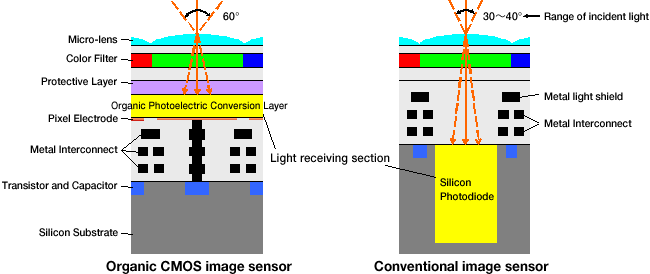
Fuji innovated the camera industry by developing the X-Trans Sensor. But the future seems to be a based on the “organic sensors”. The new technology promises among the others “Industry’s highest dynamic range of 88dB”, “higher sensitivity than conventional sensors” and “ range of incident angle expanded to 60 degrees for faithful color reproduction“.
One source told us that this is still far away from being implemented in X cameras. If all works fine we can expect the first camera to feature that sensor in late 2014 early 2015 only.
Last year in a Lenstip (Click here) interview Fuji said that the super high quality organic sensor (that we hoped to be inside the X PRO 1) will not be find any use in the short term. It’s still too early for a real use on cameras.
25 Responses
2015? It’s probably a joke, Fuji will be long gone by then…
yeah, you’re right…
What a stupid comment…Fuji is one of the only companies that is innovative right now, and they have already created, in my opinion, the best mirrorless cameras with interchangeable lenses and AF to date. If you have no interest in Fuji products, why do you even visit this site ~ probably because they are innovative and you are interested in their products.
Let me guess, the AF sucks and you can’t take sharp images with these cameras…haha, what a joke ~ if you think that is true, you better take a look at yourself, because the camera is not the problem. These cameras have very nice image quality, are designed very well for photographers, and the images are very sharp straight out of camera.
So, I don’t see how you think Fuji is going to be long gone by 2015. There really is no other company designing mirrorless cameras with interchangeable lenses, AF, and an APS-C sized sensor as well as Fuji. Sony may have good sensors, but they do not have very good lenses and the NEX series is poorly designed, in my opinion. While they are likely going to introduce a full-frame NEX, it will likely be poorly designed (just like all NEX series cameras) and will not have a sufficient number of high-quality lenses that are balanced with the size of the camera.
+1
Well … the latest camera from Fuji was using the same tech as from two years ago. Not really innovation. They did manage to add WiFi, but tellingly not a touch screen and not their new sensor. And they cut the level sensor out which takes away some useful functions.
Either Fuji is failing OR they are playing the market (that’s us) by putting out camera’s in a way that benefits them more than “us”. Where is the 23mm lens we have being waiting nearly 2 years for … its on the x100s, so if you _need_ it … or the expensive 27mm the pricing on which only a true fan can defend.
And that is how Fuji behaves time and time again, so I would guess they will be around in 2015! And nothing much will have changed.
43 land looks more interesting and more innovative. Oly is rumored to have a deal with Sony on new sensor tech, will be interesting if they get access to the FF sensor.
Innovation doesn’t necessarily mean new technology. For example, it’s Fuji who brought back the aperture rings (though Nikon kept them for a whilst) and rangefinders (apart from Leica). Their use of “refreshed” old techno positioned them as innovators in terms of ergonomics.
The word innovation is well defined.
Fuji has done two things of note. The hybrid OVF/EVF and the XTRAN sensor. Both of these are over two years old.
What Fuji did could be accurately stated as making a simple rangefinder style camera incredibly complex. Admittedly most of this complexion can be turned off and then again .. the camera is simple. But this is not innovation, this is simply knowing your market, where visible complexity (menus buttons dials) is equated with capability and value.
The only truly great thing Fuji is doing is the OVF/EVF.
@Tim, what is more complex, having a dedicated dial to change the primary functions of photography or having to push a button then dig through a menu system? Fuji did not make a camera incredibly complex as you say but rather made it simpler to use for photographers by “unburying” the primary functions of shutter speed, f-stop, etc..
X-Pro1 comes out last Spring. X-M1 is less than 1.5 years old. The X-M1 has new AF features compared to X-Pro1. The sensor is not that old.
This indicates to me that this is Fuji’s answer to the “full-frame” sensor most have been asking. With an increase in incident light of 50-100% it may very well perform like a full-frame. Hopefully it wouldn’t require a new line of lenses.
Good point. But Sony is also rumoured to work on such technology, so… the APS-C / FF dichotomy won’t be over either.
Sony has the patent for the tech but differently from Fuji/Panasonic that already showed something concrete, Sony has yet to show anything, which leads me to believe that they will take longer to make a debut with the organic tech. Panasonic also has the micro color splitter to add on that, Fuji is fine with a APS-C sized sensor, a bigger FF sensor would compromise the size of the lenses and it would lose a bit of the point of having a more compact set instead of a DSLR.
Yes, Sony would join the party later, but would eventually continue the push for FF sensors (which is already its strategy). Therefore Fuji would not be free from worries, even if it had enlarged its user base and secured an even better image quality by then.
This is the point I’m trying to make.
As for the lenses, we all know that FF doesn’t mean bigger lenses as compared to APS-C… but that isn’t the debate here.
I wish Fuji and Panasonic could share more stuff, for instance Panasonic could trade a bit of their video knowledge for a bit of Fuji Color.
I think that although a lot of people have this mirrorless FF wet dream I think that APS-C is the adequate size for a mirrorless camera. Sony will make their FF camera with the E-mount but although I’m pretty sure Sony will be able to shrink that camera to the size of a APS-C camera, how are they going to do with the lenses? That besides the fact that Sony doesn’t have so much commitment toward lenses, they will ask Zeiss and Olympus to do their FF lenses but I hardly think they are going to be small. Look at the APS-C lenses, they are not small and even Zeiss was not able to come with a lot of optical quality for the E-mount.
So, what’s the point to have a small camera with huge lenses? IQ should be what’s important and that’s something Fuji can deliver. Fuji should only go FF if they can find a balance between sensor size and lens size.
the way i look at it. Fuji must go full frame. there are 2 different markets to cater for – apsc and full frame. For apsc market, users can look forward to upgrading from apsc to full frame. We have to put physics considerations aside regarding the size of lens. if someone is willing to upgrade to full frame, they have anticipate bigger lens in exchange for better image quality. So, Fuji , please go full frame with 35mm lens f1.4.
I would suggest that a 43 camera and a FF camera is a better combo than an APS-C and FF combo. Since the 43 system is more compact and Olympus is doing a better job with their PEN cameras than Fuji is doing with the M1.
Still, my Leica FF lens is smaller than a Fuji APS-C lens ….. and it has better image quality. Just no Autofocus, which I don’t miss – the 35mm has not been on the camera since I switched.
No autofocus and no OIS – that’s why it’s smaller.
Given how Fuji was crucified for not having fast enough AF with the launch of the X series, they would have to be mad to not include it on FF lenses. So it would be a lot bigger.
That time frame is about right for the organic sensor to be in the X-E2. By then, processor technology should have also improved significantly. No more excuse for slow processing and EVF lag.
I’m not sure how innovative Fuji is, using sony’s old sensors with a new RGB filter.
Sony is getting rid of their old tech while Fuji sells it to us by using an improved JPEG engine.
I guess that in a year or two, Sony will let fuji use their nex-6\X100s sensor with phase detection in some mirrorless cams with exchangeable lenses.
The Organic CMOS is just marketing statements, it won’t be viable till the year 2059.
but you should keep reading this site to get updates on the matter, every month the admin will tell you that is was supposed to be released today, but there is a rumor that it is going to be posponed.
sony canon and nikon will develop a new sensor before any organic sensor
FUJIFILM X-S2
Pro Digicam, Super zoom
General
Lowest price $???,??
Announced ???/2014
Sensor
Type CMOS
Size APS-C 22.5×14.6mm
Crop factor 1.5x
Megapixels 25.9 MP
Light sensitivity 51,600 ISO
Light sensitivity (boost) 102,400 ISO
Sensor (Advanced)
True resolution 25.9 MP
Native resolution 6150 x 4150
Pixel size 39.9 µm²
Screen
Type LCD
Size 3.0″
Resolution 1,250k dots
Touch screen Yes
Flips out Yes
Lens
Zoom 100x
Wide angle 24 mm
Telephoto 2.400 mm
Aperture (wide angle) f/1.4
Aperture (telephoto) f/8.5
Macro focus 0 cm
Form factor
Size 135x107x150 mm
Depth 5.9″
Weight 930 g
Interchangeable lenses No
Waterproof No
Viewfinder
Type Digital
Viewfinder size 0,59x
Covarege 90%
Movies
Format 1080p @60fps
Supports 24p Yes
High-speed framerate 1200 fps
External mic jack Yes
Autofocus Contrast detection
Continuous focus
All formats
1080p @ 24fps
1080p @ 25fps
1080p @ 30fps
1080p @ 50fps
1080p @ 60fps
1080p @ 120fps
1440×1080 @ 24fps
1440×1080 @ 30fps
1440×1080 @ 60fps
720p @ 25fps
720p @ 30fps
720p @ 60fps
720p @ 120fps
720p @ 240fps
480p @ 25fps
480p @ 30fps
480p @ 60fps
480p @ 120fps
480p @ 240fps
480p @ 480fps
480p @ 560fps
320p @ 25fps
320p @ 30fps
320p @ 60fps
320p @ 120fps
320p @ 240fps
320p @ 480fps
320p @ 560fps
320p @ 720fps
320p @ 1000fps
320p @ 1200fps
Features
Panorama Yes
HDR Yes
3D Yes
Image stabilization Lens
Supports RAW Yes
GPS No
Performance
Battery life 1200 shots
Continuous shooting 18 fps
Focus system
Autofocus Phase dectection
Focus points 30
Cross type focus points 30
Shutter
Max 1/10000s
Min 60s
Flash
Built-in flash Yes
Popup Yes
External connection Yes
Storage
Storage slots 2
Supported formats SDHC
SD
SDXC
Hope early!
Please, come out from your box. Instead using FF, Fuji has successful deliver very good image (equal with FF) with their APSC XTrans, which can translate to other people, very good image in good price. Off course if we tell, 1st wave of XTrans is expensive than other APSC but you might get quality as good as FF in lower price, right? then you have to spend expensive FF lens.
and for histories, Fuji has experience for sensor experiments than other competitors. Remember for Super CCD and Super CCD SR? Still using that and no compromised about the color reproduction even compared with current newest digital camera (when have good lighting).
And now their path to produce organic sensor become visible, not only patent or just plan, or playing with sensor size (FF race war). That’s made Fuji become one of digital camera company that maintain their consistency to make very good camera with reasonable price.
About lack of focus speed, what do you want? Image Quality or Speed?
You buy an expensive F1 race car but want to drive it into villages or off road? 😀
so please come on, get out from convenient zone and think out of the box.
Now that we’re droowing because of this over mouth-watering news concerning a fantatic new sensor, would you please consider returning to your lab to finish the job and fix that thing into a X Pro 2 ….and FASTER please….
It is too long time. Canon will release new sensor this year. And it is very good on low light. I hope Fuji and Panasonic releasing faster