
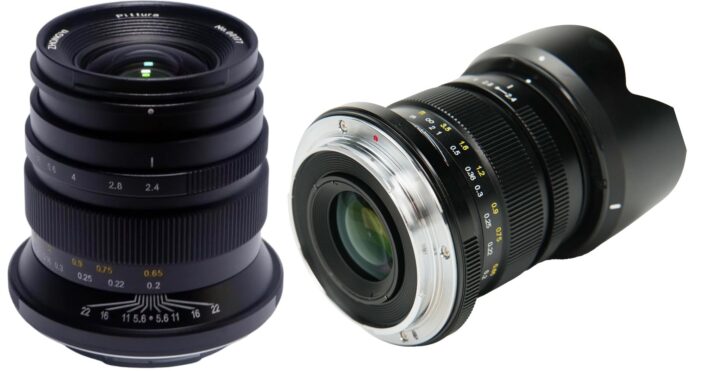


The facebook page Fujifilm X World pubslished the first image of the XF 35mmF2 R lens… and it seems to be a very compact and WEATHER RESISTANT lens .
Spotted by FR-reader Markus (website mworsdorfer)





The facebook page Fujifilm X World pubslished the first image of the XF 35mmF2 R lens… and it seems to be a very compact and WEATHER RESISTANT lens .
Spotted by FR-reader Markus (website mworsdorfer)

72 Responses
Weather sealed 35 f2! Just in time for a weather sealed X-Pro2.
I suppose this lense will not only be WR, but also a lot faster in terms of focusing speed, which is IMHO much more important.
I hope it has internal autofocus mechanism. The 35mm F1.4 is a superb lens, but the autofocus mechanism (front lens movement and the sound it produces), to some extent, can be quite annoying.
F3 in 35mm format eqv. Not so nice. Should just do F1.4 WR with faster AF. Improve on the old wining formulae!
50mm lenses with f/2,8 apertures are amazing for all sorts of things. The 35/1,4 is too large a lens for what it tries to do. Great lens, but exactly the same size of a FF SLR 50/2 lens. This one will outclass every single 50mm FF SLR lens because there are no real analogues. I have the pancake 45/2,8P, which is much, much smaller (about the same size as the Fujifilm 27/2,8) but that lens was made for a very different purpose. Looks great.
+1 I think Fuji should have a set of compact, high quality(!) prime lenses for the x-pro cameras. Price can be a little bit higher than expected if the build quality is solid. I think 16mm f2, 35mm f2, 56mm f2 and 70mm f2 would be enough. A bonus would also be a 16-50 f4, 50-135f4 and maybe a 10-16 f4.
The size of the latest Fuji lenses really got out of hand.
Does not matter; Wish there would be a 23mm f2.0 version soon. Small lenses with good IQ aer imperative for Fuji.
Actually, I’d rather Fuji remodelled the 18mm and 60mm with weather sealing and a couple of tweaks to performance. Those first three lenses were inherently right focal lengths for a rangefinder-esque design and they are nice and small.
A 23mm f/2 WR in a similar form factor to this new 35mm f/2 would be be great, too.
I’m not too bothered with all this equivalence FUD spreading. I don’t need paper thin DOF for most subjects, light gathering concerns are hypothetical at best unless you are trying to photograph a candle-lit black cat on a black velvet background, and EV is not altered by the size of the sensor at all.
“…light gathering concerns are hypothetical at best…”
Perhaps for you. For others they are very real.
Really? How? Please show some real-world examples.
A lot of real world examples to choose from, as you can’t use a tripod everywhere and not all subject are still subjects.
I had my daughter’s birthday party inside, in a relatively well lit room, but I was struggling to get relatively sharp pics of the running kids (4-5 yo) without increasing the ISO to a level that I was not entirely comfortable with if I kept the f at 2.0, so I went to f1.4 on the 23mm. 2.0 would not have done the trick.
No. If you metered a scene and it returned a reading of f/4 at 1/60th of a second at ISO 100 (which is EV 17, BTW), it would be f/4 at 1/60th of a second at ISO 100 irrespective of whether the camera had an APS-C sensor, a 135-sized sensor, or you were loading a Hasselblad 500C with ISO 100 print film.
In the case you describe, you would have had to have either raised the ISO or opened the lens up to f/1.4 regardless of sensor size, because the EV readings were low.
This is one of the big problems with this particular slice of FUD. It conflates light gathering, DoF, and exposure value. When someone says an f/2 lens on APS-C is equivalent to f/3 on FF, they are describing the relative depth of field properties of the different sensors and nothing else. In terms of exposure, f/2 is f/2 is f/2. If it’s not, it’s a badly computed lens! But because people just pontificate about aperture equivalence and throw in ‘light gathering’ as a spooky buzz word, other people assume they mean exposure value. And that’s completely wrong.
This FUD would go away fast if people still used external light meters. When you think about it for a nanosecond, an external light meter has three settings; ISO, shutter speed, and aperture (f-stop). It does not have a fourth setting for sensor size, so why do we continue to think sensor size has a significant effect on exposure?
The properties of light gathering are important to lens makers in computing lenses (especially when computing lenses for astrophotography, very low light photography, and photo-microscopy – as distinct from macrophotography or even microphotography). It’s of lesser importance for the calculation of T-stops in cinema lenses, even though cinematographers have to take the change in transmission value across a lens’ focus range into account. For the rest of us, it’s of no practical real-world use.
Yep, you are right. I read ‘light gathering concerns are insignificant’ to mean that the differences in light gathering ability between 2.0 and 1.4 in the real world are negligible. Obviously, that is not what you meant. Completely agree that 2.0 is 2.0 irrespective of the format and the sole – perceived – difference is DOF.
No problems. It’s one of my trigger points, I guess.
That is a handsome lens: almost looks like a rangefinder lens, but the aperture ring I feel will get in the way on a narrow lens like this. (Yes, again I’m thinking of manual focus ergonomics.)
Oh man, looks like we will have a silver option too.
could look great on the graphite silver X-T1… or graphite silver X-PRO2 🙂
No, this won’t look good on the X-T1. Same as the current XF 35/1,4 not looking ‘fit’ on the X-Pro. The current one looks GREAT on the X-T1. This new one… wow, says rangefinder from start to finish.
I’ve had my toes crossed for a silver X-Pro 2 for months now…
It looks (slightly) from the picture of the silver version that there may be a manual clutch design. If we compare to how the Olympus versions are made there seems to be room to pull the focus ring back and engage manual for zone focus use. I think that would be very nice considering this could be used on the street because it’s so small and nice.
I think you’re just noticing problems with the bad advertising photography here that doesn’t show the subtle details under the focus ring to match the reflection on the top. I’m surprised that they released this photo to the internet.
You might both be right, however, I was thinking of the more zone focus oriented version that Olympus uses for their zooms, the one you pull back and it shows only distance (when pulled back), not the aperture value.
At closer inspection, ohm image seems to be right, there is a bad reflection that looks like a detention but probably is a similarly thick unribbed-ring.
It isn’t – the distance scale is always partially visible on the 14mm and 23mm, there’s clearly nowhere for the focusing ring to pull back to on this lens to reveal the distance markings.
16/1.4 and 90/2 also WR lenses according to this:
http://www.bigheadtaco.com/2015/02/interview-with-fuji-guys-canada-ryuichi.html
16mm and 90mm are the ones I would really like to use.
Glad to see the 35mm f2 has a bayonet for a lens hood and aperture ring, not repeating the mistakes of the 27mm there. Looks like a very attractive little lens, might have to get one if it performs well! Beggars the question what the future plans for the 35mm f1.4 are though. I suspect something a bit bigger and with clutch AF/MF like the 14 and 23 is in the works.
Ah yes, good thinking. Maybe the 1.4 will become a bigger 1.2. I was wondering what the point of this was, but I think you may have hit the nail on the head.
I would love to see a 35mm f1.2 with clutch and fast AF. I personally don’t think the 23 1.4 is big or the 56 so a 35 1.2 would be great.
Oh FFS I just noticed Fuji has introduced yet another filter size – 43mm!!! Now we have 39, 43, 52, 58, 62, 68 and 72 in the lineup >_<
They should give away a stepper set when you buy a new x-t1. The filter size thing is definitely the weakest thing about the whole range.
Certainly not _the_ weakest link, but one that proves yet again that Fujifilm’s planning is about as good as Tokyo Electric’s.
Indeed! I don’t think the target audience for this lens will care much about filters. However, and more in general, I’m a bit annoyed by Fuji’s choice of filter sizes. I already have 2 sets of filters for 3 lenses (23/35/56) and will have to buy a 3rd set when the the 16mm comes out…
I believe this is very good news IF the lens is rather cheap. Now that the lens lineup is mostly complete (in terms of focal lengths) what’s missing are the small and budget primes. The entry into the ILC X system is still still too expensive in my opinion (except for X100 with converters).
Cover the most basic focal lengths with cheap primes and you will make the system a lot more attractive:
– 23 f2.0
– 35 f2.0
– 56 f2.0
Especially the last one should easily be possible. Nikon has a great 50 f1.8 for FF which costs 190 €.
If you think about lens size you have to take the flange distance into account. I have a wonderful 114mm f/3.8 lens that is about he size of the XF 18. And it covers 8x10cm! Only problem is it has to be 10cm away from the “sensor”.
Good point. I’m not an optical engineer so I have not clue about that stuff. But isn’t it generally easier to build small lenses with shorter flange distance (especially wide to normal lenses)?
We’re getting the 35 f2.0 and the X100 proves that 23 f2.0 is also possible. Since 50mm is generally considered to be one of the easiest lenses to build (everyone has a great 50mm prime for little money) I can’t imagine the flange distance being a major problem here.
As a rule of thumb you can say: the further the focal length is from the flange distance, the larger the lens, no matter if you go to shorter or longer focal lengths. For Fuji-X it is about 18mm, an average dslr has about 40-50mm. So a 50mm is a very simple lens for a DSLR.
The x100 can not really serve as an example. The lens is built almost directly onto the sensor, which has a specially aligned micro-lens array to support this design. That is not feasible with interchangeable lenses.
Okay, thanks for the info.
That means it should still be possible to build a cheap and great 50mm lens even if it means that it won’t be too tiny because Fuji might need to put some “empty space” between sensor and rear element. Right?
Of course it is possible but looking at the current lenses I don’t think it will happen. It does not seem to be the Fuji’s strategy for the X-System.
Keep in mind that for the X100 series part of the lens design is actually inside the camera body. It gives a false impression of how big the lens really is.
This is also possible with an X Mount lens, however the focal plane is further forward in the body compared to the x100 so it would still be bigger given the same optics.
I don’t think a 23 2.0 will come. Rather a 23 2.8 and 56 2.4 to differentiate between the 23 2.8 and the X100 series.
It would be a shame of Fujifilm considered their non-interchangeable own body competition to a lens… It makes perfect sense for them to make both.
The decreasing diameter shows it was designed with an OVF in mind. Don’t think it will come cheap though. The construction looks very solid, probably fast internal focus and you have to factor in WR. And the length suggests it is optically very well corrected.
And I guess anything put a rectangular hood will look ridiculous on it. A reversible hood is probably difficult with this design anyway.
Olympus did the ‘same’ and they don’t have OVF in mind.
This is basically what I wished my 35/1.4 was, so I’m certainly interested in this. I’m fine with f/2 if it means such a tiny lens – I have a Voightlander 25/4 which is similarly tiny, although the M adapter adds a bit of size unfortunately. Still, it’s a great compact and lightweight lens for street photography.
Can anyone explain, why the teleconverter is compatible just with the XF50-140, XF120 and XF100-400? Why wouldn’t it work (well) with the 35 mm?
Exellent decission! I was waiting for smaller primes – 18/2 is fantastic little lens, with X-E2 is best combo for street dynamic shooting, forget it with 56/1.2, or with 23/1.4 with its linger AF (because of glass size). Hope next step will be 23/2, 55/2, 85/2.8, I keep fingers crossed for Fuji to continue releasing smaller primes.
Smaller primes is definitely something I was waiting for. Should have bought the X100 series, but would like to swap glasses. (Made my decision before the x100 lens addons)… Rather small F2 than a new and larger F1.4/1.2… Then everyone has a choice 🙂 Only wishing for a similar 23mm lens now…
none of them are stabilized, not a limitation for making photos of moving objects (like people) where a we need 1/100 sec or shorter but real disadvantage for any steady objects where the ISO can be very low with a stabilized camera (or glass).
Olympus and now also Pana are clearly better in this area. No way compensate the lack of stabilization by a higher ISO capabilities of the Fuji camera.
Agree, I love my fuji X but bought into the Panasonic GH4 for video work and their f1.2 42.5mm Nocticron is phenomenal. Even so, I’d rather have IBIS like the new Olympus em5ii.
About time someone made a nice small simple weather resistant prime! The 35/2 lens could not come quick enough…
I can see your point, but I’ve rather have IS in camera. I’m now able to take sharp images down to 1/20th, but I rather have a smaller lens without IS. IS take up a lot of space and weight. I live in the dark north so I rarely shoot below ISO 500-600 even in “sunny” days. The noise from X-Trans is actually very pleasing consider other sensors.
That’s nice… Give me overall image quality, in a decent size. I’d take that over IBIS anyday. Ibis doesn’t help much in street shooting anyways.
Is 120mm macro the same size than 100-400mm ?
If priced right this should be a good option for us users who like to keep a compact system to draw less attention. Focus speed will be important. The weather sealing is welcome, now I just need a weather sealed X-pro2 to then attach it to.
Same here , except I’m waiting for the weather sealed 18mm
f2 18mm R + X-PRO2 and I’m in heaven…
On the contrary, series filter users that care about compatible filter sizes tend to be the ones that get into a single size, and often that is the smaller ones.
I know dozens of people that go Elmarit/Summicron/Elmarit for 28/35/90 or 28/50/90 in order to stay with the same filter size. Loads. The people that don’t care are the ones that buy any old lens as long as it’s new.
nice…I see an XF 35 f2 on an X-E3 in my future….
Am I the only one here who feels the 35mm 1.4 isn’t ‘big’???? I also bought the 23mm 1.4 and admittedly that is a bit big but I have no issues at all with the size of the current 35mm. Personally I would rather have the speed of the 1.4 lens.
That said, it’s always good to have choices!
It’s not big, but it’s not cute either. And some people prefer cute.
OHLOOKATTHISCUTELITTLELENS!
These lenses have a similar look and aesthetic to Leica glass, to say nothing of the aperture choices. They’re undoubtedly designed with the X-Pro 1 / 2 in mind … so I see this as another direct assault on the Leica M, which the XP2 will almost certainly trump in most regards.
I agree. This thought came up when i saw the picture and if They would add the tab on it mounted on a xpro1 it would look like a leica M…not really though 🙂
Has anyone else noticed Fujifilm’s facebook post about this lens? It says, “Whether you prefer to shoot wide angle or standard angle of view, this lens is definitely to look out for.” What is that supposed to mean? This is a prime lens. Did Fuji just admit they’re about to go full-frame?
I think the post was written by someone for whom English is a second language.
Here’s a much higher res version of the photo for you.
Wow. Dream come true. I’ll get this one instead of the 35F1.4. Hope they also consider a 50 ~ 56mm F2 in the future.
As attractive as the 35mm f2 seems, but who is going to sell his 35mm f1.4 to get the f2 version?
Or is there anybody who has an X camera but didn’t get a 35mm f1.4 yet? How can that be? Someone with an X camera but without a 35mm f1.4? That doesn’t make sense at all. The 35mm f1.4 is THE prime lens, how can one not have it?
I would sell the 1.4 if I had to. I would rather have the small size and WR for a daily driver.
But I will most likely keep the 1.4 for low light
Some of us bought the Zeiss 32mm f1.8
Well I don’t mind having both. But if I had to, I’d sell the 1.4.
I expect it will be very good, and the size is perfect. And it looks like a proper rangefinder lens. gotta love that.
so does anyone know when these are coming to market?