







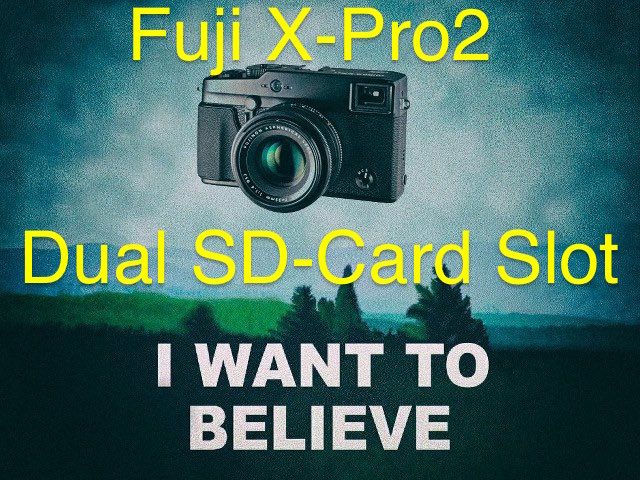
I’ve already shared it last year from a new source, and now an anonymous source (thanks) says it too: the Fujifilm X-Pro2 will feature a dual SD-Card slot.
No confirmation from trusted source so far.
As you might remember, the Fuji X-T1 was planed to have 2 SD-Card slots, too. However, Fuji changed plans (as so often), sealed one SD-Card slot, and decided to go for a single SD-card slot with support for ultra-fast UHS-II SD-Card.
I’d love to see a Fuji X-Pro2 with dual UHS-II SD-card slot. But if you should decide between just one of these two feature, which one would you prefer?
[poll id=”140″]
X-Pro2 Rumored Specs List (TS= trusted source / NeS =New Source / AS = Anonymous Source / SRP = source who was right in the past / OS = other sites)
TRUSTED
– APS-C sensor (TS + AS + AS)
– 1/8000 of a second mechanical shutter speed (TS)
– coming late 2015 (TS + AS)
– delayed to 2016 (TS)
– Coming after CES (TS)
– Announcement on 15th Janaury 2016 (TS)
– weather sealed (TS)
– 4K video (TS + NeS)
– Faster Processor EXR III (TS)
SOURCE RIGHT IN THE PAST
– Sync Speed faster than 1/180th (SRP)
– coming in January 2016 (SRP)
NEW / ANONYMOUS SOURCE
– 24MP sensor (AS) – More than 16MP (AS)
– about the same size of current X-PRO1 (NeS)
– dual SD card slot (NeS + AS)
– tilt screen (AS)
– WiFi (AS)
– Price about 20% to 30% more expensive than the X-T1 (AS)
– Two X-PRO2 version, one 24MP APS-C and one 25-27 MP APS-X, compatible with XF/XC lenses (NeS + OS)
OTHER SITES
– coming September / October (OS + OS)– Non organic APS-C X-Trans sensor (OS)
– smaller than X-PRO1 (OS)
39 Responses
Why ot 1 slot with UHS-II support (for speed) and 1 slot without (for security) ?
Very likely will. No reason not to.
Or just 10 bucks more and two fullspeed UHS-II slots 😉
answer depend on size of Fuji RAW file with 24mpx sensor size?
A camera like the X-Pro2 is not meant for spray-and-pray-shooting. So the absolute write speed doesn’t really matter much to me.
What does matter (in any camera) is responsiveness and that should be addressed much more urgently by Fuji. Don’t know about the X-T1 but my Nikon D7000 was a ton more responsive than my X100S and X-E2. Image review (immediately after taking the shot) is nearly unusable because the Fujis black out after they are finished writing to the card. With the X100S this is even slower due to the OVF cover sliding in and out unnecessarily. With my D7000 I was perfectly happy with 30MB/s cards and never wasted a thought about them. With Fuji I had to buy much more expensive cards just so I wouldn’t keep getting annoyed at the camera (and I still sometimes do when needing to chimp).
So for me two slots (security) would always win over one (speed). UHS-I is plenty for my way of working and I bet it is enough for most of you if it is implemented well (like Nikon does).
If it doesn’t have 2 slots, it shouldn’t have the word “pro” in the title.
I just hope the X-T(2) or whatever it’s going to be named isn’t too far behind the X-Pro2.
And I don’t even use UHS cards. Don’t own any. I own 16 of the 32 and 16G 45mb and 90mb cards and for me they work perfectly. I use the 90mb/s card when I’m shooting my dogs, or my grandkids as the buffer clears faster but other than that, my 45mb/s cards are perfect.
Then they would be UHS I cards…
Instead of 2 slots bring 2 more direct Fn buttons and take off this funny “Pro” sign. If Fuji still wants to call it “Pro” than should bring both features, and really much more. Many Panasonic and Olympus cams offer more features without “Pro” name than Fuji.
I think that’s the least of Fuji’s concerns. “Professional” doesn’t have to be short for Professional in their minds … it could be short for “Prosumer”.
As to Olympus and Panasonic: they can hardly be considered pro using a sensor that’s rapidly being outpaced by everyone else in terms of overall IQ, DR, and high ISO performance.
People want 4K video, but forget that for that UHS-II is exactly what is needed…
This is exactly right. If the camera has 4K, it’ll need a card slot that can handle that. I’d love to have two slots, with one slower one for still capture and you could keep the fast card for video capture. No idea if they’ll be able to fit that into the camera though.
Let me know, two SD card slot……..what’s for? I nver use that on Canon body with 2 slots….
A dual card slot is crucial for me. This will definitely decide whether I stick with Fuji or not. The direction my photography is taking requires me to play save. Since the X-Pro2 wouldn’t be for me anyway, I will have to wait for the X-T2.
The UHS-II card I use for the X-T1 proved to be a disappointment. 95 MB/sec cards are plenty fast so 2 card slots offering that speed would be one of the most crucial requirements for a future camera. If Fuji doesn’t offer that in a X-T2 it would be the biggest disappointment for me and would probably lead to a system switch.
After all, the dual card slot is one of the last things where DSLRs offer more than mirrorless cameras. I think it’s about time Fuji catches up.
Maybe I’m just lucky but in the 11 years I’ve been shooting digital I haven’t had a single memory card failure…that said I only buy quality memory cards. The only memory cards I’ve seen fail from friends are cheap ones I would never buy.
I never had a failure either. But for paid jobs, a backup slot really is a nice thing to have.. I think we can agree on that.
Remember that it’s a relatively small percentage of DSLRs that offer dual card slots. But I agree they need to introduce it.
But the major issue that needs to be addressed is autofocus speed and accuracy, particularly in low light or when tracking moving subjects. That’s the REAL trump card of a pro DSLR over mirrorless.
I don’t have any issues with Fuji’s AF on weddings. A big improvement would be a flash with that IR focus help.
For paying work I want 2 card slots, and both should be as fast as possible. Sometimes I want a backup on the second card, and sometimes I want to record video to the second card and stills to the first card. I want to shoot stills and then shoot video for a minute, then back to stills, etc.
I am expecting Fuji to include in the x-pro2 and x-t2 all the proper 4k video functions we expect in a 2016 camera. And I expect to be able to switch between stills and video, on one camera, quickly.
How about UHS IiI support??? Why have last year’s spec? UHS III is here!
If it has 2 slots I’d still expect UHSII support for both. Or one with UHS III and the other with UHS II. That way you can store jpegs on one and raw on the other I suppose.
We’ve been waiting so long that the new X-Pro2 should include:
* Triple card slots;
* Masterpiece mode;
* Built-in money printer;
* Optional lottery result prediction module;
* Kitchen sink, because Internet.
I gave up. I am selling my Fuji gear and switching systems.
By the time it arrives, I’ll need a cane that unfolds from it. Or perhaps a walker.
As only few Pros use the X- cameras for their work, the dual card slot is not essential. I’d not use them. In 15 years of digital photos (and probably several hundreds of thousands of frames shot) I had never a card fail and bury all the stored photos in digital Nirvana. Never, not 1 time. That is enough for me…
I’ve never had a card fail, either. If you use Sandisk Extreme Pros they’re highly reliable.
But failures have been known to occur. It only takes one failure on a critical assignment and you’ll never trust a single slot system again (this from other pros I know who’ve experienced it).
I hate to say this Patrick but this poll doesn’t make much sense 🙂 The X_T1 already supports the faster cards, why being single or dual make a difference here in UHS-II support?
If you shoot wedding/events/sports you can back up your photos on the other card. Alternatively you can shoot till one is empty then automatically move to the next card. So for people who have to shoot a lot and/or can’t risk losing the files in the event of card failure (imagine shooting a wedding for money and you lose all the files because one of your cards dies!!) two card slots can literally be the difference between getting paid or getting sued.
What I think the Xpro2 needs is a quicker/easier way to switch ISO. Right now I have mine set to the function button, which is ok, but I think the XT-10 might have it right. A small dial at the front you can program to ISO, push it in and spin the dial to what you want. IMHO that’s better than the XT-1 iso dial on top as you can do it on the fly, though I think the XT-1 ISO dial is better than the convoluted Xpro1 method (others may disagree and that’s fine).
Another weird thing about changing ISO on the Xpro1 is when I hit the function button and I’m using the OVF I can change iso using the rear dial. If I’m using EFV or the rear LCD I have to use the D-pad… seems silly.
I think – and hope – XPro2 will also have two dials, like X-T1 front & back, but will also receive more direct Fn buttons (X-T1 has only 1!). Another “a must” feature is Custom Modes – no Fuji camera offers it yet while all Fuji competitors – Sony, Pana, Oly offer them for a long time. I also hope Fuji will allow with XPro2 to program all buttons with any feature, not just with a few… again Sony, Panaosinic, Olympus offer wider camera customization than Fuji. Hope this will change with X-Pro2.
I would like to exchange the space needed for a 2nd card slot for a slightly bigger battery compartment…
I can definitely get behind this.
People voting for 1 card clearly don’t have a pro work flow.
I am being paid to shoot, I need a constant back up. This is the only thing stopping me from selling my 5Diii. I can promise this, no 2 cards no sale at least from me. Its the main thing I hate about the x100s that I own.
People voting for 2 cards clearly don’t have a idea of professional digital work flow!
On film era you didn’t wish to have a SLR that had two rolls in body!
On DSLR you needed the 2 CF cards because cards were unsecure, cameras made lots of write errors etc!
Today only idiot use two cards and believe they are safe!
No!
You use one card, you have fistful cards in your pocket that you swap now and then quickly. So every card gets used all the time. And there is ALWAYS time to quickly swap the card. This means that you never have a card that has every photo in it or that you have just a two cards slowing camera down!
And here is the catch!
You use one of these kinds (multiple different kinds available): http://www.bhphotovideo.com/c/product/1019599-REG/nexto_di_nesv_nvs2511th_1tb_2501_pro_video.html
And then you simply mount it to your belt or bag strap etc.
Now what you do.
Now and then you swap cards in camera and you put the card from the camera to that portable HDD SD card reader and you press a button. It starts copying the SD card. You will continue shooting and then you repeat the swap at some point.
Now, you have every photo duplicated, but you have eliminated the possibility that you lose lots of photos if a one card gets malfunction! You have as well eliminated possibility that you break the camera, you break the card or you lose the portable device and you lose all the photos! EVERYTHING IS TRIPLE SECURED! NOT POSSIBLE WITH DUAL SLOTS!
And here comes the juicy part!
You get to workstation (you do have one at the studio, right? A color proofed room, with color calibrated light bulbs and painted walls, a real workstation with 14-bit display? Not those stupid laptops on the go!) you just plug the cable to that device and you import all the task photos at once. No playing with the cards, no wondering what card had what as all are in that drive as duplicate!
Now if something happens to that HDD, you still have everything doubled in the SD cards! You see, TRIPLE SECURITY! NOT POSSIBLE WITH DUAL-SLOTS!
You just don’t secure against card malfunctions, you will secure against everything. And you will speed up your workflow as after import and process and backup, you delete all the files from cards and drive and charge the drive for next task!
Some of those drives offer WiFi, you can quickly just allow one of your assistant (you are making at least 2000 dollars per gig, right? So you are professional and you have at least one assistant with you?) to download those files wirelessly to laptop and then rank those and even do some quick editing so while at the or after the gig you can just show the clients on the site the ipad and they see nice previews.
And do you know what is the best thing? With single SD card slot and multiple bodies, you never have any problems with security, you just swap cards now and then no matter what camera you are using! Take the card out, new in, old one to reader on belt and press a button. Old card to other pocket and new card to camera and card from camera to reader etc.
And what happens if camera breaks down (drop it to ocean, down to mountains, drop it to fire etc) or something? You only never at worst case scenario lose the photos that were taken after the card was swapped! FAR SAFER THAN WITH DUAL-SLOT CAMERA THAT BREAKS BOTH CARDS AND ALL IN THEM!
What if SINGLE card breaks down? DUAL-SLOT DOESN’T SAVE YOU ANYMORE BETTER WAY EITHER! BOTH WILL HIGHLY LIKELY GET CORRUPTED!
The whole demand for dual-slot cards are from old generation professionals who didn’t have the tools 10 years ago and repeats just the same old propaganda “You need dual-slots” while technology has since offered far better security!
You always need a triple security and dual-slots doesn’t offer that!
What this guy said^^^
Dual card slots would allow for more product differentiation amongst mirrorless competitors. It would also steer people like me shooting Sony who doing wedding work but who want the added “insurance.”
I think X-Pro2 need a full frame sensor…
More like true medium format sensor. Just imagine. Pretty epic huh.
I seriously need to rent this XPRO1. My curiosity is killing me.