







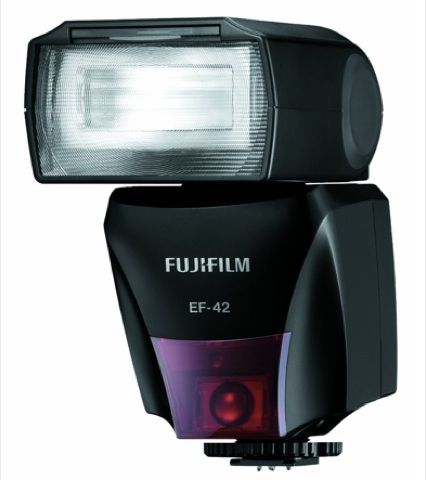
the Fujifilm EF-42 is one of the Fuji flashes available at the market. More flash units are needed… and maybe coming within the next few months.
_ _ _
A couple of weeks ago, an anonymous source told us that Fuji plans to launch new flashes “later this year” (see this rumor). Well, today a new source confirmed the rumor, and said that a powerful flash with remote communication and HSS will be launched within the next few months.
Sure, it’s still all unconfirmed (ergo: grain of salt is needed), but the number of hints is growing. For now, the question is if the flash will be available by the end of this year or we have to wait until early 2015.
If there is anyone out there, who can confirm the flash rumor (and maybe also share some more specs), then feel free to contact me at fujirumor [at] gmail.com or completely anonymously via rumor box.
I remind you the Nissin i40 flash should be available late fall (mid-November, according to BHphoto).

49 Responses
Concerning flashes, here’s a little info for those who could be as naive as I have been. If you have a x100/s and TCL, buying the EF-X20 is no solution to get rid of the shadow thrown by the flash-light when shooting with the lovely piece of glass in front of your camera.
But then, putting a thing as huge as an EF-42 on a x100/s doesn’t seem much of a conceivable option. Or I could have spared a lot of money continuing to carry around my DLSR… 🙂
You put the flash on the camera?
Ha, ha, ha… 🙂
Having a big tall flash is a pain but one needs the hight or spend the cash to get an off camera cord! works wonders.
Lucky I have an old Nikon TTL-cord, but I loose high-speed sync and quite a bit of “portability” of my system…
Then again, the results with off camera cords are great, you’re so right on that.
EF-X20 style/size with a bounce head would be perfect, perhaps in a similar way to what Canon have with the Speedlite 270 EX ii
I would love to see something like the Leica 24D Flash for the Fuji X System. Something nice and compact, yet powerful enough. I preordered the Nissin, which looks like a nice unit, but would gladly cancel my order if fuji releases something both powerful and compact with better build quality.
Patrick any rumor whether this will be a compact flash, or another monster like the ef-42?
No, the source didn’t say anything about the size. I will do a little bit of sleuthing work for you 😉
Big is good they make small ones.
I hope it will be an off-camera capable one.
I think (FWIW) Fuji should create two flashes.
One small retro-y one that balances well on X cameras but also tilts and rotates (perhaps not dissimilar from the Nissin) and another pro-grade flash.
The pro-grade flash should still be as small as possible because the x bodies are small and pro-grade flashes already balance terribly on heavy DSLRS. Both flashes should have built-in radio wireless (Canon got this right, Nikon’s CLS is a joke when you need reliability. I shoot Nikon….). If Fuji really wants to knock the socks off of the industry, they should make the flashes use removable Lithium ion batteries. It would help make them smaller and lighter and really there is no need for photographers to have 8 sets of 4xAA just for their flashes. No other common consumer electronics device with a high power draw uses AA’s, why should flashes.
Properly functioning red light AF assist would be nifty too although I am unsure how well this would work in conjunction with contract detection AF.
Oh and for the love of G… make is easy to adjust the power/flash compensation on the flash.
DO IT FUJI! This is how you get another set of photographers into your system!
If you’re not happy with AA’s, get a Quantum battery pack. Proprietary flash batteries are evil, I’d rather stick with AA’s.
(ditto on AF illuminator though)
How about making the flash run on the same kind of batteries as the camera? Then we’d only need one kind of spare. I’m sick of AAs too… not just carrying them, but the ongoing maintenance/failure/replacement cycle as well.
Let’s do a simple math with some good off-brand batteries.
NPW126 by Wasabi Power costs $13 from Amazon. It’s a 7.4V, 1360 mAh battery (let’s believe what it says on a tin, shall we?). That’s 10.04 Wh per battery.
A 16-pack of Panasonic Eneloop “2100” batteries costs $43 from Amazon. These are 1.2V, 2000 mAh batteries. That’s just 2.4 Wh per battery.
At the first glance, NPW126 clearly wins. Now, 13/10 = $1.3 per Wh. In case of Eneloops, that’ll be 43/(2.4*16) = $1.12 per Wh.
In short, a lighter package will cost ya. Nothing new here.
But I can get AA’s darn near anywhere on the planet. Try getting a spare Fuji battery in East Whogivesakrapistan.
West Whogivesakrapistan has a Walmart so you might be in luck.
I live in the East Whogivesakrapistan, a province of Nofujiretail to be exact. Paradoxically, I am overstocked on NP-W126’s exactly because of it.
Dan Cope, you are asking for impossible feature. No external flash AF assist light works with any mirrorless camera across the manufacturers. It is a limitation of mirrorless, across the board. external flash AF assist light on flashes works ONLY with DSLRS that feature normal mirror Phase AF (not on sensor AF). The only exception could have been Sony mirrorless which logically should have been made this feature available with LA-EA4 adapter and A lenses, since with LA-EA4 adapter you do have on mirror phase detection so no excuse there, but Sony decided to turn that feature off in conjunction with their mirrorless cameras even with LA-EA2/4.
For other mirrorless it is impossible. The flashes designed that AF assist light on them only works with DSLRS (through mirror phase detection).
Lithium batteries are bad for high-energy-draw systems (ie. flashes at full power). NiMH chemistry is the best for flashes, they cycle faster (on avg 2x faster than Lithium). Even Alkaline batteries cycle faster than Lithium batteries.
So no. You don’t want rechargeable proprietary Lithium Batteries in your flash.
And why do you need 8 sets of 4xAA? I can shoot through an 8 hour wedding/reception with 4 sets of 4xAA of rechargeable NiMH on 2 Canon 580EXII.
“Lithium batteries are bad for high-energy-draw systems”
…that’s why LiPo batteries are almost exclusively used in stunt RC electric helicopters that could easily draw 300 A and more. That’s why nearly all self-contained modern studio strobes have Lithium based batteries. Heck, I’m planning to photograph an entire day tomorrow on a 2-pack of Vagabond Mini Lithiums.
They are not bad. They are badass.
you’re talking different use. I don’t think your RC copters use 4xAA batteries. I was specifically referring to the 4xAA of the above comment.
Nobody would use 4xAA in a studio strobe. Those are larger (same with RC I guess) for more capacity. And in a studio strobe you can wait for recharges more readily than in a wedding situation where I would have to fire off multiple consecutive shots sometimes with little time time to wait for the battery cycle-time to catch up.
I’m no electrical engineer so I don’t know what “draw 300A” means. Is that in 1/180th of a second? Because then the RC would drop in 1 second even if you had a 30000A battery. I would think that a full-power flash discharge would draw a HIGH ENERGY in a 1/180th of a second compared to an RC plane.
In short, 300 A means “wires as thick as a pencil, or they will melt”.
Now, for some reason you think that flash is fed directly from the battery. That’s not the case. Flash (the “lightning” discharge itself) are fed from the capacitor. The capacitor is fed from the battery during a period of time, called “recycle”. How fast flash recycles depends on how fast we can top up the capacitor, and pretty much nothing else.
Flash capacitors operate at high voltages, typically in 300-380V range. That voltage is supplied by a DC-DC converter (internal thingie that makes a high-pitched noise). Converting 5 or 6V of typical 4xAA set into 300V loses a lot of power in the process. That’s why flashes recharge helluva lot faster from external battery packs such as Quantums: their capacitors are fed with 300V directly from the external source, while internal batteries are used just for controller circuitry.
How could we improve recharge times from internal batteries? By increasing the voltage that comes to a DC-DC converter, or increasing the power that converter can suck from the batteries. Or both. Neither of this is not possible with AA batteries, as they are already working on their power drain limits – sometimes high-discharge AA’s such as Maha Imedions come out of flash extremely hot. Increasing the voltage is not an option either: NiMH’s weight to watts ratio sucks. However, Lithium packs quite a punch for its weight, so we might see Lithium-powered small flashes one day.
This is correct, says the engineer.
I see. But doesn’t regular (AA, not battery backs with higher charge) lithium batteries recycle slower than regular NiMH? From my experience (and research couple years ago) NiMH was always faster at the recycle time. And I know the weight ratio is one reason that NiMH is not used in RC flying machines.
Good non-rechargeable Lithium AA’s (for example, Energizer Ultimatum) are specifically targeted “for high-drain devices”, weight about 1/3 less, and are better than non-rechargeable alkaline as well as rechargeable NiMH AA’s in all aspects except price. Here’s a comparison of some popular batteries under relatively high drain (3A): http://lygte-info.dk/pic/BatteryAA/data/AA%20batteries%20at%203A.png
As you can see, the most advanced NiMH, black Eneloops win for most practical applications… however, non-rechargeable lithium outperform them in all appliances that have more advanced DC stabilization circuits.
That’s why I use black Eneloops as my “workhorse” power source for small flashes, yet keep a pack of non-rechargeable lithium batteries in my rolling bag as a backup. With a shelf life of 15 years, they are carefree.
I don’t know why everybody is hammering on the EF-42. Its produced from the same company (Sunpak) than the Nikon flashes and did an fine job related to its costs and especially to the costs of the Nikon flashes. It has no remote TTL, but I got me a 10 Meter Canon flash cable for that….
The sunpak Ef-42 is (IMO) built much more cheaply ( I know this is somewhat reflected in the cost), the interface is terrible (!), and balances poorly on X-cameras. I think it would be an interesting design exercise for Fuji to create a modern flash that coordinates (reasonably) with the size/weight and aesthetic of the X cameras while still providing a high level of features and usability.
To GeoLoco’s point, I didn’t have any real problem with the TTL exposures of the EF-42, although fine tuning the Flash Comp is a bit of a bear
All I can say re a new Fuji flash system is it would be about frickin’ time! One of the biggest holdbacks to taking Fuji seriously as a DSLR replacement is that their flash system has always been so lame.
It’s not just a question of needing new flash units with different features. They need to get off their duffs and implement a modern wireless TTL/remote system, like Nikon/Canon/etc. have had for eons. Within in the compact mirrorless segment, now that Panasonic seems to be adopting Olympus’ excellent “RC” remote system, Fuji is the only one still out in the cold. (Yeah, I know, TTL cords are great. So is the telegraph.)
The good news is that we can hope that by arriving so late to the party, Fuji will be able to implement a thoroughly up-to-date wireless flash system (since they don’t have to worry about supporting a legacy protocol.) That would mean going straight to a full radio-signal system, rather than the optical (preflash-controlled) systems everyone else except Canon is still using.
The downside: Existing models probably would need a somewhat clunky shoe-mounted “commander” unit to access any new flash features. But we can hope that future bodies would have the system built-in and menu-controlled.
The big dream would be for Fuji to make its wireless-flash protocol a fully documented open standard, making it easy for third-party manufacturers to offer compatible accessories. Nobody else has that yet.
I don’t think Fujifilm making its wireless protocol open is the right way forward. They should adapt someone else’s system and apply their technology to an already existing standard. X isn’t big enough, and enough companies are hedging as they don’t know yet if X is worth it to invest in.
Heard earlier this week that HSS will be one of 10 new features they spoke about in the interview with luminous landscape. It seems like this rumour is actually true
Hss is camera limitation so fuji flashes won’t help with 1/180 issue
I wonder if the new Electronic Shutter can do HSS. Maybe Fuji never really worked on mechanical HSS on their cameras because they were looking into the electronic shutter version.
haven’t read enough about the electronic shutter to know one way or another.
nope, with electronic shutter, camera flash shuts off (on Fuji XT1 after December (as confirmed by Fuji guys) or any other camera with electronic shutter feature like the one described (think Panasonic G5, GX7). So you cannot use flash at all at the same time with electronic shutter feature on. Only with mechanical shutter on
David, you are confusing HSS and X-sync. Latter is the camera limitation, while former can be performed by flash alone (as long as it receives some shutter-specific signals). Basically, HSS is a “long flash”.
I am well aware of the difference. However, it is a camera also that needs to be able to support the feature of HSS as well. Let me give you example. All Nikon flashes like SB600, SB700, SB800, SB900 support HSS (called FP on Nikon, or ESS on Canon, each mfr calls it different). However, only Nikon D7000 and above allows for FP. If you have a lower Nikon like D5300 or anything below the 5XXX series, you are stuck with listed X-sync rate even if the flash supports it. You cannot go above. So to get to FP, you need to step up to D7000 and above. Thus it is a camera limitation, and perhaps a flash limitation for some flashes as well.
This is a marketing limitation, unfortunately.
Still waiting for Fuji to accept the Nissin i40
First Fuji needs to design new x cameras with possibility of High Speed Flash Synchronization. Do that first, then worry about flashes
Indeed. A maximum of 1/180s is ridiculous. And of course, the X-Pro 1 can’t even select that maximum speed manually.
Canon has a maximum sync speed of 1/200. So how is that 1/180 is soooooo bad? That is less then a third of a stop. Don’t get me wrong I would love for Fuji to up the max sync speed and or have high speed sync. But for now I really don’t see 1/180 to be such a big issue.
Which Canon are you talking about? The 7D, and almost all professional dSLR cameras have at least 1/250 flash sync speed, some even faster. 1/180 can make a big difference when using in action, or in low light with movement.
But even if that difference is too small to be bothered about, it is a hit against the X cameras, especially the X-T1, which is known in the X line to be _the_ action camera.
5D III for one, as for some of the other Canons, i.e. the 7D I stand corrected (was a Nikon user for 40+ years). I have an X Pro 1 and I can set the shutter speed manually to 1/200 without problems, though I cannot with the XT-1. In the end as the saying goes “there are no free lunches in life”. The XT-1 is not a DSLR. The Leica M also syncs at 1/180. Can’t say as I hear people complaining about it. The good thing is there are options, like the EM-1, GH4 and the A7S that sync at 1/250 or higher. Good luck and have a nice day.
Can anyone here recommend a reliable manual flash and radio trigger set that REALLY work with the X-Pro1 without any limitation? I heard the LumoPro LP-180 is supposed to be good but haven’t seen any reviews of it.
I have four Nikon SB28s that are real work horses. Flashwaves III triggers are reliable and not too expensive. They work great both in setups with large strobes from Profoto or Broncolor, and on their own, as main/secondary lights.
Thank you. Are there any weak points I should look for when buying a used SB-28?
The SB28 has the same weaknesses the EF42 has: plastic foot and screw tightening. However, SB28 can be had for 10-20$ for one, has a plethora of manual and automatic (only on Nikon) controls, and has worked for over a decade.
I’ve replaced the plastic foot of my SB28 once and once on an SB24. Mine were bought well used, and not well looked after. I throw them around.
hss? finally!
EF-42 is fail, can’t even use dat infra-red AF. pls Fuji, fix da flash system. 1/180 sync is lame
I can confirm that this rumour is false. Fuji is not likely to announce a new flash in 2014. I am pretty sure about this!
it was corrected by a trusted source later on, which said it will come in spring 2015.