







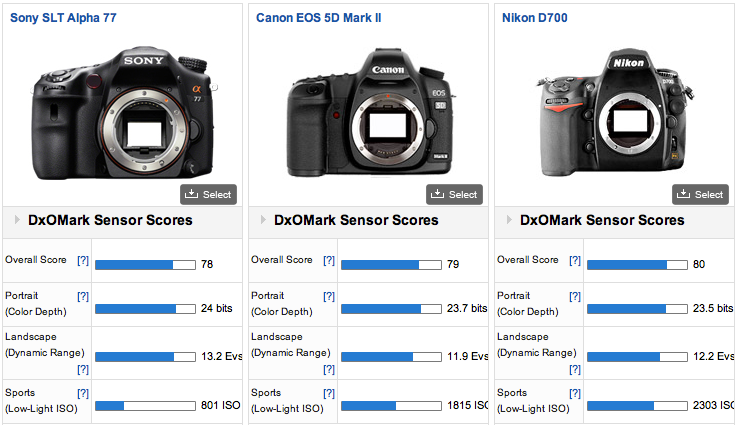
DxOmark (Click here) just published an extremely interesting [shoplink 8461]Sony A77[/shoplink] sensor test. The A77 sensor has a very large Dynamic range that easily suprasses the results of the Nikon D700 and Canon 5D markII fullframe cameras: “In conclusion, thanks to its capacity to innovate always further and to break the limits of sensor design, Sony is about to bring on the market a very good semi-professional camera body. The next question is the capacity of the lenses to address the challenge of these very small pixels. The DxOMark lens measurements should give us an answer very soon. Last but not least, as the same sensor will be used by the [shoplink 8459]Sony A65[/shoplink] and the [shoplink 8454]Sony NEX 7[/shoplink], we should see some nice reviews very soon. It will be especially interesting to see the NEX 7 results as it doesn’t feature a translucent mirror and should take full advantage of this amazing sensor.”
The real surprise is that the Sony A580 sensor has a similar A77 score. because at High ISO it’s still noticeable better (Click here to see the comparison). I confess I am now very intrigued about how good the [shoplink 8452]Sony NEX-5n[/shoplink] can be. And of course as DxOmark said, I expect the [shoplink 8454]Sony NEX-7[/shoplink] to be a tack better than the A77 because of the absence of the semitransparent mirror.
Now it’s up to you to preorder the right camera. I give you the links to all of them 🙂
A77 at [shopcountry 8461].
A65 at [shopcountry 8459].
Sony NEX-7 [shopcountry 8454].
Sony NEX-5n [shopcountry 8452].
Zeiss 24mm f/1.8 [shopcountry 8450].
Sony 50mm f/1.8 [shopcountry 8448].
Sony 55-210mm [shopcountry 8444].
NEX-5n viewfinder [shopcountry 9110].
279 Responses
This should shut the haters up. Especially those who like to use DxO marks.
Not when the NEX-C3 is showing even better numbers in some aspects. 🙂
That means the Nikon V1 beats even FF cameras! Hahahaha.
lol!
LIKE: dynamic range – at least a stop better than the other two
NOT LIKE: high ISO performance – that score is terrible!
The takeaway: in this comparison the Nikon D700 is the winner. Slightly below the A77 in dynamic range, but its high ISO performance blows the other two away. And it’s the winner in the overall score.
Just as “terrible” as the best Canon semi pro aps-c camera, the 7d, despite the half a stop light loss. Keep the comparisons realistic.
Comparing a FF with an APS-C ???
Ha! Ha!!
And do you know how much the D700 costs???
No further comments.
New or second/third hand D700? 🙂
Here I can get for almost same price either new A77 or second hand D700. In more developed countries (or lets say countries with more friendly Sony pricing) like USA, it will be different..
The high iso score is not terrible, it’s average for today’s DSLR’s.
Let’s keep it real k?
C
If, as you say, it’s only average, then you’re acknowledging that there are better DSLRs available. Why would anyone want to buy a merely average DSLR?
I believe that the DxOMark results are wrongly presented. Here is a step-by-step guide to understand the results:
http://www.dxomark.com/index.php/Cameras/Compare-Camera-Sensors/Compare-cameras-side-by-side/(appareil1)/734%7C0/(brand)/Sony/(appareil2)/685%7C0/(brand2)/Sony/(appareil3)/441%7C0/(brand3)/Nikon
Click the ff. to better understand the results:
Click Measurement
Click SNR 18&
Click Screen
Thereafter, click any of the following:
Dynamic Range
Tonal Range
Color Sensitivity
The 580 easily beats the A77. The Nikon D700 is way ahead of the Sony A77.
Clicking screen simply compares pixel quality, which is really only useful for scientists. Photographers, who actually have a targeted output, rely on how cameras compare at specific viewing or print sizes.
“Clicking screen simply compares pixel quality, which is really only useful for scientists.”
Do you really believe this? So pixel quality does not count or matter?
Most want the A77 to perform well. Yet the NEX-7 will do better simply because of better pixel quality sans the translucent mirror. This alone disproves your point.
Please see my reply to this a few posts below.
It’s the pixel quality of the output that matters. What “print” does is equalise the output size. If a camera A beats camera B it will do so at any output size.
Bear in mind, if you print an A77 and D7000 print at (say) 300 DPI without rescaling the A77 prints will be 50% bigger in area. You simply can’t objectively compare the output of two cameras at two different output sizes. It’s a scientific nonsense.
And dxomark is all scientific nonsense then for bothering to test for “screen” instead of just “print”?
BOTH results are relevant if you want to understand how a sensor performs and LGO is correct to point out the other one as well. And the dxomark test results shows that the A77 does not match the Canon and Nikon full frame. Any other conclusion is nonsense.
@ Steve Jones
You were doing well with your explanation until you said that it’s a scientific nonsense. To see how a camera performs without consideration of how many megapixel it has is not scientific nonsense. Instead, it only shows your lack of understanding.
It’s a scientific nonsense as it’s not standardising the test considerations (which is why DXOmark is reported at a normalised output). Of course they have to measure the “per-pixel” values to derive the standardised one. So it’s not a scientific nonsense to report them, and if you intend to “crop down” to avoid the use of longer lenses, then it’s of some utility. After all, the A77 has 1.4x and 2x “teleconverter” modes which give 12MPiX and 6MPiX respectively. In that case, per-pixel measures could be useful in working out the effects on DR and noise.
However, to repeat, and it’s what I was getting at, comparing two camera systems at different output sizes for things like noise and dynamic ranges is not valid. Comparing “per-pixel” measures of the A77 and A55 is basically comparing an 81% crop (in each direction) from the A77 with a whole frame from the other.
Steve Jones, your circumlocution only serves to undermine you. Better make up your mind on what you are saying. What is beyond argument is that both measurements are valid. You on the other hand say that one is valid, then that the other is valid, but that only that one is valid? Fail.
@ Steve Jones
The print size that dxomark used as a reference is a 300dpi 8” x 12”. This size tends to favor higher megapixel camera but screen will show how the camera may fare when printing in much large sizes. In this aspect, understanding the camera’s performance under screen is not only beneficial but necessary. Arguing that one should look at the performance of different cameras on the basis solely of printing to a 300di 8” x 12” is preposterous and grossly misleading.
This quote here taken by this site from a review at http://nl.fotovideo.nu/reviews/2339/sony-alpha-a77-review is a better indication of the results of dxomark and illustrates that it is helpful to look at the dxomark results in both screen and print.
” The step to use an EVF over an OVF is couragous, though it’s up to the advanced photographer wether it’s a good alternative (in some cases it’s not, e.g. battery usage). The major disadvantage is that the a77 has lots of noise from ISO 3200 and up. We think it’s a pity that Sony didn’t choose to use the 16 megapixel-sensor of the NEX-5N (we also have a review in preparation for that one). Also, compared to the fullframe Canon 5D Mark II, the a77 lacks detail (despite of the additional megapixels).”
@stone
I rather suspect in you childish one word dismissal of an argument that you clearly don’t understand, you are betraying your lack of understanding of scientific testing. Fortunately some of us were trained to a exacting standards in some of the most prestigious universities in the world.
Your words speak even as you choose to hide. The last resort of a weak mind is false pretensions and verbal abuse. Fail again.
this… should translate into a PP heaven… feel free to move your RECOVERY slider in LR :p
haha awesome 😀
Exactly. IF you don’t account for the difference in megapixels, these low ISO tests are bogus.
Its how dishonest people pretend like great cameras suck.
By their logic, a 1 megapixel camera would have the best low ISO performance!
Yes but we were expecting more on ISO performance…
I think Sony was expecting the same. I remember one of their engineers had said that “this new sensor will perform on par with the A55 or even better.”
Yes but with this dynamic range, i can underexpose my photo, and pull the levels in PP and still get a clean image.
I believe it’s more like the other way around, you can expose more to the right and still recover the highlights! 😉
+1
Underexposing is generally better in recovering details. You can shoot at 1.3stops less than 5Dm2 an still get same details after editing. That means same detail at 800 ISO with A77 compared to 2000 ISO with 5Dm2. You just need to set -1 1/3 on camera and +1 1/3 on lightroom.
Hypothetically speaking, of course. I still need to wait before my A77 to arrive.
That said, it might appeal to studio and landscape photographer even more.
It is, of course, better to underexpose than over, as you can never get those clipped highlights back. However, you still want to fill those charge wells as near full as possible as that improves the SNR. Half the exposure and the dynamic range will drop by half a stop due to the relative increase in the noise floor (mostly due to photon shot noise which goes to the square root of the photons received).
Of course it’s not always possible to set aperture and shutter speed to do this. All turning up the ISO does is to amplify the electron charge. What is true is that with the latest range of Sony sensors, rather than turn up the ISO you can underexpose at a lower ISO and “push” the resultant RAW and get much the same result.
The give away on this is the almost straight line inverse relationship between DR and ISO on the new cameras. That implies the Sony sensor does an exceptional job of keeping read noise controlled.
So by all means underexpose a little to avoid clipping highlights – I’ve just come back from a music venue where I dialled in -1 EV as the extreme contrast range caused highlight clipping). However, in more normal environment, if you want the best possible DR do not underexpose. You want as many photons as possible up to the saturation limit of the photosites.
(wrong reply)
Not beating nikon d7000 yet
meant pawn by D7000 😀 lol = pawn by 5n 😀 lol…
The A77 underperforms the Sony A580 by a significant margin.
To get a more accurate “picture” of the relative performance between these two, toggle the measurement results to “screen” instead of the default “print”. Unless one is printing the full photo in a 8″ x 12″ size print, the “screen” setting would give a better indication of what the relative performance between the A77 and A580 (and thus the Nikon D7000) are.
The A77 lags considerably behind the Nikon full-frames when viewing the results under “Screen”. The NEX-7 should show better results but is unlikely to beat the A580, much less the NEX-5N.
Again, please read the reply to your earlier post.
“Picture” analysis is not “more accurate,” since it is only addressing per-pixel quality. Hence the A77 may have less quality per pixel in terms of noise when compared to a camera with fewer megapixels. But, given that it has more megapixels, it can capture more detail, and its increase in per-pixel noise can be largely negated when resized (normalized) with the camera with fewer megapixels.
Results need to be normalized among different cameras before one can even make the judgment of better or worse. Although DxO is calling this process “print,” all it means is that the results have been normalized, while “screen” has not since it involves viewing pixels 1:1 on the monitor, which is almost always unimportant for a published product (whether physically printed or published on the web)
Please stop spreading misinformation.
I posted this first before posting above where I detailed the steps. Check the time stamp.
It is not my intent to spread disinformation.
Screen is relevant when examining the pixels, specially against of similar or close to the same pixel count (e.g, 5D Mk II, D3x). While the apparent quality of the 24mp sensor may improve when the results are normalized against a lower resolution sensor (e.g, 16mp), the true quality will be revealed when the results are compared to another sensor with the same resolution, specially when printed to a very large size and one is standing close to the print.
Evaluating the sensor’s performance on Screen remains a useful and valid exercise even while doing the same on Print is also true.
You don’t seem to understand that the print tab gives you all the information you need to evaluate that. Unless you prefer comparing cameras at non equal displaying sizes (which you would’t if they both have 24 mp), which makes it apples vs oranges. You need a constant.
It is you who do not understand that you need to look at BOTH “print” and “screen” tabs to understand how the different cameras perform in relation to the other.
Somebody makes an effort to help us to understand our cameras better and he gets shouted down. This is not how it should be and only reflects badly on those who did this. Thanks LGO.
Maybe the CaNiko’s would have performed better if they had SLT mirrors. Oh no that’s silly. All they need is to change their logo colors to Cinnabar… that should do it.
i think the links to preorder sites are wrong. but DigitalRev is shipping mine, as we speak!
I have little doubts about the sensor. The weak part of the chain is the glass we can put in front. Only the announced 24mm Zeiss prime can possibly match the quality of the sensor. The other E lenses won’t resolve 24MP. Oh and adapters bring their own limitations (size, no auto focus, no real aperture control).
Except that an australian website showed that even the kitlens already resolves close to 14% more lpmm than a Canon 7d with a good lens. Which in turn is close to the difference in pixels per axis. Sofar every increase in pixel resolution, has given us measurably more resolution, at every aperture and even with mediocre lenses. See for example photozone.de tests.
So it’s official….
The high iso performance sucks…?
I’m so disappointed, i don’t think i can buy the a77 anymore.
Concert (low light), and wedding photography are my two fields. I was looking forward to the “hundreds of thousands”. Really, just the huge improvement at iso 3200/6400. But i got nothing. 🙁
Worse than the A55 as well! 🙁
I wanted the A77’s high ISO performance to be between the A55 and A580 for me to become a buyer. Not good enough for my uses. Shame.
It’s other ratings are impressive though.
This is a measurement on pixel base! so its slightly worse than the a55 in the 100% view. But you have to keep in mind that it has 8 MP more (50%).
At the same output size, and this is what matters to me, the a77 will perform better.
“As we can see in the comparison, this Lowlight Score is very similar to the A55 which got a 818. This shows that Sony managed to keep the same excellent level of noise despite the reduced size of each pixel on the sensor.”
What are you saying? In the “Print” graphics the A77 is a almost a perfect match with the A55! Absolutely no advantage to A77 except for very low ISOs.
Hay Duarte
I think the A77 has a much high resolution so crop factors will be allot better and faster shutter speed and as you mentioned the lower ISO’s. There is also ALTO of benefits on the A77 its self over the A55, why are people stuck on thinking like wanting a 0.5 stop increase in ISO performance it’s really not that much at the end of the day and if ISO is very important for your needs I would suggest waiting for the next full frame camera as I have a feeling we are going to see some great ISO improvements and might be just what you are after 🙂
So you’re saying a quarter of a stop (the difference between what you wanted and the real performance) is the dealbreaker? Any idea how small of a difference that is?
@ Juan
Hei, it’s the person behind the camera who does the magic, not the cameraitself!!!
I do wedding with a a200 and I am still able to get bucketload of details at high iso.
6400 is more than you will need in weddings anyway. Get a fast lens and away you go. No worries
the noise you get is easily sorted with lightroom so really this isn’t an issue.
I’ll take DR over noise anytime
The 2 year old 7D is still better than this in low light, I’m surprised.
The A77 sandwiched between the Sony A500 and the old NEX5 as well. Not good enough.
I’ll take the DR.
No, it’s not better, it performs equal in overall noise, but the 7d is much noisier in deep shadows.
What is there to be surprised about? It has more MP than the 7D.
Some people can’t seem to understand a simple graph. It’s the same SNR at say ISO 6400 at similar display size, as a 7d. And that’s including half a stop light loss, so the sensor itself is half a stop better than the one in the 7d in this regard.
ISO performance really sucked, but I am not sure how this translates into real world results.
Will the noise be less visible since images will always be downsized more than competitor’s images?
DXOMark is evaluated based on RAW files. Are A77 RAW files supported by software at this time?
HOw about NEX-7?
ops i’m just too excited. 😀
Me too!
I wonder why all the fuss about low light performance nowadays.
Go get a night vision goggle if you want to see in the dark.
Because if there is poor light sensitivity the image will be grainy noisy and some times unusable ,simple as that
+1
You obviously don’t shoot sports in varying light conditions do you? *sigh*
This is a measurement on pixel base! so its slightly worse than the a55 in the 100% view. But you have to keep in mind that it has 8 MP more (50%).
At the same output size, and this is what matters to me, the a77 will perform better.
“As we can see in the comparison, this Lowlight Score is very similar to the A55 which got a 818. This shows that Sony managed to keep the same excellent level of noise despite the reduced size of each pixel on the sensor.”
Hay Maximus
I think your point is very valid increasing the MP count so much and managing to keep the ISO is a great achievement! Perhaps a more accurate comparison would be to downside the A77’s image size to a comparable MP count as this will increase the ISO ‘rating’ when pixel peeping?
+1
You wouldn’t compare IQ of 24 MP vs 12 or even 16 MP so why ISO? Some of the comments on here are ridiculous. Pixel vs pixel ISO is worse, sure, but to see pixel resolution on a 24MP print the print size would be 4 metres wide. I think the science is getting in the way of common sense here. How many people print a 3200 ISO image larger than A3? Really?
Well said Jonathan.
You wouldn’t compare IQ of 24 MP vs 12 or even 16 MP so why ISO? Some of the comments on here are ridiculous. Pixel vs pixel ISO is worse, sure, but to see pixel resolution on a 24MP print the print size would be 4 metres wide. I think the science is getting in the way of common sense here. How many people print a 3200 ISO image larger than A3? Really?
Dave, with the A77 you have a single camera that gives the same 16 MP high-ISO performance as the A55 but a higher resolution base ISO performance.
And most high-ISO images are not displayed or printed at full resolution (ie, they are printed and displayed smaller). You don’t get the A77 to have a 24 MP high-ISO camera, you get to to have 6 MP high-ISO camera and a 24 MP base-ISO camera in one package.
Snapperbox,
the reason for all of the fuss about low-light performance is that some folks (myself included) have to shoot in situations where we have no control over the lighting (or the time of day the shoot has to occur). In my case, it is ballet and other dance performances (which is harder to shoot than football, BTW). If you want to see what the fuss is take a look at the photos in this gallery
http://photos.echenique.com/Dance/International-Ballet-Fest-2011/broward/19117135_PxFJWm
All were shot low-light, high-ISO and during live performances.
I can tell all those images were processed with noise reduction, later in post processing. You can always do that!
If the low-light performance is better than my A850, then that’s already an improvement.
For us living up north the sun is a rare guest during fall and winter, so high ISO is an advantage.
We have the A900 for perfect studio (and other full lighted) work .
It is good for shooting fast moving kids at parties or indoors without resorting to a flash. Poor low light performance of my current system is what has me in the market for something different.
Disappointed about the ISO performance. 🙁
i not understand one thing as recently i saw the comparison in high ISO among 5n-5d2-gh2-a77-60d; since 5d2 ISO in dxo hit ~2000 versus 5n (still unknow dxo mark), are we conclude 5n will also hit >2000 mark? if not, assume 5n = a580 (~1100) in dxo, how a lower dxo iso mark camera perform better than 5d2?
lol yeah and what firmware did they test btw? anyway numbers doesnt mean anything u have to test the a77 with ur lenses and see how it works. it is still a very young camera with an huge captor and im pretty sure it will need some testing before finding some good lenses fitting for this cam.
13.2 EV is nothing to sneeze at.
Sony needs to crank out an A57= A65 body with NEX5n sensor
AND A67= A77 body with NEX 5n sensor.
This would satisfy all the high ISO moaners.
🙂
its meant whole marketing campaign is a failure, same goes to sony imaging engineering 😀 sony should not roll out 5n >.<
No it’s called choice
Like Nikon D3- D3x
Same body different sensor for different purposes
Although Sony shouldn’t chargetwice asm much for the higher MP body like Nikon does.
😉
Nex-5N and a55 use already the same sensor.
I’d prefer my A67=A65 body with NEX 5n sensor, for its lower cost and useful features, and A75=A77 body with NEX 5n sensor. But then it would mean that the 24mp sensor is a total failure for Sony. Is Sony going to swallow its ego and do the right thing?
Sony will most likely continue with research and development until they can deliver a 24 Mpixel APS-C sensor with better low light performance.
It isn’t likely that they have hit a brick wall yet, but these things take time.
Aren’t the Canon and Nikon FF cameras the Sony A77 is being compared to almost 3 and 4 years old? Aren’t the two FF cameras about to be upgraded in the next few months (as well as new offerings from Canon and Nikon in cropped frame camera DSLRs)? The A77 is a great camera, but the next 6 months will bring newer cameras in FF and Cropped Frame arenas that will serve to set the bar higher again. New cameras have about 15 minutes of fame, so Sony better enjoy it while it can, as the Digital Camera wheel continues to turn…
Why you are comparing an APS-C sensor camera with FF cameras???
still significantly better than the A700, which is the most important factor to me. If you want the best high ISO, sell up and buy a Nikon.
The DxO ratings seem far from conclusive to me anyway, the A850 gets a whopping 1415 on the ISO, yet in the tests with the beta A77 firmware, it was roughly on par with the A77.
I assume the tests were done with NR turned off. The noise reduction built in to the 850/900 isn’t very good.
It’s done on RAW data, and, apart from Sony’s unwise introduction of NR into A700 RAWs (which was backed out in later firmware releases), NT doesn’t come into DXOmark results. Although, it should be noted, DXO note some strange behaviours that camera manufacturers do get up to – especially with regard to mapping indicated ISO to measured ISO.
Cant wait to see the new nikon bodies with improved sony sensors 🙂
I might be wrong in saying this (correct me please). But if the camera is rated with an ISO score of say 800 to be a single stop better it needs to be 1600? So this means the 7D is about the same and the D7000 is around 0.45 stops better at ISO which does not seem allot?
What is impressive then is when comparing to the full frame camera’s the 5D is only just over 1 stop better and the D700 has around 1.4 stops better performance than the A77’s APC sensor. This Seems very impressive… I can’t wait to see what Sony’s new Full frame sensor will be. I think I’m going to purchase one of these A77’s to have a play around with it (I hope they add tethered support via firmware update though as this is something I want to get into)
Also another thing to take into account (although not as important and not really a fair comparison but for a starter it might be) is the kit lens is now F2.8 meaning you have a number of stops better performance with the stock lens so when comparing say the A77 stock kit with the D7000 or 7D kits the A77 should product much better low light pictures out of the box for new comers.
You are right there is only one EV difference between ISO 800 and ISO 1600
An f/2.8 kit lens is only about half a stop faster than an f/3.5 kit lens (and one stop faster than an f/4.0 kit lens). Still it is something. Unfortunately the kit lenses are not constant aperture throughout the zoom range.
With all that resolution it is going to take exceptional lenses and technique to get the most out of this sensor. A 12mp sensor on on a full frame camera (like the D700) is likely to be far more forgiving of lenses and photographer.
I believe allot of kit lenses are around the F3.5 to F5.6 range meaning they range between half a stop but when zoomed they are a full 2 stops slower than the new Sony Kit lens which is a constant F2.8 through the entire zoom range which will basically give you a much better low light performance boost and quality!
Under Type: Dx0 lists the A77 as an “Entry-level DSLR” but the A580, which is half the price, as a “Semi-Pro DSLR”.
Seems like the NEX 5N is THE HIGH ISO KING for now :>
Never ever had a client tell me the images are too noisy. Never a complaint from anyone about noise. No print ever ruined because of noise.
Pixel peeping is a dangerous habit.
I truly believe the noise argument is as much of a marketing leverage as mghz is for computers. Real world advantage is unseen.
Now I understand people have the right to complain about anything they want. In this way we challenge manufacturing to always do better. In this way competition thrives.
But for me, low light images don’t look right without a little noise in them. Making them too smooth seems artificial somehow. For me, low light images need a certain degree of noise to properly relate the atmosphere they were captured in. But the photographic pallet changes over time. Perhaps noise free images are the look to pursue for everything.
But what’s funny to me is thinking how someone might demand ultra smooth noise free captures but choose an imperfect lensbaby technique to purposely degrade image quality for the sake of effect. We togs certainly are a finicky bunch. It’s all good!
I hope everyone gets everything they ask for in a camera.
Problem is, people who complain usually do not have clients and are mostly hobbyist.
There is quite a lot of noise in the human retina in low light. This may be why a grainy photo of a low light scene (the photo being viewed in good light) looks more natural.
It’s fine for people who print but most of us these days just look at pictures on a pc or tablet. ISO 6400 is unusable to me with the 7D and I only use primes now because of this. When it’s too noisy it robs me of the finer details and colors.
Nikon is doing a good job at this and NASA knows this too.
Well said. We need a term similar to bokeh but for high ISO. Bokeh is about the quality of the out of focus area of a scene. I’m more interested in the quality of the grains when Sony cams are at high ISO. I like it grainy with a rough texture and not splotchy and smooth.
I continue to be annoyed by all of the super high ISO freaks. Use whatever camera works in Finland for your midnight rock concerts. If that is your 16 MP Sony A55, then use it. But when you go to Provence to do scenic photography in the summer, let’s hear praises about the ability to shoot at ISO 50 and 80. I never realized that there were so many vampires in this world shooting dance recitals in Forks, Washington. Maybe all future camera reviews should be tested for their ability to shoot infrared. People, get a life, use remote flash, or use the best camera for each situation. Really, I don’t think that there is any law on any of the continents that says that you can only own one camera body.
I know, I will hear the tired reply that I can’t do this and I can’t do that and whine, whine, whine. But again, I pose the question, “How many super ISO freaks are just too damn lazy to set up properly for your photoshoot?”
Having grain is one thing, losing sharpness because of poor sensitivity to light in another. It’s all about exposure.
ISO is of paramount importance in situations where you have no control over light.
Have you ever shot a wedding in a dark church (where you can’t use flash)? ISO 1600 is the bare minimum with a 2.8 lens.
What about any indoor concert/music/ballet/event where people move. Flash in this case is also not an option. If the people on stage are very active, then ISO gets pushed very high to get 250/sec+ shutter speeds in-order to freeze action.
With that said, i ordered an a77. I’m going to try to make it work… hope Sony will make one of the a99x FF cameras next year a low light/ISO monster.
I get this, but it seems like you should have already purchased a D700 years ago. Nikon already makes two great how iso cameras. Why not buy one?
SAR if full of trolls now a days – using SAR to sell Nikon cams!
Uh, I’ve shot Sony DSLR and NEX for 5 years, and I’ve never owned a Nikon camera. The D3s, and, to a lesser extent, D700, are still the cameras to beat if ultimate high ISO is the goal. I’m not personally interested in such a thing.
“ISO is of paramount importance” – so maybe you should have invested in a D3s and some fast prime lenses. 😉
Looking at the DxO scores, an A580 might be a little better than the A77 in this regard. Maybe get one as a backup. A tripod or monopod might also help.
Hi Robby
I agree with what you are saying but it sounds like you might benefit more from the full frame system perhaps? The larger sensor should offer you great benefits for shooting in low light and events you have suggested above. I personally shoot more landscapes (day and night but with tripod of cause), portraits.etc so APC is great for my needs.
I think the resolution achieved by Sony in the A77 is amazing for an APC size sensor and to keep ISO performance close to older 16MP sensors is quite an amazing achievement I think. Perhaps what Sony should now do is not increase the MP so much with the next full frame camera but use the newer technology’s they have to increase the MP slightly but use it to increase the ISO performance which I think would suit allot of users such as yourself?
Robby, if high ISO is your thing you are with the wrong manufacturer. Nikon have been doing high ISO for years and it sounds like you need a FF Nikon.
I want an APS-C sensor, low ISO and 24mpix for huge cropping. Sounds like the A77 fills that gap nicely!
Robby “Have you ever shot a wedding in a dark church”… “What about any indoor concert/music/ballet/event where people move.”
Robby, yes I have… countless times through 30 years of client shooting. Never a complaint about noise ever…
Wedding albums generally print no larger than 12×12… a print order from a Ballet or indoor Basketball game is generally no larger than 11×17… On print, and small web images… 3200 ISO on a 10mp a200 is no problem. It’s never once been questioned by anyone. You’re way way ahead of the game with an a77.
Pixel peeping makes us see things that never manifest in real world shooting conditions. These issues just don’t transfer to print orders. The high ISO noise argument is a marketing hype plain and simple.
We should not act as though every shot we produce will need Museum Grade quality at 36×48 shot at 3200 iso. It’s just unrealistic and not needed at all.
The voice of sanity…
I guess Marketing Pixel maniacs don’t have to listen that?
+1
When you want cute pictures of the kids running around indoors, the results at 1/8s iso 800 are worthless. Having good results at 1/64s iso 6400 becomes very useful.
And you can get that with practically every Alpha ever made. How large are you printing these photos that they make people cringe and whisper “too noisy”. My family photo album is 4×6 and 5×7… Photos on wall are 8×12 to 16×20… Most shot at very high ISO on very low mp cameras… They look great.
Yes because some internet expert (and Nikon fan) says that low noise at high ISO is the most important thing nearly everyone else seems to repeat it like a flock of tame parrots. Or maybe Nikon’s PR department have done a great job convincing people.
Nikon have always prioritized news & sports photographers – and for them the ability to shoot at high iso is a good thing. However Nikon so far can’t seem to produce an affordable camera with a high resolution sensor (except maybe the D7000) which is often what you want for studio, landscape, portrait and everyday photography.
Wheelus,
I’ll forgive you for not knowing of what you speak. As a photographer that shoots everything from editorial to mainly low light concert work, high ISO is important. Remote flash is a ridiculous notion for stage work and simply not allowed by most acts.
As a NEX owner, I would love to buy into the Sony Alpha platform, believe it. But the reality is that Canon can give me a camera that does well at low ISO and excellent at high, thus enabling me to use one camera body for all my professional work. To invest in another platform just for low ISO capabilities that won’t be readily visible (compared to the difference in high ISO performance) is a non-starter.
What I’m tired of is not the “reply that I can’t do this and that” but the people that have no tolerance or understanding for how others shoot.
Chad I might be wrong hear but from what I’ve seen Canon has fallen a little behind in ISO performance in the last few years have they not (especially in the APC world)? I think it sounds like you could benefit from Full frame as well and perhaps the next round of camera’s from Sony and the other players are going to be interesting times for us all as I’m also interested in having a full frame body in the future to get into low light photography.
High iso on the A77 performs effectively the same as the top range canon aps-c camera, the 7D; so why are you saying canon is better?
You get the added resolution, DR and bit depth at low iso too, so it would seem to any neutral observer than the A77 knocks the 7D for six… yet you claim theother way around. What gives?
Chad, have you ever had a client complain about too much noise? Has noise ever prevented you from publishing an image or making a print sale… ever? Even with old equipment or 1600 Film… has too much noise ever stopped a sale or been the reason that you didn’t get the contract?
I guess that I think more out of the box than you do. Do you really need to shoot stage work during the performance? Why can’t you do it during the dress rehearsal where you can control the light and get much better photographs? Can’t use flash during a wedding? How many of photographs of a wedding are during the wedding ceremony. Aren’t most of them before and after the wedding when you can use controlled lighting and the setting is controlled?
As a professional are you really working with only one camera body? I would think that anyone working with a $5000 Canon would have a $1200 backup. I would make sure that backup would do some things that my primary body could not do.
As Clyde says, what size of prints are you making? Are they 8X10, 11X14, 13X19? I would think that most of your clients rarely go above that size and never ask, “But what does the print look like at 100X magnification.”
If I purchase an A77/65 I will know what its limitations are, and if I need more I will purchase a full frame A99 when it is available.
I continue to be amazed that photographers for over 100 years were able to shoot stage performances, weddings, and sporting events with ISOs of 400 and less. Again, I contend that those who think that they can’t live without super ISO are just too lazy to set up the tripod, shoot flash, or think out of the box when it comes to a photoshoot. They want to walk into the room, shoot for five minutes, and leave.
It’s not always about shooting in low light that you need high ISO
Sometimes you need high shutter speed 1/2500+ to almost stop the wings of clearwing hawk moths/humming birds/sports etc.
Even with a 400f5.6 wide open on a sunny day this requires ISO 1600
What size of prints would you make?
The issue John describes would show up in a 4×6 inch print.
I cannot believe that for a single second. I’ve got five photographers shooting a200’s at 1600 iso and sell 4×6 prints to happy customers all day long never a complaint. They purchase enlargements up to 16×24 and never ever complain. Shot with a little old Tamron 200-400 f5.6.
It doesn’t matter what so ever what size I print.
What matters is that to shoot wide open I need ISO 1600 minimum to get those shutter speeds.
If I want to stop the lens down to say F8 to get more feather detail and DOF that could end up being 3200.
Its about getting the capture.
I’m not complaining about noise just the fact that high ISO is a need for others than those that shoot in nightclubs/concerts/bars.
If Sony had unlimited flash sync that could be a solution but its only 1/250 without SSS.
Not great for 400 mm hand held
Oh and flash sucks anyway.
Tripod? that wont increase my shutter speed.
Oh and tripods suck as well.
😉
If you are using flash as the primary light source SSS is completely inconsequential. The duration of the flash is very, very short indeed. Much shorter than the shutter exposure time. Because of this very short flash, image stabilisation is an irrelevance for flash-dominated photos.
But noise would not be as apparent under good lighting conditions even if you use high iso….
I hope Nikon does something better with the sensor. ISO 800 puts it in m4/3 class. Way too low for my work, I would take the 5N over the A77 at this point. There is no way I would replace a 5D or D700 with it unless I did strictly studio work.
90% of my work is done with natural lighting. I know I’m not alone. A score of ISO 800 makes this camera unusable when I need to shoot a MLB game at iso 5000 to keep my shutter up.
A77 is perfect LOW ISO camera – Kudos to Sony for this !
Nice to see ISO 50 and 80, I like this approach, more than some of the old cameras without even ISO 100.
It looks like it will be a very fine landscape camera, with the possibility for canon 7D quality for sports too… not too shabby.
The statement is wrong an misleading! I don’t see the A77 being as good as the FF competition. The ISO part accounts for a lot. Actually all the figures need to be up there in fact and any figure which is by contrast far out will show noticeable difference. This is my experience from owning and using a lot of cameras regularly. So if you say as good up to a certain point, that might be more understandable.
On monitor or print?
Cause if you print A77 and D700 at same size (DxOmark is using A4 – 8 mpix print), then you will see that SNR is same, just with plenty more details in A77. Though Canon 5DMK2 will be better, just good luck with getting some decent colors out of it.
You’re right Daemonius… it just doesn’t transfer to print images or small web res galleries at all.
Let’s not pretend – the real competition for the A77 is other crop-sensor cameras not full frame cameras. In comparison with other APS-C cameras the A77 scores pretty well, has extra resolution, good dynamic range and other features. (And don’t forget that, at only half the price, the A580 also scores well.)
Compared to other current full frame cameras at low to moderate ISO’s Sony’s A900 is still very competitive ~ especially when you take price into consideration. It is true that at really high ISOs Nikon’s D3s currently seems to beat everything else hands down. But then take into consideration that many of Nikon’s fast prime lenses are not stabilized – so, if you are not shooting rapidly moving subjects, handheld you might be able to use the A900 at a slower shutter speed and shoot at a lower ISO. The gap then becomes much narrower.
By sometime in the first part of next year Nikon, Canon and Sony will probably all have announced new full frame camera models – it will be interesting to see where things lie after that.
Don’t forget the Nikon D3s is only 12 megapixels…
Well, everything as expected. Whats really interesting for me is metamerism index, 86 points under “natural” light and 82 under artificial light.
To compare D700 has 83/83 (natural/artificial – apparently well calibrated camera), and 5DMK2 has 80/76.
And direct competitor Canon 7D? Crappy 78/73. Which really isnt good.
What does it mean? Quite simply, more accurate colors you have, easier to get pleasing skin tones. And good colors overall, metamerism index is simply how much camera colors are different from perfect 100% accurate.
Best currently is still Sony A900 with 87/82, for example Canon 1Ds MK3 has similar color accuracy to Sony A77.
If they did everything right, A77 will be pretty good studio camera. And retouching photos will be fun with 24 mpix and high color accuracy.
The NEX-7, despite using the same sensor as the A77, may not have quite as high dynamic range at base ISO. The lowest selectable sensitivity on the A77 is 50, compared to 100 on the NEX-7. Of course it could end up being the same measured ISO that’s labelled differently, but that remains to be seen.
Look at the effective ISO measurements at DxOMark:
A77 ISO 50 = real ISO 63
A77 ISO 100 = real ISO 80
So the two really aren’t that far apart from each other. I suspect that the sensors base sensitivity is ISO 100 (real ISO). However, the translucent mirror eats a little of that, so you have to increase the gain a little in order to get something close to effective ISO 100. Hence, at ISO 100 setting on the camera, the chip is effectively working above its base ISO.
At a setting of ISO 50, it seems there is no extra gain enabled, the sensor seems to work at base ISO, with 1/3 of light being lost to the translucent mirror.
The NEX-7 doesn’t have the semitransparent mirror, so when the chip is working at base sensitivity (ISO 100), you really get that base sensitivity. Therefore, I expect that the measurements of NEX7 at ISO 100 will be equal to the measurements of A77 at ISO 50.
Dennis, I hadn’t taken the effect of the semi-transparent mirror into account. Your reasoning and conclusions make perfect sense.
Yes, exactly.
We have an ND filter built-in with an a77!
🙂
As an upcoming NEX-7 owner, this is yet the best way to present the “benefit” of the SLT in the A77. Bravo! 🙂
The only reason you can have a base ISO of 50 (which is a measured 63) is that the SLT mirror acts like a very mild ND filter. Take that out of the equation and the base ISO of the sensor is about 100. In other words, you can expect the NEX-7 to offer about the same DR at its base 100 ISO as the A77s 50 (actually 63) ISO.
The reason that the NEX-7 can’t offer a 50 ISO setting is that it will blow highlights as the charge wells will saturate in bright areas.
I’m not understanding this whole ISO argument that much we are talking about Canon being 0.07 stops better and the Nikon around 0.45 stops better? This does not seem like allot? Also when you take into consideration the SLT system that is causing a loss of between 1/3 and 2/3 stops so we can benefit from some of the other great functions the camera offers along with a much higher resolution sensor it seems the new Sony Sensor is a great achievement and might just be the best APC sensor on the market right now? People shooting sports/low light why not look at Full frame?
So the D700 5d II and D7000 have better SNR at all ISOs
They show better DR after iso 200. sony is only holding a lead at what looks to be ISO 75 and 60 iso
and the D700 5d II and D7000 have better tonal range and color selectivity at all ISOs
not to mention the native sharpness improvements you see with larger sensors and you want to call it as good as. (huge win by your title.)
The a77 seems to have a very nice sensor and sony had been doing a great job with sensors in the past few years and I like to see the improvement from ISO 200 – 50. But it is in no way as good as the FF cameras you showed nor as good as the D7k in pure IQ (just close).
I am sure the nex-7 will show results that bring it right along side the D7k in performance.
Cool!
Now you Sony meatheads will have the best shots of your mailboxes, cats, a tree branch and more. The rest of us will unfortunately continue to get paid to shoot, be in galleries, publications, etc.
Go Sony!!
It was funnier the first time.
aww, innit that cute Biff wuvs his canikon…I guess getting paid to shoot and displayed in galleries is only possible with those two, but wait, my camera has an orange Greek letter on it….I better not let my clients or the galleries I’ve exhibited in see that!
Speak for yourself s**thead. My clients regularly pay 4-5k to fly me around the world to shoot their wedding using Sony cams. We have a couple of things you useless Canikon w***ers will never have and it’s something that gives my images way more wow factor than my Canon colleagues, given the same shot.
Zeiss AF optics and Minolta bokeh. So shove that up your a*s troll 🙂
Speak for yourself Biff (what sort of name is that!!?). My clients regularly pay 4-5k to fly me around the world to shoot their wedding using Sony cams. We have a couple of things you useless Canikon w***ers will never have and it’s something that gives my images way more wow factor than my Canon colleagues, given the same shot.
Zeiss AF optics and Minolta bokeh. So shove that up your a*s troll 🙂
Speak for yourself Biff (what sort of name is that!!?). My clients regularly pay 4-5k to fly me around the world to shoot their wedding using Sony cams. We have a couple of things you average shooting Canikon trolls will never have and it’s something that gives my images way more wow factor than my Canon colleagues, given the same shot.
Zeiss AF optics and Minolta bokeh. So shove that up your trolling hole 🙂
Speak for yourself Biff (what sort of name is that!!?). My clients regularly pay 4-5k to fly me around the world to shoot their wedding using Sony cams. We have a couple of things you average shooting Canikon trolls will never have and it’s something that gives my images way more wow factor than my Canon colleagues, given the same shot.
Zeiss AF optics and Minolta bokeh. So enjoy your $100 high school soccer comissions with you Canon biff.
We have to consider the camera with all its features, not the sensor ! Continuous PDAF even in video mode, 12 fps, iso 50 capability, …
I’d like to know if anyone ever missed a print sale or lost a job or missed a contract because of too much noise or grain in their photos. Go back to the film days even… your entire career as a photographer… has anyone EVER suffered client rejection because of too much noise?
Choose any camera you want and any print size you want… Have you EVER lost cash because of too much noise?
short answer no (long answer yes bc I had to rent a MF camera). In fact most of all my work is done with an older camera. but that is not why I made a comment about the a77 IQ but because how the admin presented his post (and how his post have been increasingly provocative (fan boyish)).
I think all DSLR cameras provide more than acquitted IQ if used with in there limits.
It is indeed remarkable to give 8 additional megapixels and still be at par with A55. All those high ISO freaks, read what the scores imply at DXO mark. The difference is not even half a stop. Stop whining, I’d say learning to hand hold your camera better might give you a complete stop advantage and here you are cribbing about 0.1 of a stop ?? Learn to relate numbers to real life and GET A LIFE
We can’t complain if others require our Sony’s to be equal to competition in every regard. It is their right and it keeps Sony on her toes. But we have every right to ask of them if those concerns ever affected their bottom line in real life shooting environments for clients and publication. Has anyone ever lost cash because of too much noise?
Digicams reached a level of quality publication a very long long time ago. I have full page magazine covers and fashion editorials shot with 3mp cameras. Never a complaint. Never a whisper or a hint of dissatisfaction from any client. Never a bride complaining. Never an indoor sports client complaining. Never a mention of too much noise from anyone ever.
Not everyone sells photographs for a living. So we have different needs and I don’t know why people are upset that we are pointing out one shortfall, which isn’t bad at all.
Get over it people the camera sucks at high ISO’s! Big deal so does the 7D and I can take good pictures with it. The A77 excels in other areas too so it’s great, but I wish they worked on the low light ability of the camera.
This would have helped the sports and wildlife photographers in some situations.
I hate noisy pictures on a HD screen with no magnification what so ever! 😀
The problem is not that people are complaining. The problem is that they are whining. To say that ISO could have been better, perhaps a stop better is OK but to say that the current ISO performance sucks ?? Having the same noise at 8 extra MP sucks ?? That is when you have to draw a line between wishing/complaining and trolling/whining
I get that and I know people do whine a lot here. When I got my camera I knew the disadvantages of buying it, I deal with it.
You start by acknowledging them first then you buy what suits you. I’m sure many still buy first and end up disappointed.
Don’t get upset because people express their opinions. When people reply to every negative post it does sound like whining too.
Don’t get me wrong… I encourage everyone to voice their concerns no matter how small. I desire for Sony to lead in all areas, including noise.
My point is simply that it’s not as bad as to make any difference in any type of publication other than 100% screen comparisons. Perhaps your eyes are better than mine. But I just don’t see the differences in real world shooting… pro or not.
If you are making serious money from your photography, buy the best camera for the work in hand. I know someone who years ago paid for a new Linhof panorama camera with one shot. But otherwise, for an APE-C camera at $2K the A77 is overall a pretty compelling package.
Well yes, that’s the point really. The people complaining about high ISO are the very people that’ll be putting their images up on flickr to be viewed on un-calibrated monitors by people who no nothing about ISO noise.
The vast majority of people viewing your tiny web images could not care less whether the D7000 is “better” or not.
Rubbish article. The referenced data shows the opposite of the article title.
For anyone who shoots indoors or in low light, the A77 is worse than cheaper recent APS-C cameras like the A580 or NEX5N
Rubbish comment. Please read my second comment above.
No it isn’t. I would MUCH prefer to shoot inside with the A77 EVF than the crappy OVF on the A580! Using fast glass there will be ZERO ISO difference between the images.
I’ve shot two weddings with the A700 at ISO 1600 and the B&G were extremely pleased with the results. Although I was worried there were no complaints of noisy images so I’ll take the A77 improved ISO performance any day.
Photography is full of compromises and you have to know the limits of your gear. Where the A77 may not rock at concerts (excuse the pun) it excels in other areas which is why I own one. It suits my photography.
Look at the whole package on offer and it’s impressive.
Yeah… I know… it’s just not apparent in the real world. We’ve created a ghost that no one can see other than at 100% screen view. The clients just don’t know or care.
I’ve never had an Art Director reject an image because of noise.
Funny I remember a few years ago hearing stock photos were rejected from photogs using Sony cams. Reason given….too much noise. When the EXIF data was faked to mask the Sony file name suddenly they were accepted.
🙂
I feel humbled! So many people seem to print 40 inch wide pictures of dark things in dark places with no tripod!
+10000
EXACTLY the point these pixel peepers are missing.
I strongly believe that a “sister” model to the A77, the A76 with the 16mp sensor would outsell the A77.
Would YOU buy a Sony A76 with all the 77’s features excpept that it uses the amazing 5n sensor? Damn..I would.
The A55 and A35 use mostly the same sensor as the 5N. What makes you think it is any better than the A77? The advantage is the lack of translucent mirror on 5N, K5, A580, D7000, C3. Expect an A75 with 5N sensor to perform very similarly to A35 and A55, which other than being 8MP less than A77 will be much the same. Oh except DN seems to be slightly affected by SLT as well, so expect it to be less on your made up A75.
As far as I can tell, NEX7 (without mirror) will be the performance leader in APS-C ALL factors considered. That is until Pentax/Nikon get their hands on it and tweak it bit a-la K5/D7000 – not that there is a significant difference.
I’m extremely pleased that THE point being raised is basically high iso performance. After all the “24 mpx is too much” and all that stuff we come to the point were it doesn’t shoot well at 6400 handheld with crappy lighting. When I get my A77 or &5 (or maybe both) it’ll more than fulfill all my needs (mostly birds, nature, landscape, ruins).
Is it the best camera? No. Could it be better? Yes. Does it take astonishing real-life on-print at human viewing sizes? Yes.
Don’t like it? Get another one and break the bank for good glass.
i seriously consider this a downgrade, i really like sony camera products, but this sensor is simply overdone, it might have a real good DR, but the noise/iso performance is just a step back, the sweet spot for lenses becomes F5.6 with this sensor, which is not ideal for many photographers.
Even the 1 year old 16mp sensor in the D7000 and K5 perform better than this just because it has less pixels. Too bad, i think iwill skip the Nex7 because of this and just take the Nex5n.
What? So many freakin’ experts here. In what way is the older 16MP sensor better than the new 24? Performance appears to be roughly the same when the SLT mirror is factored in. Yes the 16MP performed better when there is no mirror in place, this DOES NOT make the sensor not as good, it makes the camera design less good.
In the real world though, I prefer the advantages of SLT over the slight negative impact it has on IQ. Sony do too it would seem.
Indeed. I fail to understand why people are taking ONE aspect of the A77 and then saying the complete package is somehow a failure. The positives FAR outweigh the negative of the A77 matching the A55 for ISO.
The ISO is not a huge problem for me. ISO 100-400 is more than enough
so, I want that A77 😀
We should be comparing the results of the A77 with the results of the 5n. I think that would better show us if Sony made the right choice by going to 24mp – or if the cheaper 5n camera blows the a77 away in low light performance. High ISO is important to me. It’s like the third leg on a stool. Being accepting of a camera that only performs well up to ISO 800 is like being okay with a camera that only reaches a top shutter speed of 1/800 of second. I suppose some people don’t go faster than 1/800 of a second, but I would complain because I certainly do.. Low ISO performance means less control of the camera.
nice comment! to say that someone is only shooting at a max Iso of 800 or 1600 a bad argument. then you also can shoot with better compacts, they have also really nice ISO performance up to 400, sometimes 800!
the high iso is the speciality of larger sensors! and even if you “only shoot up to Iso 800” wouldnt it be nice, if there is such a situation where you HAVE TO go up in Iso, you can do it without huge detail loss?! 😉
I’m honest, of course during the day or outside i also shoot only up to ISO 800, BUT for example in churches or other dark buildings (castles, etc.) or in the evening with the nice panorama of a city you have to use higher ISO’s! and then you start thinking what is your benefit of the 24 MP now? while people “NEXt” to you shoot those situations without problems paying the half for their camera!
Especially if you want to buy a Sony with that much features like 12 fps (ok, only for one second :-/ ) or the new EVF … you also want to have nice high iso capability as a feature!
Yes. It’ll be almost comical to see one person with an A77 struggling to take an evening downtown shot due to low light… and a highschool student stopping next to him, whipping out his 5n, snapping the scene at iso 3200, and sharing it with his friends on facebook.
That’s not comical. That’s sad 🙁
Chruch and sundown are not the scenarios for high isos. they are the scenario for image stabilisation and tripods….
so with build in image stabilisation you can go up with your exposure time and so decrease the iso values. as it looks like the a77 is only 1/2 a stop worse compared to thex nex-5n or so and the stabilizer is capable of doing way more than 1/2 a stop you will get better results with the a77……
The scenarios you need high iso for are wildlife or sports in low light, or if you want to shoot shows in dark buildings where there is lots of movement.
So essentially the a77 is not for wedding, concert and wilflife fotographer. Most other (and i guess that are a lot more) could be really satisfied with teh a77.
I am as well a bit worried about the iso performance but ithink for everyday use the performance is way good enough and i love to take advantage of the other features of the camera that a d7000, k5 or 7d does not offer. if my hand does not like the a77 or my eye does not like the evf i will go for the d7000 which is too very attractive
well, of course you can shoot nice pics in churches without a tripod and with higher isos! look at the faces of the other visiting people if you come in with your tripod, position your large cam and large lens and make all the people dont move to avoid to much moving on the low iso long time shots.
definately shooting like walk by, shoot your higher iso shoot, go away would be a lot less annoying!
and also evening city panoramas are shootable without a tripod most of the times. of course you can try everytime with lower iso on your A77 and your tripod, but with the plus of weight you are more limited where to go and how far to go 😉
yes, also wildlife or sports photography are sometimes low light shots, but isnt it also a category where Sony wanted to make points with the 12 fps shooting, more AF points (especially more cross type) and first curtain shutter? in my opinion all is done to make it possible, except with the 24 MP sensor :-/
I want to see a picture where the A77 does better results than the NEX-5N … of course not comparing, 12 am sunlight, blue sky, tripod ISO 50 pics of A77 with 3000$ lens … I mean a realistic comparison, like everyday life shooting. no night, no day … something like afternoon/evening without tripod and comparable lenses in price range!
but of course I want to agree with you. There are a lot of great features in the A77 and most of the pictures will be at least ok for some printing, but the problem in my opinion is that Sony claims to be the best in that price range, but features arend seen on the pictures in the end, there you only see details or no details, noise or no noise and so on … if you say, shooting with the A77 with all these features will be easier, I will definately agree, a really nice system I think … but image quality is that what counts most!
definitely you are right with what you are saying except the city panoramas i think. in a77 you have the advantage of the stabilizer so you don’t need a tripod in order to get similar results to the 5n. just go down with te iso and up with the exposure. stabilizer does the rest. so very comparable in my opinion.
what exels the 77 about the 5n is the form factor in my opinion. you have a full size dslr body with very similar image quality. i am not talking about small prints. i think even when printing out large pictures a77 will be a good camera, so as 7d is too.
As everybody complains about the iso you have really to take into accout what you are going to do with the camera. i used a 7d for shooting aerobatics with model planes. the results have been amazing, sharp, in focus and it was very easy to take these pictures. you can’t simply compare what the sensor score is in my opinion. you have to take into account what the camera system is capable of.
And i think the overall performance of the a77 system is much bigger than the overall performance of the nex-5nexcept in the cases you need high iso and small form factor 🙂
do you agree with that?
@TT11:
yes I agree that the A77 is in many other categories better than the 5N, but of course you can’t compare some of them because of the huge price gap and the different target groups, one tries to be as small as possible and still have an APS-C sensor and one is the top model of the SLT technology with a lot of stuff added…
I only used the NEX-5N as comparison for the image sensor, and ask myself whether a A77 wouldn’t be better with a 16 MP 5N-sensor ?!
No, the only thing that will determine whether Sony was right to go with 24MPx will be the comparison between Nex 5N and Nex 7.
You can’t compare the sensor in 5N with the sensor in A77 because the latter is crippled by the mirror.
You’re comparing 2009/08 cameras and Sony barely caught up in 2011. Also, you’re comparing with the wrong range of cameras.
Amazing. But siince I already own an a700 and an a55. I can’t justify buying another camera
well for me it isnt surprising … in my opinion its also part of the strategy of sony 😉 think of it.
well dynamic range and color depth … but where?
right, at Iso 50, what the others can’t offer … take the same Iso and you get the same and not better results there!
and what all critized was of course the high iso performance … and yes, also DXOmark says, that its not good 😉
and why the noise performance is good? yeah, because of the smearing Noise Reduction. of course that is a software analysis, so the software doesnt care if the picture looks terrible because of smearing all over it, it only recognizes the low noise 😉 nice move Sony!
Maybe at base ISO. But the high ISO seems to be rather shoddy in comparison. Though it does, judging by the IR test images, seem to match or beat my d300 at ISO 1600 & 3200, which is pretty darn cool. The extra resolution compared to my d300 is also just awesome. 😀 Too bad there’s no way I’m upgrading my camera unless the replacement has a solid couple of stops of extra high-iso goodness.
This is just bullshit. Take a look, and for more info check the Dxo site.
Sony SLT Alpha 77 Pentax K-5 D700
Overall Score 78 82 80
Portrait
(Color Depth) 24 bits 24 23.5
Landscape
(Dynamic Range)13.2 Evs 14.1 12.2
Sports
(Low-Light ISO) 801 ISO 1162 2303
It’s worse than the K5 with the 16 mp sensor.
Do a comparsion with the d300s, and you will see a negligable difference between both. If you are desparate for high Mp sensor, the A77 will give you D300s quality with more pixels. Nothing else.
Do you know how much D300s costs? Go troll somewhere else.
1000-1100eur
Now aint that a surprize …only that much ?
That’s actually not too bad considering the extra resolution. Maybe in another 4 few years they can nail the high ISO ability.
The reason the score is so high is because of it’s dynamic range, but if you look, both other cameras have better dynamic range by the time you reach ISO 200 (!). Same goes for color.
It’s only a GREAT sensor at base ISO. By mid ISO, it’s just ok, and after that, it’s pretty bad.
Here’s the numbers at ISO 800 compared to the Nikon.
Color Depth: Sony = 18, Nikon = 21
Dynamic Range: Sony = 10, Nikon = 11.2
Keep in mind this is Nikon’s 3 year old camera. Here’s the A77 against a 2 year old full frame camera, the D3S, again at ISO 800.
Color Depth: Sony = 18, Nikon = 21.5
Dynamic Range: Sony = 10, Nikon = 11.5
But wait, what Alpha Rumors didn’t mention in the headline, the D7000, Nikon’s newer crop camera. It handily beats the A77 in every test, at every ISO.
Quit with the misleading headlines and out of context quotes so we can take this blog seriously.
Your conclusion about sensors completely faile to account for the half a stop of light loss. Reading (it’s even mentioned by dxo) does help.
For one we know the A77 is not perfect 😉
And I guess we can’t hope much for the high ISO performance (and remote and tethering etc)
So Sony hasn’t monopolized the market yet, though they did shake Canikon.
Good enough for the money 🙂 But I still won’t pre-order it. I’ll just buy it on the second day or something.
Next Q! Backup camera for A77 – NEX 5N or NEX 7? :[
a77 accepts standard Alpha DSLR wired remote. It’s the NEX system that doesn’t allow for that.
Get rid of the SLT and you will see sensentivity reach 1000, we will see in the NEX7
Good news for Sony
COMPLETELY DISAGREE!!!!
Go to Dxo Mark site…
Compare the A77 with the A700 and with the Canon 5D Mark II
Here’s the link:
http://www.dxomark.com/index.php/Cameras/Compare-Camera-Sensors/Compare-cameras-side-by-side/(appareil1)/734%7C0/(brand)/Sony/(appareil2)/483%7C0/(brand2)/Canon/(appareil3)/562%7C0/(brand3)/Sony
Compare the ISO Noise, for example and the dynamic range…….
The results are a complete deception for the A77… honestly… after so many years, IF DXOMARK site is really “truthfull”, the A77 is really no big deal!!!
Really?
D700 doesnt have 24 mpix and if you downsize A77 to 12 mpix, it will look quite similar to what you see if you set DxOmark to show “print” results.
5DMK2 does have 21 mpix, but really heavy handed AA, plus not-so-good colors. DR lacks compared to A77 over 1 eV at base ISO (and its not better even at higher). Plus 5DMK2 is famous for banding if you try to even peak into shadows.
Its not just rumor, and it doesnt make it bad camera, if you simply expose to the right and keep shadows visible and remember to shoot landscapes with polarization or graduated ND. But compared how far you can lift D700 shadows without problem.. well.
I would say A77 is positioned somewhere between D700 and 5DMK2. Better than both in case of DR and colors. SNR will be other thing, but since you have 24 mpix, its very easy to smooth out that bit, and anyway, you wont see that on print, or small web size photo. Its just pixel-peep issue as it was with A900. Good prints from A900 are comparable only to D3X and you wont see that SNR difference on them.
But it depends, do you want camera for pixel peeping, or for good pictures?
LOL
Just compare the A77 with the Nikon D7000, both APS-C, with sony sensor, and see what I am talking about!
property would be better without the mirror
I don’t know what you’re talking about, but the a77 has better dynamic range and better color depth than both the cameras you listed. It’s better than the a700 in terms of noise, but gets beat handily by the 5D ii. At the end of the day, you do realize you’re comparing an APS-C to a full frame camera right? The results for the a77 then are quite solid.
Incredible!!!
Someone seems to have forgotten to compare the a77 against the D3x & the A900 this tells a ‘very’ different story, especially considering these cameras are from 4 years old!!
http://www.dxomark.com/index.php/Cameras/Compare-Camera-Sensors/Compare-cameras-side-by-side/(appareil1)/734|0/(brand)/Sony/(appareil2)/485|0/(brand2)/Nikon/(appareil3)/371|0/(brand3)/Sony
The A77 is an aps-c body that costs $1500. You think it needs to be compared to two full frame bodies, costing $7500 (D3x) and $2500 (A900) respectively, before it can be fairly judged?
Why don’t we also add whatever camera they have hooked up to the U2 spy plane to the list of cameras that it needs to be compared to? That way, we can really say how much of a piece of garbage this latest Sony offerring is…
Comparing with a $2500 D700 and $2500 5DII is ok (because it wins) but comparing with a $2500 A900 is not ok (because it looses)?
My goodness me people, why all the huge issue over what is not even a stop performance increase, and NO it’s never ‘fair’ to compare an APC system with a Full Frame one. The Full frame system SHOULD always win! If it does not well that’s just an amazing point and something to be very impressed with. But you need to compare the A77 with other APC camera’s only and remember it has a SLT design so there will be slight loss as well as the high MP sensor which you expect allot more loss again… BUT yet the A77 seems to be comparing very well even with these two points that work against ISO performance but do offer allot of other benefits and for the matter of net even 0.5 a stop over all it’s an amazing achievement and improvement I think when looking at the entire package.. I think I’m going to buy one to check it out… (P.S. Keep in mind for the new comers, the constant F2.8 lens Sony offer upto 2 stops better performance than other stock lenses from competitors meaning for the average users they are FAR ahead with ISO performance, sure for the experienced user with a wide range of lenses this is not as valid but we are talking LESS than 0.5 stops worse off in some cases, surely the other benefits over come with?)
Great comment. The fact the A77 even comes close to those 2 camera tells the whole story for me. Those people above who print their 3m x 2m images can moan about high ISO all they like but if I want images at ISO3200 I’ll downsize to 12MP and print at a mere 18×12 inches.
There are some crazy comments on here.
Now that a reputable source has tested the a77 and the results are very favorable I guess “ALL THE EXPERTS/HATERS” can shut the hell up. Out of that test the only thing I can see Sony needs to better is the ISO issue. Maybe a software update in the future can remedy the situation.
A77 vs. D7000 vs. 7D
http://www.dxomark.com/index.php/Cameras/Compare-Camera-Sensors/Compare-cameras-side-by-side/(appareil1)/734%7C0/(brand)/Sony/(appareil2)/680%7C0/(brand2)/Nikon/(appareil3)/619%7C0/(brand3)/Canon
Comparing anything other than the a77/d7000/7d is plain idiotic. These are the cameras people should be pitting against each other.
I would say that comparing the A77 against full frame cameras is at least a little interesting, considering it seems to have caught up at low ISO in many ways.
Considering ISO 50, its not just another APS-C camera. Btw. thats really nice aspect of A77 (now what about ISO 25 Sony? ..and nothing still beaten ISO 6 in one very old dSLR:D)
Its 24 vs 16 vs 18 mpix. Size everything down to 12 mpix (or 8 mpix as DxOmark does) and its pretty much tie for A77 vs D7000 (except DR, but theres like 0.5% ppl that actually know how to use DR advantage that D7000 has).
And Sony wins in either case, cause D7000 is still “Sony inside”. 😀
And Canon is loosing.. badly.
The A77 is good, but I guess not the “high ISO camera” many people had hoped for now. That is why some people will say it is not good enough. And that is fare if they need a excellent high ISO performer. If you “live” below ISO 1600, the camera looks like an excellent performer.
I might buy NEX-5N this time and wait for next A7x or A7xx, or maybe FF camera if Sony next year release some. Mirrorless FF… I am interested but keep the MP’s not to high. I just don’t need all these MP’s.
The key reason is that QE is unlikely to rise further by any significant measure, I’d say a 1/3 of a stop more is all we see in the next five years. Noise in the deep shadows can still improve some more but the ‘low-hanging’ fruits in sensor development in regard to high ISO have been plucked. Get used to much more stagnation regarding high ISO.
The base ISO improvements of the recent Sony sensors will trickle down to other sensors, and switching the cell voltage can possibly increase base ISO performance noticeably without compromising high ISO performance. Equally, DR might improve noticeably if faster sensors allow for automatic HDR via multiple exposures.
Just like multiple exposure low noise modes?
Yes, multiple exposures to lower noise (at high ISO) can help but I think the effect is limited. If you can merge two 1/100 s exposures that are only 1/100 s apart, you might as well take a 1/33 s right away. If the motion blur is very uniform across the image, merging the two exposures will give you a better a image (in a sense this works similarly to stabilising video footage digitally). But for non-uniform motion this merging won’t work that well.
But this is much more a digital image stabilisation than a sensor improvement.
I actually received my A77 today. Because I had relatives coming to stay I didnt have a chance to take any photos with it- I have just unboxed and fitted 16-80 my first impressions are generally positive-
It comes with a hotshoe cover- small details make a difference
The strap is cool- sony brand name is understated and it has “A77” on it.
Joystick is a bit crap- too plasticy
Pop up flash is great- brilliant movemen compared t a550.
I cant comment on its actual photo quality yet!- who cares about that anyway?
I use a 0.8 MP barbie point and shoot camera to shoot wedding photos.
It doesn’t even have an ISO setting and takes 2 AAs for a powersource.
I print Billboards with these photos and nobody cares….
Please reconsider the Nikon V1….
This comparison confirmed my suspicion that the A77 will be big improvement over my A55. I’m happy with the images I can make with the A55, but I need the weatherprofing, the resolution, the color range, and the dynamic range of the A77. I’m planning to buy the body and the kit lens in spring of 2012.
Isnt photography about lighting control and understanding light conditions before taking a shot?
Seems like people wants to abandon the wise old principles and seek for a magical breakthrough in high ISO to shoot in bad lighting conditions.
Isn’t innovation about pushing the boundaries though? a hundred years ago we would have been asking people to sit motionless for minutes, why be happy with what we have if we can go further. That said, I’m glad the Megapixel arms race is winding down and manufacturers, like sony, are looking to bring improvements in other regions. Though 24MP still seems a bit excessive to me.
Seems like there’s no winning… Sony sacrificed high ISO for other features. The camera’s not out yet so it’s yet to be seen whether the trade-off was worthwhile. Sony didn’t bring out a SLR version, so we’ll never know what it could have been. Though I must say I was pretty jealous when Pentax came out with the k5, which is the sensor the a55 uses, but with a mirror.
I’ve been shooting with minoltas, then alphas, and the last body I’ve had, for a few years now is the a700. I think all here agree that it was time to bring the successor for a while now. I think the two top reasons I missed some shots were focusing issues and lighting. Those who’ve shot in a dark church are no strangers to the later. I think, according to the specs, that the 2 to 3 extra usable stops will make a huge difference. Additionally, addressing my first issue, microfocus adjustment and more focus points are the two improvements I needed the most. So while it’s no d700 in therms of hight ISO, I’m very excited about the a77 and ready to take on all the Uncle Bobs with their their Mark IIIs.
As someone that’s looking at this from a business standpoint, the $1500 to upgrade a camera and retire a backup body makes good sense to me. As for the clients that want to know how the camera stacks up against others on DxO, I’d rather not deal with them anyway.
What do you mean it isn’t out yet. I know people who have the A77 NOW!
it isn’t out yet in my neck of the woods
I can’t claim to know how exactly they perform this test and get these results, but I don’t really buy the ‘lower end’ result of this camera based on what I have seen. I think this camera is more than capable of performing well under low light. It seems from samples that 1600-3200 is completely realistic for use in the most general sense, and even Luminous Landscapes’ review of the a65 with 1.02 firmware had acceptable results up to 12800. Noise that is apparent at the 1600-3200 point looks very easy to clean up and reduce without much if any loss, but maybe it’s just me. Even beyond that I don’t take much issue in a realistically sized image. I won’t have any qualms about pushing my ISO up if need be, but in all honesty, I don’t think I will have much need in that regard either.
agreed, looking at the crops, 3200 is still clean, and even 6400 can be cleaned easily. (with the a700 I was afraid to push it to 1600 and would rarely do so)
100% crops don’t take into account the 24MP sensor. That noise will get lost when I view it on a 32″ monitor or in reasonable sized prints.
3rd best ,or whatever it may be, doesn’t get bragging rights though
Apparently the a77 has gone from “1/2 stop loss from the mirror” to “crappy camera only-for-noon-shots-in Mercury”.
And even the “bad” mirror is a trick to get ISO50.
Maybe the those Canons and Nikons are better at high ISO, it simply means they are better than a very good camera and not that the A77 is a bad one. Clyde made a good question several times: “If you’re a professional photographers does that difference show in actual print?”
How were people shooting weddings 5 years ago with APS-C cameras if you really need noise-free handheld no-flash ISO6400 for $1500 at 400mm?
And, of couse, 100% crop at 24mpx starts getting ridiculous; it means nothing in real life. It’s like complaining how crappy your 60″ LED TV is at 20 cm.
This a hideous ISO1600 pic, it’s even a straight jpeg.
http://www.flickr.com/photos/sportsphotorob/6089598155/
And this ISO6400 monstrosity should be made illegal, the noise is horrible!!! Is is a guy playing the sax or a seagull with a smartphone?
http://www.flickr.com/photos/sportsphotorob/6090134836
I hope my A77 is terrible like this one.
haha I think you are joking, but here are some more high ISO pictures for people to complain about, all between 1600-3200 =P
http://www.flickr.com/photos/jim-lin/6158244998/sizes/l/in/photostream/
http://www.flickr.com/photos/jim-lin/6158150596/sizes/l/in/photostream/
http://www.flickr.com/photos/jim-lin/6158115752/sizes/l/in/photostream/
So awful, right? Man, I can’t wait to take crappy pictures with my a65! 😉
I’m dissapoited by ISO performance of A77 too. But after some thinking I realized that the performance is in practice almost the same among all APS-C CMOS sensors regardless of Mpx if compared on the same output image size (prints, screen size). It means that it is sensitivity of CMOS material what defines ISO performance. I can see lack of progress (or very low progress) in that in recent 4 years. DXO data proves it. So we should not complain about 24Mpx in A77. It give us more resolution in good light. If SONY was not able to improve CMOS sensitivity significantly over 4 years, other manufactures will not be able too. Only options we have for now is to go FF if we want 2 times better ISO sensitivity (2.5 times without translucent mirror). Hawk.
Yup, they look like the VGA pics from my 5 year-old cell phone.
Can you imagine a PROFESSIONAL trying to use those pictures??
Jokes aside, I see that in high ISO scenarios the A77 is very good but not the best (especially when compared to FF). I’m perfectly OK with that.
Hi folks,
I’m a person who does fotography mainly as a hobby (though quite passionately) and to me it seems a lt that people complaining about high ISO performance mainly are. Why? Well, probably they have to justify to their significant other spending a hell lot of money on equipment (or just can’t afford) and therefore want to buy a single camera for every purpose and not carry around plenty of lenses, tripods, flashes. With the latter there’s also the issue that they might annoy people by using a flash frequently or simply aren’t allowed to do so. But one of the key mistakes seems to be reading DxOmark results to justify a camera rather than investing in fast lenses! Otherwise they’d understand that “Sports” is the right title/scenario where high ISO performance really matters.
If you do pictures of concerts for a living, you certainly are allowed to shoot from front row or on stage – take a f/1.4 prime and you want need much more than ISO 1600 … and nobody would criticize you for a bit of flash to freeze some action. But as a hobbyist, you frequently don’t get close enough to abandon zoom (and you won’t invest in an arsenal of non-zoom telephoto lenses and also not spend 2000+ on a f/2.8 zoom), so we have something like a f/3.5-5.6 (kit) zoom and know that flash won’t help at this distance … similar to what sports and wildlife photographers have to deal with – only that they do invest the money in fast telephoto lenses. Hobbyist concert photography is when you need high ISO – but this is also where I personally would be much more concerned about an excellent LiveView mode on a tiltable/articulated screen: You are several rows away from the action, need to shoot overhead and can’t use any viewfinder.
And this was the main reason why I got an A350 in first place and then switched to an A580 and would consider buying a A77: They LiveView handling is just so much better than with anything I’ve seen and tried from Canon or Nikon. Nikon had great overhead handling of a camera long time ago – with the compact camera series Coolpix 950/990/995/4500, but that sophistication never translated into their DSLR designs (mainly for technical reasons), the D5000 articulated screen is no comparison in handling. Canon has articulated screens with the 60d / 600d / 1100d, but that only supports well video recording by placing them to the left side of the camera … when in shooting photos your left hand should actually control and stabilize the lens and your right hand should always remain on the trigger. So Sony is in my opinion the best choice – and that’s why some people may see it as a pity that high ISO comes at the cost of high noise. Nevertheless, for me, the better handling outweighs by far the noise – but handling is much harder to put into “hard numbers/facts” as high ISO performance as DxOmark does.
Other categories mentioned: at weddings, my A580 performed in general very well – except sometimes for focusing. And here the package of a f/2.8 16-60 lens with the A77 could certainly outperform my combination of a Zeiss f/3.5-5.6 16-80 with the A580 … and a Sigma 50mm f/1.4 which had most trouble in focusing due to the narrow DOF; so having an SLT with much more cross sensors could be a great benefit. And in line with Clyde’s experience: Even when I was concerned about all the noise I saw very well on my 27 inch iMac, nobody ever complained about that noise – it just didn’t matter to anybody else than me.
I read your first paragraph and then I just got bored because it was just too long.
About concert shooting, people who shoot concerts have a favorite weapon of choice, the D3S which is usually paired to the 70-200 2.8 VR. They do shoot at up to ISO 6400 and never use flash unless they want to get kicked out.
I would prefer to catch the mood that the lighting director is trying to convey to us and not use flash even if I could.
Does anyone use an APS-C camera to shoot concerts? I’m just curious.
Yes, ofcourse, if you don’t have anything else. 😉
I shot somewhere about a hundred concerts in the last two years, and I did a lot of them with my old A300 with which I can’t go above ISO 400. 😉
So, it’s possible, but it’s also very difficult.
And the thing about A77 is, there are a lot of us who need good high ISO, and there are very few of us who need 24mpx.
The new Sony APS sensor is simply worse than the old one in every way except for the mpx number, and that’s just, well, stupid. 🙂
Stupid, stupid comment.
If you don’t need 24MP at high ISO then rescale the image to 12MP. You will find the noise miraculously improves then too.
Why are people comparing noise performances of different size images? Annoying, pointless and a waste of time.
Well you are wrong, Then noise then reduces a little bit, yes … BUT you cant compare it. Because thanks to less light on the smaller pixels of the 24 MP sensor, Sony tries to compensate it with a lot of smearing noise reduction … and if you then rescale the resolution, you have LESS DETAIL! Fact!
None of the music venues in London where I’ve had photo passes have allowed photographers to use flash on live performance. It’s simply not allowed at any of the medium/larger venues. In general, flash on live performances looks horrible as it tends to wipe out the atmosphere. You also tend to get beautifully illuminated stage furniture – which you generally don’t want as the typical musical stage looks like a junk shop.
Of course there tend to be lot of little flashes from the audience using compacts and mobile phones (as the organisers long ago gave up on banning them), but they are so far back that they don’t disturb the performers – or for that matter do much good as they are too weak. I know of no large London venue that will allow DSLRs into the audience (you might get away with an NEX provided the lens isn’t very big). That would also go for carrying around a large flash gun.
There are a whole bunch of smaller venues in London where amateurs can (normally) take a DSLR, but even then etiquette prevails and a flash gun is a way of courting unpopularity.
Far and away the most important thing about live performance photography of music and theatre is stage lighting. Given that photographers generally have precisely zero say in that, it’s the high ISO performance and appropriate lenses that make the difference. In general, it’s dynamic range at high ISO that really matters – stage lighting tends to have large contrast ranges.
As for f1.4 primes, I do use one of those, but the DoF at f1.4 at close quarters is narrow. At 5 metres, and a rather coarse CoC of 0.02mm, it’s about 50cm. However, if you want a CoC more appropriate to digital resolution, you are looking at about 20 centimetres of DoF. That’s fine for nice arty photos where you have an important single focus point, and the rest of the image blurred. Also, in a typical photographers “pit” you tend to be shooting up at a fair angle so you pretty well never get the chance for a direct head-on at performer level (at least in a venue with a raised stage). In general, very wide aperture shots are of limited use in my experience – most of my performance shots are taken at f2.8 with only a very few at f1.4.
I’m afraid that there’s no substitute for sensor size and high-ISO in these circumstances. Ultra-wide aperture lenses impose DoF limitations – they have their uses. Flash is an absolute no-no for artistic, atmosphere and disturbance reasons.
We are nearing the theoretical limits of sensor technology. Already the QE of the latest APS-C sensors is up around the 50% mark. Much of the read noise is limited, and if any manufacturer manages another stop improvement in sensor performance I’d be amazed.
So if you want really high ISO then you want to get rid of that SLT mirror and go FF. Maybe an FF version of the E-Mount might be that answer, if they can get AF working well enough.
Very true but how large do you need to print? The Nex7 without the mirror should be up to ISO1200 in DXO parlance, and binned 2×2, you’d be up to almost 5000. Still left with 6Mpx, well enough for a 15 inch spread. Is that enough or do you need larger prints?
I could usefully use up to ISO 6400, but it’s the dynamic range that’s the issue. Generally there’s always a bit of cropping to do. At ISO 6400, the Nikon N3S is giving almost 9.2 stops of DR whilst the A580 has about 7.7 (standardised to 8MPox). I expect the NEX-7 to be similar to the A580 in this regard. To get back that 1.5 stops of difference, the A580 image would have to be reduced to perhaps 3MPiX (before any cropping).
Actually my biggest problem these days is LED lighting. Some stage lighting managers seem to love using dominantly red LEDs. Unfortunately, quite apart from colour balance, bayer-pattern sensors are biased towards sunlight with twice as many green filtered photosites as either red or blue. In consequence, you can end up with only one in 4 photosites providing significant image information. My 12MPiX camera ends up as 3 MPiX, and even the last resort B&W conversion can only help so far.
With traditional lighting (even filtered lighting) this was never quite so bad as there wasn’t the sudden spectral cut-off you get with LEDs. Fortunately LEDs aren’t (yet) up to lighting really big stages, but it’s coming.
Very interesting, I had no idea! The Sonys clearly aren’t the best tools for those conditions! Good luck
@ Pascal645
Problems with photographing under LED stage lighting is absolutely nothing to with the make of camera. All digital cameras have the same issues. Here, for instance, is a thread in a Pentax forum
http://www.pentaxforums.com/forums/pentax-dslr-discussion/93809-modern-led-stage-lighting-photography-problems.html
Thanks for your comment. A bit on DoF: agree, f/1.4 is very narrow – but it’s significantly more narrow on FF than on APS-C. If it’s too narrow, stopping anywhere down to f/2.8 still offers advantage to where zooms would be.
FF with E-Mount: I’d guess AF would not be the only problem – none of the current E-Mount would work without excessive vignetting. So either somebody releases a bunch of heavy, expensive new lenses only for FF use, or an FF NEX would only be usuable with adapter and A-Mount or other FF lenses.
the result from DxOMarks are pretty clear: the A77 is significantly inferior to Nikon D7000 and Pentax K5 in all the things that really matters!
Color depth is just a bit better but both the dynamic range and the low-light ISO capabilities are much worse than the Nikon’s and Pentax’s ones.
So in the APS top class compart the Sony A77 scores worse than its competitors. It did better only with camera that are 2 y/old or older.
I guess that what we have suspected since the annouce is true: 24MP are too many!
A77 get a bigger score only because of the ISO 50.
Starting from the ISO 100 it shows exactly the same results as A35.
So the new 24MP sensor gives exatly the same results in noise, dynamic range and color sensitivity as 3 year old 16MP sensor, which is inside D7000 also.
As the translusent mirror eats up almost half a stop, A77 looses D7000 in sensitivity, dynamic range, color sensitivity about hal a stop.
I was waiting for these results…. thanks for posting.
I’m sad though…. and I can see that many couldn’t swallow the failure of Sony in delivering a better quality sensor.
I was also reserving my comment untill I see the final results, and couldn’t believe earlier that Sony would actually fail so miserably.
Sadly, the 24MP sensor is just a disgrace.
It is clear now why A77 and Nex-7 were packed with so many awesome features…. Sony needed some reason to sell these two cameras despite this crappy sensor.
I feel that Sony knew from beginning that they cannot improve anything within the APS-C size over what they achieved with the 5n sensor.. However, since they promised improvement over the competition (D7000 was already out then), they simply decided to reduce the size of the photosites and cramp up 24MP within the APS-C size. Knowing how horribly it affects the photos, they decided to add all the cool features to the A77 and Nex-7 cameras.
A77 achieved a legendary status online from all the anticipation. And Sony’s promise of adding the coolest features and rumors added more to its wide publicity. So, I know many will still buy it… However, in the end.. A77 is a photographing tool that does not take good enough photos in challenging conditions.
Just look at the samples…. traces of noise show up even at ISO 400 losing significant details… This is just unacceptable for a semi-pro camera of today.
Downsampling a noisy picture to reduce noise can be a workaround to save the images, but to say it would be as good as the 16MP images from a 5n sensor is utter ignorance…
To explain briefly…. A 16MP sensor records the 16MP resolution from the real-life environment using the analog light source (noise free)… So, when the 16MP images are noise free, each pixel retains the color that is the closest to real world recorded by the sensor…. Now, a noisy 24MP image is already in the digital form and has distorted significant color information during the processing with added noise and hot pixels… Now, downsampling that 24MP image to a 16MP one may make noise hard to perceive, but the image quality would be much lower than the 16MP images captured from the original environment using the analog light source.
@saiman
So many words, so many misconceptions, so little understanding…
Just to pick up a couple of fundamental errors in the last paragraph alone. Light is not an analogue source – it’s quantised. Secondly, no light source can be “noise free” due to that very quantisation. Noise is fundamental to the nature of light because of a statistical effect called “photon shot noise”.
Thirdly, it makes not one jot of difference if the downsampling is done by having larger photosites that receive more photons or if it is performed in the digital domain, provided that read noise in the electronics is well controlled (which is is on the current generation of Sony sensors).
The fact is, if you took a high-ISO RAW photo from an A77 and one from an A55, and downsampled the former to 16MPiX with equal processing (colour, sharpening etc.) and examined the output and didn’t know which was which you would almost certainly not be able to determine the difference (just possibly the A77 would be preferred as the higher spatial frequency of colour sampling helps, even after downsampling).
@Saiman
If you were waiting for these results, why didnt you bother to read them to the conclusion: ‘Sony A77: a very good semi-professional camera’?
Accoring to DXO, Low ISO is the ONLY thing (including price) that the 5D II and D700 really beat the a77 on.
Wow Saiman, you are one very disappointed person by the sounds of things, and it seems you are kind of reading into things incorrectly perhaps? When you say the new sensor is a ‘disgrace’, ‘crappy’, ‘failure of Sony’..etc..etc. What you are referring to is the LESS than half a stop compared to the top performing camera correct? You seem to forget you have around 50% more resolution, a SLT design (which is around 1/3 to 2/3 stops less light in its self to what you are comparing it to)… So on those two points alone this to me means this must be the most advanced sensor out of any currently available on the market!
As you mention the camera also features a very wide range of ‘extra’ features/tools that will aid you in low light… Also down sampling is possible and acceptable practice to perform a more accurate comparison. Another thing to keep in mind is even with your argument of total and utter disappointment in Sony from being an underdog in the industry they sure seem to be shaking things up and growing in market share. What I would suggest is if you don’t like the A77 simply to not buy it and go and buy your D7000 if that’s what makes you all hot and sweaty under the collar.
From what I’ve read and seen with this sensor it is by far one of a significant achievement and some are even comparing it to full frame sensors on the low ISO (again this is not ‘fair’ and should not be done BUT it’s producing some amazing results!)
I care more about dynamic range then iso. I would like to see a 20mp ff camera that shoots iso1600. And shoots 16bit images at 12 stops of light. Like medium format cameras. If they can do it with medium format 80mp sensors why can’t sony do it with 20mp chip.
@david safiier
It’s quite simple, an MF camera has a much larger sensor surface. The Phase One P65 Plus has about 2,180 sq mm surface area versus about 380 sq mm for the A77. That’s approaching 6 times larger and, in consequence, can collect 6 times as many photons (for common technology levels). That alone is worth 3 bits.
Also, bear in mind that not all those 16 bits contain useful data. The P65 plus has a peak dynamic range of 13 stops. That basically means that, out of those 16 bits, the last 3 contain nothing useful. It’s simply digitised noise. (In fact it’s a bit worse than that – the 13 stops is after downsizing to 8MPiX, thus the useful content on a per-pixel basis is less than 12 bits).
Note that at higher ISOs those extra bits are wasted anyway as more and more bits contain useless information due to the noise floor increasing as gain is wound up.
Sony’s semi-translucent mirror technology is a failure. It wasn’t needed by anyone and it degrades image quality. The NEX-7 will have better IQ than the A77 because it won’t be crippled by a semi-translucent mirror that reduces the amount of light that reaches the sensor. If Sony has any sense they’ll abandon STMs and go back to regular mirrors.
I disagree. If Sony wants to get big into de DSLR market it will not be able to do it with traditional SLR technology and without maasive investments that it doesn’t want to do.
Therefore it has chosen to go in a different direction with STM. The SLT line is fewer than 2 years old, both for the good (speed, continuous AF) and the bad (1/2 stop loss). They can only get better.
Even if SLT proves to be a failure (highly unlikely) they would never go to SLR but rather mirrorless, in the NEX direction.
I agree that if Sony doesn’t want to return to a more traditional SLR with a mirror then they should concentrate on mirrorless cameras, because with their current crop of STM bodies they’re actually going backwards in terms of image quality. And high ISO performance isn’t nearly as good as it should be. I hope that they don’t screw up the FF successor to the A900 by giving it the same STM as the A77.
Well I guess at the end of the day it all depends what you are after out of the camera, if you are printing bill boards you should not be shooting with an APC camera in the first place. If you are printing your pictures or viewing them on your 50” LCD TV you will not notice any difference at all between STL and SLR. If you are a pixel pepper (which we all do at times) yes there is slight (and I mean very slight) decrease in performance but it’s hardly worth even talking about as it’s not even 0.5 stops worth of difference when compared… Also if you compare it to the most sold camera (being the Canon) Sony is already ahead of them with APC even with the SLT technology AND 24MP packed into the new APC sensor! So from an underdog company to be already getting ahead of Canikon and having growth in there market I think they are doing very well and must be doing something right!
@Doug.
Such a broadbrush, nonsensical comment.
You take into account all of the drawbacks and none of the benefits.
My mate and I do a lot of landscape work – he has a Nikon D7000 and because he can’t see the final image effect on his LCD (I can see it on my A55 EVF) he has to re-shoot so often while I have exposed perfectly.
You, sir, are a troll.
Hi Dave,
You make a very good point most people complaining only seem to focus on what is really LESS that 0.5 stops less performance when compared to what is currently the highest scored APC camera, this really not NOT much of an issue and is a great achievement when looking that the SLT technology alone can have take upto 2/3 of a stop AND you have a new sensor that captures 50% more MP that before… Also as you say the other features/bells and whistles that come with this camera are amazing yet people only are focusing on the single slight (less than 0.5 stops, slight) negative. If you guys don’t like the A77 simply do not get it, no one is forcing you to, in fact go buy the Nikon D7000 but THEN do not complain that it does not offer all the features the A77 does… end of the day you chose the camera that will suit your needs if that is the A77 or D7000 all the best to you with which ever you chose I personally think they are both great camera’s but I’m leaning towards the A77 for my needs.
@Cox – Fact: Sony’s STM degrades image quality. Fact: any lens you put on the A77 instantly becomes 1/3 to 1/2 stop slower because of STM light loss. I’m not a troll, you’re a fanboi who can’t deal with the fact that Sony screwed up. End of story.
as a result we can say, Sony does everything right to look good in benchmarks and tests thanks to the move to add Iso 50 😉
If you look at Iso 400 or 800 (no, it doesnt have to be 6400), the A77 is definately outperformed by the D700 and 5D MkII easily in Color depth AND in dynamic range!
also the signal/noise-ratio shows that the A77 has no chance in EVERY ISO!
So we see, the A77 gets its good result only because of the good Iso 50 perfomance, all above that gets worse very fast.
if you wanna look for yourself (go to “measurements” and look at every result in all ISO’s): http://www.dxomark.com/index.php/Cameras/Compare-Camera-Sensors/Compare-cameras-side-by-side/%28appareil1%29/734|0/%28brand%29/Sony/%28appareil2%29/483|0/%28brand2%29/Canon/%28appareil3%29/441|0/%28brand3%29/Nikon
Alphafan2011, Excuse me but what on earth are you doing comparing full frame camera’s with the Sony A77 which is an APC camera? I would HOPE that a full frame camera that costs twice the price would out perform any APC system. You do realise you are comparing an APC sensor which has around 370mm2 surface area to full frame that is at around 864mm2, which is OVER twice the surface area? I would surely hope it’s dynamic range, ISO and Colour depth are superior! What I would suggest you do is wait for Sony’s new full frame camera next year (?) then compare that with the D700 and 5D if you like to get a more fair comparison. In the mean time compare the A77 to other APC camera’s. My goodness me what is wrong with people? YES the A77 can seem to show GREAT results agains some full frame camera’s but this does NOT mean you can expect it to be better especially with dynamic range, colour depth and ISO, it’s like expecting full frame to outperform medium format, it’s just not fair to expect this.
well, it wasn’t my comparison, it was the comparison here on SAR?! 😮
so of course that are bigger sensors, I only tried to relativize the results cause its here presented, as if it would be on par or even better at the DXOmark!
but you are right, the best comparison would be with the cheaper contenders from Canikon: http://www.dxomark.com/index.php/Cameras/Compare-Camera-Sensors/Compare-sensors/(appareil1)/734%7C0/(brand)/Sony/(appareil2)/680%7C0/(brand2)/Nikon/(appareil3)/619%7C0/(brand3)/Canon
and what do we see? again Iso 50 makes the good results on A77, everything else is much lower than D7000 and on par and from ISO 400 mostly lower than 7D … and thats only the Color and dynamic range performance, I dont want to look at the noise performance, there its even clearer!
yes, then the arguments come like “it has the additional SLT design with the fixed lens, without the results would be better” … yes, maybe, maybe not, but the lens is there, you cant remove it 😉
Hi Alphafan2011, You are correct the heading of this article can be a little misleading but I think what was trying to be conveyed is that it’s managing to pull of results of some full frame camera’s which is amazing. I think the D7000 and 7D is better camera’s to compare with and both in the same price range (7D being more expensive than the A77 and D7000 slightly cheaper). Also keep in mind if adding a lens the equivalent F2.8 lens in Canikon will make it a significant price increase!
When I look at the results on DxOMark it’s not a HUGE difference and I believe the great advantages of the A77 camera outweigh the slight decreases you are talking about (well for my shooting needs they do any way). I also wonder if all 3x camera’s images are downsized to the same 16MP of the D7000 if the results will narrow down closer together?
DxoMark does calculate the overall score with some of these required conversions and when this is done the A77 is ahead of the Canon 7D but the D7000 still had a very slight edge over the A77 but only just! So when looking at the results in this way it seems to be a very very impressive sensor in this camera, and let’s not forget about the benefits of the SLT technology and other great features the A77 includes that will help you get the shot you want.
I think when looking at the entire ‘package’ of features, results and price this A77 is looking like a great deal and for a new SLR/SLT user it’s a no brainer choice for what you get in value.
As good as FF…. Using DxO Marks…
LOL. Look at ISO values…
DxO does not measure the flexibility of a sensor…
Let’s try to under expose a 400ISO 14bit CRW or a NRW and do the same with A77 ARW…
Bye Bye… 😉
well dont know how the prices are in your country, but in Germany the A77 is by far the most expensive, the D7000 ist 2/3rd of the A77-price (http://geizhals.at/deutschland/?cmp=458190&cmp=569825&cmp=675394#xf_top)
yes, an F2.8 lens makes every body more expensive … but probably the A77 will only work with high end lenses, while the D7000 and the 7D will also work with (only) good lenses, because only high end glasses can feed the small 24 million pixels with enough light!
yes, its not a huge gap, but the A77 is under its rivals, which also are cheaper. if you prefer 12 fps burst for one second or maybe better continous shooting thanks to Compact flash support is everyones own decision I think … so all have their advantages and disadvantages.
And we also talk only about color and dynamic range, not about noise, which is definately worse on the A77.
And thats not all. Sony has especially at higher isos much of detail loss thanks to the smearing noise reduction, but as a result less “noise” which probably makes the results better than they are…
so we will see, but I don’t know any reason why Sony didn’t choose the really good NEX-5N sensor for the A77?! 🙁 it would have so many advantages:
– better high iso performance (low light)
– easier to use not the most expensive lenses
– smaller file sizes
– longer 12 fps burst rate (cause file sizes are smaller and probably in camera procession doesnt last that long)
– less detail loss (Sony does a lot of reduction, even starting at ISO 800 !)
– probably better Color depth and dynamic range
but instead of that Sony chooses the 24 MP with its own advantages like:
– bigger resolution
– what else? 😮 well see, bigger resolution isnt always more detail … so why else? 😮
Could Andrea please put a sign at the top of the website saying “We know that the pellicle mirror take 1/2 of light and it hurts in high ISO”?
Because apparently no one has noticed it or made it the A77’s death charateristic.
Maybe another banner saying “if you blow an A77 picture to a 60×40 inch size and then get to 5cm of the image it looks worse than other cameras with fewer mpx”?
———-
It’s so bad that nobody could shoot dark images until the 7D, D7000 and 5D.
Why 24 mpx?
For me, when/if a buy an A77/65 it means more reach for my camera due to more cropping being possible. I can always use more reach.
I just want to see what many will say about “too many mpx” when Canon and nikon get similary-dense sensor nexxt year.
The 60D’s sensor would be 21 mpx if it were the size of the A77’s.
Is 21 also too much?
Yawn.. all this measurebating is stupid. Results are as good as any other APS-C camera. And I’ve never had a customer complain about noise anyway. It’s a photographer issue, not a customer issue. And if you’re a hobbyists.. who cares? The handling, design etc are much more important.
I’m trying to follow along with this discussion of ISO performance, but I have a hard time relating to all these technical specifications. I have a Sony a350, I’m up grading because I need a bit higher ISO performance (now I don’t go higher than 400, so if I could go to 1600 I’ll be thrilled. I want the good video capabilities (60fps P) and that’s about it. Here are some pictures I took with my a350 last night http://www.mediafire.com/i/?hm6sqb35arca2kq
Pretty good eh..? Now with my a77 I’d have had more possibilities of uping the ISO, making my little speed lights more powerful, but honestly, still not really needed. Taking good pictures is up to the photographer, the camera has something to do with it, but less that most people might think.
As an owner of both D700 and NEX-7(same sensor as A77), I cannot say it is “as good as full frame cameras”.
D700 is so much better in high ISO and long exposure(without NR).
The 24Mp Sony sensor is good at base ISO, love the resolution and DR. I don’t feel I want more resolution.
BTW,5D2 & D700 is released years ago.