







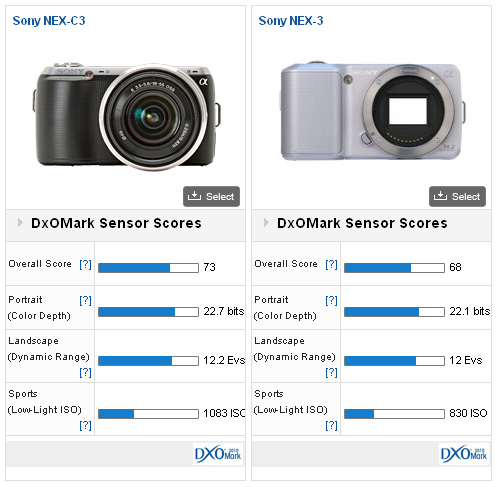
DxOmark (Click here) tested the new [shoplink 7207]Sony NEX-C3[/shoplink]. They also tried to understand if the Sony NEX C-3 vs [shoplink 5509]Sony A580[/shoplink] vs Pentax K5 vs Nikon D7000 are using the same sensor: “The scores say no, but our measurements loudly say yes, this is the same sensor but it has been tuned differently:
- Strangely, the lowest ISO available on the NEX C3 is a mere ISO 200, this limitation does not allow the user to take full advantage of the built characteristics of this sensor in Low-ISO.
- Not being able to go further down than ISO 200 explains the difference in scores as far as dynamic range and color sensitivity are concerned.
On the other hand the Sony NEX C3 should be able to provide the same Image Quality scores in High ISO (the lowlight ISO Score is of 1083).”
So why did Sony ban the ISO 100 from the Sony NEX-C3? Mystery!
P.S.: Those are the direct search links to the Sony NEX-C3 at [shopcountry 7207].
35 Responses
No a77 news!!!? 🙁
Ya me too…I thought we were to stay tuned this week for more a77 news. 🙁
So why did Sony ban the ISO 100 form the Sony NEX-C3?
I’m wondering if it’s because of the target market–you have some consumers who’ll only ever use it with the kit lens, which is pretty slow. Having the ISO range start at 200 would result in fewer blurry shots.
Still, it’d make sense to put an “expanded” ISO range in the menu, like most starter cameras. The Low ISO performance of the K-5 is great and can even be expanded down to 80.
Then again, those same consumers will probably only ever use auto mode, and therefore ISO would be automatic too.
I HATE when there is no ISO 100 or lower 🙁
Same here. I’m in need of using ISO100 more often than I’m in need of using ISO6400… what might be quite surprising for Sony I guess after checking the news like that.
Yeah its a shame its gone.. especially for those of use that try to drag exposure in daylight.. I guess ND filters are way to do that if we want to allow technology to pursue the higher iso capabilities… I’m guessing there is a technical difficulty with producing sensors that can do both High and Low ISO.
As long as ISO200 is decent I doubt it’d be an issue for most.. Its not like the C3 is intended for Studio/Flash work.
I don’t mind, but that’s because I shoot in raw. For the consumers, I guess it doesn’t seem to effect them as much when the lenses available have such small f-stops.
Mey be sony will update fw with iso 100 after nex-5 replacement.
That’s exactly what I was thinking… They need to keep some stuff for later marketing, just like in every other consumer electronics
Very good, I will buy this camera as soon as is available. I just hope sony releases very good lenses for this camera soon.
Yeah, let’s add ISO 100 and maybe lower to Firmware 05 wish list…
I hope the nex-7 has 100 or even 160 like the film I use to use!
The sensor’s been redesigned for efficiency in live-view only cameras. At the cost of low ISO, you’ll get to enjoy longer battery life and noticably less overheating. And it’s still a better sensor than most on the market right now.
I’m all for it.
Not sure if it’s redesigned but ISO200 should generate less heat than 100
Good grief!
The NEX-5 and the NEX-3 bottom out at ISO 200. THIS IS NOT NEWS. This is the same as all NEX cameras, so far. I don’t recall such dire aghast during any older NEX reviews….
Oh, and the spelling is MYSTERY.
One more time: MYSTERY.
Not MISTERY. Not MIYSTERY.
Please make a note of it, if you’re going to use the word so often.
Now spell that in Italian.
😉
That was just a typo Thoots. No need to be so rude.
+1000
Seems you are a teacher thoots!
But, a boisterous one!!
thoots, could you explain how to spell MISTERY again? i didn’t quite get it
I think he’s saying it’s spelled with a ‘Y’, not an ‘I’.
the world’s first system without lenses
Wow, and i thought NEX 5 is better. NEX-C3 is way ahead in low-light ISO. I changed my mind to buy NEX-5. I’ll just wait till August.
“Way ahead” is exaggeration. The difference between ISO 800 (Nex-5 score) and ISO 1100 (Nex-C3) score is 0.4 stops. In most daily use, you won’t even notice the difference.
But of course he should expect some improvements from an forthcoming NEX-5 successor. What I like about the NEX-C3 are the built-in microphones on the front instead of the top, the redesigned buttons and the new display suspension. And more than a year further there should be at least slight sensor improvements. But I’m very glad I bought my NEX-5 last year and already had a good time with it, that even boosted once again with Firmware 04’s Focus Peaking…
Please sign NEX 30mm f1.7 pancake petition
http://www.petitiononline.com/mod_perl/signed.cgi?NEX30mm
Since the announced SEL-30M35 isn’t available so far your chances to get a SEL-30F17 Pancake in the foreseeable future are even worse than mine getting 12mm. Additionally I’m expecting more interesting lenses from third parties instead of SONY anyway…
NEXfive, thats why we need this petition, HIGHfive!
ISO 200 is native sensitivity of the Sony sensors. Simple as that. No mystery here. And who cares? Use ND filters if u need longer exposures or to shoot at wide aperatures in bright light …
It’s really not a big deal if you don’t want it to be a
big deal …
Please explain this noob question. The major reason for a lower ISO is improved image quality.
I don’t understand how dulling the light coming in with a Neutral Density filter will increase IQ. Other effects perhaps, but isn’t IQ why people want lower ISO in most instances?
The lack of ISO 100 and no native fast glass has me shopping MFT when I would of course prefer an ASP-C sensor in a reduced sized package.
Bill
“The major reason for a lower ISO is improved image quality.”
That is true but occasionally, a lower base ISO can help you to shoot your lens wide open in bright light. But this is only a secondary reason. (The shutter speeds needed for deliberate motion blur usually so long that a base ISO of one stop lower rarely really makes a difference.)
doesn’t all mirrorless start at ISO 160 already? which body use ISO100?
Still not a single clue (beyond “august”) about effective availability outside Japan?
Hollidays are quickly approching and I need a new camera… cant imagine to buy a 3 or 5 so close to the c3 release 🙁
UPDATE: Available in Singapore since today (yesterday for some…)