








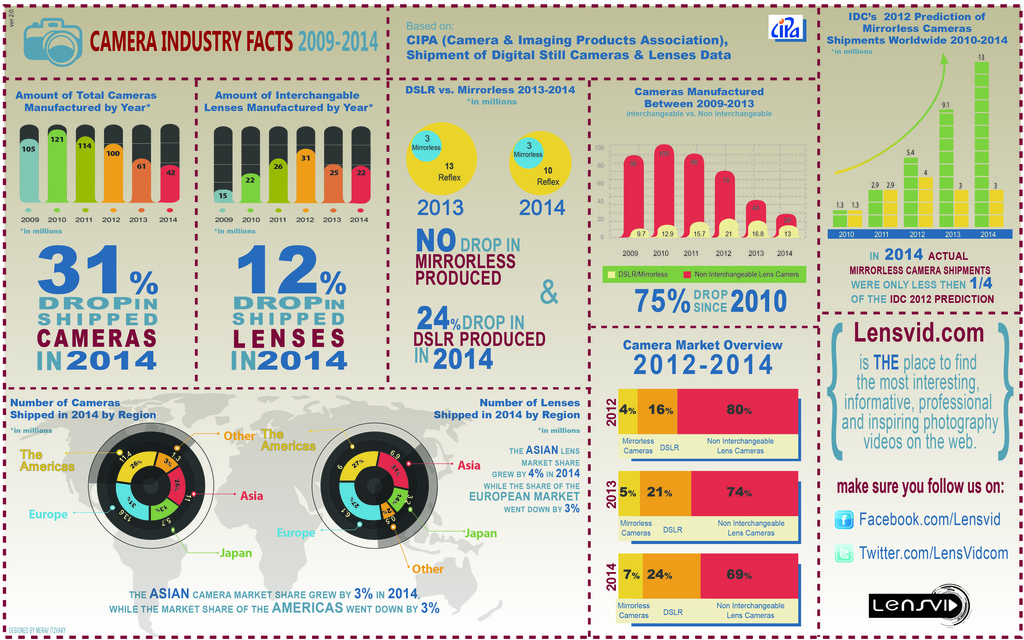
Lensvid made the great effort to summarize the photo industry market. And as expected the scenario is quite negative. Only Mirrorless system cameras manage to have no loss during the year. But it also has to be said that the amount of mirrorless cameras sold is still very low compared to DSLR.
Here is also a video from Lensvid which explains the data in detail:
12 Responses
This is a little mixed up. They have certain graphs labeled total number of cameras MANUFACTURED per year, then it turns out they are using CIPA numbers to list total number SHIPPED per year.
Also the various boxes change their comparison dates all over the place, as though each one is trying to make a separate editorial point. Is 2013-2014 significant? Is 2012-2014? Is 2010 to 2014? Might suggest they just pick a consistent period so that the reader himself could identify any actual trends, and be consistent in the years examined?
The bottom line, though, the outlook is dismal across the board. Yet the manufacturers still price their new items as though this were 2011 and we were at the top of the bubble. This even despite the decline of the yen relative to other currencies. Their products just cost way too much.
Most of all, the market is not going in the direction most MILC-fans seem to believe. Hyper-competitivity – way to many brands, camera models and all @ way too high price – while more and more people discover that a smartphone is all they need – that’s what’s killing the ‘true’ camera-market now.
> way to many brands, camera models and all
Choice is great. It is a good time to buy a camera.
> way too high price
Luckily, regardless how many times you repeat that, it doesn’t affect reality at all.
These days you can buy into any mirrorless system for less than 400€.
> more and more people discover that a smartphone is all they need
When time comes, yes. But right now most smartphones do not even offer a zoom or multiple FLs.
He is spot-on.
“Choice is great. It is a good time to buy a camera.”
True, but many photographers are not buying because we all have at least one camera / camera system, and are expecting a significant improvement (not only mp, but also better wi-fi connectivity, better integration with the computer workflow AND the internet, more lenses for some mirrorless system, etc.). The only one actually happening is the latter one (lenses), and not for all systems.
> way too high price
For new models, which are the models the manufactures wants me to buy, that’s true. I am now buying the cameras they phase-out (just bought the Fuji x-m1 for nothing, and I don’t think that was Fuji market dept’s original intention).
> more and more people discover that a smartphone is all they need
When time comes, yes. But right now most smartphones do not even offer a zoom or multiple FLs.
You talk for yourself, and sure enough also for me. But not for the 99% of potential buyers who need a camera only for taking selfies, or “me-in-front-of” kind of pictures to post on facebook. For those people no zoom is required, and 8mp are already overkill for facebook and other social networks. Either cameras change dramatically, or that market is lost forever.
It’s not me, dear Dummy00001, the market is changing and there is still a lot to happen. It will not get bigger, but a lot smaller and competitively will increase and eventually kill some of the current players. The fact that Apple is in some other charts being considered as a ‘camera manufacturer’ tells enough and we haven’t seen the very best to come yet. On the other hand, all that ‘premium’ in the MILC market is a very thin layer on top of what those manufacturers one were: just compact camera developers? Not even making the best stuff, but entry level, margin sensitive solutions for moms & pops. They are all experiencing both from a technical as commercial point of view now what it means to keep a rock-steady product range in the air that competes with the same image quality, ergonomics, stability, flexibility and market support as the DSLR-manufacturs have done for decades. A lot of that gear is really overpriced, excessive margin stuff – neither the OM-D, X-series, NX1 or even the A7’s are really fully worth their price tag, a lot of these concepts will not longer live than a few years too.
>>> way too high price
>For new models, which are the models the manufactures wants me to buy, that’s true. I am now buying the cameras they phase-out
Yes, people are buying some of the remaindered last year models because the price is now cut. Which only supports what he said. If they priced cameras that way at launch, they would sell many more.
But no, product marketing will still launch at way-high prices, forbid retailers from discounting, and then blame everyone but themselves when sales slow. They’ll blame smart phones, even though cheap consumer cameras have been around for 130 years; they’ll blame the economy, exchange rates, demographics, blah blah, anyone but themselves.
>>> way too high price
>Luckily, regardless how many times you repeat that, it doesn’t affect reality at all.
Of course it doesn’t affect reality, it merely reflects reality, and he can prove it: Camera sales are falling off a cliff at the price manufacturers are offering them.
Also, it is worth noting that Samsung does not report sales figures or shipments to CIPA, so not including their sales figures in these charts for mirrorless is a bit like leaving one if the name brands off when talking about DSLR sales.
except Samsung doesn’t really sell that much in japan, nor really in Europe nor really in the USA.. so it’s probably a non-factor.
Samsung is practically banned in Japan, and that’s why it doesn’t sell. OTOH it sells preatty well in China, which is the most important Asian market.
Wow, really bad news, but not totally unexpected. Not sure why IDC thought mirrorless cameras were going to take off. I’ll look for their report. Me as a consumer, not sure how this news will impact me. I have noticed significant and consistent price drops for both Canon and Nikon dslr’s on the secondary market, like on eBay (brand new from a seller with 1000’s of feedbacks), refurbished directly from Canon etc. To the point where it is just expected to save $500-$1000 on a high end dslr. Primary sellers like Amazon and BandH prices hold pretty steady. For compacts, hmmmm, I would never buy one. My iPhone 6 is plenty good for point and shoot type shots. This area is so confusing for consumers due to the number of compact camera models. Both Canon and Nikon are guilty of having over 40 models! Cut the number of compact models down to 10-15 to save money and avoid consumer confusion. Why I don’t buy a compact? My iPhone 6. Why don’t I buy a mirrorless? No need for it. Between my iPhone and Canon 70D, I don’t really need something in the middle. I had a Rebel t3i, but ended up selling it. Why haven’t I bought a DSLR in 2+ years? I don’t need one having a 6D, 5DIII, 70D. If the new feature is 4K, I definitely won’t be buying one just for 4K which I don’t plan to ever use. Honestly, the AF, Metering, Megapixels, overall feature set are better than I need for the foreseeable future. Maybe that’s why dslr sales are down? Still, I’ll probably buy a 80D and maybe the 6DII when they come out. Probably not a 5DIV though.
Where Apple created the iPod, iPhone, iPad, iWatch, and even an electric car? and created a new market, I don’t see this type of innovation from photography companies. Remember the APS film cameras back in 2000? Look up Canon EOS IX and Nikon Pronea if you don’t. It looks like mirrorless was similar to this, smaller but with great features and quality. Well, the image quality was terrible for APS film cameras (at least the Pronea I owned with Nikor lenses) and the smaller advantage was no big deal people figured out. Mirrorless I thought was going the same route, but it looks like image quality is good enough so it will be around for the foreseeable future, though in much smaller numbers than people thought. The smaller and lighter advantage is just not that big when looking at the Canon SL1. The image sensor on some of these mirrorless systems like the Nikon 1 system’s 1″ (13.2 x 8.8mm) sensor is considerably smaller than the Four Thirds and APS-C format sensors used in competitive mirrorless interchangeable lens cameras. Image quality from a smaller sensor would make me immediately avoid this whole system. The Canon M series uses their APS sensor, but why not just get a SL1 and have all those lenses available to you? Maybe that’s why they pulled out of the US market. If this downward sales trend continues we may see some mergers or companies drastically reducing number of models or pulling out of photography all together.
So I’m looking for a camera for a 12 year old relative on a budget. A new Rebel is too expensive and heavy so mirrorless looks like the way to go, so that 3 million unit market is hopefully here to stay if the cameras keep getting updated. The point is, that if mirrorless wasn’t available, I would just get her a used Canon Rebel or SL1 and say carry the weight, it’s worth it. So the pie size doesn’t grow, the slices just get reapportioned.
2015? Expect more of the same meaning a slight downward trend in sales for compacts and dslr’s, but mirrorless may stay about the same at 3 million. The reason is smart phone cameras killing compacts and DSLR’s are plenty good enough for the vast majority of consumers. No new feature like built in meters, matrix metering, auto focus that spurred sales in the past is on the horizon. 4K and 50mp doesn’t matter to the masses.
Compacts – Camera phones are only getting better and compacts have plateaued years ago. What can they do, put 4K or 50mp into a compact? This market may shrink to nothing. Scary but that’s my prediction. If I had to chose a new compact for a kid, I would consider the iPod touch since it does so much and has a decent camera. What if Apple’s next iPod Touch focuses on the photography aspect with a zoom lens ? I would buy it over any compact out there for my 12 year old due to it being able to be used as a music player, video player, web surfer, app device, etc
Mirrorless: Expect the same, 3 million units. Hopefully these cameras will get better, but again, what cool new feature will make you want to buy one? 4K or 50mp? Canon pulling out of the North American market is very troubling. The industry can’t even agree on what to call these cameras. The terms, “Compact” and “DSLR” have been adopted, but Mirrorless, MILC, EVIL, 4/3’s, CILC, or ? This just makes it confusing for consumers. DSLRs I know have full frame or APS sensors. Mirrorless though have several sensor sizes which makes it more difficult to comparison shop.
DSLRs: These cameras are in as a precarious position as the compacts. What smart phone cameras are to Compacts, mature technology is to DSLRs. Remember when the first AF cameras came out? Wow, what a great reason to buy a SLR! I bought each new Nikon introduced since the AF got better and faster. 8008, 8008s, N90, N90s, F100, F4, F5. AF is to film cameras what MP are to digital, the main reason to upgrade. Now, consumers realize that AF is plenty fast and MP are more than adequate for a 20×30″ print. No reason to upgrade and buy a new camera anymore. 4K and 50mp are only needed/wanted by a very small % of the market. Who blows up a picture bigger than 20×30? Who would shoot a home movie in 4K and show it on their new 4K television? Very few of us I suspect which means little mass market appeal for the new 4K DSLRs or Canons 50mp cameras. Consumers can use their 2-3 old DSLRs with no compelling reason to upgrade. Have you missed a shot due to the AF technology? Have you been unhappy with the resolution of your 20×30″ print? Nope, so no reason to upgrade. I expect both DSLRs and Compacts to continue to decline in sales and mirrorless to stay about the same at around 3 million and then decline in 2-3 years for the same reasons DSLRs decline, no reason to upgrade.
Another reason sales of Compacts and DSLRs is down and will continue to slide? The secondary market of eBay and craigslist makes it easy to pick up a used camera with plenty of MP and AF technology for cheap. I just bought a Canon EOS M with an 18-55 and EOS adaptor for $150 off of cl. This set up MSRP’d for over $800 three years ago. Wait three years and get an 80% discount? That’s pretty good. Another reason for the decline of camera sales is the availability of used gear and the infrastructure to support payment and delivery.
In summation, a very dim outlook for everyone impacted financially by camera sales. A great outlook for consumers since prices for DSLRs and Compacts keeps falling.
” Mirrorless I thought was going the same route, but it looks like image quality is good so it will be around for the foreseeable future, though in much smaller numbers than people thought. With such a small sensor though, IQ can’t be nearly as good as APS or FF. ”
What are you talking about? Mirrorless cameras use the same apsc and FF sensors of DSLR cameras. Or are you referring to m43 only (and even in that case your statement is questionable: compare today’s 43 sensors with the 5 y.o. apsc sensors still used by many photogs)?