








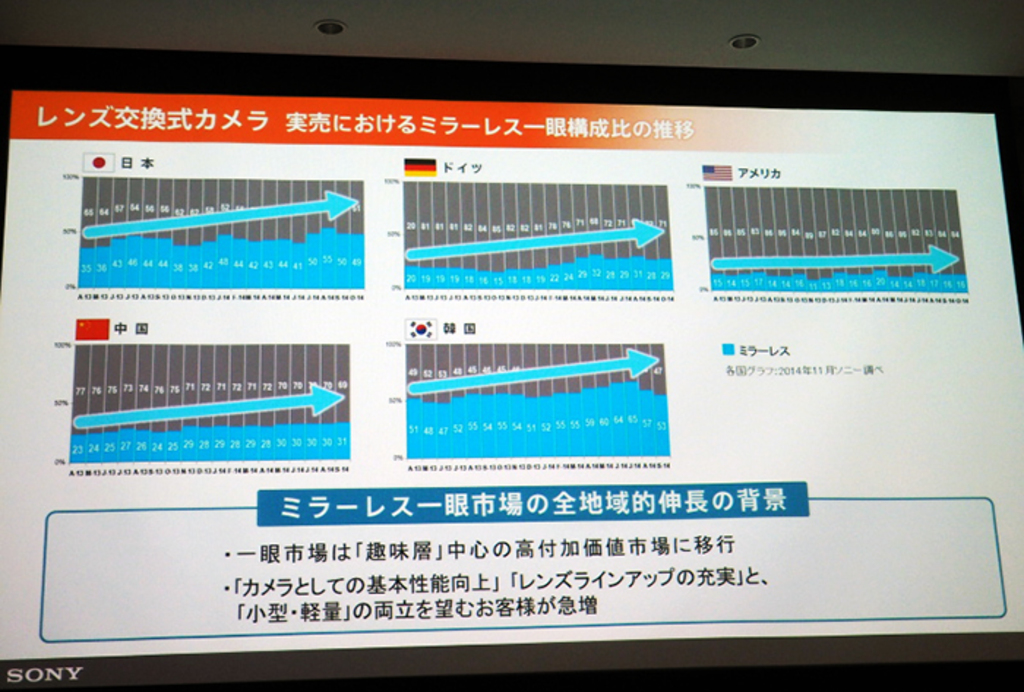
At the Sony A7m2 presentation in Japan Sony showed the graph you see here on top (Source: DC.watch). it shows how the mirrorless system camera market is growing compared to the DSLR market. The blue bar shows the market percentaga of mirrorless in the system camera market:
– Half ot the system cameras sold in Japan and Korea are mirrorless
– US is the “weakest market” with only 11% of share
– Mirrorless is growing in all amrkets (althaigh at different speeds).
INteresting additional note from Sony: half of the A7/r/s camera owners never owned a Sony camera before those!
7 Responses
Who was the audience of this slide?
What is the source for their numbers?
What exactly are we measuring? Units sold? Units shipped? Prices? Cameras alone or total sales? Profit?
Is it ALL mirrorless, or just Sony?
It would be good to see another slide showing these figures plotted against the total sales (or shipments or units or revenue) for ALL big boy cameras, regardless of how the photographer views the subject year after year.
1) DC.watch
2) Sony doesn’t mention it but it’s like to be the CIPA data
3) units sold
4) all
if it was CIPA data, then it’s units shipped. looking at dc watch. that’s shipments, and thier arrows really don’t match up that well to data. they also showed the first graph here:
http://dc.watch.impress.co.jp/img/dcw/docs/677/030/html/05.jpg.html
which you didn’t include which shows basically the ratio levelling off between MILC and DSLR.
In fact, ignoring the arrows, the slides above seem to depict the reversal of the trend in the last two time units (vertical bars), with DSLRs most recently regaining market share from mirrorless.
5 contries is not all parts of the world. You forget at least 220 other contries.
Growth now does _not_ indicate it will grow forever. Most likely it will stabilise.
That precise slide only shows these countries. But ther eare more slides on DC.watch and Sony cleary talks about “worldwide”.
I had an opportunity to work with Sony for a while and seen some of their slides for internal communication. They have a tendency of over exaggerate (especially their own sales and performance) in order to boost faith and motivation to their fellow employees around the world.