








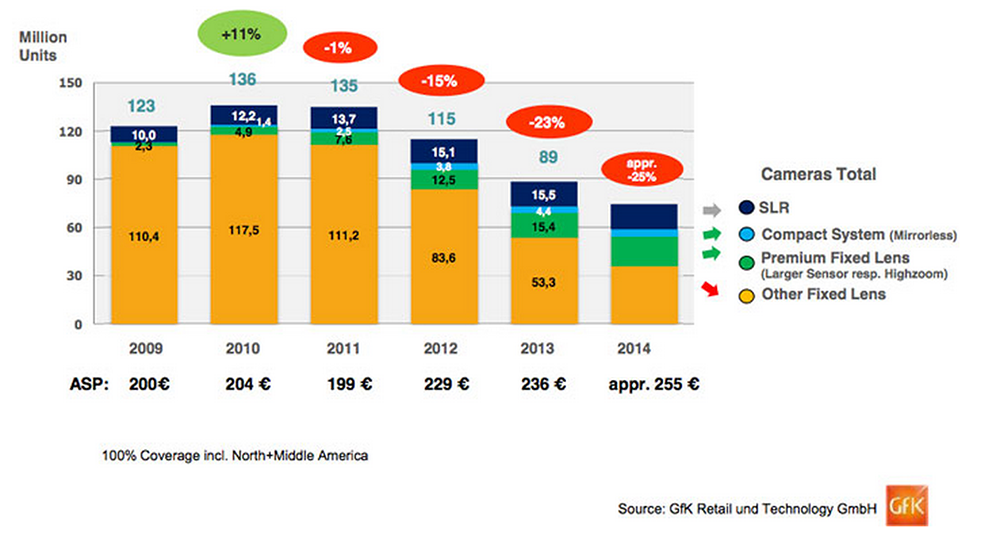
The German Photokina partner agency GFK published those graphs and data about the worldwide camera market trend. And there are plenty of interesting info!
Let’s start from the graph on top. It shows:
1) The low end compact camera market is rapidly shrinking
2) The premium camera market (DSLR+Mirrorless+premium fixed lens) are growing
3) Mirrorless is growing more than DSLR
4) The overall revenue is growing.

That graph shows that Mirrorless market share is growing in Asia primarily but also in Europe.
And than it’s very interesting to read when people actually prefers to use a proper camera over a smartphone camera:

And these are the top 5 reason why smartphone user decide to buy a digital camera:

In summary. The analysis form GFK debunks a couple of myths:
1) DSLR market is not shrinking. It’s well alive and stable.
2) Mirrorless market is growing (despite some sites claiming the opposite). Although it’s growing less than expected and still has a hard time to get popular in USA.
3) The future for premium digital camera makers is bright because the overall market is expected to growth!
4) Digital camera Companies are making more money than before! They are selling less lower margin compact cameras. But they are also selling more higher margin premium cameras!
Well, what’s your thought on this?
found via Photoscala.
10 Responses
The trend is that within five years they will be selling 0 cameras, and making a boatload of money doing so.
http://xkcd.com/605/
um admin, dslr market is shrinking. the first graph indicates the entire market is shrinking rapidly (115 million to 89 million units in one year!).
Interesting way to look at it lol. In 2012 3,956,602 mirrorless cameras shipped in 2013 3,305,798 that is a 16.4% decline in real numbers , meantime DSLR numbers declined by 14.7%. The first quarter of 2014 has been better for mirrorless due mainly to multiple model releases along with a glut of cheap old stock being sold off , the next big DSLR model updates are due later in the year.
http://www.cipa.jp/stats/documents/e/d-2013_e.pdf
http://www.cipa.jp/stats/documents/e/d_2012_e.pdf
The data presented here also excludes USA/Canada/ Americas which last year showed a 45% decline in mirrorless sales and also accounts for 20% of the DSLR market. The only numbers that matter are those from CIPA. tBy ignoring the USA/Canada etc players should make this obvious to anyone bar the mirrorless fanboys.
Looking over the period from 2009 when 12.3 million DSLRs sold {10% of 123 million units } last year DSLR’S sold 13.78 million units { 15.5% of 89 million units} so not exactly the doomsday of DSLRs that many mirrorless fans seem to think.
One important element that is not mentioned is Market Saturation.
Based on the first chart 2010 & 2011 were the peak of the periods reported.
Subsequently, (my guess) many households had no need to buy a new camera due to almost everyone using their smartphone cameras.
The Japanese growth in the compact system market doesn’t surprise me at all. I often visit Tokyo and lately see tons of people using them. Of course the main reason IMO is because Olympus, Panasonic and Sony put out tons of ads for their system cameras here. More awareness is the first step to getting people on board.
or maybe because the same camera which weights 1% of average American, weights 2% of average Japanese person? 🙂
> “Let’s start from the graph on top. It shows:
> (…)
> 4) The overall revenue is growing.”
It’s not the overall revenue that is increasing, it’s the average sell price per unit: €199 in 2011, €229 in 2012, €236 in 2013 and approx. €255 in 2014f.
This is logical since the lower end of the market is more rapidly decreasing than the upper end.
Unfortunately, the decrease in volume (number of equipment sold) is quicker than the increase in average price per unit, thus meaning that total revenues are decreasing, not increasing.
admin has posted something s/he completely does not understand.
The real news here is the average sell price increase and the growth in premium compact sales. I know what I’d bet my money on and it’s neither the mirrorless or dslr markets.