







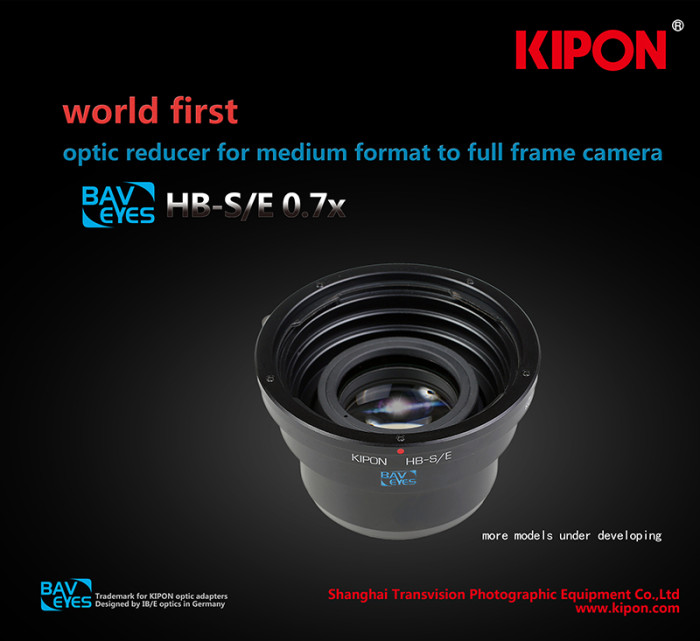
The Japanese-German partners Kipon and IBE today announced the development of the world first medium format to Sony E-mount lens reducer adapter! The Baveyes HB-S 0.7x “Speed Booster” will be offered for Hasselblad C-F-CF lens series owners. They can use those lenses with the “native” focal length and 1 stop aperture gain on Sony Full Frame E-mount cameras. Kipon did yet no share any info about the pricing of the lens and the possible shipment start.
93 Responses
I don’t see much sense is this since even with 1 stop better specs, MF lenses are just big and slow compared to what is available for the FF image circle.
Agreed. Resolution wise, I don’t think a focal reducer would help.
Same. A tilt-shift adapter is always nice. But a MF focal reducer just gives out something not even as good as what’s already available. Too bad, because I really like my Kipon tilt-shit adapter.
Haha, brilliant – if the 35 1.4 isn’t oversized enough, now we can put even bigger lenses on our Sonys!
What f stop gain would you get if it was med format to apps c instead?
it’ll be the same f/stop as with full frame. however, you get a cropped image (0.5x) of the full frame sensor.
F-stops of course none at all, there is no chance in focal length happening here. But if you use both this and the Metabones Speedbooster you should get 2 T-stops.
F stop changes too because field of view changes.
nope, F stop changes because entrance pupil stays constant and focal distance change.
No, focal length stays the same, and as long as you do not change the distance to the model, F-stop does NOT Change.
you can’t do that. There is simply no focal reducer from E-mount to E-mount because both E-mounts have same focal distance.
You are right about that, forgot that.
the same as on FF. But you crop into the inner section and lose the outer section.
Actually seems the price is about 415 USD when it goes on sale in feb.
I had a strange experience adapting a Hasselblad 80mm 2.8 lens to my sony A7 with a dumb adapter. I wanted to compare it with an old Nikon 80mm af-s lens. When I looked at the photos I realized that the focal length was exactly the same: both behaved as 80mm lenses on a 35mm sensor: same angle of view. I expected to have to factor in a multiplier for the Hasselblad like you do when adapting full frame lenses to apsc. The problem with my thinking was that the use of 35mm as a frame of reference is completely arbitrary. When you adapt the lens with the larger image circle to the A7, the A7 becomes the crop sensor. If you adapted a sony lens, say the 55mm, to a Hasselblad body, then it would behave like a 35mm lens on apsc, and you would have to multiply the focal length by the crop factor to get the proper angle of view. So this optic reducer would turn the 80mm normal lens from the Hasselblad into a 50mm (or thereabouts) normal lens on a 35mm sensor, and make it brighter. It would no longer behave like a short telephoto on the A7 (and it never was a short telephoto on 80mm). I am not sure this makes any sense. But the point is, the lesson I learned is that if you adapt a medium format lens to 35mm you should not expect a change in the nominal focal length, compared to the same focal length in a native lens. I need a drink.
80mm is 80mm is 80mm no matter what you shoot. A MF 80mm has a larger image circle to cover mf film / sensor, a FF lens on a MF camera will give you a FF image circle inside the MF frame. same as APS-C on FF. Focal distance never changes, just how much of the lens circle you use does.
I’ve always wondered if these focal length reducers change depth of field. I don’t think they do, but I’ve read some people say that it does, which is confusing.
No, F-stop is not changed. Only T-stop. And you get the angle of view of the large format camera.
Hmm that makes sense since the aperture ring is the same size. How do they work then? I can’t really find a diagram or explanation online. How do they increase how much light enters the camera and why do they change the field of view?
edit:
Since focal length is the distance from the sensor to the point in the lens where the light converges (the first lens diagram in the article):
http://expertphotography.com/understand-focal-length-4-easy-steps/
That means by adding a piece of glass between the lens and the body, that distance is increased. But the reducer acts by bending the light (in the example of the second diagram, making the red beams of light close more inward).
If you look at the second lens diagram in that article, you’ll see that it says that when the sensor gets smaller, you get a “longer focal length” because of the fact that you see less of what the lens is projecting, which makes sense and also explains why when you put an APS-C designed lens on a full frame, you get vignetting, because the area the light is projected onto is smaller than the sensor.
What still confuses me is why the focal length reducer will change the field of view considering all those facts. Since the distance from the sensor to the point of conversion gets longer, the image projected from the back of the lens to the plane where the sensor is would get much larger, but the image would not change, since that’s what is entering the lens (and wouldn’t that mean the image on the sensor would be cropped/zoomed in compared to before?). Even if the focal reducer bends the light, the most it can bend it is right onto the sensor (any more would cause vignetting), but wouldn’t the image then be exactly the same as before? Am I thinking about this entirely wrong?
Edit2: Srsly tho can someone explain this to me? I really wanna know how this works.
Edit3. I GET IT. Focal length reducers can only be used with lenses that are for bigger format sensors. Why? Because the reducer works by “squeezing” the bigger projected image onto a smaller sensor. Thus a wide view. This also means that there’s more light hitting the sensor. Cool cool. Yeah noone’s probably gonna read this but it was really bothering me I had to know.
They don’t increase the amount of light that enters the camera. Look at the boosters as nothing more than a magnifying glass that takes a stream of light and focuses it down onto a smaller circle than before. Like holding a magnifying glass outside in the sun… The amount of sunlight that goes into the magnifying glass is fixed by the size of the lens…. but if you hold it further or closer to the ant the light is more or less concentrated, that is all the boosters are doing concentrating the light that is there into a smaller circle that goes from covering a MF size sensor/film to a FF size sensor.
Once you understand that the f-stop is a ratio (focal Ratio = focal-length/Aperture[front lens Diameter]) it’s easy to understand.
The aperture is the most important feature of any optical system but due to practicality isn’t used in photography (it’s used for telescopes, binoculars etc.)
When you reduce the focal-length the focal-ratio gets smaller as the aperture always stays the same.
=> the f-stop gets smaller and so does the focal-length.
This is what is in the Metabones FAQ regarding this question:
http://www.metabones.com/article/of/faq
Does the Speed Booster® increase only T-stop of the lens leaving F-stop unchanged?
This is one of the common misconceptions about the Speed Booster®. However there is a contradiction right within that assertion since T-stop cannot be any faster than F-stop. It is not possible to experimentally observe a T-stop increase unless the lens has a corresponding F-stop increase.
The logic of the allegation is that since the depth-of-field of the lens does not change, therefore neither does the F-stop of the lens (untrue). What had never been under any dispute was that the T-stop of the lens did increase, as could be seen with the increased exposure in the resulting footage or photograph.
Before we clear up this misconception, let’s find out why there is so much confusion in the first place. Focal length, maximum aperture and depth-of-field are physical quantities that are independent of sensor size. These quantities do not care whether a full frame, APS-C or m4/3 sensor sits behind the lens.
Speed Booster® makes the focal length 0.7x shorter. F-number is simply focal length divided by entrance pupil diameter. Since the former reduces by a factor of 0.7x but the latter remains the same, F-number also becomes 0.7x smaller, or one stop faster. The F-stop increase is real.
Note that a 35/1.0 lens (from 50/1.4 + Speed Booster®) will always have shallower depth-of-field than a straight 35/1.4 lens at any given distance.
The only way to do this is to use a ND-filter so the T-stop is lowered (bigger numers, less light), but I guess that was not the idea.
Is there anything you CAN`T adapt to E-Mount? 😀 Now only every adapter should have an AF-Performance like the a7rii with canon lenses 🙂
Yes, all other mirrorless camera lenses, at least not without loosing infinity focus. Some might not even work without eletronical contact (focus-by-wire MF for example needs power to operate).
MFT lenses work, only Fuji’s X-mount have shallower flange than e-mount.
Why bother if it doesn’t cover the frame?
For video it could be useful on cameras like the FS series.
And I think Sony should make a m43 crop mode too, just to piss them off.
lol alright
Yeah, especially the M-mount adapters suck in AF performance. 😛
16/8mm movie camera lenses – they have smaller image circle.
Yup, it’s a shame though. There are ultra fast dirt cheap zoom lenses with a great zoom range on 8mm…they only go on Pentax Q, lol.
actually I use 16mm projector lens – 50mm/f1, it narrowly covers the frame (aps-c)
The fastest MF lens is only F1.9 and the widest is only 20 or 24mm (I don’t remember), I don’t see much use of this adapter… FF lens options are much richer due to more intensive competition.
In addition, the manufacturing tolerances are not as severe for MF, so I wonder what the quality might be like. My understanding is that very few MF lenses can match 35mm examples.
It would seem to be an expensive way of using poorly suited glass unless you have a large collection that’s not worthwhile selling owing to the poor return.
true, 80m F1.9 is only a 56mm F1.3 in full frame terms, not terrible but you can very easily find 58mm F1.2s
Heck the SLR magic 50mm F1.1 costs peanuts, and the Mitakon F0.95 isn’t that much either
And if you add a metabone booster XL and tack it onto the end of this booster your 80 F1.9 now becomes a 35mm f0.85… Maybe if enough companies come out with more and more boosters my camera won’t need any light at all.
That concept is wrong I’m afraid, speed boosters don’t create more light, it simply focussed the light into a smaller image circle, the total amount of light received is the same
You can already find 40mm f0.85 lens for Aps-c for under $800, but 0.85 on crop sensor doesn’t have any light gathering advantages over a 1.2 lens on a full frame
You can’t, it’s E mount…
Darn… I here I was thinking maybe I could see in the dark like Riddick.
Just looking at the equivalent focal length and aperture, I don’t see a benefit either. I wonder if there’s anything beyond that…
That said, I would be happy that my Cinelux Ultras could be used with a larger part of the imaging circle, if it works, as the front element in the middle doesn’t look very big…It’s supposed to be at least 7cm in diameter, because MF film is at least 57x41mm right?
———–
Sorry I know how it works now, they put the element in front of the optical path before where it creates the usable image…but I could see this having a huge impact on the IQ, how do they compensate for different lenses with different exit pupil distances? It may…smear really bad for wide angles?
there are much faster medium format lenses than f/1.9….try f/1.8, f/1.7, f/1.4, and sometimes even f/1.2
20mm on Medium Format is pretty damn wide.
що за идиот ще иска да закачи 5 кила обектив на безогледално тяло? освен снобите с отуси. те са ясни – от снобарство имат всичкото медиум и се чудят де да го ползват…
I don’t see the point of 5 kilo glass or Otus monsters on a mirrorless either. But there is no reason to call them idiots or snobs. To each their own.
agreed. i’m just impulsive 🙂
What? Why snobs, i waited for this all the time. Sonnar mc 180mm f2.8 is around 100 euros, fantastic lens, imagine what would it look like with this reducer. Medium frame look for 100e! And it is not much heavier than 70-200.
Canon FDn 200/2.8 is half the weight. no idea if it’s half the quality, but highly doubt it. maybe the Sonnar has better bokeh.. no idea. this is subjective.
but hey.. if you want the Sonnar – go get one and enjoy 🙂
If it works like some other adapter/booster combos the bokeh get a bit jacked up in the process so even if the medium format lens had a good bokeh before with the adapter all bets are what was once round circles will likely become ovals of some sort.
I doubt you could find fdn that cheap.
it probably won’t have the medium format look since it’s basically converted to a full frame lens – 180 F2.8 is about 126mm F2.0, similar to many full frame 135mm F2.0s
correct, you won’t get medium format look definitely. You can’t put 18×24 large format Petzval on mft-sensor and expect same look. Such strange ideas can only come from people who still think “lens is everything, camera is nothing!”
Thats exactly what i am talking about. There is no ff 135 f2 nowhere near that price.
well when you factor in the price for the speed booster alone..
Samyang 135 F2 isn’t expensive and is probably better quality
Hardly. But i do agree that this is way too much for an adapter.
Meatball sandwiches
I want a Tilt-shift for Bronica Lenses.
I’m already using tilt shift with Bronica SQA lenses on my Sony A7Rii. I use a Mirex Sony->Canon EF adapter and then a Canon EF->Mamiya 645 adapter and finally a Mamiya 645 to Bronica SQ adapter. I love the 50mm and have played with the 40 but am still waiting for a nice copy
Damn, Adaptception!
One step closer to my dream of using the Contax Zeiss 80mm f2 on the A7 series.
Same here!
It would essentially function as a 50mm f1.4 on an A7, and there are a lot of good 50s that already work with the A7. Is there a particular quality you would hope/expect to come through from the 80? It would be very interesting to see a comparison.
The contax 80mm f2 has famously wonderful rendering, and just as important, using an 80 instead of a 50 changes the perspective. A normal lens on a medium format camera has a unique rendering compared to 35mm cameras, the same way a 50mm on a full frame looks better than a 35mm lens on an aps-c.
perspective depends on subject distance.
50mm on FF and 35mm on APS-C at the same distance will give the same result.
But this converter will make it a 56mm. So you saying you gain gain a lot between this converted 80mm and X 50mm lens? Research EF-MFT speedbooster and the changes experienced to the lenses used with it. Their “look” does not remain intact.
I used to own a Contax 645 with a few lenses and I wouldn’t go through the effort of converting them to FF, however fantastic their characteristics are. Best macro ever, that 120mm, and I would still not trust another set of lenses between that lens and the camera and expect the same result.
You’ve got too many things mixed up.
1. Rendering is related to optical design. It’s got nothing to do with the image circle.
2. Using an 80 with a proper reducer doesn’t change the perspective compared to a 50.
3. The Contax 80/2 is an electronic aperture lens and the focus motor is engaged by default so it’s still to focus because you’re turning the motor. You run the risk of grinding the gears if you do it quickly.
4. It’s not as amazing as you think it is. It’s not exactly sharp and the bokeh is not anything that special.
5. You’re not getting the real thing when you put this focal reducer on. It’s glass! People don’t even put filters on when they want the best quality.
I think I would rather forego the extra t-stop and instead take advantage of the larger image circle on my RB lenses for some serious movements:
http://www.bhphotovideo.com/c/product/1131861-REG/cambo_99010706_actus_camerabody_black_sony.html
Always wondered why no one did this before…
small market
Almost pointless? Fastest MF lens I’ve used was f2 80mm from Contax. This converter would make it a 1.4 56mm. Is it really worth it? I don’t think so.
Now think of your average 2.8, 3.5, 4 lens and see how far you get for alternative glass. Also, adding another set of elements to any lens will make some of that lens’ characteristics be lost. See the reports of people using EF-MFT speedbooster and the way those lenses interact with the converter
Yep. A smaller version of the Rhinocam (something like a shift adapter) would make more sense as it would at least also result in higher resolution (pixel count)
According to the article, they can use the lens “with the “native” focal length and 1 stop aperture gain”, so maybe they have worked some optical magic.
Nailed it. And if you have MF glass, don’t waste it on a wimpy 35 sensor – go grab a roll of 120 instead 😉 (also re: EF-MFT speedbooster – I hate the way all my lenses render on the GH4!!!)
These “reports” compare aps-c cam with reducer against FF cam with no reducer == a very different thing…
how fast does a 85/1.5 biotar formula lens become with the speedbooster? or double gauss 100/1.5? or double gauss/petzval 120/1.8 and 140/1.8?
What the heck about aperture, we are talking about render, bokeh, color….
https://flic.kr/p/bWuGpR
I can’t wait for this, I hope I could find a way to mount the Noritar 80/2
This may have the old problem of the FF reducers, they won’t allow the extra light of really fast lenses in. The original limit for FF reducers in general was f/1.4, any faster and the light from the edge of the rear element won’t be allowed through, I hope it isn’t as slow as f/2.0 for this adapter or it won’t work with my intended lens.
How many medium format lenses faster than f/2 are you in possession of exactly..?
3.
Oude Delft 112mm f/1.4
Oude Delft 64mm f/1.4
Wild Heerbrugg 98mm f/1.4
You’re a baller. I want that falconar/wh 98/1.4….
Here’s a sample taken with the falconar on a A7s @ f/1.4 (handheld infront of the camera / extender)
https://uploads.disquscdn.com/images/6d26676349d47e05a6a1b5de336d041fc20c31b489cf20abe8712143a58dc702.jpg
not bad. are you on any other projection lens forums or fb groups? 😀
One. It’s a projection lens. It covers MF but it doesn’t have a mount. In other words I could get any mount with a suitable flange range CNCed onto it.
For me the only need to use MF on FF is the superior ability to tilt/shift due to larger image circle. And especially A7-series with such tiny flange distance allows to use bellows and thus being much more flexible. But the focal reducer… makes almost no sence for me
What the real question is (since you guys are only bickering at each other), the hasselblad is 6×6 and is roughly two stops more DOF and half the crop factor compared to 35mm film.
Now this adapter only adds one stop DOF, so it probably doesn’t convert t to a 35mm circle? Or maybe it is compressing/stretching it more?
Lets see their spec sheet and then we’ll see what the hell this is about.
Here are all the specs you need to answer your question: “0.7x focal reduction”.
Finally!
http://www.kipon.com/en/articledetail.asp?id=87
“expected to go on sale in early February Retail price is 415USD”
nice price 🙂 i love it 🙂
the Hassi lenses are not fast (DOF, bokeh), so for what should I use it with this adapter?
I use them with the Rhinocam for higher resolution and or bokeh.
If you don’t need/want the higher resolution you can use it as a shift adapter.
Here is the Rhinocam with the A7R and Hasselblad Zeiss 40mm.
https://c1.staticflickr.com/9/8819/17061863727_dd2db1ff2b_z.jpg
who said hasselblad lenses were never fast? 110mm f/1.7 on hassy v mount then to 645 adapter. your rhinocam is sweet (i have one too) but sometimes we don’t have the luxury of stitching 4-6 images per shot:
https://scontent-yyz1-1.xx.fbcdn.net/hphotos-xfp1/v/t1.0-0/p296x100/12301665_10156258265080503_5076183601208825311_n.jpg?oh=be87fa42d1dcff6842f18bcaa1e4182b&oe=571F76D8
Every time I hear about these reducers I feel sorry for those who will delay seeing/never see the real thing.
I have used my 165mm F2.8 Pentax 67MF lens on my full frame Sony VG900 camcorder.