







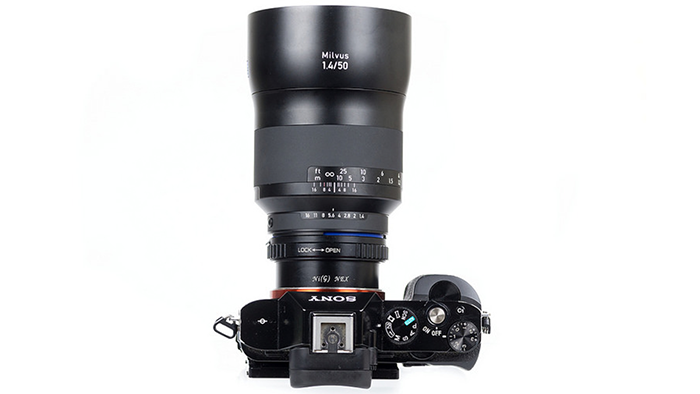
Milvus 50mm on the A7 (image courtesy: 3D-Kraft ).
The new Zeiss Milvus lens comes in native mounts for Canon and Nikon DSLR. Of course you can sue it on Sony FE cameras too. But how much sense does it make to use those lenses on a Sony? 3D-Kraft (Click here) posted a comprehensive view on the Zeiss Milvus family tested on the Sony A7. The conclusion is:
“As a mirrorless shooter always striving for highest achievable image quality with equipment as lightweight and compact as possible when on the move, I must concede that I am in a kind of conflict with the Milvus line. Their extraordinary solid mechanical quality in a wheather sealed metal housing comes for the price of size and weight. Most of the Milvus lenses seem to be better balanced when used on full frame DSLRs but on the other hand, manual focusing is far better supported by mirrorless systems with in-body stabilization working in live view mode with focusing aid by zoom magnification and peaking. For Sony Alpha with FE mount meanwhile you get many native and more compact pendants from Zeiss in the same price range like the Loxia line (a Loxia 21 review will follow soon, stay tuned!) or primes including AF support like the FE 1.8/55 and Batis 1.8/85.
However, the optical quality (sharpness, bokeh, micro contrast, flare resistance, distortion control) – especially of the new designed 1.4/50 and 1.4/85 – is very good, the only weak point is their lack of apochromatic correction so that you will see some axial CAs (“boke fringing”) at open aperture especially from the f/1.4 lenses. Usually this type of CA can be removed in post processing quite easily. If you look for “no compromise” apochromatic corrected lenses, you might consider lenses of the Otus line (Otus 1.4/28 review coming soon on this site!) but those do not have features like wheather sealing or declickable aperture ring, which you find in the Milvus line.”
Read the full detailed test at 3D-Kraft
Here are the detailed Lens info and preorder links:
Zeiss Milvus 100mm f/2M ZE Lens for Canon EF at BHPhoto (Click here), Adorama (Click here).
Zeiss Milvus 100mm f/2M ZF.2 Lens for Nikon F at BHPhoto (Click here), Adorama (Click here).
Zeiss Milvus 21mm f/2.8 ZE Lens for Canon EF at BHPhoto (Click here), Adorama (Click here).
Zeiss Milvus 21mm f/2.8 ZE Lens for Nikon F at BHPhoto (Click here), Adorama (Click here).
Zeiss Milvus 35mm f/2 ZE Lens for Canon EF at BHPhoto (Click here), Adorama (Click here).
Zeiss Milvus 35mm f/2 ZE Lens for Nikon F at BHPhoto (Click here), Adorama (Click here).
Zeiss Milvus 50mm f/1.4 ZE Lens for Canon EF at BHPhoto (Click here), Adorama (Click here).
Zeiss Milvus 50mm f/1.4 ZF.2 Lens for Nikon F at BHPhoto (Click here), Adorama (Click here).
Zeiss Milvus 50mm f/2M ZE Lens for Canon EF at BHPhoto (Click here), Adorama (Click here).
Zeiss Milvus 50mm f/2M ZE Lens for Nikon F at BHPhoto (Click here), Adorama (Click here).
Zeiss Milvus 85mm f/1.4 ZE Lens for Canon EF at BHPhoto (Click here), Adorama (Click here).
Zeiss Milvus 85mm f/1.4 ZE Lens for Nikon F at BHPhoto (Click here), Adorama (Click here).
18 Responses
Hilarious. I was just researching this very thing. Interesting.
what need of f:1.4 lens with shallowed DOF at 1.4 and a A7xxx serie cameras which can almost see in complete dark 😉 Maybe having a high price tag?
Always take a (new) Sony F1,8 (=T1,8) over a normal F1,4 (=T1,6-1,7) – the difference is not worth the size (If I recognice any at all).
Very interesting review.
Interesting to see how the difference between the Batis 85mm and the Milvus 85mm is negligible. It is actually insane how similar the bokeh is.
The 35/2 and 50/1.4 Milvus are looking really nice. I hope we will see Batis incarnations of these lenses as well.
Both have nice round bokeh balls in the middle, but cat eye at the edges, perhaps one of the few things the Otus handles better, if bokeh shape is important to you. I wonder if there will be a 50-55mm Batis in Zeiss’s future? Some will point out the Zony 55/1.8, but made in Thailand plastic / metal clad “sort of junky” construction, not really interested personally in that.
I would love to see a 135mm APO-Sonnar (Macro) Batis. It would curb my GAS for the Voigtlander 125mm or the Zeiss 135mm APO-Sonnar ZF.2.
But, since I have been in the process of starting over, my GAS has been greatly reduced.
Much too big, I have a 50mm f1.2 Nikkor and its much smaller, who would want to carry a 50mm that is the size of a 105mm
“who would want to carry a 50mm that is the size of a 105mm”
Someone who’s concerned with obtaining the highest image quality as opposed to convenience,
With a A7 camera I could use the faster Nikkor, its only 12.7 oz. or a small Leica RF lens half the size or a Voigtlander 58mm f1.4. All very prized for their image quality and build. The Nikkor is my favorite stopped down to F/2 where its razor sharp. This lens has been and still is an active catalog for at least over 20 years. A product doesn’t have such a life unless its really exceptional.
I also have the Sony FE 55mm f1.8 because everyone who has one says its without a doubt Sony’s best lens.
How many Zeiss lenses have come and gone in the time the AIS Nikkor has been around? I am impressed when a lens is compact yet has awesome IQ.
I have several Zeiss lenses, the 100mm Makro Planar is my favorite, its fast at F2 and very compact, its heavy for its size because its made so well and has so much glass in a smaller lens.
the Zeiss 50mm is 13mm longer than the 50mm f1.2 Nikkor. Its not that much of a big deal.
IMO the Milvus line shows two things:
1. How Zeiss still views the mirrorless market: They made the Touit line for all APS-C MILC with only 3 lenses, the Batis line with only 2 lenses and the Loxia line with also only 2 lenses (and now added a 3rd one). But for DSLRs, they created a complete line of 6 lenses for both Canon and Nikon out of nowhere. That shows interestingly how committed Zeiss is to the mirrorless market, which they claim is the future.
2. How much more material is necessary to make it just a little bit better – if any. Compare the Milvus 50/2 with the Loxia 50/2! Size and weight difference is huge but show me anyone who says the Loxia is a bad lens. Or the Batis, even with AF. Or take the ZM lenses … IMO the Milvus series is as much a dinosaur as DSLRs are.
Out of nowhere?
Only 2 out for 6 Milvus lenses came “out of nowhere”, the others are based on the “Classic” ZE/ZF lenses.
point 1 is wrong on a few points..
As 3D-Kraft points out the Milvus line are (mostly) repackaged existing lenses. The new Melvus 100mm f2 is internally identical to the old classic 100 f2 for example.
Past the batis, Touit and loxia many of the existing native Sony lenses are designed by Zeiss too.
When you add all the lenses up Zeiss are currently making, or have designed its something like 15-20 lenes for the FF e mount.
neither the Batis nor the Milvus have a really pleasing bokeh – maybe the upcoming sony can do that better?!
Sorry, don’t know what you mean: 50/1,4, 85/1,4 and 100/F2 have all wonderful bokeh. Not as sterile and lifeless as a Sigma 85mm, and yet wonderful.
But luckily tastes are different.
I saw a video on youtube where the Batis 85 was doubling everything out of focus.
probably a broken one? you got a link?
Sony should push Zeiss to offer these lenses on Sony A-mount. Lenses like these would feel better balanced on the a99 or a77m2