







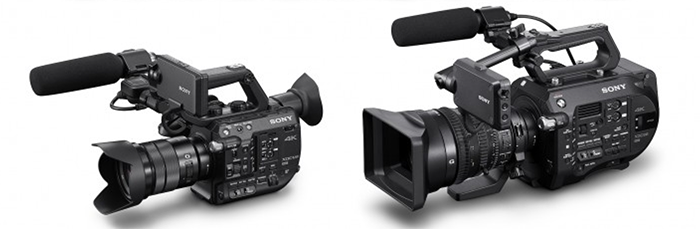
The Sony E-mount FS series is having a huge success among filmmakers. And this certainly helps to make the E-mount system as a whole even more popular. So let’s hope the following rumor turns out to be true:
A source told me Sony is developing an Internal Compressed raw set of codecs which will be released when the FS5 gets its (most probably paid) update. An internal raw would be huge for these cameras. He called it “FS Raw”.
This would certainly be a big news! And it would be even more impressive if it could be added on the A7sII too. But honestly I really think that’s just me dreaming. Don’t think the A7sII hardware could even handle this…
–
To not miss any rumor quickly subscribe our social network:
RSS feed: http://www.sonyalpharumors.com/feed/
Facebook: https://www.facebook.com/sonyalpharumors
Twitter: https://twitter.com/SonyAlphaRumors
GooglePlus: https://plus.google.com/104216500156717934391/posts
And if you have some “rumor” to share just send me an anonymous messages here:
[contact-form-7 id=”14822″ title=”Share”]
Reminder (SR = Sonyrumor):
SR1=probably fake rumor
SR2=rumor from unknown sources
SR3=50% chance it is correct
SR4=rumor from known sources
SR5=almost certainly correct!
66 Responses
Oh wow, raw would definitely be a game changer.
Yeah, because no one used RAW before. ROLLEYES
It’s fairly unique at this price point, the BlackMagic Cine/Production cameras have it but they’re a bit more expensive and don’t have the same features as the FS series.
With the exception of the URSA 4.6k, all Blackmagic Design cameras are priced the same or cheaper than the Sony FS Series.
The FS100 / FS700 are a lot cheaper than the FS5. It’s not exactly a like for like comparison, the BlackMagic cameras aren’t directly comparable.
Yes, they are now.
RAW video, not RAW photos – which would be fairly significant for a more mainstream camera line such as the FS.
of course video RAW.
who else uses video-RAW. And what resolution needs what bitrate to do so?
Arri (Arri raw) Red (r3d) Black Magic (Cinema DNG) Sony (MXF) Panasonic (v-raw) are raw video from the mentioned companies. Don’t know if bit-rate is a relevant term for the data-rates in this case. Data rates depend on resolution and compression.
Blackmagic
Atomos
Digital Bolex
Indiecam
to name a few
ARRI uses RAW also in their Alexa range.
http://www.arri.com/EN/camera/alexa/learn/arriraw_faq/
Thank for the link. I’ve read it and if you translate Gigabit/sec you get:
16:9 ARRIRAW has a bit rate of 168 MB/s at 24 fps.
4:3 ARRIRAW has a bit rate of 223 MB/s at 24 fps.
4:3 Cropped ARRIRAW has a bit rate of 200 MB/s at 24 fps.
Open Gate ARRIRAW hat a bit rate of 270 MB/s at 24 fps.
Each format needs bitrates much bigger than memory cards can write. having a SSD or a SSD-raid inside a small body like A7 series is mechanical not possbile. And I am sure the Sony RAW-compression algorithm will come to the small bodies in some years, too.
Storage is cheap today. Why not simply use well established standards, like Cinema DNG or ProRes? Seems everyone must have their own format to lock in customers. Not good.
ProRes is a uncompressed RAW format?
Of course not. I was generally speaking. The point is the new superflous format not the compression.
With this thinking there was no need to have another video-codec after MPEG-1. DVD would not have gotten MPEG-2 – meaning after 40 min you have to change discs. DivX and h264 would be never be invented, because MPEG-1 is a standard. And h265 is superflous, too.
No, I disagree completely. Sorry.
At the times where MPEG-1 was state of the art, we didn’t need Real, WMV etc. I was talking about superflous, redundant, proprietary formats.
Maybe I’m wrong, and Sonys new format brings significant value or improvement. But for now I can’t see why we need another format. We’ll see.
Is not the first time we both don’t agree.
But coming to superflous: We have already good video codecs out here. Some codecs with good compression, some with a weak compression but they are good for post processing because it requires less computing power.
But there is no codec that compresses RAW information as RAW – no WB balance or the like done. Meaning of retaining 12 or 14 bit color depth, but doing compression in motion-changes. With a RAW (compressed) video format you don’t need vehicles like SLOG2 or SLOG3 any more for dynamic range. And you get all the fine details that are lost with a SLOG-compression.
And after reading the rumor, it sounds like Sony is exacly doing what I described here. So it is not superflous – it’s the first codec of its kind.
CinemaDNG offers Lossless Huffman JPEG compression. I don’t know if Blackmagic or any others uses this feature, but it’s there.
And even then, how about a contribution to the CinemaDNG format, helping it to become an ISO standard?
Of course you don’t need SLOG in RAW. That’s the whole point.
I just read that the following cameras use Losslessly compressed CinemaDNG:
Blackmagic Pocket Cinema Camera,
Blackmagic Cinema Camera (firmware 2.1 or newer),
Blackmagic Production Camera 4K,
Blackmagic URSA
CinemaDNG means, every picture is compressed like a standard DNG. For 4K resolution 30fps you need ~260 MB/s. This is too much for todays SD-cards.
And if it is really lossless compressed, I don’t know how much CPU power is needed to guarantee a steady stream. So it is not an option for cheaper priced models and small bodies.
It is hardly “superfluous” when Sony can use neither r3d or BMD’s raw compression. Plus I’m sure Sony believes theirs is superior and better to use for some reasons or another.
Cinema DNG is quite big – too big to be stored for a 4K video just in time.
ProRes is weakly compressed and lossy compressed – and it’s no standard; it’s an Apple de-facto standard. But it’s crap.
In my opinion it is good if manufacturers develop something new to make a better de facto standard. It’s better if one company is doing that alone instead of making a consortium. Currently I know no RAW-video compression codec. It should be something like h265, but with 14..16 bit depth per color. And the compression-algorithm (lossy – of coarse) can throw away noise-pixels, too. It would be bigger than a h265 codec, but it would contain more information – especially good for dynamic range.
r3d (RED) is compressed raw. Black Magic offer compressed raw via Cinema DNG. There are programs available that offer to compress uncompressed Cinema DNG sequences. Check slim raw.
Uncompressed 4k raw video , how much megabytes per second takes ?
Easy to work out. Assuming only one colour channel per pixel location and 12 bit depth, with 1:1 mapping then that’s about 3840 x 2160 x 1.5, or about 12.44MB per frame. At 25FPS it’s approximately 311MB/s, at 30FPS that’s 373MB/s (double those for 50 & 60 FPS respectively). Cinematic 4K is a bit larger due to the wider aspect ratio.
If the sensor is “oversampling” – that is it has more photosites than the output size then it will be proportionately larger (conversely, if undersampled and interpolated to 4K later it will be smaller).
With a modest gamma compression then you might approach those sizes without materially changing the image quality (essentially discarding noise bits) then the size might be reduced to about 2/3rds the size.
Depends on bit depth, but for 4K @24fps, somewhere around 2-2,5Gigabits/s, which means 1 hour of video is around 1TB.
Forget about raw video coming to A7RII or A7SII. Cameras that presently are able to shoot 4K raw uses super fast SSD media, preferably raided. I’m 100% certain that the internal UHS-I bus in A7x cameras is way way insufficient.
It won’t come to the existing cameras because the card interface is poorly implemented. UHS-I (and more importantly UHS-II) do have the bandwidth IF you properly implement them. More likely Sony would switch to XQD though. As much as the cost of XQD cards makes me go bug eyed, they make much more sense for a $3k camera writing 400-800MB/s.
I wouldn’t be surprised if this was true – Sony sure do like lossy RAW compression 😉
Well, that wasn’t very nice was it? 🙂
+1
Can’t do it internal on the FS5 –the media wouldn’t be able to support it. Maybe you’d need an external [Sony] recorder. FS7 can already shoot in a very good RAW-like codec. A7SII is a consumer camera, RAW is also impossible internally due to the media.
Black magic pocket does 1080/24p,25p,30p in compressed DNG raw to SDXC cards, so yes it is possible, at least in a 1080/2k mode. Could the FS5 get the bandwidth by running both sdxc card slots in raid0 like the oddysey 7q does when shooting high speed? I don’t see that providing 4x the bandwidth, but I am not an engineer. I rank this as nearly 0% likely to happen- its just not like Sony to put such features in low-end cameras. I think more likely is a small form-factor external recorder with raw support- Allister Chapman eluded in comments on his website that a device like this would launch when FS5 raw was announced. Perhaps a Ninja-star raw model?
A7S-II raw video is not possible. HDMI out can’t do raw sensor data. (Remember, raw us not “video” as you know it) Sony raw data is transported over its BNC port.
Sony already has a raw data protocol with the FS700 and FS7. Are they changing the protocol? If so, Atomos will need to redesign it’s products to accept the data stream changes.
This seems unlikely.
Sony already does it’s own thing with the signal coming off the SDI port. I think that theoretically Sony could send it’s raw signal via the HDMI port (although off protocol) if they wanted to, but it would also require the receiving device would know how to interpret the signal. I know the axiom guys are experimenting with raw over HDMI. Sony don’t have to change the output FS signal to be able to enable internal raw. Only limitation would perhaps be that both could not be offered at the same time.
Now they should make a FF one.
Lowless Blackmagic 4K DNGRAW 4:1 is 135 MB bandwith, a SD Card 1000x is 150mb speed, and Sony can make more compressed file like RED, 13:1 so for me it’s really possible ! Look at the Magic Lantern os on Canon 5D MkII they made RAW possible on device technology old year ago and with less CPU power than today.
Lowless Blackmagic 4K DNGRAW 4:1 is 135 MB bandwith, a SD Card 1000x is
150mb speed, and Sony can make more compressed file like RED, 13:1 so
for me it’s really possible ! Look at the Magic Lantern os on Canon 5D
MkII they made RAW possible on device technology old year ago and with
less CPU power than today.
Blackmagic 4K CinemaDNG compressed raw is 265MB/s @30fps. The A7SII and A7RII use UHS-I internally and the fastest SDXC UHS-I U3 card today has a write speed of 90-100MB/s. Easy to see where the problem is. If you are shooting critically, get an external recorder and shoot ProRes HQ or raw. It’s not that complicated.
https://www.blackmagicdesign.com/products/cinemacameras/techspecs/
Just read what wiki states about CinemaDNG and I immediately knew this is HUGE. 265 MB/s in 4K @30 fps makes totally sense. This is about 8 bit per pixel. I guess this is the lossy DNG compression option. Otherwise it would be impossible to guarantee the bitrate, nor is there the CPU power to compress it lossless so fast.
Thé 256mb is raw without compression. Thé 4:1 is 135 mb
Yeah but the Sony cameras can’t write faster than ~35MB/s regardless of what interface you use.
4:1 Balckmagic raw is not lossless but lossy.
They have a separate lossless raw output, which is approximately 1.5:1.
Compressed raw, what a paradox… People are really catch by the words not really their true meaning. Loss less has 2 words that separated have some bad meaning.
Lossless compression is done all the time for all sorts of data. Why not raw images or image sequences, aka movies? Now, if that’s useful, that’s another question. But certainly there’s no inconsistency between “lossless” and “raw”.
Just don’t separate the two pieces of the word lossless and you’re good 🙂
lossless would be a better word for it, if its raw it actualy means its not compressed because raw is raw. Its dificult to express in another language, at the same way its easier to see what im saying for people who have not english as the mother language i guess.
It’s not actually the same as “dressed nude” because dressed nude is a contradiction. Raw means that you capture the unprocessed data from the sensor without any post processing. An unprocessed signal can still be raw and compressed. Raw doesn’t refer to compression. Many digital cameras today like the Sony A7 series offer only compressed raw.
With all respect, but you have absolutely no clue what you are talking about.
Evidenced by the fact that he defines the word raw using only the word itself: “raw is raw”. If I described any word using the word itself it would be clear to you I didn’t quite know what the word meant.
RAW in its common usage refers to data that is stored in a format that corresponds to the image sensor color filter array pattern. Compressing that data doesn’t mean it’s not still raw…
Exactly.
Evidenced by the lack of english vocabulary of my own to explain what is raw in its primitive essence, which i guess is related to food(one of the most basic things in life, so primitive in that sense), when you have raw food, means it has not had any kind of process that alters its initial characteristics.
Changing the context to “raw data” it should be equal to uncompressed data(where you did not change its original caracteristics), so if raw means uncompressed it can’t mean compressed and uncompressed at the same time. The thing is, you can obviously compress raw, but now it shouldn’t be called raw anymore.
So please someone tell me whats the diference from the compressed raw and jpeg in terms of meaning, because Jpeg is type compressed raw too, its just more compressed than the “compressed raw” and use a diferent algorithm i guess.
https://en.wikipedia.org/wiki/Raw
Whats the defining point to know if its still raw or not on photographic terms, for me the definition seems to be so open that losts its meaning.
it’s like lossy RAW vs JPEG or PNG – so it makes perfectly sense.
Lossy raw makes more sense, but still not perfect for me, if its raw, it can’t be compressed, it changes the basic meaning of the word, when you have jpeg you know its a compressed file, but a compressed raw its like saying a “dressed nude” or its dressed or its nude, doesn’t make any sense.
That’s not true at all. You can have lossless compression. There are plenty of compressors around that are lossless.
Indeed.
There are even cameras outputting losslessly compressed raw, like the Blackmagic cinema cameras. And there is also that SlimRAW program (http://www.slimraw.com/) which does lossless compression of raw video.
Nearly all video camera compress the RAW file.
The only camera I can think of off the top of my head that has uncompressed RAW is the Arri Alexa. The file sizes are huge and means 95% of people are unable to shoot RAW on the Alexa because it generates too much data.
In this world “raw” pretty much means Bayer matrix data.
It has nothing to do with being untouched sensor data. Neither does it have anything to do with being uncompressed.
Please : 4:2:2 – 10bits on HDMI outpout for a7s (II)…. Please Ms & Mr. Sony
Raw doesn’t refer to compression, so it refers to what?
But if the camera compress information its not post-processing something? Processing something after its existence?
It says so in your links. It refers to unprocessed data from the sensor. Compression is something completely different.
Yes i know, the problem is the meaning of RAW in its essence.
https://en.wikipedia.org/wiki/Raw
https://en.wikipedia.org/wiki/Raw