







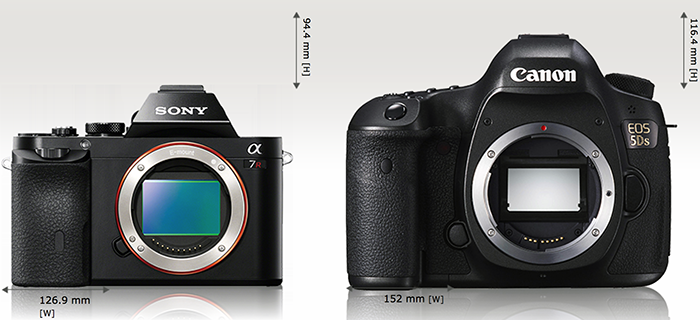
Canonwatch reports:
“I hear that Canon is considering to sell off its sensor fab and acquire from other manufacturers the sensors of its future cameras. Furthermore, I learn that an EOS camera currently in testing is being tested with two different sensors, one made by Canon and the other one made by another sensor manufacturer.”
It’s quite obvious that if the rumor is true that this means Canon is testing Sony sensors. But I don’t think it would make sense for Canon to switch to Sony sensors. They would always get the best sensors a long time after Sony’s own camera implementations.
210 Responses
“They would always get the best sensors a long time after Sony’s own camera implementations.”
Not sure if that’s a disadvantage. See Nikons D810: It can hold up with Sony and eventually beat it in some areas. And there’s a reason why people buying Nikon or Canon (or Sony or Fuji or Pentax …). The only disadvantage is for the customer: When Sony’s sensor devision becomes a quasi-monopol with no one to compete, they become lazy.
“They would always get the best sensors a long time after Sony’s own camera implementations.”
I doubt that very much. This site had a news story about Sony setting the sensor business up as a wholly owned subsidiary rather than a division. One of the reasons for doing this was undoubtedly to address issues such as this. Major customers of the sensor division would not tolerate being second class citizens with the supply of such a key component. If they were then it would be the sort of thing that would drive potential customers to other suppliers.
There is a precedence in that Nikon used the 36MP sensor before it featured in any Sony camera.
Well put. As always.
That 36 Mp sensor was a long time ago, from a time before sony got into the FF MILC market. So you should keep the option alive that Sony might have altered some of those policies.
I’m frankly going to to curious to know what you will conclude 1 year from now, if that FF BSI sensor is still Sony exclusive.
“It’s quite obvious that if the rumor is true that this means Canon is testing Sony sensors. But I don’t think it would make sense for Canon to switch to Sony sensors. They would always get the best sensors a long time after Sony’s own camera implementations.”
1) No, it’s not obvious that Canon would be using Sony sensors. How about Aptina or CMOSIS?
2) No. Nikon had exclusive deals for the 36mp sensor for a long time before Sony used it on the a7r. Do you think Canon would sign up to get second dibs?
Let’s get off the fantasy wagon. This is business, not the Legend of Zelda.
“Do you think Canon would sign up to get second dibs?”
If they don’t have the money, yes.
Ok, let me just say I value this website for “rumor facts”, but these opinions and “half analyses” is what makes it look more like a blog of sorts. Lets say Canon starts using Sony sensors in important DSLRs, which would be hard for them, cause it’s a “proud japanese company with traditions”, but it’s also obvious their in-house sensors are not the best performers on the market for some time (DR, ISO). Why would they “get the best sensors a long time after Sony’s own camera implementations”? It would be such a huge deal for Sony sensor division/company to manufacture for Canon so it might even be completely the other way, Canon having some privileges other companies wouldn’t have. Do you think Nikon gets some worse/older parts from Sony?
Anyway, I would be very curious to see how would Canon manage this collaboration from marketing/PR standpoint, I’d expect them to be more involved with such development like Nikon was at least during the D800 sensor era, maybe even trying to hide/cover/lessen the fact, but at the moment Canon still can rely on it’s brand with their sensors, but it might not be like that forever, it would be wise for them to really consider all options.
Are “rumor facts” in the same category as: silent scream, blind light or cheap Leica?
I’m sure Canon could play the same PR game as Nikon does and describe such sensors as Canon designed. In reality I suspect sensors for major customers are all slightly tweaked within the same basic design. For instance, there might be slight differences in the Bayer filter profiles.
I think that Sony should apply the same thing as Intel and propose two pricing structure for their sensors:
1. At a lower price the user has no option but apply a small “Sony Inside” sticker on the product and same logo on his packaging and documentation.
2. At a higher price there would be no obligation to apply a sticker, logo, etc… even though some customers would always find out…
The decision to go with either of the aforementioned options would be a great one. Would you imagine the publicity for Sony having all these stickers and logos on third party products ? And what about the Canon, Nikon, Apple, etc… marketing guys having these “Sony Inside” logos on their products ? And Canikon hardcore users would then realise that Sony is not such a dog afrerall…
It is a blog.
“which would be hard for them, cause it’s a “proud japanese company with traditions””
>Yeah, thanks for the “analysis”.
“I would be very curious to see how would Canon manage this collaboration from marketing/PR standpoint”
>There’s nothing to manage, same as what Nikon is doing (or, more precisely, not doing). Btw, Canon has already used Sony sensors in its compacts.
“Why would they “get the best sensors a long time after Sony’s own camera implementations”?”
> Agreed, no idea where this came from and nothing to support it yet.
It’s just the internet echo chamber that claims consumer camera makers other than Sony have to wait a long time to access Sony made sensors. No manufacturer ever said anything about that.
Hard to see what motivation Sony Corporate would have to turn away revenue. Sony Sensor Division would be screaming murder- some of my best customers (Nikon, Fuji) can’t get my product, and I have to refuse revenue???
Of course the end user influences the design where practicable. GM and Toyota outsource parts and assembies from manufacturers all over the world, parts GM and Toyota engineering design and specify. Most manufacturers of complex products, from PCs to tractors, outsource. Why would camera manufacturers outsourcing specific components be penalized by the supplier?
Fabrication is one thing, design another. Canon will keep designing their sensors and at some point they will have to turn “fabless” as their fab lines are 500nm (ancient) and 180nm. Typical APS-C sensor today is done with 90nm, some even at 65nm. Full frames are still often manufactured at 180nm, though Canon uses 500nm for that and it has obvious drawbacks. Also Canon won’t invest into back side illumination (BSI) for those fabs as it woud be economically unviable.
What Canon will do is they will design their sensors just like before and use commercial fabrication services like most sensor manufacturers do. It is highly unlikely they’ll be using Sonys services as Sony needs it’s fabs for it’s own sensor production. But there are numerous of other options available.
One should realise that this is not “giving up” sensor manufacturing or anything like that, but just normal evolution where Canon becomes more flexible when it comes to production and much more competetive when it comes to performance.
This would be terrible news due to lack of competition.
Well, it is not like Canon’s sensor have improved things anyway.
Rubbish. Why wouldn’t they test other sensors? That doesn’t mean they are going to stop developing their own.
I have 2 very differrent ideas so will make 2 seperate comments
Canon plans to develope thier own version of Foveon…with Canons own improvements.
After offerring 10x the fair value for Sigma tjey were turned down, and talks switched to sharing technology.
So I expect a Canon/Foveon sensor, and in return I also expext we will see proprietary Canon technology on some new Sigma ‘ll ense…who knows, maybe even BR technology.
I think Foveon is same dead as Wankelmotor. It does not matter if the concept is better, but there is already so much money gone to do R&D for pattern-sensors, so Foveon can not catch up any more.
I think there could be only two reasons for Canon being so slow on the sensor front and one of them is precisely spending a lot to develop a new type of sensor. Let’s hope that’s the case.
Foveon is a dead end. Micro-prisms is where it’s at.
They tried to buy Sigma because Sigma undercuts Canons lens prices and thus breaks part of their business model.
Samsung has recently patented such a sensor.
Long term however if Quanum jots can be used with Quanta sensor and Quauntum processor..
Quantum has 4 states rather thsn 2 of conventional provessiing
A jot can possibly be made to do thos
Return to its oriiginal stat..0 energy, 0 quantum state.
When struch by a photon it jumps to 1 energy
If struck by long wavelength a – spin..or quantum stat
If struck by short wavelength a + spin
If struck by middle wavelength no quantum spin.
Result
00…none
1-…..red
10…..green
1+….blue
And return to 00 state hundreds of thousands of times per second.
Thats full color data from every photon
This comment is based on use of Quanta sensor and Quantum processor.
Panasonic signed Color Separator prism for more 2 years,
and i saw again on samsung’s patent.
so bad Samsung will camera market that make this patent will lose.
Samsung is still in the sensor business, and will continue to make sensors.
They have closed thier camera factory…but still have the ability to star back up sometime in the future if they choose.
Foveon has fundamental problems with poor colour channel colour separation.
Canon has been doing a lot of work with thier own 3 ‘ll ayer organic sensor ….without the limits os Sigma patents Canon could comine thier own tech with foveon tech for a better tech.
Maybe, but that’s not Foveon which is a very particular design which makes use of the statistical relationship between photon energies (i.e. wavelength) and how likely that photon is to be absorbed over a given depth of silicon. Essentially higher energy (blue) end photons are more likely to be absorbed whilst lower energy (red) end photons are less likely to be absorbed. The problem is that it’s a statistical relationship, so there’s a lot of “cross-pollution” between the three colour channels at different depths. At low ISOs some stats can be applied to provide a bit more colour separation, but at higher ISOs (where there are fewer photons detected) that statistical process can’t cope and you get the characteristic chromatic noise artifacts of Foveon.
There are other speculative designs for detecting three colour channels at each location on a single sensor using different principles but no prototypes have appeared in public as far as I know.
Hmm… an A99 with 5D3 AF would be a dream come true. But maybe it will come the other way around, since Sony is unwilling to produce an A99II? Although I doubt Canon would ever make an SLT. So it’d be just a classic DSLR with Sony sensor, no different than current Nikons.
Sony sensors became a seperate division for a reason.
As a seperate company they are obligated to fair practices and are unlikely to exclude major possible customors like Canon or Nikon to waiting in line behind Sony cameras.
Now that Sony sensogrs are no longer part of Sony cameras Canon can more easily deal with them without feeling like they are dealing with thier enemy.
Competing with Sony sensors , without falling behind…would cost Canon too much, and take away most of the resources Canon needs to delope cameras and lenses…money better spent.
Canon must also develope a top notch mirrorless line that can successfully compete with Sony E mount…with Sony’s huge head start that will be no easy task.
Sony sensors are better than Canon’s. ..Canon will not survive the fransition to mirrorless if they are burdened by second class sensors.
If Canon can compete on an equal basis to Sony with the same sensors then Canon will build a mirrorless camera system with more of the “professional” features thier users demand
Bigger battery
Dual card slt
Bigger controls
More solid feel
Better ergonomics
Those are things Canon can do well.
Canon has always said
” We will use the best availble sensor regardless of who makes it”
Sensors might be a separate entity now, but only on paper and for accounting reasons, for now. It is still 100% owned by Sony and governed by same management. That means that they will stop selling sensors to competition, if in medium to long term that would mean more total (cameras+sensors) profit for Sony.
This might change due to monopoly regulations, however. They are really close to the margin, even more so after Toshiba acquisition. At some point local and international anti-monopoly regulations might start applying to them. That could mean potential real separation from Sony, enforced fair competition rules regarding all camera/phone/automotive imaging device manufacturers, all kinds of trouble. They are not there yet, but they will be if their success continues. Perhaps the real reason for the separation is preparation for these possible anti-monopoly issues.
That is not going to happen. Sony sensor business to competitors profits out weigh their own camera sales. Remember, sensors are not just cameras and cell phones. Sensors go into tons of other applications.
They don’t just outweigh, they dwarf. A bit like comparing Jupiter to one of its moons.
Correct. SONY’s “marquee” item is probably televisions (could change as new products arrive). Just like Canon is cameras (not printers), Bousch and Lomb is Contact lenses (not medical optics), etc. Sony has made screens for competing brands for years. LG/Samsung do the same thing. I managed a GM parts plant for 22 years and we made the struts/shocks for the first US made Toyota camry’s and later Japan models for a few years. Jeep Grand Cherokee back in the 90’s….GM/Delphi suspension. Go to sears and buy replacement shocks/struts….GM/Delphi made. Monroe? Guess who made those as well.
I was never suggesting they stop selling ALL of their sensors to third parties. What I meant was that if at some point their CAMERA sensor sales to competition no longer outweigh their own camera sales, they will stop supplying sensors to those CAMERA competitors. In a sense, this seems to already have happened with the A7rII sensor, which for now is exclusive to Sony, unlike the the 36Mpix sensor which was other way around. Does this put Nikon in a tough spot? Perhaps not yet. But it might.
The new company was formed for monopoly reasons
Sony sensors would never be allowed to have acquired Toshiba and Softkinetic if they were part of Sony imaging.
They will be required to give equal treatment rather than favor Sony cameras.
That is why the curved sensor Sony camera did not happen…and the 43mp rx camera happened instead.
Sony cannot build a special sensor for the exclusive use of Sony unless they are willing to do so for everyone else too.
This is also why Canon can now consider buying Sony sensors that they would not have considered before.
“Sony cannot build a special sensor for the exclusive use of Sony unless they are willing to do so for everyone else too”
Rubbish.
The real reason is profit-related.
By creating a separate entity, they now have an opportunity to gain a significant marketshare (Canon cameras) that otherwise was not possible. The newly created unit must be completely autonomous in order for this potential gain to come to fruition.
Yet the new entity is absolutely not autonomous at all, at least not yet.
Also, how big the DSLR sensor market actually is, compared to phone, automotive, industrial sensor market? How much more combined profit could Sony potentially gain by leveraging it’s sensor advantage to steal Canon’s camera market share? Your assumptions are based on prediction that DSLR will continue to dominate the camera market and that Canon and Nikon will continue to dominate that market. That is far from certain given the current state of camera market overall and raising popularity of mirrorless.
Some of the raising popularity of mirrorless may be due to the image quality which is linked to the sensor and imaging algorithm performance. If Canon could match Sony’s mirrorless image quality then perhaps the mirrorless popularity would be a bit lower as less Canon devotees would switch…
Sony rules the sensor world now.
In 10 years things may or may not change
Quanta sensors may reach the final sensor endgame…counting every photon
A billion jots
Hundreds of thousands of readouts /second
And we may use Quantum processors to handle the terabytes/second of data they generate without overheatng.
Ultimate resolution
Ultimate speed
Ultimate sensitivity.
When Sony used these words in thier presentation this is what they were talking about….!!!!!!
In the recent interview with Imaging Resource, the Canon representative said Canon was planning in the future to change all their sensors to having on board analogue to digital converters. So maybe they’re considering this as an interim strategy. At the moment you’d think that Canon would be struggling to make the Canon 5D mkIV a worthwhile upgrade. The thing lacking would be a sensor upgrade. The 5D mIII sensor was only a minor incremental step up from the 5D mkII sensor, although other features such as the AF, and weather sealing were significantly updated. In other words, even if Canon updates the AF etc, again, it wouldn’t be like the jump from the 5D mkII to the mkIII. In other words, Canon really need a jump in sensor performance, and it is not clear when Canon’s sensors with on board a/d converters will become available.
Likewise there is the 1Dx update due. Both these cameras are Canon’s professional workhorses that usually have a long product cycle. Lots of Canon users are calling for increased dynamic range to match the shadow pulling capabilities of Sony and Nikon cameras. If Canon can’t design their updated sensors in time for these new cameras it would make sense to explore 3rd party sensors.
Canon can only leverage their installed lens base for so long, before a landslide of market-share-erosion takes place. They need to be image-sensor-competitive and maybe they have sensor design but not fabrication. Exploring 3rd party makes perfect sense.
You’re arguing that Canon will have 75% erosion before Sony has 400% growth. Doubtful either would ever happen.
All I’m stating is that Canon needs to fit better sensors in their cameras before their installed base of lens holders begin to defect. Nothing about percentages and all related to sensor sales.
“They would always get the best sensors a long time after Sony’s own camera implementations”
If Canon decided to use Sony sensors in all their dSLRs, I would think they would likely get the best sensors they wanted, when they wanted them.
Exactly, this is why semiconductors are now its own division, to operate outside of Sony’s camera business. Canon sells many times more cameras than Sony. Nailing Canon would be very lucrative.
+1
Business is brutal and money talks. Canon still has the largest volume. Samsung and Apple hate each other but business is business and Samsung’s not gonna miss out on producing chips for Apple.
If you’re going to use Apple and Samsung analogy, it would also be a good idea to point out Apple owns SoC designs that are exclusive to Apple and not sold to anyone else, and that Samsung owns certain SoCs that are exclusive to Samsung products as well.
No doubt.
And perhaps Canon might go fabless and have Sony manufacture sensors of their design. Or there might be other cross licensing going on. It’s probably much more complicated than it seems on the surface.
But the point being that there are big volumes and money to be made.
Do you think Sony will exercise protectionism over profits?
Profits can be found many ways, even via protectionism. It’s too early grant eternal life and prosperity to the DSLR.
How would they do it since they would be the buyers rather than the seller. And it is the seller who has control. Of course this would be unless Canon was to accept to do like Intel for PCs and accept to apply a sticker to all their products using Sony sensors: “Sony Inside”.
As it isn’t mentioned that they use Sony sensors in this rumor, maybe they use Samsung sensors. If the rumors are true that Samsung drops the NX line, maybe the supply Canon with the 28 MP BSI APS-C sensor and a not unveild full frame sensor (There is also a rumor of a Samsung FF sensor around)…
Why consider only Samsung??? OmniVision and CMOSIS make good sensors too. As well as Panasonic….
I would suppose they will use Japanese, European or US sensor maker before they go to Samsung. Especially given that Samsung is not all that big in sensors.
Thats is true! Samsung came in my mind becaus of eventually giving up their NX lineup. So what will they do with their sensors… selling to canon is a good way in my opinion.
Agreed. I meant also that eastern companies like Japanese or Korean have some sort of national pride. They did not let Samsung buy Pentax before, which would have been great development for both….
It is not necessary to use Sony sensors! Leica is not using Sony sensors and they produce quite admirable pictures.Their 24MP sensor is made by CMOSIS and seems to be better than Sony 24MP sensors. Samsung too produces big sensors and their 28MP was better than Sony’s 24MP APS-C. Panasonic AFAIK makes own sensors for GH4 and that one is quite good.
Except for top of the line sensors like the 42MP and 12MP on A7rII and A7sII Sony sensors are not all that great in photo…..
Canon may as well be considering other manufacturer.
Yes, but Leica sell 100 units a year.
If you want to sell millions you need the production capacity, plus, since Canon are actually selling in a very competitive DSLR market they need cheap sensors, which means mass-production on a scale to bring the cost down.
Also it doesn’t look like Samsung/Panasonic ever made full frame sensors at all.
Canon seem to have the manufacturing capacity but lack technology so all sorts of deals may happen. Consider that Samsung and OmniVision are not that much behind Sony in terms of sensor technology or capacity.
What I am saying is that Sony is very far from monopoly and only game in town. We are looking at very small part of imaging sensors market which is the niche of advanced amateur and pro photography and things look skewed. Even in this niche while dominant Sony is not monopoly. Actually quite the opposite Canon still own the majority of the large sensor camera market and do not use Sony sensors as do Leica and Panasonic
you are wrong here too, omnivision’s BSI sensor is just a copy of sony sensor, they don’t even know how to design another one, samsung is pretty good in electronics for sure, but let me put it this way, you can ask intel, or qualcomm to make a cmos for you as well, they have better litho printer, but design a image sensor is a whole different thing. samsung can make cmos because they can make cpu chips, but they are lack of imaging sensor experiences
and even though omnivision and samsung can make BSI, they can not make stacked cmos, currently sony is still the only company that can make stack cmos
monopoly is not always about tech, another reason could be sony is just the one can make excellent cmos so cheap, because of their massive production, which make other company have no reason to compete with them, that could also cause monopoly
40% for Sony sensors, plus 1.9% for Tosiba sensors…
Samsung has closed thier camera division
And Sony also acquired Softkinetic.
You are contradicting your own statement. Sony sensors were “not that great”, now the others “are not that much behind Sony in terms of sensor technology”.
Sony certainly isn’t the only game in town, but it also quite certainly has the biggest share by far, considering that Sony, Pentax, Fuji, Olympus, Apple etc. are all using their sensors. Now, I certainly do not have the numbers, but if we put all of these together and limit ourselves to large sensors – APS-C, FF and MF (or, only FF), I certainly do not see how Canon will own the majority.
” Canon still own the majority of the large sensor camera market”
This is false since Canon has less than 40% of the ILC market. They may have the largest share, altough I believe Sony’s share is similar or larger since they produce the bulk of the remaining 60% (Nikon 5xxx series, Nikon 8xx series, Nikon 6xx series, Nikon 7 series, latest Nikon mirrorless, Sony A plus E mount, RX1 cameras, Fuji X cameras, Pentax K mount cameras, most of the current Olympus mirrorless cameras, etc).
Just with a single move recently, the release of their CMOS medium format sensor, Sony overtook the whole MF sector and Pentax, Hasselblad and PhaseOne use their sensors now.
I know this is a relatively small market, but this just shows you their capacity and resolve to expand in the sensor market.
For sensors larger than mobile/surveillance only Canon is real competition to Sony at the moment. All other manufacturers of FF/APSC sensors have at least 10 times lower market share.
the 24mp cmos from leica has very high base noise, and poor low light performance, well, i agree leica doesn’t need low light sensors since they have large aperture lenses. but no, the sensor is not as good as the sony ones.
samsung’s 28mp compare to IMX220? please no joke here.
panasonic and olympus both use 16mp M43 sensors, the best performance one is from OMD, made by sone, the rest of them made by pana, but start from GX8, pana use sony made 20mp M43 sensor now. which one is better huh?
Gh4 is by far the best m43 camera to date. Image quality and video quality are better than Olympus.
On smaller sensors they use Sony and may be Sony uses Panasonic chips etc. This does not change GH4 position of best m43 camera
Straw man. First it was a discussion about sensors between different brands, now it is about which m43 camera is best.
first of all, GH4 is the best M43 camera by far, that I agree, because pana drain the maximum quality from that sensor
a good sensor and good performance in image making is two different thing, let me give you an example, iPhone use the same 8mp sensor from 4 to 6th generation, and it could produce good images, but does it make this 8mp sensor the best phone sensor? NO! because it takes time for the image algorithm engineers to know well on one sensor, so they could make the best use of it, so a iPhone 6 can make better images than a samsung 18mp camera phone not because the sensor in iPhone is better, but because the engineers knows that sensor so well that they push that sensor to the maximum possibility
so same story to GH4 here, its better only because the engineers knows it well and they adjust it to the best, because they ve been working with this 16mp sensor for many years, but if we only talking about sensor performance, sorry but sony is way better
why you told 20mp m4/3 made by Sony,there are many sensor made by panasonic’s partner fab.
The rumors about GH3,it used same sony e-m5 image sensor but Chipwork can’t told that is Sony’s sensor because they had unique code on chip.
And impossible Sony will type label ‘MN’ on chip.
do you know?
the 20mp M43 specification is completely match with the sony 20mp M43 sensor
I never heard GH3 use the same sensor with EM5, and I never said that, I didn’t even mention anything about GH3
“Except for top of the line sensors like the 42MP and 12MP on A7rII and A7sII Sony sensors are not all that great in photo”
> What?? The 1″ sensor in the RX series, the 16MP in the OMD, the iPhone, the 24MP in the a6000, the old 16MP that is still used by Fuji and was used by Pentax, the 36MP that goes into the D800/a7r….
“Their 24MP sensor is made by CMOSIS and seems to be better than Sony 24MP sensors.”
> Based on what? Price? Leica needs a custom sensor so it’s “outstanding lenses” are actually be bale to perform properly.
Samsung is no longer in the camera business
They have closed thier plant and transferred thier employees ti differrent divisions
That’s not true. They have publicly said that it was false information.
Luminous-Landscape talked to them and they are well and alive!
Samsung lied..!!!
After that interview papers all over the world are reporting that Samsung has closed thier plant and transfered the employees that they are keeping
“Withdrawing from the camera business is not true and there is no official plan to stop production of cameras and lenses. Samsung continuously analyzes the varying needs and requirements of consumers in each market and region very carefully. However, we do not officially comment on rumors or speculation.”
But you can’t deny that more and more sources showing up pointing to the death of Samsungs camera business. Of course there is no official statement. But seriously, with the NX1 it seems, Samsung has everything done right, but it still is not selling so well.
You are right, it’s all rumors, but very plausible rumors I would say.
http://www.mirrorlessrumors.com/very-bad-news-samsung-will-really-kill-the-nx-camera-system/
“As some of you know there was a new rumor today from mirrorless rumors about the death of the Samsung camera line.
Well today I was at the PhotoExpo Plus show in New York and went to
their booth to inquire about the rumors. Bottom line, the famous line
from Mark Twain, ‘the rumors of my death have been greatly exaggerated’ are just that rumors.
I showed them the rumor article and they said it was simply not true –
this coming from a product manager who said he, “I would know since
that means my job.” They seemed very proud of their camera and the work that went into making it the best APS sensor to date. They had a large booth with plenty of people though not as packed as Nikon or Sony’s booth.”
http://www.dpreview.com/forums/post/56666681
https://www.youtube.com/watch?v=O0AZx7qd1i8
Perhaps Canon will buy Samsungs sensor business.
If Canon decides to source a sensor instead of using an in house part it will definitely be Sony. And it’s a bit of a disappointment that the Leica didn’t use Sony’s 36 or 42 megapixel sensor and chose to use a sensor that’s available in a $1100 camera in a $7000+ dollar camera.
Not sure what that is based on since noise levels appear similar in daylight (light temperature wise) to the A7II in the dpreview test scene at higher ISO’S, worse when the light is short in the blue spectrum (typical low light scene), about a stop less DR in their DR test scene (A7II can be pushed a stop further with similar noise levels) and huge amounts of shadow banding in comparison.
Sony has many class leading sensors, including the latest 1 inch series (topping QE charts for all Bayer sensors, regardless of size plus low read noise too) and smaller phone sensors.
I am not saying Sony make bad sensors. I am saying that there is some competition and the competition is not far behind. So it is not inconceivable that Canon may test sensor from another maker contrary to the above article.
M 240 sensor is designed by CMOSIS, but made by ST Microelectronics.
Q & SL are rumored to be made by Towerjazz,owned by Panasonic (Designed by CMOSIS ?)
Anyway, there is definitely nothing obvious that if the rumor is true that this means Canon is testing Sony sensors.
Perhaps Samsung and Canon can make a deal? Would this be a way for Samsung to recover some of their investment?
that not good,if Canon drop image sensor fab,many patent will lose!.
if samsung drop camera market,there are Sony,Pan/Fuji and Canon.
if Canon drop image sensor fab,we had Sony and Panasonic.
Panasonic do not produce image sensor on-date,but they design by patents and research that why Organic patent of FujiFilms want Panasonic.
Sony’s will be semiconductor company when camera manufacturer order last image sensor ,they will received best sensor better than Sony imaging.
Sony take over Toshiba and in future they buy others image sensor company.
but Panasonic do not worry,they had much connection in China.
Sony Japan vs Chinese that mean War.
Sony don’t look at Chinese image sensor companies.
just let the DSLR die. There is no need for better sensors in ancient technology…
What?? you must be kidding!
why must I be kidding? Because you have another opinion?
Because not everybody can use a ILC!!
Mind you that technically speaking, dslrs are also ILC
Ok but you obviously know what I mean. We could also call it mirrorless or MILC.
why can’t everybody use an mirrorless?
I give up. This is a complete waste of my time.
LOL, I guess you are right.
Ran out of arguments? That was fast…
Because someone on a blog said so.
I get headaches from the lag, smearing and pixelation of even the best EVFs (not tried the Leica SL). Even in technical terms, the responsiveness of electronic finders is not sufficient for fast action scenarios (sports, street).
so you are not using a Sony body at all? Or at least nothing beyond the a850/900?
I had a A6000 and sold it. I loved how responsive it was. The AF feels DSLR quick. Hated the EVF.
BTW, Sony cameras have other qualities than their viewfinders. 😉
What are you doing on Sonyalpharumors then? There will not be another Sony camera with OVF, ever.
Hmm.. that is a different story.
There are different reasons, but the most important one is, that compared to SAR all other camera rumor sites are boring. Or, in other words, SAR is the most fun. Of course my highly subjective opinion.
BTW: I don’t like Sony’s ergonomics, menus, EVF’s, design … , however, despite all that, my next camera purchase will most likely be a A7S. Because it has some features that are unique in combination: Astonishing high ISO, compact size and very reliable low light AF. But if there would be a DSLR with these three attributes from Pentax, Nikon or Canon, I would never consider a Sony.
See, I’m not wrong here. 😉
Really ? Would aspirin not cure these headaches ?
I have yet to experience these EVF induced headaches. Even after shooting for a full day I have failed to get these headaches.
It is not opinion, it is fact.
DSLRs are as obsolete as cathode ray tube TVs.
Sorry but you obviously have no clue! And that is a Fact!!
and advantages on DSLR technology that isn’t or can’t be overtaken by DSLR?
What????
You seem quite confused.
If you call your opinion a fact, doesn’t make it a fact. You may also stamp with your feet and cry, but it won’t help. A fact is a fact because it is one (or not), but not because of you saying it.
Baby, you can stamp with your feet as long as you want. The DSLR is obsolete technology
I would not say that the DSLR are obsolete given that most PRO photographers rely on these to do their work. The very fact of FF mirrorless cameras does not make DSLR obsolete. Both are useful and different, the photographer can decide to use one, the other or both.
What use would we have to flea late the DSLR dead prematurely ?
SLR is legacy technology designed to overcome certain problem that no longer exist. At the expense of size and bulkiness.
1. Sony a-mount lenses does not work perfect on e-mount especially those not SSM lenses. 2. A-mount cameras have better ergonomics than e-mount.
3. The AF illuminator does not work on e-mount but on a-mount.
4. Many still want an OVF.
So regardless of your point there is still a need for dslr or a-mount cameras. Sony actually confirmed this in the video dpreview posted yesterday.
1. current A-mount cameras are not DSLRs
2. better ergonomics is not a matter of the technology. Every company can put a mirrorless in a DSLR body for those who like it big
3. Just switch it off
4. Because they have never seen a good EVF
1. I know but obviously Canon and Nikon sells dslr cameras and more than sony sells e-mount cameras!
2. Yes but nobody has done it!
3. Stupid to shut it off if you need the AF illuminator.
4. Thats certainly not true. Some just hate EVF’s. I don’t but some do. Furthermore. The EVF still lacks compared to OVF when you shoot sports.
1. brand recognition and broader lineup. Nothing to see with the DSLR technology.
2. Bigger doesn’t equal better ergonomics. That nonsense should stop.
3. Problem with Sony’s implementation, not an advantage of DSLRs.
4. In my experience, that is exactly true – most really haven’t seen a decent EVF. That some people hate it for no reason is not an argument at all. Sports are pretty much the only thing where it may lack; how many people shoot sports versus landscape, studio, travel, family etc.?
DSLRs have outlived their usefulness. However, I do not think they should disappear, a few models should most definitely exist, but certainly not the crap that is available right now.
to be honest, I found it annoying to have a completely silent shutter on my a7s but a small light that indicates each time that I’m pressing the shutter button…. you will loose some of the surprise effect that may count for certain pictures or just the discrete charme under certain circumstances (e.g. when shooting inside a church)
4. Absolutely true.
1. That’s today numbers. Look at the trend and in 2 years that is not truee anymore.
2. So it’s not a matter of the technology. BTW the Leica SL is not big enough?
3. Stupid?
4. Some people also hate electic cars.
4. with good reason
4. Because there is no good EVF (compared to an optical finder).
not good for what?
compared to what OVF?
Not good for making coffee with it.
Compared to the OVF in a disposable film camera for 7 bucks.
(I already regret to even answer to a troll like you.)
That’s interesting. I personally much prefer the EVF to any OVF. The reason for this is that when I change the ISO and speed I can see the impact on my picture before I take it whilst with the OVF none of this can be seen.
But it is OK to like OVF; in fact each to their own preferences, right ?
How much time lag has the A7r mk2 EVF ?
An FS5/7 is much better in ergonomics, yet a lot of stupid people still try to use them for filming, this ergonomic BS doesn’t mean anything, never did, in photography history.
If they where thinking in ergonomics they would made a full grip camera like the Phase One.
Since A55, the mirror is in there to feed light to the AF module, not to reflect light in the optical viewfinder.
Since the introduction of SLT it exists to feed light to AF sensors, not to the optical viewfinder
What??
myNamelsWhatt??
Whatt?
It’s spelled ‘watt’ 🙂
I don’t believe in this rumour.
Canon’s semiconductor fabs are so horribly outdated relics from the past, I don’t believe for a second that Sony could make any use of them. Sony would be better off making new semiconductor fab from scratch, or buy from other companies like Toshiba, who at least bothered to keep its fabs somewhat up to date over the years.
You know from DXO score about the technology of the Canon fabs or it happens that you work there? 🙂
Their sensors have been analysed by 3rd party reviewers.
http://www.chipworks.com/about-chipworks/overview/blog/full-frame-dslr-cameras-part-ii-canon-stays-course
In short, Canon’s semicontuctor fabs are trash from the beginning of this
millenium. And they have been kept in bad shape for over a decade.
My point was that just because they using an older technology you don’t know what they are developing in the meantime.
They are a bit behind in low ISO dynamic range but pretty damn good in high ISO(and high ISO dynamic range) and developed some interesting sensor based technologies like the Dual pixel AF.
Just because something is not as good as another one it does mean it’s trash.
You’re talking about Canon products, I’m talking about Canon fabs.
It doesn’t take a lot of advanced manufacturing to produce sensors with large pixels for high ISO performance.
I am talking about sensors which are made in fabs.
The 5DS has pretty great IQ and the 7D|| is on par with Sony 24MP sensort, except low iso DR, despite the 40 million pixels.
So yes, it is behind a bit but i wouldn’t call it trash.
I didn’t say your sensors were trash. I said Canon’s fabs were.
You can use outdated tools to create decent products, but that doesn’t mean your tools aren’t horribly outdated compared to the rest of the industry.
First, Canon has a 180nm process fab that is producing image sensors for some of their cameras. Not a relic from the past, and competitive with Sony’s fabs.
However, I don’t think the rumor is “Canon will sell its fab to Sony and switch to Sony sensors.” I think the rumor is that “Canon is considering going fabless.” Which is what Nikon does.
I don’t buy that. At best it would be a few production lines that produce the microscopic amount of 5DS(R) sensors.
The 99% of what Canon outputs is old 500nm stuff. And it would make sense for them to go fabless, since the camera market is shrinking. But for them to go fabless, they would need to find a buyer to all this old tech, who would be interested?
You don’t have to buy anything. Canon does ;~). As in new fabs to stay competitive.
No, 99% of what Canon outputs is not from the 500nm fab. Indeed, that number is going down rapidly now.
Used fab equipment is still viable on the open market. There are still some types of chips being made that aren’t size sensitive. But you’re still missing the point. It’s not how much money Canon gets for the existing gear that’s important, it’s how much they might need to spend for new, state-of-the-art gear that is. Canon is producing APS sensors on 180nm, Sony on as small as 45nm. The more stuff we put on the sensors (ADC, phase detect, smart correction, rollover electron wells, memory cache for higher speed transfers, etc.), the more you need smaller process.
It’s hard to believe Canon had anything resembling a 180nm fab in 2007 as you claimed.
All their stuff from from this side of the decade, 1DX to 5Diii, was all old 500nm manufacturing.
Canon’s thought process was something along the line of “it’s useless to update fabs, since image sensors cannot and shouldn’t be shrunk in the same way computer processing chips do. So we might as well save money and use 500nm process for as long as we can.”
And they got away with this line of thinking for more than a decade.
You don’t have to believe me. Go look at Canon’s white paper on their 52mp prototype developed in 2007. Page 3: sensor technology listed as 180nm. If you have money, you can also buy a Chipworks report on Canon sensors and find out that several Canon sensors are 180nm, but I doubt you have the money ;~). Also, the S100/S110/S120 uses the Canon LC1320 sensor, 180nm, and in production back in 2011.
I think you attribute your beliefs to Canon rather than actually looking at actual data. It’s true that many of their older full frame sensors are made on 500nm process. But frankly, until Sony’s last two Exmor generation updates, those Canon sensors were highly competitive, and they were out there long before Sony got around to full frame. Tech tends to leapfrog, as I’ve long noted.
Finally, as I noted elsewhere, I believe that the basis of the rumor is actually a make/buy decision Canon is currently pondering. They can continue to do their own fabbing, or they can go fabless. Apple is fabless. Qualcomm is fabless. Nikon is fabless. Plenty of companies that are competitive and rely upon state-of-the-art semiconductors are fabless.
Fab or no fab is a “money now or money later” decision. Sony is all in with fabs (money now), and it strained their financial resources a couple of times now, as any new fab is a billion dollar plus investment before you make a single product. Nikon is all in with fabless (money later), and it’s worked quite well for them.
Canon’s early reliance on their own 500nm fab was actually a very smart decision. They already had it, it was already written off on their books, and it could be easily re-purposed for image sensors at a time when Canon needed a fast response to what Nikon was doing (D1, D1h, D1x, D100). It’s served them quite well. The question is what to do next. And I believe that’s going to be fabless.
“Also, the S100/S110/S120 uses the Canon LC1320 sensor, 180nm, and in production back in 2011.”
I was wrong then. Since those are definitely high volume products, which could justify having a complete fab to produce them along with other products.
I guess I erroneously assumed all their smaller sensors would be using the same old 500nm process.
The reason I doubted your statement is because it’s insanity to have a whole semiconductor fab idle away the majority of the time while you occasionally use them to experiment with prototypes. It just didn’t add up.
So what is your take on the rumour Canon recently made several offers to buy Sigma, was it for their lenses line or more likely something to do with Foveon sensors / patents. Its been reported they are now working together, but on what?
i could see low-end image sensor companies like omnivision etc pickup canons fab equipment
“Canon’s semiconductor fabs are so horribly outdated relics from the past…” This is really surprising for me. Do you have any detailed information? Do you know the fabs?
I see, Canon’s current DSLR sensors trail behind Sony’s, but horribly outdated?
This looks not like horribly outdated:
http://www.usa.canon.com/cusa/about_canon/newsroom?pageKeyCode=pressreldetail&docId=0901e02480fb7db6
But I’m not the expert in semiconductor fabs, please elaborate. I’m interested.
I’m saying Canon is using outdated tools to manufacture new products.
You got insulted and thought I said Canon used outdated tools to manufacture outdated products.
Don’t worry, I don’t feel insulted. I just heard the first time such drastic words, like “horribly outdated relics” in connection with one of the leaders in digital imaging. I think it is totally plausible if somone claims Canon has outdated fabs, but I can’t imagine that you can produce up-to-date sensor tech with “horribly outdated relics from the past”.
Thats all. I’m just interested to know, if you know what you are talking about or not. I’m serious.
That’s because you and the majority of the consumer market believe Canon has up to date sensor tech. They don’t, they are far behind Sony and Samsung.
I’ll post the link again:
http://www.usa.canon.com/cusa/about_canon/newsroom?pageKeyCode=pressreldetail&docId=0901e02480fb7db6
I still don’t know if you know what you talking about, or if you are, yust like me, part of the consumer crowd who has no clue about semiconductor fabs. I’m still interested.
What makes you think that sensor is bleeding edge advanced manufacturing technology?
Just the fact that is has large pixels?
What’s exactly wrong with the Canon sensors besides the slight lag in the DR that is irrelevant for 90% of the market?
Nobody said they are wrong. Rather, the question is, what makes you think those Canon sensors are so insanely advanced when they have such inferior DR?
But the DR is not everything… Yes, I do enjoy an extra DR while shooting the landscapes on the A7r2, but 99% of my time I shoot portraits so I don’t really care. After shooting the 5ds r for a couple of months I didn’t find any deal breaking flaws compared to the A7r2. The output is quite comparable (ignoring AF, handling, etc.) to my eye. If I screw up with exposure – I won’t go more than +1 in LR/C1 on both cams, because they both start to suck. I saw people were doing like +4, but that should go straight to the trash bin.
Ok, TL;DR… 🙂 I just want to say if people really demand a better DR – nothing prevents Canon to make sensors with better DR, they have resources for it, and I hope the 5dmk4 (Spring 2016?) will catch up.
It would be easier if you would just admit Canon fabs aren’t as advanced as the other players’ in the industry.
Just because they have the money for it, that doesn’t mean they have fabs that are up for the task.
I would admit if they didn’t make the 5ds r 🙂 See, right now only Canon has a usable 50Mpx FF sensor, yes, on paper it has lower DR, but it’s a current FF “resolution champion”. I would say Sony and Canon are just going in different directions, but nothing is wrong with either of the companies, and in the end it’s all about revenue. If there is a demand for a particular feature on the market – they should try to satisfy it. Canon “thinks” people need resolution now – and they made the 5ds, if they realize the customers are still unhappy and need more DR – I don’t think they can’t make sensors with a better DR. Peace.
There is nothing particularly advanced about the 5DSR’s pixel density that actually warrants that awe your have.
Other foundries are already way above that.
“Other foundries are already way above that” example please.
Samsung and Sony would be good examples. Smaller chips, but if pixel density if the reason to your awe, they already surpassed the 5DSR before it even launched.
I didn’t see any 50Mpx FF sensors from Sony and Samsung… Theoretically the 7d has the same pixel density too.
In terms of pixel density the smaller 1 inch sensors already wipe the floor with the 5DSR.
In terms of total resolution, look at the Phase One and Pentax medium format camera.
So again, can you tell me what is in the 5DSR that is so advanced that all the other industry giants cannot hope to achieve the same?
All true, and you may look into the 20+ Mpx 1/2.3 cell phone sensors – they have even higher pixel density, but show me please any other FF 50Mpx camera on the market besides Canon? I don’t want the 1″ sensor and I don’t have money for the MF bodies and lenses. I want a usable and versatile system that won’t cost me an arm and a leg. I have 2 cameras now: the a7r2 and the 5dsr. I choose the 5dsr if need fast AF and I choose the a7r2 if I want to shoot my manual focus glass handheld. I don’t care about the sensor manufacturing process or the DR, and for my needs the 5dsr sensor looks just as good as the a7r2 sensor.
P.S. try the 5dsr with the 70-200L f/2.8 II or the 11-24 f/4 – you gonna love it 🙂
But the sensor manufacturing was the reason why you started this argument to begin with. So let’s stick to that.
Or…
It would be a lot easier if you and Condor would just admit you’re miffed because I’m not revering Canon’s outdated manufacturing technology and giving them the time of my day.
I’m just trying to say the 5dsr sensor doesn’t look any worse than the a7r2 sensor (_to me_), and I pick a camera for a job based on other features and requirements than the DR. I’m also trying to say the “super” DR is not really important to me, and probably to many other Canon users, so it shouldn’t be the only indicator of the sensor’s “advanced tech”. The new 120Mpx and 250Mpx sensors do use some pretty cool tech as well, similar to the BSI: Canon can achieve 5fps on the 250Mpx one as far as I remember. But whatever man, it was a good discussion, let’s just stay wherever we are, time to go home for me 🙂
The DR thing seems like a pointless thing for you to blurt out out of nowhere to begin with, since I never mentioned it anywhere.
Anyway, Canon’s handful of prototypes are not comparable in anyway to BSI sensors, nor are they comparable to Samsung and Sony’s capability of mass producing said BSI sensors.
They employ cavemans with sledgehammers to make the 250Mpx APS-H sensors http://www.canon.com/news/2015/sep07e.html. I also suspect they use slaves captured from Nikon and Sony on their fabs.
Creating a handful of of functional prototypes out of a wafer of 87 APS-H sensors isn’t impressive tech. When that’s the best your entire fab can output, you’re already far behind the others, who actually have mass production capability.
There was a time when AMD was superior to Intel. And Intel was able to make a comeback with the core2 series of processors.
My point is, while Sony sensors are better… competition is a good thing. Maybe canon can battle back.
You forgot the point out that Intel was dominating the market before AMD was at the top, and that Intel was dominating the market even while AMD was at the top.
I don’t know about you, but I felt miffed seeing people cheer on while giants like Intel are crushing smaller companies like AMD, while at the same time chant “competition is a good thing”.
It’s veery close to the same thing here, wishing the giant Cannon to wake up and crush the other smaller camera makers. In the name of competition.
I fundamentally believe in the same as you. But when the reigning king of the market (Canon) gets lazy, and doesn’t even bother to upgrade its semiconductor fabs for over a decade, don’t you think that warrants some kind of criticism?
You are right…. Sony is the little guy in the Imaging sensor business, with small clients like Apple, Nikon… etc :s
You might not have realised it, but Canon is the larger company with far more employees.
Canon had some of the best sensors, they had their own semiconductor fabs, they had (and still have) the leading position in the camera market.
But it was their decision to get lazy.
It was their decision to truck on with old 500nm fabs forever.
It’s their decision to develop new cameras at snail pace.
If all this should not be allowed to be criticized, when will you ever allow criticism?
I wish the Canon 5DS were bigger.
Errrmm… The 5DS is already bigger than the Leica SL! You know, that is the new camera, that no one had in his hands so far, but is called too big by almost everyone here.
I’m confused.
An AT mount would have been awesome. Like M136 AT4 🙂
The 5DS is awesome BTW 🙂 You won’t find anything better that works with the 70-200L IS II.
It isn’t as if Canon is a skint company.
Oh, that’s a new word for me – thanks!
Well, given what they are doing with the EOS-M line and their sensors… and their cameras in general… I’d say that they either don’t have the money or really suck at making cameras. If it is a question of money, it may be for plenty of reasons, but I think mainly two – they are in trouble or they are investing in research. I certainly hope for the latter.
What if Coca Cola would buy it’s main ingredients from Pepsi? Which one would you buy?
Bingo. We have a winner.
The question for Canon is simple: continue investing in new fabs at great expense, or go fabless and let someone else worry about that problem? Exactly the problem that Nikon was grappling with in the late 90’s. Their choice was to go fabless but retain their (then) three image sensor design groups.
Canon’s 180nm fab went online in 2007. It’s likely it is due for updates, just as the 500nm fab that Canon’s been using for full frame is long overdue. So here are Canon’s choices: (a) spend a huge amount of money now on new fabs, and recoup it later on camera sales; or (b) spend nothing on fabs now, and pay slightly more for sensors later? It’s a FVM (future value of money) question, and I’d be surprised if (b) wasn’t the right answer.
“(b) spend nothing on fabs now”
Canon has never spent anything on updating their fabs to begin with. So this was always the answer since the beginning.
Not exactly true. The 500nm fab was indeed already written off so didn’t have an acquisition cost to imaging, but the 180nm fab in 2007 did indeed have acquisition costs. Moreover, there have been improvements in both fabs along the way, though those are refinement costs, not acquisition costs, and much lower.
Improvements to refining the process for higher yields, sure, but they never upgraded their fab to smaller process nodes, like most other foundries do.
That requires completely replacing the stepper, basically. That’s why fabs are so expensive.
I believe Sony’s latest full Frame is produced on a modern process like Samsung’s BSI lens. They both feature copper metal on the sensor, so it’s not unthinkable they have very similar manufacturing as well.
That said, I don’t think modern manufacturing is typical at all for APS-C. There is a lot of other APS-C designs out there that isn’t anywhere near as advanced as Samsung’s
‘I don’t think it would make sense for Canon to switch to Sony sensors.
They would always get the best sensors a long time after Sony’s own
camera implementations.’
As if their own sensor aren’t behind the competition themselves…? With the 750D/760D they’ve finally left years of the ‘same’ 18MP sensor dating back to the 550D. And the new one is not even that impressive. And it’s not like Nikon’s not doing it (taking Sony’s tech) and they’re still ahead of Canon.
But I don’t think they’ll seize own development, they have their own weird vision, like 250MP sensors or very light sensitive ones for industrial/advanced field purposes.
After Samsung surrender and left their cameras cold there were only Cannot and Sony left.
Now it turns out even Cannot will be relying on Sony.
I guess in 2-3 years there will be only Sony that will be kicking butt in cameras.
After Samsung surrender and left their cameras cold there were only Cannot and Sony left.
Now it turns out even Cannot will be relying on Sony.
I guess in 2-3 years there will be only Sony that will be kicking butt in cameras.
…and relying on the Canon’s lenses.
I hope not.
Great… Sony goes under and takes everybody else with them.
Competition good. Monopoly… not so much, especially when controlled by psychopaths.
I love my A7 cameras and wouldnt trade for any DinoSLR but I dont like the idea of only one company doing sensors because we will end up like the CPU industry were after Intel left AMD behind in technology the progress has been REALLY slow as there is really nobody pushing them to innovate.
I dont want the same thing to happen to Sony. :/
will be same Walkman/BetaMax,LOL ha ha ha.
Guy,there are no person knew the future.
How does this even compare to Betamax man? Its simple, one company doing all sensors is not good for anyone in the long run but I sure hope I am wrong.
yeah,and you look anti-monopoly like me?
Quanta sensors and Quantum procsssors will rule the industry in 10 years
Ultimate resolution
Ultimate sensitivity
Ultimate speed
Whoever has that will rule the sensor market…whoever does not will be unable to compete.
See my post above: it will end in tears!
Quantum processors (i.e. quantum computing) in 10 years for mass production, or what do you mean?
Please clarify your question
Are you asking
What is Quanta
What is Quantum processing
Why do we need it
Can it be stacked on the sensor
Or Will it be ready in 10 years
Which question are you asking, or are you asking something else?
Pretty clear. You said quantum processors rule the industry in 10 years. I doubt that you get quantum computing for cameras for the mass market in 10 years. So my question is simply whether you indeed believe quantum computing to be used in cameras in 10 years?
My comment was only intended to include quantum processing for use with quanta sensors…because I know of no other way the huge amount of data can be prcessed.
I did not intend to imply any broarder use of the technology.
My timetable is arbitrary and not intended as an actual date of release.
He said “procsssors”, that’s probably something else.
It’s quantum, so it exists and doesn’t exist at all points in time, albeit with a greater probability of existing at some indeterminate time in the future. So theoretically 10 years from now is still possible! So there, EAT QUANTA HF! (and don’t eat it at the same time)
Liquid CPU cooling might come earlier and be more relevant in the short time.
I agree with everyone who says just one giant producing sensors would be bad all around. However, it is very understandable in these days of rapid technology change.
What is happening all the time is that a great deal of money is invested in R&D and fabrication set up to produce the ‘latest and greatest’, only for it to be superseded by something better before it has realised any profit. The same thing happens at each step, with one company leapfrogging the next, and no-one sees a decent return.
Ultimately, it becomes a war of attrition until one is left standing and they can finally begin to recoup some money, at the expense of slower progress.
At the moment, it’s looking like Sony will be the one for sensors.
the effect after sony semiconductor takeover toshiba fab.
i do not see this news on others site.
or someone want discredit to Canon semiconductor.
As we know,begin of digital camera many camera company had no image sensor fab.
And they order to Semiconductor company.
Canon bought semiconductor manufacturer for made their image sensor.
That long long time ago.
i think they can not drop their fab all on this time or nearly future.
According to sources like Thom Hogan for one, Canon has 40% share in sensors for ILCs.
First, no offense to Hogan, I like his writing and opinions, but he certainly wouldn’t be my reference for any statistics. Second, what other sources do you have for these numbers?
According to this research (2014), Sony has 27% of CMOS market share, while Canon only 7%.
http://www.eetimes.com/document.asp?doc_id=1326279
Of course, these numbers do not translate directly to ILCs, but I simply do not see how Canon can own the biggest share when Sony sensors are found in almost every other system (including many Nikon bestselling cameras).
“DSLRs have outlived their usefulness. However, I do not think they should disappear, a few models should most definitely exist, but certainly not the crap that is available right now.” That is too hard a statement for me. Many pros still use them successfully. So they may be on the decline or whatever, but to say they outlived usefulness is not appropriate imo. I still like mechanical watches and tube amplifiers. And I know many finding them useful albeit being still mechanical and not digital.
I meant that the usefulness of the DSLR technology has been superseded. The fact that many are still accustomed to it or that it can be used successfully is irrelevant. One can use an Olympus OM-1 successfully too.
I also like mechanical watches, that is why I said that the DSLRs should continue to exist.
Canon Q3 profit slides on weak camera demand but full-year forecast lifted
http://formulaspy.com/features/conclusions-from-the-beijing-eprix-20039?utm_source=dlvr.it&utm_medium=twitter
Canon Q3 profit slides on weak camera demand but full-year forecast lifted
http://www.reuters.com/article/2014/10/27/canon-results-idUSL4N0SM25K20141027
sony needs to sell the sensors. That’s the only thing they are good for
Their imagining group makes junk cameras in like Thailand while canon is still making everything important in Japan
Sony already is selling a lot of smartphone sensors, and a lot 1 inch sensors.
If you’re referring to Full Frame sensors like that 36 MP one, then it’s entirely Canon’s own fault they haven’t bought any from Sony.
If you include cell phones, then Sony certainly is huge. But for ILCs (and that was my answer), Canon has a huge market share of about 40% using in-house sensors in a majority of cases. So why shouldn’t they have about 40% market share here? In 2012 it still was the case and market share didn’t change much up to now http://image-sensors-world. blogspot. de/2012/10/market-reviews-by-yole. html.
Newer Yole reports don’t change this view, albeit the ILC sensor market share is expected to decline from about 47% (2010) to 24% (smartphone sensor share increases to 30%) by 2016-17 according to these sources.