







Image courtesy: Photoscala.
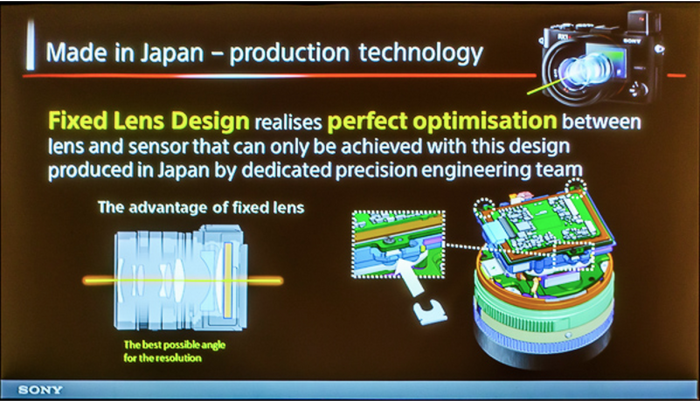
Sony is assembling the new RX1rII camera in Japan. There is special trained people who have to perfectly align the Lens and Sensor. Nice to see Sony is taking care about quality and precision!
And Trustedreviews posted a hands-on review:
The Sony RX1R II is a camera easy to lust after. A full-frame sensor in an ultra-portable body? It’s a photographic dream come true.
RX1rII worldwide preorders will start on November 5 at 8am New York time (Source: Bhphoto, Amazon and Adorama)
73 Responses
Gonna get two of these.
Why two? I can understand getting two A7Riis so can put a different lens on each, but I don’t understand why would get two of the RX1Rii. Just for back-up if in the middle of a shoot?
Back up for anytime. Not just during work, but if the camera needs to go for repairs, that could be a couple of weeks until it gets back. The silent leaf shutter is a major plus when taking stills while filming.
I am really tempted this time…
I think this is the first time I’ve seen diagram of this lens. Heavy rear elements are completely up close next to the sensor, giving the body a good center of gravity.
Focusing element is tiny and low weight for super fast PDAF on the sensor.
Beautiful precision work.
It’s unfortunate this precision design is incompatible with IBIS.
But on the plus side, by not having IBIS, you get super precise assembly and incredibly compact Camera body with room for EVF.
So it’s good synergy.
Don’t know how much IBIS would offer at 35mm anyways (maybe 1 stop?) Seems like a worth-while trade-off for precise optics and a smaller, lighter body?
I agree it’s worthwhile the trade.
And in the future, they might also beef up the Sensor with stacked memory on a Mark 3, which add a lot of weight to the sensor. This is yet another thing which won’t play nicely with IBIS.
So, Precision design + Small Body + Stacked DRAM Sensor will all play nicely together.
IBIS is more like the Black Sheep feature that doesn’t play nice with the other 3, so it makes sense to leave it out.
If you mean sensor stabilization then it won’t make sense on this model. Lens stabilization is more likely.
IBIS might have been nice for video – though not sure what the video on this camera is really like. For something premium like this, you’d hope they’d add slog – even though can’t seem to have 4k like other recent RX releases (RX100iv and RX10ii)
Freaky cool.
I think IBIS makes more sense on interchangeable lens cameras, with fixed lens, there’s no reason to not use in lens IS, much more simple.
It was the same lens with RX1R. The bad thing about this compactness is that, you get a even smaller battery.
Dedicated engineering team.
This looks more like Canon and Nikon teams last 3-4 years :))
Judging by their lack of innovation …
I’d love to see Sony finally made its way to somewhere close to where today’s Nikon achieved. Anyway, IMO factories are burdens. Sony spent a lot of money to develop and produce before selling. Nikon just made demands and buy it afterwards then play with it. The level of easiness is quite different. For the same reason, I think it’s a good thing for canon to sell their cmos factory and just buy from other companies in the future.
As for innovation other than sensors… I don’t know what else you need from Nikon other than a small body and fancy sensor. Maybe ability to log into your FB and post pictures, and allows you to play youtube videos?
What do I expect from Nikon?
Maybe, just maybe, they start thinking for mirror-less full frame and APSC lines. Perhaps they’ll need a new mount/system as well to take full advantage of the lack of mirrorbox.
I fully understand that it is still difficult for mirror-less cameras to compete with SLRs that have been refined for 60 years, but Canon/Nikon should have already started building their mirror-less lines so that they do not find themselves 2 years behind once mirror-less start replacing FF SLR cameras.
Even today Sony’s A7 series are starting to eat into Canon/Nikon FF market share. A7 series are not 100% ready to replace DSLRs, but very capable and even outperform them for several types of photography.
I think Nikon is doing fine in its own realm. Sony and Nikon will ride along each other for a long time to come.
Nikon’s own realm is fine at the moment, probably shrunk just a little bit, but will start shrinking faster in the next 1-2 years and they need to have an answer.
Some photographers that were shooting Nikon exclusively before, now have a Sony A7/R/S/II camera just for specific tasks, like completely silent shooting, video or others. But as they are getting used to it, adding some E-mount glass, and future faster and more solid A7 series bodies are announced Nikon will start to feel it.
Canon’s bottom line has already started to feel the effect, with the capable Metabones EF-E AF adapters.
First, the whole market is shrinking. I am not worried about their not answering to Sony’s challenge as they don’t have burdens from manufacturing and developing sensors.
2nd, not every Sony A7 camera shares the same focus system. Those 3rd party adapters only performs great on 7R2, which I will never buy due to several reason I don’t want to go deep into. The possible thing to come is Sony changing SSM working scheme for a-mount lens to work better on A7 series, which could kill these adapters in the process.
Yes Sony has a bright future. However based on their current pace you really need to buy a camera every 15-18 month to access new features. As I am not a pro, I won’t keep buying cameras. I already regretted buying D810 for resolution and got a Df for handheld low-light shooting. I should just get a D750 and be happy.
So I’d rather wait until they release a more mature system before entering. I also believe Nikon will have its own mirrorless solution at the time. Anyway I am happy with my D810 and Df combo for next 3-5 years and I don’t need to worry about adapters eating battery that kind of stuff.
I do have a few thoughts on this. First I am grateful that Nikon keeps a unchanging mount since decades ago. This allows me to use my digital lens on some film bodies and film lens on digital bodies. This also makes things easier for 3rd party lens makers since they have a larger customer base. Then mirrorless or not? To me it’s a matter of choice. I can use both. Why I don’t like mirrorless now is still related to hardware design. I don’t like something that comes along with mirrorless cameras, such as shutter-lag. Weight is not yet a problem to me. I had Df+1735 and D810+tamron 70-200 VC USD on my neck for 2 hours last weekend and I am totally fine. What nikon is really missing now is video function. It’s good but not class-leading.
“I don’t like something that comes along with mirrorless cameras, such as shutter-lag.”
This is not only wrong, but the opposite is true for the majority of current mirror-less cameras.
Only mirror-less cameras that do not have electronic first curtain shutter (EFCS) and older models had issues with shutter-lag and/or shutter-shock because they first had to drop the curtain and only then could reopen it to start the exposure.
Current mirror-less cameras with EFCS have advantage over SSLRs as they do not have to take the mirror out of the way before they start an exposure!
Plus on-sensor phase-detect AF can function all the way. Not with DSLRs with their mirror up. And they get blackout as well.
Also EVFs have now become an advantage rather than disadvantage for almost everything, but sport.
I do not like electronic front curtain since it impacts image quality. I won’t use it at all. EVF or not is not a big deal for me. I tried both and can live with both.
I’ve never seen anyone complain from IQ due to EFCS. At least on the current generation of cameras. Maybe you refer so issue with the first NEX cameras, which also had EFCS, but I’ve not heard anyone complain.
However, it is the SECOND electronic curtain that causes artefacts.
But only in certain situations and it gives a huge advantage being able to shoot completely silent and free of shock, and you can always switch it off.
I don’t care how real world samples are and whether a random customer complains or not, I would like to follow the best possible practice. So the fact is, I won’t use those features you mentioned, such as silent shutter.
Even your favourite Nikon advise on using Electronic First Curtain at long focal lengths, and show an example at under 200mm where EFCS gives better sharpness!!! (D810)
http://nps.nikonimaging.com/technical_solutions/d810_tips/the_electronic_front/
You wouldn’t have fully silent (electronic) shutter unless you have A7S, A7SII or A7RII. But if you have one of these it makes possible to shoot in places where silence is important, e.g. churches, temples, etc.
Nikon is not my favorite. However i like using nikon so far after playing with a7 and xt1 for a year. It only provides most features and lens selection i need. Therefore, less complains. My wish list only contains Leica and alpa.
I refered to silent electronic shutter. I have zero problem with mechanical shutter. Under most circumstances, I don’t use my camera to shoot things like church events. But i do shoot churches and temples when there is no event.
LMAO!!
Was planning to get the Ziess 1.4 35mm. Now that this thing is out I think I’ll put the money toward this. The only concern I have is the low pass filter/glass. Is that going to effect the image quality as compared to the original Rx1r?
Yes, this is the only thing I don’t like about the RX1RII as well.
It’s a bit annoying that they took these two engineering marvels, 42MP sensor and Zeiss lens, and then put a piece of ‘experimental’ technology in between.
It would have been much better to not have low pass filter at all.
…says the man who has absolutely no idea how it will impact the image quality.
(too harsh?)
“says the man who has absolutely no idea”
Wow, this is an objective assessment.
In fact its you who is making comments about other people without having “absolutely no idea” about them.
Do you know me by any chance – my name, profession, field of work or experience?
No, it is you who makes comments having absolutely no idea!
My comments, on the other hand, are at least based on actual information by Sony for their new camera.
First of all, just look at this electronic variable low pass filter:
http://www.sonyalpharumors.com/wp-content/uploads/2015/10/Sony-Cyber-Shot-RX1R-II-OLPF-OLED-EVF-Detail_1444844900-700×375.jpg
Does this filter look neutral to you ?!?
Do you think this blue-ish cast and obvious loss of light do not have any effect on image quality. Of course they can be compensated for, but DO affect the dynamic range and colour accuracy you have available !!!
Then, let’s look at the actual low pass filter:
http://www.sonyalpharumors.com/wp-content/uploads/2015/10/Bildschirmfoto-2015-10-14-um-17.11.15-700×433.png
First of all, the ‘R’ version of RX1 series cameras is the version geared towards maximum resolution. Putting any, even the clearest, glass in front of the sensor will derogate image quality with certain percentage, let alone a low pass (blur) filter that relies on some electronically charged liquid crystal layer to cancel the blur effect of the optical filter.
2 comments.
1) lensrental mentioned in their blog that some Sony lens perform better with 2mm of glass in the optical way. That’s probably why Sony put something in 1R2. And since they have to put something in it, they made it fancy. http://www.lensrentals.com/blog/2015/10/sony-e-mount-lens-sharpness-bench-tests
2) This is exactly what D800/D800e does. So I agree it’s not the best thing to have.
Your name, profession, and the rest of whatever credentials you’re flinging around are completely irrelevant to my statement (this is SAR, are you really trying to impress a bunch of anonymous people on here, LOL). Unless you’re the guy who designed the darn camera, you – like everyone else – don’t have a crystal ball to predict the impact (positive, negative, or neutral) of this new filter implementation.
“…It would have been much better to not have low pass filter at all…” is a moronic comment as of today. Babbling about loss of DR, color casts, etc. without knowing how those things have been addressed (or not) is pointless until you and everyone else have had the chance to evaluate the results.
Until then, I sTand by my statement – you’ve no idea.
There is only one person making moronic statements here and this is you.
I am not going to make my reply any longer because, apparently, you are unable to read understand and it anyway.
Wouldn’t that mindset result in technology never advancing?
You mixing the innovation and perfection. I’ve been on of the first who bought into NEX system and only have mirror-less cameras at the moment.
The RX1 ‘R’ series have always been about maximising resolution and striving for perfection.
Getting the best full frame sensor existing and one of the sharpest and compact 35mm lenses, specifically designed for it, and then ruining this perfect combination by placing low pass (blur) filter in front of the sensor is not acceptable. They should have just dropped the filter to maximise resolution.
People buy such camera to use for 5-10 years, not gadgets to play with for a year.
Should they rely on some untried electronically controlled liquid crystal layer to cancel the effect of the optical low pass layers sandwiching it?
What if this electronically controlled layer starts to lose its efficiency in a year or two?
Ugh – still over a week to go. Can’t wait!
So when they say available for purchase on Thu, Nov 5 11am, that means they will have some in stock right? Some other sites say Pre-order?
X2
it’d be nice if our a7rii’s were made in japan too :/
My rx1 was also made in japan, lens manual focus broke year 2… Go figure
I also wonder if this dedicated engineering team will be dedicated to making firmware updates
I think cleaning personnel is working on the firmwares.
A7RII kicks ass but software is crap.
If Sony would open source the firmware it would be the best camera ever.
Lol no, they were trained only to align lens.
My manual focus also broke. Were you able to get it fixed? I have not looked into it.
Not yet, a few people had this issue and apparently it requires lens replacement which is not cheap…i use the macro ring for faux manual adjustments which works pretty good, just hard to tell now with no focus peaking….aside from that its an amazing camera
After buying a RX1R and NEVER having revived ONE SIMPLE update I will NEVER buy another Sony Camera.. is that simple..
That is your prerogative but I am curious as to why you are hanging out in a Sony forum.
Does it have any problems that need to be fixed?
His skills maybe…
Just wished this camera had a 24mm. Would buy it in a nanosecond. 35mm is such a boring view. Let’s hope for a wider version if this thing does well.
Are you actually serious?
Why not?
Completely serious.
24mm? Peasant. Let’s make it 12!
Agreed. I would even prefer 21mm.
It should have the universal 50mm.
I rented the RX1R to get a feel for whether I would like the RX1Rii. I took a few fun shots comparing the RX1R to my new iPhone 6s Plus.
https://flickr.com/photos/11429381@N07/sets/72157660370210765
Maybe you should stick to that iPhone. Bokeh isn’t everything… Stop down that lens for shallow shots. The red rose looks plain bad.
I don’t like to comment negatively about other photographers photos, but since you’ve brought up an iPhone vs RX1R, you deserve it….
Dang it! I always forget to stop down those macro shots. Insane shallow DOF when you don’t. Thanks for the reminder.
You should be moderated.
Cool gallery, thanks.
Cool. Just don’t give it to Roger.
Now put E mount on and give me a wearable viewfinder.
Need more marketing bs.
This is good news.
However, I am missing “confirmation” of quality control for some time.
When I bought my first ZA lens with my A900 several years ago, I opened the box of the lens, and I found a little control sheet with some check boxes on it, and hand-signed by the Sony engineer . Such nice touches are intensifying my confidence in the high price parts.
Maybe that’s typical German I don’t know.
But I was really dissatisfied that the only difference of the A7RII box compared to a A7 (1/3rd of the price) box is besides the camera itself – a second battery and a bloody cheap charger…
No special box, no quality control sheet, no gift, no nothing. That’s tight…
You should realized that we have copier these days.
I think to remember having seen the same with a ZF lens.
“There is special trained people who have to perfectly align…”. I think it is usual in specialised engineering departments, plants, etc., that specially trained people do the job. Wouldn’t make sense otherwise.
Yes. But specially trained people and specially trained people are two different types…
I think they wanted to indicate that now not only “assemblers” are putting together the pieces according a plan, but higher skilled engineers.
Possibly, but not necessarily engineers. Many jobs require specially trained people, but those don’t usually require a master in engineering to align a lens or assemble a mechanical watch at Glashuette. Otherwise, the German industry would have a problem, for example.
In these factories people work as robots and repeat one thing over and over. Training is very task specific. However, MIJ doesn’t equal to great quality. Nikon’s japan factory occasionally has assembly issue. This is totally decided by clients of that factory.
That means zeiss detachable lens is not precise and is shit. Only fixed by special peoples can be precise lens!