







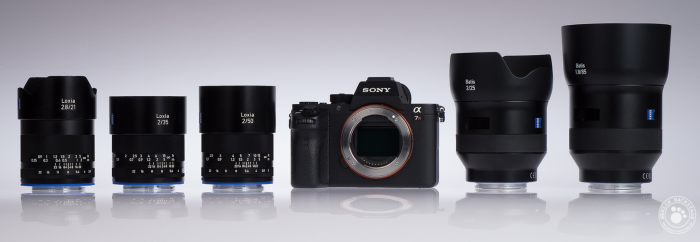
Christian Dandyk posted that great image of all five Zeiss designed FE lenses.
You can now preorder the new Loxia 21mm FE lens at BHphoto (Click here) and Adorama (Click here). In Europe at WexUK (Click here).
And we also have two new Loxia 21mm lens reviews:
Colin Peddle at Petapixel reviewed the Loxia 21mm lens
When I first mounted the Zeiss Loxia 21mm f/2.8 and began taking pictures, my initial thought was “uh oh, bend over and prepare the credit card” — and this feeling latest for about two hours. After which my fingers began to strain — just a little — from focusing manually on the smooth knurling of the lens’ barrel. Furthermore, the aforementioned difficulty I’d been experiencing when changing aperture hadn’t gone away.
As I write this I’m talking myself into dealing with the slippery focus ring and only shooting at f/2.8 because well, its tack sharp wide open anyway. Slippery grip aside, I think I’ve just convinced myself. Now if I could only convince the bank account.
Diglloyd writes:
The ZEISS Loxia 2.8/21 is marvelous for Sony mirrorless, indeed it should be considered essential for any serious shooter. It trounces the Sony 16-35mm f/4 in sharpness, and is a full stop faster, more compact, just a gem on the camera. At least for me, mastering one focal length is far better than jack of all trades zooms; I always make better images with fixed focal length lenses, which do not allow foot-dragging laziness by zooming instead. I felt frustrated having to return the test lens to ZEISS, knowing I would be deprived of it until my own sample arrives from the first production run.
Loxia 21mm FE lens at BHphoto (Click here) and Adorama (Click here). In Europe at WexUK (Click here).
46 Responses
Already having the 35mm and 50mm, the Loxia line up is fantastic in so many facets: compact, colors, and character. If I didn’t need the wide angle my Tri-Elmar provides, I would purchase this without hesitation. The Sigma 20 1.4 with an extra stop of light is an interesting option as well. Choices, choices.
The Sigma is much larger and heavier so I guess depends on what’s important for your needs?
Nice 🙂 the lens didn’t seem very popular in SAR’s vote but it’s appealing to reviewers.
F2.8 is generally never appealing to people. And especially not F2.8 lenses on the expensive side of 1500 bucks.
It’s an ultrawide after all, and it’s a Zeiss, plus it’s a new unique design. This seems much better of a deal than the previous two bland Lox…iae?
You can say what you want about the first two Leica Loxias, but at least they were F2.0 and still banging good quality lenses despite not being designed specifically for E-Mount.
There are too many choices at 35 and 50, even native we’ve got two 35s and a 55, the latter of which faster, sharper, very slightly bigger(even lighter), and at an even lower price. For the 35 you might still argue the 35/2.8’s simply too big for such a slow standard wide, but then there are so many third party choices. For a 21, you’ve got Leicas(pretty much out of the question) and the ZM(too much vignetting which means it’s effectively slower and frankly not worth the price, at least not as good a value as this), provided you’ve got the Kolari modification, or else you’d need SLR lenses which are mostly heavy and/or big and may have adapting problems.
I was looking into the OM 21/2(washed out colors and questionable sharpness, and long flange range) and Contax 21/2.8(big and expensive and heavy distortion, and long flange range) before this but with this released it’s obviously the best choice. All-round top performance wide open at an acceptable price and size, it’s like the Contax but much smaller and with better illumination, half the distortion. I’m more than pleased.
http://voigtlaender.com/sl-ii.html
Cheap,smal,light… adapter.
Oh, and since the 35 was an unnecessary Biogon, it has half a stop more vignetting than Leica’s 35/2, couldn’t find vignetting data for the Sonys.
I’ll take a sharp f2.8 lens over a soft f2 lens. Besides this is a wide lens, why is the extra stop so important? The A7 bodies generally has good-very good high ISOs to begin with. The only gain you get is bokeh and that’s about it, light transmission will depend on the T stop of both lenses but is usually not advertised with photo lenses.
extra stop fro astro for me.
Sigma 20/1.4 for half the price. Its bulk probably wouldn’t bother you.
Bulk really doesn’t matter for astro, you just set it on a tripod, pull out a chair and have tea beside it.
I just read about that lens. I actually don’t want to use an adapter. I just want everything to be FE. I already have enough adapted lens as is.
Is it an an Fe? Ive been wantinf those rokinons but they seem to only make apsc
Being a new design, I hope that they designed to handle a AF motor inside, why wouldn’t they make a Batis version?
SAR you should set a quality limit for reviews and not just distribute everthing you can find.
Thanks
Hmm.. let’s do a quick comparison to Nikkor 20mm f2.8:
Nikkor:
— weight: 270g
— size: 2.6″ * 1.7″
— min focus: 8.5″
— auto-focus: yes
— price: $674
Loxia:
— weight: 394
— size: 2.44 x 2.83″
— min focus: 9.84″
— auto-focus: no
— price: $1,499.00
Pay 3x more for this? No thanks.
Wow ! If you are seriously happy with an ancient optic like the Nikon 20mm f2.8 then good for you.
These lenses are for those who appreciate quality and can afford it. Those who don’t are happy with cheap lenses.
I personally would love to have the Loxia but I simply can’t afford it. But there is no way I am going to settle for some old optic like the Nikon 20mm which isn’t going to perform great on modern digital sensors.
Your numbers are correct, but do not forget emotion… All these mf lenses have phantastic haptics and are built to the highest standards available. They could last forever.
More like 2.2x More than $300 difference from your silly calculations.
For someone THAT concerned with numbers you fucked up pretty bad in this one.
Sony would probably let the cat out of the hat with a 20mm in 3 months for $899
I’d definitely think long and hard about it…
This shit is expensive as hell. I was really waiting for this lens…kinda. I was waiting for this wide lens with a faster aperture for cheaper. Wishful thinking? lol Now I can’t afford this.
Get the Voigtlander 21mm 1.8 with an adapter for less. Might be somewhat less sharp overall and you lose EXIF, but that’s it.
You’ll probably see a Batis version eventually. I’m happy with Zeiss commitment to the Loxia lineup
Agreed! Who’s excited to see what’s next? 85 or 135?!
Hope it’s 2/85.
180 degree focus throw like other Loxiae?
Never mind, spec is 90 degrees, perfectly acceptable for a wide
The Loxias are tempting lenses, but as Lloyd Chambers and other reviewers have pointed out, Zeiss decided not to give them auto aperture stop down, which means for really accurate focusing you have to focus at the widest aperture and then change the aperture to the one required (if not the widest). This makes focusing slow on those occasions when you need it spot on. I imagine it could also become rather irritating.
That’s good to know. However, I don’t use that technique anymore (when light levels permit) because focusing at the capture aperture is better. Why? Because then I can focus at the closest point in the distance scale where my subject is in focus thereby maximizing depth of field. Had I done it with stop down, I’d usually be focusing way past the hyperfocal distance for the capture aperture.
Agree 100%. Having constant DOF preview is perfect. If I shoot wide open, this is of no concern, if I shoot stopped down, this is of lesser concern since the lens becomes more or less hyperfocal. I can only see a small span where the manual stopping open-up and close-down would help. But with practice, you become both fast and exact without the (what I call) SLR-behaviour-technique.
And I don’t agree with Colin Peddle about the aperture and focus rings. They are not at all hard to find. Grab the lens close to the mount, and you have the aperture ring. Grab the lens close to the front, and you have the focus ring. Simple as that. And the surface too slippery? I can adjust focus with just the tip of my finger while supporting the camera in the palm of my hand. The only explanation would be if the 21mm is considerably stiffer than the present Loxias, but I doubt it.
Agreed. The handling is muscle memory after a while, at least for me!
For really sharp focusing it can often be important to nail focus on the focal plane – the focal plane being the distance from the camera at which the sharpest focus is attained. Depth of field is the range of distances either side of the focal plane at which the focus is “acceptably sharp”.
I suspect that as megapixels rise this will become increasingly important.
It’s interesting that in their Loxia reviews both Lloyd Chambers and Sean Reid mention the need to focus wide open and then stop down to obtain really accurate focus.
Apparently it was a conscious design decision by Zeiss to leave out AASD to save weight and complexity.
I agree that as the resolution of sensors get higher and higher that hyperfocal distances get further and further, but if you’re focusing at full zoom in liveview and see that your subject is in focus I fail to see how your technique would help.
Also Admiring Light: http://admiringlight.com/blog/review-zeiss-loxia-35mm-f2-biogon-t/
Seems like a few experienced guys think this is important.
I’m not sure a fully manual lens should have any kind of auto stop down. You also need to take into account aperture related focus shift, which can render accurate focusing wide open pointless and actually harmful to the focus when stopping down – I would always focus at the intended aperture where possible.
A valid point, however in the reviews of the Loxias that I have read there has been no evidence of aperture-related focus shift.
Sorry “Everlast” and Lotus Eater, “Auto aperture stop down” is from the pre.digital era, standard on MF lenses. It is the opposite of workaround!
EVF do NOT have sufficient resolution and focus peaking lacks consistent accuracy – especially when the lens aperture is stopped down.
Max aperture and use magnification is what must be used if you want to nail focus. The methods you advocate produce “about in focus”.
With mirrorless cameras you don’t have to use such ancient SLR techniques, or should I say workarounds, caused by the limitations of good-old OVFs.
With EVFs you see what you get, both in terms of exposure and focus plane and you can have it magnified if you wish, you have focus peeking.
No need to focus wide open and then stop down for the shot in 2015, plus the lenses have beautiful distance scales so you can judge the distance when DoF is too large to judge from the EVF/LCD image.
Do you guys find 21mm wide enough for architecture shots e..g inside churches and so on. I found the 14mm Samyang to be barely enough but convinced myself that 16-35 is more practical and use that at the moment albeit 16mm seems somewhat narrow.
This all said I really like this smaller f/2.8 lens. I have also been eyeing the CV 15/4.5 III but that f/4.5 seems not a great and I cannot really find deep enough tests proving it works better than 16-35/4. Samyang 12mm fish is interesting as it de-fishes well I have yet to try it, size spokes me a bit – 14/2.8 too is not very compact.
So what do you use for wide angle on your A7x cameras.
I am now trying to teach myself to use the 28/2 and always seem to lean towards the 35/2.8 instead – the 35 is simply sharper lens with much better bokeh and contrast, so pictures look better.
Zeiss vs my wallet: 1-0. This is not a matter of desition anymore, just a wait for it to hit the shops… Gotta have it, no Christmas gifts for the family this year, the winner takes it all…
Diglloyd strikes again! The obligatory comment about sharpness : “It trounces the Sony 16-35mm f/4 in sharpness”, the mildly derogatory comment “foot-dragging laziness by zooming”. And, of course, the flawless conclusion “essential for any serious shooter”. Thank you Zeiss for providing samples to the loudest.
There’s nothing better than the FE lens line up. Lol joke
Yeah, this is one of the worst reviews I’ve ever read- and I’ve read a lot. Mental note to self: Don’t surf Diglloyd.