







Official press text via Lenspire:
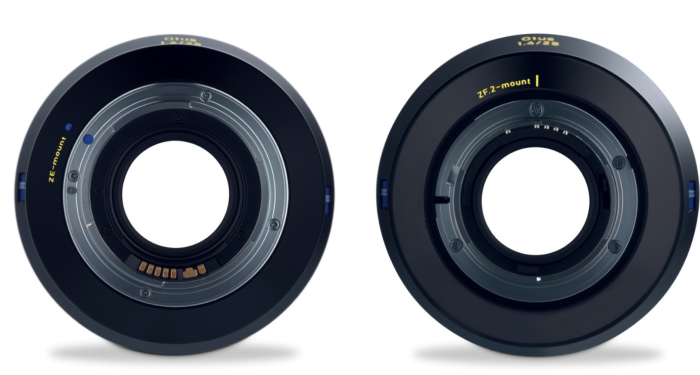
With the new ZEISS Otus 1.4/28, users of shorter focal lengths can now also take advantage of the most powerful image quality of the ZEISS Otus lens family.
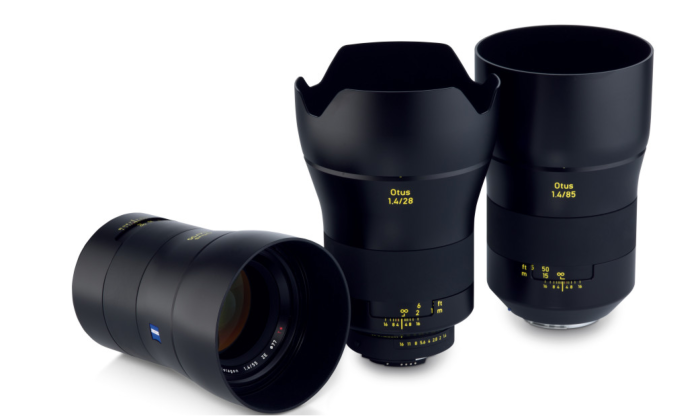
Where details count in wide-angle photography, the Otus 1.4/28 for DSLR cameras with F- and EF-mount is the lens of choice.
The Otus 1.4/28 shows off its strengths particularly in landscape and nature photography. Even with a maximum aperture, the corners of the image are completely usable, so there are no limits to composition. In poor light combined with fast-moving objects, the lens also doesn’t break a sweat – thanks to its high speed of f/1.4. While other lenses reveal their shortcomings in correction in night photography, especially when lots of open light sources dominate an image, the ZEISS Otus 1.4/28 boasts a stellar performance. Finally, the latest member of the ZEISS Otus family is excellent for taking pictures of image elements in the foreground, as they take on a greater feeling of depth to the scene due to the wide background and the open aperture; here, the lens’s harmonious bokeh ensures a 3D effect.
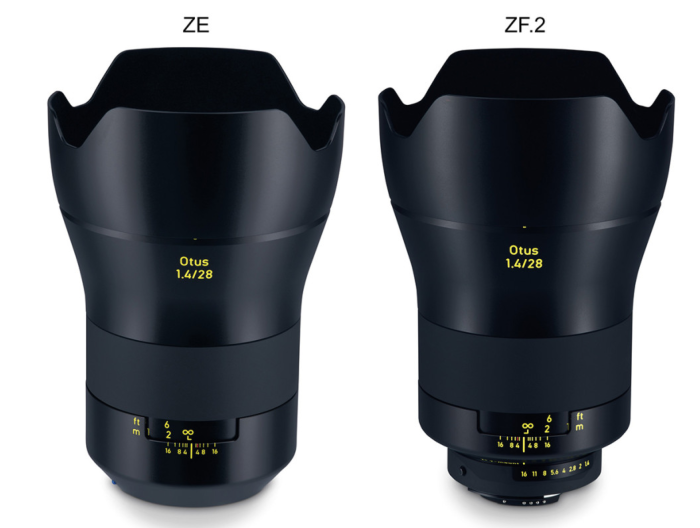
For professional photographers
Inner focusing, a dial window and yellow labeling of the dials for easy legibility designate the Otus 1.4/28 as a lens, developed to meet the high demands of professional photographers. The mechanical quality also impresses: the soft focus operation with the large rotation angle allows for the finest variations when focusing – something that is only possible with a metal construction. In every focusing situation, the user is given freedom to compose – one of the most important creative factors in photography. An artistic tool is literally put in the photographer’s hands. With its robust all-metal barrel and easy-to-grip focus ring, the Otus 1.4/28 is also well suited for a photographer’s demanding everyday work.
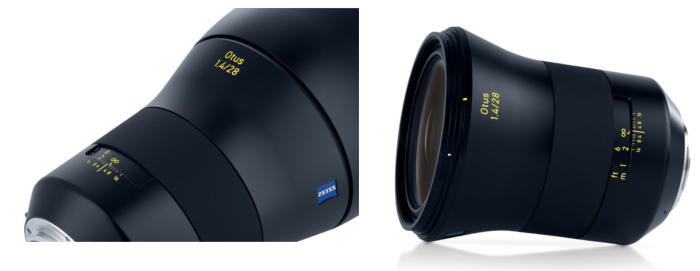
With high image contrast all the way into the edges of the image – already at an open aperture of f/1.4 – the Otus 1.4/28 demonstrates its optical brilliance. At all distances it offers consistent performance (minimum working distance of 0.15 m), highly detailed images without any bothersome artifacts, and a neutral bokeh in the background.
“With these features the ZEISS Otus lenses set themselves apart from the other ZEISS SLR lenses, such as the ZEISS Milvus family, which we recently presented,” said Christophe Casenave, Product Manager with ZEISS Camera Lenses.
Intricate construction for uncompromising imaging performance
A view inside the lens reveals how such optical excellence is achieved: The lens consists of 16 elements in 13 groups. One of the lens elements has an aspheric optical surface and one element is aspheric on both sides. Eight other lens elements are made of special glass. The basis of the optical design is a Distagon. The special glass has anomalous partial dispersion, as is typical for an apochromatic lens. This corrects the longitudinal chromatic aberrations superbly, which therefore lie considerably below the tightly defined boundaries. Bright-dark transitions in the image, in particular highlights, are depicted almost completely free of color artifacts. The floating elements design (the change of distances between certain lens elements when focusing) allows for unrivalled imaging performance along the entire focusing range, from 0.3 m to infinity.
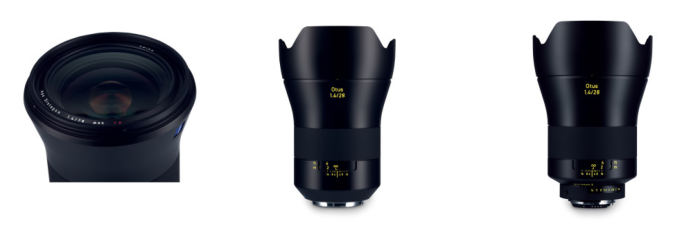
The ZEISS Otus lens family
 When ZEISS introduced the ZEISS Otus 1.4/55 in 2013, creating a new family of high-end SLR lenses, the trade press and users alike were enthusiastic. The ZEISS Otus 1.4/55 has exceeded its promises up to this day. The second member of the family, the ZEISS Otus 1.4/85, which was presented at photokina 2014, continued this success story in the short telephoto range. It enables photographers to express their creativity in a unique way – and that with the unsurpassed high imaging performance for which the lenses in the ZEISS Otus family are known.
“The ZEISS Otus 1.4/28 continues the tradition of its lens family. It is the best wide-angle that has ever existed. Now we can offer three outstanding lenses for the widest variety of applications,” added Casenave.
Price and availability
The Otus 1.4/28 ZF.2 and Otus 1.4/28 ZE will be available worldwide starting in the second quarter of 2016. The lens shade is included with delivery. The retail sales price is unknown to date.
Further information and technical data:
56 Responses
Zeiss, shut up and take my money!
You shut up and give me your money
I can’t. No money to give– It’s all gone to Zeiss
I didn’t expect Zeiss to post photos with such bad posterisation in the skies ! Supposed to be top quality….
awful banding
Canon?
Nope, Nikon D800.
Bad post processing (or something like that).
Please stop the awful brand bashing. I never seen a in camera JPEG engine that has not terrible, or at least clearly visible, compression artefacts. That’s the way they are.
I’m pretty sure the samples are not in-camera JPEGS. I guess it’s the webmasters fault.
Which is what I meant. And I agree 100% – stop the brand bashing 🙂
No. There are no issues with the Flickr samples.
https://www.flickr.com/photos/carlzeisslenses/sets/72157657249840463
Haha… Seems SAR is accountable.
That’s not banding. These are artefacts caused by heavy compression.
EDIT: Seems that the word “banding” is used more loosely than I thought. So I have to correct myself.
Yes, the sky in a couple of the samples is compressed to kingdom come. Shot with a Nikon D800 so it should definitely be better. The webmaster for Lenspire should definitely address this. I think it’s their CMS chewing up the quality.
Possibly the webmaster is accountable for this.
SHUT UP AND TAKE MY KIDNEY!!!! 😀
No E-Mount 🙁
Nature and landscape? It is obvious that the lens will deliver amazing IQ, but who would lug that expensive monstrosity in the wilderness? Honest question, I am actually impressed somebody brought a 2kg setup to take a photo of a climber.
I wonder why they did the announcement at least five months prior to the availability, and then not list the RRP. Seems like a rushed announcement to me.
Lastly I was bowled over by the number of glass elements and the arrangement it had inside.
thats means zeiss ask us to start saving money 5 month prior
Yeah, getting mortgage papers in order takes a while not to mention the divorce
WOW, this seems to be a h*ll of a lens! A worthy successor to the glorious Nikkor 28/1.4D.
BTW: According to the specs, MTF curves and images samples, and given an expected price in the $3-4k range, I would not call this a bad value (in contrast to the overpriced Loxia 21/2.8).
Why is the Loxia overpriced?
It’s a ordinary f2.8 lens in the 20mm range. It is surely good optically, but that is (or should be) any quality prime lens developed in 2015. It is not perfection or anything spectacular. For such an ordinary lens, $1.5k + VAT is way to high in my book.
This is not a definitive opinion of mine, cause the lens is not even out or tested. So, I may easily change my mind later.
Remember, I’m talking about value (totally subjective), not price/production cost ratio.
BTW, to a lesser degree, I do think the same way about the other Loxia’s, the FE35/2.8 and FE55/1.8. They are nice lenses, but too expensive for what they offer.
Sorry Condor. It just sounds as if you are not making enough dough.
That’s why I asked (in the Loxia thread) if you guys all get $3k paychecks each month. If that’s the case, then it’s me. 🙁
I think it’s about managing your expectations in line with your budget. Eg I wanted a moderate wa for street photography. The 28/2 is an affordable option but for me the 35/2.8 was worth the premium.
28/2 is sharper/lighter/cheaper
No brainer
28/2.0 is one stop faster and $250 cheaper.
35/2.8 is 23mm shorter and 80 grams lighter.
You pay extra $250 for having a more “pocketable” lens for street photography.
If you want to buy only one of both lenses, it might be a difficult choice.
If the average joe, like me, wants that Zeiss 35/2.8 (mainly because of the lack of alternatives), a $250 premium is really not a problem. Even I can easily afford this. 😉
However, that Zeiss 35/2.8 is still bloody expensive for what it has to offer.
Exactly. Between this both lenses my criteria-choices are:
Aperture: 28/2
Price: 28/2
Focal length: 35mm (my pers. choice for street photography over 28)
size/weight: 35/2.8
So the final result is 2:2 – at least for me a very hard choice.
Disagree. It isn’t quite up to the standards of the 55/1.8, but its rendering is its primary strength. I think it’s a bargain TBH.
I can understand why are you criticizing Sony for pricing, i mostly agree with that, especially they recent releases. But than again, you praise Leica Q which is utterly overpriced, and both Loxia 21 and RX1`s Sonnar wipe the floor with that summilux in Q… Not to mention sensors….
Oh no….. you got me all wrong. I’m not saying the Leica Q is sanely priced, or even worse, that I would buy one for real. I agree with you! The Q is totally overpriced for what you get. Same as the RX1 (first one as well as this new one).
My point is, in the $3-4k range I would prefer the Q anytime over the RX1, even if it costs 30% more. So, I just don’t think the RX1 wipes the floor with the Q. Try out a Q and you will probably agree.
But I would NEVER EVER prefer a $3-4k camera over a long travel with a Ricoh GR in my pocket.
Personally I found it distorted and generally uninspiring
Sharper and lighter than what?
Actually my paychecks are bigger.
Nevertheless I am not willing to pay $1.4K for a fixed lens with only f2.8 and lacking AF.
Lucky you. 🙂
I have to add, I’m from Europe. Paycheck means here: after taxes, pension insurance and health insurance is paid. I have a few friends earning in this range, but it is definitely way beyond average. Maybe photo gear is not for the average anymore. 🙁
Me: Germany 🙂
My message is just that I this lens isn’t worth the money. And even if I would earn more money it won’t change my mind. Maybe I am thinking like IKEA-Boss: One of the richest mans in the world, but driving an old Volvo.
I just read: ” average apartment rent within 10 miles of New York, NY is $3642″. LOL
That makes someone getting a $3k paycheck a homeless sucker. So, seems that makes my statement sound ridiculous in the US.
Holy s**t!
But not all US people are New-Yorkers or live in a comparable high-price region. I got rumors that somewhere in Texas are people living without an oil-plant like J.R. Ewing.
I can’t say I’ve used anything that beats the 55/1.8 at a lower price point. The 35/2.8 isn’t cheap, but it isn’t hideously expensive in the UK now and fills a pretty unique niche.
OK, so why do you think the Otus is not bad value in comparison?
Because it’s something really special. State of the art. More so than the other two Otus lenses.
Remember we are talking about unreleased lenses, just looking at specs and some pictures. I may change my mind later, but these are my initial feelings.
Diglloyd already reviewed the lens yesterday. The Loxia is an extraordinary performer, with peak central sharpness wide open. I don’t know of any better performing ultrawide. The Nikon 20mm f/1.8 may be faster but it’s not better from f/2.8. The only really comparable lens might be the Zeiss 21mm f/2.8 ZF.2 which is arguably the best ultrawide available. How you can say it’s nothing spectacular is beyond me.
Can’t wait to see a shootout with the Nikkor. 😀
Who buys this and puts it on a Metabones?
Most people who would buy the lens (i.e. Sony A7x users)?
Surprised it is good for climbing.
Thanks for the photographs Andrea. Very beautiful. It’s strange but, on some of those, the lens looks wider than 28mm. Particularly on the umbrellas and climber. Can’t wait to see the lens in the flesh. Maybe Salon de la Photo, in November ?
It is an optical illusion that it is wider because the subject is in extreme corner of the frame.
That last image shows dust in the lens ! .. oh wait that’s my monitor. (◔◡◔)
I’m sure there’s a car right behind the photographer shooting the climber. I would think a A7rII and Batis 25 or FE 16-35 would make a much more practical choice.
lol, tell that to those crazy large format landscape shooters lol
Another thing I don’t get is why the omission of weather sealing (at least I don’t see it mentioned anywhere). That’s a compromise in my book. How much does it take to put a thin rubber gasket on the rim of the mount?
Adding weather sealing compromises the focusing feel, adding unwanted resistance to what is current a perfect manual focus cine-bearing action. The Milvus range have noticeably more resistance than the Zeiss classic line.
Totally content with the 28 f2. I bet my pictures won’t look worse than yours with this lens.