







[shoplink 40637 ebay]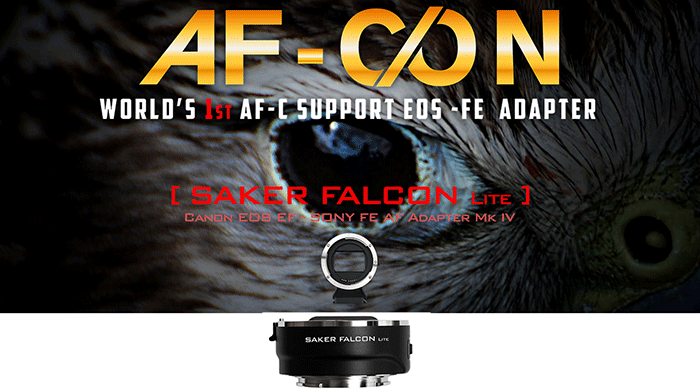 [/shoplink]
Deo (website here) just released a new Canon EF to Sony FE mount adapter. They write it’s the world’s 1st Dual-operation mode AF adapter. The lens has a switcher between two modes:
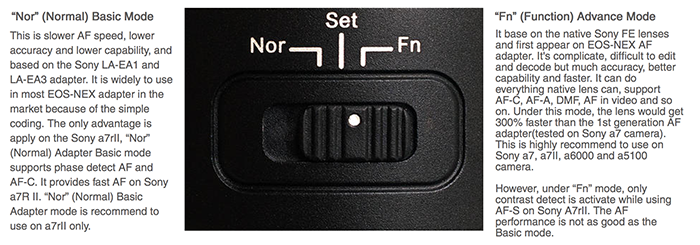
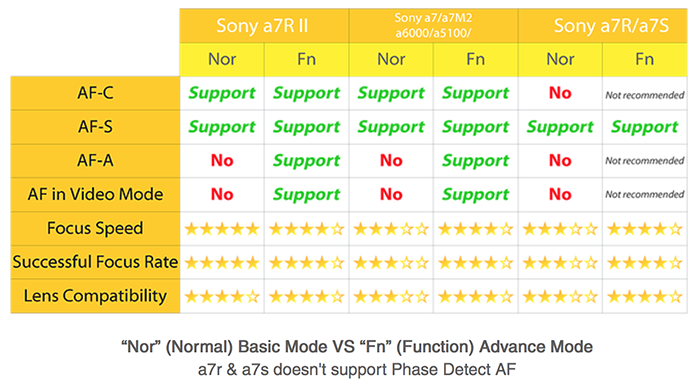
And is how the two modes do work on Sony cameras:
You can preorder the lens directly at Deo (Click here) and within the next days on [shoplink 40637 ebay]eBay (Search link here)[/shoplink].
72 Responses
What I don’t understand is, why is AF-C supported on one model and not on the other. Is the communication between lens and camera really that complicated?
I thought the lens receives simple commands, like turning direction, acceleration, deacceleration. The actual focus calculation is done in camera, isn’t it?
Why on earth must lenses be that complicated that they need such things like firmware updates?
I think the answer must be that it’s more complex than it at first appears. Whilst the AF calculation must clearly be done in the body, it’s not as simple as just telling the lens to “stop” when optimal focus is detected. I don’t think it’s possible to have an instantaneous stop and such an approach might cause overshoot. Very possibly there’s a constant stream of instructions, which might be carried out semi-autonomously. Perhaps move a certain distance, possibly at a defined speed (if tracking). All these movements will need constant calibration for particular lenses (especially zooms) such that the camera can make sensible judgement. It also gets complex as most modern lenses don’t have a fixed focal length as they focus (and that’s even before we deal with zooms). All this is bound to have some impact on the way that AF calculations have to be made in things like how far the lens is to be moved, how far is it off focus.
There’s also a fundamental difference between PAF and CAF in this respect in that the PAF element does (or at least used to) work out how far the lens had to be moved and was at least, in part, open loop (although tests reveal it was never truly open loop). In contrast (no pun intended), CAF was fully closed loop with the body directly controlling lens movement. Hybrid appears to have brought about a combination of these approaches.
Of course all of this has to be done in such a way that legacy lenses still work, even if imperfectly. My experience in IT tells me that loading more and more functions into a protocol whilst establishing backwards compatibility can lead to some very messy results.
It’s notable that Sigma have been caught out on compatibility on several occasions, and that was in the says when AF systems appear to have been a lot simpler.
Thanks for your thoughts.
I miss the times where a lens mount had clear specifications and constructing a fully compatible lens was a rather straight forward process.
The fact that even lenses from Zeiss, who has a deep collaboration with Sony, were partly incompatible (PDAF w. Touit lenses) with the target platform, is a rather grotesque consequence of what you explained above.
Good old times…
The lens protocalls are deliberately made complicated because the manufacturers want you to buy only thier own products.
The camera manufacturers continually attempt to defeat 3rd party compatability, and the 3rd party continually tries to work around these these latest attempts.
None of which is in any way intended to benefit the consumer.
I think they are deliberately kept secret, although licencing is possible, at least in the case of Sony E mount (although what’s actually disclosed under those licences is not in the public domain).
If camera manufacturers wanted to make it virtually impossible to produce third party lenses (at least without licensing), it would be fairly straightforward in that they would use an encryption or authentication system which would be very difficult to break, rather in the way that some printer manufacturers make it impossible to use third party ink cartridges. Even where the encryption is broken, the US DMCA laws come into play in that circumvention of protection systems is unlawful. Whilst the DMCA only applies in the US, and company with an American presence is liable to action. (Anonymous Chinese manufacturers of things like camera batteries that circumvent the sort of authentication system that Sony put into their cameras manage to avoid this simply by being beyond the reach of US law and it’s fruitless trying to enforce it).
In any event, yes camera manufacturers don’t make things easy by not publishing the full specifications but there’s no reason to think they make things complicated for the sake of it. There would be easier ways to do it.
Good news is I haven’t seen any evidence of encryption anywhere in the E-mount lens protocol.
Bad news is, it’s incredibbly complex. Well, the basics of how packets are transferred is simple, and I haven’t seen any really long packet sequences – but the repeated command and status packets at 60 Hz are big and contain lots of data. From what I recall (I’ve been travelling for two weeks and haven’t touched this project in more than a month) there are no additional packets during focusing – it’s just different data within the existing status/command handshake packets.
I don’t have the link with me right now (travelling, not on my normal computer) but when I get home tonight I’ll post some links to information on the EF-mount protocol (simple, fairly well characterized) and my personal efforts to reverse engineer the E-mount protocol (many unknowns).
I can tell you that an E-mount lens sends around 100-150 bytes of data in two different packets, each of which is sent at 60 Hz. (not sure if it’s 50 Hz on PAL bodies…) I’ve only identified half the fields in one of the two packets so far…
It seems that pre-A7RII OSPDAF needs a LOT of characterization/calibration data from the lens, which is why even a lot of native E-mount lenses have limitations (such as Sigmas only supporting center PDAF)
Delighted to hear from somebody whose actually got information. I was just guessing what probably had to do on.
The fact that the Sony hybrid AF system need a lot of lens calibration information is very interesting and not so surprising. However, there’s an important point and that is whether the calibration information is static, or dynamic as the lens focusses or zooms. If the lens calibration information is static data then it is, in principle at least, possible to have a lens adapter provide that information as long as the it can determine the model of lens.
If, however, it’s dynamic data, then that’s a vastly different matter. If dynamic lens encoding of come characteristics (like the effective, rather than nominal focal length) has to be communicated as it is zoomed/focussed, then that ranges from very difficult to impossible for an adapter to generate.
I know one issue a lot of adapters have had is properly reporting min/max aperture for some lenses. Read the Metabones documentation – it’s clear that the adapter has a min/max aperture table for “known” lenses. (If I recall correctly, the EF protocol lacks a method for reporting min/max aperture other than “go to min, read it, go to max, read it” which doesn’t work on a zoom lens. Either that or it hasn’t been found by anyone who publishes their findings…)
I’ve also not yet figured out how the focus position field is calculated. (e.g. what units it is in and even exactly what it’s reporting). I do know that an adapted lens with Viltrox or FOTGA adapters only reports one of the two focus position fields, a native lens reports two – they seem to be nearly identical when the lens is not changing focus but not when the focus is moving, one lags the other.
But EF must be able to determine min/max on zoom at any particular focal length or it wouldn’t know how to present the possible exposure settings. Surely go to min/max would work at a particular focal zoom setting. Of course that won’t give the min/max of the lens as such, but as many zooms change the min/max dynamically through the zoom lens, I don’t see that being needed at all.
nb. does this really mean physically opening and shutting the aperture rather than it being emulated? It would surely be highly undesirable to actually perform the action.
I was also going to say that the 60Hz status update is surely closely related to the EVF refresh cycle in some way (and, of course, the reading of AF information from the sensor). That would make sense. It would also point to a very different mode of working in liveview vs OVF modes.
I don’t think there’s any difference between liveview (LCD) and EVF… Or are you talking about the differences between EF and E? I have not tried seeing if the refresh rate changes in EVF as opposed to LV mode (they’re pretty much the same, just different displays…)
I’m really curious to see at what rate BODY_VD_LENS pulses low on a European (PAL) body…
http://www.dpreview.com/forums/post/56186515
I wasn’t suggesting that the EVF and rear screen worked any different. The are both liveview as far as I’m concerned.
The comparison was for DSLRs, where the lenses have to work with both liveview and OVF modes, and the focusing control requirements will be different. It may well be that some DSLR lenses (especially the older ones) are not well suited to the full-time liveview mode on mirrorless cameras, even with on-sensor PAF.
Would explain why when some cameras added LV, a few lenses performed HORRIBLY. I have a Sigma 18-250 on my Pentax that has HSM – Liveview + HSM is pretty much useless on that lens. Constant overshoots/hunting.
The good news is – Canon also has OSPDAF in some of their bodies. (Dual Pixel AF, and they also have something like “CMOS Hybrid AF”) – so many of their lenses (almost surely the newer ones) are likely designed to be able to work with various forms of OSPDAF. It’s just a matter of proper protocol translation.
At some point I might need to borrow a Canon “hybrid CMOS AF” body and build a breakout for EF lenses in order to look at what newer Canon bodies do.
It’s what I was thinking. In most areas mature areas technology eventualy conforms to a standard that the human race thinks is optimal (or at least it’s good enough, and not worth the effort of changing – there are lots of imperfect standards out there which have been bent enough to do the job). In the case of systems cameras and AF, then the combination of PAF and CAF will surely mean some form of convergence.
Beyond this will require something rather more revolutionary than the standard Victorian era of how a camera and its lens works. After all, a camera (as we know it) only captures a tiny part of the information contained in the light from a scent.
Not that I’ve any idea what is possible – light field cameras have played around with some variation – but there is surely a revolution out there somewhere. It just won’t look like an evolution of a Canon, Nikon or Sony. Or maybe that is the limit…
are you same person as Entropy512 of dp?
Yup, that’s me.
Good question, hence my “either that or it hasn’t been found by anyone who publishes their findings”. 🙂 https://pickandplace.wordpress.com/2011/10/05/canon-ef-s-protocol-and-electronic-follow-focus/ is the best EF documentation I’ve seen so far (some of the really good stuff is buried in the comments)
Even without any calibration, center AF spot *should* work with any lenses (which are rotationally symmetric 😉
I think most of changes to AF in A7RM2 is due to software, not hardware, and they simply are wanting people to buy $3200 camera instead of $650 one
Might be why the Sigmas only do center OSPDAF… Which I find to be an acceptable compromise in many cases. However in addition to rotational symmetry, there’s also the characteristic of the lens properties as it focuses. I am GUESSING that one of the big issues with these adapters has been the focus position/focus drive formulas. Native E-mount lenses report TWO different focus positions, one of which usually lags or leads the other but are almost always the same when the lens is stationary. One might be “commanded focus position” and one might be “current focus position”? I’m not sure. Adapted glass using EA1/EA3 emulation lacks one of these two focus position variables. I haven’t figured out the focus position formula yet – Min/max position (or was it only one of the two, I can’t remember and I don’t have my data with me) definitely varies depending on lens focal length. My TODO list includes writing a script that ONLY parses out the focus position number so I can look at it in realtime as I move the lens and compare it to what the camera UI shows.
It is acceptable that Sigmas on Sony cameras work with only 1 pdaf point, however it’s not acceptable that Sony’s own A-mount lenses don’t have it all with a6000 + ea1/ea3. a7rm2 cannot be better in knowing how lens focuses so it certainly isn’t strictly necessary
While it is understandable why camera makers do this, Sony is clearly the most friendly towards adapted lenses. They even ran a promotion 2 years ago whereby if a consumer purchased an FS-700 they would get a free metabones EF adapter.
So ah, when was that exactly, these good old times?
When lenses had no electronics at all.
Even then such a thing didn’t really exist, everyone comes up with their own standards for things because they think they know better. Having come up with a standard they then hope to capitalise on their ‘innovation’ in making yet another standard.
There always be a “back to basics” movement. However, we always seems to demand things work better or faster or do more. This complexity follows.
Even though it’s the aim of every wise engineer to make things simpler and more elegant, it’s difficult to think of any technology where that’s really happened. Just look at the size and complexity of the operating system in modern computers or under the hood/bonnet of a modern car.
I don’t think those good old days are coming back any day soon.
A7R and A7S which are not supported don’t have PDAF on sensor to take advantage of for AF-C.
Correct, I forgot.
Good to see they are evolving fast, maybe it’s possible to get fast hybrid AF like a native lens.
If the battle between types of AF wasn’t complicated enough, along these come and say the Phase detect is slower, less capable, and less accurate, while the Contrast detect is faster…oh, what fun!
It’s poorly worded, but they’re saying the “Nor” setting is only worthwhile on the A7rII since it is the only body to support Phase Detection, so if you don’t have that camera, performance will poor on the “Nor” setting.
I thought the original A7 does have PDAF just not as many points as the RII
It does and this adapter can take advantage of that, including on the A6000.
where’s any video that proves the adapter can use pdaf points on a6000?
They just stated on their site, I have no interest in finding videos that prove it. But it may very well be wrong or I may have misread, but it seemed to imply that A6000 and A5100 work as well.
I’m afraid it focuses in 1 second instead of 4 — faster but still not what i’d rate with four stars.
So you are saying it does in fact use the PDAF? I find ‘1 second’ referring to AF to be absolutely meaningless as that basically seems to refer to ‘ok but not instant’ AF by pundits.
Only the A7RII can PDAF with EA1/EA3 adapters – “Nor” mode emulates an EA1/EA3.
yes, it does. less points and poorer tech.
Great idea/concept! Hopefully not as inconsistent as their version III Contax G to Sony adapter has proven to be. Given the complexity of what DEO is trying to do with this dual-operaiton mode adapter, I expect it to be another frustrating science experiment for early adopters. I don’t know, maybe better to use the best adapter for Canon lenses, a Canon DSLR.
Looks like Sony messed up things in their protocols so workarounds like this are needed…
Err how is that?
Sony clearly failed to make a full compatible AF system for every manufacturer on history, lame.
Dude to be able to use lenses other than the native are considered bonus. Can Canonikons DSLR able to use E/FE Lenses? I guess most of us are being too spoiled… wait for sony to complete their FE lenses lineups. patience is a virtue. they’re new to this market. Do you think canon and nikon invented a DSLR with 200 lenses in the same day?
How do you work that out? Sony designed their protocols for E-mount. If Sony had designed an EF mount compatible system in the first place, you might have a point. But they didn’t. That Sony’s e-mount protocol can be translated for an alien lens mount is something of a wonder.
What is the wonder – they are doing the same thing?
The mess is that different E-mount cameras work differently so the switch had to be added.
No workarounds needed for NX1 AF! Fastet in the world #beatsony
NX1 cannot focus any old DSLR lenses at all.
It can and does so faster than any Sony will in the next 3 years. Insider info, not that you would know…
get a life….
There are no NX adapters with AF for any DSLR mounts.
I think Sony should release a firmware update for the LA-EA1 before we A6000 shooters buy Canon lenses instead of using or even buying Sony A-mount.
Sony’s SSM drive system might not have the precision and control that EF EF has.
Canon lenses can be commanded by the body to travel exactly N steps at speed Y.
Umm… thats exactly how A-Mount SSM lenses work, and just about every other high end DSLR lens out there, which has a silent ring motor.
Oh, where’s the reverse engineered protocol documentation that describes this and a confirmation of this with a logic analyzer? I have not seen any documentation of the A-mount beyond the ability to read the lens ROM. Have you specifically seen the command format for adjusting focusing speed and focus target? Otherwise you have no way of knowing that the lens doesn’t just relying on a PWMed H-bridge in the body to control speed and direction.
Whereas for EF-mount, people have seen the specific commands to do all of these things – https://pickandplace.wordpress.com/2011/10/05/canon-ef-s-protocol-and-electronic-follow-focus/
Too bad they haven’t figured out (either via trial and error or extrapolation) how to support lenses longer than 200mm properly. I would’ve expected they’d at least get to 240 thanks to the 240mm FE lens.
I to was puzzled about the “fragile” switch. It surely isn’t difficult to design a robust one.
Turning the camera on and off between mode changes is a bit more believable. Clearly the adapter has to present itself in different ways for the different modes and the camera firmware might well not have the capability of dealing with “on the fly” changes. It might have been possible for the adapter to electronically simulate a lens being changed (briefly going “dead” on the interface maybe?), but maybe there is some reason why this won’t or is difficult.
In any event, it’s interesting to see development in adapters like this, and it will be interesting to know if the issues with AF and on-sensor PAF with long lenses is some aspect of the geometry of on-sensor vs off-sensor PAF or just the current state of play.
I know that the A6000 will actually keep the lens interface “powered” even when turned off it sees LENS_XDETECT go high. (The body pulls it up, the lens pulls it down. Native lenses short this, adapters seem to pull it down with some resistance, probably so that the EF-mount lens detect which is also a pulldown can get passed through somehow.)
Well it might remove power from the interface, but it will not go through the initialization/speed negotiation sequence if LENS_XDETECT was held low between power cycles.
Wake me up when somebody figures out how to get PDAF support with adapted lenses on the A6000…
Um, you didn’t read the article at all did you?
THAT IS EXACTLY WHAT THIS IS.
Sorry, my brain mis-parsed some of the Engrish.
Not recommended or no support and it’s still three or four star focus speed?
The ratings only apply to the supported modes.
I read Snake Falcon, This is so MGS~!!!
Looks like the adaptor’s will be undergoing a continuous improvement process for some time, good news for legacy lens and E-mount users.
They have a video with a prototype, but only on a A7rII
https://www.youtube.com/watch?v=YWttNlOpZGg
https://www.youtube.com/watch?v=n8puRnJkAPE
https://www.youtube.com/watch?v=dO7mRl4IEbQ
Finally!! The only reason why I returned my a6000 was the poor lens selection at an affordable price. I have been using rented/borrowed Canon 70D with the 18-135mm (~300$ slightly used) and 50mm (110$ new), and this adapter (if it works) would help replace the 70D with the a6000.
Interesting that there is so much focus (sorry for the pun) on using Canon DSLR lenses on Sony mirrorless cameras. Sony is loosing so much potential and money and only getting 3K USD instead of thousands over thousands on lenses.
Time is running out.
We have more MP than you!
DXOmark lies and is unscientific on all levels. All independent sources agree NX1 beats A7Rii in DR, high iso noise.
Don’t forget your medicine, pal !
A6000/A7 doesn’t even work properly with their own A-mount lenses.
a7r/a7s no pdaf and still 3 or 4 stars? i’d rate a7r with la-ea3 with one star.