







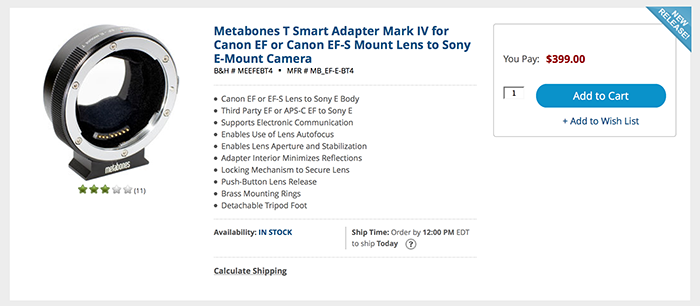
Metabones just sent me the following press text:
Vancouver, Canada, September 18, 2015: Metabones® adds phase-detect autofocus (PDAF) support for Olympus OM-D E-M1 and Sony Alpha 7R2 to its EF-mount Speed Boosters and Smart Adapters through firmware update version 1.8, available from Metabones’ web site for download.
Free of any potential misalignment issues, on-sensor phase-detect autofocus is capable of attaining excellent accuracy. Overall, phase-detect autofocus offers a significant performance improvement over contrast-detect autofocus, and for shorter focal length lenses the autofocus speed approaches that found in digital single-lens reflex (DSLR) cameras. Performance, features and limitations of our solution are comparable to other on-sensor PDAF systems involving adapted DSLR lenses on mirrorless cameras, such as A-mount lenses on Sony Alpha 7R2 with LA-EA3 adapter, Four Thirds System DSLR lens on Olympus OM-D E-M1 with MMF-3 adapter or Canon SLR lens on EOS M3 with Mount Adapter EF-EOS M.
Limitations include:
- During video recording there is no AF (Olympus) or only slow contrast-detect AF (Sony).
- Continuous AF may have unsatisfactory performance (phase-detect AF) or not supported (contrast-detect AF).
Also added to Metabones firmware update version 1.8 is fast contrast detect AF for other Olympus cameras including E-M5II, E-M5, E-M10 and E-P5. Contrast-detect AF accuracy on Olympus is lens-dependent with most Canon-brand lenses introduced over the last 10 years working satisfactorily. However, some older Canon lenses and some third party EF-mount lenses may not be able to achieve pinpoint-accurate focus on Olympus cameras with contrast-detect AF. These lenses should be used on OM-D E-M1 instead.
In addition, AF support for JVC GY-LS300 is added to this new firmware version. Existing Panasonic contrast-detect AF support is enhanced with 24p added as a supported frame rate for single-autofocus (AFS) during video recording.
By simply downloading and running Metabones App Version 1.8, new autofocus support is added to the following Metabones products:
- EF-E Smart Adapter Mark IV (model number MB_EF-E-BM4)
- EF-E Speed Booster ULTRA (model number MB MB_SPEF-E-BM2)
- EF-E T Smart Adapter Mark IV (model number MB_EF-E-BT4)
- EF-E T Speed Booster ULTRA (model number MB_SPEF-E-BT2)
- EF-Micro Four Thirds Smart Adapter (model number MB_EF-M43-BM1)
- EF-Micro Four Thirds Speed Booster (model number MB_SPEF-M43-BM1)
- EF-Micro Four Thirds Speed Booster S (model number MB_SPEF-M43-BM2)
- EF-Micro Four Thirds T Smart Adapter (model number MB_EF-M43-BT2)
- EF-Micro Four Thirds T Speed Booster ULTRA 0.71x (model number MB_SPEF-M43-BT4)
- EF-Micro Four Thirds T Speed Booster XL 0.64x (model number MB_SPEF-M43-BT3)
The following discontinued products must be updated by factory service. Please contact Metabones customer service for details.
- The original EF-E Smart Adapter
- EF-E Smart Adapter Mark II
- EF-E Smart Adapter Mark III
- The original EF-E Speed Booster
34 Responses
I just installed the firmware:
– still no Autofocus in advanced mode
+ EF 135/2 L AF works*
+ Sigma 85/1.4 HSM AF works*
*the AF is not to fast, not to bad..I only used these lenses on the 5dmk2 so I dont have a good feeling for the benchmark on a DSLR. AF ist similar as with the 50/1.8 STM or the 40/2.8 STM..
My Sigma 85mm has been working fine since I got the A7R II, only issue was near minimum focus distance where it simply stopped working below 1m. All else worked perfectly.
Imho The 135/2 works poorly. Try to select a focus point and move around the frame. Or try to focus in non perfect light condition
Does this mean that all those lenses that Brian Smith tested and found wanting will now suddenly get a kick in the AF pants?
Those would be the older USM ones – 50mm f/1.4, 85mm f/1.8 and f/1.2, 100mm Macro f/2.8, 135mm f/2 etc.
I loved this effort to bring those contents but He really should’ve made a table, not a list, it’s really PITA to find quickly what you want there.
Brian Smith test is shallow. He didn’t test the lenses in different conditions. Even now, after the update, many lens work poorly. There is still a lot to work to do for metabones. In fact the firmare version is 0.43 not 1.43.
I don’t think that’s the Metabones problem, most likely the camera / ospdaf limitations.
uhmmmm, maybe… no one of us can know the truth. The fact is that some lenses work well and others do not.
“The truth is out there” LOL
This review almost coincides with my own experience: https://www.youtube.com/watch?v=Nwy6O774NR4, but mine is actually worse for some reason. I don’t have many Canon AF lenses, but those I have aren’t much usable. I was very excited when shortly after the A7r2 announcement many “reviewers” said it can auto-focus all Canon lenses almost as fast as a Canon body does. Well, now we know that was just a marketing BS. Yes, it can AF some lenses indeed, but definitely not as fast as the high end Canon bodies, and it’s simply not reliable, sometimes it can focus no problem, sometimes it just keeps hunting for no apparent reason. I have a few A-mount lenses, those are suffer too on the LA-EA3, even the 24-70 f/2.8 SSM first gen works nowhere as good as on the A99 or the SLT adapter (EA4). That’s why I think the problem could be in the camera.
Tried using them in AF-C? Mine work very well but I only use AF-C, AF-S isn’t so hot.
No, mostly AF-S. I’ll try AF-C tonight.
i thought metabones already had phase detection for canon lenses before?
It did, but I feel like it was almost by accident and not by design. Hopefully this fixes some of the quirks.
So now all the testers that painstakingly tested Canon lenses via the Metabones adaptor on the A7RII will have to do it all over again. 🙂
That was what I always thought when those tests started to show, and worst, it just made more BS to haters spread around.
This is working wonders on my A7Rii. Before this update the AF on the Canon 85/1.8 was from none to worthless, now it locks focus fast and accurate. Sadly no EyeAF…. yet…
you made my day! oh yeahhh!
The AF still sucks on the 70-200L f/2.8 II. It’s OK with the center AF spot under 100mm in a decent light, but anything else is unusable. I guess they’ve just added support for the stubborn lenses like the 135 f2. The best adapter I’ve seen so far for the L glass is called 5ds r, it even adds 8 extra megapixels while sacrificing some of DR…
Is anyone else having trouble downloading for Mac from Metabones site? I agree to terms, click download, and it takes me to the page: http://www.metabones.com/download/of/MetabonesAppV1.8.dmg but nothing downloads. Anyone know the problem or would be so kind as to post a download of it?
download does not work… did click ok then download, then the screen changes to blank but nothing happens…
same here (mac & Win), I guess the site is overload…
WHAT CAN I SAY! METABONES IV T – I LOVE U!
THIS FIRMWARE IS AMAZING. SONY A7R II x CANON EF L IS WORKING HUGELY BETTER FINALLY! (All quick tests AF-S One-Shot for now)
Canon EF 14 II, 16-35 IS and 24-70 II are on TURBO CHARGE (was very fast and accurate before)
Canon EF 100mm f/2.8 L IS Finally works perfectly (before it was just hunting and hunting without AF locking).
Canon EF 70-200mm f/2.8 L IS was working from 70-135mm AF and now all range and slightly faster.
Canon EF 28-300mm L and 100-400 L are fully AF now but just a touch slow but working fine.
What light conditions are you testing? I guess outdoors in a bright sun?
Works fine in low light as well.
Do you have the MK4 T (new) or MK4 M (the older one)? In spite Metabones claims there is no difference between these two except of the finishing – some people say the T works better with the A7r2. I don’t want to spend another $400 to just try the T, but now I really want to create a video of my experience and upload on YouTube, to just see what people say about it. Maybe my adapter is just broken or something? It focuses ok in a good light, but even then it can start hunting for focus sometimes. In low light I wouldn’t rely on the AF at all.
I have the original MkIV, not the T. Some lenses worked ok before and others not. Now they all seems to work as expected. Faster aperture lenses work much better in low light than slower lenses, but they all work best using AF-C and I tend to use the large flexible spot (you get more points with this for the system to work with, but without being extreme).
Thank you for sharing! My common set up is the “S” (small) spot AF-S. I tried the full area AF-S, still doesn’t help much. Maybe AF-C will do the trick. But I’m wondering how accurate it’s going to be, since AF-C theoretically won’t stay still and will be always moving.
No it stays still mostly, or very tiny movements. I have no issues using AF-C on static subjects and always perfectly focussed. My 70-200mm f4L can be a little slow if there is a big change in focus distance (focussing on something really out of focus) but the rest of the time things are quite speedy.
Thanks man, your advise did help! Now the AF is finally usable. You were right – the successful focus acquisition rate is higher in af-c, and the large spot also helps tremendously. Even in af-s @ 200mm I finally got successful shots. It’s not as fast and reliable as the 5ds r (this one focuses almost instantly in 100% cases, unless you point it on a white wall) but the accuracy is truly impressive, unlike the 5ds r that I still can’t figure out if my lenses need AFMA or not because the accuracy is simply inconsistent.
No worries, glad it is working better for you. Yeah it isn’t the fastest on the planet but it’s definitely much more usable in this mode and as you say, absolutely accurate every time.
Yep, it works way better, thank you 🙂 Now I want to share some of my experience as well – the AF works great in the middle vertical “column” (landscape orientation) even for a medium-sized AF spot, but if I move it to the sides – the AF gets much worse, and it’s worst at the corners. I guess this could be related to the AF sensors types. I know Canon puts double cross type sensors to approx. the same location – middle column, and the rest is either a regular cross type or just horizontal/vertical. Sony is probably doing the same, but again – just my “theory”. Wondering why camera manufacturers charging $3200 (a7r2) or $3900 (5dsr) can’t just use double cross type sensors everywhere? 🙂
I haven’t really found that, but sort of have. I think it is probably more due to a)the extra illumination in the centre of the frame and b) the extra sharpness. I don’t think any of these points are ‘cross type’ but I could be wrong. There may be some other lens characteristic that causes this as well, the points should be no different across any part of the frame where the points are AFAIK. The edges left to right are much further from the centre than the edges top to bottom are in regards to the image circle of the lens which is probably also worth noting.
That totally makes sense. I was thinking from the sensor perspective, not from the lens 🙂
Well you are welcome to put his data into a table…