







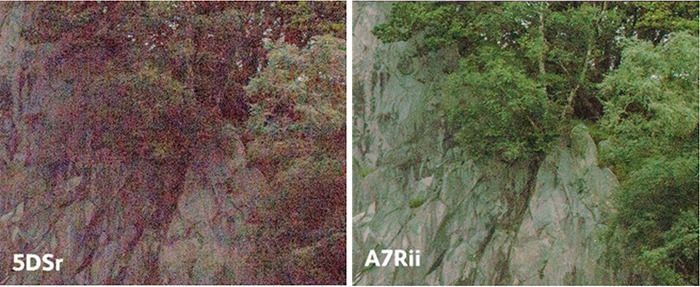
This is the very first Dynamic Range image test comparison between the Canon 5DSr and Sony A7rII done by Tim Parkin from On Landscape. Tim writes:
“We can obviously see a considerable difference here and so straight out of lightroom the A7Rii is nothing short of incredible. Let me remind you, this is +5 exposure and +100 shadow recovery!”
With the Mark II the A7r has grown-up quickly to become a camera that needs no excuses. I still lament the absence of a touch-screen, but otherwise the A7r Mark II is shaping up to be an extremely promising camera.
Ongoing A7rII owners discussion can be followed on our SonyAlphaForum.
A7rII preorder list:
In USA: at Amazon, BHphoto, Adorama, SonyStore US, FocusCamera, Uniquephoto.
In Europe at Sony DE, UK, FR, IT, ES, NL, BE, CH, AT, SE, FI, NO, PT. Wex UK.
In Asia at Digitalrev, CameraPro.
A7rII Gariz case
The current A7II Gariz cases suite perfectly for the A7rII too:
Alcantara case in [shoplink 38168 ebay]Red (Click here)[/shoplink] and [shoplink 38169 ebay]Black (Click here)[/shoplink].
Leather case in [shoplink 38164 ebay]Orange (Click here)[/shoplink], [shoplink 38165 ebay]Red (Click here)[/shoplink], [shoplink 38166 ebay]Black (Click here)[/shoplink] and [shoplink 38167 ebay]Brown (Click here)[/shoplink].
As this is the same A7II case you can buy them all also at Amazon US (Click here).
267 Responses
Sony A7RII; the camera to have with you when you’re drunk and botched the settings.
Thanks for that! I quoted it on the original post.
Are you speaking from experience?
…I still lament the absence of a touch-screen…
I sign this
Unless you already have a bunch of Canon glass and are adamant about using it on a native mount, there’s not much argument for the 5DS/r. 50MP isn’t that much greater than 42MP, and that difference in dynamic range is astounding.
And don’t mind carrying 5 spare batteries with you at all times…
I just got an a7ii yesterday. I only had a Pentax K-5ii before, and got about 1200 shots per battery. I thought people were whining too much about the battery, but I now see that this is a completely legitimate complaint. That being said, I can carry 2 or 3 sony batteries in the same space as 1 pentax battery. I just wish I didn’t have to switch them so much.
I always do that 🙂 Not that heavy though…
You always only have 1 battery with you?
I know, those 42g batteries really weigh you down. Sarcasm.
More like buying additional chargers or end up doing it all day.
If getting a couple dual chargers and a few extra batteries are too much of a hassle, you can just use a high capacity battery and power the camera for days.
http://www.amazon.com/Anker-Ultra-High-Capacity-25600mAh-Technology/dp/B00M3073L4/ref=sr_1_5?ie=UTF8&qid=1438715627&sr=8-5&keywords=external+battery&refinements=p_89%3AAnker
Link for Sony dual charger please. That looks necessary.
This one works great, get 2 or 3 they’re so cheap and 10 extra batteries. http://www.amazon.com/Neewer-Dual-Channel-Display-Batteries-Compatible/dp/B00WS8J828/ref=sr_1_6?s=electronics&ie=UTF8&qid=1438716182&sr=1-6&keywords=dual+battery+sony+a7
Ehhh it’s not Sony…
Some off-brand with no review of the charger and bunch of 1-star for their battery.
Not risking the batteries catching on fire or exploding during charge.
I have a bunch of wasabi batteries, no issues. Same for many others I know using them. YMMV.
Yet you brag about the smaller size factor of the a7 series…but then seem to brush off the fact that your a7 kit would in fact have to take up more volume because of the extra batteries…
A few spare batteries doesn’t take up as much bag space as a 5d body, but its worth it for 4k video, IBIS, superior DR and so on.
5 batteries in your bag – 2 charged, 3 empty, you are in a hurry and the light is dimmed
Do you mix charged and spent batteries? I put charged batteries in one compartment in my bag and spent batteries in another, its really easy and I don’t even have to look when changing batteries. Just reach into the fresh battery compartment and swap out of camera. Sometimes it seems like people try to conjure up scenarios just to be difficult.
so your bag needs two separate pockets, each capable of holding 5 batteries. My street photography bag is much smaller than this.
I carry a small backpack and it’s never been even close to a problem. The batteries are tiny. I’m guessing you have room. Or you have too much stuff you don’t need for street photography
I don’t want to talk how to workaround small batteries – I want Sony to put a bigger battery in a bigger grip.
and then you’re happy and 100 other people are yelling about how it’s too big now. It’s such a small tiny issue when you look at the sheer amount of bonus in this camera. Small battery, carry a couple of extra, big battery, get a bigger bag. I could care less either way.
do you really care about a better lens balance with a bigger grip, when it is about the lens that makes your camera deep?
Even a kit-lens sticks up with a bigger grip.
*humble brag* I’m fairly strong and lens balance has never been an issue for me. I’ve used Canons and Nikons and Sony’s and I feel confident and comfortable with them all. It’s waaaayyyyyy down on my list of concerns.
You need a bigger purse or man bag.
Man Bag…
The flap on my small messenger bag has two zippered pockets, one gets charged batteries, one gets spent batteries. They take up very little space, we’re not talking Canon batteries here. I can also drop them in the space between the padded camera insert if one of those pockets is needed. Typically I only carry the A7 with 2-3 lenses and a few accessories in my small bag. I usually have 3 or 4 spares, keeping them separate has never been an issue . YMMV.
My method is super simple..I cut strips of paper to cover the batteries I charge and hold them on with a rubber band.
When I replace the batteries I do not replace the paper strip.
Covered batteries are charged, naked batteries are empty.
I have 6 batteries… and I’ve never used more than 3 on a full day of shooting. And yea, one spot for empties, one for charged.
I know there ary many systems:
2 pockets
flip the empty ones upside down
writing numbers on your batteries and always start with 1
…
But you need a system. Having only one battery for spare it’s much easier. When recording a movie-clips you change with 25% rest – just to avoid not to run out of power duriung the clip
I cover my charged batteries with a strip of paper and a rubber band.
When I take one out of the camera I just drop it in the bag…so I do not waste field time and always know which batteries are charged.
I use green paper, but you can use any color you want.
5 batteries are still smaller than a flash head! You should see them side by side before judging like that. Body side is just one factor, lens and accessories sizes are also smaller. I moved from Canon and the advantage of size wasn’t the main thing I considered, that’s the quality and freedom I would have.
ROFL
Canon body has so much air in its silly shutter box. Space enough to put the 5 Sony batteries in there!
The Canon 5DSR is actually a battery holder for Sony batteries.
I still vote for a BIIIIIiiiiigggg handgrip with a DSLR sized battery, and the rest of the body as small as possible. Any lens sticks more out than a bigger grip.
I hope 3rd gen will do that – battery complaints already reached Sony management
The Canon batteries are larger and heavier. Worst case scenario, the Sony needs 2.4 times the amount of batteries. Once you start using LV on the Canon, the tables actually turn.
Either way, if you end up using more volume with the A7RII due to spare batteries, you must be feeding them to the ducks.
Troll is having some fun!!! Nice!!
Or if you don’t mind having to do ridiculous shadow recovery every shot out of the canon just to get mediocre shadows and non blown out highlights. Carrying 5 batteries that can fit in basically any spare compartment is well worth the enormous gain in IQ. Clients don’t care about how many batteries you have to use. They want images that don’t look like the example above.
Both images above are grainy and blurred with bleached colours… One just happens to be worse than the other…
Do your clients want photographs that are grainy and blurred with bleached colours??
The difference in IQ that shows is night and day. You can look at that and try and justify it however you want, but for everyone who isn’t married to canon it’s pretty obvious.
They are parts of the photo were restored to find the artefacts in the shadow, which means the very harsh condition.
Are you kidding me? The Sony image is still useable and quite clear with decent colors. You want less bleached colors? increase exposure one stop less. The canon image is perhaps showing the same general shape but is basically completely composed of chroma noise. You could easily eliminate the small amount of noise from the sony shot, trying to eliminate it from the Canon would render a disgusting blotchy blocky mess.
Power consumption issues are a matter of ergonomics. For that small inconvenience you get 5 axis stabilization which will allow for sweet sweet justice in getting lower isos, a gorgeous EVF, customizable everything in a small form factor with a balistic AF system, and solid 4k.
The sony beats the canon on every single feature which is irrelevant to the discussion here. The discussion here is how much more functional the sensor is then the canon which it clearly beats in everything from dynamic range to noise recovery. The 8 additional mega-pixels will make no real world difference even under the pristine conditions the canon needs to be shot under and ultimately will just spell more HD space requirements though I suppose you could downsample the images to try and deal with the massive amount of noise. Mind you, the additional sharpness offered by premium Zeiss optics will make up for the additional detail of the 8 MP, so.. Ya.. I suppose if you forgo the canon primes and rely on sigma the canon would make a comparable image in a low dynamic range scene with plenty of light… Though of course the advantages of 5 axis stabilization, no mirror slap and EFCS will 9/10 give the sony a sharper image even under ideal conditions.
Simply put the canon looks like 5 year old tech in a 15 year old body. The sony is Fresh and Delicious.
I see not a
Gotta check your eyes dude!
Eye Dr. needed…the sooner, the better!
OK, there’s the one aspect where the Canon wins…
It’s easier for Sony to construct a body with bigger batteries than catching up in sensor-technology for Canon… guess what will happen first
The funny thing is, that if you plan to use LV on the Canon more than a bit, you’ll find yourself running out of juice much faster even than the A7RII. Even best case scenario for Canon (no LV use), the difference will be a factor 2.4, which means that for every 2 spare batteries for the Sony, you need about 1 for the the Canon too.
Canon was thinkjng to get away with simply doubling the size of the 7D sensor, which itself is just mediocre in the APS-C world. It was the next try to milk their loyal customers, year for year the same game. Now Sony wipes the floor with the 5Ds/r, and they wipe it as shiny as never before…
“Canon was thinkjng to get away with simply doubling the size of the 7D sensor”
The 5DS is not an upscaled 7D sensor.l
Apart from world class auto-focus, weather sealing, ergonimcs, professional support infrastructure, proven track record, using native lens (hence a single point of warranty support) etc.
For the types of shooting either of these cameras will be used for, I think the AF-performance is close enough to not matter all that much (neither one is exactly a high-FPS sports camera), the A7rII is weather-sealed, ergonomics are highly personal (some prefer the smaller bodies), and – well, you got me on the pro support structure; Canon is the leader of the industry there.
In terms of AF Performance the 5d’s system has a distinct drawback: it works off a dedicated sensor. With those cameras all the little deviations either in the AF system or due to lens aberrations add up and the sujets ask for accuracy rather then split seconds. The canon should have gotten an hybrid AF…
R.I.P. Canon
Sony never went under when it continually produced poor camera’s in comparison to other brands for many years…
Now suddenly the sensor on the Sony’s are outperforming Canon (at the moment) and you think Canon is doomed?!!
pretty much yes
hey that’s a comment section for flamewars! Don’t come up trying to make valid arguments!
People will believe anything on the Internet.
Considering that Sony is by far the worlds largest image sensor manufacture; who is making a vast amount of money from its imaging division. I would suggest that the current image sensor superiority will only continue to grow. Canon simply doesn’t have the sensor technology and manufacturing technology to compete with Sony. We also see Sony investing heavily in their sensor division over the past few years. We are now seeing the fruits of that investment.
As Sony cameras continue to improve at the pace that they are. I think the pressure will be for Canon to use Sony sensors. They can only survive with subpar image quality for so long…
Is this some kind of joke? The A7R2 is 1/1000 second, where the other two are 1/2500 second.
second this
The Canon is not designed for high ISO’s!!
That is like doing a resolution comparison of the A7s vs the 5DS… You know which is going to win, because one is specifically designed for that particular purpose…
Huh? Unless I’m misunderstanding, that was not a high ISO test. Those were all underexposed by 6 stops, to see how the files would react when pushed back up. ?
You’re definitely right, this is the test for dynamic range, not high ISO
This test is designed to demonstrate Canons weakness.
If I were a Canon fanboy, I would claim that only a bad photographer underexposes 6 EVs in order to crank it up again, a good photographer knows how to use his tool for best results
The 5DS high resolution sensor is of interest for landscape photographers. Now dynamic range is bad so it’s bad for landscape photographers
This is isn’t remotely like comparing the A7s to the 5Ds. One is a low light video/stills hybrid and the other is a high resolution camera. The A7rii and the 5Ds are both designed as high resolution cameras. The difference between 42.5MP and 50MP is negligible. Just because the A7rii offers far more features doesn’t make it not a contender.
So you mean A7Rii was designed for high ISO? If so, why the hell they still need to produce A7S and A7Sii??
“More doctors recommend A7rII. Lancet reports a decrease in “camera envy” from A7rII users but also reports an increase in “fortified fanatism” based on brand ownership. World NGOs report on their perspective:
WWF says A7rII unlikely to save white tigers or Rhinos alone, but it may just capture their souls. Souls unlikely to generate real interest in the long term and prefers real photographers do work that can increase awareness of endangered species. MSF reports unchanged gear possession among award winning photographers used for their campaigns and Magnum, VII, Time and NYT say it’s talent that counts. Gearbator4all, NGO based on gear-minded people, say that people’s loyalty may be too attached to the brand but that measurements coming from international independent body Measureb8 could disuade brand loyalty change albeit it only matters to those whose self confidence is already underminded by “greener grass” syndrome (reported to be common among 90% of the photography community.
UNICEF gives a stark warning, however, that photographers and afficionados that take a neutral stance are bound to be flamed twice by keyboard image makers on both sides of the Measureb8 statistics and the Gearbator4all research.”
The Canon 5dsr CAN save the white tiger.
Just shoot an orange tiger with it and you will have a white tiger.
The orange tigers I shot with Canon 5dsr all had upper 1/4 of thier bodies look like white tigers.
Thanks for having a sense of humour
Let the Fanboy War begins~!!!
*Grab chips and beer~
Canon USA headshots Sony USA with it’s in-house repair and service. BOOM!
Canon cameras need much more repairs due to mirror, misaligned AF module and shorter shutter life, BAAM!
You know too much.
For that the Hitman will be coming after you. Better be careful when you sleep.
is there a way to sleep carefully?
*Grabs chips and kegger
The D750 would be an an interesting addition to that test..
Why? You mean D810?
The D750, while lacking in as much resolution, has just as much shadow recovery as the D810 and the A7r in my use of them. Both great cameras
As bad as 5d2 in shadows, and all canon troubles with shadows recovery. Need to overexpose canon image to match A7RII quality but not shire its really possible…
Meh, correctly exposed images and Canon colour any day. Kudos on the ground breaking sensor, just work on a pro body with all those features and then we’ll talk.
Until then, usability is more important to many.
Muh Canon colorz!
I usually push my photos 7 stops, so this test is no good.
lol
Seriously, what test would be good for you?
Yeah, I just hate when they push back.
Okay Sony, we know you do good sensors. When are you going to do a pro body? Enough with the small camera bodies.
WARNING UNFAIR TEST
a7RII shot at 1/1000ss
But the a7R and Canon 5DSR both shot at 1/2500ss… nearly 1.5 stop disadvantage…
OR…
Sony a7RII is biasing ISO readings to make it look better… Similar to what they did with a77II vs a77. They cheated the ISO to fool public into thinking it had better high iso performance than it really did.
This test is very very flawed.
_________
Jens G pointed this out below. I just double checked and he/she’s right. a7RII is biased shutter speed.
Please, any info regarding A7000???
I don’t know what to say to humanity today. Read these Apple iPhone 6 vs Sony Xperia Z3 articles. look at the heading and the reviewer’s name…all done by the same guy! On the Pcadvisor site he sided with Sony but on Macworld site he sided Apple and literally trashed Sony with the headline. Do you see why Sony mobile is failing and lossing on the Internet? Tweet it and pass this on folks. The Internet is so loose!
http://www.macworld.co.uk/review/iphone/iphone-6-vs-sony-xperia-z3-comparison-3573071/
http://www.pcadvisor.co.uk/review/iphones/xperia-z3-vs-iphone-6-smartphone-comparison-3573459/
LOL!
Too bad they didn’t include the Nikon D810 in this test.
I personally feel this particular sensor is better poised to compete with that sensor than with the existing Canon ones.
On his site he compared to the A7r, which is close enough to the D810 in my opinion. The A7rii should set a new benchmark. GAS is overwhelming me.
Actually we did include the D810 and it was so close to the A7R (a has been confirmed elsewhere) that it wasn’t worth including.
Sounds like I’ll be buying the A7R then. Just goes to show…the A7R is still a bargain if you can work around it’s limitations.
Do you think A7II is better than A7R?
Don’t know
on the battery thing, the main draw backs are a)remmbering to pack extra, b)charging capacity, ie 2-3 extra chargers.
I use a mix of cheapo generic usb powered chargers and the oem ones, and number each side of your batteries.
think i can do 6x sony large, 3-4 sony small, and 7x sigma dp batteries
I can change a battery in 3 sec blindfolded.
lol really? This article is so uninteresting that I didn’t bother downloading any files, but that would just make it priceless.
I have been saying this for several weeks now.
I used the 5dsr for a week with the Sony a77ii as my back up.
The 5dsr was unable to hold highlights in outdoor shooting.
The bright pale blue beaks of ruddy ducks…the most intense pale blue imaginable, came out white in every one of hundreds of shots in perfect bright lighting
Orange tigers looked like the top 1/4 of the body were white tigers.
Tracking autofocus for moving animals and birds in flight was totally uselss.
And focus accuracy was totally hit or miss.
The few good shots I got were were spectacular, but I got very few good shots.
None of my photos looked like what I saw in the viewfinder, I totally could not trust the camera to deliver predictable acceptable results.
I rented it for a week long shoot but returned it halfway through the shoot and finished with the a77ii
In my opinion the 5dsr is only suitable for highly controlled situations such as studio, macro, and landscape, and totally too problematic to trust in situations where there is only one chance to get the shot.
That’s funny as I spent a morning at a show jumping event and the 5DS was outperforming the A7R2 by quite a margin.
……….continue……….?
I thought the very test this article was about, made by you, dictated that the a7rii was outperforming the 5ds…?
I think he meant AFC, not base ISO dynamic range.
Ah got it. Well, that’s to be expected (unfortunately).
Sorry – I lost a bit of that post. Regarding Tracking auto focus yes
What happened here?:
Canon EOS 5DS: iTR subject tracking at close subject distances:
https://www.youtube.com/watch?v=efAQI4CbS5s
This verifies Animasbyberry’s statment “Tracking autofocus for moving animals and birds in flight was totally uselss.”
Sony a7R II – Eye AF (AF-C)
https://www.youtube.com/watch?v=8wYuelBt_pk
As I said…under the ideal conditions the 5dsr will yield spectacular shots.
But under anything less than perfect conditions it is extremely difficult to get anything usefull out of the camera.
To much generalizations for me. As the 5diii and 6d are used very successfully at weddings for example, The 5ds, which I doubt will be much inferior to these cameras, should get the one shot required. Based on my experience with low light AFC, which can be problematic with mirrorless cameras, the 5ds should work fine.
Test is flawed and biased. See below. Sony cheats the iso setting.
a7RII shot at 1/1000ss. Others shot at 1/2500ss.
Bad test… or Sony cheats. You decide!
Think you will find the test shots were all the same exposure with the A7RII taken in darker lighting conditions hence the longer shutter speeds – Although not ideal they had the same exposure. There is always another reason for the different shutter speeds than cheating etc, guys. Looks at the RAWs and you will know before you judge?
Pretty much sums up my findings when using the 5ds for a week. I was able to take some fantastic images. However, some shadows were just as ugly as my 5Dii.
How’d the camera function though.
The functions were fine and overall did a fantastic job. The high resolution is amazing. The ergo and menus typical Canon and I was able to get familiar within a couple minutes. I would be very happy with the 5ds/r. I was just a little disappointed with shadows. I could live very happy with the Canon. I’m going to rent the Sony system and see which makes me happier and my pro life easier. I’m going to buy two bodies over the next 6 months. One just may be a Sony, the other will be a Canon (hopefully the 5Dx).
The difference in ISO between A77ii and A77 is a minor 10-14%. So DXO will reveal whether there is indeed a huge true ISO difference, which I doubt, certainly not in the range of 1.5 stops.
Actually it isn’t- the A7Rii has more dynamic range in the highlights and so I based the 6 stops on clipping the highlights, not based on ‘the same exposure’
Historically, Canon sensors weren’t really that good in the DR department, Nikon was. But now it seems that this M2 is gonna pwn the D810…
But this M2 still has lossy compression working against it.
-Anton Berlin
You mean “paw..n”
I’m so tired of this marketing BS already… No doubt the r2 is a great camera, but the comparison is plain unfair.
Such silly and useless test .. best way to get greyed black, washed colours no contrast !!! lol
They should learn how to expose correctly pictures before going out and testing +5 underexposed zone et +100 dark ..
Conclusion
is just ridiculous ! ..were is the sample of the picture with +5 and
+100 ? .. even my grand father beginning of last century would have
laughed if he need to made such correction.
I just uploaded the sample picture taken in my back yard with those settings. I also uploaded a comparison at -3 stops just to make you happy. No need to thank me..
I do agree that with more latitude, even a smaller push will look cleaner, so it is still useful.
The Sony has more dynamic range in the highlights (in the same way MFDBs often have) so a comparison based on the same exposure would be incorrect. We used rawdigger to find the point of clipping and counted 6 stops down from there.
Far too many people are consumed by “it’s not a pro body” statements. The quality of the output is what matters.
Sure, compare the A7rII files to the Nikon with the same 42 mp sensor; that’d be more fair. Oh wait, Nikon doesn’t HAVE a 42 mp sensor.
As for people saying the 5Ds(r) outperforms the A7rII – it likely does, resolution-wise, in controlled lighting environments, or in bright light. Need long exposures? Need high ISO performance? Want in-body image stabilization? Want to put nearly any lens, by any manufacturer on your camera body? Want higher dynamic range? Want a lighter weight camera body? Does that 5Ds(r) still outperform the A7rII?
It may for your needs. But there is no “one camera to rule them all”.
Stop saying “pro” camera bodies, and worry about “pro”-ducing professional quality images.
Uh, no… the quality of the body is paramount when using on commercial assignment every day. Emount lost all my vertical controls, and can’t do low angle verts like a99 can. There are literally shots that a99 can do that a7X cannot because of the crippled LCD movements.
I load three batts and two cards in a99 and forget about it all day. I get the shot while a7X user is fumbling in bags and pockets for all the extra carry along it requires.
Emount not ready for prime time… have to mount my lens adapters multiple times because aperture reads “–” on first try. Same for both LAEA and Metabones.
Continuous AF DOES NOT WORK on high speed continuous shooting with a7X series. Must go down to 2fps for continuous AF to work.
Amount is so much more pro. You wouldn’t know what you’re missing unless you’ve compared. Emount doesn’t even have a spring lock on the battery door. Thanks for the extra step Sony. Amount is snap and go.
I’ll give Emount pro credit when it deserves pro credit. Until then, it’s just a fancy joystick toy. Sure the tech is fabulous. But why make users suffer crippled body for it? Very insulting compared to the refinements of Amount for 30 years. You think a new camera from a gaming company can compare to that? You don’t have a clue what’s been lost. Three steps backwards for one wobbly mount step forward is NOT progress my friend.
There is relevance in the pro body argument. In certain markets you only need a tool that does what you need with simplicity, efficiency and reliability.
Imagine a professional janitor and a vacuum cleaner. A pro would have a simple, heavy machine with an on/off switch. They wouldn’t get excited about an infomercial cleaner that has 30 attachments and built in wifi.
I wouldn’t buy the Canon in a fit. It has no relevance for what I want in a camera. But the right tool for the right job and in a controlled environment then I’m sure it has a place.
Picture above is the worst of it. Gotta read the whole review.
I rarely push above 2 stops. But I do hate the idea that you should “expose for the highlights”- as if the shadows are secondary. Shiiit shadows are just as ugly as blown out highlights. If the extra DR is all about recovery- then count me in. I’m down with this sickness.
Don’t get too excited – read the comments (Jens G), the test is a BS 🙂
Wow, the canon hired goons are in full force today!
the 9000lbs gorilla in the room is how difficult it is to use Sonys because of the EVF and no OVF in a studio with strobes. Unless you put up strong practical light to help with focus you have to open the aperture or the aperature/ ISO/ Shutter speed to get critical focus and then reset all those and hope for the best. You don’t have to do any of that with the Canon. if you could with Sonys I’d be ALL_SONY but it doesn’t. I guess most people who buy Sonys don’t do studio work or work with strobes. It’s kind of a big thing, unless I’m missing something very obvious.
I only hope that the people who thrash me for blasphemy have actually done a studio shoot a Sony and a Canon and understand the process first hand.
There’s a Framing mode on the camera that do just what you said, and it exists since the first digital cameras back in 2000, are you that mal informed?
Turn off the live preview option.
Aparently you dont have a Sony camera.
Thrash!
Edit – I do none studio work. No opinions here. Just thrash.
I think if you need a studio camera first, I would say a Canon or Sony a99 may be your best bet. However, most studio lights have a modeling function and by magnifying the scene in the EVF, I would guess you could focus more accurate even in very low light since your focus point can be right in your face so to speak. Just a guess
The A99 uses an EVF and with the “Setting Effect Off” functions perfectly for studio strobe use. It also has the added advantages of focus zoom and focus peaking which is visible both in the EVF or the rear LCD display.
NO IT DOESN’T… Not even close to a900/700 OVF. Setting Effect On or Off doesn’t matter. Still not enough viewfinder shift for black or white backgrounds. Neutral backgrounds no problem. But not the high or low key. EVF is terrible compared to OVF.
I make a living at this. White background is important because Amazon requires all lead photos to be white background for fashion work. No exceptions.
a900 is by far the best Sony studio camera. a700 close behind. Far better than any EVF Sony. Tried them all.
Couldn’t you just turn off EVF effects so that the viewfinder overrides the camera settings for focusing?
Yup, do all my studio shoots with Sony EVF cameras (and have done a few with Canon). You just turn the “setting effects in live view” to off, and you can see everything just fine, just like you would through an OVF.
No 9000 lb gorilla, just a simple setting change “Setting Effect Off” and the live view works perfectly with studio strobes. Ignorance is bliss.
Not for white background. I make a living at this. No EVF comes close to a900 OVF. “Settings Effect Off” doesn’t help. Impossible to judge facial expressions with EVF silhouette.
I’ve tried a99, a7R, a7RII, a77II… It’s terrible. a900 is perfect studio camera… especially with intelligent preview function.
So… now that multiple people have pointed out the purpose of “Setting Effect Off”, are you “ALL_SONY”? 🙂
(full disclosure, I’m currently a Canon shooter, and do a lot of studio work, and had this same panic attack, before digging around and finding that answer)
Yes i have shot in studio with both. You simply change the Evf setting to free mode so that it gains up to show you a clear image. Rather than trying to see in the dark with an OVF.
Good to know
No. EVF doesn’t work for white backgrounds. I shoot twenty white background catalog studio sessions per week. Still use a900 body because all Sony EVF pales in comparison to good OVF. EVF sucks for white background studio. Everything a silhouette. Impossible to judge facial expressions.
I will try that but “gain” in a littlee ef sounds pretty scary from the start. Now i can spend a month going through the menus trying to find this setting. Hope it is a solution but qm dubious, GAIN is rarely anybodies preferred setting.
Dude…what are talking about…the term gain has no reference to exposure or noise in the image. It is purely the Evf in free mode getting brighter so you are able to see in the dark…yet to find an OVF that can do that…
I think the 5DSr image is probably closer to what the scene actually looks like. So in that respect could we not say Canon outperformed Sony?
lol
One thing I did notice with the 5Ds that I rented, the AWB is a big improvement over the 5diii. I always finalize raw settings in post, however, the starting point seems to be more accurate
Comparing my Sony A7rII to a 5DSR that I rented, or any of my Fujifilm cameras, the Sony A7r, and A7rII have been pretty pathetic in terms of nailing the AWB or even the exposure for that matter. Let’s not mention autofocus accuracy. 🙂
Are you eyes contrasty and grainy?
I think he’s talking about the magenta cast throughout the scene. Of which most people know, is closer to the original color of rocks in nature. 😉
Global institutions hail A7rII’s outstanding capabilities, but there are mixed feelings and some facts to understand. From Newsflash:
“WWF says A7rII unlikely to save white tigers or Rhinos alone, but it
may just capture their souls. Souls unlikely to generate real interest
in the long term and prefers real photographers do work that can
increase awareness of endangered species. MSF reports unchanged gear
possession among award winning photographers used for their campaigns
and Magnum, VII, Time and NYT say it’s talent that counts.
Gearbator4all, NGO based on gear-minded people, say that people’s
loyalty may be too attached to the brand but that measurements coming
from international independent body Measureb8 could disuade brand
loyalty change albeit it only matters to those whose self confidence is
already underminded by “greener grass” syndrome (reported to be common
among 90% of the photography community.UNICEF gives a stark
warning, however, that photographers and afficionados that take a
neutral stance are bound to be flamed twice by keyboard image makers on
both sides of the Measureb8 statistics and the Gearbator4all research.”
Better not forward that article on CanonWatch, their readers will claim it’s a sly smear campaign from Sony 😀
Yes apparently dynamic range is not important!
In fact I think either photo is useable.
I agree…the 5Dsr is a great camera….My comment is aimed at the articles from canon sites claiming that the superior image quality of Sony’s sensors doesn’t matter…..Also lets not deny that it is enjoyable to watch canon users squirm when they see the image quality difference…:)
I won’t buy a camera to do what it doesn’t do well.
There is actually no need to worry as Sony users are basically everywhere internationally.
Who cares if the A7rII is better, the Canon produces 14 bit files and the Sony doesn’t. Canon has nothing to worry about 🙂
How does that translate to better image quality that we can see? (Serious question.)
I believe his statement was in jest, note the 🙂 at the end of the sentence.
Indeed, thought seemed kind of obvious…
That’s the best you can do? A canon has a 14 bit file? What is the use of 14 bit when the dynamic range and latitude is so bad. You can see extra flat white and black tones
Read the Sony specs. The a7r2 produces 14 bit files.
AHhaaahahahahah. Yeah, right. Anything else Cannot fanboy?
Producing 14 bit files is pointless when the bottom three of four are just capturing the random stuff from the noise floor. This ought to be no surprise. Canon sensor produce competitive results at higher ISOs. However, at base ISO they have a high noise floor which results in noise and even banding if the shadows are pulled up.
For several years now Sony sensors have had higher DR due to lower noise floors at base ISO (the A7S apart, which has a wholly different design optimised for very high ISO). I suspect that with BSI and the possibility of optimising on on-chip circuity without compromising on the photosensitive part of the chip, Sony have been able to improve even that. We will see when we see some proper measurements of DR.
I found that Canon DSLR’s typically under expose high contrast ratio scenes by design to avoid blowing out highlights. This isn’t necessary using the Sony sensor, hence the difference in auto exposure settings. I do agree the test is unfair, the sensors and not comparable in dynamic range.
These comparisons between the 5dsr and the 7rII are starting to get a tad silly. It is fairly obvious that the a7rII is a superior general purpose camera whereas the 5dsr is a specialist tool for those that can control their shooting situations to obtain the highest resolution and quality (primarily studio work, low ISO commercial shooting, interiors). Other than beig somewhat close in megapixels, the bodies are not really in competition for the same work.
This comparison: “+5 exposure and +100 shadow recovery” is absolutely ridiculous. If you need to do that to 5dsr photos, it is not the camera for you. Really, the only camera for someone who needs to do that is a cell phone camera. No one would seriously consider a car magazine writer that deems an off-road test is necessary to determine the qualities of a Ferrari, so I cannot understand the value of these stupid tests for specific photographic tools.
Ultimately the a7rII is the better camera for some people but for those who can and do control their shooting environments very specifically, these photographers will be able to obtain a higher achievable quality of image with the 5dsr. The better tool is the one that fits the users needs.
…or you could’ve simply said A7RII smokes Canon. See? I said same thing as you, but in 1 sentence.
Well they are both 5fps bodies so neither will be accused of being speed demons.
To be more precisely, under certain scenarios. But this basically applies to all cameras.
The test clearly demonstrates a very significant advantage in dynamic range for the new Sony sensor. The 5DSr clearly is optimized for studio use under controlled conditions, however under the same controlled conditions the difference between the 5DSr and the A7rII is likely to be very slight.
Right tool for the right job. But for many cameras are toys. Happiness easily arises when comparing it to other brands, not from photos captured.
I think I will frame that quote and place it next to my Zen Buddhist sayings
Pretty spot on.
Actually you have just cured my Gear Acquisition Syndrome.
I love this camera, but now I realise I don’t actually need it….
It is easy to get new toys but the passion went away very quickly. I had been lusting a 24MP camera for quite some time a few years ago. When I finally got it and used for a year I stepped back down to 16MP for reasons other than IQ. I went through a lot during that process. Getting new equipment is easy, however finding the most suitable ones that brings you pleasure while using them is not.
“…will be able to obtain a higher achievable quality of image with the 5dsr”….
Maybe, unless shuttershock kills that last bit of resolution advantage.
What shuttershock? There is none with A7RII
No, but the 5DSR…
Haven’t used it, but from what I read Canon designed a shutter to handle the high mp as Sony did.
The comparison clearly is about dynamic range, it didn’t say canon is not good in general but in terms of DR sony is obviously better
now, I know many studio photographer do a lot of retouching and need the extra DR, if you shoot still life, canon its okey, but if you shoot portrait or anything that moves, but need a good amount of post production as well, the extra DR help save a lot of time and work
the +5 exposure and +100 shadow recovery is just for demonstration purpose, if they just say, sony is 2 stops better than canon, a lot of people can’t have a clue about the real difference when look at the image, so they give this extreme condition to give you a visual example
and if you do read more about DR, you will realize low DR can hurt real resolution
In the studio, when you control the lighting, you can control what clips and what stays in detail. We all know that the sony is the sensitivity and DR winner.
It depends on which colors of the gamut that are being used by the processor. And If you like the way it renders the colors. And if your calibrated monitor can actually use them anyhow. And for me which ones that I can actually see being affected when I move the sliders. If I can’t actually see whats being affected, I don’t care. I can have plenty of dynamic range, but if they are not the colors that I’m concerned with, It’s pointless. Each processor renders the colors differently. Before you even get the RAW files themselves, the colors have been rendered by the BIONZ, DIGIC, and EXPEED processors. Sony tells you this in their explanation of their BIONZ color rendering. One can hype the dynamic range variable all they want, but if that color rendering is horrible it doesn’t matter.
Very sensible and relevant comment.
Unfortunately the comparison above is invalid because the author collected more light on the A7R II sensor than the 5DS R as noticed by another reader on his site: “…exif shows 1/1000s F8, where the other two shows 1/2500s F8?”
I’ve owned and tried to use a sony a7r (mk1) for many shoots, but it been a pain to use professionally. I have tried hard to get use to the menus and use it intuitively, but its been a stressful to use.
I realise even the mk1 a7r has great files (up until now, it was far better than the 5dmk3, but i have yet to test it against my new 5dsr), but even when shooting pressured jobs i would always go back to the 5dmk3.
The canons just work effortlessly and make my job easier- which is a big part of what I need.
I have a a7r mk2 on order. I am sure it will be great for video, but to use it for advertising photography under pressure, time will tell. Even if the sensor has a few more stops of latitude, getting a shot easily is sometime more important. Most situations you can expose around the latitude of the sensor- just knowing what you are doing.
But if Sony made a pro body, then that would be great. Even if they don’t, maybe sony could make the entire menu system customisable and give you the ability to choose the features you want the camera to have and what it shows, then the camera would be easier to use. Sony has never made easy to use cameras, so this is a way around them even having to.
paul
Not sure why a7 and 5d are shot at 1/2500 vs a7r2 at 1/1000. 2 1/2 stops more light is a huge advantage. No wonder it blows the doors off both so bad. Expose them the same using the same lens and let’s look at the result. I expect the a7r2 to beat the a7 but not by this much
Due to the lack of dynamic range of the sensor the Canon’s metering system will underexpose by a stop in high contrast lighting conditions in an attempt to keep the highlights from blowing out. I noticed this when comparing my D800 to the 5DM3, the Canon always seem to underexpose in comparison. It’s just a way of keeping the bright areas from clipping. No conspiracy here, just a method used by Canon to optimize image quality. Manually setting the exposures will yield similar results, perhaps a bit better shadow detail but loss of highlight detail.
Agreed, all canon dSLRs I’ve used (starting with the 20d) tended to underexpose.
Canon tends to keep under-exposed details, while 7r tends to keep over-exposed details. I won’t easily draw the conclusion that Canon is inferior in DR.
https://uploads.disquscdn.com/images/b5ebfed072d2b78046d65ca90ee255301c4d921da7ba5c851457aed74ce48dec.png
In my usage of a 1dx, I’ve tried exposing normally according to the camera (under exposing then pushing in post), over exposing slightly (properly exposing) and exposing as much to the right (overexposing then pulling it down in post). The final option worked the best bringing out the most contrast & sharpness without adding it and being the cleanest in noise. The danger is if you overexposed too much the skintone colors and saturation can get too weird to bring down later. Lacking as much DR as Sony has been limiting at times.
I’m only comparing A7R to A7R2. Why meter them 2 1/2 stops differently and say there’s a large improvement when it’s probably very minor
The key is to make a7r2 looked more superior
From TimParkin, below:
“The Sony has more dynamic range in the highlights (in the same way MFDBs often have) so a comparison based on the same exposure would be incorrect. We used rawdigger to find the point of clipping and counted 6 stops down from there.”
If that’s true, then it means that the A7Rii effectively has a native ISO ~40 which would be a huge deal and I can’t understand why Sony wouldn’t advertise it. I think it’s more likely there’s a mistake in their methodology but it would certainly be a pleasant surprise.
Correct exposure is based on 18 percent Gray. An incorrect exposure is an incorrect exposure. Lab tests do reveal different ISO results. DxoMark tested the A7ii at ISO 73, I think the manufacturers like to stick with whole numbers. I wasn’t feeling like there was anything wrong about this test until reading your point of view. I am doubtful the ISO of the A7Rii is around 40. I think both cameras should have been set to the same exposure to judge this comparison a little more fair.
Every real world test for me comparing Canon to Sony or (especially) Nikon Canon’s dynamic range is terrible. I have shot weddings with different Canon second shooters, even when comparing the 5Dii to the Nikon D7000, the dynamic range of this cropped sensor blows the Canon out of the water with regards to dynamic range.
I suspect that if both exposures were set the same the Canon will look a little better than this, but there would still be a big difference between the two cameras.
Possibly because it also means the A7Rii effectively has a max native-range ISO of 12,800 (assuming the disparity relative to A7R is real, not based on changing light, and persists throughout the range), and they wanted to advertise 25,600.
What does this mean: “more dynamic range in the highlights”?
Dynamic range is from saturation to the noise floor. DR in the highlights makes no sense, it’s like saying my Prius has more range in the last 10 miles it can go than my F150 has in the last 10 miles it can go. Range is the totality.
Maybe the intent was to say A7Rii has a greater FWC than the A7R.
I think he wanted to compare efficiency of individual pixel. However, sensors are equally big in all 3 bodies.
it’s not 2.5 stops by the way, it’s 1 and a third.. If we set the exposure by ISO then the shots would be two thirds difference as the metering on the two cameras is different by two thirds. If we set the exposure to be exactly the same and then check shadows we’re ignoring any difference in highlight latitude. Also the light quite possibly changed over the time between changing cameras – bear in mind I did this test on 7 different cameras. Our procedure was to take the base exposure and then bracket down until we reached -6 stops and then take the base exposure again (to check the light hadn’t changed during exposure). So for each test we were sure the light hadn’t changed but we couldn’t be sure the light level hadn’t changed slightly from test to test. However the general light was still flat cloudy and hence the ‘distribution’ of light was the same if not the overall level.
A7S was released earlier than A7Rii, and its mark 2 is not even rumored.
many people, especially canon users, didn’t realize the importance of high DR, they judge sensor performance by “well, the straight output image looks good to me”
this is like talking about the differences between RAW file and JPEG, you can’t see the difference when just look at a JPEG and RAW side by side without adjusting anything, you need to understand that theres a lot of information saved BEHIND each pixel in RAW, same thing as higher DR, more DR means more info. thats the real difference
stop judging sensor performance by just look at your screen!
and if you think straight output JPEG is good enough and you don’t need any post production, yeah ok, a point and shoot can serve you well, you don’t even need a pro camera!
With that reasoning, a Canon 1Dx isn’t “as professional” as an a99, because it is “crippled” by a complete lack of LCD movement.
PhaseOne? Not professional enough, because the LCD doesn’t move either. Sorry PhaseOne…
Changing batteries isn’t exactly a big deal. Takes all of 5 seconds. The D4s is rated to over 3,000 photos on a single charge. On one battery. Guess the a99 isn’t “as professional” as a D4s. Unfortunately again, many PhaseOne users recommend 4+ batteries for a full day of shooting, so unprofessional!
As there has been no definitive reviews yet on continuous AF yet with the A7rII, it is a bit early to be stating absolutisms, I would think.
If a spring lock on a battery door is what sets pro cameras apart from “consumer” bodies, someone should probably tell that to Leica, who for many years (and maybe ongoing) had no spring loaded battery doors. Lame.
Here’s the thing. A professional is able to use whatever tools they have at hand. Several years ago, Terry Richardson shot an entire feature in the Sports Illustrated Swimsuit Issue with nothing but disposable cameras.
It’s not the tool. It is how you wield it.
The a99 is a wonderful camera, I have no doubt.
The a7RII is going to be a wonderful camera, I have no doubt.
Every camera has “it’s thing”. But the person that argues that one camera is incapable of producing professional results because it doesn’t have a spring loaded battery door…
Then there is Zack Arias. He shoots a lot of large commercial campaigns and jobs with the Fuji X-series. I’ll let you tell him that he’s not using “professional” equipment, because they are crop bodies.
http://youtu.be/PHYidejT3KY
This review made my day… Big thumb up coz he s totally right…
So so true.
Any one downloaded his raw files? In EXIF, 7r2 was using 1/1000s shutter speed, while other two bodies were using 1/2500s. ISO 100 and 24mm@f/8 for all 3 cameras.
See bmwzimmer’s query and subsequent replies just two posts down. Also see the author’s response to a query in the original article.
no it does not come on don’t fall for that crap, shooting in bulb,Silent Shooting,Long Exposure NR,Continuous Shooting,Continuous Shooting Bracketing all are 12bit files everything else is what 13bit if that. AT NO POINT DOES THE CAMERA SHOOT 14bit.
He has too many variables in his test so it is hardly comparable. He put more water in the 7r2’s bucket and managed to recover more from it. It’s meaningless as a comparison.
The key is “if” the reason is that the Sony has more highlight headroom that is because the buckets can take more water at the high level and hence you get better shadows because of it. What people aren’t remembering is that these photos were taken in a place called the real world and it is also possible that exposures could have been different because of lighting conditions.. However from my experience so far it does appear that the Sony files can take more exposure at the same ISO as Canons before clipping.
Exposure correction is magnifying data from all channels equally. Only dynamic range adjustments are partially adjusting highlight or lowlight details. So what he did is applying equal gain to all 3 files while he didn’t have equal exposure.
yes that’s exactly what I did! Problem?
Regarding to his experiment, there is a concept called lower-limit of detection(LLD). That means you can only detect signal reaching a certain strength (noise dependent value). This varies between instruments. If you have a exposure meter of something that has a rated LLD of 3ev (accuracy +-0.01eV) and another 1eV (accuracy +-0.1eV). If you put 2 devices in a environment of 2eV. The readout from first meter would be 0-0.01eV and 2nd one 1.9-2.1 eV. Then you amplifies signal from the first one to match the 2nd one … what would you get?
I believe he should redo the whole comparison.
erm… ETTR – do you get it or not? I didn’t use a light meter to work out the exposure
I am using it as an example. This is really hard to explain. My idea is you should ensure both devices have decent counting statistics when measuring their performance. That means you need a decent exposure for all three and explore downward and upward from there, just like what DPR used to do.
Yes that’s a nice way around of working it but it’s not what I did – that doesn’t mean what I did is invalid. It’s also quite a possibility that the light had changed in between pictures as well as a difference in sensitivity. Either way I found a point at which the cameras clipped highlights and under exposed six stops from there.. Here’s a studio example showing the same things done on a step wedge in my studio. Now this is a sample 5DS and so is probably not running the best firmware but the results are indicative of those I got with the 5DSr. This is six stops below the measured exposure. Interestingly the Sony measured the exposure 2/3 stop brighter than the Canon and hence base exposure was exposed 2/3 less than the Canon. Sony still had more highlights before clipping though (about a 1/3 stop) so final exposures at clipping were similar. This leads me to believe that the difference in exposures in the test was half light variation and half the extra headroom of the Sony
Refer to my other post. I believe you ignored lower detection limit by overly underexposed and introduced different levels of amplification.
So you are saying that the Canon has a lower ‘lower detection limit’ than the Sony?
Each camera is going to be different unless they have the same sensor. Even the same sensors could have sample variation. In reality DR is a range and not an absolute term. It stretches positively and negatively from what you called 0 eV exposure.
So we agree then – the sensors are different and hence we can set our reference point either from the metered reading (in which case we would have to measure the increase of exposure until highlight clipping AND the decrease in exposure until shadows reach an unacceptable noisiness. Or we could set the reference point as the highlight clipping point and decrease exposure until the shadows get unacceptably noisy. I’m not sure what the difference is?
I think, with your test, the issue is you might went overly underexposed that majority of light are considered noise by 5dsr and 7r2. Green spots have twice areas compared with red and blue thus higher sensitivity. Excessive greenish is such an indication that red and blue are lost. If you automatically exposure you won’t loose this much information.
I’m not sure I’m with you – are you saying that a one stop darker exposure, even with a longer shutter speed to compensate – will have more noise? I would think 16 or 17ev will be enough for the pixels circuits and a2d to be working most efficiently. If it were 5 stops difference and we were talking about 1 or 2 ev then I may agree..
p.s. I’ve just bought a remote for long exposure so hope to test this weekend..
Comments?
https://uploads.disquscdn.com/images/a7056bdf4a5b22a0fd747851dec29be61a7b1860434333af824fe32b13ac042c.jpg
https://uploads.disquscdn.com/images/da680aa2347d835e21d480b7573771feaeabb69cba7929d639e1c5135c16f402.jpg https://uploads.disquscdn.com/images/3b42453f4da7df5d8842bb0c9e8bec7cfdfe90353758fffe660c990f06570299.jpg
The A7R2 doesn’t look great here. But how does a 30s darkframe shot at 0EV compare with the test above..
In reply to your initial accusation of ‘shite test’ have a look at the following screenshot of lightroom and rawdigger histogram showing ‘idential’ exposure settings. Personally I see around a stop difference..
https://www.anony.ws/i/2015/08/07/histogram-a7r-a7r2.jpg
https://www.anony.ws/i/2015/08/07/80th-comparison.jpg
p.s. for a 1000th second exposure like in the example..
https://www.anony.ws/i/2015/08/08/ooccopy.jpg
If you think your data is valid. Repeat same experiment with AE should reproduce exactly the same result quantitatively.
I’m just trying to get an Imatest step chart test done at the minute.. I’ll let you know once it’s done.
Thank you.
Imatest step chart shows 2.3 stops between Canon and Sony in low values and about a third of a stop difference between A7R and A7R2. However the colour in the A7R2 shadows appears to be more ‘balanced’ (less magenta blooming) and so look better than the A7R by more than a third of a stop. Interestingly the A7R2 and A7R meter differently by a third of a stop too.. (the A7R2 underexposed in comparison).
Have you tried doing long exposure? I came across some posts that DR of 7r2 drops significantly in long exposure.
Tim, glad you did this. I just did a similar test (I won’t publish it because I did not use the exact same lens and I’ll publicly get massacred by the angry photo nerds). I also noticed the Sony shot a bit brighter. By almost a full stop. Do you think this is because of the back illuminated sensor in the Sony? I would think the same cameras with same settings would have to lock the ISO at a standard exposure rating. Since they do not, I would think it would void most peoples shadow recover tests.
That being said when I matched exposures instead of settings, the Sony a7rII was better, by only slightly. I would go as far as saying Sony might be just cooking their RAW files differently, adding more noise reduction and what not.
On my tests, matching settings, the Canon 5DSR out performs the Sony A7rII when recovering highlights, but again the Sony is a lot brighter.
I don’t know if this makes sense to you. Put 0 eV (in absolute terms and LINEAR just for this example) absolute darkness as our ground level. Imaging a camera that would only capture light brighter than 6 eV. It would always exposure automatically at 15 eV and retains information from 10 eV to 19eV, which is -5 to +4 from reference point.
Now you manually set it to expose at 8 eV (6 to 12eV are retained) and afterwards amplifies it to 15 eV. Now you end up with information from 13 eV to 19 eV. Then you draw conclusion that measured DR is merely 6 eV.
I mean, even to match exposure you have to increase exposure for only 5dsr and 7r. How can you compare DR in this way? He didn’t even bother to put a grey card in there.
Another question is, imagine this, if you have 3 cameras to test under extreme weather. One is rated to work at -20C and other two -25C. Would you test all three at -25C?
Ermm… not sure I’m with you here.. The Sony has more headroom and hence you can use a longer exposure to get the same level of clipping
My point is that he should provide equal ground. Find a high contrast scene and exposed correctly and equally at a given object. Then figure out how much shadow and highlight details can recovered without adjusting overall exposure.
By that comment. I must assume your flashes have no modelling bulbs?!?
Not nearly powerful enogh. The strobe in a softbox gives you 12 stops under your proscibed f stop and forget about autofocus in dim light like that. Like i mentionedd please comment when you have done pro jobs in studio with these cams.
Let me add that i like evfs and mirrorless cams, and have several, but don’t use them in studio for anything other than video
Ah yeah….. so I guess I am qualified to comment then…..by the sounds of things you have very dim modelling bulbs. The “professional” (he says with a sarcastic tone)standard is between 150 and 300w bulb. I have used this level of light to AF people jumping around with no problem. Seriously dude..not sure what your issue is. Do you shoot by candle light? It is no different from using a camera with an OVF. Except with the Evf you can see what you are shooting….wierd.
Einsteins have 250w modeling lights. I must turn off the background light so EVF can compensate. No need with a900 camera. Only EVF makes me work harder and less efficient than necessary. Only Emount makes me suffer workarounds.
Under ideal controled conditions both cameras produce superb results, and the differences will be minor, more a matter of prefferrences.
As conditions move away from ideal conditions the 5dsr fails miserably while the a7rii continues to excell.
Exactly – at least someone understands things. I use Velvia 50 in my main camera and the same is true there. I manage quite fine in nearly all conditions with my set of grads. Occasionally I can’t take a shot I might want in a single exposure and then I might take two shots or use colour negative. The same is true for the Canon 5DS – I certainly wouldn’t give up Velvia 50 just because of dynamic range..
Ideal for what? (the capabilities of current sensors I suspect)
ie, if/and when, the day comes when we can stand in a sunlit room facing an outside window and capture exactly what the eye can see, then and only then, will we have achieved what I’d call fundamental performances insofar as image captures go.
Try using Colour neg 🙂
oh shit
I’m a Canon diehard and I do not get why all the Canon people get their panties in a knot when the Sony reviews are positive. I think Tim’s test is very informative. He took the camera to extremes. Just like Road and Track magazine takes a passenger car thru extremes that 99.999% of drivers never do. His test is not scientific. he just compared two similar exposures of two newer cameras.
I do many interior/exterior images for “home” magazines. The publication does not always schedule around optimal times of days to shoot. Yes, even shooting exteriors at noon is not uncommon. Very rare with those publications that I am able to get optimal times for exterior shots. If I am shooting and outside light is quite contrast heavy, I bracket. However, even with high exposure bracket of dark areas (for example…woods at far end of property, artifacts show. If I am using the Pentax MF system, the DR is so good, that I could tecnically not bracket (I still do, but much less work going into extreme dark and highlighted areas). The 5ds fails just like the 5diii. I overcome the issue, however, I have to spend much time masking and blending those troubling areas. So, If I can get a DSLR type camera that provides such (Nikon would have been to big of investment) and keep using my Canon lenses…I’m all in
Let’s stop just looking at bricks and leaves. Let’s take a look at skin tone comparisons also, and the like. There’s a whole gambut or reasons why one choses lenses and camera bodies.
You can’t just pluck the dynamic range variable and run with just that one variable alone. Then say oh, this body is the be all end all for everyone. That’s like shooting in a vacuum. Some fotogs are artistist also or sports fotogs also. Throw in some other variables than just bricks and leaves. Put an honest effort to take good photos with the same lense on each body. Now that both bodies can support Canon lenses, no excuses. Let us see how we like the colors. You are right about interiors/exterior home magazine stuff. But human skin is different. Very often lenses and bodies can make that furniture look apealing but the skins tones of humans look horrible. There’s a ballance. For those that just need objects and fine detail, the analysis from that view point is sufficient. But for those that use the optics and light differently such as with various skin tones, there’s more to it than just processing the pixels. The pixels must be appealing to they eye. There’s a reason why Canon and Fuji lenses are loved by many. It’s not the camera body. Keeping it real. If I can put my Canon lenses on any body and get the full functionality that I paid for, then I’m good. So far only the Fuji lenses + processor, have come close to what I am looking for in skin tones and eye pleasing artistic rendering. But I am not taking photos of trees and furniture. Don’t get me wrong, I appreciate detail. Just not total details of human skin. Many clients don’t want to see everything exactly.
As opposef to the Sony goons? I actually prefer my Sony to my Canon but on pro jobs, no way, always an issue, or time wasting menu diving. As i mentioned in my original post, pleaee comment when you’ve actually done a professional job under these conditions. I suspect 90% of the folks here are enthusasts/ fetishists who need validation that their expenditure was the best one.
I’ll use my A7s for video , RX100IV inthe bag for fun, travel and some video. when it comes to paying jobs with lighting it’s the Canons. Can’t get around it, so far.
Tim Parkin was looking for a situation to make the Sony look good. He fudged the different exposure times in the tests. Maybe down the road Sony will have good compensation or contract for him? Don’t rule it out. Money does make the world go round. Most users do not use their cameras to take photos in extreme light conditions. So probably for 99.999999% of the time when the proverbial Ordinary Joe in the street uses either camera, his photos will be just fine. Especially if the consumer is simply shooting for his own fun and there is no client to please – unlike pro-photographers who have to satisfy clients. Then if the shot does not come out perfect – well, who cares? Just delete it. Life goes on. Why fuss and remonstrate over a trivial thing like a digital camera. For many, a digital camera is merely an adult toy. That is all. One last thing. The Canon DSLR is a system camera with a full range of lenses and accessories to complement it. The Sony A7 R II and the rest of the Sony A7 series of cameras are NOT system cameras.
“Canon has more lenses and accessories”–the last bastion of desperate Canon defenders.
Actually I shoot large format – 5×4 and 10×8 Velvia and Portra. I don’t need or want a contract with a camera company and I have stronger relations with Canon than Sony (or I did until this). Go get a copy of rawdigger and check the peak values in the highlights for all the files. Have you ever thought the light might have changed from one test to another. I don’t know if you go out in the landscape much but light levels change by a stop quite often over a period of time.
Can we please stop looking at bricks and leaves in comparison. Both photos look horible. So how is one to not say “The photographer is at fault”. Show me some skin tones. State the obvious, “what lense are you working with?” Why we keep looking at all the data in a “vacuum”
Am I the only one that is disappointed with the omission of a touch screen for manual focus point selection? @onlandscape:disqus how did you find manual focus point selection on the A7rII? I’m really sad we’ll have to wait at least another 1-2 yrs before they add this…
“his is +5 exposure and +100 shadow recovery!””
So is it like +6EV in the shadows? Or more? What “+100 shadow recovery” in Adobe translates to in terms of brightness? Any reason for such extreme adjustment except extreme incompetence in exposure selection?
Yes – a very bright sky and a very dark foreground. Check the example at the bottom of my post.
For advertising photography you probably don’t need the latitude anyway as you have complete control of your lighting.
Hmm… somehow I have shot portraits with my A7 against a white background and have not had this issue. Making a living doesn’t mean your doing it right. It just means your doing it wrong more often. As someone with a bit of a technical background I see this A LOT with other creatives. No shame, just learn proper technique.
you should make sure to also check raw converter differences: http://www.valentino-photography.com/comparison-medium-format-hasselblad-vs-canon-5dsr/ ACR does not seem to do a good job on the 5dsr files.
You did get the bit where I run a landscape photography magazine. Leaves tend to play a big part (not bothered about bricks though)
It seems to a very hard time in September for Sony .. http://www.cipa.jp/stats/documents/e/d-201509_e.pdf
Only a few photographers seem to be interested to get Son’s washed colours or underexpose their pictures by -5EV…
So what? Who cares? Presumably only incompetent photographers who will find some other way to make lousy images?
I do not underexpose 5 stops and try to recover. I’d be much more interested in what sort of image you get when the exposure is correct.