







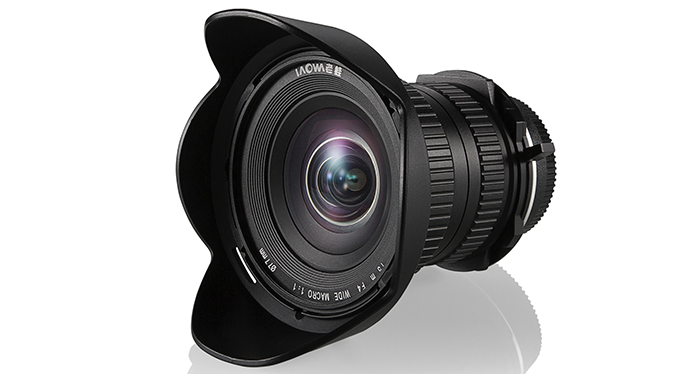
Venus optics announced the World’s Widest 1:1 Macro Lens. It’s a 15mm f/4.0 which comes for both Sony A and E-mount. Image samples can be seen here:
http://www.venuslens.net/images/15F/A1.jpg
http://www.venuslens.net/images/15F/A2.jpg
http://www.venuslens.net/images/15F/A3.jpg
http://www.venuslens.net/images/15F/A4.jpg
http://www.venuslens.net/images/15F/A5.jpg
http://www.venuslens.net/images/15F/A6.jpg


Here is a short video:
Press text:
Anhui China, Jun 12, 2015 – Venus Optics, the Chinese camera lenses manufacturer who had launched the world’s first 2:1 Macro Lens in last Sept, has just released the world’s widest Macro lens for full frame cameras, Laowa 15mm f/4 Wide-Angled 1:1 Macro Lens.
The new Laowa 15mm f/4 1:1 Macro lens is the first lens in the market which posseses a ultra wide angle of view and 1:1 Macro ability. This allows photographers from around the world to start experiencing the rather undeveloped field of ‘Wide Angle Macro Photography’ without using an extension tube. Macro Lenses currently in the market tends to have a mid to long focal length and it limits users to take very close-up shots on the insect or flowers, without showing much of the background details like its habitat or environment.
The new Laowa 15mm f/4 1:1 Macro lens features an ultra wide angle of view of 110 degrees with 1:1 maximum magnification. Photographers can focus very close to the subject and let the foreground dominates in the photo but at the same time, have the background telling viewers about where and how the subject lives. You picture will immdiately become very informative and intriguing.
The lens can also serve as an excellent ultra-wide angle lenses with infinity focus for cameras with full frame sensors. A shift mechanism is added at the rear end of the lens with a maximum adjustment of +/- 6mm, which is extremely useful for landscape/architecture photography for distortion correction.
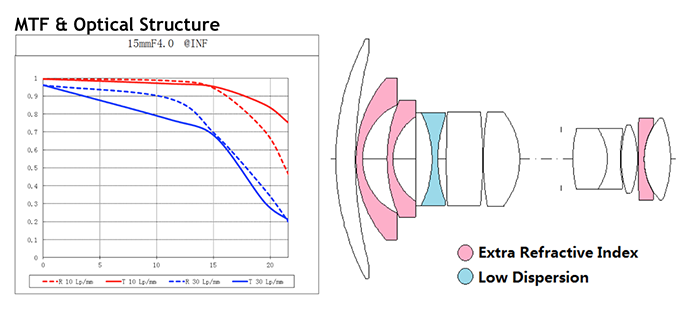
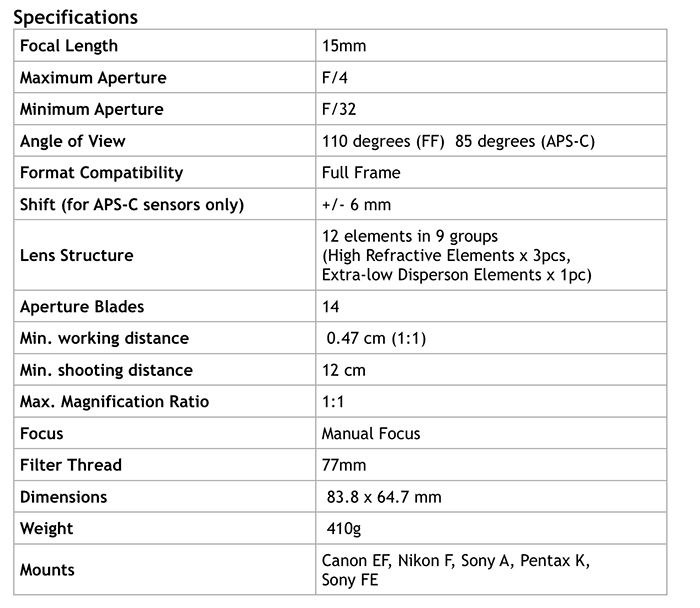
The lens houses with 12 elements in 9 groups with 3 pieces of High Refractive elements and 1 piece of Extra-low dispersion elements to deliver crystal sharpness both in the center and the edge. Barrel Distortion was also carefully controlled. 14 pieces of aperture blades form a close-to-circular aperture, capable of creating creamy shallow depth of view. The enclosure of the lens is made of metal to strengthen its durability. Canon EF, Nikon F, Sony Alpha, Sony FE and Pentax K mounts are available.
Sample photos and videos can be found in our English website (http://www.venuslens.net)
Pricing and Availability
The Laowa 15mm f/4 wide-angle macro lens is currently available at authorized resellers and at the English official website (http://www.venuslens.net). The recommended retail price is at USD 479. Free shipping will be provided during the
108 Responses
Amazing !
Interesting lens, although I’m not sure how practical actually getting 1:1 magnification would be with such a wide angle. Even using Sony’s 30mm Macro on an APS-C camera it feels like you have to almost be touching the subject to get true macro. Not poking the subject with the lens, let alone lighting it and avoiding the camera’s shadow covering it, would be a challenge when something is less than half a cm from the front lens element.
Since the inception of the Tamron SP90, I have been waiting a good 180mm Macro debut but seems like the current 180mm macro can’t have a stellar performance like the SP90.
Yes, if the composition requires close contact with the subject, you’re going to block both ambient light or light modifiers while casting shadows
which is the working distance for 1:1 on sel30f35?
According to the Sony site, the minimum working distance of that lens is 2.4 cm and 9.5cm from the subject to the focal plane. That suggests it doesn’t behave quite like a simple symmetrical lens of fixed focal length which would require a 6cm subject to focal plane distance for 1:1 magnification. (Many modern lenses change effective focal length as they focus, or it might be a mildly retrofocal design).
I used to use an olympus ultrazoom compact for my photography and I preferred it for macros over the CZ 16-80 I use now (usually on 80mm to get the most magnification). The lens was locked at around 35mm on macro mode and it was very close to the subjects but it’s perfectly fine for most things except insects. Saying that, I almost always use natural lighting and just take the photo from the right angle to avoid shadows. I rarely want the subject lit from the front anyway.
Can someone explain how this is possible? I assumed 1:1 magnification requires a distance to the sensor which is twice the focal length, so 3cm for a 15mm lense… but the lense looks longer.
Well, the samples look rather impressive, but it will be interesting to see how it works on landscape. And it is smaller and lighter than the Zeiss 18mm!
Looks fascinating to me. Check out the stills from it…
And it has shift!!!
Huge lense compared to a 15mm Voigtländer Heliar. For my personal preferences too heavy.
Nobody ask the most important question – how much?
If this lens offers 1:1 magnification and a 180mm lens offers 1:1 too,
could someone explain me why their image would differ ? (for angle of view).
Aside that the 15mm lens has a much higher depth of field.
@180mm the background is more compressed.
@180mm you can shoot insects without scaring them away too early.
you get a lot more background with this lens, but there is a lot more perspective distortion and you need to be very very close
the advantage of the 180mm is that you can be 1m back and still take 1:1, this you might need to be like 15cm away
With a 180mm lens and a subject 1m away (from the optical centre of the lens), you would get an approximately 4.6:1 reduction. To get 1:1 the subject would have to be 36cm from the optical centre of the lens (or 72cm from the sensor plane).
To get 1:1 at 1m distance from the optical centre of the lens it would have to have a focal length of 500mm. If you are happy with 1m from the sensor plane, then that lens could have a 250mm focal length (that’s assuming it’s a symmetrical design – a telephoto design would be different).
With this lens the subject has to be 3cm from the optical centre of the lens (6cm from the sensor plane) to get 1:1. Given that there’s a good deal of glass between the optical centre of the lens, that explains why the subject might be as close as 0.47mm from the lens.
That’s going to lead to simply absurd levels of perspective distortion. Given this, and the problems with lighting the subject, I think the 1:1 part is just a gimmick. It’s probably just making use of the fact it’s relatively easy to put in the required lens movement to allow such close focusing on a very short focal length lens. Far more likely (especially given the built-in shift for cropped format), this will be aimed at more general WA uses than as a macro.
Look at the table with the specs: for 1:1, the front element would be just 0.47 cm away! You move a tiny bit and you are already touching it with the lens. Insects are out of the question, unless they are dead. With anything else, you’d get MASSIVE perspective distortion. You have to also pay special attention to positioning, as you could easily block the light with your lens, camera and your own body (casting a shadow); or you’d get the Sun in the frame, tossing your subject into dark, and perhaps also giving you flare.
Sounds like backlit bugs crawling on the front element.
It’d be great for flowers though and some animals aren’t that shy as shown in the samples.
Actually, the depth-of-field remains the same, for equal subject size. This is a common misconception! The angle of what you see in the background changes, making a 150 mm more suiteable for macrowork, as the background will be nice and calm, while with a wide angle it is very busy. Also you do not scare insects away with longer focal distances.
15 mm, and macro? With the very short working distance it implies and all it’s consequences (scaring insects away, blocking light, severe perspective distortion), I see many more disadvantages than advantages (more DoF without having to stop so much down, more background).
Most macro lenses are in the 90-120 mm FF-eqv. FoV range, and for good reasons.
Using a canon fd50/3.5 on my a7 has given me some interesting creative options, but I can’t honestly say I’d want to go wider…
Very capable MTF drawing, only one stop behind ZF – and in color!
If it’s 15 mm, does this mean it’s a good lens for far distance Landscape images as well?
In general, macro lenses are great at everything.
I fail to see any possible reason for making or buying this lens.
The working distance would be virtualy noncexistant, the mtf charts are terrible…and I do not believe this lens can even be legitimately called macrot.
A true macro lens has a flat field…I really doubt this lens does.
Lol.
Just for fun I believe – quite unusual rendering, like wide angle horses, cows, babies, etc…
Do macro extenders make the angle of view narrower or image circle smaller on sensor? With an extender to make a long flange distance wide angle lens macro focus so that you can exploit a shift adapter too, would you end up with narrower angle of view than the focal length of the lens you started with for instance? If so you can likely shift with this one to great effect on 35mm sensor using shift adapter gaining a few mm perhaps and while keeping angle of view wide: if it is still wide at close focus. Any ideas? Ha ha
I have read several of your comment and none of them make any sense, including this one.
A diopter allows closer focus be slightly reducing the focal length and goes on the front of the lens.
An extension tube goes between lens and camera and focuses closer in the same maner as a lens normally focuses. It has no effect on focal length or angle of view.
‘In the same way as a lens normally focuses’ Really? I thought true macro lenses maintain angle of view whereas such as Zeiss 55 1.8 change a lot as you focus closer, or so it seems, and of course other ‘macro’ lenses don’t maintain angle of view either: does this you think? Extension tube doesn’t effect angle of view or the size of image circle on sensor regards resolution, that’s good- i couldn’t find this just now as I don’t have extenders, actually come to think of it, i can stack a couple of the e mount adapters as they sort of connect XD but less light?
Amazing! i did that with my widest lens and see just dust on front element!
Older lenses focus by moving the entire lens in or out, similar to how an extension tube works.
These maintain a fixed focal lenght but the physical size of the lens changes.
Many modern lenses have internal focus where only some of the internal lens elememts move.
The physocal size of the lens does not change but the focal length change. This os in some ways similar to how a diopter works.
These lenses do indeed change focal length and angle of view.
Extending the lens does reduce the light reaching the film plane. Use of a diopter has no effect on the amount of light reaching the film plane.
Generally however the qiality os better with extension tubes than diopters.
As I havr previosly said I have absolutely no desire for a wide angle macro.
Moving all the lens elements together is only way to keep same angle of view, ok, will lenses once focused using internal movements of elements, with an extender added behave ok? Such that in no way might a sharper lens like Voigtlander be in anyway as bad as this not so sharp lens, at the 1 to 1 extension, just because the Voigtlander is not built for that purpose? What effects the image quality situation considering only addition of extender to a given lens, from say the closest focus using internal elements without loss of quality otherwise? Will some lenses do macro better regardless for other reasons and what are they? Flat field only? Flat field lenses are always the best for macro with extension then, assuming no interest in focal length? And the amount of Diopter type closer focus methods built into said lenses as opposed to those with the all together extension method, generally.
How then, can Diopter method ever beat extension in any case, within the lens for close focus quality? Simply more flat field? And if loss of light somehow inhibits the image capture by sensor relative to Diopter type lens equivalent in same instance, presumably, or regards available lenses in preferred focal length and thereof most relatively tricky to produce flat field sharp results. 90mm is a well worked out and easier lens to engineer so perhaps that’s why it often gets macro features…So we will be wondering which apart from ease of making would be the ideal focal lengths for 1 to 1 functioning and common use at macro 🙂 Not 15mm XD
There are some 2 element diopters..achromatic…that sustantially ouperform single element diopters.
Canon makes them, and Sigma makes a 62mm one, raynox amd centiry optics also make some.
The cost more than regular diopters.
I do not know how a specific lens/acessory combination that I have never tried will perform.
I use true macro lenses as they have the best performance and are easiest to use.
I love macro lenses but do not like short focal length macro lenses.
I may have one of those, a russian one, i’m not sure if it was 2 element, but i think i saw another even better, like perhaps a three element one? lol, or maybe like you say it was just a single element. Looking for that, which i didn’t find, i found the power lead for my BM pocket cam and it at least turns on plugged into that, so there’s some hope yet as i read something about that…
If the extension of lens is applied in a ‘true macro’ which also maintains the original angle of view, you can expect the light reaching the camera to diminish in proportion to that extension therefore if you see the light dropping off with a macro lens at close focusing you know it is applying the extension form and if there is no drop off that the angle of view is changing absolutely if what you said is the case. The amount of light dropping might then allow you to work out how much the extension is occurring and how much the angle of view change instead, or is that not possible to discern from just light lost and calculated expectation for original focal length?
What you see is what you get
Just take the picture.
Would it not always be superior to use a widely variable macro extender with accurate and easy adjustment, to reach the focus we want at the focal length we intend to start with, or perhaps relative to a cropping of the image circle of that to avoid corners or edge softness, a two stage variable extender, one which brings it closer for this ‘cropping’ of image circle to ideal area of image circle and another to extend it conveniently with measure so we can understand it and use external measurements and calculations with it. Adaption of lenses or bellow type lenses on our Sony E mount allows both to and fro which means this would be possible and evidently very useful for the very best results possible. Shoudn’t we ask for that adapter from third party companies? Any adapted long flange distance mount lens at its best point and crop for image quality and this adapter to make it the best macro in existence, Otus and the like, or just Sigma 50mm 1.4 for copying documents and the like (if its flat field)
Yo continue to come up with wild ideas because you obviosly have never used a macro lsens.
It is already much simpler than all the wild ideas you think would make it simplfe.
Moust macro lenses have a magnifcaton scale on the focus ring.
Turn off the autofocus, turn the focus ring to the desired magnification, and move the camra in and out until it is in focus.
This is the standard method of using macro and callefd ” simple setup” all settings, flash and anything else you want to use is attached to the camera with brackets.
The camera is then manually prefocused to the desired distance.
Now simply walk up to your subject and move the settup in or out till they are in focus and click the shutter.
Focusing rails are available so you can achieve the same results on a tripod, and copy stands are available so you can simply slide your documents in and out after setting up your camera once.
Sure I know I haven’t shot macro and 1 to 1 are special lenses, I have close focusing lenses however and including zoom. You can move camera relative to subject that is true, however what you have missed is I suggested a zoom macro might be useful because then you can change the relationship with subject to make it easier where you can’t move subject closer differentially anyway, say an insect on a tree or something that you cant rail towards. Further I suggested weather sealing which you have now forgotten you wanted, didn’t you? the logic of a zoom being it is obviously detrimental to image quality and thus macro but all lenses are to an extent and utility wins over in this case, as you are in a context that can’t be controlled. Otherwise bellows and rails are looking to be very useful too 🙂 How much are you willing to pay for a great macro zoom and what range do you want it in, aren’t you all about that stuff? when shooting tele you want smaller and smaller detail than performance of current sensors….how about being objective about the lens side of things, and overcome this basic reliance on using smaller sensor cameras somehow altogether, just for maximum possible resolution no matter weight and cost.
What range would your ideal macro 1 to 1 zoom for nature shooting be? Could it perhaps cross over with long tele and closeup portrait use? A macro zoom presumably has the benefit of fitting lighting and stability situation and distance from given subject easier. Lets just ask for exactly these lenses, as new layouts. For portrait with such I would need weather sealing too for outside use and for it to be sturdy.
For ff 90mm and longer
For apsc 60mm and longer.
My top pick 60mm apsc tamron f2.8 macro.
I ordered the new Sony fe 90mm macro and I believe this will be my favorite 90mm.
Most macros out there are very good and will give excellent performance.
I have a 180mm macro that I also find very usefull.
Is the Zeiss Makro-Planar T* 100mm f/2 ZF.2 the best macro in that sort of focal length if you can afford it? Ah its only 1:2 macro
Most of these high quality macro lenses are so good you cannot go wrong with anyvof them.
The one you mention is an excellent choice.
Another excellent choice is the new version ofthe tamron 90mmf2.8 macro
Sigm makes a very good 150 f2.8 and 180 f2.8 macro
Each of the cameramakers have a good 100mm ish macro.
The reason most macro lemses npw have internal focus is to make focusing easier.
If the front element moves it changes the distance to the subject making focusing difficult.
Internal focus is particularly beneficial in macro lenses.
Just why? . .
If you are asking why you don’t know lol It looks spooky and funny!
In Republic of China, Wide Angle Lens is Macro Lens~
In Soviet Russia insects take your pictures with a wide angle lens 😉
Хорошо~ товарищ~!!!
Here is another one: Mother Russia is so vast & wide, even a 500mm looks like a 15mm~=D
Great, товарищ Jesse, but it breaks the meme http://knowyourmeme.com/memes/in-soviet-russia https://en.wikipedia.org/wiki/Russian_reversal 🙂
Hahaha, because I can’t think of any other In Soviet Russian Reversal meme to suite this scenario…XD
Obviously, if you ask why and comment that it’s useless, it’s not a lens for you. I see uses to it, and I think it looks pretty well done. I like that they added the shift ability. And the field of view offers interesting possibilities. Sure, if you get that close you’ll scare insects. But hey! You can have more than one lens. Use your long focal length for insects, and that one to play with perspective and have a more defined background.
I liked the examples they had on their site, and I’ll be looking forward to seeing tests. If it’s good, I’m interested.
I understand how this will change your FOV and therefor your background, but too me it seems like a very obscure lens that would probably better served with extension tubes. I’m interested in macro myself and will eventually pick up the FE 90 2.8 but doubt id ever have use for this lens. If others are interested and this sells reasonably well then all power to Venus.
Yeah, it’s true for the extension tubes. And you could use a Kippon shift adapter with extension tubes on top. Just curious, what lens would you choose to use?
Its hard for me to say which lens because I’m not the biggest fan of extreme ultra wides, ive heard good things about the Zeiss Distagon 15mm f/2.8 ZE but it is very expensive. The widest lens I have is the Samyang 12mm 2.0 ncs for apsc e mount, this lens is even too wide for my tastes but I got it primarily for astro. Here is an example I took with it, I know its only an average pic but then I’m only an average photographer (if maybe a bad one heh).
https://flic.kr/p/sDitsg
Its hard for me to say what lens as I’m not fond of extreme ultra wides but I’ve heard the Zeiss Distagon 15mm f/2.8 is good but very expensive. The widest lens I own is the Samyang 12mm 2.0 ncs for e mount apsc and even this is too wide for me but I got it mainly for astro here is an example shot I took with it, its only average but Im only an average photographer (if even maybe a bad one heh).
Six months later, Venus proudly announced world first 135mm Fish Eye lens~
Winner !!
That’s funny. But the 15 looks pretty interesting as a UWA shift lens.
Will TS on 15mm has noticeable effect?
There’s no tilt. But yes, 6mm of shift on a 15mm does have noticeable effects.
Think of this as a 15mm ultra wide angle lens, which also focuses VERY near when needed. If you have a look at the image samples in the links, you’ll see that it provides a very unique perspective to “bug on a leaf” shots, where you also get a view of the surrounding area. I say this is a very useful lens for some styles and since it also focuses on infinity, it’s quite a handy lens.
Also, it has a built in 6mm shift ability with aps-c sensors so you actually get a 22mm shift lens for your APS-C camera. How about that? That’s the widest shift lens you can get for an APS-C body.
It also doesn’t require the in camera distortion correction that such as 14-24mm 2.8 nikon might lose used in adaption, though I don’t know how these compare, hopefully someone can find out.
But jokes aside, I can see the use of this lens, since most macro lens are on the tele-end, thus the background are totally compressed and creamed-out. The wide angle macro allows shots with close subject in focus while maintaining a more wider field of view of the background.
Imagine this, a lady-bug one a leaf in focus with a slight blurred out scenic view of a grassy meadow with alps on the background on a clear blue sky with some marsh mellowy clouds floating araond~=D
But its practicality still needs some field works to be proven sane-worthy~XD
You’ll have to be extremely close to the subject (~5mm) to get 1:1. It’s very creative and unique, but hardly practical, unless shooting dead / frozen insects 🙂
I guess it will be good to shot mushrooms, berries & pine cones with this lens~
Mushrooms? Sounds interesting, especially being under mushrooms 🙂 That reminds me
CA and corners look pretty bad, and after studying a couple of the .nef files from the Chinese site, it’s also clear that this lens is not very sharp, definitely not the way one would normally expect from a macro lens. But… I can see some use for the odd WA macro abilities, especially for video work. Might just buy one for just shits and giggles.
A close focusing 15mm lens that also offers 6 deg of shift for perspective correction? For less than $500? Sign me up!
Only APS-C sadly. I’d buy the lens for that otherwise!
It says Full Frame in the article. 110 degrees angle of view.
6 deg. of shift works only on APS-C sensor, with shift function you loose portion of imaging circle
Sorry about that. I didn’t even know what Shifting even means.
Sorry, I didn’t notice you were talking about Shifting. (I didn’t know what it meant)
Look like a fun lens.
Hmmm, pretty interesting lens.
Imagine this on the newer E mounts with NFC connected to phone to trigger, just place the camera there in front of the flower or what not, wait for the bug to crawl into focus point, BAM, snap from the phone!
Except that it takes a random amount of seconds until you click on your phone to the camera actually taking a picture so the bug will be dead by then.
I’ve been using my CV 15mm f4.5 on a close focus adapter on my A7. It is a lot of fun and gives a very unique look. Don’t think this lens offers enough extra to justify it over what I have but it isn’t as crazy as it seems.
Well, it does offer shift.
Sure. Lets see ONE such shot with the above setup and we can compare the rendering at least, one as cool as these ones are with context and interesting subject. We can then interpolate the fact no one has such imagery with any quality with the fact this has some sharpness at all. We can then look at other uses for such a wide angle and see if these sort of images and with good rendering are better. The images look good at reduced scale and who is looking for the aberration more than smooth eerie dramatic look anyway? But more so, can you even make use of said presumed quality difference which is at cost of smooth rendering? Close focus adapter and that other lens are more than the difference of having A7R but of course you want the LOW image quality, heavier advantage. One problem with some Voigtlander may be rendering and sharpness, but here it isn’t trying to be uber corrected or anything, but rather suit a purpose and with almost no other options. That ca may even be from the shifting also.
I thought modern lens users loved the stuff? With just a modicum of forethought one can imagine all the amazing photos we will see from this soon from those who think it is zany and new and are enthusiastic. Lets also check out a Sony capture before judging it on whatever this is shot on at low resolution and grainy. I bet a lot of casual shooters finally move up to Sony just to use it in all its glory 😀
Images look a bit soft, hopefully the price is cheap
dshould Modern macros are good all rounders but vintage macros can struggle at infinity (it’s the only real weakness my fd 50/3.5 has).
Agreed, it is a generalization after all.
$479.00
How to light something proper that is only 4.7mm away from a 83.8mm diameter lens?
This is so stupid that its fabulous.
The company’s name is more of a joke. LAOWA means old toads in chinese. I didn’t know frogs has good vision…
So, they are like chinese version of Dog Schidt Optiks?
I don’t think so. Dog Schidt collects and re-purpose old glorious turds into modern vintage optics. While LAOWA seems to be obsess with anything macro. Since they just start up, I guess you gonna give the tadpole some time to really become an old toad~
LMAO
Brave soul to shoot a deadly green viper with a 15mm lens… wouldn’t be me.
Austin Steven, is that you?
Homepage FAQ:
>Q: Do you have Fuji X or Sony E or MFT mounts for this lens? Can this lens be used in Mirrorless camera?
>A: We currently do not have plans for making Fuji X / Sony E / MFT mounts for this lens. …
And now you can read in the specs:
“Canon EF, Nikon F, Sony Alpha, Sony FE and Pentax K mounts are available.”
This looks like E-mount has gained some importance over MFT by lens manufacturers. The future is E-mount! Hurray!
Makes sense as it’s full frame…
Don’t be too happy. Its still just a DSLR lens with a long plastic tube to make up the distance. 😛
I am thinking of buying it for it being an UWA lens with filter support. Also thinking of getting the Sony 10-18mm OSS used and using it from 13mm – 16mm on my A7.
The thing I wanted to tell: E-mount version before MFT. :))
The built-in tube-converter is a bad compromise – I know. But still better than Canon-mount + $15 Adapter. And I usually want to avoid any dead tube in my lens – because of size-reasons.
Except long teles like Sigma 150-600 – this lenses are already so huge that 25mm extra-length is negligible. For those kind of lens, the AF-software inside lens is most important.
OMG MFT mount is dead!
L O L
Those weren’t real 1:1 macro to start with. They even had trouble with the snail – c’mon, a snail 😀 So anything that moves (even flowers swaying in the wind), you’ll have trouble with if you want 1:1 macro.
You can still use it for close-up, though; but then, you can also use most non-macro wide lenses for that as well. Tests will tell if it’s a worthwhile lens or not, but I still don’t see much rationale for giving such a wide lens macro as a feature.
You are obviously right. I also don’t see much use of such a macro, just thought of some close focus uses. But if that lens is sharp and without too much distortion, it would be a nice purchase for such a price.
The politos could shoot with this and post the results, they will, expect a lot more image posts from nefarious people…that’s why they are all nay saying, that and because stupid. They couldn’t actually because these have cool contexts to them. Expect countryside versions of these shots, with no context like their posts.
And the MTF in macro? It kinda matters? You know, for a macro lens?
i think the 1.1 thing is because they can, but .66 mag or whatever will be fine in normal use. am really interested in this lens tho 🙂
1 to 1 perhaps avoids having to use an extender as well as a variable adapter to get such close focusing without a lot of adapters, complication and switching: hence even shift is included. I am looking forward to more examples! Of course, I could tilt it on my adapter too!
Doesn’t make sense at all. Maybe it has also a flash built inside?
So subject has to be positioned inside the front lens element?
I wonder, if this lens does not show the color edges like Leica lenses?
It is made for DSLR.