







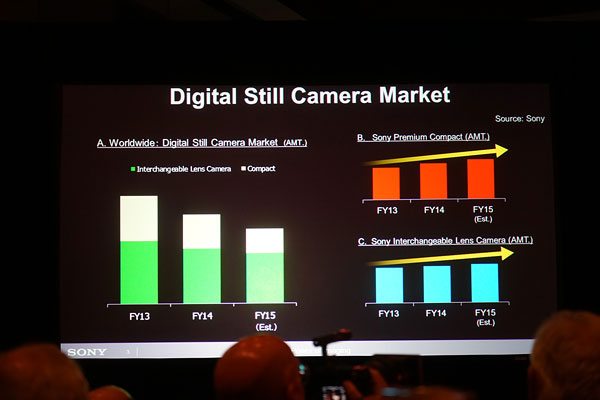
At a Sony conference in New York Imaging Resource posted a nice set of slides. The one on top shows you that despite the shrinking worldwide digital camera market sales Sony managed to increase their sales in the interchangeable and premium compact market.
Among the other cools slides we have those (all via Imaging Resource):
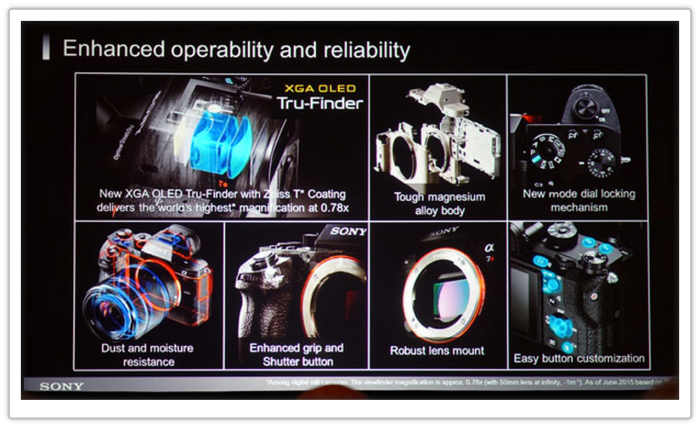
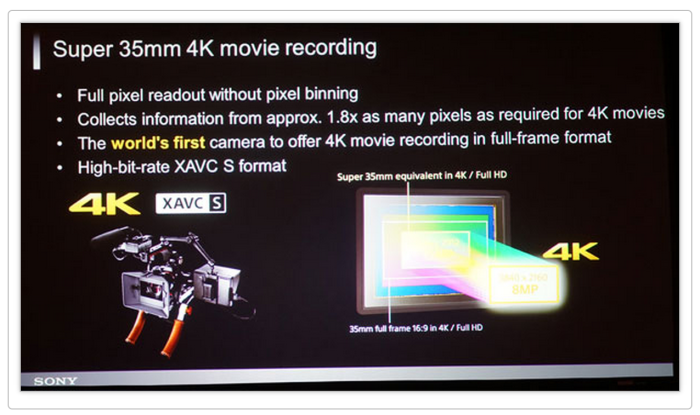
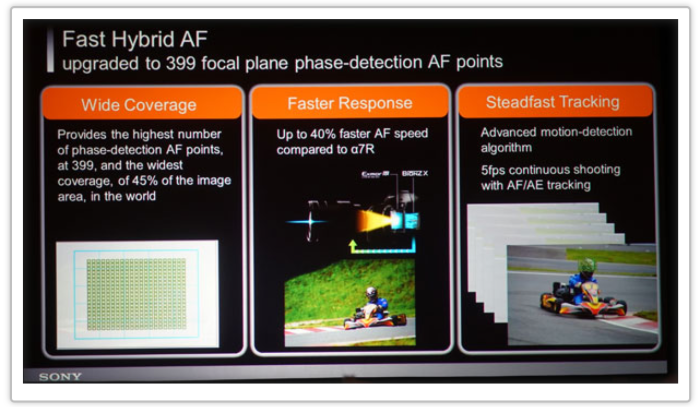
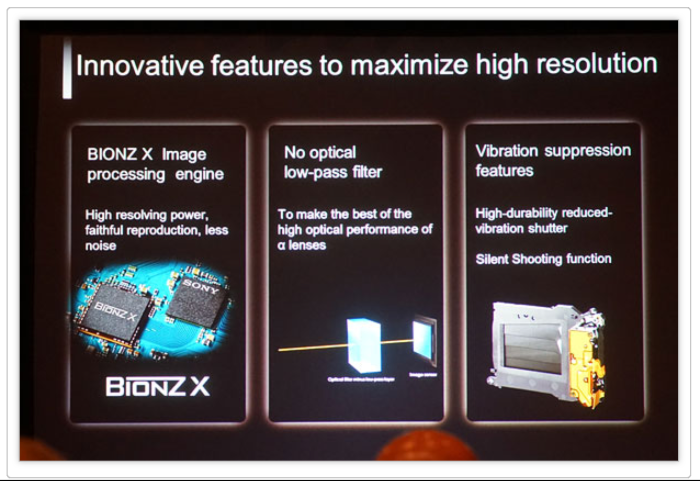
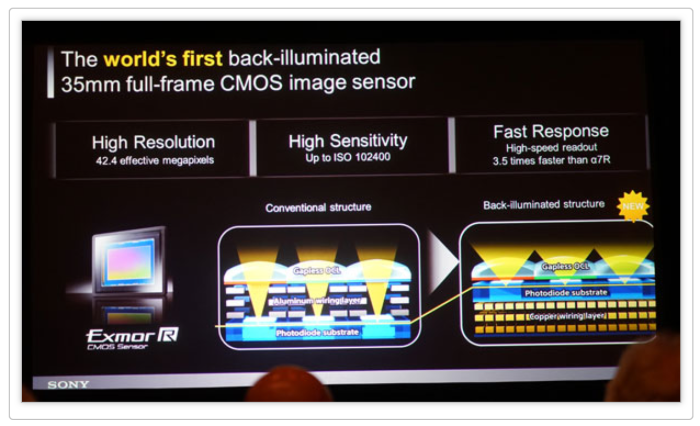
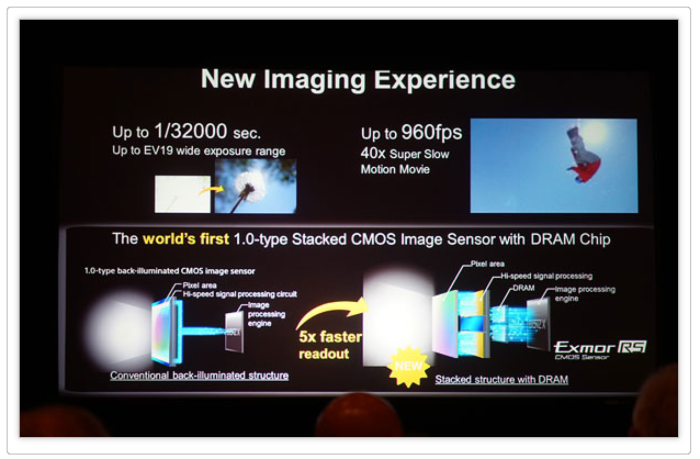
Reminder:
Sony decided to allow preorders of the three new camera starting from June 17 at 16.00 London time (confirmed via BHphoto). In other timezones this means:
8am Los Angeles time
11m New York time
17:00 Berlin time
24:00 Tokyo time.
Be sure to be online on SAR on that hour as I will link to all major stores offering preorder options on the very first minute! If you want the camera as soon as it gets stay tuned on SAR 🙂
Store links:
In USA:
A7rII at Amazon, BHphoto, Adorama, Uniquephoto.
RX10m2 at Amazon, BHphoto, Adorama, Uniquephoto.
RX100m4 at Amazon, BHphoto, Adorama, Uniquephoto.
In Europe at:
A7rII at Sony DE, FR, IT, ES, NL, BE, CH, AT, SE, FI, NO, PT. Wex UK.
RX100m4 at DE, FR, IT, ES, NL, BE, CH, AT, SE, FI, NO, PT. Wex UK.
RX100m2 at DE, FR, IT, ES, NL, BE, CH, AT, SE, FI, NO, PT. Wex UK.
In Asia at:
A7rII at Digitalrev, CameraPro.
RX10m2 at Digitalrev, CameraPro.
RX100m4 at Digitalrev, CameraPro.
218 Responses
Sony doesnt have a “premium camera”.
They have a particular top of the line… Premium no.
Nice tech sure. But forcing toys and adapters upon the pro user is not the path to redefining pro standards. Any game controller or cell phone can do that.
Ahahahahaha! I love the ‘pros’ that spew this nonsense. Try hard pros more like it.
Ahahahahaha! I love the “mind readers” that spew insults to avoid reality.
Oh yes, you are so very pro. Well done for choosing the single most dying profession. Pro does not equal smart. It equals whiney little girls that think wedding photography is hard.
“The Pro camera” is not existing
Wedding photographers prefer D800 / 5Diii like stuff
Fashion shooters in a studio prefer 50+ mp (like Pentax 645Z / 5DSR)
Sports-event shooters prefer 4DS / 1DX
POV-Action videos are often made by GoPro and the like
…
There are different cameras that can be regarded as a “Pro” camera for a certain type of photography. (A7Rii would be excellent for wedding, and decent for studio work)
There is a difference between premium and pro. A mercedes is a premium car, a nascar vehicle is a professional car. The a7r by all metrics of the word is premium. This is coming from a 1dx user.
If you’re earning a living from an a5100, it’s a pro camera.
Definitely. There are pros using GoPros.
Bad analogy. Pros use “specialty cameras”, like GoPros, to fulfill specialty needs.
No it’s not. You may be a pro, but your tools are not.
Define “pro”, please, in terms of your tools.
1.5 kg :))
You’re kidding, right? Annie Leibovitz is a pro, but if she uses a Kodak Brownie camera it doesn’t change the fact that it’s a consumer box camera, not engineered, designed and built to stand up to the daily needs of a pro.
What are the needs of a pro? Pros conduct a vast range of assignments and so have different needs, surely.
No. It’s a pro suffering the reality of using a consumer camera. We do the best we can. But surely you wouldn’t hold it against the professional a5100 user for wanting more? Would you?
Especially if the a5100 was the best it could get… and someone defined it as a “premium camera”.
The digital revolution has taught the lesson that professional content can and will be produced on lower-end or consumer tools from phones to go pros to compact cameras. Brandon Li produces beautiful videos using an rx100. It’s not good to be closed minded about what can produce what.
Anyway, I defended the a7r-2 as a premium camera as it certainly is.
Your opinion
It’s not an opinion that professional content (i.e. content that has been sold / viewed commercially) has been produced with consumer-grade tools. For instance, where once primetime broadcast television programming was shot on Super 16mm / Super 35mm cameras you can find instances where episodes were shot, not with top-tier video cameras, but with a 5D2 (“House” and other shows).
To be more precise:
Your opinion (that A7Rii is “premium”)
You mean to be precise since you were not at all.
Would you say that the a7rII is less than a premium camera? If so, why?
The dang thing doesn’t even have a spring lock on the battery door. Compromises ergonomics with no full control on VG. It forces one button to be used as two… Ever try using AEL simultaneously with AF/MF with vertical grip? Not without moving left hand off lens…
Premium cameras don’t force compromise… and advertise it as professional. Can’t even use a native Sony/Minolta teleconverter with anything Emount. Just silly.
The list is much longer friend.
For other it may be a pro camera. I think weddings should match quite good: silent shutter – good in church. For a FF kind of lightweight, so one in your hands, another one around your neck – all day long.
Shootouts in studios – maybe not best choice because medium format is better (or even maybe 5DSR with the right lens) – but it is very decent for that job.
And both examples are for professionals – for others it may be a just premium camera – or a high end enthusiast camera or whatever you call it.
My point is, that I hate this classification. It always leads to unnecessary discussions because you always find someone who has another opinion and he thinks that his opinion is the only one that is right.
I agree, with you. At some point in this discussion I think I was confused with “.” (that’s his screen name). I was defending the camera as premium while he was denouncing it.
The adjective of professional may not mean something is better just perhaps more specifically designed or marketed. Personally, I would not want commercial cooking appliances in my kitchen – they lack the amenities and features of those designed for the home (and have different requirements). Sometimes when I’m using a 1d-x, I miss a99 features like face tracking / registration and most definitely the flip out LCD. Everything has its trade-offs.
I may get the a7rII and will most definitely use it for paid work.
I think I know what you meant:
Premium camera or maybe upper-class class camera categorizes the A7Rii very well – indeed. Nevertheless I suggest not using terms like that because i already hear someone whining “But for me it’s a Pro camera – I earn money with it”
LOL
Perhaps you would understand better with an analogy…
Have you ever heard videographers talk about their “premium” tripod heads? They live and die by them. Sure, any tripod head has the same movements… many are cheaper and can provide the same stability… sure…
… but the fact remains that seasoned professionals respect and appreciate the nuances of a finely crafted tool that has improved through many generations of evolution. Anything else feels cheap by comparison… toy like.
Embarrassing to call it “premium” when we’ve worked with real “premium” for decades. Emount has abandoned many hard won evolutions that Amount refined for thirty years. I applaud you for not noticing. Please don’t think me bad just because I do notice. It’s not just different… It’s lacking.
+1 ! I totally agree with that. Professionals do use all sort of tools for the job and their output is rarely flawed.
a pro who is using sub par gear has sub par output and will keep sub par clients with sub par budgets.
Until you realized that the memory card gone bad and lost all of your works THEN you realized you need a real pro camera.
Or just stop cheaping out with budget memory cards…
You do realize that even the best memory card you can buy could possible goes bad, right? Never heard of single point of failure?
Bad analogy. A “professional driver” can use a toy car for the race. But he’d rather have a premium car for his profession… not the same one that any soccer mom delivers the groceries in.
A taxi cab is a premium tool used for a professional purpose. It doesn’t have to be used for that purpose. The tool and the profession are separate.
Bad reply. A Nascar driver cannot use a toy car in a race, the stock cars are specific to the purpose.
Often premium is preferred by most over professional. For instance, I would much prefer to have a premium road-approved ferrari than a nascar stock car that can only turn in one direction.
I didn’t say “Nascar”. I said race… as in competition.
Preferred by “most”… yes. a7RII is a very nice consumer grade camera designed to appeal to most. It is not a premium camera that professionals necessarily WANT to use, but something they will suffer using until a real premium device is offered by Sony, or more likely, the competition.
. is right.
For me a Nascar is a toy. And a go-cart is a toy, too. It’s a race car – a car built for entertainment. For a professional driver this toy becomes a professional car.
A Mercedes is for me a premium car, for a taxi driver it’s a professional tool.
> The tool and the profession are separate.
is true
Er…no. A tool or object can be described appropriately as professional. This is a generally accepted adjective usage in the English language:
professional
[pruh-fesh-uh-nl]
– of or for a professional person or his or her place of business or work:
“a professional apartment; professional equipment.”
Source:
http://dictionary.reference.com/browse/professional?s=t
See number 8 below adjective.
Back in the day… Olympus rocked the pro market with OM-3/4 with multi spot reading and titanium body… along with big pro glass 350/2.8, 250/2…
Challenged the big CaNikons…
But the little Oly had a problem… The little lens mount wasn’t stiff enough for the big lenses. The little camera’s mount flexed so much that the multi spot reset pin was engaged, clearing the reading. Making the fancy tech feature useless in the real world.
Not surprisingly, my experience with Emount adapters to professional lenses have also lost connection many times… leaving me dead in water… forcing me to shut down, remount lenses, and fumble frantically in front of client and art directors. Never again.
Make it premium or suffer pros talking bad about it. Simple math.
And if Sony did make it premium, then pros would praise it… and give all the free marketing that Sony could possibly handle for selling same or less to enthusiasts.
You are all right, however, how many pros did invest in a-mount in the first place? Not many, or Sony wouldn’t have to focus in the e-mount now…
And the 1DX is premium too, right ?
This is an extremely fine camera, capable of producing outstandingly fine images, but in its design compromises and “everything but the kitchen sink” feature set it is clearly geared to the advanced prosumer, not the pro photographer. Still holding out for a true pro-level Sony camera, hopefully designed for A-Mount.
Me too. Very few here can relate to all that’s been lost, omitted, and sacrificed from the 30 year refinement of genuine Amount, which was designed from the ground up to serve professionals. It had 9 series from the beginning, and 300/2.8 from the beginning, and pro grade flash from the beginning, and multiple accessory motor drives, IR releases, computer backs… FROM THE BEGINNING OF ITS INCEPTION. It even came with a companion 7 series to offer affordable second camera, and a means for enthusiasts to enjoy the pro grade system.
Emount comes along with philosophy of compactness and plastic lens mounts, FROM THE BEGINNING… and what… like two lenses?
Now they want users to accept that it’s pro worthy because of fancy tech?
The only reason Emount is getting love these days is because Sony is making them more and more like genuine Amount… menus, IBIS, bigger, more lenses… But that recognition comes at the expense of abandoning what we already enjoyed for the sake of pretending that Emount can become something that it was NEVER designed to become in the first place. It’s crippled from the start.
Good grief – you’re 30 years out of date. We’re not shooting 200 ISO “high speed” Kodachrome anymore. Multi-media, we designed the E Series for multi-media.
Hope they will come out with professional A99ii soon for the professionals… Should kick ass then..
I agree. This is still an amateur cam, no doubt a very good one.
If they want the pro market, I think they would be better creating a Pro Brand separate to Sony, like Teac did with Tascam.
Never understood that. So, to make it a pro camera, they should omit features or what precisely?
Sorry, but my budget can’t afford such a camera, on the other hand, a new APS-C = A7000 with all this new technology could be much more affordable to many people, so Sony where is the A7000 ?? anyone ?? thanks.
I see still photographers still can’t customize the movie button so it actually does something useful. You’d think that would be easy. I guess it’s back to the crazy glue. 😉
Crazy glue will customise the button?
I see video shooters can’t reconfigure the mode dial to be completely video and therefore useful. You’d think that would be easy. I guess it’s back to the hacksaw.
To be fair, in this day and age all the buttons should be customisable…
and manufacturers should give source code, lol
It is by far and away the most unpressable button on the camera.
Crazy glue won’t customize it but at least you won’t acidentally hit it. I did that all the time with my RX100 until I glued it. I can’t for the life of me figure out why anyone would want to shoot video with a camera ergonomically designed to shoot stills. You never hear of anyone buying a pro video camera and then using it as a stills camera. It may be cheaper to just have 1 camera, but if you’re a pro the cost is written off anyway. It’s called using the right tool for the job.
what is about alpha 7000?
Any words about a new RAW compression? Or still a lossy one?
$$$
Is the last slide (up to 1000 fps) also related to the A7RII?
RX10MkII I think.
1″ stacked sensor. So no. 120fps 720p for A7R II.
They can still do it with bigger crop or line skipping.
Says who?
It’s different sensor tech:
The stacked sensor has some buffer-ram at the backside of the sensor, so there is more or less a direct wiring from sensor to ram, that allows a ultra fast readout.
In theory Sony could make exactly the same for a FF sensor, but this would raise the weight of the sensor and I guess it is then an issue with IBIS.
Looks like Sony is trying to become the Apple of Mirrorless, complete domination
With all due respect, Apple doesn’t dominate anything, and rightly so. They aren’t half as revolutionary as their marketing claims. Despite their massive capital, they’re deceptive and sell overhyped, frustatingly proprietary shit. They could and should learn a thing or two about open, well integrated systems from Sony. Or Microsoft, given the recent developments.
Sony and Microsoft are “open”? Lol.
Apple stuff sells not so much of marketing, but precisely because it is proprietary and closed. And we’ve seen how well open works, i.e. not at all.
Andrea, Now the A7rII has been announced any hints as to what else is coming in the FE mount for the 2nd half of 2015 like the say a pro A9 or A7 monochrome?
The most interesting about A7r II and its new sensor is it is not in a Nikon D840 yet. Despite Nikon’s ability to sell more of them. That means somebody in Sony corporate (maybe even Kazuo Hirai himself) gave Sony Devices order to give Sony Imaging the first shot at this sensor. Meaning Sony is very serious about FE, it is their last hurrah and they are all in, trying to penetrate Canikon’s dominance, not just carve their own little niche like everybody else is doing.
And that explains high initial price for A7r II ($3200, wow, is it the most expensive Sony camera ever?), they must have promised real profits in exchange for withholding the sensor from other clients for awhile (but we all know that Sony is able to drop the price to $1K and still stay profitable on every one of them), the strategy which worked for them with 1″ sensors.
Wow.
For a stills camera, maybe their priciest yet. But for commercially usable video, which I suspect it can deliver (the A7S already do), it is really cheap.
A7s video is still better (full-sensor readout in full-sensor mode). In Super35 mode its video is good, but not far from NX1, GH4 and a bunch of Blackmagics which cost less (and all are commercially useable and de facto used), so I would not say that A7rII broke some price barriers there. Especially if you consider cinema lens system, where useable (not focus-breathing and vignetting Samyangs) cinema lenses for the Sony (well, with adapter) START FROM 4-5 times more than Veydra lenses for m43 (that is the real cost breakthrough, not even the cameras themselves).
It’s highly possible the A7S is the better video camera, but don’t you think a camera that can measure up with the videocentric bodies you mentioned, and work as a excellent FF stills camera does not deserve a higher price tag? And if you are on a tight budget, you can easily adapt legacy FF glass. I find the Contax Zeiss C/Y lenses to be very good for that, with a very nice cinematic feel. As a matter of fact, several of them are identical to the legendary Carl Zeiss Superspeeds in optical design and rendering.
Legacy photo glass is not the same as special video glass. If you are asking for pro video, it is out. Smaller sensor with good glass will look better in video than other way around, you cannot realistically deal with distortion and vignetting and focus breathing in video within production time frames and budgets (not to mention that old rangefinder glass produces color shift, and old glass in general is not sharp enough for 4k, let alone wide open). And old photo glass, without smooth aperture rings and long-throw focus rings geared for video equipment is simply not made for pro video, even IF it would be optically OK (which is not).
Most of what you wrote is junk. 4k is not at all a demanding task for good old SLR lenses. They easily deliver the resolution needed. And who mentioned rangefinder glass? You seem a bit clueless about the Contax C/Y SLR lenses I mentioned. Google it and return when you have learned something.
Which cheap old SLR lenses deliver 2160 lines per picture height wide open? Come on, you are dreaming.
Maybe you have a better understanding than the amateurs at Cooke? (Though I highly doubt it.)
http://www.redsharknews.com/technology/item/288-4k-lenses-what-does-that-even-mean
http://www.cookeoptics.com/techdoc/AFEEAD0010089A9585257BB40064E20F/Are%20your%20lenses%20good%20enough%20for%20that%204k%20high%20definition%20camera.pdf
We still don’t know that they prepare for A9….
Now we don’t know even whether or not there will be A9, at least this year. They might just spend their R&D creating A7sII, with added IBIS and OSPDAF and maybe faster sequential speed in electronic shutter-only mode. Although A7rII covers 4k, it is not full-sensor readout in full-sensor mode… And A99 II requires immediate attention, with the same sensor, IBIS and EVF from A7rII and the same body from A99, probably even without PDAF module (or with the one from A77 II), it might sell a few while keeping fixed costs to the absolute minimum.
A99 II will propably use a 24MP sensor just like A99, unless Sony this time decides release two versions. The advantage of SLR and SLT is AF. High MP is more for studio and tripod use. For that A7R II is fine even with adapted lenses.
No need to release two different 42MP cameras. And how many would buy a A99 II if a $3,200 42MP model was the only choice?
But why? What’s the point of the A99II? Sony have more or less invented a perfect E/A double mount with the A7RII focusing system + LAEA3. There is seriously no point in developing a special A99 A-mount only camera. If to satisfy the big camera niche, they’d invent an A9 E-mount with A99ish specs.
1) Best AF for all A.mount lenses.
2) Unfortunately the new focus system in Sony A7R II only works with the newer SSM and SAM lenses, not the older ones with screwdrive.
3) The AF in the Sony LA-EA4 is not as good as in A99 and according to Sony space for the AF sensor is a problem. The E-mount takes upp the natural space for the AF sensor used in A99.
4) Maybe a new LA-EA5 adapter without SLT mirror and accepting screwdrive lenses will work. Or not. We don’t know as such an adapter doesn’t exist yet.
5) AF with A7R II is 5fps versus 8fps with A99. Despite the advertisement about the AF-tracking even the old A99 is propably much better.
6) A7R II is just too expensive for most people. Until there is an A7 III with same update of the sensor and a new LA-EA5 adapter there is no serious alternative to a new A99 II.
7) A new A99 II doesn’t need a lot of development, just an update of the same body. Sony simply can do the same already developed updates from A77 II and add some other things already developed for E-mount cameras. So why not do it? Especially as they can get back the relative small cost for the update by raising the price of the new model.
8) A99 II would just as A99 be more ergonomic. An adapter solution is more clumsy. And A9 is just a rumor. We don’t know if it is coming. How it will look. Or if it is coming at all. And an A9 will propably more expensive than A7 II and therefore also more expensive than an A99 II.
The OSPDAF may works on a-mount lens, but it will not focus as fast as dedicated PDAF.
A77ii show you that the AF is a mile better than A6000 at indoor lighting. And A6000 use hybrid AF, which use both OSPDAF & CDAF at the same time to improve speed & accuracy. However, a-mount lens are not design for CDAF.
Why? Well, profits. A99 II with the same body, just a new sensor and processor (and maybe thrown out PDAF module) will be cheap to develop (certainly cheaper than some brand new A9), and have open market in all the FF A-mount lens holders.
NP-FM500H battery alone is worth a different body from A7rII, 290 shots is a joke.
But it’s not very cheap! A new PDAF module isn’t cheap, using the same crop frame module as the A77(II) would be a disappointment, and what sensor and processor do you want to use? A fully new and expensive type? The kinda last-gen 36mp+BionzX combo? The already expensive A7rII combo? With that kind of complication, might as well develop an A9 with bigger body/battery.
That is the point, they might not need a new PDAF module, they could either use the old one or throw it out and use OSPDAF like A7rII.
But then, I don`t see the point of making a new camera at all. Maybe a combo of the A77II PDAF module with 36mp sensor, BIONZ X and lots of video features? 42MP sensor and 4k?
The point is stop using the old 24mpix sensor, and make something half-competitive (which in this case would be 42mpix).
That will be $4000 thank you very much… or not.
Well, they have raised the price compared to A7r, even at release. After all, if you sell it cheap, where are the profits? 24 mix A99 II would do them nothing, what’s a point? Everybody who wanted it bought A99 already, or will buy it now that it is cheaper.
OSPDAF is capable of at least as good AF as regular PDAF (only more points, and more precise every time, without microadjusting for every lens), and A99 was not that good to begin with. Actually better, as AF sensors in DSLRs and DSLTs never able to get 100% of the light.
Now I think the A9 will come some time, but it is definitely better the A7r2 was more than just a cold update with IBIS in… It both shows Sony is willing to counter the Canon 5DS and still has room to bring a higher resolution sensor in the future… Why come with a 50+ sensor first when you can bring an impressive A7r2 first and then land the next punch once this camera has sold all out… If the A9 comes out first, who buys the A7r2 for 3000 bugs first? Canon is now all in while Sony hasn’t even showed his hand fully…
From a spec sheet point of view, not sure what they could add for the A9 and what price point they would slot it in. I can’t see one coming right now.
You kidding me?
This, and possibly A7SII are merely prototype testbeds if you will. Here’s what a “A9” could have, and it’ll be worth it.
It’ll be a super-flagship D4/1D competitor with similar/lower price but smaller/lighter body. It’ll have a next gen. BIONZ that will solve many drawbacks that the current BIONZ-X cameras have, like lack of lossless RAW, USB3 and HEVC, along with many smart features/gimmicks like advanced teathering. It’ll have a more ergonomic and less retro style, dual card slots, and proper weathersealing. Finally, it’ll have blazing fast/accurate/wide/super-customizeable AF and burst ideal for sports.
It’s not that simple. These are two different lines of business. We have no idea of the contractual obligations of the commercial sensor division.
The commercial sensor line has its own P&L and would not care to sacrifice that to favor the consumer product line. Playing games with your large customers for a short term corporate benefit- especially to sacrifice a profitable lob to favor an unprofitable one- can have very negative long term repercussions.
“The commercial sensor line has its own P&L and would not care to sacrifice that to favor the consumer product line.”
That is exactly what I wrote – except, UNLESS TOLD TO DO SO by their own higher-ups. So far, Devices preferred to sell their latest and greatest to Nikon first (for example, D7000 or D800), probably even with some exclusivity periods (as the price can be higher with exclusivity). Sony’s own flagship A99, released AFTER D800, did not have IMX094. But all that has changed recently, and it seems by now it is a trend, all the latest and greatest sensors appear in Alpha and RX cameras first.
And as usual, selling directly to end users is where all the money is. I am sure Nikon squeezed Sony Devices for very good prices, OR exclusivity.
Most of Sony’s imaging profits come from selling sensors and its pro broadcast division – not from cameras. Once again you have your facts wrong. Look at Olympus, can’t turn a profit selling cameras, margins are small and development costs are high.
“Most of Sony’s imaging profits come from selling sensors ”
NO, ABSOLUTELY NOT. Sony _Devices_ sells sensors, not Sony Imaging (which sells cameras and lenses and EVFs and flashes). Sony Imaging has to BUY sensors from Sony Devices just like everybody else, except there is always corporate to meddle (which I guess happened this time and with RX100/RX10 before that, to try and revive Imaging strategically, otherwise they were close to writing it off like their PC unit).
That’s not what Sony’s financial report says, read the 10q, not BS press releases. Get your “facts” straight.
What financial reports have to do with it? It is about organization:
http://1.bp.blogspot.com/-Iyk_B7dNsK4/UcGueGfr3iI/AAAAAAAACmE/d6Bk56yjdt8/s1600/Sony+org+structure.PNG
Do you see where Devices & Semiconductors under T.Suzuki are, and where Digital Imaging under S. Nemoto is?
Read the 10q – which details all financials, not some management chain.
Why? I am talking about management and organization, and Semiconductor & Devices (which makes sensors) and Imaging (which makes cameras) are separate.
Ignorance is bliss. Enjoy your org chart. The 10q tells the real story. Sensors are under imaging.
Chris, WHERE do you see sensors under Imaging? You must be Imagining things. See for example:
http://www.sony.net/SonyInfo/IR/info/irday2014electronics/devices_E.pdf
It is VERY CLEAR that sensors are under Devices, for which it makes 43% of sales. At least it was the case on November 25, 2014.
We are all speculating here aren’t we?
I think the reason D800 got the 36MP sensor and A99 didn’t was that Sony only intended release one A99 and not two versions, one with 24MP and the other with 36MP.
Considering AF is faster if MP is lower 24MP was the only realistic choice. And by the time of the A99 release Sony should already have planned and started development of the A7 series cameras.
A99 did not rely on sensor for AF, it has separate focusing module. It has a few OSPDAF points but they are as good as on it useless anyway, just a gimmick.
Yes, Sony now seems confident they can sell enough FF cameras on their own. For the first sensor, it looks like they absolutely needed Nikon to get to high enough numbers… I believe without the Nikon 800 it would have never been economical to make the 36mpx sensor just for Sony itself. Now they seem to believe to have enough momentum themselves.
You have that wrong, Sony is doing nothing more than carving out its own niche. Its not eating to CaNikon’s market share, its eating into other mirrorless sales.
The D810 refresh hasn’t been around for long, I’m sure we’ll see a new model soon with the new sensor. Sony just got theirs out first.
DSLR sales are falling, Sony (and mirrorless in general) sales are rising, so… And how withholding high-res FF sensor from Nikon is “eating into other mirrorless”? They do not sell FF systems, Nikon does. A7rII will even eat into 5Ds.
Again, you’re wrong, year over year mirrorless sales are completely flat and actually peaked a couple years ago, CIPA data backs that up. Last month DSLR sales actually increased more than mirrorless, and because they outsell mirrorless more than 3:1, that’s a larger jump in overall units sold. But I’m speaking from facts, not hyperbole.
Yeah, that’s a clear sign that Sony has a higher belief in their own Product and that they think that the A7r II is a camera that has broader appeal then say the A7r.
Don’t agree on the pricing though. The pricing contradicts that broader appeal since few enthusiasts will be able to afford A7r II + 1 or 2 native lenses.
Do note that here in the EU the price is set at €3500 (aprox. $3941, incl VAT). A price that is right up there with what some considers “pro-level” gear. In comparison i can easily find the D810 for $3730 (incl VAT).
The problem with A7r II’s price isn’t that it is expensive though but that it suggests that the camera is somewhat “pro-level” since it has the “pro-level” price tag. Such things demands that stuff such as software isn’t crippled and that lossy compression of RAW’s just don’t exist at all. Or…, and this is key…, that such things actually get fixed in a timely manner and not some half baked fix 6+ months after launch.
Oh god give me strength…..There is no issue with compression. I have been shooting on A7 cameras since they were launched. I am yet to see a single example…Every time I ask one of the compression Nazis to provide a Raw file. So that we can really see the whole picture (pun intended). They go silent and run home to momma.
The A7rII is completely a professional camera in every sense of the word. With that in mind, compare the specs to the Canon 5DS and then tell me it is over priced!…Such nonsense….The the D810 has the 4 year old sensor in it and you’re quibbling about $200. Seriously!!! When you shoot professionally. You get the gear that works…You suck it up and buy it. It is called the cost of doing business…
No, i’ll not give you strength.
You seem to mix up the “its no issue” with “there might be a issue in situation x or y” (star trails being one — google it). It’s not about it not being a problem in 99% of situations but more about buying something one can trust in all sort of situations. Even though the lossy compression is seldom a real world problem it’s hurting that trust that is so important to have when you’re out in the middle of the Sahara desert in north Africa at 05:00.
And that’s the real problem where lossy compressed RAW’s just make up one of these issues that make the trust for these cameras lower. Another problem that adds to this trust issue is the poor weather sealing.
Really……..I have had Canon 1Dx cameras, refuse to turn on, AF suddenly go out by feet (google mirror dust on AF sensor), Canon zoom lenses that won’t calibrate. Nikons that won’t tether, will not focus, or when they say they are focused are waaaay out.
All issues far more serious on a shoot than gnashing your teeth over what compression Sony are using…
I have no issues traveling with the A7 cameras. Never missed a beat……..I don’t expect them to…Then again you would be an idiot not to have a backup body on a job, no matter what the brand…. Or perhaps you just leave your gear out in the rain over the weekend?
That you’ve had a 1Dx that ceased to function doesn’t make the trust issue less important though.
Wow…. you completely missed the point.
A7s and A7rii both have increadible video capabilities, and that makes them attractive for much more target customers than professional still photographers, the guys that make real money for video productions. Canon 5Dmiii sold for many years for over 3000 bugs in stoves, so the best camera for video and stills will for sure sell to enough professionals for this price. Too high for enthusiasts like myself, but the tech will tickle down over time. No doubt Sony will easily sell out their production run…
So basically D810 and A7r II is the same price, very little diff. They compete head to head. And 5Ds is there too. But of course A7r II is cheaper for Sony to make, this way they are able to undercut 5Ds a little while still being profitable on it. And they will milk it all the way to $1K and below, Nikon and Canon cannot do it.
They are not looking to ‘penetrate’ Canon….They are creating a whole new market. One that canon has no presence. Why challenge Canon when you can simply move the industry away from them…
Penetrate the market, not Canon. 🙂
And no, it is not the new market. Neither capabilities nor price range are new. D800/D800E, D810, 5Ds/5DsR (and D3x before them) all compete in the same market – high-res “slow” photography (landscape, architecture, fashion etc). All in the same $3000+ price category. There are only so many buyers in this category, and A7r II tries to take sales and money both from Canon and Nikon. And all of them took sales from MF cameras too. For a new buyer, it would be impossible to really justify 645z when 5Ds and Sigma Art lenses are available, for example.
It is a new market….They are the only company offering full frame mirrorless cameras. I moved to Sony because I agree with where they are taking image making….(whether it is still or moving). They are moving the industry away from a traditional model by not hold back on technology to maximise profit. They are increasing profit by offering the market advanced image quality and technology when it becomes available. Effectively creating their own market.
Mirrorless is a technology, not a market. Market is determined by capabilities and price.
So a spear is the same market as a gun…and a horse is the same market as a car….
‘Market: A demand for a ‘particular commodity’ or service
Would you really say that the ipod didn’t create a market when it was launched?
So the spear is the same market as a gun, and a horse is the same market as a car…Of course not. Because technology in and of itself can creates markets, as revolutionary change occurs. Markets are determined by consumers…example…iPod
They also had a slide that said, $3200.00 body, $1200.00 lens, And a $400.00 adaptor just to use all of your good glass. JACKPOT!
“rising”
Only a person or a company can raise prices. Prices themselves can only rise.
Let’s say, m43 is Apple
Sony is Android
And Canon can be 3rd in mirrorless like Microsoft in smartphone market
I’ll roll with the 1st analogy 😉 I believe in a brighter future for MS and Win Phone, can’t help it… Both them and Sony are THE innovators at the front line right now. All the others make pitiful excuses. ($0,02)
If they come out with a stacked APCS sensor for the A6100 or A7000 would be insane 🙂
The A7Rii will have a big impact on Sony sales…
Especially since a huge number of Canon users will buy one…
They do not need to switch to Sony in order to fully utilize this camera.
Yup. This thing will be sold out for quite a while. Even with the current price tag. Assuming there aren’t any issues we aren’t aware of yet, there is not a whole lot missing from the spec sheet (hold your nitpicking, people!). Personally I can’t wait to put all the native FE glass on it and put it through the ringer.
Only way its sold out for awhile is if Sony keeps production numbers low, the A7II – which is half the price can’t even crack the Amazon top 100. A $3200 body isn’t going to set any sales records, it’ll get lots of blog hits though. In 6 months I’ll buy one for $2000 given how fast the A7 bodies have dropped in price.
lol, $2K? Keep dreamin’
With the way Sony puts stuff on sale before Christmas? Its going to drop like a stone, they all have. Only a fool would pay the launch price of $3200.
Again, you’re talking out of your behind. Yes, generally every retailer has discounts during holidays, but if you think you’ll be saving $1200 in a few months… you’re a fool. I own a complete A and E mount system and I’m well aware of the pricing trends. For some folks a small drop in price is chump change and people buy stuff a full MSRP all the time. How long did it take for A99 to drop? How about RX1? Or how about A7s which has never been discounted from any official retailer? $2,999+some garbage worthless accessories by Xmas time? Sure. $2k? Keep dreamin’
You have a short memory, the A5100 and 6000 got steep discounts before the holidays and all the A7’s were discounted and included free grips. There will be deals. I paid $1800 new for a US A7s last year. There have been a number of deals on the A7II which had been out for about 6 months. The mirrorless cameras drop really quickly compared to other cameras, if you’ve bought the complete system then you know this. The A77II followed the same trend when it was recently put on sale with a free grip. Nobody – including Sony – cares about the A99. Early adopters will be dumping them a couple months after release too, so I’ll be able to get a barely used camera for much less than $3200.
Alright, I’ll give you that 7s deal… Though wherever you got it wasn’t Sony nor a major retailer like B&H. I must’ve missed it and actually that’s one that I down own yet. Anyway, gluck with that bargain shopping, I know I look for deals myself when I can.
The primary way a camera holds price these days is if it sells above the expected curve. We don’t know what Sony’s expectations are and how many they produced, so we’ll just have to watch for what happens with price/offers in the weeks and months following its first shipment. If the price holds for a long time, then it’s selling at or slightly above Sony’s expected curve. (If something sells well above you expected curve, you often use that extra volume to push discounts and solidify the position of the product.)
The other way a camera holds price (your RX1 example) is if it was a very low volume product in the first place, and you had limited production of it.
Right now the Japanese companies are still repeating a pattern: they believe that their latest engineering efforts will outperform the market contraction, so they over produce. Then when the inventory starts to pile up, they have to price reduce quickly. Each year, the CIPA makers predict the full year sales and announce that in February at CP+. They’ve been overshooting the mark for three years now. That means they’re more optimistic than the market should make them.
If Amazon.com was ever a good indicator for worldwide (let alone mirrorless) camera sales…
Well how about Sony’s 11% market share, which has changed very little in the last couple years? Amazon sales rankings reflect that. So does Walmart’s (worlds largest retailer) and Best Buy’s (worlds largest electronics retailer). Market share is most telling, and Sony isn’t moving up at all.
Sony, unlike some others, refuses to disclose manufacturing runs, so it would be easy for them to manipulate it as being out of stock.
The A7r was cheaper than a D800 and had quite a bit of the same marketing of technology flash in it. It didn’t sell all that well and was readily available from the get go. At nearly 50% more in price, I don’t see the A7rII changing that.
I’m very happy that Sony is continuing to invest highly in moving the bar. More competition is good for the camera business. As a long-term techie nerd (dating back into the 1960’s), I love seeing where technologies are being changed and incremented. But I would also point out that change for change sake isn’t always good. I really wanted to see Sony admit that 11-bit lossy compressed raw files aren’t state of the art for such a sensor and give us a new option, but as far as I can tell, nothing’s changed there. Yet just doing that one thing would give me better quality out of the A7 gear I’ve already got.
We Will add a non compressed raw file option 3 A7 bodies from now (You know, in 1 year) Thanks, Sony.
Extra set of batteries, chargers, flash, brackets, tripod plates, adapters, menu systems, ergonomics…
… constitutes a “switch to Sony”, regardless if they keep their Canon or not.
So you’re saying people cancelling their Canon 5Ds orders for the A7Rii which is $500 cheaper?
People can continue to buy thier Canon equipment and Sony.
The DSLR compatability of this camera means that even though Sony has some serious gaps in thier lens line up, that can now be filled by some very good glass by Canon and others.
As for the 5dsr …I believe the a7rii will seriosly outperform it….with Canon lenses!
I guess we’ll have to wait for some reviews on how fast the AF is on the A7Rii with Canon lenses.
I believe some will.
There are plenty of people running around chasing what they think is technology that will make them great. They tend to be in and out of cameras very, very fast, because the latest technology will be marketed just as fiercely in the next camera.
As a still camera, if we’re still talking about 11-bit lossy compressed data, then I really don’t think the A7rII moves the mark for a US$3200 camera.
You don’t buy technology, you buy capability. Show me an A7rIII that will outperform my D810 at everything the D810 does well for stills and I’ll switch. But I’m focused on final results, not what technologies are inside.
Cameramakers have traditionally taken a proprietary, all or nothing approach…buy my system and nobody elses.
System sales are plummetting because people now have more choices.
Now Sony has wisely taken the aproach…buy my camera if you like it, use it with whatever you choose. If you like our native lenses biy them too, if you like someone elses buy them.
This is the only way Sony will break Canons rule in the camera industry.
There is no going back, others will eventually need to follow and make cross platform compatability part of thier system.
Barring some absolutely terrible surprise this camera will be a huge success.
You may wonder why I consider 42 mp good when I consistantly ask for much higher…
This is the first bsi ff sensor, and while Exmor was getting close to its practical resolution limit bsi has the potential for much higher resolution…which I expect we will be seeing with each future new release..
Extrapolating fron smaller sensors current bsi technology could produce as mich as 200mp ff
Typing on the phone again, Barry?
Yes, camera makers are stuck in a proprietary frame of thought in what is more and more an open world.
No, sales are not plummeting because people have more proprietary choices. They’re plummeting because all those choices are really just variations of the same choice, and that’s not what they want.
The wise thing about what Sony did is to make the A7 bodies all the same and give customers different choices as to sensor and capture. They aren’t all in on that yet, though, and this only applies to their most expensive products. The A7rII really needs 14-bit uncompressed to show any real advantage at 42mp, for example.
No, just making A7’s is not the “only way” for Sony to break Canon’s domination of ILC. Frankly, there’s nothing that Sony has done that Canon can’t also do should they ever get up off their butts and look out their windows in Tokyo. I’m also not sure what you mean by “cross platform compatibility.”
Define “huge success.”
I doubt that BSI will create any dynamic range benefit. As I’ve written, the primary benefit I see is that it probably eliminates the need for offset microlenses in the short flange cameras. Exmor, for what it’s worth, is nowhere near its “practical” resolution limit for full frame. Not even remotely close. Most of us believe that number is up around 100mp, and some argue higher. But that would require more on-board memory and probably some tolerance to rolling shutter using current Exmor technologies.
That said, the smartphones are likely to deliver (again) the technologies that will propel cameras in future generations. In particular the multi-lens/sensor aspects that give you depth fields. Breaking out of 2D capture is going to be the prime driver of imaging in the future, even if our output remains 2D.
Yep this is indicative of Sony’s change of direction for the last few years in all of its divisions. From Sony Music disappearing to be replaced with a partnership with spotify. The same with Sony pictures partnership with Netflix. In motion with the open for format of XAVC and is standardisation across broadcast media, and in its software such as catalyst which is usable with most motion codecs in the market. Sony has chosen to trust consumers and professionals will invest in Sony because they offer better products with better technology.
Products can be purchased or not purchased based on merritt.
This will start a trend….interchangeable lens cameras that actually have interchangeable lenses.
I dont want a camera that will make me great.
I want a camera that will take great pictures.
That means that at the same skill level the pictures will be better..most important for me is the highest achievable resolution, for others that means differrent things.
I want a camera that will collect and maintain optimal data.
so dangerous for Nikon that it’s distance from losing Thom is just 2 bit 🙂
Nobody is dumping anything until they can actually see how good Canon lenses perform – especially indoors and low light situations. My guess – it’ll be ok in good light and really poor in low light like any mirrorless camera. That’s not going to lead to a mass exodus – especially at $3200. A huge number of Canon users shoot Canon because of the system as a whole, the A7’s flash options suck and even with tons of phase AF points, mirrorless cameras still struggle to accurately lock in low light.
After the initial rush the A7rII will not even be in the top 20 for ILC’s.
This camera is not much more than the a7r was when it came out.
you should actually try using an A7X before gracing us with your “wisdom”
I’ve owned the A7 and A7s. I’m quite familiar with them. But there’s a delusional thread here where some seem to think people are suddenly going to switch to this camera and that’s just not the reality. Sony’s market share has changed very little since the introduction of the A7’s. A $3200 body isn’t going to change that.
Here’s a link to my for sale ad when I dumped the A7s. I sold my A7 shortly after. http://www.fredmiranda.com/forum/topic/1348918/0?keyword=sony,a7,a7s#12869822
It’s not about photography anymore. I don’t mean that in a negative way- it’s just the reality of the market. I remember when car stereo turned a corner in the early 2000’s. You couldn’t buy a solid head unit without having it built in with a DVD player, motorized face-plate or other stupid features. You ended up paying excessively in the end for specs you didn’t want. I’m amazed DSLR’s in their current form have stuck around so long.
Do I need 5 axis? No. Higher ISO? Can’t even think of many pro situations in which – regardless- you aren’t trying to keep it under 1600. 42 over 36? Meh. Now that shutter though- that’s a serious improvement. Most of it however is what I call “filler.”
Apple dominates all the profits in Smartphones. They are not after market share but if you look at profits Apple has it all, they dominate where it counts. I think Sony is going for a similar strategy, focusing on top quality products that might not sell to the grandmothers looking to buy a camera but will dominate where the profits are in the industry.
Google too.
Only Samsung HTC Sony LG etc have a very low profit margin.
“They are not after market share,” to the extent that since they have been shedding marketshare despite all their efforts to the contrary, they now declare that this fits right into their plans.
What are they down to, 12% of the smart phone market? Yes, their plan is working out!
I see the back of my head in these shots. LOL
Is it really your head? lol
When really a manufacturer that evolve versus future. Good sony your research team is the best! Nikon and Canon have done its times bye bye and welcome sony the true innovation
So 4k in crop mode (Super35/APSC) is a full sensor readout. But Sony’s documentation doesn’t say anything about how it delivers 4k in FF mode. It does say that it uses a full width of the sensor, but says nothing about sensor readout technique. Does it bin pixels? Does it do line skipping (most likely)? Does it oversample(doubtful that it has 8k oversampling readout)?
Nevermind.
It bins.
10-bit or 12-bit 100mbps+ Full HD video via firmware update please, then it will be playing with the entry level big-boy digital cinema cameras. 8-bit video is fine for delivery but SORELY LACKING for acquisition for professionals who plan to do color grading / color-correction.
Says you. A nobody.
And I’m instantly reminded why I discuss these matters in the real world with professionals instead of on random forums.
8-bit video for acquisition is inferior consumer-level tech and a disappointment of this otherwise jaw-dropping camera whether I’m a nobody or not.
Why not just buy one of their Professional Level video cameras?
LOL. Good luck with that.
Maybe the a7s II will be 10 bit, otherwise either the processing isn’t there yet for such a compact camera or Sony has no intention of cannibalizing fs7 / f5 sales.
That sounds like a good idea. A7SII, with upgrades BIONZ equipped with 10bit video, HEVC, and lossless photo RAW.
When I watch movies like Harry Potter 6, I am always disapointed how much noise I see in dark outdoor scenes. I guess A7S would have done better in any way.
I don’t know which equipment they used, but it certainly was a high budget cinema production and I guess professionals used “pro” equipment. If it was 10 bit… what was the advantage?
IMDB says HP6 was shot on 35mm film which is nowhere near as sensitive as an A7S. As it is film it doesn’t have a bit depth until it’s scanned (telecine) at which point it is probably a series of 16-bit DPX images.
Digital cinema cameras like Alexa, Sony F55/F65 and RED all record 12-16 bits per color channel. The number of colors these cameras can record is exponentially higher and makes a big difference when manipulating video files during post production.
Film generally benefits at the other end: highlights. That’s because of a few things, including reciprocity failure. Digital tends to benefit at the shadow end but has some real issues if you push exposure to where saturations are hit.
Real pros use Sony F65. True 16bit raw. Wider than film color gamut. Real TC embedded.
For TV work, 8bit is standard, 10bits for post only. Have you seen how bad the compression is OTA broadcast? The measly TX data rate is worse than a retail DVD, FYI.
While 8-bit is indeed poorer than 10-bit, I would strongly argue that 4.2.0 capture is the real problem that generates consumer-level captures. To hit something that broadcast entities find acceptable, you really need 4.2.2 at 50Mpbs minimum. Anything else degrades too fast when it is transcoded downstream. So I’ll take 4.2.2 first, 100Mbps second, and 10-bit third in terms of my priorities. At a second much higher level, 4.4.4, raw capture, and as deep a bit depth as the sensor can distinguish (probably 12-bit with most current sensors at anything other than base ISO).
Frankly, the A7rII passes my first hurdle just fine.
Per B&H the A7RII is 4:2:0 unless you use an external recorder (via HDMI which becomes flaky under heavy field use) to get 4:2:2.
B&H quote:When recording internally, users will record video with a 4:2:0 sampling at 8-bit, however, to even further improve image quality the a7RII has clean HDMI output for use with an external recorder. This allows users to capture 4:2:2 uncompressed video and save in an edit-ready format.
In the days of DV tapes, broadcaster had accepted 4:1:0 quality. They even accepted chroma keying of DV materials. I wouldn’t fret on the current 8bit captures, House season finale used 5D2 entirely & broadcaster took that in with no issues at all. Don’t think the 5D2 is 10bit or 50Mbps either.
Ad hominem much?
That wasn’t nice of me. Guilty.
That won’t record on SD cards!
Here’s hoping the A7S II will have 10 bit recording internally
I think we need to get to 4:2:2 before that
Its been too long a wait for the new APS-C mirrorless
I feel as if I’ve been misrepresented. In my opinion…a camera may be described as premium as well as professional (and these terms are not mutually exclusive). For instance, (back to cars) a bare bones nascar car can be professional – but not premium (a highly specialized vehicle meant for speed & handling in one direction), it can be premium but not pro – a BMW 3 series with great handling and premium amenities or it can be both – a BMW limousine with beautiful amenities but built to run as a commercial vehicle.
This a7rII camera, in my opinion, meets the qualifications for being a premium camera. I’m not clear on why some people do not think it is inferior but I believe it is premium. It has features that no body offers (highest resolution full frame sensor with IBIS, full frame 4K capture, full pixel readout) and amenities such as wifi, apps, tilt screen, better weather sealing, et al. The camera carries a premium price and a better build than its predecessor.
Can it be used professionally? Absolutely. Will it be? Most certainly. Has it been designed or marketed as professional with certain features that many pros may need? Not really. It lacks dual cards, the durability of a full size body, poor battery life, extreme AF speed, low recording time for video, etc.
It hasn’t been designed for extreme use in the field but it makes for an excellent studio camera, great for interiors/architecture, and more. It’s not over-designed for extreme weather, war zones or pro sports but it is a premium device nonetheless.
A7r was US$200, A7rII is US$3200. It is a $3000 upgrade.
Still lossy, but Dave Etchells had a word with Mark Weir about it and the latter said he was aware of the desire for a non lossy format (optional) and hinted at the possibility of a firmware update to add it.
I know there was a petition for a lossless raw and constant-speed manual focusing algorithm (to help with the fly-by-wire lenses) firmware upgrade going around recently.. I’m not sure what happened with it though.
Not bad at all. There are pros doing nothing but specialty jobs.
Yeah
Maybe in 5 years Canon is doing the biggest innovations in mirrorless – I think both analogies are good.
But for now it looks like mirrorless is 90% m43 + Sony (and Samsung), and Canon is just sleeping – just as microsoft was recently at smartphones.
Microsoft is a big company and it has the power to catch up. Canon can do with mirrorless in future, too.
(They have still biggest lens portfolio, and you can adapt w.o. 3rd party)
Truly an amazing set of new tech went into this cam. Really, really good times ahead. Competition will have to step up to catch up.
But by then Sony will drop another bomb on the market probably.
I always wonder if Sony actually makes new products just as ashowcases for their tech that they sell to others.
It’s not like anybody is really forcing them to make such big and/or such quick product changes rendering old ones quickly unwanted. Poor A7S, it needed and expensive 4K external recorder to less what this one can.
That’s like saying CaNikon makes new products just to showcase better ergonomics, stability, wider lens selection, better third party support and an actual flash system… just so they can sell it to Sony.
Tech is cool. But it is a far cry from refinement.
show off the leading technology is one thing, sony is now trying to convert itself to a parts supplier. look at all the phone cameras
Another reason is because sony parent company is at the edge of bankruptcy, (the imaging department is doing well tho, and profiting!,so no worry on this, )
so as a new guy in the photography equipment industry, compared to canon nikon, and as a company that trying to quickly build up its market share and influence, sony is on the right strategy to make everybody believe they are new, but fabulous.
take canon as an example, they built up some very good credit years ago, leading the digital technology for many years, say from early 2000s till 2008 when 5D mark II launched. back then canon was really good, and they made people believe they are good as well, BUT, years later, Nikon designed the 36MP IMX094, and sony start to have many new tech in CMOS, (BTW, no one else can make stack cmos but sony, they are still the only one who hold the tech as far as i know when writing this comment).
So what happened to canon? What I heard is in 2010, they failed to invent the next generation lithography machine and a series of new experiments along with it. Which basically means, canon had mad a mistake on spent too much money from the research and development funding to this machine but end up with nothing useful. So canon is totally screwed, and of course they won’t tell everyone this, and don’t ask me which japanese friend I got this info from.
But, as you can see, canon is still making good money, keep some very good market shares, WHY? because the inertia of thinking from previous customers, who bought canon years ago, think canon is good, during the years when it really was, and doesn’t want to try new things which they think might be risky.
The big picture is, canon is now the next fallen Kodak, people just didn’t realize it yet, and BTW, canon was the first company decided to use CMOS rather than CCD in their pro DSLR body, just like Kodak was the first one trying to make digital camera, but kodak film was killed by digital two decades later, History is always strikingly similar, how ironical is that!
What a strange labyrinthine logic. Moreover, it would apply more appropriately to Nikon, whose semiconductor equipment business is the only other viable largish business Nikon owns other than cameras.
Canon is not going to fail because of missing a lithography generation. That’s too small a piece of their overall business. At Nikon, on the other hand, the difference in the sales of three steppers can have a huge effect on their bottom line.
But you’re missing a point. Both Canon and Nikon are still highly profitable at making DSLRs (and other cameras). It has to do partly with the size of the market. Sony’s profit on still cameras this past year was small compared to Canon and Nikon’s profits in their camera groups. Indeed, Sony’s camera group made twice the money off of pro video gear than they did off of still cameras, despite that being a much smaller market.
True, Canon and Nikon are both under stress in their camera groups. But they still have time to address that. Whether they will or not is another story. I suspect Canon will, I worry that Nikon will not. Some of that has to do with how the companies interact with customers.
Canon still sell well with some good market shares at present, what I’m saying is, canon is over-drafting it‘s credit that was built up in the past few years. they built good credit in the past, but now building bad credit, the consumer’s response is always half step behind, but it will emerge soon or later
About the litho print machine, I didn’t say that was the only tech that they were far behind, litho is one thing, and without the accuracy, canon was not able to put AD converter in. many design can not be achieved, therefore the circuit has more noise alone with signal, making the signal not usable. and so on, it’s a chain reaction.
take a look at Nikon on the other hand. First of all they know how to make litho graph machine, and they are one of the best(canon knows too but probably the worst), plus they know how to design CMOS better(canon do know how to design but they can’t put it down to production line). imx271 and imx094 and NC81366W were all designed by nikon, and at the moment when nikon come up with this NC81366W, even sony can’t achieve the read out speed, so nikon had to ask Renesas to make it.
So nikon can still make the best CMOS even without sony, but canon can’t, it’s either canon still use their outdated tech, or they go out and look for some help. I think Canon is at least 5 years behind nikon and sony in terms of technology. take a look at the DR and NR of 5Ds/sr. compared to IMX271 which has the similar pixel density.
Don’t you get it?
Canon can make good profit NOW because they benefit from the credit they built years ago,
BUT, what they are doing right now will reflect to the next five years.
Sony is trying to build up it’s credit, FOR “the next five years”
Nikon never lost a good credit in terms of CMOS making
To my knowledge, Canon is still not using small process in their sensor fabs. They’ve got plenty of accuracy for their process size. It’s really been their decision to stick with what they’ve got in the fab that keeps them from doing some of the things Sony is doing. But Sony’s also investing billions of dollars in new fab to do that. The camera market alone cannot repay such an investment. Much of Sony’s infrastructure investments are really paid for by smartphones, and cameras eventually get some of the hand-me-downs that result.
As for Nikon, they basically enabled Sony, and that was potentially true since the D1. Only recently, however, has Sony Imaging manage to take advantage of that. I wrote quite a few years ago (I think just after the D3/D300 introductions) that I saw Nikon and Sony teaming up to try to dethrone Canon. Nikon couldn’t care less if Sony was #2 in cameras if Nikon was #1 ;~). However, that’s proven much harder than anyone thought. As I noted last week, QVC alone has sold 2% of the US DSLR sales in the last two years just hawking the 5Ti for a day every few months. Canon has deeper and better marketing reach. “Best” doesn’t always win.
Frankly, I believe ALL of the camera companies are vulnerable right now. If I was as rich as Jim Jannard, I would have already done what he did in the video business and try to disrupt the established players. Unfortunately it’ll take a deep, patient pocket to do what needs to be done, so it might not get done.
Lol I read the first part of this slide in Jeremy Clarkson’s voice xD
Jeremy who….? Oh yes that alcoholic with anger issues…
It might be helpful not to parrot just Sony’s PR, but to research the background as well. The most obvious omission that becomes apparent in the first slide: Sony does not show its actual market share, but picks highly selective trends. And of course it won’t mention that its mirrorless market share has been outpaced by Olympus. That is not to say that Sony were not a highly innovative camera maker, and of course, the A7r2 is excellent and may probably win buyers over from the competition.
>share has been outpaced by Olympus
lolwhat? Source for this?
lol olympus never outpace Sony when it comes to mirrorless market share. NOT EVEN CLOSE. If there is one camera company to reach that first it would be fujifilm.
Olympus…hahahahaha….you’re dreaming…
Sorry, Sony has the largest mirrorless market share, and by a large differential over Olympus. It even has a bigger mirrorless market share than m4/3 combined. Those numbers are available to people who want to pay for the research. The numbers for 2014 worked to about this: Sony 11% ILC market share, Olympus 3% ILC market share. That 8% difference was not SLT cameras ;~).
You are correct that Sony marketing likes to cherry pick what they show, and they also have the obnoxious habit of using charts without numbers or data source. I’m suspicious, for example, that the scale of the “rising sales AMT” values isn’t linear to zero, a habit that even BusinessWeek tends to do because sometimes small growth just won’t show up otherwise.
I am waiting so long now for the A7000 and no it’s still not there, why ? anyone ? will it also have that new sensor tech ? when can it really be there ? thanks.
Sony said you are not, there are people wait A99MK2 even more longer
There are so many tiny toy camera out there already.
We need a real pro camera, A99II.
See my note above. OTA is generally a transcode. Cable is almost always a worse transcode, and especially if they’re getting the local channels via OTA. The issue is what you give the entities at the top of the stream. 8-bit is okay, 10-bit is better. 4.2.2 is pretty much a minimum.
The highest quality stills are more important to me than video or I would get an FS7. But I am only in the market for one camera and ideally it would do pro-level HD.
100Mbps 4K will fit on SD cards, so 10-bit HD at 100mbps certainly could.
If you want quality fill-frame HD (this camera isn’t it) buy the A7S. This is a 4K, S35 camera.
Black Magic Pocket Camera already eats cards recording 4:2:2. Going to 10bit is very unrealistic.
Lexar has SD cards that write at 150MB/s which is 1000mb/s.
FS7 records 10-bit 4:2:2 ProRes at 176Mbps. That’s 58 minutes on a 128GB card. XAVCS would be even lower bitrate.
You can store 22 hours on one 3TB drive which sells for under $100.
I gotta tap out here. A7S = 4:2:0 in camera too
Sensor development is expensive. Sensors for high-price low-volume cameras are even harder to redevelop, as R&D cost determines the price. I think this 42 mix will be with us for at least 3 years, maybe more (as the cycle has to slow down with sales decreasing). I would not expect 50mpix Sony sensor for years to come, I bet they (Sony Devices) have underestimated Canon and simply have lost this round of megapixel wars (and probably had their 44×33 50mpix sensor to protect). If there will be A9 in the next year or two, it will be about battery life and sequential shooting speed and real weather-sealing and maybe AF speed, not about resolution. But I find it more plausible that the next A7s will be about speed, without investing in the whole new body yet.
I am sure they will eventually sell the sensor to 4rd party buyers too, like it happened with they 1″. Sony Imaging probably has exclusivity for a year, if not for 6 months. After a year of production, new sales are not going to be significant anyway.
You know that it is professional-oriented with granular controls & emphasis on ruggedness & reliability over comfort or portability. It lacks premium features like flip out, articulated screen and built in wifi – but the $800 canon wifi dongle is lightning fast and has FTP unlike the lame sony wifi implementation geared more towards casual social sharing. On a 1dx I transfer hundreds of images wirelessly va FTP with a single button push per image in one hour. When I tested using an a7s it simply took too many steps to transfer a photo with internal wifi and too many steps to protect a photo for selective transfer with an eyefi card. I was really rooting for the a7s but the software wasn’t there.
You should be aware that the user named “.” Is the one criticizing the a7rII as being less than premium where’s I defended it.
Open & well-integrated systems? Sony has been fighting within itself for years up until recently. For instance, the music division sabotaged their digital Walkman because of their insistence on a propriety file format (atrac) with serious DRM restrictions. It flopped. Thus the iPod came to dominate that market saving apple. The divisions at apple create devices to work well with one another. THe disparate divisions of Sony (until recently) famously ignored one another. As part of the restructured sony execs have realized he absurd this is – learning from apple.