







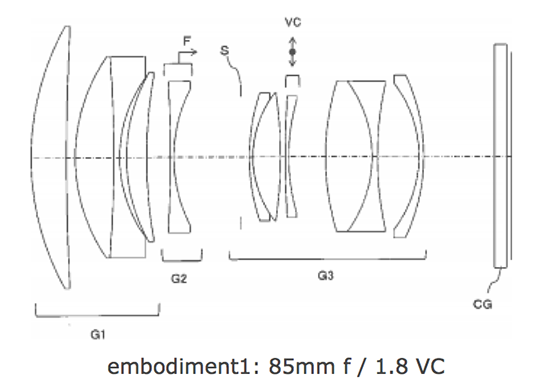
The Japanese site Egami spotted a brand new Tamron patent for a 85mm f/1.8 optical stabilized lens for Full Frame mirrorless system. We don’t have yet the official lens element design of the new Zeiss Batis but it could be that the Tamon design has been sold to Zeiss for the Batis?
Anyway, what really matters is that the lens performance is terrific no matter who actually designed it. And it’s quite common in the lens world to buy lens design from other companies. So this doesn’t diminish the value of the lens. Or, what do you think about it?
Both Batis lenses are now available for preorder in USA and Europe (UK/Germany)
Zeiss Batis 85mm f/1.8 lens in US at Adorama, Bhphoto. In Eu at Amazon DE, WexUK. In Asia at Digitalrev.
Zeiss Batis 25mm f/2.0 lens at Adorama, Bhphoto. In EU at Amazon DE, WexUK. In Asia at Digitalrev.
In Europe and Asia the Loxias can be found in Stock via [shoplink 36456 ebay]eBay sellers (Click here)[/shoplink] and Digitalrev (Click here).
94 Responses
There is option that Tamron release 85mn lens too. This is highly desirable focal length and a cheaper option would be more than welcome
An 85mm 1:2 macro would shake things up…
why would you need large aperture macro?
Because he probably likes the creamy diffraction when he stops it down to f22. 😉
He said 1:2 macro, not F1.2. He is talking about the magnification factor, not about F stops.
Depends on what you’re aiming for – personally I don’t like to stop down too far when shooting flowers (it gives more creative options than shooting at f16). The Tamron 60/2 was a great lens in that regard.
Why would you need a large aperture macro? So that it can double as a portrait lens duh? Aka Zeiss makro-planar 100/2. , leica 100/2.8apo, voigt apolanthar 125/2.5. Why carry both a macro and portrait for travel? Just because you like to haul dead bodies while traveling doesn’t mean the rest of us would too
I know there were a few lens designs shared by Sony/Minolta/Tamron (the 11-18mm comes to mind), but I thought the new Batis line was supposed to be an actual Zeiss design?
They use computers to calculate optimal lens design with desired lens properties as input.It is very probable the results are almost identical for gives set of requested parameters.
I doubt it is a tamron design. But more manufacturers the better!
Lens design is done using optical design software. Given the same set of constrains, the lens design can be almost identical then.
How many lenses have you designed?
Do you need a custom lens? I can share contact to a small company which does design and make lenses for optical measurement systems.
I was asking you, apparently you have designed none.
But the constraints can be different:
Because different glass-elements have different manufacturing prices, one lens needs maybe an additional element to correct other elements problem – or another arrangement.
Example:
Look at Element/Group-Count of 70-200 f2.8 from Sigma/Tamron/Canon/Nikon/Sony-A – all this lenses have the same requirement, but are constructued totally different.
There were very similar but not identical Tamron designs floating around for a 90mm f2.8 macro, too.
As long as it performs though, I couldn’t care less if it was designed by Zeiss, Tamron or Santa.
11 elements in 8 groups — matches the Batis.
That’s 3 groups in this design.
Iz gittin hot en har.
It would surprise me, given that Tamron doesn’t really go in for primes (other than macros)
Sounds like pure speculation
200+
Who cares? We, because lens with tamron internals for zeiss price is ridiculous
Would they be tamron internals? Or just optic design?
There are no “Zeiss internals”. At this point AFAIK all Zeiss lenses are made in Japan by Cosina (a very high-end optical company, so no worries about quality).
We can be almost sure that Zeiss doesn’t have any decent AF technology, so at least the Batis’ AF had to come from someone else. From what I’ve read about the performance and other characteristics, it might be the Tamron’s PZD.
Because Sony cooperates heavily with both Zeiss and Tamron, I wouldn’t be surprised if e.g. Zeiss traded their optical design for Tamron’s AF.
The ZM 15mm is made in Germany, as are many of the Zeiss Cine lenses.
All, of the Zeiss cine lenses.
This probably doesn’t include the CP.2. The glass at least is made by Cosina on the same production lines as the glass for the identical ZF.2. That economy of scale is the whole point of the CP.2 being rehoused ZF.2 instead of their own designs.
Supposedly the CP.2 lenses/elements are “hand selected” (QC’ed) by Zeiss in Germany, but we don’t know if that means they actually make any of the cine housings or do any of the assembly there. It could be that (and would be my guess that) Cosina does all of the assembly and Zeiss simply checks and approves/rejects the finished units.
CP.2 lenses are definitely assembled at Zeiss in Germany. The components aren’t made in Germany, they are just assembled there. Guys I work with have seen it when they were at the factory for training. They only work 2 days a week on cine lenses. The original CP lenses were not and they had quality control issues. Not sure about the C.Z zooms. I guess they are too. When the guys I know were there, they only saw CP.2 primes and Master Primes being put together.
The CP.2s have multiple floating elements each, so I don’t think the optics would be exactly the same, besides the CP zooms aren’t even available in any other mount.
Most Zeiss industrial, specialist and cine lenses are made in Germany (hand-crafted). Also camera lenses for formats bigger than 35mm. In other words: low volume gear.
Today ZM 15/2.8 is almost a built-to-order lens, so I wouldn’t call it “made in Germany”. If you ask them politely and pay $2k extra, they will make you any of their lenses (by hand!) in Germany instead of Japan. 🙂
$2k is the current difference between mass-produced 15/2.8 ZE/ZF (Cosina) and 15/2.8 ZM (Zeiss AG).
Lets agree that the “last ever made” 15/2.8 ZM was (most likely) made in Germany and lets call it a day. 😀
Oh great, someone else spouting off incorrect nonsense about Zeiss.
I would say $1200 is closer to Tamron prices than Zeiss, esp. considering the smaller market for E-mount
I would say different: except Otus, many Zeiss or Sony/Zeiss lenses are around $1000. No information about Tamron-prime-glass, but their zooms are typical $200-$600.
Agreed. Tamron prices are usually 50-60% of a comparable Nikon/Zeiss/Canon lens.
The lens was designed by people. Quality optical engineers, and all of the major lens manufacturers have quality optical engineers. If a great engineer for Tamron designs a fantastic lens, then people say ‘it’s a Tamron design…terrible.’ If that same engineer then is hired by Zeiss, then creates the same lens, then it’s a Zeiss design and is awesome. See how that works? Sure, Zeiss has a specific design philosophy and tradition that I’m sure is managed by the senior engineers and project managers, but ultimately, the lens designs are created by people, and there are brilliant optical engineers working for all these companies.
The real issue is often whether the company wants to spend the money required to produce lenses with complex optical designs, or special elements, or so on, or to assemble them in a way that yields tight tolerances and low variability. Since Zeiss already requires tight tolerances in lenses that get their name, and they aren’t afraid to spend the money on precision manufacturing, the ‘source’ of the design is irrelevant.
I can mostly agree. But Zeiss lenses are expected to have mix of properties which distinguish them from other brands. Excelent QA, coatings, sharpness edge to edge, 3D pop are typical characteristics of Zeiss. Me and many others here would be dissapointed if Zeiss produce a lens not having these characteristics. Others make some excelent lenses too but they are different.
Don’t buy it then.
If I’m buying a tamron lens, then I want to be paying a tamron price. For me, the ziess badge is one of Sonys biggest cons.
It’s not a Sony lens.
So we could hope that QC is better, somehow I like the Batis better than ZEs.
The Price is Zeiss!
We don’t know anything until Zeiss publishes the design of the 85 f1.8.
Well actually there are means to discover lens internals without disassembling it
I didn’t say disassembly was necessary to discover lens internals.
A plain image from the manufacturer of the design would suffice. Just as Zeiss does on their website with most of their lenses.
Zeiss might decide not to publish it because they won’t us to know it’s a Tamron design 😀
It is silly notion that Zeiss outsourced optical design of their SONNAR lens with T* coatings.
Sonnar is not a design anymore, it was maybe 20 years ago but now it’s just a name that has no particular meaning.
We already know that the Zeiss lens has 11 elements in 8 groups. That matches the Tamron design above.
The designs may be strikingly similar yet not the exact same, like the Contax 70-210/3.5 and Vivitar Series 1 70-210/3.5.
As if 11/8 design is any proof. My Zeiss APO 135/2 has very same design, 11/8 is very common design for longer Sonnars. And in the end, who cares what kind of cooperation may be behind lens, performance matters and initial reports of Batis 85 are very very good.
time tells the truth when they are both released
To all the geniuses in this forum:
1. This is not even a SR1 rumor, the admin just asked a question (… it could be…?)
2. Even if Zeiss bought the lens design from Tamron, it doesn’t mean the Batis is a Tamron lens for the Zeiss price. A lens has way more qualities than just the optical design. Why have Tamron lenses the reputation of being sub par compared to Nikon, Zeiss, Leica or Canon? The lens design? I think not. My own not so good experiences with Tamron and older Sigma lenses have to do with bad quality control, sample variation, tolerances etc, which are all a immediate function of the lower retail price.
Exactly my thoughts too. The old Sigmas were pretty inconsistent until the ART series which also included a price hike along with the greatly increased quality.
So if this Batis is a Tamron then it’s a Tamron with Zeiss QA standards which should imply significantly less sample variation compared to a regular Tamron. That alone should be worth the price, unless you enjoy regularly sending back new lenses for QA issues like softness, decentering and wonky OIS.
Thank you, Genius.
I studied computer science. I met quite some geniuses, but I’m definitely not among them. 🙁
@SAR_Admin, what makes you think the Batis is “terrific”, if you didn’t try it yet?
“…what really matters is that the lens performance is terrific…” he didn’t say it is terrific, he said this is what matters on this (and of cours any other) lens.
The only thing I want to know about Batis is if I can attach the Lens-Hood upside down for transportation.
According to the pictures it looks like I can’t.
I’m also not sure, but I would say yes.
http://www.zeiss.com/content/photography/international/website/en_de/desktop/website/landing_pages/batis/jcr%3acontent/stagepar/stage_2fa4/slide_8dbc/stageimageml_9dba/image.img.jpg/1429690466522.jpg/batis_stage_small.jpg
B&H had responded to a question on their pre-order page saying that it could be reversed.
Sorry, but I guess no one outside of Germany will understand this. LOL
anyone who speaks English gets it.
You have to speak german to recognize “Der Preis ist heiss”. Savvy? 😉
Nein.
LOL
oic, thanks
Ah, thanks for clarification. My apologies to the OP.
It would make sense that the Batis 85mm is a Tamron design as Zeiss has limited experience designing stabilized lenses.
Apart from all those video camera lenses.
Heh. M. Zuiko 75 f/1,8 – top-grade portrait lens for m43 – actually designed by Sigma, and, in my opinion, performs very close to Sigma 85 f/1,4. So, I wouldn’t be surprised, if Cosina (which actually owns Ziess brand) bought Tamron’s lens design.
The 75 is a fantastic lens.
I actually preferred the build of the 75 1.8 to the Pro line. The MF rings on the Pro lenses are fairly gritty while the 75 1.8 has a wonderfully smooth MF ring.
The thin aluminum on the 75mm dents and scratches easy.
I’ve have a lot of trouble with the focus/zoom rings on my 40-150 being scratched by my wedding band although I haven’t noticed it as much on the 12-40. To be fair though, that’s not a problem unique to Olympus, my 16-35 FE has the same issue.
All my Olympus lenses have scratches. I don’t mind for the 45 and 25 1.8- but the 75 really annoyed me. With the silver, it sticks out like crazy. Next time I’m going all black.
I had the black version and didn’t really notice any tendency to scratch like the 40-150, but I didn’t use it as often as I’ve used either of the pro zooms (hence why I sold it) so maybe that’s why.
Thanks. I’ve been eyeing up that 40–150. I saw a comparison to the 70-200 FE F4 Sony and …in terms of build…the Oly excelled. I hear it is quick as well and very accurate on the EM5II. I’d move my wildlife over to Oly but I’m not to sure just yet. Pictures look very promising- I should probably rent it.
No, Zeiss owns the Zeiss brand. However, they licence it to e.g. Sony, but not to Cosina. Cosina “only” manufactures lots of Zeiss lenses for Zeiss.
Cosina does not own Zeiss.
Cosina ownes Zeiss. I love SAR! LOL
Zeiss & Cosina is like Apple & Foxconn, the OEM things
*is rumored to be designed by Sigma, but never confirmed.
It’ll diminish resale value…but that’s just about it.
I doubt it. The rumor is just that Zeiss bought the optical formula patent from Tamron, not that Tamron is actually building the lens for Zeiss.
Well, I hope the rumor isn’t true and that tamron is actually making an 85/1.8 competitor. THAT would definitely lower the demand for the batis and diminish its resale value.
I like Zeiss for build quality and to a lesser extent for coatings. If they bought an optical formula patent from somebody else it doesn’t bother me one bit.
I like Zeiss for the badge on the side. It makes me look pro.
But that’s the tricky part, the “requested parameters”! One element needs to be light for OIS, but somewhere, where it impacts the optical axis. The focusing group also needs to be light. Not all elements can be toleranced the same. For which ones are you going to admit aspherical surfaces? Or exotic glass? It highly unlikely two designers optimize with the same set of parameters and with respect to the same merit function.
Back in the day I used to shoot with Contax SLRs and a couple of Zeiss lenses. One of my favourite lenses then though was the Tamron 90mmSP 2.5 – a brilliant, brilliant lens. If Tamron made a full frame e-mount version I’d get it in a heartbeat. With this story, I’m more excited to see that Tamron are designing lenses for full frame mirrorless systems which basically means full frame Sony E-Mount lenses may be on their way.
As for this specific lens, well Tamron design combined with Zeiss glass & build quality control sounds like it could be a wonderful combination. I’m waiting for more details on the lens itself, but I will say I’m saving up my pennies… maybe I should assume the best and put my old 85mm Sonnar on eBay. 😉
lol SAR spreading more rumours for click baiting.
Patent does not include OLED distance scale, so I doubt it is the same lens.
I think what is more feasible is that Sony asked both Tamron and Zeiss to come up with 85mm f/1.8 IS lenses for the FE system, and preferred Zeiss to produce its lens freeing up more resources for Sony for other necessary lenses. I think it is fantastic that Sony and Zeiss are coordinating between each other to populate the range of lenses.
So, it seems that the 85mm Batis is based on a Tamron design… click image to see both designs overlaid.
And a Tamron it is as the lens figures are identical.