







On that Youtube video (Click here) Tony Northrup claims that there is actually almost no noise performance difference on still images between the A7s and D810 (once you downsize the D810 images). Mark Galer spotted some “problems” with Tony’s test:
In response to Tony’s Northup “Pixel Density vs Noise” test.
There are a couple of problems with Tony’s argument. He is basing most of his judgement on a photograph of a white wall at ISO 6,400. The highlights of an image are more of an even playing field. The problematic area for noise in our digital images is to be found in the shadows and not the highlights. The test ISO has been capped at ISO 6,400 and the A7S low-light performance really becomes noticeable when the ISO is raised beyond ISO 6,400. 12,800 is the maximum ISO for the Nikon D810 (without artificially pushing it) and 25,600 is the maximum ISO for the A7m2 and A7R.
I would like to quote Ian Norman from the Lonely Speck website: “The sensor on the a7S is relatively ISOless between ISO 3200 and 51200. This means that for any given shutter speed and aperture setting, changing the ISO between these values shouldn’t change the relative level of noise in the image.”
http://www.lonelyspeck.com/sony-a7s-astrophotography-review/
This means that the A7S has two full stops more light collecting potential compared to the Nikon D810 for recording information in extremely low levels of ambient illumination, whilst holding onto the same levels of noise that is present in the files produced by the Nikon D810. I am not sure why Tony forget to mention this in his 22-minute video – but I can see why some people would begin to question his motive or expertise in making this assessment. This is a failure to recognise a significant leap in sensor development – and as Tony pointed out, the Video comparison at ISO 51,200 is profound – but Tony dismisses the A7S advantage as ‘in-camera software processing’ – truly bizarre.
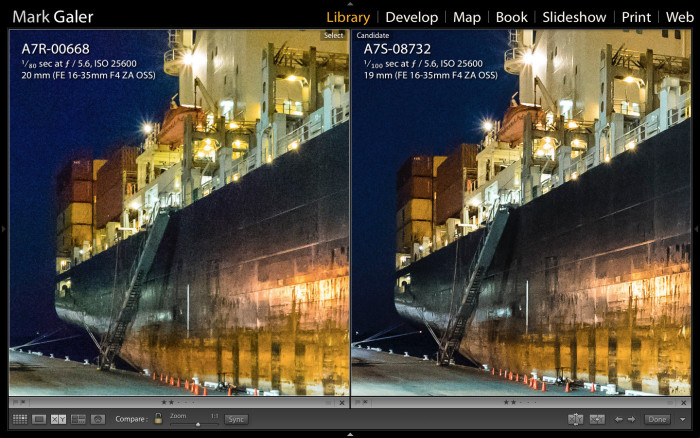
Click on image to see the full set of comparisons from Mark Galer.
Here is a link to the gallery of sample images.
https://www.flickr.com/photos/markgaler/sets/72157652903515692
This is a ‘real world’ test. No white wall and ISO values above and beyond the maximum setting capable by the Nikon D810.
I ‘exposed to the right’ and processed each file using the same settings in Adobe Lightroom. Noise reduction was switched off in camera. White balance was adjusted slightly to render the same colour for the pairs of files and a moderate amount of sharpening and noise reduction applied (+40 & +40).
The A7R stacks up well in these conditions (especially when expositing to the right) but the A7S still shows a clear advantage in additional detail and with less noise when the files from both cameras are exported as 4K files. The A7S still has a stop up its sleeve with noise at 51,200 not climbing above that being recorded at 25,600 although the low light conditions did not require any higher ISO values.
You can also discuss the matter on Mark Galer’s SonyA7 Facebook group:
https://www.facebook.com/groups/AlphaA7/
Sony A7s store links:
Sony A7s in USA/CA at Amazon, Adorama, BHphoto, Sony USA, Sony Canada.
Sony A7s in Eu at Sony DE, UK, ES, FR, IT, NL, BE, AT, CH, SE, NO, FI, PL. And Wex UK.
A7s Gariz leather case in [shoplink 27569 ebay]Black (Click here)[/shoplink], [shoplink 27570 ebay]Brown (Click here)[/shoplink], [shoplink 27571 ebay]Red (Click here)[/shoplink] and [shoplink 27572 ebay]Orange (Click here)[/shoplink].
225 Responses
At some point photon shot noise is not the only dominant factor any more. If there is less and less light, read out noise and pixel response non uniformity will play a part as well. And these noise sources are not independent of pixel number.
A really good (but little dated) explanation of ALL effects that account to the total noise is given here:
http://theory.uchicago.edu/~ejm/pix/20d/tests/noise/index.html
That’s an excellent article. It’s still valid, if a trifle academic for many.
True, but if you want to dive deeper into it than the first order approximation “Noise is independent of pixel size” (which is a correct first order approximation), this is what you need to read.
But if you are interested in the extremes (like the A7S ultra-high ISO), then maybe you do need to understand the issues. That said, there’s a bit more to the A7S in that it’s very clear it is optimised to give very low read noise at those high ISOs, which it cannot maintain at lower ISOs (as with the D4S sensor – maybe for the same reason).
In contrast, it appears from statistical analysis that the sensor designs in the A7, D810 etc. have fairly consistent read noise across the ISO range. Similarly Canon sensors have issues with read noise at low ISO (which is why they are competitive at high ISO yet rather deficient at low ISO if pulling details out of the shadow is important). That makes a difference to the sort of camera you might want to buy.
However, if it kills the idea that higher MP cameras automatically have higher noise at any given ISO (at equal output size), then I’m all for that.
Some of us made exactly those comments in the original thread (I also left a – lengthy – comment on the YouTube video). As usual, the issue is always over-simplified as it seem the public-at-large are considered to only understand a simple message. The truth is (as always) a bit more complicated.
In general, my advice would be if you only go up to ISO 6,400, then the A7S is probably not for you (unless it’s video, silent shutter or fewer corner issue on WA range-finder lenses which attract you).
The original a7 is more than enough if you shoot up to 6400 (very pleasing results in my experience).
>In general, my advice would be if you only go up to ISO 6,400, then the A7S is probably not for you (unless it’s video, silent shutter or fewer corner issue on WA range-finder lenses which attract you)<
Well stated.
Two question! Why that?
“a moderate amount of sharpening and noise reduction applied (+40 & +40)”
and
Why he don’t take a max resolution picture of the A7s and a downsize of the A7r file and show us a crop section?
And round and round we go…!
The basic premise of the ‘original’ article remains and, while Mr. Northup was hardly the first ‘debunker’, the statement is basically correct: more pixels does not necessarily make the image noisier.
I use an A7S because of the way it behaves, in and of itself, and gives me nice small files (relatively), not because I have some misplaced notion that it is low noise as it has fewer pixels. The sooner people judge a camera for what it does objectively, rather than comparatively, the better we will all be!
Well said Peter. Bottom line it’s about the camera you have in your hand not one your not going own. The A7s is a marvel at higher ISO. What it comes down too is what level of image quality the end user is willing to accept. I’m not a fan of noise but some folks maybe willing to accept higher levels of it. It’s a personal decision. Shooting a white wall to test it is not where noise will come into play, it’s more mid tones and shadow areas. Right out of the gate his test was wrong
“The sooner people judge a camera for what it does objectively, rather than comparatively, the better we will all be!”
When buying a camera of course you need to compare it to what else is available. Or rather anyone with a functioning brain would.
In relation to this article, I disagree.
When you start examining such notions in minute detail then the whole ethos is lost. My heart can soar if anyone says, “Wow, that’s a great shot!”, but it will be dashed lower when they immediately ask, “What camera did you use?”.
The differences in feel of the A7S & A7R are quite noticeable in the field.
I’m not actually sure if you’re agreeing with me, or not.
How does this relate to the issue of noise and pixel count?
>I use an A7S because of the way it behaves, in and of itself, and gives me nice small files (relatively), not because I have some misplaced notion that it is low noise as it has fewer pixels<
Not everything you say, but this struck a chord!
LOL. Way to go. Replace one broken article by another.
‘This means that the A7S has two full stops more light collecting potential compared to the Nikon D810’ WTF?
A person who still believes that you can capture more light by simply raising the ISO dares commenting on this issue? The best part is his flicker folder containing ISO comparisons with different exposure (SS). His conclusion is valid but the rest is s**t. Interesting coincidence.
Unfortunately most photographers are just ordinary people, not geeks, engineers or whatever. They know what button does what, how to apply some post process stuff and for them science ends here. Tony and this Mark are two of these guys.
See my post above, he’s not incorrect about his statement, it was just worded poorly.
ok.
The issue is more complex than that. “Exposure” has nothing to do with ISO. It only has to do with the amount of light that hits the collector (film or digital), which means aperture, shutter speed, and area are the variables that are important.
What’s being talked about with ISO is the integrity of the data collection, basically. A precise, accurate collection will indeed be more manipulative in post processing compared to less precise, inaccurate, or data with rounding errors in it.
I mostly agree with you here. This was one of the first things I tried when I bought my first A7R shortly after release and was disappointed to find that using a ‘virtual’ ISO 3200 results in significant posterization as well as a purplish haze. That said, you can definitely do less extreme underexposures and get high quality results (i.e. shoot ISO 800 and then push to 3200) and I think this is the kind of procedure to which the other author was referring. With that said, I’ve never had the opportunity to use an A7s so I have no experience with that camera.
What he means is that if you treat the A7S as ISOless from ISO 3200 and higher, then you can emulate higher ISO settings by underexposing at ISO 3200 and boosting exposure in post. Since the A7S is supposedly ISOless in this range, it would give you the same overall noise as if you had exposed at the higher ISO setting but you would retain data in the highlights that would have been thrown away with a higher ISO setting.
Yes and no. Yes in the theoretical sense. But often no in the practical sense. In most cases I’d rather have the camera do the ISO multiplication in an ISOless camera. That’s because raw converters are notoriously problematic with math precision. True, there are some that stay in the 32-bit calculation world and use good floating point math, but there are many that will happily calculate data in ways that create significant rounding errors in the data.
@Thom: In any comparison of the D810 vs. A7s, what effect do the different raw data compression schemes used by Nikon (14-bit) and Sony (11+7 bit) have on the final image? Is this important for bringing up the shadows?
Theoretically, it should have a small impact. Practically, converters get in the way because their color models and limited math get in the way.
I’ve written for some time: capture optimal data. That’s what you want, always, which is why I’ve said that Sony needs to offer a non-compressed option. What optimal data means is that 11 photons get recorded as 11 photons and 53 photons get recorded as 53, and nothing truncates, rounds, approximates, or otherwise alters those numbers down the pipeline. The Sony A7s has the advantage of having its sensor gain set to optimize data capture at higher ISO values, at the expense of not optimizing it at base ISO. The Nikon has the advantage of potentially getting more discretion in the data, but it’s optimized for base ISO.
I think a lot of people mix up a number of things that interact: resolution, acuity, sharpness, and noise. For example, noise–at least luminance noise–can be seen by some as “detail” in certain circumstances. But like rendering above Nyquist, noise is not actually resolution, it’s faux detail.
Personally, I have a much simpler approach to the problem. If I’m shooting in low light, I want a sensor/camera optimized for low light. In the Nikon world, that would today be a D4s or a Df; in the Sony world it’s an A7s. If I’m shooting in good light, I want a camera optimized for that with as much resolution as possible. In the Nikon world that’s a D810, while in the Sony world that’s the A7r. If you can’t afford to have multiple cameras to optimize for different jobs, you should probably end up with the middle choice (Nikon D750 or Sony A7II).
Yes, you can pixel peep and measure-to-death to try to put a “value” on what’s happening between brands or models, but for most people that’s not going to tell them much that’s useful.
What seems to be missing from many of these posts is that it’s not all about sensor noise. What is called sensor noise is actually a combination of sensor noise and quantization noise, introduced by the electronic circuits that measure the sensor output. these aren’t perfect either. By making pixels larger you obviously don’t create more light. However, you move the level of detected light that hits the noise floor of the electronic sampling of the sensor output. End result, cleaner images, particularly in the shadows, as others have pointed out. this quantization noise does not average out when down sampled.
Could this be the reason sensor manufacturers didn’t just go straight to 50Mpix 5 years ago??? Perhaps? Both sensor noise performance and this effect have been improving year on year, hence the gradually creeping up resolutions, with relatively unchanging noise. The a7s stands out as it has stepped away from this continuum.
Tony who ?
Haha.
Mark is also a bit ‘off’ here by quoting that the A7S is ‘ISO-less’ between 3200-51200, which he seems to take to meaning that there is no difference in noise, which is not the same thing.
Tony (and DPR and especially that idiot Rishi Sanyal) fails to grasp a very very VERY simple fact, high ISO performance is not ‘just’ noise. It is how the sensor performs at high ISO’s, which means actually bothering to look at things like colour performance and dynamic range, but it seems those things are only ever important at base ISO.
I have stopped valuing anything DPR has to say so long as Rishi has some kind of input.
I never did.
You are right in that high ISO performance is all about maintaining DR. However, it’s not unrelated to noise, but it’s a different sort to the stuff Tony seemed to concentrate on. At high ISO, it’s sensor read noise which is dominant and for that you need to poke around in the shadows. Taking photos of white walls just gives you shot noise (at other than hyper-high ISOs) which, for any decent sensor, will be much the same for any given sensor format as it’s innate to the light. (SLT cameras apart, as they throw away about 1/3 of the light before hitting the sensor).
Strong words against Rishi Sanyal. Using words like these doesn’t shed good light on you, irrespective of whether you are right or wrong.
Why?
He is certainly not an i… I agree with you on color performance etc. Above I posted a link to a high camera comparison where it is clear that the A7s performs very nice in this regard.
I think he can call anyone he wants an idiot. You two don’t have to agree…
He can. But why should he? Emmanuel Kant anyone?
His tests, which have become such a huge part of their reviews are seriously flawed as are the conclusions he draws from them. Any time you question them they are ‘holier than thou’ and can do no wrong, everyone else must be an idiot in their eyes.
‘We also found the a7 II to have 1-2 stops worse ISO performance than an a7S or D750, shown in our studio scene & confirmed by DXO.’ saying ‘confirmed by DXO’ I guess means that they don’t expect anyone to actually look? And which is it, D750 or A7S? I mean of course it is the D750 because they have a glory hole shrine to that thing, or at least Rishi does.
Or how about:
‘The differences are quite visible, with the D750 pulling ahead by a full stop at ISO 6400… In fact, in terms of ISO performance, the a7 II appears to fall near performance levels of the smaller, APS-C sensor in the Nikon D5300’
So apparently the A7 II falls way behind the D750 and is close to the D5300… now according to DXO which is it closer to?
“glory hole shrine”? Difficult to prove. As I own the A7ii and D750, the D750 seems to have a visible advantage when I take (non-scientifically) pictures of similar targets with the same lens (adapter on A7ii) and histogram as close as possible.
As I’ve written for some time, maybe even the entire history of DSLRs, the issue is the integrity of the data. Noise is just one way you look at whether the data collected is optimal to the scene being recorded, not a be-all, end-all stat that determines winners and losers.
Simply put, Sony biased the gain and pre-amplification in the A7s sensor towards high ISO integrity. Most cameras bias towards base ISO integrity. This does make a difference as you scale up the ISO values.
I wrote when the A7s came out that I thought this was a good decision by Sony. Basically they gave us the choice in three models that were otherwise the same of what part of data integrity we valued most, with the A7 itself a somewhat balanced camera in the middle.
On the Nikon side, we don’t get as clear a choice, though the D4s/Df is tuned more like the A7s and the D610/D750/D810 are tuned as ISOless from base. Still, I don’t have the choice in the Nikon side of picking up an identical body purposed differently as I do in the Sony lineup.
Cant they combine that two bias in one sensor? Dual gain or something?
Agreed, except from calling someone you don’t really know, an idiot.
The A7r images still retain more detail which
you could sacrifice to further NR and end up with very similar noise and detail
levels. Especially when you take final display/output size in to consideration
the bottom line is if you need to look at 100% crops or shoot at 52000 ISO to
see any differences the “differences “for pretty much all real life
applications are indeed unimportant.
You should get your hand checked out.
Its interesting to read so many people talking about noise using simple words, its much more complex than that, and as much i like tony’s show, sometimes he just miss the ball. This mark Galler just didnt make any science here… and iso less is not just from the 3200 to 51200, the iso less goes for all of the sensor 3200 is just the base iso from A7s so the maximum dynamic range should be at that iso. I will no try to explain the noise dilema but theres much more than noise only, dynamic range and color should be at least be mentioned here.
The A7S is not iso-less at low ISOs (which is why the DR is relatively poor at high ISO). It’s optimised for the high ISO end (at lower ISOs read noise grows markedly).
In contrast, the “mainstream” Sony sensors exhibit iso-less behaviour for the great majority of the ISO range. It’s just that the read noise is notably higher than the A7S achieves at the high ISO end (a statistical analysis reveals that that the A7S read noise at high ISO is around the half and electron charge level – that’s truly remarkable. About 3-4 times better than that in the A7 or D810).
Tony Northrup was mistaken, he mean the Nikon D81000 with the QuantumFilm Sensor release in 2021 is in noise better than the a7s. But he forgotten to say, Sony release 2019 already the Sony a7siv with the same Sensor……
No Noise with a small candle.High Dynamic Range. No Rolling Shutter. Clear bright Colors:
All benefits QuantumFIlm Sensor here:
http://www.invisage.com/technology/
Test Video here:
https://youtu.be/tMBI1DLWp8U?t=3
He’s giving you that real-world “what he does in the field” scenario with the slight grade/tweak.
As for downsizing the A7R to match the A7S via software that’s not what anyone does, photographer, or more importantly, client. I’d suggest Mark’s method is more accurate as photographers/clients/editors all click that 100% button within seconds of seeing a file they like, they shouldn’t, but they do.
I donwsize high ISO images before working in PS. Smaller files, less noise, benefit for me.
Sounds like a plan. I’m lazy, I grab for the A7S over my right shoulder when the light gets low, horses for courses. There’s no right or wrong way on a journey, just getting to the destination from your particular starting point. But I’d respectfully suggest you’re the exception in this case.
This site or Mark site talk to??? Client or equipment enthusiasm? Where the interest to talk a client language when no client will see this video???
“As for downsizing the A7R to match the A7S via software that’s not what anyone does”
At the start, nobody did that kind comparaison, where your point? Who you know reduce at 4K picture before showing to the client or did print?
I’m not here to take defense ok Tony Who, but Mark answer to Tony.
Never understand why when we are talking about high performance or pixel peeps, they’re always nobodies to come and tell we should never do that?
Finally, OK you think it’s a pertinent test…Cool Why not!!
I’m sure the original files test are not delete. I’m curious to see it!
Just buy it all. Solves the problem of having to compare. Done.
And hire a couple of Sherpas to carry all your gear all the time
A comparison of horshack in a dpreview forum (A7s,A7r,A7,Df). A7r is close to D810, so it is not a perfect comparison but gives an idea, when colorshift sets in compared to A7s:
http://horshack.smugmug.com/photos/i-5Dd3Tbn/0/O/i-5Dd3Tbn.jpg
Here is the complete version (starting with base ISO)
@12800 and up A7S is clear winner. But interestingly I would give A7R an edge over A7
http://horshack.smugmug.com/photos/i-mTFMHrZ/0/O/i-mTFMHrZ.jpg
A7S looks better at 6400 and 3200 too. Especially in dynamic range and shadow noise.
Only because you can’t see the difference on some test charts, or Tony on his white wall (LOL), doesn’t mean they aren’t there.
That’s the fundamental logic behind any physics experiment. If you see something than it’s there, If you don’t see something, doesn’t mean it’s not there. There are many possible reasons for that. Wrong testing procedure (white wall), incapable measuring equipment (that includes your eyes), you name it.
I see the difference at medium ISO’s. That’s what matters to me. That’s why I’m willing to pay more for an lower resolution A7s than a higher resolution A7R or A7.
Tony says it’s a myth. I say it’s wrong.
These stuff have created a lot of mess lately, people do talking about Tony, DPR, so on. Why never have an phd. engineer to educate us and give the real knowledge on these….
“I am not sure why Tony forget to mention this in his 22-minute video – but I can see why some people would begin to question his motive or expertise in making this assessment.”
Because Tony is a tool.
This is not the first time that, in order to prove something he wants to pass over as true, bashes a brand in favor of another.
He did it when talking about FE lenses as well, ending up making a commercial for Nikon.
Everything he does ends with “buy my book”.
Some people are really good in building a reputation on bullshits and wrong stuff: like the crop factor of the lenses, right Tony?
How to make money on nothing.
For the lens crop factor he was perfectly right. I never understand how people can’t see just by a look how much more light pass true a 50 mm 1.8 fullframe lens VS a 25mm 1.8 4/3
Mistery of life
OMG, here we go.
f stop doesn’t change with a crop sensor.
It’s the DOF changing.
If the video was telling that you were right but it’s not!
In few words the video tell: if you put a FF lens on a crop sensor 75% off the light bring by the lens will be outside the sensor. Tony try to convert this lost on the f/ scale.
Simple thing!
I like Tony. He’s very personable, has a great web presence, and I truly believe he’s got great intention trying to help beginners ‘de-mystify’ some of the more obscure areas of photography.
However (like me) he’s not an overly ‘technical’ photographer, and I really think he should refrain from trying to be one. I’ve found a number of his technical videos/discussion to be misleading. There are certainly many better able to discuss/explain those issues.
but hey, it’s a great way to get traffic!
Tony is actually right on this issue. You can compare the raw image downloaded from DPR yourself, when D810 at ISO51200 is downsized to 12MP, the noise is indeed significantly higher than A7S. But you can also notice that A7S has built-in noise reduction which is only activated at high ISO, and results in very poor sharpness. If you apply some noise reduction in ACR for D810, I would say the result is pretty close, D810 even wins a little bit.
On the other hand, A7S is the king of video, because most of the cameras are only using a small part of its sensor when capturing the video. A7S also has an amazing EVF which is close to a night vision, something that the OVF can never achieved.
I do not see poor sharpenss in high ISO on my A7s :)… Or at least much MUCH less than expected on such high ISO.
OK let’s agree to disagree and change the word here: it is relatively poor. Anyway, my point is D810 has more noise but also more detail, and after some cooking it is at least as good as A7S for still photography
“A7S is the king of video, because most of the cameras are only using a small part of its sensor when capturing the video”
It uses 2/3 of the sensor (16×9 section of 3×2 sensor).
…I think, what he try to say ist not, that the A7r, D810 and so on, are better at ISO12.800 and more. What he wants to say is, that you don’t see a difference from ISO100-6400. Over ISO6400 you get problems with the shadow colors at the 36 an 24 mpix sensors. But up to ISO 6400 you can scale the image and you won’t find that difference you might expect. And for that, he is right…
Comments I posted to Tony’s video on YouTube:
——-
For equivalent-generation technology sensors, a lower density sensor will have better High ISO Dynamic Range vs a higher density sensor. This translates into lower shadow noise at high ISO, which will be most visible in images dominated by dark tones such as night scenes. The amount of noise in the midtones and highlights will be the same. As you move up to ultra High ISOs, what were the shadows at lower ISOs become the midtones at high ISOs, and the overall noise advantage of the lower density sensor becomes more obvious. Here is an A7s vs A7r comparison I did that helps demonstrate this, using the same absolute exposures, lighting, and lens, and normalized to the same resolution:
http://www.dpreview.com/forums/post/54031579
Here is the technical explanation behind this:
http://www.dpreview.com/forums/post/55278918
http://www.dpreview.com/forums/post/55280773
Lastly, for tripod-mounted High ISO comparisons, a higher density sensor will have an unfair testing advantage over a lower density sensor owing to the nature of real-world, shutter-speed limited shooting scenarios. I discuss this in more detail here:
http://www.dpreview.com/forums/post/54024514
——-
Tony’s response:
Well, the theory sounds fine, but I looked at actual scores for every camera released in 2014 and found no correlation between pixel density and noise. Then, I did my own real-world tests. In practice, I can’t find any relationship. It looks like you compared 100% crops? I discuss in the video why that doesn’t relate to real-world imaging.
——-
My response:
Tony, the score you’re relying on from DxO is a composite based on a hard cutoff between SNR, DR, and color depth. While that score is useful for a quick, cursory evaluation it does not reflect the full dynamics of sensor noise performance. If you dig deeper into the individual DxO data points you’ll see the High ISO DR differences I discuss – those relate to shadow performance and are a direct function of pixel density for equivalent-technology sensors, the basis of which is explained in the technical links I provided. For example, at ISO 12,800 DxO measure’s the A7s’s DR at 9.53EV vs the A7r’s 7.97EV – that’s a full 1.5 stops better and the difference is clearly visible in the deep shadows. My A7s vs A7r comparison used 100% crops that were normalized from 8MP downsamples of raws, so they correlate directly to DxO’s “print” measurement and are relatable to real-world imaging.
I like his response that 100% crops don’t relate to real world when he’s shooting white walls.
Your tests though are still the best I have seen for this type of comparison.
Thanks Slingers. There are a lot of pitfalls when performing noise comparisons between cameras and unfortunately most comparisons fall into one or more of those methodology pitfalls. Not only does one need to use the same ambient lighting intensity and absolute exposure, you also have to use the same lens to make sure it has the same light transmission (t-stop) and ideally one with a physical aperture ring so that you discount differences in electronic/mechanical camera aperture control. One also has to use a scene that contains not just midtones and highlights but also deep shadows as well.
Wow very well done mate.
Resolution adjusted, noise of identically sized CMOS based sensors of similar generations is almost the same. The major difference is the improved dynamic range and color dynamic at high ISO, which leave you significantly more room for image processing after noise reduction.
This guy forgot to apply some NR for A7r before downsampling. In my experience the A7r is not worse yet on this sensitivity.
Mark is right.
Tony photographing a white wall and re-sampling a high resolution image to compare it to a low resolution image is as far from scientific as you can get. If Tony knew the real intricacy of digital optics and photographic testing he would stick to photographing birds and posting pictures.
To re-sample a high resolution image into a low resolution image and then compare the noise to that from another low resolution image is totally pointless.
A high resolution sensor with smaller pixels and lower signal to noise will produce more detail and, unfortunately, more noise.
There is no free lunch.
hahaha
>To re-sample a high resolution image into a low resolution image and then compare the noise to that from another low resolution image is totally pointless<
Exactly!
I hope there is a sort of sarcasm in there
Why do you hope for sarcasm?
because I hope people are intelligent – at least a little bit
To compare the noise of a high resolution image to a low resolution image without downsampling the high resolution image is completely pointless. There is a good point to be made about shadow noise vs. highlight noise. But mixing it with the silly idea that 100% pixel peeping is the way to determine noise levels just undermines the credibility of the argument.
Nobody buys a 36 MP camera based on how much noise it shows after being re-sampled to 12 MP.
There is a place for re-sampling a high resolution image but it has to do with optimizing an image taken in insufficient light:
1. Purposely underexpose the image
2. Process the image back to where you want it
3. Look at the noise level
4. If too high, down-sample, experiment, reducing resolution reduces noise.
There is an optimum in there. Find it.
5. If necessary use some final noise reduction without smearing the image.
I buy it to get the optimum resolution at low iso’s, the target application for me with this camera. For higher ISO I know that I get better results when downsizing to, say 16MP. No problem with this for me. I trade MP in this scenario for a better S/N ratio.
Exactly.
Perhaps comparing prints would be a more useful test for you – same setup / settings and prints at 8×10 & 16×24.
Thanks for the idea, but I don’t print. It introduces a whole other world of variables. A large, high resolution photo monitor does just fine.
The point of downsampling to 12mp would be specifically to compare to a 12mp camera. Alternately printing both at 8×10 or 30×40, or preparing each to be viewed at a given size at the same size on the web would do it. But if your use case doesn’t involve any of these, then I think your use case is a very uncommon one. If you only every view at 4K on screen then reduce the images to the size of your screen and compare them that way.
Agreed.
“noise reduction was switched off”
There’s no reason to believe that RAW files are not cooked — even A900 applied NR on B&R channels.
They both have their place, but the A7S is vastly superior for lowlight stills, as witnesses out in the real world above 3200 ISO.
At the end of the day, Tony Northrup (and good for him) is simply generating ad-revenue from novice shooters. His discussions add little value to practical shooting situations, they are what they are, revenue generators.
We are at the step you attack the credibity with a totally lack of arguments???? I’m done with you! You should have better thing to do with your high end professional photographer time. Have a good day.
Why argue intangibles, it is what it is, this is not an exact science, you should know this!
Nikon cameras tend to have little noise and a really high dynamic range around ISO 100-400, and are hence especially suited for any kind of photography that needs high dynamic range, good color production at lower ISO. Yet D800 and D810 are nice allround performers, and you will be able to get cleaner high ISO photos by downsampling the 36 megapixel images when you need cleaner images in low light.
Now, if you look at A7S, it’s sensor doesn’t have as much performance regarding dynamic range and color production on the lower ISOs as the Nikon cameras.
What’s interesting about the A7S, is that it can provide a much higher dynamic range at higher ISOs compared to all other cameras. At ISO 25600 the A7S still has a 9 EV step DR, while the D810 has 7.3 EV steps.
As a D800 user I’m happy with the low light possibilities for my own needs. But for photography where really high ISO (12800-409600) performance matters, the A7S would be a much better choice considering dynamic range alone. And then the signal-to-noise diagram seems to tell the same.
Check the diagrams for signal-to-noise and dynamic range under the Measurement tabs at DXOMark: http://www.dxomark.com/Cameras/Compare/Side-by-side/Nikon-D810-versus-Sony-A7S-versus-Nikon-Df___963_949_925
To me it seems like Tony Northrup hasn’t tested thoroughly enough. DXOMark’s results shows that the 12MP A7S performs better at the really high ISOs compared to 36MP D810.
I don’t know what settings Mark Galer had used and how he did his post-processing, but when I look to a neutral source (DPReview) and I compare both prints, up to 6400 there is hardly a difference visible. Maybe a slight edge in terms of noise to A7S, but a better sharpness for D810. I guess if I run a slight gauss filter over D810-image, the result is equal.
I trust DPReview more than anyone in youtube.
You’re right to be skeptical of “tests” – trust your own eyes for what YOU shoot!
Actually I trust my eyes – but it is hard to shoot without the equipment… But thats’s why I look at DPReview, DXOmark and other sites
In this case I’d side with Mark, plus, he’s got the work to back up his assertions, that’s a big plus. Problem with DXO, they test to a very narrow criteria. I’ve got files from both cameras that look almost indistinguishable where they shouldn’t, and files from the A7S that look simply stunning at lower ISO’s. Color and quality of light are rarely taken into account on these tests.
Go look at those 5DS R shots over at DPReview (100ISO) and tell me what you think is wrong there. Testing cameras is a fools errand unless its a longterm test on real-world assignments.
Agreed. I trust my eyes too. That’s why I like the DPReview Studio Comparison Tool, and why I don’t like DXOmark.
It ISO6400 DPReview shows the A7S holding about one extra stop of dynamic range over the D810.
At ISO12800 it’s about an extra stop and a half.
Be careful with DPReview, because they use different lenses with different T-stops and different sharpnesses, so the sensors are getting different light levels.
Good point, Tony.
Honestly I never look at the used lenses…
This was the first time and the Nikon lens has a T-stop 0.2 below f-stop. The Sony 0.0X – I would say there is no disadvantage to the D810.
I can do the same comparison with A7R, too. Same lens as A7S, same result as with D810. As long we are not in high-ISO of 12800 range and above, your theory is true.
The one thing I don’t understand is, why a CMOS with higher pixel density can gather the same amount of light as a sensor with lower pixel density. I would understand that fact, if we were talking about BSI-CMOS. But in standard CMOS, each pixel has a kind of a wire-frame that blocks light.
Sorry for talking back, but once again I don’t understand what you two are talking about.
When I set two cameras to a certain ISO, then both cameras will have the same ISO. The actual ISO may slightly differ from the value on the display or ISO dial, but it depends not on different T-stops. Different T-stops will cause different shutter speeds on both cameras, which have no influence in a sensor testing scenario.
In real life you will of course benefit from a slightly better T-stop (needing a little less ISO), but that’s pretty obvious.
In case I misunderstood something in your conversation, I would be glad to be enlightened.
Yes and at ISO 200 the A7S results look indistinguishable from my NEX5N. So what’s your point? That there is no relationship between noise and pixel density up to a certain ISO step, like Tony said? Right, that’s true even to my NEX5N to a certain point. But what’s the meaning of that? Does that prove any of Tony’s wrong generalized statements to be true?
Sorry, I don’t get it.
Mark seems to be too much in love with Sony. And most of the time he just skips the problem or finding an arguable/unrealistic method to show that Sony has no cons.
example in a comment section about WB: https://www.youtube.com/watch?v=rQWesejlA9c
PS. Same happened with Gary Fong, too much relationship with company. They never say about cons only about pros (even when cons outshine pros of same feature)
“Mark seems to be too much in love with Sony”… and Tony always seems to be too much in love with Nikon and Canon….!
that’s why he filming with Panasonic G4, and one of his favorite cameras for his travels is a6000 even when he outshine cons 🙂 ?
Yeah man, I think you’re off point on this one. Normally your comments are pretty tight. Have you watched all of his videos? He’s a big Sony fan as well.
I don’t see any love for a particular camera brand. Tony seems pretty much unbiased in regard to camera brands. Dunno about Mark.
The only brand Tony cares about is his own one. 😉
Well, he’s sponsored by Sony, so of course he’s biased. For the record, we’re unaffiliated with any camera or lens manufacturer.
>For the record, we’re unaffiliated with any camera or lens manufacturer<
Nor overly experienced, often drawing erroneous conclusions (setting effect OFF) for better/faster/more accurate Auto focus when shooting in a dim aquarium.
Tony Northup is somewhat arrogant and biased on his reviews, and on that one he exceeded himself. I actually couldn’t even see it all, so absurd it was!
All this back and fourth arguments, calling Tony and Mark this and that, kind of makes me bummed.
tony n = ken rock…. same shi*
both trinig to make money from the imbecil who visit their websites….
Making money is not a bad thing. Talking s*it and teaching beginners with false facts is a bad thing. In this regard Tony = Ken.
Considering your tenuous grasp on spelling I’m not sure who’s the ‘imbecil’
Nobody should listen to this Tony weasel. Why even bother, he has exactly zero scientific credentials to test anything properly.
Having scientific credentials is secondary case in relation to the topic at hand…which is….has Tony adequately provided support in regards to his view on pixel density and ISO noise? He’s using a lot of primary resources in order to state his case. I’d take up issue with that rather than his “credentials.”
“to test”…
Who cares …. in film there was a grain now we have a noise but for price of extremely high ISO … I think film is better but in some way inconvenient way to operate in still life photography …
Digital photography rules since amateur photographers are spending in massive amount of money for taking sunset pictures and they LOVU to have discussions on photo – equipment …
From marketing point of view these forums are very educational.
I embrace the noise. I often just leave it there. It’s of little consequence for most applications and I rarely go about 3200. If I have to go above that I introduce light.
It’s not the noise that bothers me, it’s the low dynamic range at higher ISO values. The noise is not that different between D800 (downsampled) and A7S, but the dynamic range, color fidelity, shadow details is so much much better with the A7S. In that regard the A7S is spectacular.
So, I embrace the noise too, but I do not embrace flat dull shadows.
Film was different. An ILFORD Delta 3200 is just grainy, but it contents huge amounts of silver for tremendous shadow details at ISO 3200 (which was the extreme end in film days).
I’ll have to give it a try. I normally don’t go above 1600. However, I’m intrigued to think about the types of night shooting scenarios in which the A7S could be applied.
I’m pretty sure the reason he cut off the test where he did is that he would consider anything shot at an ISO that high to be unusable anyway. One might be better than the other eventually, but they’re both full of noise regardless. Tony seems to be of the mindset that almost any noise is unacceptable, and must be removed in post if present. I suspect that this has to do with his stock photography business, where noise is entirely unwelcome.
But if you’re willing to accept a certain amount of noise and push it, like Mark does, then you can get better performance.
I would say that they’re both right.
I’m concerned with a different approach. Same ISO comparison, but scale a7s up to a7r native resolution rather than scale a7r down to a7s resolution. Both cameras offer great iso for smaller web needs. a7r can be tweaked for perfection with lower resolutions required for proofing. But I’d question a7s ability to survive enlarging.
Point being, I’ll stick with the higher megapixels. Looks like everyone can have their preferences for how they need output to behave.
About a week ago, I have started a thread ” A7S: King of Dynamic Range.. ” Please take a look:
http://www.dpreview.com/forums/post/55762379
If you can live with some technical details, this is an excellent write up from a scientist-cum-photographer’s website:
http://www.clarkvision.com/articles/does.pixel.size.matter/#sensorconstant
Go to this section of the post (Hit control+F and paste the line below)
Different Sized Pixels in the Same Sized Sensor
To paraphrase Dr. Clark’s explanation, the advantage of large pixel size (as in A7S) over the smaller pixel size (as in D810) in same sensor size (full frame) is very real in high ISO situations. When there is abundant light, or image highlights region, the difference between noise (in terms of print size, as referred to be Tony Northrup) in the small pixel size sensor (D810) and large pixel size (A7S), is not very apparent up to a certain ISO, which appears to be 6400 for for these set of cameras. Beyond ISO 6400, A7S is a clear winner, which was also reported by DPReview.
Further, to credit Mark Galer, his points about Tony Northrup’s methods having shortcomings (tests on white wall, up to ISO 6400 only) are consistent with Dr. Clark’s explanation.
Finally, Tony Northrup’s comment about A7S having low light advantages at very high ISO stemming from ‘software’ are truly absurd.
As I mention below, I did the white wall test after finding the D810 to be cleaner in real-world tests. I wanted to do something more objective, and a white wall reflects all colors evenly.
It wasn’t a super-high ISO test… I didn’t test ISO 25,600. Higher ISOs might be different, and that doesn’t mean my findings are invalid, it just isn’t what I was interested in studying at the moment.
Re: the a7S benefits during video being from ‘software’, you’re right, that passing comment isn’t completely right. It really was just a passing, unplanned comment, and in my mind, I was thinking, “If the D810s stills are cleaner when scaled to the same resolution, than proper software processing with the raw sensor data could make the video just as clean.”
The problem, of course, is that the D810 can’t dump all that raw data and blend the pixels together into 4k at 30 frames per second. The a7S can (because it doesn’t have to scale anything). That’s not software, that’s definitely hardware.
That one comment wasn’t at all related to the topic of my video, but you’re right, it’s definitely not a software-only advantage, and I hope that clarifies my thinking.
Tony, thanks a lot for your reply. It does clarify the scope of your video.
It is reasonable to hope that no one is clever enough (or has time/energy) to understand and explain all the technical details. So that passing comment is entirely okay, especially given the fact that you took time to correct it.
This is my first communication with you so I wanted to add that I am a huge fan of your work. If I may add, I’d say that if the video was titled appropriately, it would’ve been perfectly fine. Something like “Noise in Small vs Large Pixel Size in Full Frame Sensor for Still Photography upto ISO 6400”.
Finally, thank you for making that video, I definitely learnt from it. 🙂
mate, I’m just an amateur and sometimes even happen to shoot jpegs: have a look yourself between a d800 and a7s what happens, shooting raw helps a bit the nikon but it’s the same story.
d800 file https://flic.kr/p/nNjAtq ISO6400
a7s file https://flic.kr/p/qNXYrP ISO12800
oviously I also have same subject and same lighting comparison and results are the same of mr Galer, only don’t have them on flickr.
So what you’re saying is you paid over 2k to take a low light photo of someone dialing on their cell phone?
actually 3 grand if you account the lens.
I also find it fantastic to take pictures of my son’s dirty nappies, wanna check the noise level on those?
A7S looks like it should, but although i think its much better in low light than D810, your Nikon example is not the best. D810 does much better than this at 6400.
Only showing low ISO results and then claiming that sensor size doesn’t matter when it comes to ISO performance is a fairly irresponsible thing to do.
The difference between D810 and A7S in low light video is tremendous. Of course I’m not talking about line skipping artefacts. I’m talking about dynamic range, noise and the overall look.
So, you say it’s all made in software? Coincidently I’m a software engineer and I would be glad to hear about the technical details that let you make such a bold statement.
Please tell us, what exactly Sony is doing with their software, that their results are so much better despite a D800-comparable (in terms of low light performance) hardware.
He just said “that’s not software, that’s definitely hardware”. What are you on?
Yes, he corrected himself somewhat: “..it’s definitely not a software-only advantage…”, but he obviously still thinks there is a significant software advance. I just wanted to know why he believes that this is the case.
Besides that, I don’t think it needs any drugs to get slightly confused by Tony’s contradicting statements.
I think you are an arrogant person who would rather wage a personal crusade against an individual than take the time to understand and engage with that individual’s views. I think your constant references to his wife are enough to suggest the personal crusade. And your belief he contradicts himself demonstrates the lack of understanding. Above, that individual took the time to write this to you
“It really was just a passing, unplanned comment, and in my mind, I
was thinking, “If the D810s stills are cleaner when scaled to the same
resolution, than proper software processing with the raw sensor data
could make the video just as clean.”
The problem, of course, is
that the D810 can’t dump all that raw data and blend the pixels together
into 4k at 30 frames per second. The a7S can (because it doesn’t have
to scale anything). That’s not software, that’s definitely hardware.”
If you believe this oversight affects the central point in the video under contention, you haven’t watched it. If you think someone having different beliefs as they learn new things over time is contradictory, you must be God; or a simpleton.
I have to admit that I was the first who made a personal comment. It’s possibly my own fault that you get personal in return. I apologize for that.
Chelsea is definitely not the reason for being critical to Tony. I just think she is hot, and made some jokes about that.
Feel free to read my comments again to get my point(s). I will do the same with Tony’s.
Very cool! I’m glad someone did a high-ISO comparison between the a7S to the a7R.
I don’t think it has much to do with my study of the relationship between pixel density and noise, however. I was primarily interested in the theory, to see if we’d be doomed to choose between noise and detail as this new generation of 50 megapixel cameras are released. I checked the sensor scores of every camera released in 2014 and didn’t find any relationship between noise and pixel density.
I also compared the D810 and a7S at ISOs 3200-12800, and in the video, I used the results from ISO 6400 (but I found the same results across the entire range). I found that the D810 was a bit cleaner than the a7S at that range…
BTW, I took pictures of a white wall to be objective about it, but I started that study because I was hired to shoot stills for a band in concert and I brought both the a7S and D810, and the D810 was distinctly cleaner.
Is the a7S the winner at higher ISOs? I’m sure, as the D810 doesn’t support them natively. Anyway, that wasn’t the topic of my video.
So I must be a Nikon snob fanboy who hates Sony, right? Well, no, and if you look at our two a7S comparison videos, or my latest column in Rangefinder magazine, you’ll see that we’ve found the a7S (and Shogun) to be simply unbeatable. It’s our main video camera. We have three Sony cameras and probably half-a-dozen native lenses.
We took a family trip to Madrid last month, and I brought only the a7 II and a bunch of primes. It’s my favorite casual shooter (and we have one of everything here). I keep it in B&W mode most of the time, because I like using the viewfinder like that. I love the SteadyShot inside, especially with fast primes handheld in low light. Night photography at ISO 100 without a tripod is game-changing. I love it.
Chelsea brought the D810, because she’s a snobby fanboy. 😉
Sorry I don’t watch any of your videos, I find them to be too boring.
I don’t feel any way towards Tony, but this comment tickled me. Perhaps work on your delivery, LOL. You can do better, Tran man.
Well, at least Chelsea had those dual cards slots in the D810 as back up. One card slot for a trip out of the country…man, you’re living on the wild side. Crazy, just crazy.
It makes sense Nikon didn`t include higher than 12800 ISO, because as a pro camera (semi-pro whatever people find more precise), it shouldn`t have option to capture unusable photos. On the other hand, we are seeing thousands of more than usable 51200 ISO from A7s, and that speaks volumes for itself, tests are redundant. Maybe you could have avoided all this internet mini war if you only stated that “In low ISO levels, pixel density has little impact on noise.” Because those levels are indeed low to what Sony does today.Why would Sony ever sacrifice so much resolution only to achieve nothing?
Tony, you seem unwilling to consider information that runs contradictory to your thesis. Perhaps this is the consequence of having invested the time in producing your video. However if you look more closely at the DxO data you quote to support your thesis you’ll find it actually supports the opposite conclusion. As I wrote on your YouTube page and also repeated in my comments further down this disqus discussion, pixel density relates to more read noise at High ISO, which translates to lower High ISO dynamic range, with the net effect being more noise in the darker tones of images. Since many High ISO images are shot in low light/night scenes dominated with dark tones, this translates into overall noisier images for higher pixel density images. This is demonstrated in my A7r vs A7s comparison here:
http://www.dpreview.com/forums/post/54031579
It is also supported by the DxO data for High ISO DR. Here is a sampling of DxO’s High ISO DR “print” measurements (normalized to 8MP) at ISO 12,800 for various full-frame sensors, sorted by ascending pixel density:
Sony A7s (12MP): 9.53EV
Nikon D4s (16MP): 9.25EV
Canon 1DX (18MP): 8.99EV
Canon 6D (20MP): 8.65EV
Nikon D750 (24MP) and Sony A7II (24MP): 8.44EV and 7.89EV
Nikon D810 (36MP) and Sony A7r (36MP): 8.13EV and 7.97EV
The data above shows how higher pixel density relates to increasing read noise for High ISO, with the A7s has a full 1.5EV/stop shadow noise advantage over the A7r. The technical reason for this differences is explained in the following two links:
http://www.dpreview.com/forums/post/55278918
http://www.dpreview.com/forums/post/55280773
Keep up the good work Tony. I really appreciate your attitude and presentations.
Hey look who it is?? Mr. Sexiest Geek Alive himself. I had to unsubscribe from your channel because I couldn’t take your arrogance and condescending way you address people only to have to see you on here because you decided you were going to make a video talking about a whole bunch of unfounded theories. I would re-subscribe to your channel if you posted more videos of when Chelsea is pissed at you and you force her to host the show. That episode was great!!! What happened to it? Anyway, you’re a perfect example of why I can’t stand people from Connecticut, which is probably the best thing you’ve got going for you… or maybe that sexiest geek alive thing LOLLLL!! – http://www.geek.com/news/sexiest-geek-alive-565275/
I’m pretty sure he wouldn’t have won the contest without Chelsea on his side. LOL
I’m glad you love night photography at ISO 100, but stating such bullsh*t that there is no relationship between noise and pixel density is something that p*sses me off.
Dpreview does already pretty professional studio comparisons, which are at least close to real life scenarios. Noise performance is obviously most relevant is shadow areas. Making a test with a white wall and at medium ISO’s is misleading and just plain wrong.
Distorting reality in your head might be good for you, no complains about that, it’s not my business, but teaching unexperienced photo enthusiasts the result of your “study” is just as dangerous as some of Ken Rockwells “theories”.
Everyone is free to google for “dpreview a7r a7s high iso” and decide who is posting bullsh*t here:
http://www.dpreview.com/articles/4613822764/high-iso-compared-sony-a7s-vs-a7r-vs-canon-eos-5d-iii
Thanks for that link. I didn’t know about the sootout article.
And yes, you are absolutely right, it shows exactly who is posting bullsh*t here.
Interestingly on your pictures the difference is bigger than in the dedicated DP-article…
Indeed interesting…
Maybe it has to do with the light source. If you switch from tungsten (as in my examples) to daylight, the differences are not that obvious at 25600. But they are still there. Maybe the scene in your example is lit by fluorescent tubes or sodium-vapor lamps. Who knows. It still doesn’t change my opinion about Tony’s “study”.
LOL – you are just jealous because he got Chelsea – she is really beautiful! Isn’t she?
Yes, I am. And yes, she is. 😉
Oh God no! I really think she is not beautiful at all, quite the opposite. Just my opinion.
He was comparing with D810
In the Example of “myNameIsCondor” above you can select A7R instead of D810 in PDReview and the result very very similar. In other words – D810 and A7R perform the same at high ISO.
What a ridiculous review.
The main feature of the A7S is to allow photographers shoot above 6400, 12800 ISOs and the guy decides to test it at low ISOs, what was he thinking ?!?
He literally specifically told you why he did it. He wasn’t testing high ISO performance, and he just now pointed out the A7S is king for that. He also did another video comparing high ISO with video and showed that the A7S was king. The entire video was about pixel density vs noise, something you clearly missed.
I believe that camera companies aim for a standard in noise performance, and while larger photosites might naturally equate to less noise (even if it isn’t directly related to the photosites but the processing of data from said photosites), they overcome this by developing to a standard rather than the best product they can make.
The a7s was obviously designed specifically for low noise performance, it’s the exception to the rule, but in general, I don’t think we have to pick between lower noise or higher mega pixels.
I like listening to longer videos but the problem with talking for more than 2 minutes is it’s more than 2 minutes of time that someone can pick the weakest point and create a straw man fallacy out of it.
Would you consider creating a video demonstrating the canon flash system and comparing it to the oh so innovative company, sony’s flash system? It might be a bit humiliating for sony, but you are already labelled as a sony hater. I think it’s ridiculous there’s not a native radio controlled flash system yet
“I also compared the D810 and a7S at ISOs 3200-12800, and in the video, I used the results from ISO 6400 (but I found the same results across the entire range). I found that the D810 was a bit cleaner than the a7S at that range…”
A test needs to be comprehensive (at least to some extent) that it mimics real world cases in order to prove something. Test on a white scene to measure noise is not sufficient. At least it should cover various grey levels. That is why there are complex test patterns. Noise characteristics in highlight and shadow areas are not similar. Averaging may work well in some test cases like in the highlights but not as well in the shadows.
Folks, we’re splitting cat hairs here. Don’t get all in a tissy. It won’t matter once the 50MP organic barry cam sensor is dropped- so sensitive to light it’s practically allergic.
Photographing a white wall for an ISO test??? And then re-sampling? Brilliant. This guy has no clue. What an amateur…
Tony did mention a7s is the king of low light and stands above all cameras to date. The reasoning was because of sensor technology and not because it is a 12mp. It is just a great sensor which happens to be a 12mp.
I think Mark Galer missses the whole point of Tony’s argument.
And the rationale for not using the same “sensor technology” in all of its sensor?
I am not an expert but I can think nevertheless:
As long you use not BSI-CMOS, there is a little bit of “conducutor-wireing” around each pixel that blocks light. The less pixel you have, the less wires are blocking light.
Maybe there are another factors, too. But as I said, I am not an expert.
My point this, if it really is some magic sensor tech, sony wouldn’t have made a 12 mp sensor and employed it in every single sensor instead. Why would they not?
Sony uses 2 year old sensor in their Xperia phone while giving the latest sensor to Apple and Samsung. I don’t know what their rationale is 😛
I have not been aware that Mark Galer has mentioned Tony in his clip. Mark tested at ISO 25600, Tony at 6400.
Both are right from their perspectives.
Having a day job for some people would be a better use of their time.
I really don’t want to post up, and say what everyone else does about Tony being a tool. But honestly he misses some key things. Like when using a native Nikon lens to test a Sony system your going to lose some light with the adapter , when you put it on a Sony Camera. Second he says Sony, and even Zeiss lenses are much worse then Nikon. Then he compares the lenses on the newer D810 that has been optimized with native ISO’s of 50 and better raw, The Sony sensors on the older a7r body will not perform the same. They don’t even have native 50 iso. So the test is not valid.
Lets raining brain – hallelujah
1. An adapter from F->FE does not lose light at all
2. The differences between D810 and A7R are neglectible
3. It is not a pixel-peeping test to discuss who has the lastest greatest sensor-setup
4. It just shows that for everyday photography higher pixel-density is not a drawbrack in terms ISO-noise – unless you go to the extreme ISOs
Test is valid – period
>2. The differences between D810 and A7R are neglectible<
You're correct on number two.
I am correct with all points. But lets start with the first point:
> 1. An adapter from F->FE does not lose light at all
If I am uncorrect, please explain me how an F->FE adapter is losing light?
Photography 101.
Go look up the theory on “extension tube use in practical photography” we all learnt this basic crap in photogs school and on the job! That would be where your T-Stop is actually worth looking at.
The adapter does not act as an extension tube. The flange distance of sony e-mount is shorter than other mounts designed for mirror boxes. Light traveling through the space of an empty mirror box and light travelling through the same distance of the mirror box placeholder (aka the adapter) should have the same quality(in case both do not introduce additional reflections).
And then we get into that whole incidence angle of the light reference wide lenses, fall-off on the corners (light loss due to deep pixel wells?) nightmare. No free meals with any of this stuff as someone else pointed out earlier. Its an imprecise science all said & done.
How should this affect a comparison of the D810 and the A7s? They are both CMOS Cameras that have the same problems with the incident angle of older wide angle lenses designed for film. The adapter does neither change the incident angle of light nor does it alter the focal distance. It simply compensates for the shorter flange distance of the e-mount.
I admire your confidence, but number 4 wouldn’t fly with 99.99999% of the jurnos who pay a premium for that piddly D4S sensor. Wonder why? You are over simplifying your analysis.
Yes, I am simplifying – this is good for 98% of all photographers out there. The remaining 2% are have special usecases and know what they need. They are not adressed by Tonys message (but free to moarn if they want – haha)
If you ask 99.99999% of the jurnos who pay premium for that piddly D4S sensor when they could get a even better sensor in A7S for less money, I expect they tell you something about a rugged and weathersealed body, something about 2 memory cards, something about 11 fps, something about a real huge frame buffer, something about good usability with many buttons, something about good battery life, something about fast and reliable autofocus and maybe there are a few who think the D4S is a little bit overpriced.
What Sony are you shooting with?
NEX5
The A7’s aren’t too good if your a stills centric user, they’re too slow & quirky! But, for documentary work, stills & motion, they raise the bar beyond say a D4S/D810, mainly for the EVF & audio options.
None of this kit is a given, its all a compromise and anyone who thinks they have a lock on the perfect kit is either delusional or lacking in real-world experience. For me, shooting motion & stills (in that order now) the A7S is a very usable compromise.
Valid or not, it is at least superflous. A quick look at Dpreview’s studio comparison tool shows pretty clear how wrong Tony is.
Stop your “Tony is wrong” obsession. I looked at DPR, I posted the pictures in here some hours ago, and up to 6400 ISO there is no difference.
Yes, in traffic jam, my Fiat performes the same as a Ferrari. But what’s the point? Saying the Fiat performes the same as a Ferrari is still wrong.
For a person that usually tells to go out and shot pictures, you are making strange comparisons.
But well – there are many tests how much time you can save using a ferrari compared to a fiat in mixed daily traffic usecases. It is usually 5%, 10% percent if you do a street race with ferrari and fiat is driving normal. If we have a racetrack, the result is different. Do you use your car in normal situations or do you use is exclusively on a racetrack with 50000 ISO and higher?
LOL. Nice one. But I think you understand what I was trying to say.
When we talk about high ISO performance, we talk about low light situations, which are normal everyday situations and not “exclusively on a racetrack” situations. That’s exactly why so much people love the A7S high ISO magic. For every day low light situations, where the results from any other camera s*ck in comparison.
And now a smart guy is coming and says it’s all a myth. Do you really wonder why so many people are p*ssed off by such ridiculous statements?
The point they’re all missing is the A7S actually holds detail in the shadows & mids at silly high ISO’s – the A7R does not, it bands & turns to mushy color noise. I’m running both cameras and see this all the time, they’re too busy drinking the Northrup cool-aid to smell the coffee here, oh well…….
You can down-sample the A7R like Northrup did, make things look like he did, but it aint that way when you’re banging around north of 12K where the A7S excels for those “couldn’t get any other way” shots.
Exactly. But I still like his tutorials when he is shooting Chelsea. 😀
He puts together a good presentation, he’s selling to a particar audience though, and not necessarily one that has the practical experience to question his conclusions.
Tony makes a general argument, gives some statistics that aren’t completely accurate because it’s impossible to give completely accurate information, someone then picks his weakest point, exaggerates it, and someone else makes an argument from that
He is not wrong If the images are compared at the same print size. That is his point.
It’s not my intention to be rude, but if you really cant see the difference, I seriously think you need a guide dog. (Just to make it clear, I’m not talking about Tony’s white wall test shots, which are totally misleading.)
BTW: If Tony really believes what he is “teaching”, then it is reality distortion at it’s finest.
But to be honest, I think this is not the case. It’s well calculated misinformation. It’s just my impression, I could be wrong.
BTW #2: I always set “Image size” to “PRINT” in the (New) Dpreview Studio Tool, which downsamples all test shots to the same resolution.
I agree with Tony.. The D810 is the best camera for shooting white walls and OOF Floors.. He proved it 100%
Haha, good one!
What I remember from that video is that the theory was: if you put a full frame lens 50/1.8 (for example) on a smaller sensor, than the f stop changes.
Wrong!
The f stop doesn’t change, it’s the DOF that changes.
The lens doesn’t stop gathering less light because it’s mounted in front of a smaller sensor.
It’s built that way, and that way remains.
I think this discussion (and the one in the Tony thread) might be the most elaborated waste of time ever. How about going outside and taking some photos with the cams you have?
That sums it up pretty well.
It really doesn’t. What separates us from other creatures is that we can communicate better, in general. If he wants to behave like a worker bee with asperger’s, that’s fine, but not everyone is like that
That’s just not how discussions work. If people were discussing ferraris and mclarens, they wouldn’t just say how about you drive them instead? People are entitled to discuss whatever they want to.
Your comment, by your own logic, demonstrates that you’re wasting your time. Why aren’t you out taking photographs instead of commenting, huh?
The fact of the matter is, there’s plenty time during the day to eat, sleep, take photographs, discuss things with people, etc. Not everyone has asperger’s and some people are capable of doing more than one thing in life.
Do you think camera manufacturers failed to discuss new design ideas? They just said “this is perfect” and left it be?
In regards to the actual discussion, I think tony’s point in general was true, but it’s hard to compare same generation sensors. As soon as the generation changes, the entire argument changes
Well I guess anyone can make a mistake and we all do. But if you pay attention to Tony’s instructional videos there is a pattern of Tony usually finding a way to fault Sony mirrorless cameras. You can find further evidence of this by reading his more forthright comments about Sony mirrorless cameras on his Youtube channel responses to people who complain. I believe Tony uses the Sony brand to attract people to his website and Youtube channel as he knows how popular these camera models have become, but then once you listen to his instructional videos the Sony camera models are generally used to compare what Tony presents as superior Canon technology and occasionally Nikon. Lets face it Sony mirrorless cameras have their strengths and weaknesses and if you are wondering about Sony mirrorless weaknesses watch Tony Northrup’s Youtube channel. You will hear and read that the camera manufacturer agnostic Tony Northrup is also NO Sony mirrorless fan.
A good presentation doesn’t make false facts any better.
My thoughts on pixel density to noise relation:
In my mind there are some theoretical correlations that should not be argued over in this discussion. And I do not think that Tony disagrees on those:
1.The bigger the net photosites surface the more photons can be detected
2.Signal Error(per pixel) lessens the more photons are detected
3.In theory Signal noise(of the whole image) is not related to pixel density but rather by the overall surface that captures the signal
Then there are some real-world issues that need to be taken into account:
1.Raw Data on sony cameras is processed and compressd
2.Sony A7S needs to have an anti aliasing filter due to lower resolution which also lessens the photon count
3.Photosite wires should have an almost identical size on A7S and D810 despite vastly different photonsite sizes -> these wires obstruct more photons from being detected the smaller the photon sites are -> this is the reason why small size, high pixel density sensors profit the most of backside illumination/wiring.
So when speaking of signal noise the primary difference between both cameras should be that the D810 should lose some light, because across the space of the whole sensor a bigger part of it is wasted to wiring 3 times as many photosites.
I think Tony’s methodology of taking down sampled images for noise comparisons and up sampled images for detail comparisons is reasonable. I cannot tell wether the white background is the best test subject.
What I take home from all these information is, that the low light capability gain of using the A7S is somewhat weaker than some of the sheer numbers might suggest. Iso Score 2900 vs. 3800 does not mean that the A7s captures 3800/2900 times more light. The loss of light due to less favourable ratio of photon site size to wire size on high megapixel cameras are dampened when accounting for the higher detail captured.
This does not decrown the “A7S – Low Light King” but shows that the D810 is maybe more versatile than the A7S and is still able to hold up itself in low light situations.
No. Stick you a subject you know.
Maybe I have not seen enough of Tony’s videos to comment on that, but I did not have the impression that Tony is anti-Sony or a fanboy in any way. I even think he uses Sony A7 series cameras.
The thing is, that many of his videos are useful, especially for the beginner. However, from time to time he makes videos which are controversial by intention, like this one, just to gain attention. And doing this, he gives a f*ck about what camera brand is the “victim” or how much damage he causes to unexperienced beginners. In this regard, he is in the same ballpark as Ken Rockwell.
I may be wrong, but that’s my impression.
Martin did not say communication is a waste of time. He said this particular communication is a waste of time.
BTW, my comment contains a fair amount of self critique, because I’m pretty much part of this discussion. 😉
This particular type of communication is no different than another type
There’s a huge difference between the A7S & A7R reference wide angle performance. The larger pixel sites on the A7S make the FE 4/24-70 a very good lens in the corners, the A7R by comparison looks pretty bad. Take a look at the two, do a comparison & see what you think. I’ve never tried this on a D810, I’m referring to a direct A7R & A7S comparison.
This has nothing to do with light loss due to adapters.
No review is completely accurate. If some reviewer makes a mistake or a wrong conclusion, people discuss about it, but I never seen the majority picking the weakest point and making a big deal of it.
But if someone makes bold statements like “bla bla bla is a myth” or “all manufacturers cheating on you about bla bla bla”, than his main conclusions should better be right and well backed, or people get angry.
That’s exactly what happened with this video and, even to a higher extent, with his infamous “Crop Factor with ISO & Aperture: How Sony, Olympus, Panasonic, Canon, Nikon & Fuji Cheat You” video.
What’s wrong with the crop factor video?
My conclusion was just that there are people that understand what he is saying and there are people that don’t understand. And maybe there is a group that don’t want to understand.
http://www.mirrorlessrumors.com/updated-the-errors-in-tony-northrups-cheating-accuse-video
(note: the linked video on top of the page is not the discussed one)
For those people I mentioned the 2nd group:
> “there are people that don’t understand”
And after reading this article (I did not go into forum) I can assure you the author belongs to that group.
They do cheat you in the sense they’re willing to advertise one equivalent but not the other. In the same way that a 200mm lens might be 150mm at 10 feet away but 200mm 10 metres away. They don’t give all the details, but they typically give details when it’s in their marketing favour
Nor that the original topic………
So you cannot argue against LittleCam’s claim “1. An adapter from F->FE does not lose light at all”.
Glad we could work that out.
I agree Darden12. I remember seeing his video when the A7S was first announced and how he scoffed at every aspect of it before even touching the camera. His bias doesn’t bother me so much as his arrogant attitude, especially with how amateur his work looks.
Noise does not depend merely on pixel density, there are many other factors, such as microlens on a diode cell, material, algorithm, amplification… If a person watches a weird diagram of noise over density Individually and concludes there’s no relation between them, he’s got a narrow perception. It’s like: you have a A-group blood and your cousin’s is O, then you two are not related???
You wanna tease me, right?
OK, I’ll try it one last time. By “particular communication” I was referring to the topic of that communication. The content. And in most discussions that content is different. Come on Aggro, It’s not that hard. 😉
He’s kinda using apples and pretending they are oranges; the A7r produces significantly more noise than the D810 in RAW according to all credible sources (Ming Thein, DpReview etc). That lonely speck article also says the A7s base iso is 3200 and totally miss uses ‘isoless sensor’ … so probably wouldn’t trust that.
Clever reply. I like your thought out reply to Ben’s thought out statement of his understanding of this matter. Oh wait…