







[shoplink 36240 ebay]XF 16mmF1.4 WR[/shoplink] – save $150
XF 100-400 Recap:
– July 2014: Fujifilm releases a new roadmap, showing a super tele-photo zoom lens coming in late 2015.
– Photokina, September 2014: Fujifilm shows XF 140-400 mock-up with an aperture range that goes from F4 to F5.6.
– February 2015: Fujifilm updates the roadmap and now shows an XF 100-400 coming in early 2016… no aperture range indication on the roadmap
– CP+, February 2015: a journalist of ValueTechTV says that the XF 100-400 release was delayed, because Fuji decided to change the aperture range at the wide end and make it slower and smaller.
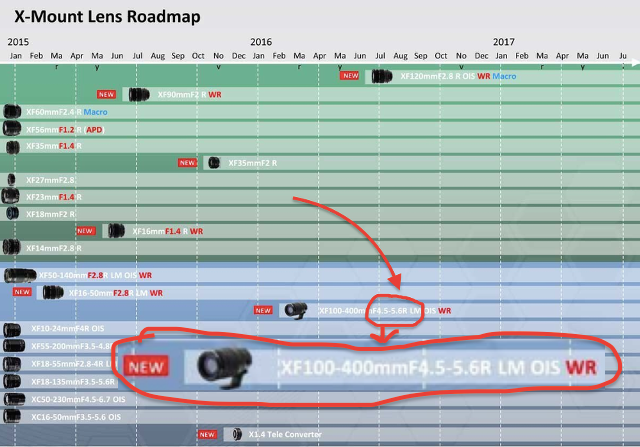
– The latest roadmap shared by FR-reader Stalkdog here, shows that Fuji will release the XF 100-400 in March 2016.
Now, FR-reader aki noted, that the roadmap shows an XF 100-400 that is 4.5 at the wide and 5.6 at the long end, confirming what the journalist at ValueTech said.
Well, since we now have the unequivocal evidence that FujiFilm reads FujiRumors, we can let them know what we think about the XF 100-400 aperture. Is it better not to care about the size (since it will be big anyway) and make a F4 constant zoom out of it? Or should Fuji try to contain its size (and price) by making it slower (F4.5-5.6)? Or maybe just keep the aperture range they displayed at Photokina (F4 to F5.6 – at that time the lens was planed as 140-400)?
Your thoughts are appreciated and keep in mind: Fujifilm is watching you 😉
[poll id=”91″]
_ _ _
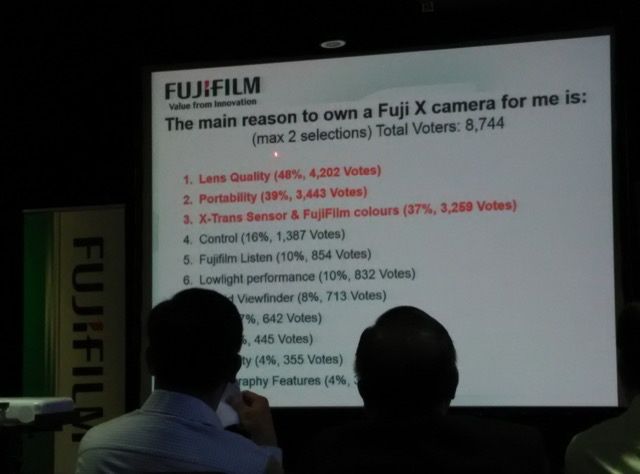
Fujifilm shows one of the FujiRumors Polls to the Press
103 Responses
Not very obsessed with constant F value on this focal range. I hope it comes with a nice pretty and smaller size.
Constant f/4 is just wishful thinking. Won’t happen due to size, weight and cost, which would increase significantly. 4.5-5.6 is fair, given the Tamron and Sigma equivalents have 5-6.3. So the Fuji is a tad faster, providing the same focal length range.
they can even make it fixed 5.6 if it makes it *significantly* smaller…
Won’t.
A lot of people voted for Constant F4. Is it realistic? How much would it cost and how big cand it be at Constant F4?
You can have the 100-400 Canon and Nikon for around 2000 Euro’s.
Which is a reasonable price for such lens.
None of which are a constant f4.
This 100-400 lens will only be worth buying if it is a constant f4.0
Especially because it will be used during sports or birds in flight and not ideal lighting conditions. If its slower then its more aimed towards the amateur photographer and not towards those that take photography serious.
Just because I don’t make my living by taking pictures doesn’t mean I don’t take photography serious. 🙂
If you ever used a Canon 7D2 with the new Canon 100-400mm f4.5-5.6 you would think otherwise. Im sure the Fuji combo will be smaller and lighter. I just hope they can match the Canon performance as the 100-400 MKII is one of the best lenses I have ever used for shooting wildlife at that zoom range and crop camera. I am hoping the new firmware will help the X-T1 out. Patiently waiting. 🙂 I would rather have a Prime 400mm constant f4 though. 🙂
Are you ready for $6000+ 3+kg lens on x-t1?
With respect, that is a bit of a crock (and borderline insulting to serious amateurs), IMHO. Would you suggest that Canon’s 100-400L Mk II is not aimed at “serious photographers”? You might want to look at the impact both in cost and weight (of what will already be a heavy and expensive lens) before suggesting that this is the only way to go for serious photographers. Puh-leeze.
Yes f/4 @ 400mm … because there are many slow lenses on any system
… and With TC 1,4x hmmmm 🙂 I’ll sell my sigma 500/4.5 and D610
Canon produce a very good, very popular 100-400 f4.5-5.6. I think this all misses the point. What it needs is an excellent image stabilisation system.
BUT no IS system can shorten time… for action ptoho is useless
If you print and hang your picture onto a wall, it’s a pretty stabilized system. What do you think?
As we have a few medium tele zooms, ranging from 50mm to 230mm,all with good reputations, why didn’t Fuji look more at something in the region of 150-300mm, 150-350mm or 200-400mm zoom range, that way they could improve on speed and size without as much compromise. While the idea of 100-400 is good on paper the compromises re speed against size could be stretching the envelope too far.
200-400 is like two chicken McNuggets, it’s not enough.
50-230 with good reputations? I have this lens and love it, but this lens is the most overlooked lens in the whole system. I guess I’m one out of 10 people worldwide who actually bought this lens. But yes, it’s too slow. But also yes, it’s damn good!
I can agree with you entirely, the 50-230 is a very good lens but as you say is also slow, too slow; while the 55-200 is faster it is still over f4. These facts are why I suggest, even favour, a shorter range to enable faster glass, after all the main purchasers of this range would more than likely be the more enthusiastic photographer with specific subjects in mind calling for a faster lens.
I’d have to disagree with that, at least for my own purposes. Having extensively used Canon’s 100-400L for many years, it’s almost an ideal range. For birding and wildlife, it’s barely long enough and could even benefit from additional reach (which the extender will provide with Fuji’s version). Having a longer wide end can be problematic as well, particularly if you’re hunting for a flying bird or other small object. Searching at 200+mm isn’t easy since the FOV is pretty narrow, even at that focal length. As far as compromises go, if Canon can deliver an “L” quality lens at a “reasonable” price ($2K-ish) and with the excellent IQ that their latest version offers, I see no reason why Fuji would not be capable of the same or better. Fuji has more than demonstrated their ability to deliver high quality optics, and if the 100-400 offers anywhere near the IQ of their most recent lenses, there will be little to complain about, at least optically.
Constant F4? I haven’t seen a single lens with those specs till now. The only one that comes remotely close is Nikon’s 200-400mm F4 and that one is almost 40 cm long, over 3,5 kg heavy and costs $7,000 or something…
I know we all want fast lenses but how many of those who voted for constant F4 would really be willing to invest this kind of many in a tele-zoom?!
I’d say make it F4.5-5.6 and keep the price closer to the old Canon L 100-400mm than the newest versions of the CaNikon bis zooms and I’ll buy it ASAP!
Make it constant f2.8. Make it big, fat, fast and expensive. This lens will be used in concert with a tripod only anyway.
Actually, I suggest to sell it in a package with a free tripod.
The cost & size would appeal to a very limited number of users. Maybe one day when the Fuji user base is large enough they can build something like that to show off their engineering skills. It would be a beast like the Sigma 200-500mm constant f/2.8 that looks like a shoulder fired missile.
Holy Cheeseburger, that’s quite a lens for a nice walk around the parking lot.
4.5-5.6 in a zoom that’s fast. If you want faster ask for a 400mm f4 telly
Both of those are 4.5-5.6 AND are 2k, how much for a constant F4?! The mind boggles…
To keep the size / weight reasonable then f5.6 at 500mm is OK for me. I’d prefer f4.0 at the short end provided it does not increase size too much. But if Fujifilm are listening then:
a) If the image quality at 400mm is compromised by making the short end 100mm then I’d prefer 140mm.
b) Even for variable aperture lens I’d prefer a marked aperture ring, preferably one that locks wide open.
With such lens close focus distance is one of very important parameters too.
Are there variable-aperture zoom lenses out there with marked aperture rings? I only ask because I haven’t seen one.
If so, is the mechanism for moving the ring automatically something that would add size/weight?
None of Fuji’s variable aperture zooms have marked rings, so don’t expect this one to be an exception.
I don’t really care about the wide end, so f/4.5 is ok.
Personally I’d prefer a cheaper and smaller lens.
Furthermore Fuji should do a 200mm f/2 lens with 1.4 (integrated? or specially made for it) as well as 2x teleconverter.
200 f/2
300 f/2.8
400 f/4
everything with one lens!
At that focal length, depth of field is already so shallow that we’d be stopping it down most of the time. So I don’t think constant f4 would bring that much of a benefit.
That being said, I’m not a big fan of variable aperture zooms. When shooting wide open and zooming (or the reverse), I have to constantly check if the camera changed my aperture setting behind my back. Since I usually shoot in full manual, this might mess up my exposure without me noticing.
I voted for the 100-400 f4.5-5.6 as my preferred option, the originally proposed focal length of 140-400, was not given in the poll. The reason being that 100-400 is a 4:1 zoom ratio, whereas 140-400 is a ratio of 2.85:1 and should therefore provide higher optical quality. It would also be even smaller in size and be a perfect match for the 50-140 f2.8.
Yes because the size of a tele zoom lens is usually determined by the widest end of the scale…
Why not a constant F5? Problem solved
I wonder if the 550 people who voted for constant f/4 realise that that lens will have over 100mm filter thread and weigh an absolute tonne? ‘No no, it’s APS-C and mirrorless, it will be much smaller…’
*sigh*
16-50mm – ‘too big’
90mm – ‘too big’
50-140mm – ‘too big’
400mm f/4 – ‘f/4 is slow, will be nice and small’
Yes they probably do, and choose for an constant f4 as that suits their image taking style. A 100-400 is a dedicated purpose lens anyway. Then please let it be on a professional grade and not on a consumer grade.
Yes, all those poor professionals who have never had a professional grade constant f4 lens like this because one has never been made before… silly professionals.
There is a 200-400 f4.
Would be fine too.
And it’s $11,000 and absolutely enormous. A 100-400/4 would be absolutely HUGE, weigh nearly 8 pounds and they’d be lucky to sell 2. Professional sports and wildlife photographers aren’t exactly swarming in the Fuji camp. A $1500 f4.5-5.6 zoom will be manageable and will sell a lot. A $10K f/4 zoom will not sell at all and will be massively oversized for the cameras in this system.
Only wide angle mirrorless lenses have an advantage over DSLR lenses. Tele lenses are the same. APS-C is smaller but 100-400 than 200-400 in terms of angles. So 100-400 won’t be much smaller. And by the way 200-400/4 is flipping huge lens!
I don’t agree that the current fixed aperture lenses are “too big” because there are high quality alternatives that sacrifice a little speed for size. Constant aperture zooms will always be larger, but typically higher quality (both in terms of image and build) than their smaller counterparts.
That said, I don’t believe Fuji’s first foray into long zoom territory should be a mega expensive, mega sized zoom.
You have 200-400/4 which costs about $6k and weights over 3kg. Canikon’s ~100-400 are not constant f/4
I’m betting the people voting for a 100-400/4 have never used the 200-400/4. It’s a great lens (the Nikon, anyway). It’s also very large, quite heavy, and 6 grand.
I’m not suggesting Fuji shouldn’t start down the road towards fast teles and long zooms, but they’re still developing their base. An f4-5.6 is the best possible compromise for this lens to keep quality and speed relatively high while keeping cost and size manageable. Maybe, in a year or so, they could get us with something like a 300/2.8 or a 400/3.5. Right now, we just need a good quality long zoom under $1500.
Oh, I will add that I hope Fuji builds the XF version without the dreaded “lens erection syndrome”. I hate that my 55-200 does that. It creeps out while onlookers gasp in disgust, while sucking in lots of dust and making the design more fragile.
Rather than a zoom, something like the Nikon 300mm f/4 PF would be great. Add a teleconverter and you get back some flexibility.
That would be great…
Actually I hope Fuji goes for a 333mm F4 prime PF lens. A nice 1 kg light, 500mm equivalent for under 2k, that could turn into a 700mm F5.6 with the 1.4 TC. Would be all I need 😉
I’m hoping for a fast to moderately fast tele, too – but I think their customer base will have to grow a little more for that to be economically feasible. Meanwhile, the hypothetical zoom we’re talking about would be a nice bit with an f4-5.6 aperture.
I think my dream lens on the XT-1 would be a Fujinon 150/2 to equal Nikon’s superlative 200/2.
Make it 1.0 aperture and 1kg weight…
The difference between 4 and 4.5 is pretty insignificant from a practical point of view. If it makes the lens small enough that I’ll actually want to put it in my bag and carry it around while hiking, then that makes it a useable lens for me. 🙂 And if sharpness is outstanding wide open at 4.5 (as it is with most Fuji lenses), this is good enough for me!
100-400 f/4-5 OIS WR with a 1.4 extender “built in” like the Canon 200-400 f/4 with 1.4.
Don’t make it f/4.5-5.6, make it a little faster at f/4-5.
Don’t make me take the lens off to put a 1.4 extender on, build the 1.4
extender into the lens like Canon did on the 200-400 f/4, where all I
have to do is flip a switch.
Sure… flip a switch and add $500 (or more) to the cost whether you happen to want the extender or not. It’s a great idea, but adds unnecessary cost to the lens for those who aren’t interested in paying for it. Since the lens is already supposed to be compatible with Fuji’s extender, for most of us, that is most likely good enough IMHO. Same goes for the aperture… not sure I’m willing to pay the additional cost for less than a half stop advantage. Personally, I can live with f/4-5.6 if it helps make the lens a bit more affordable. If money is no object, of course YMMV.
What do you think Fuji’s 1.4 extender will cost?…$300 US…so for a couple hundred more you get to flip a switch…so your on safari, I would rather flip a switch…so your shooting soccer…I would rather flip a switch…the convenience factor out-weights the cost factor.
An integrated 1.4 extender on a 100-400 4.5-5.6 OIS Fuji lens would be a game changer of a lens. It would completely set Fuji apart from Canon or Nikon or any one else.
Yes,, but the difference is that I’m forced to incur that expense, weight, and bulk whether I need the extender or not. It’s a great idea but recognize that Canon asks around $10K for their 200-400L with the integrated extender, IIRC. That makes sense for Canon given the fact that there are other excellent options in that FL range in their L line, but at far lower cost (such as their own new 100-400L Mk2). The 100-400 will be the only such lens in Fuji’s lineup for quite some time, I would imagine. The convenience factor is nice, but I suspect most people would not want to be forced to spend a lot more money and deal with the additional weight and buik if they really don’t need it. Not everyone has money to throw away on options they may or may not need.
Great idea for a subsequent offering, but terrible one for Fuji’s first super tele IMHO. Obviously, you have a different view.
The built-in, flippable 1.4X extender doesn’t really work all that well, in my opinion, because there is too much overlap between the long-end without extender and the short-end with extender.
My price: $8000 ! Otherwise …….
Canon 200-400 f/4 with internal 1.4 extender, $11,000 US, 7.98 lb, 14.41″ long
Canon 100-400 f/4.5-5.6 II, $2,200 US, 3.5 lb, 7.6″ long
Nikon 200-400 f/4 II, $6,200 US, 7.4 lb, 14.4″ long
Nikon 80-400 f/4.5-5.6, $2,700 US, 3.45 lb, 8.0″ long
Make it with fixed aperture. 5.6, please.
F/2.8 or even f/4.0 300 mm would be better. F/5.6 is definitely too slow here in northern Europe and you don’t need a zoom.
You are going to have a good hunting time.
Is this a false dichotomy? Can we have a smaller lens that starts at f4 to help the focus system, but has very soft corners and vignettes? Then is sharp when stopped down a bit?
Fuji’s strategy seems is to make lenses that are very sharp wide open so that they get a good reputation for sharpness. Leica quality at Fuji prices. Could they have chosen put out the same lenses with bigger max aperture that performs poorly at max aperture? Is it possible that this is in fact what they anyway do? So lets say the put out an f4.5 lens, could it actually be f4 while focusing, we would just never know?
I think the improvements from a bit more light for the AF system (camera/sensor) is nullified by the bigger mass, that needs to be moved, thus the lens would probably end up focusing not faster
if all those >1000 persons who voted “constant f4” would actually sign a contract to buy that lens (probably around 10000$ – ten thousand, for those bad with numbers) Fuji would probably make it
People don’t get how expensive, huge and heavy such a lens would be.
All they think is: “faster is better”
Hear me Fuji!
Please make a light weight and small 300mm prime lens, in order to shoot handheld (like birds and other stuff) at close distance with an aperture of 4.5 or 5.6.
Make it weather resistant and compatible with a 1.4x converter.
Who need a 100-400 lens big as a bazooka?
I am sure there are other people who want like me a telephoto lens which isn’t heavy and expensive as hell.
Do it quickly and I’ll give you my money!
With new AF on firmware, the X-T1 will need telephoto lenses so badly!
Anybody who doesn’t vote f/4.5-5.6 clearly has never used a lens of that focal length before.
100-400mm lenses, or any lens covering the 400mm range or more, is pretty useless wider than f/5.6 unless you’re doing surveillance work (which you won’t be doing with a Fuji) or you’re shooting wildlife in really crazy conditions, where simply getting ‘a’ shot is more important than getting ‘the’ shot. Huge, five-figure lenses like 400mm f/4s are not things you stick on a small mirrorless body. They’re not things you handhold, unless you’re built like Brock Lesnar. They’re the tools of only the most specialised professionals, and even then, you will rarely see them used at f/4. (Let alone faster, if you shell out for the really absurd f/2.8 verions.) They’re never quite sharp enough wide open and the depth of field is so uselessly small that, other than when you’re working at the end of the day or the very early hours of the morning, you’re going to be stopped down.
Go look up the new Canon 100-400mm f/4.5-5.6L. Go look at how large it is, how much it costs and how people use it. Nine times out of then it’s going to be at f/8 and parked on a big body like a 1D X. When you do see that lens used wide open, the depth of field is so small it’s virtually useless and the image quality takes a really big hit. And that’s a lens far larger than anything Fuj’s putting out and built for larger sensors and tougher conditions than any Fuji lens is built for. To get a Fuji lens up to that standard is such an absurdly large task, Fuji would need to double the price just to make their money back, let alone make any kind of profit. That’s the sort of lens a shop might sell one unit of per year.
Don’t be stupid, actually think about how these lenses are used and what something like a 100-400mm f/4 would be like in reality. You’d be talking a price tag higher than most family cars. You’d be talking a lens so large and heavy it would dwarf the X-T1, with a grip, six times over, if not more. You’re talking about a lens so impractical on the market Fuji, and any shop that stocked it, would almost certainly lose money on it.
F/4.5-5.6 is the only way this lens exists.
What about constant aperture zoom (f/5 or f/6 for example) ?
A constant f/5.6 would likely be cheaper than f/4.5-5.6, very slightly smaller/lighter and, hopefully, slightly better optically. It would probably be a better idea from a practical point of view, but f/4.5-5.6 is a specification that would probably sell better. Even though lenses in this range typically are used stopped down below f/5.6 anyway, there are always going to be some people who insist on only buying the ‘fastest’ lenses, regardless of whether or not they actually use those fully open apertures.
I doubt a constant f/6.3 would be any improvement over a constant f/5.6 and again it would likely reduce sales as people see it as being slower, even if they’d be stopping down anyway. Of course the faster you go over f/5.6, the more problems you’re going to have with weight, size and cost, and the more your ‘wide open’ sharpness is going to suffer unless you really invest a hell of a lot of money in the lens. A constant f/5.0 probably would be a very good compromise, but I would guess that if it did offer a better performance:cost ratio, it would have been done already. Considering how many high-end f/4.5-5.6 telephoto zooms there are on the market already, I suspect manufacturers have already worked out that that is the aperture range which sells best and creates the best product at a reasonable cost.
Now, a novel lens would be a 100-200mm f/4 with integrated 2X converter.
It’s too bad they felt obligated to go to 400mm. Why not a lens more than a few hundred people can buy? Like a 70-300? I understand Fuji’s plan about doing an outside run around the other companies with things like medium format, but they might just be doing an outside run against their customer base. With noted exceptions, most people who shoot Fuji are not doing Pro work – let alone pro sports or nature photography. And a 400 lens at any aperture seems to me to marketed towards the pro side of those things. And certainly that is how Canon, Nikon, Tamron, Sigma, etc., all market anything at 400mm I’ve seen.
Vote all you want, eventially fuji will make two of them, one constant, one variable. Start with the variable first. It’s just common sense…
So … next poll: how many of the 44% actually own a tripod??
I’m not sure how many of that 44% who voted for a constant F4 understand that the lens would be bigger, heavier and more expensive than a 300/ 2.8. Surely not 44% of the readers want to pay 5 to 10 thousand $ for that lens. It could exist, but we also need a more reasonable and compact version. 4.5 to 5.6 seems to be that human scale lens.
16-300/1.8 please
Suggest you do a poll on whether lens should be 150-400 or 200-400 rather than 100-400. Suspect that many would happily reduce range at the short end in exchange for reduction in size or F stop range.
Personally I don’t know if I would ever buy such a lens for the X-system. I’m planning on buying the 55-140 2.8, but that’s as large as I want to go.
This is so stupid. People don’t seem to think before voting. F4 constant would at least double the weight and triple or quadruple the cost. Yeah, go put that 4-5 kg (8-10 lb) monster for probably 8000$ on your X-T10 please. I’m sure that’s exactly what Fuji customers are looking for.
We are collection poll ideas here… feel free to add yours 😉 http://www.fuji-x-forum.com/topic/463-create-your-poll-and-then-lets-launch-it-on-fujirumors/
The 35mm f2.0 isn’t marked wr anymore, please don’t let us down, make it a light and small wr prime please.
Fuji, if you really read us ! We need WR on the new 35mm F2 !
I’m fine with a little slower in the name of weight/size. This idea that every lens needs to be “fast” is annoying.
And which one you accept, a blurry photo or sharp photo?
The weight and size comes with the prize, faster shutter speed possibilities. And that is crucial on wildlife and sports photography where you need to freeze the action. In countries of Africa you usually photograph big animals in direct harsh sunlight so you can use f/5.6 easily. But come to thick forests where every third of the stop counts as you need to freeze the motion.
And the price is’t the problem, few great photos will give money back spent to the lens.
[jokingly]In thick forests where you can only see 25 metres in any direction due to the dense foliage you cannot use a 400mm telephoto lens.[/jokingly]
Fuji has proven that they can make a sharp lens that is “slow” (f/5.6), so I’m not worried about the optical quality. I just have zero interest in a lens the size of a bazooka, so a f/4 constant is a non sale for me.
Sorry, but a constant f/4 100-400 lens is going to be much too large for my needs. Hence why I’m ok with f/5.6 on the long end.
If I want long telephoto and slow one, I buy then existing f/8 or f/11 even and be happy as I get narrower field of view and better overall image quality.
If I want fast shutter speeds and narrow field of view, I am ready to pay. And I want and I am ready to pay.
Not enough range and too dark. 12-500 f1.4 or its dead on arrival
and must have a 10x ND filter as I want to be able to use the 1.4 in bright sunlight on my x-e1.
Don’t forget 5-stop IS and a switchable 1.4x extender.
Of course, if it’s not got a macro mode then I’m not buying one.
Haha, oops. If your intention was to show Fujifilm how these open polls should actually be taken with a 44% margin of idiot error then, success! ^.^
Go on… I get that these are not statistically valid results but where to you get 44%?
Many have already commented on that, no need to repeat it. Just read below, or above when sorted by upvotes.
That’s gonna be some hell of a front lens element to lug around… 🙂
100-400/4.5-5.6 makes 100% sense. Perhaps not in the very top of everyone’s wishlist, but very far up on many. More so counting how many will actually spend the money and not only make wishes. That’s what matters in the end.
Guessing the 100-400 will be around F5-ish@200mm. This would allow for something like a 200/2.8 in the lineup. Now, if the new teleconverter can convert that to something competitive to eg Nikon’s 300/4, Fuji got themselves a very nice range of tele lenses covering almost every need except the most extreme.
200 – 400mm would be suffice, if it would result in a smaller lens.
Why not 100-400/3.5-4.8? Shouldn’t be too big and much cheaper than constant f4.
make sure price and size is competitive when compared to canon 100-400, then make aperture as large as possible.
how about 150-350mm F4 or 200-400mm f4.5 constant aperture, now thats long enough, fast enough and not going to big a lens also.
F4 all the way…
Whatever it takes to make the price in line with other Fuji lenses. I’m really hoping to not pay much more than $1200, maybe I’m dreaming though.
100-200/f2.8 would be a dreamlens, who needs 400?????
Sports, wildlife etc. My only grip with Fuji is the fact that the system is skewed towards people photography.
100-200/2,8 is what we need, not another slow, heavy, softfocus beast nobody needs!
I just don’t want a zoom at all! 300 F4 would be ideal for me, and then add the 1.4X. For wildlife I use a 300 2.8 /XT1 which is very nice but would like a lens that is AF etc.