







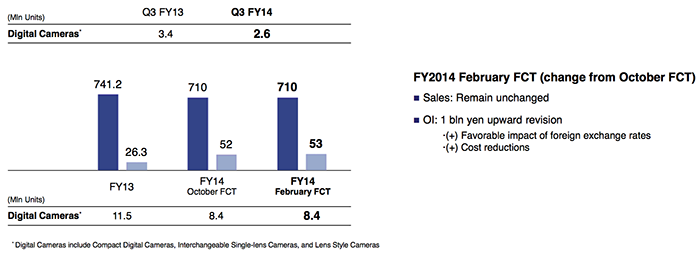
First of all let’s start with a good news: Sony is back to profit and is slowly recovering from the deep crisis they went into the last years. Good to know we don’t have to fear anymore that Sony will go bankruptcy 🙂 The full financial report can be downloaded here: sony.net/SonyInfo/IR/financial/fr/14q3_sonypre.pdf
The second news is that while Sony sold less cameras it managed to increase the profit. This is mainly due the fact that Sony is selling much less unprofitable fixed lens small sensor compacts and is focusing on more enthusiast and high-end stuff like RX cameras and E-mount mirrorless. But there is still a lot to do from Sony to growth in terms of market share and customer confidence. How about making a roadmap for A-mount and APS-C E-mount products? About time to give those camera owners something to look forward too!
104 Responses
If A mount products , such as new cameras, will no longer be produced..
Should we be officially told the truth or be allowed to cling to false hope?
Where did it say no A mount products to be produced?
IF !!!
In the meantime..I’m not seing any new A mount cameras…are you?
We will be told when this happens. I mean: when the last A-mount body leaves the factory and there are not many pieces lying around in warehouses. 🙂
Until that, you’ll still hear things like “we won’t forget about our A-mount customers”.
And I’m sure more A-mount lenses will be “updated”, but I wouldn’t expect many new designs. 🙂
My GUESS is Sony has decided to drop A mount but has also decided not to burn any bridges.
Minor lens upgrades, encouraging words, but thats all.
If E mount flops then they can still change thier minds and make A mount again because they” always claimed they would continue to support A mount”
But other than a little token encouragement A mount is dead for now.
Even the a77Ii…the last new A mount camera…was more of an upgrade than a new camera.
So one of the few camera manufacturers making money then…
Well… some people say only Canon, Nikon and Sony are able to survive in the high-end segment. A profit is essential in this task and both DSLR giants are making it consistently.
That said, I’m somehow skeptical about these results. Sony often moves profit between divisions to make them look better.
If someone is fine with current lens lineup and body quality – FE is not a bad choice.
if someone finds the offer lacking, but can wait for future developments – I’d suggest staying with other manufacturer until new products arrive.
At this point there is still a huge possibility you’ll switch on news and learn that Sony has just sold their camera division to Nikon (on the condition that Nikon will use Sony sensors exclusively for next 20 years).
To be honest: I would be ecstatic. But what about you?
I would rather Sony goes to Canon if that ever happens. But I would rather things like that never happens. It would stifles the innovation in this industry once again. Look at how Canikon were caught off guard with this whole mirrorless thing. And they’re too stubborn/proud so far to make a serious move about it.
You miss the point.
Canon and Nikon are not too stubborn to switch.
They are preparing for it – unlike Sony, who jumped into as early as they could (A-mount was dying).
Sony E-mount is 5 years old. It took them 4 years to make a body with AF that could compete with DSLRs. a6000 is the 15th body in the mount (including FE).
This is something Canon and Nikon can’t afford. They will go mirrorless seriously when they can make a mirrorless camera that matches the performance of their DSLRs. What’s the point of switching earlier?
Nikon already has the PDAF that could handle the job (Nikon 1). For them the main issue is to find a supplier who can make large sensors with 14 EV dynamic range and PDAF from the V3. Sony won’t.
Canon doesn’t have a decent on-sensor AF yet, but they can manufacture whatever they need.
Anyway, Canon has already announced they will release more mirrorless bodies this year.
Nikon hasn’t announced anything, but all signs suggest a huge surprise is coming (this or next year).
Piotr Kosewski wrote:
“At this point there is still a huge possibility you’ll switch on news and learn that Sony has just sold their camera division to Nikon …”
Certainly not!
There is only a tiny microscopic possibility for that to happen.
1) Nikon, with its shrinking revenue and shrinking profit is hardly in a position to make the risk to fork out a huge lot of money (financed by loan) to buy Sony’s Camera division.
2) Why do you think Sony would be willing to sell its Camera division when it is doing well? It gives them good profit!
3) On the other hand, Sony would be able to buy Nikon. But why would they? Nikon is operating in a shrinking market segment. I am rather certain that Sony regards it to be much better to put that investment money elsewhere – into future expanding camera markets.
4) To merge two completely opposite corporate cultures, is one of the surest and shortest way to catastrof.
Nikon:
Very conservative, experts on refining their old and trusted existing mechanically based technology.
Sony:
Stunningly innovative, experts in electronics, mass production and miniaturization. Have the balls to go where no one have gone before. 🙂
.
1) Sony camera division is relatively tiny. Mitsubishi could easily swallow 51% and give it to Nikon.
2) Because selling is sensible only when a company makes a profit. If Sony wants to get rid of camera division, this is the best moment.
I’m by no means saying that Sony artificially inflated these profit figures (which they can do).
3) Buying Nikon is pointless. Sony’s profit on sensors sold to Nikon is most likely higher than Nikon’s profit on cameras.
Sony already pushed huge amount of money into Olympus. This sustained the demand for sensors, but Olympus is losing money on cameras, so – ignoring the sensor sales – this will not be a profitable investment for sure.
4) I’m not talking about merging. I’m talking about taking over. Nikon knows how to design sensors. They simply don’t have the production lines to make them.
Furthermore, Nikon is making hardware for sensor-manufacturing. So taking control of a huge production plant could increase sales of their products (much like Sony did with Olympus).
BTW: You call a DSLR “mechanical” and a MILC “electronic” because of the mirror? Just how little you know about digital imaging? 😛
drop A-mount asap
but please keep developing adapters with faster and faster AF
Pfff. Why would they?
Adapter was important in the beginning – when there were no E-mount lenses, but they had to attract new customers and make it easier for A-mount users to switch. For the same reason they advertised A7 as a camera you can adapt other lenses easily, but this is a nonsense in a long run – Sony is not making money on someone adapting Canon optics. 🙂
FE still doesn’t offer longer (zoom or prime), so this is not the best system for sport and wildlife. But then A7 is not a sport/wildlife body and still they managed to sell a lot of these (relatively expensive) bodies and lenses. Maybe they want to take over Leica-type clients (street shooting, travel, hipsters). That’s where the money is, anyway.
Maybe they decided to leave sport and wildlife to Nikon (granted they will continue using Sony sensors). Sony would still make money, but they have no additional costs (development, marketing etc).
It’s not only sport and wildlife, it’s reportage, events and a lot of things, really. Until they have an FE 24-70 f/2.8 for starters, it’s hard to take ths system seriously.
I think they value of 24-70/2.8 is overestimated.
An excellent 24-70/4 would be easily enough for the time being.
Remember the A7 is built around contrast detection, so the extra stop won’t help much with AF. I’m sure f/4 DoF is fine for reportage.
But essentially you’re right.
We are used to the purpose-built DSLRs. Sony FE is nowhere near, but frankly – no MILC system is.
We have to wait until Nikon or Canon decides to remove a mirror from a DSLR, which would instantly result in a serious mirrorless system. 😉
and replace it with what?
More like…drop kick smack talk asap.
A-mount roadmap. Amen to that.
https://encrypted-tbn3.gstatic.com/images?q=tbn:ANd9GcSsIMZN3X-3xcaR72XAhHvdin_UfHmZrGBVOGpueq30rOj0rvW7
Compact camera is only really for super zoom today, e.g the new Nikon P900 (24-2000mm zoom).
People use their mobile for general easy/fast shooting in the standard (near 35mm) focal length.
1 inch, 4/3 or APS-C sensor size for high quality compact cameras.
And APS-C or FF DSLR for the few who really need it and have to much money. Buying lenses
can be expensive.
Rugged cameras are the other compact category that are holding their own since there are no alternatives.
Not providing any support after the sale is a very good way to make short term profits but lose customers over the long run.
5 quarters after the release of the A7 and A7r, no fixes for shutter shock and lossy compression.
Carry on.
Can’t say I’ve had a big problem with Sony’s support. The a77 I sold couldn’t have been more different to the one I bought. Likewise I’ve seen improvements with the a7…
oh, where is lossy RAW complain? %)
I don’t think they can fix the issue with lossy compression. Let’s hope it’s not in the A7RII.
Sony must have made a mid season design change because the one I bought a few months ago is a little on the loud side but it’s smooth as butter with zero vibrations. You may want to have yours looked at if it vibrates.
Your so right….
there are many companies still dreaming there, good luck! lol…
something is in progress, like it or not, it will come:
1. digital camera sales will be gone and captured by smartphone.
2. high end niche ie: RX1 will be available target for this group of users
3. conventional bulky-heavy-dslr will be left with niche for pro and big palm users
4. low end FF mirrorless will captured all APSC sales (m43, apsc will gone)
5. mid and high end mirrorless will continue the saga
6. sport camera will be remain in the arena
7. smartphone will be the 1st archive economical slomo camera, big knock on imaging industry.
ROFL
Hang on…. you were serious?
lol…
You can look at the cameras and see why they’ve quickly abandoned the A mount. E mount full frame bodies must cost very little to make once you get the technology down. Sony is making full frame cameras that I bet cost less to produce than Nikon bottom of the line DSLRs, but they’re able to sell them for much more. Having said that, with all this emphasis on full frame I think Sony will soon introduce a FE camera starting at about $1,200.
If small sensored cameras aren’t cheap to prodruce, why the industry was stuck with them for so much time?
Inertia? Many companies hang onto unprofitable product lines too long in the hope things will turn round. I’m sure companies that can manufacture small sensor cameras profitably, but they will have lower cost bases than Sony. Just like the market for Windows laptops, which Sony also exited.
Sony lost the laptop market because they wanted to get into Apple market share. They wanted to attract a rich fanboy-like customer who will pay more for feeling special.
In fact, Sony Vaio laptops were really quite good (much better than MacBooks), but they haven’t managed to build the “cult” around the brand.
This is something they’re again trying to do with Sony FE. Hard to say if it will work this time, but clearly they have the advantage of being the only manufacturer with such ambitions. At least until Apple starts making cameras or Samsung starts making them seriously. 🙂
Fair enough that their attempt to go up-market on Windows laptops failed as it’s largely a commodity market (apart from gaming). At the moment they can compete with up-market cameras as it’s largely dominated by manufacturers with similar cost bases. The exception is, of course, Samsung so that smile might yet turn to a frown for the other manufacturers in the segment as that company is probably the one keeping Nikon and Canon executives awake at night. They have the financial and industrial might to turn things upside down, and with a structural change in the industry with the slow decline of the DSLR market, then now is surely the time to strike.
Sony laptops were indeed better (at least, some of them), but certainly not by much. Also, there’s no “cult” around the Mac, that’s entirely preposterous. Sony failed in that market because it was yet another computer with Windows on it for lots of money. They simply couldn’t differentiate themselves same like Apple can.
There is a definite cult on Mac books and one of the reason is probably the differentiation it self, or the very successful marketing.
http://iplogger.org/1eiC3.jpg
You are still trolling I see
I take that back.
I am sorry.
Forgive me.
I can’t help myself.
http://iplogger.org/1jDZ3.jpg
You are not bob
Yes… I’m not “bob”, I’m “Bob”.
Where are you from Bob? Tell us
Why am I spamming this forum with rubbish?
I think you don’t remember just how bad Apple laptops were in the early 2000s.
Things improved a bit with introduction of MacBooks, but still there were issues. Like the first Air, which was just awfully engineered.
Things are somehow better today. All Apple computers are – essentially – proper hardware, but still hugely overpriced compared to PCs.
Obviously we can’t compare the “atmosphere” around MacBooks to that of iPhones, but – essentially – most people still buy all Apple computers because of the logo. Not because of the styling, quality or performance. And – as this is an unreasonable choice (more or less) – I call this phenomena “a cult”. 🙂
I hope no one felt offended. 😀
As for Sony – Windows was and is an advantage, not an issue.
In fact the reason why Apple succeeded is because they decided to differentiate less. Namely: they switched to Intel CPU and generally Macs are more like PCs than they used to.
Sony failed because of 2 major reasons.
1) The most important market for such products is US. And people in US prefer american products.
2) It’s generally hard to compete with Apple in marketing. They are very focused on their few products. This strategy is so successful people in US e.g. seldom use the word “smartphone”. “iPhone” became a synonym. This is – thankfully – not true in Europe. 😀
It is not about getting offended, it is that “cult” has a meaning that seems rather exaggerated in this context 🙂
I remember the 2000s’ Apple laptops very well and am not sure what you mean by “badly engineered”. While in the 90s I was using Apple computers because of free access, since the 2000s it has always been by choice. I’ve tried to switch and used multiple laptops and desktops over the years, often precisely because of lower cost or sometimes because of specific configurations and it never worked out. The lower cost was almost always associated with lower quality and crappy support. The only brands that I enjoyed were Sony, Lenovo, some Fujitsus and maybe Asus. Except, the computers I liked the most were actually very close to Apple’s pricing, if not higher priced on occasions, with a significantly lower resale value.
As to Windows being an advantage, I would prefer to not go into that discussion, but that is simply preposterous. MacOS has always served me better and it’s not like I haven’t used Windows.
In any case, the differentiation is there, MacOS is definitely different, the way customers are treated in an Apple store is definitely unparalleled (although I’ve had issues on occasions) and the way the whole company is run is highly specific. All of this does make for a following, but I wouldn’t use the word “cult”.
Now, to your two points:
1. What about Japan? Surely, your theory fails there.
2. That’s the thing, as far as I can see, Apple isn’t doing more marketing than anyone else, it just does it somewhat better (but not always – example, Mac vs PC nonsense). So, I’d say the following is based on the factors I listed before, all very tangible and sensible. Nothing “unreasonable”, as you are implying, although I do imagine there are these people who buy it for the logo.
Forgot to add there – the switch to Intel was met pretty badly by the majority of Apple users ad was a huge pain for a couple of years. Yet people stuck around. Whether this makes them stupid or smart, well…
Mac hardware has always been more expensive than building your own PC.
Windows offers 10bit colour on consumer cards. That reason alone was good enough to ignore apple
These are the usual nonsensical arguments. Try to come up with something better than that.
By “Windows being an advantage” I meant the availability of software and the possibilities.
OS X is a good system and I’m sure it can serve you very well. It is very focused and very refined. But that also means it is fairly limited. Windows is not. Linux is in a different world, really.
It is a bit like with Apple computers. If you’re a kind of person who wants to go to a shop, be treated well, buy a computer and use it in an expected fashion without much fuss – Apple is clearly perfect.
If you’re a person who wants to setup a computer to needs, tinker with hardware and so on – there are MANY better choices.
Furthermore, I couldn’t care less about how I am treated in a shop. Is this really that important to you? How often do you visit Apple’s stores?
What’s so special about sony FE? Looks like a DSLR, huge lenses 35/1.4 like a DSLR
Essentially nothing. That’s the point. 🙂
They work and they offer very good IQ. So you can make very good photos.
With all this “mirrorless revolution” (keywords: hipster gadget mania) we occasionally forget what photography is all about.
People got absorbed by how they use the camera, not why they do it. 🙂
We praise large number of customized buttons, IBIS, focus peaking and so on. This is simple and obvious – every nerd can understand that.
Not many people can appreciate image quality. If you don’t show them dynamic range figures or MTF charts, they won’t tell the difference between photographies made with a FF DSLR and a smartphone.
Sony A7 is not small – that is correct.
But it combines IQ and (to some extent) handling of a DSLR with all the things mirrorless cameras are leading in (connectivity, usable LCD shooting etc).
Because they are smaller and that’s what sells. This is one of the two major reasons why mobile phones have eaten that market with their high prices, tiny sensors and prime lenses.
What a trivial comment I wrote….
> mainly due the fact that Sony is selling much less unprofitable fixed
lens small sensor compacts and is focusing on more enthusiast and
high-end stuff like RX cameras and E-mount mirrorless
No. Mainly due to favorable foreign exchange rates.
Based on constant currency figured for Q3, the exchange rate contributed about 7% upwards, while Operating Income went up by 90% total. In other words, the exchange rate wasn’t exactly the main contributor.
Not really.
1) Most of Sony’s costs are local (Japan – R&D and production, Thailand – production).
2) Most of earnings are made abroad.
3) Operating income is about 10% of revenue.
This means a ~7% change in currency can easily be the main contributor in a 90% income increase.
So if they get 7 per cent more (demands regarding currency rates was very likely unchanged, as prices on aboard was the same) profit because of exchange rate, how can it translate to 90 profit? Please explain?
I product something locally and I sell it abroad.
Lets assume all my costs are where I produce, so they don’t depend on any currency rate.
Lets say cost is 1, sale price: P, increase in exchange: f.
Profit before: P-1
Profit after: (1+f)*P-1
Relative change:
X = ((1 + f) * P – 1 ) / (P – 1)
this is a hyperbolic function of P:
http://m.wolframalpha.com/input/?i=Plot+%28%281%2B0.07%29*P-1%29%2F%28P-1%29+from+1+to+1.2&x=0&y=0
This means that for a small enough P you can get any growth of profit you want. 🙂
F = 0.07, X = 1.9
gives P = 90/83.
This means the profit margin for Sony cameras would have to be around 8% and this is a fairly realistic value. And close to what they report.
Of course there are many other factors. One of them is the way Sony shows results. They can easily push profit between imaging products (cameras) and devices (sensors). You never know if the cameras are so profitable or is the camera division going to pay for millions of sensors 1 day after the reporting. 🙂
Thanks for explaining it clearly, but does the 83 relates to anything in real world? I think it’s a major factor, but not the main factor. The main factor is still the success on their cameras…
You can’t pay bill with success. You can with profits.
Arguably, Sony smartphones and TVs are also very successful. 🙂
If the last bit is sarcasm, No… They did particularly well.
http://www.phonearena.com/news/Sony-sells-12-million-Xperias-in-Q4-smartphone-division-swings-to-profit_id65568
http://www.bloomberg.com/news/articles/2014-06-12/sony-tv-sales-rise-30-in-first-quarter-most-since-2012
Sure Lol, you can’t pay bills with success… But success is needed when you want profits! Anyway, thanks again for the mathematical explanations.
Most of Sony’s camera production is currently done abroad, in countries like Thailand. And the Yen lost about 17% of its value compared to the Baht alone the past few months…
Add to that the fact only a small portion of the marketing and distribution costs are local as well (mostly foreign).
Not really.
Most of the ASSEMBLE of Sony cameras is done abroad. And this is a small part of costs.
R&D is in Japan. Many parts (including sensors and processors) are also from Japan. Many lenses are made in Japan (at least for the time being).
Also the whole production line was (most likely) brought from Japan and this contributes a lot to the total cost of running this business.
Moreover, finances in multinational companies are very complicated. If you work in such organization, ask around. 🙂
Yes, the manufacturing plant could be in Thailand, but it might turn out that Sony Japan is paying most of the bills, covering training of staff and so on.
You must also remember that in general something called “Sony Thailand” is an investment for Sony Inc. (based in Japan).
That’s why it is usually quite safe to assume that costs are created where the HQ (or rather: the main capital) is.
The sales, however, always arise at the end of distribution structure. 🙂
Operating income was 6% of the sales last years, not 10%. But most of the distribution and marketing costs are in foreign currencies. Actual production and R&D is usually no more than half of the actual costs for products such as these. And production in Thailand means different currencies too.
It doesn’t quite work that way. A 7% change in dollars taken in (currency fluctuation) generally produces far more than a 7% change in profit. That’s because there is no “cost” associated with a positive currency fluctuation: it ALL adds to profit.
Then where can we find your break down in numbers? Because you made a claim too.
It’s also notable that there were strong increases in the sales of image sensors, although much of that seems to be for smartphones.
A quick view looks like it’s just dollar up and yen down to me? Where is the positive numbers if you take away “favorable impact of foreign exchange rates”?
That’s mostly true for the revision of the forecast. Actual Q3 numbers still show about 90% increase of Operating Income year on year, of which about 7% due to exchange rate influences.
Look at the dollar-yen change! That is Q3 (Q4 calendar).
Large companies (and even many smaller ones operating internationally) like Sony have currency buffers and use hedging to cover currency value changes for that very reason. It’s unexpected changes that change results either way.
Not surprising. The high cost of their Zeiss branded lenses I suspect is one of their big money maker but I have a feeling that it will not last very long. I think many have now given up on the a7 line and sales will slip. I think many Pros have given up due to a slow lens lineup and for beginners who where excited about smaller body and reasonable price but have run into few and high priced lenses with little or no alternatives in lower priced lenses (with AF) The A6000 has been a great seller and if there will be an A7000 priced at $800 with kit Lens I suspect it will do well
It is the A7 line that I suspect will slump in sales unless Sony starts producing more Sony branded lenses
Most likely there will not be any fast F2.8 or faster zooms for FE mount so many Pros will stick with their DSLRs I suspect Canon and Panasonic will introduce more one inch censor compacts to compete against the Rx100m3
The lens lineup has been fine. Its a brand new mount. While I find the lack of telephoto lenses disappointing the FPS isnt quite there yet (wildlife & BIF) anyway. I keep reading more and more articles about pros switching to Mirrorless systems. While its not perfect for all types of photography and some still require a DSLR I dont see many going back. DSLR’s are a dying bred. Eventually mirrorless technology will fully mature and it will be a main stay IMO. I for one am really looking forward to the A7RII
Sony FE mount has been around since Oct 2013. So not brand new. Most Pros that I know use 24-70 f2.8 and a 70-200 2.8 which will not be in FE For a long time if ever Yes Mirrorless is the way to go I suspect A9 will be much larger body to be able support larger and heavier FF lenses
I do no see FE mount to be mature until 3-5 years from now with a large selection of lenses like that of Canon and Nikon
How many years does canon took to fulfill the lens requests when they switched from FD to EF? Definitely not 2. Regarding the a7 line, I do not see that it will slip. Many are switching from canikon to FE sony and they are releasing lenses. Zeiss lenses are a very small part of this successful Sony year, because sales are mostly from a6000…
Does = third person singular present of do.
took = past of take.
http://iplogger.org/1jDZ3.jpg
You’re illiterate
As I am a moron.
That is what I said in my original post – the A6000 was a success – but again there are few sub $1000 lenses available and the camera was selling around $700 with a kit lens which was a good price for what one got – for most of all last year for FE there where 5 Zeiss branded lenses – 2 G branded lenses one for $2498 and the other for $1498 – and one plain Sony branded lens – Kit lens for $498 – ok now just released one Sony branded lens 28mm F2.0 for $448 – rest Zeiss and G – so up till recently the only non Zeiss branded lenses where the Kit lens and the 70-200 F4 –
but a mute point as everyone seems to be extremely happy with lens availability and prices so far is what I gather
What is “brand new”? Two years is nothing. If we take other mirrorless systems as an example, Sony is building its lineup faster than anyone. However, I’d agree that for FE to be mature, it’d take at least a couple of years more. The thing is, with all the adapters available, does it matter?
Two years and four camera bodies and 15 native lenses versus almost 5 years and only one 5Ds update for Canon. I feel two years is very much “new” compared to the update status of the status quo.
Even if we agree with pros giving up on the a7 (an entirely unfounded assumption), this absolutely does not lead to what you are describing. Pros are a tiny part of the overall market share, so how much can numbers slip? Also, pros do not buy novelty gear with the hope that the system will get where they want it to; I’d argue that very few professionals have invested in FE for their work, so, again, nothing is slipping.
Mostly, these highly expensive lenses are targeted at serious enthusiasts, the bulk of the buyers.
As to f2.8 lenses, I have to disagree yet again. Since when do pros only use fast lenses and how come one stop of light is such an issue in today’s market?
9 new first party lenses in less than 15 months (plus a number from Zeiss & Rokinon) – that’s glacially slow! And how dare they force us to use adapters that can let anyone use nearly any lens in existence.
Samsung & Fuji released 50 lenses just last month. Sony is going bankrupt tomorrow…if they listen to some commenters on here anyway.
it is ok – FE lens selection is awesome and prices are incredibly low – lots of none G and Zeiss branded lenses to choose from – same with the brand new E mount, tons of lenses to choose from and everyone is thrilled – and yes no Pro will ever need a FF f2.8 zoom – like wedding and fashion photographers which of corse hardly exist. The FE system is awesome and the best there is and no one better bring out things that can be better or improved
La-ea4 = a world of new and vintage f2.8 zooms
Don’t like it? Then being an early adopter isn’t for you, check back in a few years when the system is mature. For a new line-up aged 14.5 months, the native lens selection is amazing and is added to every couple of months. Sony just dropped 4 new lenses with more on the way later in the year.
“..Sony is going bankrupt tomorrow…if they listen to some commenters on here ..” Haha, that is indeed true!
Good news for whom? I don’t really care if Sony is profitable. I just want a good set of lenses, which they still didn’t manage to provide.
Profitable companies tend to have greater flexibility for r&d and releasing new products.
True. However, it’s a pity Sony have been concentrating their profits on releasing a new body every month lol
It seems they’ve slowed down a bit, only one body in the last half year (a7 II).
Profitable companies tend to survive.
Again, I don’t care… If there’s a body and a good set of lenses I can get, Sony can go bankrupt, as I don’t need to update stuff every 6 months.
:). Wow you are brave. I’m sure lots of nasty comments will come your way I’m taken to the cleaners for suggesting that Sony could do better in producing more Sony branded lenses under $1000 not endless Zeiss branded and G branded lenses $1000 and more. And it appears all are extremely happy with the current FE lens selection and prices except me And all so excited. About the E mount lens selection
Everyone is happy but you and me. The mirrorless thing is advertised as lightweight, flexible, cheaper, yadayada… Then we get a Sigma 35 ART copycat that costs twice as much. A 24-240 that’s twice as big as the small gripless body… I’m eager to jump in, but I’m still waiting for a reasonably sized set of primes, priced accordingly… Such as the Nikon 1.8G lineup.
http://pastebin.com/QwLzwG4f
Too many trolls
Yeah… And you, Bob/Anton Berlin, are the first.
You are a troll and a spammer.
Sony managers when “Roadmap” gets mentioned: https://youtu.be/h–HR7PWfp0?t=1m12s
A900RII would fix all these financial ills.
Funny how people post out of context stuff.
“Last, but not least, I want to talk about image quality. As you can see from the previous page of this review, the Sony A7 II falls behind in performance when compared to the Nikon D750 (which sports a similar, Sony-made 24 MP sensor) – its performance is noticeably worse. In fact, cameras like Canon 7D Mark II, Nikon D7100 and Fuji X-T1 seem to perform similarly in comparison, which is rather disappointing. On top of that, Sony crippled the A7 II with the 11+7 bit lossy RAW compression (as detailed on the third page of this review), which only adds to the frustration…”
https://photographylife.com/reviews/sony-a7-ii/7
that says it all
Agreed, people who post completely off topic posts add nothing to the conversation’s topic and seem like fools hitting their head against a wall hoping to change something through their futile actions.
He also said:
“I am a huge fan of the technology embedded in these tools (EVF, focus peaking, small and compact design, live histogram, IBIS, to name a few) and I cannot wait to see the day when I fully transition from DSLR to mirrorless.”
Should we focus only on that and end it with “that says it all”?
Now to be fair, I personally “upgraded” from the Olympus E-M1 to the original A7 mark1 and I was not impressed as well. Was is it “better” than my E-M1? In some areas oh yeah, in other areas, not at all. But for $1,700.00 full frame DSLR touches the value for the size/price of a good performing full frame camera.
I later sold it for the A7s and that camera is absolutely perfect for my photography/video needs and is the best in low light full frame camera in the world (negligibly better than the Nikon D810).
headline for this article….. when idiots read biz charts……
sony is still in deep trouble.
I see Sony as trying to follow the Apple model: Sell fewer high quality products with higher profit margins, and make money. A prime example is Apple’s iPhone, which lags far behind Android phones in terms of units sold, yet Apple has about 93% of the profit in the cell phone market. Cachet and status are part of Apple’s success, and I think that Sony is moving upward in that department. They are the only game in town as far as FF mirrorless cameras are concerned, and that gives them the prestige that comes with being unique and being the first.