







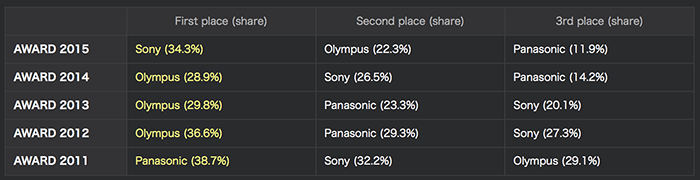
Mirrorless system camera market share in 2014 (Japan only)
BCNranking published the full 2014 camera sales date in Japan. The good news is that Sony dethroned Olympus and is now number one in the mirrorless system camera market in Japan. And in Japan mirrorless is very strong and on par with DSLR in terms of cameras sales. The (unsurprisingly) bad news is that Sony really holds no more any meaningful share of the DSLR market:
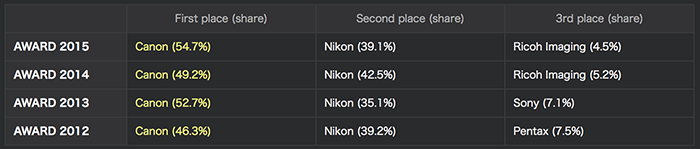
DSLR market share in 2014 (Japan only)
Sony really needs to reinvent the wheel with their A-mount system if they want to make it successful. They would certainly have the necessary tech for that but we have to see if the management really wants that.
160 Responses
Good thing I just hollowed out my 135 STF lens to make a coffee mug out of, and gave my son a 70-200 to play submarine with at bath time.
in Japan
What did you expect, to beat Canon or Nikon DSLR, Sony will have to bring much mory different camera Body’s in the A-mount, they are focussing to much on the Emount, that’s why people belive that Sony is just let the Amount die !!!
I believe it’s too late for Sony. With all those operations of Sony being spinned off and Sony considering selling their TVs and Mobile Phones division, this just means something. They’re not going to invest too much money on business with great risk.
Sony have a better lineup of A-Mount than ricoh have with K-Mount, they are letting it die for good reason.
im not sure lazyness is a good reason
a99s, a99r
a78 with all the features it should have 😐
newer low end model
400mm 4.5 prime
parts bin specials that would rival anything out there on the market.
2 suitcases, one with money, one with stickers, go to 3rd party makers and get them to produce their best lenses in a mount and put a sony sticker on.
thats pretty fucking easy to achive, and they havent done it.
But the most important question is: what will the future of photography be? Will there be room for Ricoh to exist between the giants Canon and Nikon? Look at how their market share went down from 7.5% in 2011 to 4.5% in 2014! Now the numbers of DSLRs sold are slowly going down, and the numbers of mirrorless are slowly going up, there will be a moment that Ricoh will abandon the DSLR market, as they will loose to much money there. Unfortunately for them there will be no mirrorless system to fall back on then…
Sony will abandon the DSLR (or DSLT)( market too, probably sooner then Ricoh) but they will fallback on their mirrorless system…
Congrats to Ricoh. Third place out of three competitors!
sony lost all 7% DSLR share in last 2 years
and gain 14% in mirrorless at the same time
good call sony
in 2020 when DSLR will be just a memory and mirrorless rule japan (and maybe the world)
sony could be at 75% market share, a feat nor canon neither nikon ever had in DSLR
by 2020 nikon would be a part of samsung (or in bankrupcy) and canon will make the bulk of their money from not camera bussines just like olympus had been doing lately
with sony launching even better cameras than the top rated a6000/a7 series this year, no surprise if they hit 45% market share next year
Hope that Sony buys Nikon instead Samsung, they’re third choice!
samsung will eat sony for breakfast in terms of money, especially at the moment… not the other way around…
Sony did not lost all 7% they only dropped below Pentax and so they are of the chart. Look how Pentax (Ricoh) only has 4,5% now, they can’t make a lot of money there. So what will happen with them when the DSLR market goes down even more? Will they be arround in 2020? and will Sony?
Let’s analyze the numbers correctly. Sony now has a 34% share of a 725k sized market that DROPPED 20% year to year (mirrorless). It has a perhaps a 4% share of a 1.1m unit market that dropped 25% year to year (DSLR). That’s about 300k cameras. Canon sold 600k DSLRs. Just DSLRs.
Sony’s shift from DSLRs to mirrorless actually puts them in almost exactly the same position they were in terms of overall ILC market share they were in when the acquired Konica/Minolta and were all-in on DSLRs.
Maybe, but Sony is the market leader and is increasing its market share in the mirrorless segment, a segment which is slowly eroding DSLR’s share of the overall ILC market.
Sony is in a much stronger position now than it could ever have dreamed of being in the DSLR market, where it really never stood much chance against the big two.
Anyone saw how Sony got a fair amount of the SLR market in 2013? The a99 started shipping in massive quantities that year. But with the current strategy of Sony, guess those times aren’t returning back.
And those numbers could explain why Sigma is stepping away from supporting Sony. Guess I will have to switch brands in order to get the superb 120-300 F2.8…Good thing that Sony makes Nikon sensors.
fukc this bullsihts and give me 24-240 to check it out on my a7 while FE 24-105/4 is here ! 🙂
About Dslr, I thought Nikon was much better than Canon…
is Canon at the 1st place outside Japan too?
Yes.
Canon is the established market leader (i.e. has the largest market share) in both DSLRs and the camera market as a whole, and they have been so throughout most of the digital era.
Yes, and has been since the late 1980’s.
Big surprise… No new pro DSLR Camera (a99 II)
And just am small Update for apsc (a77 II)
Small update?? A77ii ??
Have you ever tried it yourself?
It almost improve everything.
The only thing unchange is the no. of pixels,
24Mp is still lots more than 7dii.
Yes, good Camera but this was the only one. No new entry Models, no Update dir A99.
No new Killercam, think about a a99 with 5axis stab, 36-54 mpx, bette AF Maybe mirrorless (if the AF Works like a6000…)
A77II is a HUGE update over A77.
Those DSLR numbers are, of course, pathetic. But much is Sony’s own fault: the future of A-mount has been in limbo for years, and the A99 was no real DSLR as it lacked an optical viewfinder. Losing the viewfinder — which, by the way, was a prime selling point in the a900 and 9 because of its quality — was a really stupid decision. Remains of a typical Minolta gadgetry: “wait, we can make this essential function electronic instead!”. Why in the world would I buy an a99 over an a7-II + adapter?
Maybe the A99 was the camera to prepare the people for the mirrorless cameras? Maybe they trried to show people that EVFs have their place in photography. Maybe Sony is more wise then Pentax by going ther mirrorles route. Maybe Sony did see that the mirrorless cameras are the future, maybe they started early to get their cameras in line before the others (Canon and Nikon) came in.
Remember that DSLRs are loosing marketshare to mirrorless in the last years. Yes DSLRs are selling more at the moment, but more and more people are going mirrorless. In the near future mirrorless will win from DSLRs in sales and after that there will be place for one or two DSLR brands, and Sony would never on the place where Canon and Nikon are right now, so Sony had to do something else…
I think ‘pathetic’ implies they tried and failed. Closer to the truth that its a marketing plan: pro DSLRs are a shrinking market with non of the incumbents making big money on it, better to get out and redeploy for the growth areas (imaging components, mirrorless).
Sony does pretty well in mirrorless but I think that right now they don’t make much of a profit. Most of their high-end cameras include EVFs and full-frame sensors and are price rather low to medium, so the profit is not there.
Overall I think that Sony has a good strategy in its hands, with some flaws.
On one hand, they have chosen a market that Canon and Nikon don’t really compete in, and it’s a large market at least in Japan, so they solved the competition problem. Also, mirrorless is more future-proof compared to SLR cameras, because eventually the imaging sensor will be able to include a high-end autofocus system so there will be no need for a mirror and pentaprism.
On the other hand, Sony enlarges their cameras and makes them look “pro” in order to steal DSLR sales, but this hurts them in mirrorless outside Japan, because why would I buy a large camera with large lenses, but with less performance than a true DSLR ?
On the third hand ( 🙂 ), right now the optics do really get in the way of true mirrorless potential. Lenses are large because of physics. If Sony manages a breakthrough with curved sensors and very small optics as a result, they will dominate mirrorless for many years, and mirrorless will also be able to take over the DSLR
I agree 100%. Please Sony don’t enlarge the cameras!!
Why? Shooting professionally for long stretches means (_for me_) to have the possibility to have plenty of larger buttons and controls allowing for instant changes of settings (easily, comfortably accessible not cramped on a small body), a large grip to comfortably hold the camera with larger lenses. That’s of course different from my requirements for leisure or vacation.
If you want big cameras, you already have amazing DSLR stuff. Kevin explained very well the problem with mirrorless:
“why would I buy a large camera with large lenses, but with less performance than a true DSLR?”
Even profesionals are switching to mirrorless system in order to carry more compact stuff.
I already project to the future possibility of mirrorless to take over. In that case, I would prefer a larger body. Don’t forget to compare equivalent settings. Many used 1dx or D4/D4s. But the difference of a D750 with primes is not that huge in size and weight when compared to a mirrorless FF with equivalent lenses. I have the A7ii, but prefer the D810 or D750 for professional work due to the ergonomics. The Samsung NX1 is about a good compromise in size, in my opinion.
A XT-1 sized body already fits more buttons than needed.
Personally I don’t see the need for any grip larger than NEX-7’s in any scenario. For extremely large telephoto zooms a tripod is a must, for anything else I could get through a days shooting without feeling that the grip’s weighing me down.
I tried the XT1 for a few months and couldn’t get along with the tiny buttons. I like larger grips and bodies with buttons in the _right places_, for fast and ergonomic access (back button AF is my thing). The A7ii is better than the XT1 for me here. But still, I prefer the D810 most of the time. Good that there are many models around fitting the needs of different people.
The cost of manufacturing a mirror-less camera in comparison to a DSLR is 1/3 less. With a lot of the cost tied up in the complicated mirror box and AF calibration. Sony is making good money from the A7.
Having switched from Canon to the A7 (I still use Canons most days for work unfortunately) I find no lack of performance in comparison. AF on the A7II is excellent. Canon still has a slight AF speed advantage. But then you have to deal with the constant AF calibration issues that are none existent on the A7. Not finding any size issues. It is just an excellent camera irrespective of the lens you put on it.
It’s inconceivable that Sony will make significant inroads into the DSLR market. Canon and Nikon are so well entrenched, with so many customers locked into the platform because of systems investment, that’s not going to change. The sole hope would be for new customers, who don’t have system investments to protect, but given there are very few of them, that’s a thin hope. The DSLR format doesn’t allow much room for innovation, and nothing short of a revolutionary one would be required to shift Canon and Nikon’s dominance.
The best that Sony can do is retain their existing loyal users and also offer them a viable route towards the E mount platform. That’s also Sony’s best hope for whittling away at Canon and Nikon whilst those two are lukewarm about their own mirrorless range. To do this Sony will also have to attract customers invested in those systems, which means viable alien lens support (difficult with Nikon). There’s only a short window open for this before Canon finally see the way the wind is blowing and work at making their mirrorless system work effectively with their DSLR lens ranges. Given the inside information Canon has on the lens mount, they are much better placed than Sony to do it.
So I expect to see the vast majority of investment for Sony to go into the E-mount range and to widen its appeal to new users and existing DSLR system owners, not on native A-mount.
You could have said the same about Sony vs Olympus/Panasonic a few years ago for mirrorless… both Olympus and Panasonic have failed on technology despite user base (m43 sensor vs full frame sensor and/or APS-C sensor being the technology increment that seems to have done it). So a technology hike from Sony for DSLR could do it. Btw, really surprising how far Panasonic have fallen since 2011!
It’s not the same. The mirrorless market at the time was very immature, rapidly evolving technological, had considerable potential for growth and there was no large established basis of owners. None of this is true of DSLRs, where the market is mature with low rates of technical innovation, a declining market and a large base of established owners.
The first M43 camera was only announced in March 2009, whilst Sony announced the first NEX camera a little over two years later. Of course that gave Olympus an advantage, but not an insuperable one as the market is growing.
Time and time again, it has been shown that incumbents tend only to
be moved when there’s a disruptive market change. That simply isn’t
going to happen with the DSLR market which is handicapped with inherently large camera bodies and a systems legacy that is not optimised towards things like hybrid AFsystems.
A small correction: the first m4/3 camera, the Panasonic G1, was announced in 2008. The first NEX models was announced in 2010, not 2011 as you suggested.
Thanks. Fair enough, my research was not as thorough as it ought to be, but the basic line is OK. There was roughly a couple of years between the lines emerging. A head start, but not a decisive one. Canon proved that when they released the EOS line as that was roughly the same lapse after Minolta released the first practicable AF SLR.
Being the first mover isn’t always an advantage as the follower can learn lessons from them.
Arguably, Sony’s mirrorless line matured before m4/3 did. The first couple of generations of m4/3 cameras were really not that great, IMO. And Samsung, who actually launched the NX system in early 2010, before Sony NEX was launched, has only recently become a serious contender in the mirrorless market.
Agreed that the early M43 cameras weren’t that great. That first mover issue again. The M43 system will always, of course, be defined by the sensor size so Sony can address more markets with the same lens mount. The APS-C range can pretty well match M43 on compactness whilst the FF varieties can provide meaningful competition into the DSLR market for many functions. I’m pretty sure that Olympus would be back in the lead if sales were only compared with Sony’s APS-C mirrorless cameras.
As far as maturity goes, I’m thinking more in terms of market than camera lines. However, in that latter area the M43 series has better lens support. That format flexibility that Sony has is a handicap there as they have essentially two lens lines to support, one optimised for size and the other for ultimate image quality. I can’t held but think it will not be until there’s serious third party support for E-mount lenses (by which I mean fully automated types) that will really get solved, especially at the value end of the range.
The system camera market still sees strong growth in Asia. The current growth point is China, in 20 years it could become India. It’s good to see that the Asian market receives mirrorless much better than the American market, probably has to do with fewer gorillas whining about the grip, or the “balance”.
Big Surprise from Sony could be that they are coming with a Amount Mirrorless camera that work with both system lenses, A and Emount lenses ? to me it’s the only way to go, possible ? what do you think ?
I think that the only thing Sony needs to do to shut up the A-mount whiners (not all A-mount guys, I really mean the whiners, the others are pretty reasonable people) is to camouflage the future LA-EAx adapter into something that looks like an integral part of the body, hiding the E-mount behind. It would still be an adapter, but the whining would probably stop.
Yep. Any future camera that accepts both A and E lenses is going to be native E-mount with A-mount adapter, not the other way round, as I can’t see how that would be possible. As you say, the key is to improve the design of the LA-EA adapters and use improved AF modules. The A6000’s hybrid AF is better in almost every way than the ageing 15-point PDAF of the LA-EA adapters.
“but the whining would probably stop.” – I admire your optimism.
I see how this could work: Vertical battery grip with A-E adaptor attached. And seriously the part on the grip that goes into the body needs battery capacity, attaching such a ridiculously large grip with only 1 time more the battery life is really lame. I’d rather it supports external charging through a universal port and I’ll charge it from a 10000mah battery pack from my jacket pocket. It’s been done with Dpms before.
That would be a smart thing to do…as would a set of Canikon AF compatable adapters.
No, you’re wrong.
From your lips to Sony’s CEO’s ears.
Sony is trying kill A-Mount, no new lenses from sony, tamron, sigma, no new entry level body …
Sony will not and cannot kill off A mount but could make it mirrorless…canon will make a mirrorless ff that will be compatable wth thier dslr lenses.
Nope, you are wrong.
Tamron & Sigma both just announced brand new A-mount lenses.
Looses?
As in loosened?
C’mon man. I don’t want to be a grammar nazi, but it’s in the headline.
Sadly You can’t hope for Sony to keep going with A-Mount. They completely wasted it for some reason that I’ve not comprehend yet.
Loosses are saad.
Better sales …just a bigger more tempting target for Canons’s canon.
*Super sarcastic, insulting, derogatory laugh here*
Good one.
Nope, you’re wrong.
The limitation of mirrorless system is that the AF system is not able to be on par with the PDAF on DSLR. A7/ EM1 is able focus fast but it sacrifices the image quality when implanting PDAF sensors on the CMOS. It takes time for the manufacturers to apply the technology along with the increment of pixels. What the really wasted in my opinion is that Sony doesn’t own the dual pixel AF invented by Canon. Otherwise, the game already changed for a while.
Considering that Sony’s sensors out perform Canon’s. They don’t seem to have a problem with image quality.
Dual Pixel AF is not particularly impressive. Sony’s 4D AF tracks much better.
The a6000 seems to have DSLR level AF and no loss of image quality.
yeah, with A6000 0EV focusing. You must be kidding
Looses on the DSLR market – Should read – Loses on the DSLR market
Proofreaders; you need them.
SLT killed A-mount…unfortunately
They do not need to reinvent the wheel with their slr cameras again, they need to refine & perfect it and then market it. They took a good step with the a77-2 refinements. Now an a99 successor is needed that can autofocus and track quickly ACROSS the full frame. It also needs built in wireless flash controls (with a non-overheating flash that can communicate with it) – that would one up the other players. 24mp is fine if they can make it more sensitive and fast.
SSM2 updates to all the lenses would be nice as well.
This is a rather skewed article, giving an impression of one thing when it is not all the data.
The Japanese market is not typical and the biggest slice is mirrorless, compared to the US which prefer DSLRs.
It says to me that Sony are correct in their policy (even if I still find issues with their cameras) and we will all benefit as time goes by.
I’ve used Sony since before they were Sony (Minolta Dimage 7, A1, A2, KM7D, etc.) and there are always some things that frustrate, but accept the ‘quirks’ and they can produce fantastic results with ease. The idea that because you can’t line the side of a sports field, armed with 600mm f4 and a 200-400mm f4, and do better than the AP and Getty guys with their Canon and Nikon gear means that Sony are rubbish is a complete fallacy that is too often repeated. So often that it is believed by many!
Such photography is a very small market and it would take Sony a concerted effort for little return to make an impact there. In truth, the bulk of people, including professionals, will be using gear that is several years old, so relative ultimate performance is never the issue some would suggest. When I’m standing with other togs covering an event, I see many of them using gear held together by gaffer tape and hope!
Perhaps SAR should take a lead and try to educate people, rather than just publish such bland, out of context information?
Sony fares only slightly better in the US (actually, Pentax fares worse). Canon and Nikon account for about 90% of all DSLRs sold at retail according to cash register analysis.
americans, they love bridge camera more than anyone else, and they call it DSLR. LOL
But they do buy lots of DSLRs too, which look like bridge cameras LOL
Indeed, while I maintain that the figures presented are too small a data sample to be of any real importance, I think it goes some way to suggest that the task to supplant Canon and Nikon in terms of DSLR sales is too big for Sony to contemplate directly. While people have this distorted view of the relative abilities of the cameras Sony would be fighting a losing battle.
The fact is, for the vast majority of people (including professionals) Sony cameras are at least as capable as anything the other two produce for what is needed. That there is such a weight placed on the needs of top sports shooters being representative of photography as a whole makes no sense at all, but is used so often as an argument:”How many Sony do you see at the Superbowl/Olympics etc.?”
The nonsense of an amateur, who will take nothing more than snapshots, buying a Canon DSLR simply because they sell a huge range of lenses, leaves me bewildered. So what if Canon can sell you a 400mm f2.8, a 600mm f4, or even a 17mm TS-E? Such buyers will never see one, let alone get a chance to use them and certainly not purchase them!
That is why I think Sony have made the right choice. If they can continue to develop the technology of mirrorless to beat the performance of DSLRs and, at the same time, build up a range of glass to cover all eventualities, when the dust settles it will be Sony who are on top, with Canon and Nikon scratching their heads as to what happened.
Which is why I’ve pointed out that the camera makers are tackling the wrong problem. As long as people judge cameras ONLY by megapixels, lens range, dynamic range, noise ratios, and the like, it doesn’t matter what Sony does. They’d have the same poor progress against Canon/Nikon if they matched feature for feature, performance for performance, attribute for attribute as they would if they just simplified as you suggest. Why? Because it’s human nature to want the best, even if you won’t use it.
As Reis and Trout so aptly demonstrated, you have to change the discussion. Completely. I’ve been vocal for years now that the camera makers simply are ignoring what we DO with images. It’s the reason why the “good enough” smartphone wins: convenience. Change the discussion from technical specs (including size and weight, by the way), to non-technical, and you might be able to break the mental lock that Canon/Nikon established.
You are correct. An amateur probably never needs a 17mm TS-E. But they need to get a photo to grandmom stat.
Judging Samsung’s experience with smartphones and their recent introductions, I have the impression they will be the first to try out different features for changing the user experience and maybe workflow, too.
Some people still believe a mount is still alive. Fortunately, the figure tell the truth.
That graph makes sense, but doesn’t say that A-mount is dead.
The majority of photographers still buying A-mount want full frame 9-series level bodies or higher. Most of those users purchased their last bodies in late 2012 – early 2013 (A99), which is why Sony’s market share went up that year then fell again.
When Sony releases new A-mount full frame bodies, that market share will go back up again in the year they release it.
Historically not true.
Then tell me how I’m wrong.
Remember, at one point Sony A-mount had over 10% market share, globally.
Also, I think the fact that Sony moved all low end consumer/amateur camera bodies over to E-mount, is heavily impacting those numbers because that is always the greatest volume in camera sales.
Regardless of what any of these graphs say, Sony has stated repeatedly that new A-mount cameras are coming. In their most recent interview at DC Watch they stated that their lens updates are designed to support Mark II and Mark III A-mount bodies — which means at least another two generations of full frame A-mount bodies.
Until they Sony says otherwise, I’m going to have to take that at their word.
E-mount simply does not support the needs of a full time professional photographer at present.
You wrote “when Sony releases new A-mount full frame bodies, market share will go back up again in the year they release it.” I wrote “historically not true.” In other words, the LAST time Sony released full frame A-mount bodies, their market share did not go up that year. That’s what happened. You are guessing at a future that’s different than the past.
A lot of folk seem to miss a key point: expensive cameras don’t sell as well as inexpensive ones. They may create a lot of buzz, but the unit volume is still small. Nikon has a pretty full lineup of FX bodies at this point. They’ve tended to be less than 20% of their unit volume in DSLRs.
Thom, are you kidding? Of course market share went up in 2012, just not enough to put Sony in Japan’s top 5.
When A99 came out, I clearly remember low stock issues because of high demand. Even my original pre-order got delayed by a month.
However, since A99 wasn’t physically in-stores until November that year, most sales were in 2013.
Like Nikon, Sony’s volume sales are also in the consumer/amateur sector, so there market share will always be substantially larger in E-mount moving forward. I thought I already made that clear.
You can have out-of-stock cameras because you didn’t estimate demand correctly. That still doesn’t mean that you increased market share. I’ll stick with the actual retail sales numbers I have available to me from multiple sources for those years.
2012, by the way, was the last year of significant DSLR growth. Unfortunately, we have to use multiple sources to get to how much that growth is, but it was in the neighborhood of 20%. And virtually all that growth was in Canon and Nikon DSLR sales. Sony lost market share in DSLRs in 2012, and again in 2013. That’s my point about historical accuracy.
But it does mean they were selling out on cameras!
As for your so-called sources, are you referring to Japan, or overall? Show me.
I remember reports showing Sony global camera market share at around 10%, then going up to 12% sometime between 2012 & 2013, however this was including all cameras from point & shoot to DSLR.
Overall. Unfortunately, many of my data sources are for pay only. In fact, the best ones outside of CIPA are all only sold (a few analysts and journalists get access to them in return for not disclosing specific data).
Sony’s global ILC market share hit a top of somewhere between 15-17% in the 2011/2012 time period as far as I can tell. That was a distant third place to Nikon’s 33%. Sony’s share fell in 2013 and rose again in 2014, however, the mix of cameras from 2011 to 2014 changed: where originally it was mostly DSLR, it’s now mostly mirrorless. That’s good and bad news. Good news in the sense that Sony has a clear command of mirrorless at the moment, including in their home market. Bad in the sense that DSLRs still outsell mirrorless 2:1. In Japan, for instance, using BCN’s share numbers and CIPA’s shipment numbers, Sony was outsold 2:1 by Canon in ILCs. Why? Because DSLRs still sell well, only two players have any meaningful market share in DSLRs there, and Sony had no presence in that market at all. Meanwhile in mirrorless, we have the seven dwarfs all fighting for that smaller market.
None of this changes the picture I’ve been writing about: unless something changes drastically in the camera business, it’s not going to matter a lot how much market share you have. We’re going from a tops of around 20m ILCs a year to something approaching half that this year, and the decline is still unbroken.
This will be a problem even for whoever is left standing, which is likely Canon, Nikon, and Sony. At some point, the sales and distribution system breaks down because there’s not enough volume and discount to sustain it. You can see that at your local Best Buy, where the camera counter was reduced and moved out of the center aisle in most stores.
BCN AWARD 2013
was base on the sell ranking in 2012
(2012-1-1 -> 2012-12-31)
Sell ranking at 2012 in japan
http://bcnranking.jp/news/1212/121228_24511.html
a65 4.2%
a57 1.1%
a77 0.8%
——————————————————————-
BCN AWARD 2014
was base on the sell ranking in 2013
(2013-1-1 -> 2013-12-31)
Sell ranking at 2013 in japan
http://bcnranking.jp/news/1312/131227_27056.html
a65 1.7%
a99 were not in the top20
For someone so smart, sometimes you say really dumb things!
“As a result of their innovations, the products that Minolta launched with The William Esty Company increased their camera sales from third, behind Canon & Nikon, to first in the U.S. marketplace.)”
http://en.wikipedia.org/wiki/Minolta
Reading comprehension folks. “When SONY releases new A-mount full frame…” I take this to be DSLRs. Historically, this hasn’t changed Sony’s market share in DSLRs upwards.
If you want to go back and argue about what happened in the 1980’s, I’d be happy to do that. But that’s not what the original poster was referring to.
When Sony bought Minolta’s camera division in 2006, their global sales market share was around 5%. Sony doubled those numbers in less than 5 years. If that isn’t growth, I don’t know what is.
Again, however, all those graphs are focused on sales, not users. Sony only has a single newish A-mount body on sale: A77II. Their loyal A-mount customers who wanted full frame already bought A99 long ago and are hungry for a replacement, so of course their market share in terms of sales has dropped.
When the new A-mount full frame body or bodies are released I pretty sure those market share breakdowns will change again.
You’re great at the non-sequitor response. It appears that all you want to do is get some positive Sony rah-rah in. Consider it done.
I’ll repeat: I was responding to your specific assertion about full frame DSLRs. Introducing full frame DSLRs did not increase Sony’s market share. Indeed, if it had, don’t you think they would have been more aggressive about following them up? ;~)
Mirrorless is a different thing, and the jury is still out, as we’ve got very little data to go on at this point. It takes more than one data point over time to understand what’s happening. My assertion for awhile now is that Sony built their ILC market share very quickly to the mid-teen percents after the Minolta acquisition. Then it began dropping badly. The switch to mirrorless gave them a selling angle, and they are now back to something in the mid-teens.
During that time, Nikon’s market share in ILCs has been almost constant, and Canon’s almost as constant. What that means is that Sony’s market share losses and gains have been at the profit or loss of the other smaller players, e.g. Olympus. Indeed, as I posted on the 4/3 rumors site, you can see that very easily with some of the recent numbers. In the last two years, Sony and Olympus almost exactly swapped unit volume in the home market of Japan in mirrorless.
Consider that these figures come from japan. Asia is a strong market for mirrorless systems. It looks completely different in EU / US.
Well duh. 99% of those Canon/Nikon sales are Rebel and DX models. In the Sony case, an entry-level user will pick an A5000/A6000 instead. Which explains why Sony goes up in mirrorless and down in DSLR. No magic there.
What is crazy is the decline of Panasonic despite many excellent products in 2014.
Panasonic? Excellent products?? I see nothing except the LX100 which is included in neither list.
GM5
GH4
GX7
Pana Leica 42.5/1.2
Pana Leica 15/1.7
GM5-slightly overpriced without much of an improvement(it should stay the same size because that’s it’s main specialty but it got somewhat larger, offsetting some of the advantage of extra functions)
GH4-somewhat overpriced as a stills camera and dead ugly, though videographers really do appreciate them
GX7-decent but I wouldn’t say excellent. If this ones excellent then I could call a5100 excellent.
Pana Leica 42.5/1.2-way overpriced
Pana Leica 15/1.7-this one IDK
which sony camera like a GH4? oh GOD there are no 4k internal-record
LOL ha ha ha
ha ha ha ha very funny.
“somewhat overpriced AS A STILLS CAMERA” do you read?
I don’t shoot video at all and don’t give a shit about 4k video.
I wish Sony could inspire there A mount users, they have really done a terrible job over the last few years I feel.. It really is ALL about the E-mount range it seems…
Sony’s naming conventions are also all over the place and very confusing for the average/new user to understand an follow, Sony had time to think/plan a good and decent road map of names/models..etc.. but they did not do that which is a shame…
Let’s be real though — Sony DID just release a new A-mount body not even a year ago (A77II). They announced two more A-mount lens updates and said that more bodies and lenses are on the way. Additionally, it took the A99 3 years to come out after A900.
All it will take are a couple solid full frame bodies and perhaps that 24-105mm F4 G SSM lens that got leaked years ago, and I think a lot of us would feel a lot better about the future.
We all need to remember that Sony is now treating A-mount like their pro / high-end line which will mean much less releases further apart, but that also means that the updates, particularly in terms of bodies, should be much more substantial.
54.7 + 39.1 + 4.5 = 98.3%
So Sony a-mount share in Japan …….. ;-o
Good!
First, that’s SALES, not ownership. It’s no question there are many, many more users of A-mount than Pentax.
Second, that’s JAPAN’s market, not USA, not Europe, etc. Very, very, very different markets.
Third, even if Sony is 4th or 5th, that’s still more than enough interest to keep development alive for A-mount, as Sony has said they’d do many, many times.
= No worries.
Whenever you guys want to unload that sweet A mount glass for FE let me know- I’ll take it off your hands nice and cheap.
What’s A-mount?
It’s the first AF system created, back in 1985. It’s the reason why Emount can compete with Panny and Oly for full professional lens lineup. It’s the reason Panasonic doesn’t eat Emount for breakfast. It’s the only hope that Emount will retain some note of respectability after when Canon and Nikon release their pro-ish mirrorless systems.
A-Mount is the reason Sony got into this game to begin with. It will be their only hope for survival in the camera biz once the novelty of Emount wears thin on public.
You’re conflating a mount with other technologies.
All true.
And, Sony WONT survive. Even so.
How much less would Sony Emount share be if it didn’t have an entire line of Amount lenses to prop it up?
Look at the marketing photos of the full system layout. Take away all Amount gear and Sony is left with appetizer menu. Consumers would run to competition for full meal.
Pentax has small DSLR share, yet releases new bodies and lenses, and projects full frame for their customers future.
Sony changes paint from silver to white, puts a II on the name and calls it an update. Insulting the intelligence of their loyalists.
Wow, Sony is now beat out by Pentax for DSLR market share. It’s really quite obvious that they just gave up on that market.
But we’re Sony. You buy what we tell you to.
They’re like the Apple of the camera world. 🙂
Are the SLTs counted as DSLRs? If not it is not surprising that Sony has no real market share. DO you know to which group des SLTs are counted?
DSLRs. By SONY and the market.
In this survey? really?
Yes.
Source? In 2014 they stopped calling a-mount cameras with the SLT in the name.
Ex: SLT-a77 –> ILCA-77m2
And please don’t use retail store names as sources… Like BH calls the a77m2 a dslr on their website when it isn’t.
The interenet.
Ahh the Internet. Where there are MANY wonders.
“Ex: SLT-a77 –> ILCA-77m2”
There is not dslr in either model name. Canon does not use the word dslr in their model numbers. Plus, SLTs are not mirrorless.
How did canon get brought up from what I was saying?…
What I was saying was that Sony stopped calling/labeling their cameras “to the market” as a DSLT. Since 2014, Sony started considering their a-mount cameras (a77ii was the first to do this) in the ILC group and not the DSLR/DSLT group. Therefore this is why sony came off the chart in the DSLR category in 2014.
Sony Mirrorless cameras are in the ILC group,
Sony DSLR had the model (DSLR-A___), their DSLT cameras technically considered as a DSLR to them was labeled as (SLT-A__V). It changed in 2014 to a different category group… Not considering DSLR or DSLT
Ahem:
http://store.sony.com/all-alpha-dslr-cameras/cat-27-catid-All-Alpha-DSLR-Cameras
The a3000 is a DSLR? Eh, not an accurate source. It’s a marketing term. The a3000 “looks” like a DSLR so sony calls it a DSLR in terms of “marketing” to the audience. But to shares? No
An hour ago you wrote: “What I was saying was that Sony stopped calling/labeling their cameras “to the market” as a DSLT. Since 2014, Sony started considering their a-mount cameras (a77ii was the first to do this) in the ILC group and not the DSLR/DSLT group. Therefore this is why sony came off the chart in the DSLR category in 2014.”
Now, according to you, Sony is not an accurate source thus invalidating your prior argument. Therefore it is up to third parties to evaluate what constitutes a dSLR and a mirrorless camera and not the manufacturer along your lines of logic to avoid the deception of marketing.
In 2012 & 2013 Sony ranked 3rd place – these numbers include SLT cameras that are still for sale (such as the a99). Therefore BCN RANKING judges that a-mount SLT cameras should be counted (rightfully so) amongst dSLR cameras since for all intents and purposes the only difference is that the mirror is stationary rather flipping. It would be absurd and invalidate the results if a99 sales in 2013 counted towards a dslr ranking and the following year counted towards mirrorless sales.
You had to type all that?
Dude, it’s sony “dot com”… A retail site! Ever heard of marketing? Why would they call the Mirrorless a3000 a DSLR? Why would they say the “Mirrorless cameras” a7 and a6000 a next generation DSLR camera? Because it attracts consumers to generate sales!
Are you certain that since 2014 they didn’t move sales from a-mount to ILC?
BCN RANKS the a65 (69th) and a77-2 (78th) amongst dSLRs :
http://bcnranking.jp/category/subcategory_0008.html
-filter by clicking BCN awards slr and go to end of the list.
Case closed.
That is lame…using the term for marketing like this…The marketing team for Sony US should be fired for messing with the brand name. I can’t believe I’m seeing Sony handling language the stupid way instead of the correct way. It’s treating all its customers the same way it’s treating the stupid people who took the a3000 for its shape and bought it as a DSLR. That’s an insult to the rest.
sony.jp is sorting products correctly, strictly by mount, but a3000 isn’t in the catalog.
Okay then blame sony for calling the a7 series and a6000 “the next gen of DSLR”
…Ok I’ll blame them= =
No, CIPA and BCN include SLTs in the DSLR group, because that’s where they belong. They have a reflex mirror that reflects light to a separate AF module, which makes them a special kind of DSLR. And from a marketing perspective, they compete with the DSLRs from Canon, Nikon and Pentax.
Just because Sony changed the model names from SLT to ILCA, it doesn’t mean that the cameras are included in a different category. ILCE are mirrorless cameras, ILCA are DSLRs.
DSLR
http://bcnranking.jp/category/subcategory_0008.html
Then click on the filter on the left
用途で選ぶ(The green Row) -> BCN AWARD デジタルカメラ(一眼レフ)部門対象製品
Yes, A77II is number 78 on the list of 80 cameras.
Doing quite well. LOL.
A-mount is DEAD.
100Ds probably sell (much) better but they’re electronic garbage.
It would help sales to get the A7000 on the streets. It needs to be weatherproof, better stock lens, etc.
Somehow I sense that Fuji grade stock lenses are never coming. Sony’s kit will remain the same as everybody else except Fuji’s.
What A7000? You mean the A7000 that has no substantiated rumours whatsoever?
Summary – Pros have given up on Sony. Silly Japanese school girls and the men that buy those girls used panties from a vending machine are buying white and silver NEX 5n cameras in droves.
Be stupid by all means, but keep the racism to yourself.
A new low even for you Anton Berlin………
Wasn’t Sony always No.1 in the global mirrorless market?
Not at all.
Yes yes it’s all make.believe. Sony’s number one everywhere in the universe. Sony’s number one in heaven. Jesus uses an a7R to photograph angels with.
Alright I believe you ;0
they were in 2013
http://www.sony.net/SonyInfo/IR/info/irday2014electronics/IPandS_E.pdf
Canon has the worst sensors among the top 3, but their color rendering is good.
DXO boy, Canon has the worst 100ISO shadow recovery and that doesn’t make it the worst sensor. Although ypu are right about the color rendition, I love Canon skintones
Admin:
You forget to mention that Sony totally win 12 departments in BCN Award 2015
(The company that win the largest number)
http://bcnranking.jp/news/1501/150109_29662.html
Everybody go take a look at the new VAIO Z, it’s essentially a VAIO Flip 13 on a diet and steroids, perfect for photo editing anywhere!
Of course for the best “ultrabook”(not an ultrabook because it has a standard voltage CPU, but size and weight are both ultrabook class, battery life too) on the planet you’ll need to somehow get it from Japan, but it’s easy for me in China and well worth considering. If I don’t get this Z then I’ll need to wait another year for maybe a bigger upgrade of the m3800.
they need to consider mirrorless market share vs dslr
Because Sony is for girls 🙂
You no Leica de girls?
Sony just announced they’re killing off FE mount in favor of A-mount! http://www.sony.com/corporate/pressreleases/2015/2/20/sony-a-mount-future-development.htm
That looks like an internal memo. Prooooooobably not supposed to be released…
Someone, screenshot dis stuff!
Seriously. I thought this was a troll. Apparently it’s real.
Hip hip, hurray! hip hip, hurray!
Link doesnt work for me.
Typo… killing of A* mount, of course.
Wait, is that real? Are they killing FE or A mount?
Your proofreader is a looser.
They seriouslly need to kill there dslr and there A mount and focus on mirrorless cameras and more lens !!