







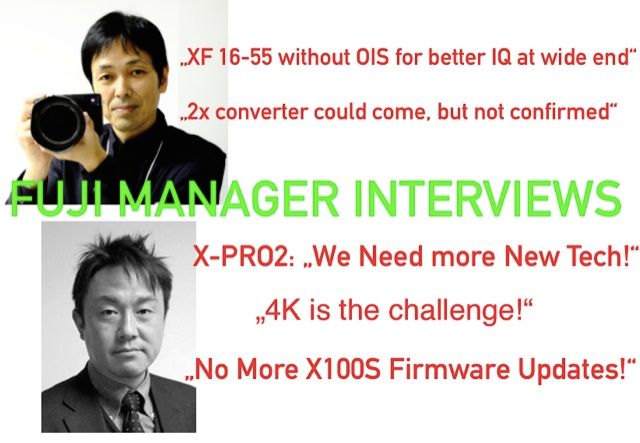
Time for another series of interviews with Fujifilm Managers… let’s start with the main points in the one imaging-resource had with Makoto Oishi from the Sales & Marketing Division, Optical Device & Electronic Imaging Products Division.
4K:”Currently, our X-Trans CMOS II [sensor] cannot realize 4K videos because it has a smaller number of pixels, like 16-megapixel. Also, if we [want to] realize 4K video, the sensor itself should have much faster reading speed.”
I remind you that our trusted Japanese source confirmed a few weeks ago, that Fuji’s plans are to make the X-PRO2 4K capable.
X100S firmware: “While we have provided firmware upgrades for the X100S many times, now we have the X100T, we’re finished, no firmware upgrades [for the X100S] anymore.”
Frankly disappointing, if true. I can understand that they hold on with the FW release, since the X100T is relatively new, and a new X100S firmware would probably influence negatively the sales… but on the long term Fuji must update the X100S. X100S owners are a VERY important part for Fuji’s success, so they deserve an update. At least Classic Chrome… David Hobby himself said here to have used it on his X100S… so why not all the other X-shooters too?
X-PRO2: “But if we launched an X-Pro, we’d need more new technologies, and we’re still developing and investigating. Especially the new devices like the processor or sensor, we’re still preparing.”
There is more to read at imaging-resource, for example about the gyro sensor used for the OIS in the 50-140. A technology missing in the 16-55… and in another interview at fujifilm-blog another manager (Mr Soga, the man responsible for the lens roadmap) explains the true reason for the lack of OIS: it’s not about size, it’s not about costs… it’s about IQ at the wide end (16mm)! He says:
“OIS needs to move the lens inside to compensate for camera shake and as a result can cause loss of resolution in the edges of the image. In long zoom lens such as the XF50-140mmF2.8, the angle of view is narrow enough to not show this negative effect of OIS in the edges. However, the angle of view of the XF16-55mm, when set to the widest setting, is large enough for OIS to affect resolution at the edge of the image. Considering this trade-off, because we wanted this zoom lens to start wide at 16mm and F2.8, and we wanted to best edge-to-edge quality throughout the entire zoom range, we decided to not employ OIS.”
Mr. Soga also confirms that teh XF 35mmF2 will have faster focussing and “we may create a 2x converter in the future although this has not been confirmed.”
Read more at imaging-resource and fujifilm-blog.
298 Responses
isn’t skipping X100s firmware update againts their Kaizen motto?
No Kai-Yen, no Kaizen 😀
This is the first time I comment. Like previously stated, unless it is defect fixes, I dont think Fuji is obligated to release new firmware every time. Understand the economic reason so as to support sale of newer model. In my opinion, I would have thought There is no relevance to Kaizen. Please understand the fundamentals of Kaizen before throwing the term around at its narrowest possible interpretation. When I started with digital camera with Less than 1MB, I was happy enough to accept with all the shortcoming, the same as I moved through D70, D700, D800. Never had expectation for Nikon to release firmware to put my D800 to be at par with D810. Same with my X-20. Didn’t moan about not having chrome simulation mode…well.enough ranting…just saying
So if OIS as a result can cause loss of resolution in the edges of the image, why did Fuji then implemented OIS in the XF 10-24?
Ok, XPRO2 is DEAD. “we’d need more new technologies, and we’re still developing and investigating”
Agree, and tempted to sell my Fuji equip.
Xpro1 is slow, x-t1 is a toy…great lenses alone don’t help 🙁
Japanese language translations are difficult to interpret, especially when the execs are picking and parsing their language carefully.
The X-Pro 2 is very much alive; they’re goal is to ensure that it uses the most bleeding edge tech they can realistically introduce. My understanding is that the organic sensor is still very much on the table.
So Kaizen ist officially dead for the X100s?! Despite Classic Chrome cleary working on the X100S we will never get it… I will definitely remember this once it is time to upgrade Fuji!
Just release an xpro1s and an xt2 with the same specs. Put in the latest sony 24mp sensor fuji can get their hands on, go for good 1080p and 2k video with as high bit rate video that the sensor can handle. Boom you’ve bought yourself another 18months r and d time.
Why is the XPro2 so video focused? It seems like an XT-2, with its large EVF and DSLR form factor would be the more likely candidate for a hybrid camera than the more retro, rangefinder styled, optical viewfinder packing XPro. Is Fuji really delaying the XPro for video? That doesn’t seem right. Misdirection?
I think fuji going for good video quality is great. BUT I agree if this is holding the xpro2 it’s a bad idea and they should have released an xpro1s in the last year. 4k would be amazing, but why not release a csmera now with awesome 1080p and 2k video?
Agreed on all points. XPro1t? Yes, please. 4K? Awesome, but not really essential to OVF cameras. More megapixels? Sure, if not at the expense of low noise. But I’d rather have more dynamic range than more megapixels beyond 16 or 24.
Ok, so it is not even coming out this year. I can understand waiting for new sensor and processor technology. However, if 4K is the bottleneck, that would be very disappointing.
Personally, I have lost interest, as it is taking too long. When it comes out, I will perhaps consider it again.
To give the 100S Classic Chrome is hardly likely to affect 100T sales, all we are talking about is a shift in the profiling of image not a major change to the capabilities of the camera as a whole. I’ve only recently purchased a 100S (Used), reason for purchase I did not want the ‘improvements’ incorporated in the 100T, the availability of Classic Chrome or not had no influence on my decision whatsoever.
Fuji has very little interest in a customer who buy a used camera with out interchangeable lenses. No money in their pocket from you.
Quite a disappointment. Fuji providing FW updates has been important for why I have been staying with Fuji. No it doesn’t seem to matter that much anymore.
And I have been glad that Fuji has focused less on video. Not so if this is holding up the X-Pro2.
Wow what a joke not only they released the x100T less than 2 years after they released the x100S now they are stopping the updates. The x100 received updates after the release of the x100S, that was one of the main reasons why I was happy to pay the fuji premium price…
we’ll have a couple of sony’s before xpro2. X200 is what we need. X100S and 100T are too similar for a firmware update.
Re IS – Interesting tests and comments at DPReview on IS with wider lenses. http://www.dpreview.com/reviews/olympus-om-d-e-m5-ii/10 It is part of the Olympus review but relevant to us all. In particular they say:
“… with short focal lengths, exposure times can become so long that the
stabilization system can’t possible compensate for user movement, while
with longer focal lengths, the IS system is extremely effective much
further below 1/eFL.”
It is why I will buy the 16-55 when I can afford and justify it.
2X Teleconverter is the most exciting news to me. And makes a lot of sense on the X100T.
You have to read the whole interview. 2x teleconverter is not going to be for the x100-line.
No classic chrome for my X100s?
Very disappointing for the X100s.
I bought it new without thinking twice, because I knew Fuji would keep improving it.
There is so much to do on the flash front (rear-sync, on-camera flash and commander at the same time, …).
More reliable AF would be nice, as well as new film simulations and advanced filters on RAW files.
Well has the XPro2 turned inti the D400??
If it had, all new models coming out would have crippled ergonomics, artificial shutter speed and flash sync limitations, different card slots from your last model, substandard silent shutter mode, lower frames per second, a body that is less balanced with a 2.8 zoom, no way to change aperture in live view or during video recording, and a full frame sensor to brag to your friends. The first professional model would also cost you three times as much for the body than your current camera did, and it would trade insane resolution for ISO performance, increasing your storage costs and forcing you to buy a new computer along with the camera to process data you won’t need.
Sure, the situation with the X-Pro1 is a bit frustrating, not having an upgrade path for so long while the old model is really showing its age, but at least Fujifilm has openly committed to 1) actually bringing the camera out at some point and 2) making the upgrade really, really worthwhile. Moreover, they have brought out a competing flagship model with the X-T1, which is certainly more than capable enough to work as an intermediate solution for a lot of X-Pro1 users.
Just to put that in perspective, we are talking about a big Japanese company publicly committing to something they have not even officially announced yet and giving us updates on how it is coming along.
Sure, the whole situation is everything from great, but to me what Fuji are doing is worth a lot more than Nikon’s unclear strategy that may or may not be to force professional users and semi-pros to either buy cameras three times as expensive than they used to with no practical gain, or to live with cameras that are primarily aimed at consumers. In my view that’s the opposite of what Fujifilm are doing, so I think your comparison is a bit unfair.
As a x100s owner waiting for the xPro2 to make the famous “from DSLR to DSLMirrorless” for my “system” (the need is not as urgent as the lust), this isn’t the best news, is it…
That’s sorry to hear about the X100s and no more firmware updates. I was hoping to add Classic Chrome and maybe face detect and maybe faster AF to mine. What happened to “kaizen.” Why are the obsessing with this 4K video. I bought my Fuji for photographs not video. If someone wants video buy a camcorder. Once again no mention of the 16mm 1/4 lens.
Fuji is focusing on updating popular current models instead of discontinued models that have already been replaced by a direct successor. This means no more “new feature” upgrades for the X20, X100S, XQ1, X-A1 (X-M1) and X-E1 (X-Pro1). These cameras should still get bug fixes and compatibility updates, though (such as the recent AF+MF update).
I expect another major feature upgrade for the X-T1 this summer.
What about the X-E2? It would be awesome if it could get the Electronic Shutter
After the last round of updates I suspect the X-E2 falls into the same category. Its internals are similar to the X-T1 but it hasn’t sold as well plus it may be different *enough* to not merit the effort. I have both the E2 and T1 and the more I think about it the more sense it makes. I’d love if the E2 gets more functionality but I’m not sure what Fuji would get out of updating it. The T1, on the other hand, is still a good seller and they would get something out of another update. Also helps distinguish it, from a business perspective, from the E2.
We’ve reached the point in most of the cameras currently sold these days where the distinctions are largely software based and arbitrary.
Updating and improving the discontinued X100 long after the X100S came out was one of the reasons I initially trusted Fuji to buy a X100S
+1! … me too!
“I expect another major feature upgrade for the X-T1 this summer.”
Wow! Oh, Rico, give us a clue, pls.
Read the DPR interview with Toshi and you know what Fuji is focussing on. 😉
Re-read it and could not find a clue beside potential AF improving 🙁
you and me both – all things they talk about (aside from film simulation) seems hardware related … not something one routinely downloads
So, what does that mean for that major feature upgrade for the X-T1 ?
So why then does the 10-24 have OIS when it seem to the engineers that it will cause image degradation? And it is even more extreme on the wide end.
I ask out of real curiosity since I have the 10-24 and I think it has excellent optics even with OIS.
The difference is the difference between f2.8 and f4.
“Currently, our X-Trans CMOS II [sensor] cannot realize 4K videos because it has a smaller number of pixels, like 16-megapixel.”
But 4K doesn’t need 16-megapixels ????
“Sales & Marketing Department” practically ensures he has little knowledge of technical details 😉
“yeah”, “yeah”, “yeah”,”yeah”, in fact the guy from imaging-resources is monologuing most of the time…
If Panasonic can do it, …
Can’t they just update the X-Pro with an OVF that allows manual focussing (X100T VF)?
I don’t care what rocketship they want to build with the X-Pro2, but the OVF in the original one is useless for manual focussing, and always switching to the EVF, I might as well use a X-T1.
I can’t help but think they’re missing the target audience with the XP2. I think most of us would be happy with basically XT1 internals along with X100T OVF capabilities…. right? Yet they keep us waiting for tech that sounds as if it would be more at home in a XT2 type camera…
It wouldn’t surprise me, and it would be awesome, if they are planning to release a Pro2 and T2 at the same time. The next T model needs to have most, if not all, the features of the Pro2. Releasing both at the same time would make a sizable impression.
@adzman808:disqus The question is, is that “most of us” big enough of an audience for such an X-Pro2 to be profitable ? You have to appear to be pushing the envelope to attract the general public and please the tech media these days. The X-T1 did that, but it’s a trump you can’t play twice.
Very true Guillaume, the reason I hope we are big enough audience is the fact that Fuji are even considering a XP2… Compare the press/user responses at the initial releases of both the XP and XT, one was ‘a good camera, but has quirks and issues’ the other was ‘wow, probably the csc in the market right now’ I would GUESS that some Fuji management types might be very hesitant to even consider another XP build… But aparently they are, so lets hope they get aligned to the majority of our tastes…
That’s what I thought too, and maybe it explains why they didn’t make an X-Pro1S (which would have been closer to the camera you described IMO) and skipped a cycle to hit harder and better. Which is fine by me, I’m not in a hurry.
If there has to be a video focused model in the line then it has to be the T model… and frankly most Fuji users don’t care too much about video or have actual and proper video equipment…
Anyway 4k is an overkill the same way the huge 50 mp files of the Canon 5D are… impractical, excessive and a pain to handle.
“on the long term Fuji must update the X100S. X100S owners are a VERY important part for Fuji’s success, so they deserve an update.”
Deserve doesn’t come into it. I bought the x100s when it first came out, and I’ve benefitted from several updates. The camera does everything and more than I bought it for. I don’t deserve or expect any more features, sure, it would be nice to have, but I have no right to be upset.
I hear what you’re saying but I think a lot of people expect the continued improvements. I know that’s one of the major reasons why I left canon to come to Fuji. I was torn between buying a X100S and X100T.. I went with T because my shop had an open box special (this was months ago).. so the price difference wasn’t that much but I remember thinking man.. I could go with the S knowing that they will provide updates. In hindsight glad I didn’t.
Good job you did! And remember the difference between S & T is a lot hardware related (EVF/OVF) nothing a software upgrade could have done
It’s difficult. In the comments, some folks are complaining about Fuji being behind the competition with regards to body technology (sensor, IBIS, autofocus tracking etc.). So Fuji needs to focus on putting their available resources (budget, time, manpower) into R&D for NEW features and new camera technology.
At the same time, folks are asking (actually, they are demanding) that Fuji spends its budget, time and manpower on adding already existing features (from the X-A2, XQ2, X30, X100T and X-T1) to older models like the X100, X100S, X10, X20, XF1, X-S1, XQ1, X-A1, X-M1, X-Pro1, X-E1 and X-E2. Not to mention that the X-T1 is still lacking features from the X30 and X100T, while the X30 and X100T are lacking eye-detection from the X-A2, while the X-A2 is lacking many features from the X30 and even XQ2 (and vice versa). Whoa.
You can’t have it both ways. Plus, software (firmware) is an important factor in distinguishing products. That’s why Capture One Pro was more expensive than Capture One Express. It was the same software, but Phase One deliberately disabled key features in the Express version. And then they killed the affordable version altogether.
These “folks” pay quite a premium price for Fuji gear. So it’s normal that they have some expectations.
very good points. But at least Classic Chrome, I mean, David Hobby already had it on his X100S…it would cost Fuji zero Cents to upgrade all X100S with Classic Chrome, and not just the one of David Hobby
Well, look at the RAW FILE CONVERTER EX 2.0. One of the benefits of going RAW is to be able to have more creative control and be able to apply film sims during processing. But in Fuji’s case, no. Your camera has to already support the sim (Chrome) in JPEG mode to allow this. What’s the point? Same as in leaving it out of the X100s I suppose. To drive more people to upgrade to the X100T.
FWIW, and granted a $100 solution, Iridient’s interpretation Classic Chrome is pretty great, plus, it’s the best RAF developer out there.
I think it would be good enough if we could somehow figure out how to make the Adobe Lightroom/Camera Raw profile show up in the selection for older models (edit a version string in the profile file or something). That way Classic Chrome and ProNeg would become available to users of all older models, or at least for those shooting Raw and using an Adobe converter.
Does anybody by and chance happen to know where these profile files for the Fuji film simulations are stored? Maybe it’s a matter of only editing a file or two.
Actually you can make your own calibration profiles in camera raw. This example shows how to do it for better IR photography but the same principles apply.
http://photography.tutsplus.com/tutorials/an-in-depth-guide-to-infrared-photography-processing–photo-9540
The DNG Profile Editor will be your key.
I am aware that this is technically possible, but the amount of work involved to get a custom profile to the level of the official profiles is just not a reasonable. It also assumes having access to the original camera for testing and comparing, in which case you would, well, already have a camera with the feature and hence you would be able to use the official profiles with its images anyway with no need to make your own. I just think it would be significantly easier if we got the official profiles to work.
I assume that was a beta firmware that David hobby has. Even if the code is written and deployed, it’s not worth it for Fuji to put a beta update out there as-is, because it could introduce many more bugs. So that requires internal testing… Which needs resources… And is a distraction from the sexy new tech they are developing. I understand why they dont have updates planned for the X100S
Don’t get me wrong – I shoot exclusively with an X100S and would love some new features to play with, and some bugs to be fixed. I might even pay for them if they were offered.
But hell, I’m not gonna moan about not having these things on a gear forum and act as though I’m entitled. I have a kick-ass camera with quirks, that can still get the job done – no big deal. It’s an imperfect tool that can deliver great results.
Stop looking for perfection, guys. It doesn’t exist. Focus instead on the 95% that Fuji got right, and USE IT. You can take fantastic photos with that.
I’ll be a little more blunt…
Gotta love all the armchair pundits in these comments, pining away for the next “big thing”; bitching about what they don’t have instead of going out and making images with what they DO have (as if the camera they originally chose is suddenly no longer capable).
Pull your entitled heads out of your asses. If you can’t get a decent image out of your camera now, then I got news for ya: a firmware update ain’t gonna help you.
Fuji doesn’t OWE you anything.
>>it would cost Fuji zero Cents to upgrade all X100S with Classic Chrome<<
NO. It would cost you, the customer, zero.
It would cost Fuji probably US$ 150,000 to provide Classic Chrome to a SINGLE other camera than the X-T1 series.
Some people talking about software development… ridiculously uninformed.
Software development is difficult, tricky and hence: costly. People always think new software comes out easily and happily like the singsong of a hummingbird.
Yes, a few frankenstein models are out there. Fuji Lab did some quick and dirty tricks on them to demonstrate what Classic Chrome would look like to a hand-picked group of X-photographers.
But personally, I don't want to shoot with David Hobby's tweaked camera AT ALL!! This stuff is potentially dangerous.
They never run through 150,000 test circles to check every potential issue. They said, ok, here you go, David, if it fucks up, don't worry, we'll give you another one.
I guess you'd not only want the Classic Chrome for free, you'd also expect to get a new model once the one you had died on you because of the update, wouldn't you?
they updated the X-E2 with Classic Chrome. Why not the X100S too?
How is it that the X-E2 is an old model when it still has no successor. Don’t they consider it for upgrades at least until a successor comes out?
Good point Rico but when I was in the market for a camera in 2013, I went with the X100S BECAUSE of what I saw Fuji doing with the X-Pro1 and X100. I said to myself “it’s a safe bet that I’ll get continual updates over time”. I don’t expect much but that Classic Chrome feature, as Patrick said, has ALREADY been on the X100S via customer firmware on David Hobby’s X100S.
In about a year or so I will move to an interchangeable lens camera and don’t want to have to worry if the next iteration of my future camera will be obsolete when a successor comes out.
These firmware updates are a nice way of letting people look past the RAW problems Fuji has had with Adobe.
But I think if Fuji sticks to this and doesn’t release Classic Chrome for the X100S, it will tell us something about their sales of the X100T. It’ll tell us that the only thing keeping people from an X100S is Classic Chrome.
Some of us are willing to pay for firmware upgrades, even to something as old as the X10 or XS1. I, for instance, would pay pretty well for a focus peaking upgrade, as well as for a Q menu on the XS1 (as they added to the X10). Not so much for film simulations (maybe the Pro Neg’s).
But how many would pay? Fuji should only make the investment if it can recoup.
I understand that. As Patrick says, though, a lot of this requires very little work on their part: focus peaking was added to the X100, which had the same EXR processor, though a different sensor, I believe, and to the HS50, which had the later EXR II processor, but a very similar EXR sensor (differing only in # of pixels, I believe). If Fuji is developing their code in a sane method, it is modular enough that it should not require *that* much development time.
I myself am aware that there is a lot of crappy, non-modular code being developed in haste, for one reason or another. So maybe it would not be worth it, after all, but given how many people are saying that they’ll hold on to their X10’s as long as they can…
Rico, the difference with software is that you can always update it and you will usually get a discounted price for the upgrade if you own the old version. Only camera makers usually expect us to upgrade the hardware as well for the new features. That’s BS. It’s like Apple only offering you the new OS when you buy a new computer. As long as the hardware can support the new software features then it should be offered as an update. I have no problem paying for it but I have a problem if I need to replace fully functional hardware with nearly identical hardware (same sensor, same processor) just to have a new feature.
Selling new cameras needs to be done by hardware improvements. Innovate on the hardware side and you’ll sell cameras. Good software features should be mostly used to pull people to your hardware platform (like Apple has been doing for years). Fuji’s problem is that they haven’t really been innovating on the hardware side for a few years (except for lenses). So now they need to cripple software to drive sales. Not looking too good for them.
This really isn’t true. They haven’t been innovating on the sensor. That’s one piece of hardware. But they have improved haptics and ergonomics tremendously, and have put out a bunch of great lenses…all hardwear.
Haptic and ergonomics might be considered hardware but it’s nothing that will sell many new cameras. I’m talking about actual innovation that will cause people to upgrade to new models like the viewfinder of the X-T1. Better sensor, better AF, faster processing engine, maybe IBIS, global shutter for video / flash sync / DR, faster mechanical flash sync, faster camera response time, better battery.
I wrote that my critique was about camera bodies excluding lenses. They have done a great job there.
I can’t speak for others, but I just upgraded to an X-T1 from an X-pro, almost entirely because of haptics and ergonomics. The sensor and AF on the X-Pro 1 did/does everything I need to make great (for me) photos. If I shot sports, or kids, this would not be so, but I have to ask, what does Fuji need in terms of “hardwear” (other than more lenses) that it doesn’t offer now? How does the X-T1, as it stands now, hamper your photographic ability?
I think Fuji is catering to photographers, not gear people
David, I understand your point. But since the X-T1 is a completely different model I wouldn’t consider that an “upgrade” but rather a “switch”. Ergonomic innovation to me is making one model with the same basic shape more usable (better buttons, better button placement, maybe better grip shape, better dials etc.). But if you define it differently it will obviously be innovation to you.
If you read my post above you will see that I don’t want Fuji to cater to the measurebators. I am mostly criticizing usability issues. In my answer to you there are several other points that I believe are actually hamping some people’s photography.
Apart from the AF my X100S does everything I need (I have a kid). I’m pretty sure the X-T1 AF would suffice for me. But I’m not the person these camera companies live off. I still use a D7000 and shot weddings with it just last year. I own one AF lens for it, the rest are old manual focus Nikkors. That way capitalism won’t work.
I was just saying that if you want people to upgrade then you need lots of hardware innovation. Apple has managed to make the iPhone camera better every single year and yet they are still at 8 MP so one can hardly argue that they cater to gear people.
Nonsense: people upgrade yearly with Fujifilm just as they do with other mirrorless people. But then there are gear people and thoughtful users of gear.
And if thoughtful users of gear were at the core of the X customer base, X user base would understand and deplore many of the inconsistencies that still plague the X system. I’ve written about some of them elsewhere in this thread.
I’m sure some do, but that is a very expensive, and unnecessary habit. Fuji aint a perfect company, but for now they are giving me more or less what I want, and I don’t want to F that up.
I’d like to hear what haptic/ergonomics problems were solved with the X-T1. Haptics: it depends on if you bought early or not. The early versions are poor:
1. selection and menu buttons cannot easily be selected by normal sized thumbs
2. AF button has the same hardware feedback as the AFL button despite having a completely different function
3. AF button isn’t easily reachable when holding via the rear grip
4. eye detector detects hand-waves so that reviewing images when on tripod causes images to go in/out
5. exposure wheel still cannot select half and third stops
6. accidentally switching drive/meter modes are easy for both small and large hands
7. doors still flop open too easily
8. battery can be inserted 4x different ways
9. large hands cannot wrap around the small grip of the X-T1 as they can around a mostly unadorned friction grip as seen on the X-Pro 1.
I don’t see any ergonomic improvements. I see a faux SLR camera. If that means improvement to you, that is personal. But in terms of reliable ergonomic/haptic improvements, there is little evidence for that.
I’m not going to try defend on each point. Maybe I am not as discerning. Of the problems you listed, I have none of them. Not saying you don’t, but I don’t. I bought a graphite version, so maybe some of the issues were improved. But then again, my mirrorless adventure has been Olympus E-p2 –> X100 –> X-Pro1 –X-T1, each of which has been an improvement on the last. Different perspective I guess.
@ricopress:disqus “You can’t have it both ways” => Yet isn’t it precisely the horse Fuji chose to bet on with Kaizen ? Not at constant resources, mind you — extra effort must be put in, but over time the competitive advantage gained would hopefully cover at least part of it.
Is the new product/older product sales ratio that important as long as the sales keep going up ?
Completely agree.
so no FW Updates for the X100s would imply IBIS and better Tracking? 😉
Do you happen to know that Fuji’s development and maintenance teams and budget are that small that it has to decide between R&D for future products vs. supporting brand by extending customer value via adapting existing code into cameras that share very similar hardware? I recall an earlier interview stating that Fujifilm decided to enhance existing customer value with some loss to new sales (e.g., X100 updates when the X100S came out).
It would be nice if Fuji publicly stated its policy on providing new features and enhancements in firmware updates to existing models and older models moving forward. Take a look at Android smartphones, where you have manufacturers state how long updates to newer OS versions would be provided.
If Fuji went the way of the other camera manufacturers in this area, that would be good for consumers to know. A lot of people (including me), jumped into Fuji-X because of the stories of “Kaizen”; of being different in the area of firmware updates.
I do wish the X100S had one more round of firmware upgrades to implement classic chrome and modifiable Q menu. I’ll keep using it, but, I am disappointed. The X-E1 got an update after the X-E2 came out.
Had I known the X100S wouldn’t be getting any more firmware upgrades, I would have sold it in favor buying a X100T back when the X100S could be sold for more.
When making future decisions, I’m back to assuming that there won’t be firmware updates, just like for other camera brands.
You are assuming a lot. Every maker updates firmware, some more drastically than others. As has been stated, many of the firmware updates that have been given to certain X cameras were updates of dire importance, without which, the cameras were either crippled vis-a-vis the competition, or at major odds with their own marketing.
In other words, Fujifilm have fixed some serious errors, and in some ways, provided extra functionality, but a broad look would show that much of that functionality should have been available from the start, especially as the cameras are intended to replace dSLRs, functionality that was available for dSLRs (immediate manual focus override, direct focus area select, etc), was ridiculous not to have been available at the start.
It is fairer to look at it this way: most firmware updates restored missing functionality. They did not supply extra, or unnecessary functionality.
I assume based on what Fujifilm has done in the past. X-T1 received significant updates beyond “extra, or unnecessary functionality”. So did the X-E1, X-E2. We’ve seen at least one firmware update for older models after the replacement model has been released.
Other manufacturers (e.g., Canon) have consistently done what you’ve said. Fujifilm advertised “Kaizen” and it was a huge deal, making the company stand out from the competition.
My long term relationship (i.e., exceptions based on past events) with Fujifilm continues to evolve. When it comes to firmware updates, I will assume Fujifilm is nothing special. When it comes to buying accessories such as replacement lens hoods (e.g., one for my 56/1.2), Fujifilm is awful — special parts order for $30 plus $12 shipping and 4 weeks wait. I’m hoping Fujifilm delivers on a significant body upgrade in 12 months or so; if Fujifilm can’t, then I will have to re-consider my long term investment in Fuji-X (which is currently $5600+).
Until then, I’ll continue to enjoy my Fuji gear as-is (which means I keep my FF DSLR system to complement it).
as I said elsewhere, David Hobby was already using some X100T features on his X100S via firmware udpate (Classic Chrome)… so the firmware is already available. I think every X100S shooter should be able to profit from it, and not just David Hobby
Is it not fair for Fuji to say, if you want this color profile that badly, you have to buy the new hardware? Just because Fuji could offer something for free, doesn’t mean they must, or that we are entitled to it. It’s a business after all.
Hear hear!
I chose to get an x-t1 after getting an x100s. Since they have the same sensor, it would be nice to have the same film simulations available on both to get the same look with a set of pictures. I also bought into the Fuji ecosystem because of Kaizen. Seriously considering returning my 50-140mm lens so I invest less in the Fuji system (already have the 10-24, 35, and 56) and move to the Sony A7 series in the future.
Well I think we do deserve a fix for all those bugs in the X100S (see my post above). We don’t deserve new features but why not sell a firmware upgrade if the code has been written anyways?
The X100S has received exactly one FW update since I bought it – and the battery indicator is still useless. Part of the reason I bought a Fuji was this continual improvement hype. Sure, the X100S was a lot better when I got it than when it was released, but that has a lot to do with Fuji’s philosophy of rushing to production and following with a lot of FW updates soon after release in order to finish the product.
Personally, I expect to see a small update in the form of an X-T2 rather than any more FW updates for that one. It’s now about the same age as the X100S when I bought it.
ah, too bad!
10-24 is a f/4 lens not 2.8 I could see that as a reason
Had Xpro1 too for several years, i switched last month to Sony A7 fullframe with 35mm SonyZeiss and Zeiss Loxia 50mm. Image quality is amazing. Controls of Fuji are the best, but the tech is so slow, using 3-4 year old sensors. Reading the full interview, they are still investigating sensor & processor after 3 years … my conclusion is that i made the right choise. Wait a few weeks, Sony will launch in april the A7R-II with 36MP or 50MP and IBIS, and a pro segment A9 with 50MP. Put some Zeiss gems on it, and it will blow you away. My A7 24MP with Zeiss does this already for me.
Frankly, Franky if you’re so overjoyed with your switch (which I don’t doubt for a second) how come you’re still hanging around in a forum dedicated to what is, for you, a thing of the past; Do you still need to convince yourself you made the right choice ? You have to let go now.
No no 🙂 There is no way back 🙂
I am still following fuji because i really like the X system and i am curious what the future will bring.
Love and hate for you, right ?
Really starting to feel like dumping a big chunk of change on the X100s was a huge mistake, especially now that they definitely won’t be fixing the broken inadequate auto focus. Bummer.
So, why did you buy the X100S, if you thought the focus was broken and inadequate?
Meh. Fanboys gonna be fanboys I guess. Too many people fooling themselves about the inadequacy of Fuji focusin – especially X100/S. Fuji themselves admitted it’s bad yet people still refuse to grasp reality.
It may be bad. It may be good. Personally, I’m not too impressed with the AF, either. But it’s competent enough not to need to be that bothered by it.
That’s not the point. Why did you buy it if you thought it was inadequate? Why use a camera you don’t think good enough to prove a point to yourself?
You are assuming too much. You are assuming that a person buys something broken to prove a point. You are assuming that users that are not happy are rich and ill-informed, the latter their own fault.
DaBomb said it: “Fanboys gonna be fanboys I guess”.
X has some awesome bits, but the marketing (especially the reviews from official X ambassadors) and the hardly adequate hands-on from big magazines, or image-quality reviews from Photozone, took all the headlines.
Yes, X cameras produce amazing images. (Others do, too; it’s not unique in today’s market to make lenses or cameras that wow.) And most of their issues were ignored by the same publications. Photozone can be excused: Their reviews are almost completely focused on quality of image, not on handling, not on AF quality, nor camera handling, etc.
Blaming end users for being mislead is unfair and serves only the holier-than-thou and does nothing to improve the very real problems that X faces.
Shame on you for attacking mis-informed users.
Exactly. Pointing the finger at me is just cheap deflection for a flawed product that won’t be getting the promised “kaizen”. Fanboys unite!
Calling people fanboys is usually a way to avoid having to come up with a meaningful argument in a discussion.
Only a fanboy could ignore a 180 like this from a company that promoted a business model predicated on continued improvement. Iow. This stinks for x100s owners
And you base this on one comment which may or may not be the final answer. And it is a one time situation so far. Too early to say it’s a complete reversal.
I can understand that people can and do buy products that are not up to their requirements – I’ve done it, we’ve probably all done it. But, that’s what a returns policy is for. What I fail to understand is the motivation for KEEPING a product that is not up to their requirements.
‘DaBomb’ clearly feels strongly about this; ‘inadequate’ and ‘broken’ are not terms used lightly. If I felt that strongly about a product I had bought, I’d have returned it. If I bought it on eBay, it would have gone back on eBay.
I wouldn’t call out someone who was misinformed in the process of making a buying decision. That seems to be an unfortunate by-product of buying online, and there is no way to entirely overcome this. But, this isn’t about the ‘buying decision’… it’s about the ‘keeping decision’.
The question remains, and remains unanswered: why use a product if a key component of its operation is broken and inadequate?
I think a person keeps using things that may or may not be up to spec, or even great when they’ve exhausted resources, or are stuck.
For instance, though I rather detest the camera, I use the Sony A7r for most of my work. All that is good about it is its sensor and its wonderful magnify/pan functions (which no one can touch). Everything else is sub-par.
I”m sort of stuck with it though. It does what I need for 95% of what I need it for. I may replace it next year with a phase one back, which honestly is the perfect thing for my work, but is too pricey at the moment.
But I continue to use the Sony. I have to. And it is too expensive and wasteful of time and resources to keep trading up or out or buying/selling.
Eventually, you have to stick with something. And I think this is a problem for a lot of people that ditched the dSLRs expecting the reviews to be spot-on, the marketing to be realistic (mirrorless marketing is far more aggressive and contains far more lies than does marketing for dSLRS. Probably, this is because it represents incumbents, who, facing larger opponents, get by with intrigue), and yes, who hoped for too much.
But this is a problem. A Nikon user could have picked up a Canon, learned a new interface and been 100% comfy within a few weeks. Not that dSLRs are perfect (I actually dislike them quite a bit), but when you pick one up, you know very well what it will do and what it won’t. And by and large, the only real differences between consumer and professional dSLRs is button layout and AF speed.
But most even high-priced mirrorless cameras are less reliable than even mid or low-range dSLRs except when you are talking about one thing: exposure preview, and absolute AF accuracy. But they come with huge penalties that affect the cameras in which they perform.
Today’s mirrorless cameras have a P&S legacy which not a one has really shaken. And that is a big problem.
That is an extremely nuanced decision-making process you have there. It doesn’t seem to bear much in common with the process of the person whose honour you have taken on to defend.
I just mentioned it elsewhere: I’m not defending a single person. I’m taking a stand against the attitude that lays all the blame on the consumer. You are polite and my initial reply came on fast and judgemental. I’m sorry.
My response was to you but I projected other comments into this part of the thread.
Still, I’m not defending _a_ user who has problems. I’m defending the buying position of weakness in a market that has very little truthful outlets that comment and engage Fujifilm gear on anything apart from image quality. Image quality is important. Again, any modern camera will give wicked image quality.
It’s how the camera is useful and can be used that in the long run matters. And by and large, there have been too few honest, or too few critical reviewers who are vocal and generate followings among Fujifilm users.
It is too easy to be misinformed.
who drops a chunk of change on a camera with broken and inadequate AF?
An idiot…?
Caveat emptor. Learn it. Live by it. Stop bitchin’ about your choices.
Sounds like victim blaming to me. The culprit here are the ones who made the camera, not those who bought into the hype.
Oh, so you feel Fujifilm victimized you because you didn’t properly research your product choice? Way to deflect the responsibility for your mistake to them.
Like I said, caveat emptor.
How are you supposed to properly research X cameras? There are so few reviews done that focus on potential and real problems. They are glossed over.
Caveat emptor does NOT apply to this case. In Fujifilm’s world of official reviewers, there are no real problems discussed. In the web surrounding it, there are few people that push for important changes, or that highlight anything beside:
awesome colours!
wow! setting the exposure via a labelled dial!
wow! the cameras look like old cameras!
No, it is not a person’s fault for being mislead about AF. Fujifilm mis-marketed it, and reviewers completely glossed over the issues because of nostalgia factor, or rooting for the underdog, or something else.
Blaming the buyer in this case isn’t fair.
You’re kidding, right?
Your pejorative, sarcastic examples don’t reflect the reality of what I’ve read online.
We have more resources available to us than ever before. Endless review sites from pro and amateur photographers; personal observations noted on forums; countless YouTube videos; the long-standing plethora of formal review sources from DPRreview to Popular Photography (and everything in-between).
All we had 40 years ago were magazine reviews.
If you can’t figure it out from all of that, there’s something wrong. And if you MUST be an early adopter in a world where product life cycles are 18 to 36 months — without doing your due diligence because your GAS is out of control — then that’s not the manufacturer’s fault, it’s yours.
A word about AF performance and all the rest: Your mileage may vary. If you need a certain guarantee of a certain type of performance for the type of shooting you do, then do your homework carefully and select a camera to fit your needs.
Could Fuji’s AF stand improvement? Of course it could. And it would be nice if the X-Trans sensor played with 100% fidelity with the Adobe ecosystem. But those are minor niggles for the majority of these cameras’ intended audience, and even they can be worked around.
There are no “bad” cameras anymore, just bad photographers.
Of course I’m not kidding.
I have not been sarcastic at all. The ! points I used are real examples of typical reviews. It’s like Douglas Adams’s chit chat about digital watches. People are so happy with the technology that they forget the implications of technology whose interface doesn’t keep up.
40 years ago cameras essentially were the designed the same: same aperture/exposure settings, essentially similar interfaces.
There were fewer things to get really wrong or really right. It wasn’t as necessary to have really as polarising reviews. Today, many X reviews get caught up on nostalgia, or simply can’t cover everything. Cameras are simply too complicated.
Apart from the position of the viewfinder, the lens, and the shutter button, standard interfaces does not exist from manufacturer to manufacturer. There are good and bad interfaces, and no one talks about the problems. And anyone that really points out those problems is labelled a troll. This is a problem.
And neither DPReview, nor anyone else points out problems with interface. There is the marketing and then there are reviews, which by and large, focus on the technology below the surface, not the human interaction.
That is a problem.
There aren’t enough good high traffic reviews that focus on things, like AF, that have made or unmade a person’s purchase.
The physical look of the X cameras is probably their biggest problem: people look at them and justifiably expect a certain method of interaction, and do not get it.
I purchased an X100s about 8 months after it debuted. My X-Pro 1 a year later. The X-T1 was my mistake, but my wife prefers using it over the X-Pro 1, so I’m happy with that.
I pre-ordered it.
It is a wonderful picture maker, but it has myriad interface flaws. AF isn’t my problem with any X camera, but I don’t really use AF.
People that do actually have a number of problems, both with the interface, and with the actual AF performance. And few reviews made enough point of illustrating the problems with AF, or other inconsistencies to properly inform the reader and potential purchasers.
Then go to your local photo retailer and play with the camera for an hour or so. Test out the autofocus on different subjects and decide for yourself if it’s zippy enough … or tracks well enough.
Anyone with an ounce of discernment powers could have immediately ascertained that the early X-Pro 1’s autofocus was lethargic.
It isn’t rocket science to research before you buy.
Fuji X cameras have their assets and their flaws … just like every other manufacturer. We could come up with a pros and cons list for every camera made.
Pros using Fuji X cameras make images like this…
http://www.lovegrovephotography.com/fujifilm-xf-35mm/#!
And this…
http://www.lovegrovephotography.com/fuji-56mm-f1-2-r-xf-pictures/
They don’t come to these boards and whine about why their camera isn’t capable enough. Usually, it’s THEY who aren’t capable enough.
And then: not everyone has a photo shop near them, and even if they do, there are problems. It’s like a 30 minute test drive of a car. You have no idea how it handles on snow or rain, or if it fits your bicycle. Renting a car is one thing, but then isn’t logical if you have no rental place near you.
Putting the entire onus on the buyer is ridiculous. Companies that make claims have to be able to back them up. Unless they are in poorly regulated places. Now I’ve said that, I should admit: Japan is very poorly regulated. Companies can essentially say anything they want with very little blowback if they are wrong.
But if we follow that logic, every purchase you make, from hotdogs to pencils had better be 100% researched so that you don’t get cancer, so that you don’t encourage children from working in dangerous conditions, etc., and so on.
I’m not defending a single user, I’m upset, and rightly so at the reviewer base that have either too late engaged potential customers with the real problems of the X series camera interfaces/and other issues that people have.
Reviewers do shape the purchasing landscape. And they have been less than helpful.
Lovegrove is a talented photographer. He could have taken those images with any camera. Obviously we are not talking about pros that feel their needs haven’t been met.
And if you’re cynical, you probably realise that pro’s who are on Fujifilm’s books, probably don’t, won’t, or can’t make public suggestions/complaints.
If you don’t like the Fuji gear, yet many, many other talented photographers do — including both pros and advanced amateurs — then one is forced to wonder: is the problem with Fuji … or with you?
Hmmm…
If Fuji doesn’t work for your needs, then sell it and get something else. Problem solved. (Though I suspect in another couple of years you’ll be over on the Sony forums — or Nikon, or Canon, or whomever — complaining about the problems with their kit.)
You haven’t read a lot of reviews, then. I’ve seen plenty of fair reviews that discussed pros and cons. Two that come to mind are from Thom Hogan and Photography Life. Each product has their shill reviews but for the most part people can rent and try the camera. Or, here’s an idea, return it within the return window if it doesn’t meet their expectations. When you have people like Scott Bourne, Bill Fortney, and Rich Harrington among others using Fuji and enjoying it there’s something there.
+1
Please stop! Just go out for awhile with whatever gear you like and make some photographs.
I tried classic chrome on my XE1 with capture one and a XT1 ICC from DPReview. It looks great… sometimes… but it’s not something I need in camera since I shoot raw anyway. I’m sure there are ways to tweak the xt1 profiles to work on any xtrans sensor in Lightroom as well.
As for the x100t, it was completely unnecessary as a camera. The improved ovf is nice, but that’s about all… Should have just worked on firmware for the x100s and keep it longer on the market.
The difficulty is ‘keep it longer on the market’ no longer works. Products have a lifespan, set by the wider market and their competition. The X100 lifespan is about 18 months. After that, sales begin to drop regardless, and only a model refresh will kick start sales again.
Did x100t kick start sales again? I don’t know the numbers so I can’t tell but personally, the tiny update in the x100t did not convince me to buy it, it actually made me want to by x100s instead because of the price drop of the older model.
Yes, I’d say the X100t did kick start sales, both sales of the X100t, and sales of the X100s at discount.
The other option is to let the product wither and die still in the catalog, like the XPro1. It’s a great camera, but currently almost unsalable (it’s on offer at the moment in the UK, where it comes almost free with two lenses, and it’s still not selling apparently). Sales will not lift until an XPro2 appears and people buy up the last stocks of the XPro1 as a ‘bargain’.
Time will tell whether the X100t will be a success in its own right. i suspect if it was flying off the shelves, there would have been firmware upgrades for the X100s.
disagree. The buttons instead of the scroll wheel make for a huge handling improvement, as does the 1/3 stop aperture ring.
Hey Fuji Classic Chrome for the X100s at least you could do that. It’s not that hard to do!
Someone needs to start a petition to get Classic chrome on the X100s.
this must be the place 😉
I’m all ears.
How do we make this happen?
maybe I could write an open letter to Fujifilm and post it on FR. Say that, as David Hobby, also other X100S shooters would like Classic Chrome on their camera, since the firmware is already available and used by David Hobby.
Please do Patrick. I would sign it ASAP. I know that some people are asking for a ton of other features like faster AF, face-detection, etc. But I am simply asking for a feature that has already been done (Classic Chrome via David Hobby).
I would sign it.
I know English isn’t your first language, so to be safe: The phrasing you have there might be confusing. You should say, “X100s owners would like Classic Chrome on their camera, just as Fuji made it available to David Hobby for his X100s.” Absolutely don’t write “David Hobby, also other X100s shooters would like” it, since that sounds as if others have it.
You working on it now?
bring out dog – clean appartment – have dinner – finish to write my feedback for a friend who send me a book she wrote for review – play guitar – and then, just then, I’ll write the letter. I should find some time this weekend… I hope
work in progress…
Are we really going to die on this hill? Fuji provides loads of updates, and Classic Chrome can be more or less achieved with a few tweaks in post. Fuji needs to dedicate themselves 100% to the next gen sensor/processor
Word.
This.
Yes because tweaking a firmware update that has already been rolled to other older existing models is the same as developing a completely new ‘next gen’ sensor.
Heck, according to you Fuji should just give up on lens development, pro-level service, native lighting systems etc and focus on this sensor of yours…
Smh..
I think you meant to say according to your internet sense of dickishness, because I said none of that. For the record, they have made classic chrome work on an X100S, but as others have pointed out here, it wasn’t a production firmware. Just because David Hobby gets to experiment with it doesn’t mean that it’s ready for mass distribution.
Just because Hobby got it, that doesn’t mean the FW is “available”. I’m sure they don’t have the super stringent validation requirements when letting a tester use beta code. IOW, they may still have to spend money and time to validate the FW before they can release it to the general public. In many cases that’s more costly than developing the code, so the question is how should they prioritize their time.
PRECISELY. This is what most people here don’t understand.
Fuji updated the X-E2 with Classic Chrome. Fuji updated Hobby’s X100S with Classic Chrome. Now it should not be that difficult anymore to add CC also the X100S
Would be great. I’ll sign it.
It does seem a bit weak not to release Classic Chrome where they can. This does not seem like a major purchasing factor, considering 1) everyone knows it works on some yet non-supported cameras and 2) there’s a million film simulation plugins. Regarding Kaizen, I not so sure this was ever a FujiFilm endorsed and touted philisophy, was it? I’d always thought this had been applied by bloggers.
David Hobby: “I have played with the new Classic Chrome film simulation on an X100S that had been altered to include it*.
So the FW update is already available… other X100S shooters would be pleased to play with it too.
http://petapixel.com/2014/09/10/classic-chrome-film-simulation-sleeper-feature-new-x100t/
That’s often not as easy as it sounds. I’ve had engineering samples before; hacked versions of the current model with more or less the firmware of the next in my day job in audio. They work to highlight what the next generation of device does, but the update is neither stable nor easy to update in the real world. That the likes of David Hobby and Zack Arias had these bastardised X100s cameras as beta testers for the X100t doesn’t necessarily mean the hacked version could be easily rolled out to the general public.
Yes, it might be Fuji is holding firmware back in order to drive X100t sales in a tough market for cameras. Which is fair enough – I’d rather there be a Fuji still around to make the next camera than be washed out by supporting those who have just become its legacy customers. But it might also be the FW update is harder to implement than expected and Fuji decided not to offer a firmware update that would be beyond the know-how of most of the client base.
To add to that, I mean we’re talking about a color profile. Is it worth that much to get so worked up about? On the one hand adding only the color profile should be no big deal, on the other hand it is just a simple color profile.
To my knowledge, they are not simple color profiles, but more involved. Basically actual image processing software with dedicated algorithms. Apparently they are not as simple as doing some HSL shifting based on input hue or something, like the camera color profiles of most cameras do. That being said, there is no reason to assume that that part of the code would not be be independent enough to be reasonably easy to integrate with the older firmware.
I’ve read that, too, but I can’t quite buy that explanation just yet. I’d need to understand more.
It would certainly explain why I can’t seem to find the corresponding ACR profile files on the hard drive, unlike those for Nikon/Canon. That would also imply that Adobe integrated Fujifilm’s color processing code into ACR to replace Adobe’s profile-based engine for Fuji raw files.
Agreed. While Canon might have a bigger client base, Magic Lantern was the public’s answer to Canon’s lack of a robust FW. They made it happen and it made important tools available to photographers and filmmakers.
+1
they updated the X-E2 with Classic Chrome… they updated Hobby’s X100S with classic chrome… c’mon, now it shouldn’t be that complicated to add CC also to the X100S
We don’t know what the ‘update’ process to these X100s cameras was, because it’s hidden behind NDAs. The update might have been handing Hobby a X100t in an X100s shell – I’ve had a similar thing happen to me.
The FW upgrade to the X-E2 suggests a FW upgrade is possible, but the X-E2 is a later camera in the Fuji timeline, so it might be the upgrade proved harder to insert in the X100s. I still suspect it’s not to compromise sales of the X100t, but ultimately I can’t be sure on this.
Very very disapointing…
for me as for many others KAIZEN was a big factor to buy the X100s (at this point it seemed for me it was more than marketing – as it seemed to be proven by fuji on the x100 which still had updates after the x100s came out)
There are a some things they rly should have updated on the x100s
– spot meetering only in the center(…)
– direct focus point selection
– autofocus improvements
– usefull q-menu
every point avaliable on the x100t…
for me its a big damage on my trust in fuji !!!
(btw I woul even pay some for the upgrades mentioned above – but not for a new x100t – sry fuji)
Fuji, Fuji, I hope this is not true…
I love my X100S but there are still a few big points that are bugs or just stupid behaviour. In my opinion a customer has every right to expect a FW update for those. Here are the major ones:
– Waxy skin above ASA 3200 (JPEG)
– No way to turn off the screen / EVF which results in lots of wasted battery (when disabling the screen the EVF stays on even when it’s not held up to the eye)
– When using eye sensor with EVF the cover of the OVF will pull out every time I remove the camera from my eye. Stupid waste of time and unneeded mechanical stress. It will also move in every time I review an image even if it’s on the screen.
– The shutter closes and opens when turning off the camera or previewing images. Completely unnecessary wear.
– When shooting with OVF / EVF and taking the camera away from the eye to check the image on the screen (normal especially when using the OVF) the image preview will show. Then it will go black, perform that stupid OVF-cover closing and then show the image again. Zooming to 100% to check focus can only be done after all this rubbish behaviour.
– No 100% preview when shooting only RAW
I consider it my right for those to be fixed. Here are some things I would really appreciate and I would gladly pay 20 € for since I they are feature upgrades not fixes of a camera that was half-baked on release:
– Classic Chrome
– Electronic shutter
– Faster AF
– Direct AF point selection (that could be considered a bug actually)
Since all four of those are in the X100T I believe it would be very little work for you to implement in the X100S.
Oh, and for the future: I believe most of us would prefer a good menu system and perfect Adobe X-Trans support over 4K video 😉 Just my two cents…
Some of those are opinions (e.g. “waxy” skin) and even have workarounds (use raw). Some won’t likely be fixed on any x camera anytime soon (100% preview from raw only). Some things are hardware limitations. I can’t speak to issues specific to the X-100s but your list is largely a nice to have and your opinion.
Regardless, I still would like to see Fuji implement a paid update system for certain features. Similar to an app store where you buy modules that add functionality or enhancements. A good modular design would help although there will always be hardware limitations.
Waxy skin is not an opinion. Saying that makes it sound like you haven’t actually seen it. It might be a cultural thing but from western perspective it is definitely a bug. There are workarounds for almost everything but that doesn’t mean there’s nothing wrong with it.
100% preview might be a limitation on the RAF format but I can’t really imagine that and it would be kind of stupid for Fuji to have made such a decision.
Please tell me which ones you consider hardware based?
If you don’t own an X100S please don’t talk about it. If your car always turned on the radio when you shift gear wouldn’t you consider that a bug? That’s what the X100S does in several cases. Completely unrelated actions that waste time and cause wear. If you had an X100S I’m pretty sure you’d agree with me that those things are not just my opinion.
Yes, waxy skin is an opinion. And I can certainly discuss the items that cross over all the cameras — and that’s precisely what I did.
Hardware based: electronic shutter, faster AF.
But go ahead with your ranting. I’m sure it’ll get Fuji to do what you want.
For goodness’ sake, Patrick please do a poll: “Is waxy skin an opinion or a bug?”
nwcs, I know which side will have more votes. Call it something different if you want: “skin without any of the detail that the RAW file captured”. That can be scientifically measured. Would that be enough for you to accept that it is a bug? Probably not…
There were two, maybe three point in my list that concern all cameras and you talked about two of them and called the rest “largely a nice to have”. So you did talk about the rest too.
What is the hardware difference between X100S and X100T in your opinion? Same sensor, same processor. I wouldn’t know what hardware difference should limit the electronic shutter and faster AF. And in the case of the electronic shutter: every camera that can record video already has an electronic shutter!
But apart from that, those two are things I didn’t call bugs but asked for them as new features for a paid FW update.
My “ranting” might get Fuji to see that they are getting some things wrong. Always praising and protecting them (like you are doing in this thread) is gonna make them sit on their butt and become lazy.
I don’t have the X100s but had the X30 and the waxy effect was present 100% of the time when the image/ was not properly exposed/. Never seen it on my x-e1 or X-T1 so I’d guess that although it is not an opnion, this can lergely be prevented.
And preview from raw … afaik no manufacturer does it, there must be a limitation (speed ?) somewhere.
Don’t have an X-E1 but from all I’ve read and seen the X-Trans I cameras don’t show this behaviour. X-T1 should though so please check my answer to Mardock above and explain to me how the image was not properly exposed.
not trying to be funny – but I could not find the answer you’re referring to
Here’s the link: http://www.fujirumors.com/interviews-x-pro2-we-need-more-new-technologies-x100s-no-more-fw-updates-2x-converter-could-come/#comment-1919541352
OK, I looked and I must say it is pretty horrible. … Not doubting what you say, trying to find a way to improve.
1. Smth does not stack up here: 6400iso at 2.8 and 1/370 in what looks like a clear room somehow does not seem to be what I would expect.
2. you mention “waxy skin” jpeg/high iso
but even your raf is not good: sharp on the left hand side (under the thumb) not sharp in the middle of the hand; and the jpeg – however horrible it might be reflects that too.
To me it does not look like a conclusive example – something looks “tilted”
I agree that high iso (and 6400 IS high iso to me) jpeg are more delicate to manage but not to that extent. May be someone with more experience with the X100s can chime in
I’d be very happy if anyone knows a solution to this problem without having to shoot RAW (which I do anyway but prefer just using JPEG when it turns out well or develop in-camera).
What you’re referring to I think is just the lack of detail because of the flat lighting. It’s indirect window light and the middle of the hand is parallel to the window, the part under the thumb is a bit at an angle. Here’s another example with the whole hand at an angle:
RAF: https://dl.dropboxusercontent.com/u/5384001/FX1S5475.RAF
JPEG: https://dl.dropboxusercontent.com/u/5384001/FX1S5475.JPG
Oh, and forgot to write: Nikon sure has a 100% preview when shooting only RAW. Can’t say about anyone else but I’m pretty sure it’s standard.
Sorry – too busy to really look into it; just wanted to answer to your last remark about the 100% preview in raw only. I am almost certain that Nikon stated that the preview is from the small jpeg which is always embedded in the raw.
Will try to come back later on your image, but can’t promise
Small probably refers to the compression if they really said that. The resolution is definitely 100%. I just checked.
I wanted to add one more thing why I also consider the waxy skin to be a bug: there’s a way around it, though not a very practical one. Got it from Rico Pfirstinger.
Instead of taking the shot at ISO 6400, underexpose it two stops by using 1600 with the other settings untouched (and shoot RAW). Then push the exposure two stops in the in-camera RAW converter. You will not get the waxy skin. Since the analog amplification of the sensor really just goes till ISO 1600 and the rest is digital amplification you should get the exact same image (which is not the case).
Interesting I’ll give it a go, thanks
If you’re getting “waxy” skin, perhaps you need to work on your photographic technique in camera, or develop a better understanding of lighting.
Photographic technique is really not the issue. It’s to do with the sensor and the in-camera noise reduction.
There are plenty of comparisons between the two. Heard it all before when the X-E2 was released and compared to the E1. People who have written reviews who used both seem to always land on the 100T as better all around.
Sure, have a poll on “waxy” skin. Maybe I’m in the minority. Maybe not. Either way, it still is fundamentally an opinion and yours is one apparently Fuji doesn’t share. If they did they wouldn’t keep repeating it.
Okay let’s just agree to disagree on the opinion / bug thing.
Of course Fuji seems to disagree but if enough users have a problem with their opinion they better offer us an option to turn NR off.
The comparisons are clear but I want to know whether the differences are hardware related or just software. I believe they are only software related (except for the new viewfinder) and that’s why Fuji doesn’t give us a FW update because it would make the X100S be almost identical to the X100T and would obviously harm their sales.
I can always agree with the idea of having an option to turn NR off. Since everyone seems to agree it doesn’t show up in raw files it has to be in their jpeg engine so it should be relatively easy to turn it off. I suspect a fair amount of the 100s and 100t are the same but the Japanese are experts at continuous improvements so the internals probably have a lot of minor differences.
+1.
You’re right. Waxy skin is not an opinion. Portraits don’t look good at ISO 6400 JPG. Fuji please give us more grain and more details.
Please tell me the RAW workaround for waxy skin. I use Lightroom and I can’t get anything to work – I get waxy skin even at lower ISOs. I tried this guy’s thing with the detail slider at 100% but it doesn’t work for me, skin tones still look smeary: http://petebridgwood.com/wp/2014/10/x-trans-sharpening/
If there is another way, one that does not involve using that weird Silkypix software, please tell me
Sounds like a workflow problem. Take a hop over to the fujix-forum web site and take a look at the post processing threads. This has been debated a lot and a lot of people have discussed Lightroom issues.
Also, exposure compensation dial does not work in Manual with auto ISO mode. (This should adjust ISO for exposure)
Right, forgot that one.
“In my opinion a customer has every right to expect a FW update for those.”
Entitled much?
—
“Waxy skin above ASA 3200 (JPEG)”
Never experienced that … even at ISO 6400. Improve your skills?
—
“The shutter closes and opens when turning off the camera or previewing images. Completely unnecessary wear.”
So you’re a camera engineer now?
—
“I consider it my right for those to be fixed.”
See my first comment.
—
“…perfect Adobe X-Trans support over 4K video.”
I’ll give you this one. I think most agree on this.
“Entitled much?”
No, just someone who believes that an APS-C camera for 1200 € that is also targeting pros should work properly and not perform silly actions or crash. And someone who believes that a consumer has a right to that. If it cost 500 € I wouldn’t expect that but 1200 € is a premium price so I expect proper service.
—
“Never experienced that … even at ISO 6400. Improve your skills?”
Please compare these two images and tell me what I did wrong. The exposure? Not in my opinion! And this is with NR at -2!
OOC JPEG: https://dl.dropboxusercontent.com/u/5384001/FX1S5471.JPG
RAF:
https://dl.dropboxusercontent.com/u/5384001/FX1S5471.RAF
—
“So you’re a camera engineer now?”
No need to be insulting. If you or any other engineer here can give me an explanation for that I’ll gladly take it out of my list. But as long as nobody does that I’ll see it as a bug. I’m no engineer but I have quite some experience with electronics.
—
“I’ll give you this one. I think most agree on this.”
At least we agree on something. If only Fuji agreed with us as well…
I get waxy skin at iso 800
Ok we have both sides… The side that is disappointed with Fujifilm for no more Firmware Updates for the X100S and the side that says Fujifilm doesn’t have to provide a Firmware for the X100S…
I am a X100S owner and I’m disappointed but I’ll suck it up and deal with it…
Though now the key word is “Trust”
What makes Fujifilm from not pulling this again and again on the existing and future models?
I hope this isn’t going that way…
Sounds mostly good to me. I like the free updates, but I don’t expect them. If the camera can’t do what I need it to do on day 1, I don’t buy it. I would love a 2x converter, but PLEASE Fuji, release a 23mm f/2, WR
There are several key problems with this sort of commentary:
1. You never can tell exactly how a product will handle from day one, no matter how much you read.
2. Fujifilm X cameras are reviewed often by tech GASers that love everything that comes out, or by shillish types to whom Fujifilm can do no wrong.
3. Many of Fujifilm’s cameras were released as concepts, not thoroughly developed cameras or platforms.
You simply can’t know what the camera is or is not capable of from day 1. Whether because of longevity of the platform, or of a powerful user base, with certain other brands, you had an idea of what a new camera would d and be capable of.
So the X world has a lot of photographers that are very disappointed. Another lot (I will consider them a less critical bunch) are happy. But it is far more polarised on basic functionality than other brands, whose criticism tends to be of higher-level functionality.
I’ve mentioned it maybe hundreds of times, but Fujifilm’s interface, where the promise was of all necessary settings being set through external dials, is broken.
A few examples:
1. you cannot select half or third stop exposures in manual mode from the exposure dial. You have to go to an unlabelled dial. Uncritical users see no problem. I have no idea how that is possible.
2. Until the X100T, aperture stops worked the same: main ring, then unlabelled dial. Again, uncritical users didn’t mind. Again, I have no idea why.
3. Many lenses lack full focus stops. Others have them. Uncritical users didn’t mind. The basic criterion for care was that the lenses looked like old lenses.
4. Many lenses lack labelled aperture stops. Others have them. Uncritical users didn’t mind. The basic criterion for care was that the lenses looked like old lenses. These lenses cannot be set, or used without directly interacting with the computer portion of the camera. They fail Fujifilm’s marketing, if not their design prerogative.
5. Some lenses lack aperture rings. Others have them. Uncritical users didn’t mind. The basic criterion for care was that the lenses looked like old lenses. Again, these lenses cannot be set, or used without directly interacting with the computer portion of the camera. They fail Fujifilm’s marketing, if not their design prerogative.
6. Many lenses lack labelled labelled distance scales. Others have them. Again, uncritical users didn’t mind. The basic criterion for care was that the lenses looked like old lenses. These lenses cannot be set, or used without directly interacting with the computer portion of the camera. They fail Fujifilm’s marketing, if not their design prerogative.
I think the main reason that Fujifilm users tend to be less critical of X’s many misses is that they just don’t want to belong to the Canon/Nikon camp, and feel that the X is superior to the smaller m43 sensor cameras.
This is all to say: there is no way to tell what a camera or lens is capable of from day 1. Not even Leica, whose interface is much simpler and whose cameras have changed the least from the introduction of the M mount in 1953.
It’s not uninformed users that are the problem. It is the uncritical X fanbase, and X’s tendency to attract uncritical/shilly users to is official X User group.
And you are not a tech Gasser yeah right! Man look at your website.
You got me there. But I’m completely against the Gassers running the show for X. There isn’t enough critical input into the body of reviews for the platform.
Sorry man, this is too much to read. Looking at it briefly, I will say that no, Fuji is definitely not perfect. I’ve never had a perfect camera. Ever. Fuji is just checking the right boxes for me, at the moment, in comparison to peers. Could they do better? Sure. Do I expect them to continually improve a product I bought a couple years ago? Nope.
It was a lot to read, but my commentary is focused on what Fujifilm got wrong, or what they glossed over, or about what they lied, or misconstrued the use/function.
The FW updates helped fix problems. They didn’t give new functionality. They removed holes in the cameras.
They may be checking the boxes for you, and that is fine, but they fail their own mission. The FW helped to fix some of the failures.
This isn’t a subjective commentary. Looked at objectively, X has some serious problems and always has, many of which Fujifilm could have dodged by releasing properly designed interfaces from the first. Because they did not, complication crept in.
Not fixing cameras that are, according to Fujifilm’s own marketing, broken, is negligent.
Ok, so what you’re saying is that Fuji is just like any other camera brand.
I accept that now.
But some of us bought our Fuji cameras thinking that Fuji actualy had a different vision and that we could see our camera as kind of a (bit) longer investment.
Just wish they’d have some official news (or at least a release time-frame) on the X-Pro2. I want to update so badly (the AF is seriously irritating at concerts), but preferably to the X-Pro2. Can’t wait forever though.
Search google for “Osbourne Effect”
Ha Ha Osbourne Effect = X-PRO2 = vaporware= lost customers.
LOL
That’s not the Osbourne Effect.
Precisely.
WE DON’T NEED more video future!!! Please.
don’t forget… we are photographes not videomaker!!!!
Fuji stinks “But [for example], while we have provided firmware upgrades for the X100S many times, now we have the X100T, we’re finished, no firmware upgrades [for the X100S] anymore”
I want same speed autofocus as x100t. There is no hardware difference in autofocus system between x100s and x100t,
I want intervalometer.
Seems like it was a couple years ago the interviews with Fuji managers yielded goals such as not coming out with new models frequently, and for continually updating older models; their goal was to be different, to reward existing customers and have their product become long standing classics over time, not just throwaways.
Look, there’s nothing wrong with being like any other money making camera company, not at all. But there is something wrong with claiming you are and promising you will be.
thats the poin!
Then buy an X100T. There’s nothing “wrong” with the X100S autofocus. It was good enough when you bought it I assume, or why else did you buy it? The x100T’s is just better. That’s what happens.
[QUOTE]“But if we launched an X-Pro, we’d need more new technologies, and
we’re still developing and investigating. Especially the new devices
like the processor or sensor[/QUOTE]
OMG, how long does it take Fuji to update a 4 year old sensor??? 24MP with better DR than 16MP models has become mainstream technology even at the lower end of DSLRs, the Sony a6000 shows the path. Fuji is stagnating at the sensor front, and since quite a long time. Forget 4k video, I haven’t made a single video with an X camera in more than 2 years….
It may well be too late for them to introduce 24MP. They need to steal a march on the competition, not just try to catch up.
And they need to work vigorously with raw processing software vendors to make sure their products are 100% supported from day one.
The sensor is fine. In fact raw sensor capability, megapixels aside, has changed little. It’s the image processing pipelines and newer noise reduction algorithms in the signal processing that have led to gains. Personally I’d be happy with an updated 16mp sensor with a faster processor and a more sophisticated pipeline.
Marketing of other companies have done a number on people.
I don’t know, I love these cameras and lenses but that sensor is kind of weird. I’d love to see something different in any upcoming X camera.
Meh. Fuji started with three lenses 3 years ago. Now they have a lens lineup that most Sony users would be envious of. What good is a great sensor without the lens you need to put in front of it? And the difference between 16MP and 24MP isn’t as much as you might think. I welcome a sensor upgrade, of course, but it’s not my first priority. A flash ecosystem is way higher on the list for me.
Fuji is making cameras for photographers, not for you.
You might be better served by Sony.
lol
Indeed disappointing news about the firmware updates. I own the Fuji x100s (as well as the x-e2). The Kaizen philosophy was a big part of my decision to switch to Fuji. Since film simulation and a few handling issues mentioned above is not reason enough to upgrade from x100s to x100t I doubt it will seriously hurt their sales.
That being said I understand that supporting an ever growing line-up is time and resource consuming. I think it’s fair to ask for a price for feature enhancing firmware updates (as opposed to bug fixes)
Kaizen means monitoring internal business processes within an organization to improve efficiency and minimize waste. Sort of like cutting out forms in HR, or eliminating a processing step in accounting or on the production line.
Not sure the relevance here.
I’ll keep my existing Fuji gear because I have a lot invested in it but in the future I will be looking somewhere else. It seems Fuji has lost it’s way which usually happens when a company becomes has success with a few of its products then seems to wander in other directions. The X-PRO2 has never been a realty and never will. No more firmware updates for the X100s. No small lens on the roadmap except for the 35mm f2 and who knows when that will come out. Love my current Fuji though but their future products just took a wrong detour.
I am expecting at least 50% of new lenses not on the roadmap yet will be like the coming 35mm f/2. In fact I would be very surprised if in the end there is not a whole range of small very fast focusing f/2 lenses.
With that said, I want OIS in the 90mm f/2.
I want the 100-400 to be f/4-5 not f/4.5-5.6 and I want Fuji to make it with an integrated 1.4 tel-converter like the Canon 200-400 has.
I want a full range of lenses, something for everyone
A 100-400 with f4-5 would be substantially bigger and incorporating a 1.4 TC would make the price very high for the market. As it is, a 100-400 f4.5-5.6 would be very much like the Canon/Nikon equivalent in size/cost. Making it bigger and adding extra would probably add 30-50% more cost.
I think they will make more of the slower “rangefinder friendly” type lenses. But there are, as you said, other lenses that need to be done before those niche slow ones.
F2 is not exactly a slow lens and also in the interview the manager said it would be faster autofocus. The real reason I am interested in the 35mm F2 and 16mm 1.4 is for the weather sealing that Fuji has promised. Camera companies keep coming out with all these weathered sealed cameras but no weathered sealed small primes. I like walking around to take photos outside with small primes and having little weather protection in case of rain or snow would be great. I’m sure there are a lot of street photographers who would love this and if you follow the Fuji small primes were what drew them to mirrors in the first place.
I think originally Fuji showed a 140-400 f/4-5. And then there was all this internet noise about how big it was, so Fuji changed it to the currently shown 100-400 f/4.5-5.6.
Now, anyone can get a Canon 100-400 f/4.5-5.6 or Nikon 80-400 f/4.5-5.6, big deal.
So why does anyone buy a 100-400 lens? For me…sports, wildlife, reach, compressing the image. All of which I would be doing at closed to always the 400mm end.
So Fuji will already make a smaller, lighter lens as Fuji just has to cover a crop sensor
So what will make Fuji standout????
Making something faster, lighter, step-up in features.
Going to f/4-5 vs f/4.5-5.6 makes the Fuji different.
So why should I have to stop and take off the lens to add or remove the 1.4 tel-converter, a complete waste of time.
Adding an integrated 1.4 tel-converter…oh yeah…makes the Fuji different.
AF at f/8 very important (5.6 x 1.4 = 7.84) (f/5 x 1.4 = 7 = even better) (but we know lenses are never f/5.6 in reality it’s 5.9 etc.)
I’m pretty sure the first display sample was f5.6 at wide end. I get what you’re saying – just don’t think it’ll happen. The physics of the longer lenses also mean there isn’t a size reduction because it’s a smaller sensor.
Oh great prognosticator! what are the winning lottery numbers for next Friday? You’re basing a lot of things on a lot of assumptions. And every lens not of interest to you is of interest to someone else. For me, I have no interest in the 35 f2 and would prefer they work on other more meaningful lenses. Still, i don’t think they’ve lost their way simply because they chose to make another 35mm lens that makes a few people happy.
Lots of matter-of-fact statements based on rumor and innuendo. Do you make your business decisions the same way? Glad I’m not a client of yours.
“We require more technologies!”
Sounds like something you’d hear on Starcraft. 🙂
I also use an X-E1 with 18-50, 14, 35, 60, 50-230, and am awaiting delivery of the 10-24mm. So I will repeat myself, I purchased a used 100S as to me it is a better buy than the 100T and I an not alone with that choice.
All forums and blogs indicate that Fuji X shooters do not buy Fuji gear for movies, and Fujifilm keep on excusing themselves on that 4k technology. Forget about 4k. By the time some 4k tech will be ready, a lot of disappointment will be already out, caused by so many years of wait. I will not use my Fuji camera for film, we’ll have super smartphones for that, or another camera for that.
4K is just another marketing hype, after the 3D dream collapsed in the same predictable way. For film, extreme sharpness is unnatural. It’s just another try to increase television sales. I hope Fuji doesn’t make a focal point of it in the next camera models.
fuji marketing pulled a fast one. Kaizen is a nice slick sounding word, for a time came to be perceived as “Continuous FW updates!”. oh fuji.
x100 owners were given a rare gift. x100s owners are a bit left in the dust. would have enjoyed some usability tweaks, god knows it isn’t a perfect camera.
“…god knows it isn’t a perfect camera.”
Show me the “perfect” camera.
While you are right to call out prankhet, it’s not too hard to find cameras that ARE perfect for their specific audience, and which nearly perfectly achieve the goals they set out to achieve, and for which they are marketed.
Linhoff’s F compact line is one: solid, providing amazing camera movements, and never compromising for anything but size.
Nikon’s original F was another: it was built to survive a war, to be modular, and to be reliable, quick, and to need very little maintenance.
As time went on, cameras became trendy commodities. Makers no longer understood core design principles because they lack a coherent market, or an understanding of who they want as their customer.
Now many drift in and out of design principles that are borrowed, or appropriated based on their reading of market conditions.
That said, Fujifilm have debuted a few cameras with very pure philosophies, but with hardware that does not meet those philosophies. Cameras with pure philosophies need pure execution. Cameras with wishy washy philosophies can get away with more.
In which case, I’d say that prankhet is right. I could say the D7200 or D7000 is closer to perfect than any X camera for the express reason that it is a wishier washier camera made for no specific reason and with no philosophy that it must fulfil.
He didn’t say “perfect camera for a specific audience”, he said “perfect camera”.
There is no such thing. A D4s is perfect for a working pro who is a generalist shooter, because it’s optimized to do the widest array of things well.
But it’s hardly ideal for candid street shooters, or those wishing to pack maximum performance into minimum size. Neither is it perfect for making enormous, wall sized fine art prints.
Horses for courses. I would argue the Fuji X-Series cameras are doing very well indeed for their intended audience. And judging from the number of pros who have adopted them quite happily — David Hobby, Zack Arias, Damien Lovegrove, Dave Kai-Piper, Tom Grill, etc, etc, etc. — I’d say they’re impressing that segment, too.
And I explained that there is no perfect camera, the same as you, but I went further, saying that ‘cameras with pure philosophies need purer execution’.
The philosophy of direct control and immediate interaction of the X, especially with the X100/X Pro, requires purer design philosophy.
It is obvious that the D4s isn’t designed for street. And Nikon, as listless as they are, did not design it for the street.
In its niche, and for its main market, however, it is one of the purest designs there is. Would I buy it? Would it be perfect for me, a still life shooter? No.
But I’m not its market.
That pros use the X100 happily is of no account. The X100’s fast flash sync speed means that it can keep up with insane flash speeds. Great. It is silent. Great. Tom Grill shows amazing use situations for Wifi, etc..
But apart from the flash sync speed, each of them could basically use any camera. I’m saying that the X100 is designed improperly for its marketing philosophy.
It is a great camera, but is far less perfect in achieving its goals than something as clunky as a D7200 for the reason that Fujifilm brought it to market trumpeting a purer philosophy behind it.
Describe [in your opinion] the “perfect” pure philosophy for the X100, then. Because near as I can tell, judging from its enormous success, it hit its mark.
Again, no camera is perfect. As finessed as the D4s is for its intended market, get on some forums and you’ll discover plenty of folks within said market who still feel it comes up short in some areas.
Some people will never be happy with the tool in their hands, always pining away for an imaginary better tool in the future. And when that tool arrives? Well, it’s rinse and repeat.
Cameras can do things today we could only have dreamed about just two decades ago. And yet all some can do is lament what they don’t have instead of working with what they do.
Unfortunately, most people who comment on sites like these are gearheads and measurebaters, not photographers.
It’s quite simple:
Fujifilm’s original marketing drew attention to:
1. Aperture ring and shutter speed dial, both of which can only be adjusted in full stops. The philosophy of at-a-glance settings, not to mention smooth transitions of your hand from essential controls, requires those controls to exist in one spot and one spot only: on the labelled dials, which should have half or third stops.
2. The OVF: only now, with the X100T is it possible to manually focus and get feedback without resorting to EVF, but still, that manual focus relies on distance scales that are buried within the electronic user interface. Distance cannot be set unless you are looking through the EVF or LCD. The lens should be labelled for distance and have full focus stops.
3. While I know Japanese manufacturers are over it, helicoid or at least, slaved gear focus systems should be installed in any self-respecting at-a-glance camera. The focus ring of the X100 not only lacks any hardware coupling, it almost floats, making the focusing system completely disconnected.
Other things: Fujifilm said the shutter delay was 0,01 seconds. In many cases, it is much longer. And considering how bad the manual focus system is, AF should be of PRIME importance.
If the manual focus system had great aids, and had some sort of haptic feedback system, be it full stops, or geared focus that moved the lenses directly, absolute AF would be of less importance.
That Fujifilm released a camera that had neither good MF nor reliable AF through the OVF (the one standout feature), it failed its mission.
What rocks: silent shutter, fast sync speed, the promise of rangefinder-type shooting, are wonderful. But until today, they are ruined by deep interface issues.
Thom Hogan mentioned it, though not expressly: Japanese camera makers need to focus on the hardware, and get foreign consultants in to do the software and interface. I suggest even hardware interface. Japanese engineers are excellent at making machines. But come here. Using most of them is a nightmare. And that should be fixed.
The idea was so pure. The execution was, and is not.
You need to bear in mind that Fuji’s X system is barely four years old. Most of the recent focus [no pun intended] has been on R&D and release of top-notch lenses. It takes tremendous time and money to build out a lens line … particularly one of the quality that the Fujinons are demonstrating. What the company has managed to achieve since the release of the X100 a scant five years ago is quite extraordinary given the climate and the competition. Refinement takes time. Nikon has been at this essentially since 1959; Canon since about 1988.
The Fuji cameras continue to improve, slowly but steadily. They will adapt, revise, reengineer … and get better and better; this much is certain.
If you believe another manufacturer’s product fits your needs better, then go to that manufacturer. Fixating on complaints here is nothing more than an academic exercise that siphons time away from making photographs. Or do you think that venting to other forum posters is somehow going to make a difference or offer you a solution?
http://www.orbitexperience.com/duplicate1/STS-37_Jay_with_Linhoff.jpg
I agree, Linhoff F is awesome camera, but size is always huge to 4×5 negatives.
And look at that filter stack front of the camera! Image quality will suffer!
/s
Well, I never complained about my analogue & digital Nikons I still don’t do. I know a remark like this causes a stream of people saying the contrary, but from my D70 towards the D800, I never had one model that worked so quirky, buggy and most of all laggy as my X100 & X-Pro1 did. Fujifilm suffers in his own particular way a little bit from the same sickness as Leica does. Leica is one of the oldest still existing specialists in high end optical equipment but electronics (no discussion here) but electronics & software development has never been their thing, boy, they have been suffering from one disaster into another one and they still are (see the problems with the M9-sensor & the silly issues Leica still has with AWB). Fujifilm has overall a better experience, but their electronic expertise originated very much from the compact camera market while optically they’re likely one of the best Japanese companies having many appliances in the professional market. Developing an ‘all electronic high end camera’ has been part a huge challenge for them. I’m still regretting a lot that they didn’t keep the X-series more a ‘mechanical concept’, say, à la Leica. I would rank the X-T1’s current electronics & firmware implementation at about 50% of what we really require. Not more. And the X100S won’t be far of this number either. I won’t go in detail, but there are still a quite few things missing to make this ‘the perfect camera’. And deep in my heart, I still hope they can make the X-Pro2 the perfect Leica killer as I told before, don’t argue anymore about sensor sizes – give it a high end 35mm sensor instead and provide it with a few ‘gold branded’ very premium primes with it (f.i. 35, 50mm), at least one based on an APO-design. I’ll be in the shop the next day, missing likely one kidney 😉 .
Kodak Brownie.
I bought a X100S because I thought that I would like it …but in reality, 23mm (35mm) is really not my cup of tea! and when using my X-T1, it is hard to go back to the X100s!!! so, I am selling my X100s, and hoping that the X-T10 comes fast enough… 🙂 😉
In reality, I am really hoping for a X-T2!!!! ( basically a X-T1 with dual SD card slot. faster AF, and 24 mp)
as posted: “X100S owners are a VERY important part for Fuji’s success, so they deserve an update. At least Classic Chrome… David Hobby himself said here to have used it on his X100S… so why not all the other X-shooters too?”
We need the Classic Chrome film simulation!!!!
These remarks are rather disappointing and hopefully not reflecting the view of the company going forward. Reading between the lines I hope that Fuji isn’t putting all the focus on the X-T1 and Pro grade zooms since they’ve had recent success. Quite a few of us came to Fuji for something different. While I understand waiting for an major advances to release and X-Pro2 it brings to question why didn’t they just give users an X-Pro1s update.
It’s Fuji’s version of a Nikon D700 successor that never came. But they do have a very nice D750 now and the wait is almost forgotten. 😉
It’s a bit difficult to decode this Japanglish. But all together strange statements. First, Fujifilm seems to wave the whole Kaizen upgrade model goodbye. To my feeling it has always been some kind of marketeer story serving to mask the full-time debugging on the back of the initial buyers. Packaged as a few serious fixes and some new sideline features, nice sweets to make us forget the pain. But now the X-series has gotten mature Fujifilm will act just be like the rest of the market, period. And when we’re honest, I can’t remember one manufacturer that had to deliver about 15 FW updates on one consumer product to make it feel a bit OK like the X-Pro1 – we, consumers, expect a manufacturer of this size to have an R&D competence center in place that can make all gear work first time right, camera’s aren’t an incremental kind of development. Question. Are the current X-T1, X E2 and X100T FW such ‘perfectly’ operating cameras? The answer is a clear no to me. Under low light conditions, I still experience the same strange problems I encountered with the very first X100 (this hassle is so far away from any Pro-DSLR body I’ve owned, it has improved but not to a degree it doesn’t matter anymore). The AF can get so slow and the exposure terribly wrong. The AF-mechanism doesn’t like colored LED and fluorescent-lighting too. Fuji’s current WIFI implementation is a complete misfit too, in particular that fail-sick PC Auto Save . One that really deserves a much more stable version. And last but not least, the famous X-Pro2 story. A bit desperate and even disappointed, I just bought the X-T1 because I started thinking this camera was just vaporware on rumors-sites. It has been rumored, almost announced, delayed so many times, it has been anything from just a minor “S” upgrade to a revolutionary, new high resolution organic sensor-based design. In reality, whatever it might become it’s clear it’s not going to land soon. I don’t even think it’s thé next camera after the X-T10. More I don’t even think Fuji has a decent working prototype ready, one that can hit the production lines soon. Not before 2016, remember my words, there are apparently serious problems to transplant this X-trans concept to other sensors and ramp it up to higher resolutions. Is it maybe rendering the demosaicing extremely slow on the current generation of computers? And despite the X-T1 & X100S/T’s current success, I’m starting to get very concerned that Fuji’s very own kind of ‘suggesting progress in poor english-spoken interviews’ is in fact hurting the whole X-series future instead of providing confidence to the market and most of all, the installed base of Fuji X adopters.
I agree, I never understood why a lot of the users/blogs/forums promoted the firmware upgrades as some sort of triumph. A lot of them were fixes for things that didn’t work properly, some were pulled for having errors, some reset all the settings (great with multiple bodies). Some don’t even work in a way that makes sense (AF+MF). Truly a mess. I just don’t think a device like this should require a constant stream of upgrades to the body and lenses.
It wouldn’t annoy me so much if they provided a more elegant solution.
Then the sensor. Everyone keeps saying: “Its just a different filter on a sony sensor”, then why is it so difficult to get a newer sensor? Are we sure it’s a simple change or sony sensor?
New technologies huh? IBIS?
No, BS.
All I want is colour peaking…. 🙁
Better tracking (and AF in general), wouldn’t mind a higher resolution sensor dual card slot and gps would be nice. IBIS? if they could make it work without the drawbacks that oly has right now – yeah!
The AF system would need some general overhaul. Tracking, Face detection, Eye detection etc, they could be implemented much better!
+1, but not only loosing “Trust”, but also that “special ingredient”, that “Fuji listens” & “Kaizen” thing. Seems like the Fuji Guys lost their Mojo.
There could be myriad reasons they’re not providing further updates to the X100S. But that’s a long way from assuming that it’s a shift in policy and that there will be no more firmware updates for any further existing or future models.
Gotta love the digital era of mass communication; folks have brain farts or ill-formed ideas and then just dump them onto the Internet with little forethought.
No no fuji…
no firmware update for x100s?
it has the same hwd of x100t!
Do you change your plans about the Kaizen
Bye bye fuji
Exactly the same? All they changed was the letter at the end.
I don’t like the idea that “go buy a new model if you want an update to fix your problems”. It is just like some android phone companies who never care about improving existing products. This is not what a company has to do, but it eventually reflects how responsible the company is to its costumer.
Don’t overrate this interview. It does not seem to me to include 100% accurate statements. I don’t think it represents Fuji’s official view at all. Not sure, if the person is really authorized to make product announcements or talk about the roadmap. Some of the answers are not more than a sheepishly “yeah”. As someone already said: Difficult to get this “Japanglish”. There is a high chance for a lot of misconception here… This is a rumor site. Feel free to bash on rumors and weird interviews, or go out and enjoy your current gear. At the end, it’s mostly not the camera, it’s the photographer.
“we have provided firmware upgrades for the X100S many times”
They mean “four” times, right? And only one of which made any real difference.
The x100 had 10 updates.
C’mon…
just simple as it is. I have x100s for one year now. Bought it new from store with a latest firmware. No more updates means my next camera will not be a Fuji
Honestly thank you for the good laugh – I needed that today.
Have you ever owned a Nikon ? then you’d know that 4 times , including one making a real difference is indeed “”many times”
I think many of us owned or still own Nikon.
And many of us chose Fuji because they show (have shown?) dedication to their customers.
I own both Fuji and Nikon and other than the enormous blunder of the D600 I think “dedication to customers” is kind of a myth. “Where is my D400?” is about equal to “Where is my X-Pro 2 with all the stuff I want?” Fuji is saying that”Kaizen” maybe over, but Nikon is saying they are going to start offering firmware updates soon.
I do know for certain that the IQ on my D800 is way superior to my X-T1 and X-Pro, although i enjoy shooting with both. So who cares more about their customers? I say it’s whoever has the best PR and marketing at any given moment.
To be fair, shipping a rushed product that needs so many updates just to be market ready is not a good thing. The fact that Nikon does not need so many updates is in Nikon’s favor.
If the updates were only bug fixes, I’d agree with you; But there were also many improvements. What strikes me as odd is that on one hand people complain that products are rushed; then other complain that they don’t have the latest and greatest every 6 months; And nobody makes allowance for the fact that engineers do learn (like all of us) and may well find that decision they made were not what their customers wanted most and they try to improve or they find new ways to do things (like the AF speed, at some point in time it was the best they could achieve then working some more they find new and better algorithms and they release it); No one finds it strange when Adobe releases 6 versions of fundamentally the same product, then issue point release to fix bugs, or implement new algorithms as when Fuji does it it’s all a big conspiracy, rushed product, cash cow and the like. I find it refreshing that Fuji agrees to improve on existing products.
In constrast, Nikon made over the recent years a few well known blunders (for which I don’t blame them) but instead of standing up to their faults just released a new – paying – products (SB900->SB910, D600->D610, Bad QC on D800, ….) I find it hard to defend their “Nikon does not need so many updates as the customer will pay for the fixes” attitude.
ah well , all a matter of perception I suppose.
So because you did not get the chance to apply a firmware update yourself you are changing brand ? Too bad it’s not stand-up comedy awards day, you’d stand a chance
Bad is fuji releasing almist the same hardware camera with the new features and messing up x100s users. You always can update previous gen iphone with new os, or upgrade your laptop to newer win version if you just bought one with the previos version.
You bought a camera, not a friggin’ smartphone or a laptop!
So sick of whiney, entitled millennials.
It is amazing that there are so many babies online!
About 2 years ago, I bought an X-Pro 1. Since then, I was lucky enough to have received some significant upgrades from firmware updates, which definitely made the camera better. However, I had bought the camera accepting it for what it was, just like when you buy anything else ~ the firmware updates were a bonus.
If you are smart, and not the babies that many seem to be online, don’t pre-order a camera, or buy a camera based on what some reviewer may say. Instead, go out and test it for yourself, as you are the only one that knows what will satisfy your needs.
Before I bought my X-Pro 1, I tested it numerous times in stores, side-by-side with other cameras, saving the shots on my SD card, and comparing the images on my computer at home afterwards. I ended up accepting its flaws and buying it as the best compromise for me at the time; and, I didn’t expect any upgrades after point of sale ~ they were bonuses.
If you don’t like what Fuji has to offer, then jump ship and buy whatever suits you. But, I wouldn’t hold my breath on the camera getting better over time, no matter what camera you buy.
While I, too, would like improvements in image quality, features, and performance, I know that I will need to purchase those improvements in the future. While I have been hoping it will be in the form of the X-Pro 2, it may be something else. That said, one thing is for sure, I will have to pay for it, and I will not buy it blindly ~ I will test whichever camera it is as thoroughly as I can before I buy it, as I won’t expect it to become better over time ~ I will be buying it for what it is.
Stop crying; and, start – or continue – producing some decent images with what you have already.
When I used to skateboard, and my friends and I were sponsored amateurs, one of my friends always seemed to blame his board for the tricks he couldn’t land – despite being spoiled with a new board every few weeks. When, in fact, he just was not good enough to land those tricks consistently or at all. The same goes for camera gear!
For once, I mostly agree with you. Didn’t think that will ever happen did you 😉
If beg to differ, though. Buying a camera is always a compromise. Buying a camera you don’t like with the features it has is stupid. Never expect free feature upgrades. But bugs are a different thing. Buying a camera with bugs from a company like Fuji is not stupid. They have given us great FW updates and when I bought the X100S I did actually expect them to fix a few of the major bugs that are left. I don’t expect feature upgrades and I love my camera even without any updates, but I am still disappointed.
I have never really been concerned about whether someone agrees or disagrees with my comments, as they are merely my opinion. Everyone has his or her opinion, which likely differs from other’s, as we are all different. That said, if our opinions are sometimes similar, that is great too.
Fuji could definitely do a better job with quality control before launch, and they will need to do so going forward. However, like I said, any upgrades or fixes after one purchases a product are a bonus.
I wish, for instance, my DP Merrills had 1/8000 of a second shutter speed and an electronic viewfinder. However, I bought them knowing their limitations, so I can’t complain. Aside from that, they are exceptional cameras, and I accept them for what they are.
Have a great day!
Yep, fully agree. My point is than 1/8000th shutter and EVF are features, not bugs. Many bugs can not be found out about by testing a camera in a store. This is especially true for bugs in a certain scenario (e.g. wacky WB in mixed lighting, D750 flare shading, D600 oil spots, ). Other bugs might happen in the store while testing but the user will usually not know whether it is user error or an actual bug. Many or most people don’t have time to test a body thoroughly enough to find out about every bug before purchase. So it is unfair to say that we have to accept bugs because that’s how we bought the camera.
Features, yes, what you buy is what you get. Bugs are different. It’s like test-driving and buying a car in winter and in the summer heat it always breaks down but the company didn’t tell you that and won’t fix it. No good.
You’re absolutely right but you may also to agree that this new posture zeroes Fujifilm marketing arguments that they “listen to users” and use their “Kaizen philosophy” to mark a difference to their competitors.
And becoming “Kaizenless” they must be more careful before releasing new models as even Canikon issues firmware updates to correct bugs.
That said, X100 (with no “s”) continues to be my Fuji X “skateboard” and even if I buy a possible future X100(n) it will have to show sound advantages and I will keep this one – at the end it continues to be as good as before.
You are right ~ Fuji gained more customers with their Kaizen. However, I don’t expect that they will do anything more for the older models, such as the X-Pro 1/X-E1/X100s. If they do, that would be a bonus.
Personally, I wish they would provide the ability to convert the files to 16-bit TIFF in-camera, as I prefer the in-camera converter. And, I think they should provide a RAW converter (in-camera or external) that provides access to all of the film simulations, including Classic Chrome, for all models. However, I don’t expect them to provide either of those, nor should I, as I bought the camera without those.
That said, just like I believe Sony should provide the option for uncompressed RAW files with the A7rII (shocking that they limited the image quality with any of their cameras), I strongly believe that Fuji should either provide its own bare-bones RAW converter, or the ability to convert the files to 16-bit TIFF in-camera, for future models. If it was up to me, I would ensure that my customers could get the most out of the files, especially with a unique sensor.
A lot of people seem to think the X100 had a better sensor, so you perhaps have made the best choice. I would love to have an X-Pro 2 with a 24mp Bayer sensor without an AA filter. I think it would perhaps be better than the X-Trans sensor. But, who knows.
Have a great day.
Yes, the sensor tech is one of the reasons why I didn’t buy an interchangeable lens bod yet.
I believe Fuji’s idea of X-trans to overcome moiré had its merits but meanwhile we see Bayer sensors with no filter and X-trans showing more moiré when recording video – what is nonetheless an irony.
We don’t know what the promised organic sensor will be and if it will adopt X-trans pixel arrangement (if it comes to life), as Fuji has already patented another array and there are news about other projects that can bring technologies producing sensors that will not need either color arrays.
We know that RAF conversion has shown some problems with third parties programs and at least one – DxO – decided not to support X-trans and one of the reasons being they were not sure Fuji will continue to support it long enough for them to invest (besides we’ve to discount this argument somehow) on developing new the new algorithms (an it happens that DxO is one of my options for both Nikon and X100 RAW conversions).
Some Fuji officials said they need some changes to a better video support, and not just for 4K.
Summing up, maybe your hope about X-Pro2 is not as strange as it could seem, besides if they release it soon its more likely they will not be as radical as that.
You must use AF-S most of the time. I don’t think Fuji provides a good MF or AF-C experience.
Man, was I ripped off! My old Contax film camera – absolutely no firmware updates, bug fixes, new features and it’s been years and years since I bought it! Ditto my (even) older Pentax. Here I am, years later stuck with the exact same camera I chose to buy! It should be a crime. And now my X-E1 – damn, it looks like at some point soon, it’s going to be put out to pasture and continue to operate *just like it currently does*! Again, a total rip off! I’ve been cheated – why oh why can’t Fuji devote billions of dollars turning my camera into one I didn’t choose to buy – those heartless corporate jerks! It’s only those Fuji corporate skinflints keeping my photos from being the great art they could be.
X-E1 indeed needs upgrades. Its peak focusing is a lot more awkward than X-T1’s. I have both so I can tell. In terms of manual focusing, both Fuji cameras do worse than my Sony A7. I am not even talking about Fuji’s useless AF-C function.
If you have to bring the film camera into discussion, I think most film cameras work similarly enough that there is almost no difference in user experience. Digital cameras are different. You paid for support and support should not be limited to that one-year warranty.
You DID NOT pay for support, beyond the indemnifications of your warranty. Read your bill of sale and your Fuji warranty. There is nothing in there that guarantees x number of firmware updates per year. Fuji has been good about this up to this point [and probably will continue this policy to some extent in the future], but they don’t OWE you anything.
Welcome to the whiney entitlement culture.
You really should rethink your words.
“Support-not-provided products are typically called DIY kits or open-source products.”
Define “support”. Then tell me who said it wasn’t being provided. This is a camera, not a UNIX machine.
And I stand by my words: entitlement culture.
My point is very obvious that software upgrades are part of custom support which I suppose you disagree. I am definitely fine when there is almost no problems that need to be solved. Unfortunately I don’t think Fuji is anywhere near perfection. Is AF-C function really working? Is video function now usable? Could they improve peak focusing experiences? Could they provide a better raw processing software? There are a number of things they could do and they should do since they priced the products high.
Linux/Unix machines sometimes receive software updates on a daily basis, and still there is room for improvements. I do not expect Fuji to publish upgrades on a quarterly basis, but at least fix the problems. GoPro has provided a good example of continuously improving existing products. Of course Fuji can do it, it is merely a conscious issue.
However, I don’t plan to keep involving in this particular issue. As a consumer, I will remain critical so at least I hope these companies would have to be cautious when they thought about treating customers as idiots.
Fuji is a camera manufacturer, not a PC or software maker. Show me ANY other camera company who has provided the frequency and scale of firmware updates to their cameras in the past four years … for free. The answer is “none”. For a fledgling system, that’s a pretty solid commitment.
If you believe there is a better camera system out there to fit your needs, then go buy it. But consider…
Nikon? Dust spot issues; flare issues; denial of problems whilst blaming customers for the issue; class action suit required to rectify problems. Mirrorless offering is nice but uses a sensor that is too small to be truly useful.
Canon? No real innovation in years; a sensor that uses a five-year-old chip architecture; some dodgy optics in the system. Big, bloated cameras. Pathetic, lackluster mirrorless offering.
Sony? Lessie now: Completely revamps systems every few years using customers as a testbed in a “throw sh*t at the wall to see what sticks strategy”; A7 cameras with dreadful ergonomics; practically non-existent lens selection; poor lens performance from all but the priciest optics, etc, etc, etc.
Sadly Fuji is the only camera maker that has problems providing a satisfying raw converter, that has no real AF-C, and provides excellent moiré and false color in videos. This has lasted for years as well. Probably Fuji will be proudly solving this in the future through paid firmware upgrades for the 1st time among camera makers. How cheerful and exciting I am!
ROFLMAO!
This.
“What makes Fujifilm from not pulling this again and again on the existing and future models?” Haven’t Fuji already done that with the X-Pro 1? If I recall an interview (about a year ago) a Fuji exec. mentioned that the XP1 was there flagship camera and they would continue to upgrade through FW’s. And since then very little has been done with the FW’s. Does anyone know if it was just a rumor or an announcement about colored focus peaking on a FW for the XP1?
The beginning of the remark about the X-Pro2 “But if we launched an X-Pro . . . . ” I find rather disappointing. But if? I for one am in the camp of the why wasn’t there an X-Pro1s.
Then again much can be misinterpreted in such an interview. Also I felt the questions were soft pedaled by the interviewers.
For the first time in three years now since I got the X-Pro 1, I have begun to think about another system. Really hoping that I won’t feel compelled to jump ship.
I’ve only seen it above ISO 3200. Sure those images aren’t overexposed? When the red channel clips (which happens quickly with skin) the skin will look terrible.
Probably Totally off topic, but can somebody explain to me how the “The law of diminishing returns” actually works? Need to brush up in my economics 101.
Thanks in advance.
Do not be naive “Kaizen” is over (actually it was overated but Fuji marketing made it sound) since X-E2 have not received most firmware immprovements and features that X-T1 got, although X-E2 has been released just 3 month ealier. In 2-3 years most camera makers will be selling firmware upgrades for some bucks, also Fuji. I do not think Fuji brings more bugs in cams than Sony, Canon or Nikon, maybe a bit more than Olympus and Panasonic. Certainly Fuji delivers one of the weakest AF system (with funy 0EV AF where most makers offers -3EV) and flash system compared to all competitors, Fuji cams are poor customable and Fuji cheats with Iso as no other. They should fix it in coming X-Pro2/X-E3 if they want my money again – I will not accept these issues in new Fuji cams anymore, I have accepted them very long time owning X-Pro1/X-E1 and X-E2, but will not anymore.
Then stop photographing people with waxy skin. 😉
I need only these improvements: best AF, good noise controlm +/- 5ev and 24 mpx, better evf in low light and much (for x-t1) details in shadows area.
Per Britannica: diminishing returns, also called law of diminishing returns or principle of diminishing marginal productivity ,
economic law stating that if one input in the production of a commodity
is increased while all other inputs are held fixed, a point will
eventually be reached at which additions of the input yield
progressively smaller, or diminishing, increases in output.
Let’s hope this is s false rumor. You can’t give me the viewfinder or wifi. For those I must upgrade to the T. At least give me classic chrome. After all, I am a loyal fuji consumer. Don’t you want to keep me happy.
how bout classic chrome for all X cameras ! including X-F1, X-10 etc…
I’d love to see the better refresh rate on the S. Frankly, I’d VERY disappointed at Fuji if they don’t keep on improving this model. The Kaizen is one of the reasons I use Fuji for many years now.
It seems that the S would be capable of most of the things brought to the T, since their share the same hardware. So, they’re gonna let the S die to sell more Ts? Sounds reasonable, but a very dirty move.
I really hope this is a false rumor. I’d think twice before getting another Fuji camera.
Some say that they have no obligation to update the cameras. Yeah, sure. But it is expected and at least for me one big reason I use their cameras. Imagine if Apple would limit their new IOS only to the latest iPhone models. I think the analogy applies here.
Don’t let us down, Fuji.
Classic Chrome film simulation on all the cameras! NOW!!! Please, Fuji………?
Heres an interesting thought – as they all have the same sensors can you install the XT1 firmware 4.0 or x100T firmware into an x100s? I’m not brave enough to try in case I brick my camera, but I wonder?
It’s not hard is it, thought the x100s would be perfect simple camera with low light af and sensor in a small package for a reasonable price (how naive), it’s not in any companies interests to produce a perfect camera. Think we were all after a leica that works like a d4s, and I think they could easily do this.
So sad, just had to rant, selling mine and going back to my om1.