







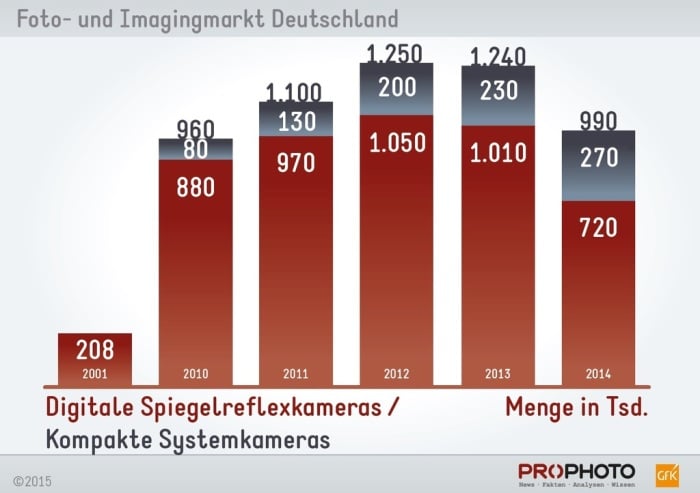
German photo market: DSLR sales in RED. Mirrorless sales in Grey (Unit sold in tausend).
The last few years Sony launched an impressive amount of cameras. But something changed lately. The last six months Soy did announce only one new camera, the Sony A7II. No other E-mount or A-mount or RX camera got announced. I guess Sony just like all other companies is now aware that the camera market is shrinking and it’s time to refocus the strategy.
An interesting and extremely detailed analysis of the German market has been posted on MirrorlessRumors. In very short it shows that:
– The DSLR market is shrinking
– Lens sales are dropping too
– Mirrorless system camera market is slowly growing
– Action camera market is booming
It’s not that people is stopping to take pictures..actually quite the opposite! It’s just that the tools used to take pictures and videos are becoming different and more differentiated. People nowadays uses Smartphones, Actioncameras and Wearables too. And most of the times the new tools are very user-friendly (APP support) and made to fulfill very special needs. According to the German GFK organisation the “classic” System Camera market is expected to shrink further in 2015. Sony just like all other companies now have to try to understand what’s needed to attract new buyers with their A and E-mount system.
89 Responses
Only one camera in the last 6 months…
Are we desperate for more?
I didn’t think the other ones stopped working.
It’s nto sya that’s good or bad. Its just to show a fact. Companies are releasing less cameras (and selling less).
Still waiting for the NEX7 replacement 🙁
I wonder how Sony A mount sales compare to E mount sales. The A7 series has been sucessful and Sony Pro video models also support E mount sales numbers too.
Its my guess that E mount lenses outsell A mount lenses 3 or 4 to 1.
Anybody know?
It wouldn’t surprise me if you’re right. I bought myself an A-mount prime (Zeiss 24mm) on eBay last night, and it’ll probably be the last A-mount lens I buy, unless I find an unbelievable deal on a used Zeiss 85mm at some point (though I’m fairly happy with my Sigma 85mm); and I only bought it because I got a phenomenal deal on it. Basically I’m solidly in the E-mount camp going forward, though; not just because “it’s the future”, but simply because I enjoy using the new system much more than I thought I would. I hardly pick up my DSLR anymore.
I was amazed at the hit when I sold my a-mount lenses – it’s definitely a good time grab a bargain…
i suspect a dslr user is more likely to buy extra lenses, as many jump to mirrorless as its small n light, sooo the 1650 kit lens is pretty darn good, as they will want a zoom lens.
and sony has neglected its a mount users, only recent compelling lens was the 70400g2 which they overpriced, 70200g2 was even more overpriced and not as good.
To be fair, we’ve had the a6000, a5100, a7s, a7ii, rx100 iii and a77ii within the last year though.
I’m pretty sure the DSLR market is dying. But more and more I have the impression the whole system camera market is dying. At least as a mass market.
We will be an a niche market for professionals and wealthy hobbyists in a not so distant future.
Most people, even those who consider themself as “real” photographers or artists, will use smartphones or GoPro’s. In the next years, these so called “gadgets” will become better and better, even with pro features like flat gamma profiles or low compression/raw formats (see GoPro 4 Black).
Seems we are heading toward a new age, where only creativity counts. Not a bad thing.
Indeed, the tools are becoming more and more irrelevant, as long as the result speaks. Did you catch this, a documentary film that made the Sundance Film Festival, and it was shot entirely on iPhones? Crazy… http://www.theverge.com/2015/1/28/7925023/sundance-film-festival-2015-tangerine-iphone-5s
Wow, thats impressive. Can’t wait to see the actual movie.
With the iPhone 6 Plus and future generations, he don’t even need a steadycam rig anymore. I mean, it’s still not as capable as a “real” camera, but I can clearly see what’s coming.
I think that lens purchasing has mainly been a professional/serious hobbyist market since its inception. 99% of the time that I see someone taking photos with an entry level DSLR they are using the kit lens that comes with the camera. How do you convince people that don’t even purchase an additional lens to purchase a new camera? I think this is where the mirrorless market will succeed. Those people will be interested in carrying lighter cameras but still getting the quality of a DSLR.
Regarding the replacement of DSLRs with go pros and cell phones, those devices will never give the dynamic range, sharpness and image quality of aps-c and full frame cameras. Those devices will get more and more popular as now everyone and their mom is able to take photos of everything, but the hobbyists and professionals will still keep the DSLR market alive.
However, what is happening to the DSLR market is the same thing that is happening to the computer market. Computers are finally to a point to where there doesn’t seem to be any point in upgrading. Technology has advanced to a point to where a cheap computer will perform most tasks needed by the average person and will continue to do so for years. The only reason to replace a computer is due to the computer physically wearing out. The same can be said about digital cameras. The average consumer that currently owns a DSLR (say a Canon T3i) can’t identify a reason to upgrade to a t5i. Their camera works for taking DSLR quality pictures and they aren’t a professional.
They may be more inclined to purchase a mirrorless camera if it takes the same or better quality photos than their t3i while reducing the weight by 1/2 of the weight of the t3i.
Ill stop writing as this post is getting really long.
Peter, you’re right about this. Most iPhone and iPad users never look at the files on a large wide gamut monitor. I suspect the same is true for many Sony mirrorless users. What most people are forgetting is that you take photos for the future, not for today. When 16k wall sized wide gamut TVs are the low end 10 years from now then the iPhone and Sony mirrorless users will finally wish they didn’t hinge a decade of memories on 11+7 bit color and Sony’s mushy resolution.
Or all those miss-focussed OVF shots from your OTUS wide-open. More likely we’ll be looking at the motion images that people where trying to shoot on the DSLR at arms length, thinking WTF, why’s it so bloody shaky and out of focus. Your thought process is like your rhetoric, short sighted and lacking in real-world application!
ahhh, the daily 11+7 bit rant is there again.
Thank you for your intersting comment!
Bingo. Most of the time I can live with M43 and don’t need full frame. I can’t believe how good the images are with the dirt cheap sub 3oo dollar lenses. So close to full frame you have to wonder why bother. Sure, I get demands and pro’s wanting the best. But even pro’s are doing a lot of work off of smaller formats and getting paid. Why would a consumer not be inclined to take note. Buy it cheaper, smaller and more feature packed. That’s why I started shying away from expensive lenses. The market is to volatile right now to know where it is going to land.
2015 the market will srinking again! Therefore, the manufacturers think about what they want to sell in the future. New model cost a lot! To update each model is not an advantage. Only Nikon goes this way, but how long? The sizes fo the kind CaNikon APS-C DSLR are not bigger then MILC!
And don’t forget the increase of smartphone with 20MP and optical Zoomlens!!!!
On the second-hand market you can buy a lot of great DSLR, MILC and all kind of lenses!!
Are the consumer willing to buy every year a new DSLR or MILC?? Hm,….
With results like these maybe Sony is ready to question its 11+7 lossy compression strategy too.
https://sonyvnikon.files.wordpress.com/2015/03/5-stop.jpg
Have you figured out the difference between setting shutter speed and focusing your lens properly yet?
He’ll come back here, again and again and again.
The main question is: what has he got to gain from all of this?
Why spend time here? Why bother at all?
Could he be like an evangelical ultra hard core preacher?
Are we all sinners?
If so, can only Nikon save us? BUT HOW?
WHAT A W A N K ER!!!
There’s a whole raft of these nerdy wankers, retired Phd/Mensa photog wannabes. They’re heavy on theoretical constructs but light on talent!
This wouldn’t matter if both use the same lens, equal camera settings. I think he’s trying to objectively prove the camera is worse, he is not bringing skill into it.
I notice you don’t know much about cameras, you posted “Technically the light gathering remains f/2”, you’re confusing aperture (aperture = size of a hole) with light transmission. Two f2 lenses might have completely different light transmission, this is sometimes due to the lens coating, the lens itself, etc. Whether you find Anton a troll or not, he is clearly not an ignoramus (which you are, and I have proven that). Perhaps you should read up on dunning-kruger
From the WordPress Article: “There are some exposure and WB differences…”. So “equal camera settings” is a stretch imho.
WB doesn’t matter when judging a raw file.
Sony use lossy compression and poor algorithms. They did this with the mini-disc, they continue to do this with their cameras.
Use a raw optimizer if you’re doubtful, better yet, take a photograph, bump up the ISO, take another photograph, bump up the ISO. Notice how the file size doesn’t change!? Higher ISO = more noise = more data = larger file size. Use your brain and stop nitpicking
Auto WB interpretation is a factor. Sony gets it wrong. Skin tones, night skies, etc. Nikon’s experience and expertise shows in every shot. I’ve spent more time messing with Sony WB issues than anything else and sometimes they are just uncorrectable. Because they are off by so far and 2ndly because the color information isn’t there.
https://sonyvnikon.files.wordpress.com/2015/02/rawdigger.jpg
It’s just like video, with poor technique, that 4:2:0 file is worthless but in the right hands its indistinguishable from a 4:4:4 file. What are you guys trying to prove here exactly, the fact that you are incapable of shooting anything other than a 4:4:4 file?
Did you actually just point out that with cRaw compression you mainly loose noise which no one needs anyway…?
Um, try learning some information theory. More noise != more data. More information, yes, but more data, no.
Also, maybe try reading the actual quantization algorithm – source code at http://darktable.org/redmine/projects/darktable/repository/revisions/master/entry/src/external/rawspeed/RawSpeed/ArwDecoder.cpp#L131 and http://darktable.org/redmine/projects/darktable/repository/revisions/master/entry/src/external/rawspeed/RawSpeed/ArwDecoder.cpp#L390
Anton’s picture is useless for proving involvement of 11+7 in the noise issues without the original ARW file.
What was the typical value of the “white” segments in the original file? What was the value of the first point in the sony quantization curve? (It’s in the TIFF metadata of the ARW file – an ARW file is just a TIFF with a special encoding algorithm for the image data).
If the “white” values there were less than the value of the first point in the curve, Anton’s claim that the noise is due to 11+7 is bogus. If they were higher than the first point, there might be a valid point, but the question is whether quantization of noise is actually an issue here. (Since the only effect 11+7 would have in a noisy 16×2 block of a single color is quantization of noise values at the upper areas of the curve.)
Is the noise worse? Yeah, although I haven’t seen a clear indication anywhere that the same aperture and ISO settings were used. Does poor noise performance from the sensor have ANYTHING to do with quantization artifacts? No.
Equal settings don’t equal ‘equal results’. You think Sony and Nikon will interpret the same settings in the same way? That’s nuts and the whole point of it. Get the two cameras side by side and start doing your own tests.
I am coming to the conclusion that the Sony mirrorless cameras only have value for video as the compression isn’t a factor and they are user friendly for live view and can take a multitude of lenses, namely the old Zeiss/Contax that make for a very easy to compile prime set for video.
>I am coming to the conclusion that the Sony mirrorless cameras only have value for video as the compression isn’t a factor<
You really are a moron, a hobbyist with no clue. Video, no compression, REALLY. Go do your homework you blathering fool.
I didn’t say such a thing (“equal results”). What i don’t get is why the Sony picture is darker AND the exposure time was different. If the exposure time would be the same and the Sony picture is darker i’m fine with it. Why don’t you just provide the exposure time information etc in the post or better provide exif?
You just need to look at the output. The “Nikon” image is over exposed and the “Sony” image is under exposed.
You didn’t see Anton’s posts the other day did you? He clearly is bringing skill into it, or lack of, when it directly impacts the objectivity of the tests.
Don’t confuse you being pedantic with me not knowing much about cameras. Regardless, if you’d bothered to read the post properly, it wasn’t about two f/2 lenses.
” it wasn’t about two f/2 lenses”
Nor was my argument, my argument was that you’ve confused light transmission (or light “gathering” as you call it) with aperture. Wider apertures of course do allow more light where all things are equal but you would not measure light transmission by its aperture which is why most objective tests show transmission data. I’m not being pedantic, you’re an ignoramus.
“You didn’t see Anton’s posts the other day did you?”
I did, however, his argument in its entirety has truth to it. I’m not going to defend sony just to upset some guy on the internet
Yes you are being pedantic. The concept of transmission was not relevant for the purposes answering the question, only aperture. I used the term light gathering as it was the term used by the guy asking the question. I am perfectly well aware of the concept of transmission.
There is truth to his argument, no doubt, but backing up his claims with badly conducted tests is no way to convince anybody that his grievances have merit.
It’s focused.
https://sonyvnikon.files.wordpress.com/2015/03/ae-file.jpg
Both the Sony and Nikon were spot on in the AE exposure. Shutter delay, tripod, sturdy surface etc. You guys keep trying to nitpick technique or user error and not concentrating on the problem that I (and the smartest people in photography) have been trying to get Sony to address for more than a year now.
There are 100s of ways to demonstrate this but the core issues are Sony’s 11+7 bit color and 20% loss of resolution.
You want better cameras from Sony ? Then stop giving them your money until they address these glaring faults.
Or continue living your cheez whiz poly/cotton lifestyle.
Mmmmm….cheese whiz.
I didn’t say that wasn’t focused, I’m referring to the images you posted the other day.
>You guys keep trying to nitpick technique or user error and not concentrating on the problem that I (and the smartest people in photography) have been trying to get Sony to address for more than a year now<
I like the part about "smartest people in photography" they predominantly produce nothing but tests. Do yourself a solid, go look at Apple's front page gallery images, look at what the kids produced on lowly 8bit iPhones whilst your were pratting around shooting that shee-ite test. Moron!
That’s not how you measure objectively, furthermore, what those iphone kids don’t tell you is that they used expensive lighting like broncolor etc.
joey makes the same comment
https://www.youtube.com/watch?v=g80pPqMtVNM
It would help me, and maybe others too, getting your point if you could explain what differences there are to see and what is causing them. E.g. why is the right one darker? Thanks
No EXIF data? This “test” is invalid.
There’s lots of reasons why the pushed Sony image might be noiser, but it’s 100% not possible that it’s due to the 11+7 compression. Over a smooth gradient or no gradient the compression isn’t lossy – that’s the point of it.
Well in addition there is the quantization curve (from 13 bits or so down to 11) – but if anything is going to have problems with Sony’s nonlinear quantization curve approach, it’s going to be highlights and not shadow noise. There’s a 1:1 mapping of sensor LSBs to raw LSBs for all values up to the first curve point.
Where’s the EXIF? What were the values of the sony curve points in the ARW metadata? (sony_curve in http://darktable.org/redmine/projects/darktable/repository/revisions/master/entry/src/external/rawspeed/RawSpeed/ArwDecoder.cpp#L131 )
Either way there’s no way that image has anything to do with any of the potential loss mechanisms in Sony’s RAW algorithm.
Jesus, give it rest will ya. Every few days I have to read the same shite over and over again, 11+7….11+7…..11+7…..’wraaawk…….pieces of eight’ . Haven’t you got anything better to moan about. This is not the behaviour of a stable minded person. If you prefer NIKON to Sony then fine, crack on with that. Why the heck does it matter to you that much to constantly bang on about one of the last few areas where a DSLR can still best a mirrorless. That’s without even mentioning that a 5 stop push is a tad excessive on the editing front and ‘should’ be quite a rare requirement.
learn to photograph.. so you don´t have to push 5 stops….
do you drive a car full speed in a wall just to test which car is less compressed on impact?
do you do that as customer?
the car manufactures may do that… but as longs as i stay alive i don´t care if the cars is 10cm more compress on impact or not. it doens´t matter … 10cm more or less… the car is garbage after a crash anyway..
and a video or image that needs to be pushed 5 stops is also garbage….
it´s USELESS what your doing… period.
They both suck. It’s the difference between partial suck and full on suck. I’d rather go for no suck.
Given that the subject clearly moves between the two shots, I’ve got no
confidence in your ability to conduct anything approaching an accurate
test (ie keeping the same white balance and shutter speed). Nice long
exposure on the Nikon and a short exposure on the Sony – guess which one
pushes better. But hey, why bother with little details like exif data?
I bet you’re fun at parties.
That graph doesn’t actually look as bad as I expected, as the drop goes against a general trend of increase to as recent as 2012, then a year of levelling off, then a drop. I assumed the camera market had been shrinking for a much longer time!
This actually looks a lot like the PC industry three years ago: ‘nobody is upgrading because their kit is good enough, with little reason to buy into something new’.
Its also interesting to note the things that have not caused upgrade: incremental sensor performance, 4k video (all technical) vs the only one that has: form factor (usability). So maybe cameras are getting so good that there is little technical differentiation for most users: its all about the ‘soft technology’ (purpose and use cases).
Customer inertia and inability to go against previous investment probably have some influence too…
If the camera market as a whole still shrinks at this rate, there is not much for mirrorless to grow to. Additionally, with Samsung now and Canikon in the future (I would wonder if they didn’t try to invest heavily in mirrorless) more and more players need to feed from a smaller and smaller cake.
Still using an a900 and a few zeiss which are still going strong.
Skipped the a99 and the a7r. I’ll be buying the next A or E what ever shows up first. The cameras since last 6/7 years are plenty good for high end jobs. After post prod and once photos are commercially printed any difference in IQ is negligeable if even noticeable.
Many users do not feel the need to upgrade at every cycle of new tech.
It’s simple, people just don’t want the cameras that are currently available. How hard can it be to produce a global shutter on a camera capable of shooting video too. That’s what we want.
very well said, give us a good camera, not every 3-6 months a new camera with some improvements. If you give a vary solid camera , weather sealed with global shutter, high frame rates with video at least 240 fps, low light clean image like sony a7s , dslr style, with nd filters built in, people will buy camera and then people will buy lenses, one person buys at least 4 lenses. Do the math, one camera can make you sell at least 4 lenses. good camera +4 lenses= company’s growth +loyalty
Armchair pundits. smh
Rather hard. Or at least if you want to maintain still image IQ it is. If it wasn’t hard, then it would surely have been done.
Yeah. Note that nearly all global shutter cameras out there are significantly lower in resolution than non-GS still cams.
A7s at 12MP for example, and it’s EXPENSIVE – likely a large amount of that cost was the sensor readout system needed for GS support.
Rolling shutter sensors are used because they’re usually cheaper.
The A7S does not have a global shutter. What it does have is the ability to read the sensor fast enough to make it just about tolerable for taking stills, partly because it is lower resolutions (fewer pixels to read per frame) and also because it works in a lower ADC resolution mode. Even so, when used in “silent shutter” mode it still suffers from significant roll-shutter artifacts.
As far as I’m aware, the only way to get a CMOS sensor to have a true global shutter with the current state of technology is to have a temporary store for each photosite into which the accumulated charges are all (simultaneously) shunted after each frame is exposed. That takes up space on the silicon and reduces full well capacity (among other issues).
https://www.aptina.com/products/technology/Aptina_Global-Shutter-WhitePaper.pdf
well it is not mirroless that pushes the compact cameras sales.
everyone and his mother has a GOPRO in germany.
i have friends who don´t care a s*ht about photography but they have 2 or 3 GOPRO cameras.
I am German and know NOBODY having a GOPRO (we know lots of people and photographers as well as students, as I work at an university).
I am German, too. Same as HF: do not know anybody who is using a GOPRO.
2010 – 1 mirrorless sold for every 10 DSLRs
2011 – 1 mirrorless sold for every 5 DSLRs
2012 – 1 mirrorless sold for every 5 DSLRs
2013 – 1 mirrorless sold for every 4 DSLRs
2014 – 1 mirrorless sold for every 3 DSLRs
its very clear that in 2 to 3 years both will sold equal numbers
we see now canon and nikon in “desperate” mode, dslrs and lenses are down, they sustain compact cameras falling from the cliff, they wont survive if something similar happend to dslrs and lenses, so they now are releasing a lot of new models, so they can firesale/clear/sold old models, but if people pass, by the end of the year they will had a mess on inventory/stock, lenses for sure will drop in the next 3 years as its coreleted as to past years dslrs sales, if they cannot keep selling dslr or go below 3 million/year sales, at last canikon will follow kodak
compact cameras are down by a factor of 10 since 2010, so every
manufacter its going premium for compact cameras, it will be a niche
because of needed high price to make it profitable, so forget that every
year new model version, that ship its not gone its sink
In the internet world, “it’s clear that…” means it’s not really clear, and I can’t supply proof, but my asserting emphatically will substitute for proof. And the more emphatic the assertion (eg, “*very* clear,”) the less proof is needed.
The other factors to take into account are margin and unit price, not just unit shipments for a single country in a single continent.
In 2 or 3 years, Mirrorless and DSLR will be both in trouble. The DSLR market will shrink much faster, because it was huge before. So, mirrorless will not “winning” anything in a long term. The whole system camera or “real camera” market will be a niche market in a few years.
I might be wrong, but that’s what I see
Either way, the DSLR will go the way of the Twin Lens Reflex.. USA will be the last country to fall, Japan was first, Europe seems to be well on its way.
He is from Berlin… that should tell you everything 🙂
I do not attract if it is A, E, C, APS-C, X-MOUNT!!
But i would like to see a F 1.8 Lense on the Body in STARTER PRICE.
and yes you…the MARKETING-MACHINA have startet the 4k -hipo!
*I ONLY BUY A 4 K APS-C BODY ( maybe Sonny, maybe another, maybe only 4/3th)–and
it costs 499,- $!!
IS THAT HARD TO READ
IS IT A CAUSE OF ANALPHABETICS IN MARKETING DEPARTMEN?
SO push out the Marketing-departemt, because THEY DO NOT DO WHAT I WANT!!! *
And i want it now. where is ist?
aahhh. rumors… next show and ahhhhh rumors the show behind next.
Sony can do it but– it will kill its own highend-Department ( Filmcameras)
and sits in the seen mass of coming smartphone-zombies, not do do it.
WE call this an point of non return event horizon liner..
as R.I.P. MR SPOCK would say: ” fascinating but logically, we are dead…”
where is the Camera? the
WORTH 4k APS-C SONY with MAX CODEC and
AND 10 bit on HDMI-PORT
WHERE IS IT !!!!!!!!!!!!!!!!!!!!!!!
Your posts never seize to amaze me – Poetry at it’s finest.
I can only imagine your beauty and elegance in real life.
Sony don’t have to do anything for you. Some people can’t afford a hot meal, but apparently not producing a camera you think is reasonably priced is worthy of a capitalised rant. Stop acting so entitled. Either you can afford it, or you can’t.
another:: Formfactor; body-sice, and so on.. nice..but?????
a big pile of same machine, every 3 months a littel bit of it in but
nothing i would change from first in line ( 2011) up to last, whren the
marketas said, waht is now dead and what is next.. and same old house makes
pretty fine photos, and strange old lenses ( not from sony) do it, because the
adapter is on it ( just not want to wait 24 years a next braaand new sony lense is out
maybe so expensive i can get the fine from..and so on)
rx-100 is fine.. but not if you get for same price pana lx-100 ( and this is so fine tahat
it is hold down from panan not to go in gh-4 ground..)= silli ill marketing oldfashion of
1989..but NOT 2014 not 2015 and 2016 you are…. out of production……
why not now and fine ( did anybody see thwe vg-900 catastrophe?? just not to jumpt to
deep in fs-100 garden..) ALWAYS THE SAME OLD GAME..and i hope they breake down..
the only way they move the fat ass… only!
Sony is way behind the curve. Scientists are now capturing wave and particle attributes of light while Sony struggles to get 14 bit color.
http://news.discovery.com/tech/photo-first-lights-captured-as-both-particle-and-wave-150302.htm
ZzzzZZzzz
Same old same old. Yawn.
Yeah and I am still waiting for my gold toilet yet…etc…etc
Yawn
Bought to shrink like a wool sweater on the hot water cycle. The days of lenses holding value are gone. Unless you shoot Leica. At which case, you probably stare at the lens every few months, put it back in it’s case and carefully take your white gloves off.
I don’t know, but it looks like he’s still got the lens cap on his Leica in his profile pic, so I’m not holding out a lot of hope…
the only reason people commit to one camera brand is the cost of lenses. for photographers just starting out, committing to sony with limited and expensive lens selections and unknown future is a gamble.
and actually people i know bought Sony because of the flexibility of the mount, adapt all those old lenses!
So we will see fewer more expensive products in the future. This is unfortunate for amateurs
I think it is, on the opposite, very fortunate for amateurs. Entry full frame cameras are getting cheaper every year and with Sony`s EVF and focus peaking plenty of cheap and great quality legacy lenses are usable and affordable. If by “amateurs” you mean guys who dont know and dont wanna know anything about photography, there is plenty of cellphones capable of nice IQ out there.
Legecy lenses- bingo. I now have 4 MD mount minolta lenses. I’m serious- this glass is very much in line with modern lenses with a couple work arounds. Great time to shoot full frame for anybody.
Never tried them, but seen some images. 58mm f1.2 looks fantastic, although very hard to find in my country. Ended with Yashica ML 50 1.7, exact C/Y Planar copy, fantastic piece for 20$. Jupiter 37a also. Still cant believe the IQ of the lens built in USSR 30 years ago.
And what is most interesting thing, when those lenses were made, no camera existed that could capture 30% of their potential IQ 🙂
I have a bunch of old Pentax pre-A glass. This glass was a pain to use on Pentax DSLRs due to the digital bodies removing one of the aperture sensing levers, making them crippled with any lens that didn’t have an “A” setting on the aperture ring.
These lenses are MUCH easier to use with the A6000 than with Pentax’s own SLRs!
If it will be so, I will just not buy and not have any problem with market development.
If later prices will have to come down again to reasonable, there will be budget. So be a bit patient and you will get fair deals.
High price politics will make nobody lucky.
Incomprehensible gibberish.
Do you even know what you are talking about?
So, let me get this straight. What exactly is ‘Mirrorless’?
Action Cams are on a Boom (GoPros?) & they also fall in the ‘Mirrorless’ category. So, the growth in Mirrorless is due to Action Cams? Not really due to Mirrorless ILCs?
What about standard Digital Cameras which were supposed to be on the decline? Those are also in the Mirrorless category? So, did they contribute to the figures here?
Mirrorlessrumors.com is specifically focused on Mirrorless ILCs. So, the German article isn’t really pointing to Mirrorless ILCs growth as stated by the site?
Can someone please clarify? Maybe I’m just thinking too much…
At least in the graph, they’re using the term “compact system camera” – “system camera” usually means interchangeable lens, so I believe that’s mirrorless.
So if people are wondering why Sony is putting less effort into A-mount – the graph is pretty clear. From 2013 to 2014, SLRs dropped by a small amount but “compact system cameras” (mirrorless) grew something like 50-60%.
From 2014 to 2015, SLRs dropped significantly (about 30%) and CSCs increased by 35%.