







[shoplink 32488 ebay]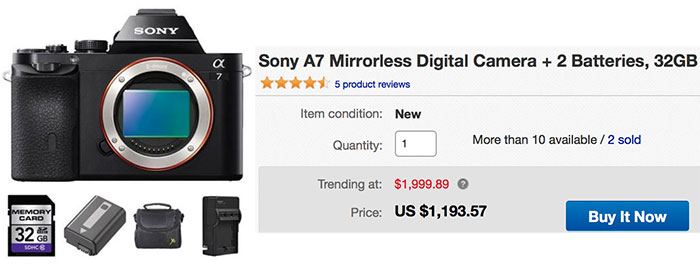 [/shoplink]
The A7 with free extras sells now for $1,193 only on [shoplink 32488 ebay]Big Value on eBay (Click here)[/shoplink]. That’s a $100 off compared to the best price in other US stores. The same store also sells the [shoplink 32489 ebay]Nikon D610 for the same price[/shoplink].
This is just to say that Full Frame camera prices are now really crashing down. And I guess on one year we will se the first FF cameras priced at $1,000. So maybe for the first in the age of digital cameras Full Frame will become “affordable” like it was back in the analog era. And maybe in 3-4 years from now APS-C will be a niche while FF will be mainstream?
One more deal: One Sony A7r for $1,599 at [shoplink 32492 ebay]CameraLand on eBay (Click here)[/shoplink].
66 Responses
299,- because nobody wants to buy the jokes they make with us. okay.
if not. no buy. and that is called market.
so cancle all sensorworks..stay only ( SONY) on this fullframe and work harder.
Bayer sensors are ancient technology….I think they first drawings appeared in some ancient France cave paintings 🙂
Developement expenses are extremely low…just modify a spec or two and call it all new.
Like any other obsolete technology the prices plunge dramatically prior to the introduction of the next new technology that will replace it.
I had expected that to be organic multilayered sensors…but rumors, of unknown credibility, of a new Sony Color Sampling Sensor have been emerging …if the rumors of the performance of this tecnology are true it would account for the fact that almmost all talk of multi layered organic sensors has abruptly stopped….even though all the manufacturers were rumored to either be developing one or buying someone elses.
If none of these emerge with the new crop of high mp sensors next month it is a reasonable bet that something new is in the works.
I agree. There will be new technologies that will empty the bank account.
Bayer is an old technology but currently it is still the best option available until something better comes along. Being an old technology isn’t necessarily a bad thing, especially if it’s still the best solution.
Totally agree. One thing about old technology is reliability and predictability. It is consistent and sharpened in smaller and smaller increments and will continue to do so until something completely new comes along.
Do you actually believe there is nothing better? I do not.
Either way Bayer is ancient , has little dvelopment cost and will continue to become cheaper until it is gone.
As more competitors develope the capabilty of making Bayer sensors that further increases the pressure on the leaders to produce something new that the competition does not have. There’s only so much they can milk out of this old technolog.
If Sony…or thier competition…want to increase sales and generate higher prices they will have to offer something new and better.
I qualified my statement by using the adverb ‘currently’.
And I qualified my agreement with you by putting limitations on that agreement.
You speak about this “ancient” technology as if there’s a problem with it. Are you really being held back by current MP count? Or severely encumbered by a lack of DR? Or maybe 14-bit RAW files don’t give you enough latitude in post?
Video can’t even handle the vast information being delivered from these technological “cave paintings” yet. A new organic flexible plasma 32-bit 1 million MP sensor would be super exciting, no doubt, but the way you dwell on the next technological improvement on this forum makes me think you’ll always be looking around corners instead of taking pictures of animals.
Yes I am being severly held back by lack of current mp count…to properly utilze a photo as I require would need over 100mp. The projected 50ish mp cameras will be better for me but not ideal.sales
I currently have to resort to stitching or multiple photos and extremely difficult workflow to compensate.
As for your video comment..which proves you only look at your photos on your tv screen….
By 2020 8k tv will be available.
That means the current max res of 36mp will not even be enough to fill your tv screen…so even you. Will need more res.
My constant comments for more resolution are based on actual need not idle complaining.
So Bayer sensors are bad, but imaginary sensors and never-will-be organic sensors are what everyone should be using instead.
I used the words ancient, obsolete, and prices plunging…I cannot find the comment where I used the word bad or imaginary…..unless I was reffering to your ability to read.
I suspect that for enthusiasts, full frame will become the new norm. It appears that Sony and Nikon are both betting on it, releasing lots of full frame models in the last couple years — 4 A7 releases, D750, D810, D610, Df.. while doing few APS-C models. They both offer more full frame models than APS-C models!
Meanwhile, your more casual photographers will probably continue to veer towards the smaller mirrorless cameras and their smart phones.
The only reason APS-C was ever created was because of the large expense of full frame sensors.
Nikon’s only saving grace is the Sony sensors (except the Df (don’t focus). Most of Nikon’s FF models have been plagued with problems and recalls. Not so sure an “enthusiast” wants to deal with design flaws, recalls and dated technology.
You mean like the shutter vibration issues on the a7r? And the light leak in the a7 series? And the frozen ibis on the a77ii? And the ghosting on the a55?
You’ll find far more enthusiasts buying Nikons than Sonys as of right now.
In the world of Nikon fanboys, it’s “I’d never buy a Sony.. No enthusiast would ever shoot compressed raw! And how can an enthusiast live without 2.8 lenses???”
And the Sony fanboy proclaiming, “who in their right mind would buy a camera that might have a tiny bit of banding in 0000.001% of badly flared shots. At least Sony ignores the defects in their cameras, Nikon actually tries to fix them, yuck”
Ahhh, fan boys.
Huh? Nikon outsources lots of components and assemblies, all of which much work together to build the product. All manufactured products do, from Apple to Ford Motor. So you are saying that only one component from one vendor is a saving grace?
The D610 and Df didn’t have problems, too many other models apparently did.
Adam Brown and Peter Kelly are brothers and trolls.
You mean, the expense and size of full frame lenses (and related gear)? The APS designation first started with film in the mid 1990’s. Remember the Canon Elph film cameras?
Everything else equal, I’d much rather take an APS-C (or S35) sized sensor (and the smaller lenses and equipment) than a full frame sensor. FF lenses are so big they look a bit ritarded. Honestly. Unless you’re a twat that equates the size of camera gear with his johnson, there’s no reason for all that extra expense, bulk and weight.
I wish someone aside from Sony knew how to make a great sensor because APS-C should be the future. It’s the perfect compromise. If you can’t get the DOF you need from an APS-C camera then you need to take a class. Everything other byproduct of the FF format (holding image quality equal) works against the photographer/filmmaker.
I aggree
My comment refers to Adam’s post.
I don’t think the question is how cheap will full frame be, but how cheap will Sony’s FE cameras be. The only thing that looses value faster is a Chevy.
Or Nikon
If you can get a d800 with grip for $550 I will personally pay you $650 for it. $100 finders fee for you. Assuming it is not grey market, or worse, stolen
It’s sold, but you can buy a brand new D610 for $1193:
A far cry from a $550 D800. Quite certain that is a grey market deal
too expensive for nikon.
On the one hand, you are correct. However, the KM7D I had still takes the same quality it always did, as does the A900, as does the A99, etc., so it depends upon how you measure value.
If you look on these cameras as business capital investment, then your argument holds, up to a point. If you are just a hobbyist, then the value remains exactly the same until they break.
I run a business, so I’d love them to retain more value, but I write them down over two years. Anything I get back is a bonus!
Peter Pan Kelly is a troll, don’t take anything he says seriously. He jumps from forum to forum trolling anything Sony. He’s a complete loser.
He repeats the same trolling talking points everywhere he goes, and tries to pass himself off as a serious poster.
The only thing you run is your mouth, a lemonade stand would be too much for you to handle.
Quit ‘niggling’ Peter.
Ignoring residual value, either of hobby or of an asset, is a mistake, one the camera makers would love us to make.
Residual value is a huge differentiator, and one that will come increasingly come back to bit camera makers.
Constant release of follow-on products with only minor feature improvements but no distinguishable difference in final image result only serves to make the item the consumer paid a small fortune for last year relatively worthless now.
That consumer just happens to be your next customer, since the hobby of photography is shrinking and new people are not joining in significant numbers. More: your loyal consumer is increasingly old and unable to afford either new models or zero residual value.
This camera pricing / new release model is not sustainable.
I actually agree with most of what you say.
Certainly, I worry that Sony are in danger of killing the goose laying the golden eggs and, to me at least, the A7II is too soon and too minor in changes (before anyone points out that IBIS is huge, the number of occasions where it makes the difference is a minority).
That said, I was trying to balance the comment of a camera losing value. It only loses value if you intend to sell which, for many hobbyists is, to an extent, either pointless or an extravagance. The implication by many is that once a new model comes out the previous version can no longer take great pictures. Clearly a nonsense!
As for a business, if you run it on the basis that a capital item has to retain value otherwise you do not make a profit you are doomed to failure.
Sony’s plan does seem to be quite odd, though, and I would love to know if they simply have a sales number in mind before releasing a camera which, if passed, then counts it as a success and they move on, rather than trying to make it a huge success.
The D610 is listed for the same price:
“The A7 with free extras sells now for $1,193 only on Big Value on eBay (Click here). That’s a $100 off compared to the best price in other US stores. The same store also sells the Nikon D610 for the same price.”
Nikon
whit all the troubles nikon has.. i rather buy sony.
And you have never tried either…
FE 24-105 f4
Why you asking a comment section?
Ask them:
http://blog.sony.com/contact/
https://twitter.com/sonyelectronics
https://www.facebook.com/Sony
https://www.pinterest.com/sonyelectronics/
https://plus.google.com/+Sony/posts
When will Sony realize that putting out a brand new camera every time they have a new innovation – no matter how small it may be – is doing them no good at all.
The majority of camera buying people will buy a camera and not buy another until it breaks or until they can afford (or convince their better half that they need to) buying a new one.
Sony really should slow down on the producing new cameras as often as they do and wait until they have a few really good innovations (and perfected them). If Sony made just one or two new cameras per year with lots of new innovations, people would not feel so bad about buying them knowing they would still have an up to date camera for longer than a few months and that the value would be a little higher than Sony’s latest but old cameras are now.
I may not have phrased that eloquently but I’m sure you all know what I mean 🙂
Go to a big camera store and ask how many different camera model Canon is selling, then ask how many models Nikon is selling. Then come back here and tell us the same thing again. Canon and Nikon have at least three times the models Sony has each and none of the innovation.
and Canon/Nikon has innovated what recently that Sony hasn’t already done first?
The A7ii needed to be done as soon as possible. It was without a doubt the most requested feature on the forums I read. This is a very big deal and an innovation Canikon do not have. Any and all glass is now stabilized. If you don’t see this as a big deal I will assume you are always using a tripod or you just don’t get it.
above comment was directed at Johnny Boy not Lvww6d6MG8.
my bad
copy – delete – reply to right guy – paste 🙂
IBIS was always the deal breaker for a-mount so releasing the updated a7 really was a no-brainer…
The A7 comes in three versions, the A7II is the first actual update from the original A7 and the improvements are significant. Most current owners of the A7 will likely keep what they have for some time, new buyers will likely purchase the latest model. The A7II is selling quite well which contradicts your “is doing them no good at all” comment. I think you’re confusing the three distinct models as being new cameras, they are not.
“The A7II is selling quite well ”
So how many units of the A7II have been sold?
For what do you need this info? Useless question in anway, for just Sony could tell you credible sales figures.
This post is recycled almost verbatim every time something is posted about a camera body. I’m pretty sure Sony knows what they’re doing regarding their imaging business strategy better than a random poster who’s parroting an opinion in a small forum on the internet.
Sony’s been putting out camera bodies at a fast pace consistently going back to their entrance in the digital camera market at least 15 years ago (at least that’s when I bought my first Sony digital camera). To get upset at their pace of innovation because you decided to connect some simple (yet irrelevant) dots, is ridiculous. Just like with other high priced items, the residual cost of a product is either fairly reflected in the market price, or sales are thrown off. It’s usually the consumers that go in blind that get “burned.”
When the a7s came out, one of the factors that kept me from purchasing it was that I felt the price was too high given its level of functionality and the pace of functionality in that segment (though Sony is sort of competing with itself in this area). But, for people who needed amazing low-light capability right then, and had the budget and patience to deal with the external 4K recording issues, the a7s was gold.
As long as you educate yourself a little bit, there’s no need to complain like that. There are only so many camera manufacturers in the world- and each one is trying to do its own thing and find competitive advantages. I think Sony is the most exciting brand to follow right now. Canon, though I’m a long time buyer of their photo and video products, has proven so lazy, dull and arrogant that I actually have a strong aversion to their brand now.
Yeah they should do a Canon and release recycled bodies with no new features to speak of…
Will electronic non sony lenses have 5 axis with this update?
If the lens can report focusing distance to the camera through the adaptor 5 axis should be available. If not, 3 axis.
Has this been tested?
Sony, the cheap h@mo hooker of cameradom…no wonder so many fgts attracted…Jeez.
Compensation for the penile dysfunction by the means of pompous internet nickname.
HOOLK even sm@sh banhammer…or Admin not worthy to wield…
How is this deal considered cheap? The a7 with 28-70 FE and LA-EA4 adapter was selling for around $800USD in Australia during the Christmas sales. Admin, stop spamming nonsense and stick to rumours.
stupid.. not eveyrone lives in OZ.
it´s hard to justifiy a 2000+ dollar camera from nikon or canon for the casual shooter these days.
the big two have to lower prices or they will loose the entry level customers.
and that will hurt lens and accessories sales in the end.
canon may get all the wildlife shooters with their very good 7D Mk2 but that is only a small fraction of users.
for the soccer mums and co. there are cheaper alternatives these days.
and there are way more soccer mums and dads than wildlife shooter with 400mm + lenses.
you need a wide userbase on the lower end of the product line.
and sony is doing the right thing to get as much of them as possible.
it´s not teh 1DX that is making the most money for canon.
it´s the rebel line that sells in the millions.
And the rebels are too pricey for you?
It’s great that Sony is leading the inevitable price war.
As market saturation for full frame 135 is reached in the next 12-18 months, its era as a growth segment will be over.
So, yes, prices will inevitably come down. The issue is, the Sony lenses are still priced astronomically.
The Canon 6D also hovers around $1300 sometimes. And in my opinion, if size doesn’t matter, it’s a better option. First of all, the lenses are much cheaper.
it is so old , they should charge higher because it is an antique
It has DSLR-fast autofocus and the same low-light ability as the A7, plus vastly better color rendition. If Sony keeps enlarging their full-frame mirrorless cameras, I think that the 6D is worth a good look. High-quality lenses are also very well priced.
Except the a7 is a technological achievement. 6D is just another brick of a dslr.
Large DSLR will be the only camera that is suited for 70-200 f/2.8 lens or larger