







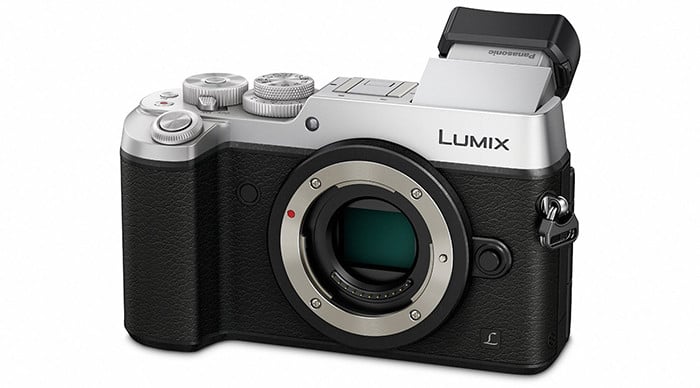
Today Panasonic announced the new GX8 (specs here). The camera is rumored to be the first MFT camera using the new Sony 20 megapixel Four Thirds sensor. Sony recently listed three new sensors on their website including the 20MP FT sensor.

Sony is now conquering the MFT world with their sensors?
134 Responses
Ugly looking camera
i’ve been saying the same thing since the beginning of the A7 series.
Looks like I’ll be trading in my just-purchased RX100M4 for the MFT RX100M5 next year. Thanks again, Sony.
I hope this means we’ll see our much beloved a7000 pretty soon…
It is really encourging to see Sony’s imaging business go from strenght to strenght.
Panasonic really needs some better designers. This one looks like a brick.
Lets face it: Panasonic sensors are not so good.
Hope this means Sony has enough confidence in their next APS-C sensor to put out sensors for their direct mirrorless competitors…
Sony sensors are all over the place, Canon, Nikon, Panasonic, Olympus
and many more camera developpers use Sony sensors. It is a way of
getting an income, developping a new sensor is very expensive so most
brands don’t create their own sensor, but let an other do it. Sony is
one of them.
don’t forget iPhone and my Galaxy S6e.
Sony IS the largest CMOS sensor manufacturer in the world as is Samsung being the largest display manufacturer.
Sony makes more money on sensors than on cameras. I think it’s more important for them to sell its sensors than cameras:-)
I’d definitely pay for this in a phone…
Get the Panasonic CM1.
Thanks – I’ll definitely check it out next time I upgrade
I though that it was supposed to be a BSI type sensor.
What’s the appeal of these cameras? Serious question, not trolling. Perhaps I’m missing something, but at these prices it becomes tempting to look at FF instead, or Fuji, for that matter.
A valid point and it is one of the reasons I moved over to FF.
Yeah, I don’t really get it either. You can get the a6000 for less than these cost, and it’s both smaller (body) and has a larger sensor. I guess an appeal might be that there are more MFT lenses, but that’s about the only advantage I can see.
Yup, I love my a6000.
Having owned M43 for 4 years before moving to an A7 (and a brief stint with an A6000 as a second body), I can tell you what M43 does better. First, low light AF is hugely better, especially in Panasonics. Second, the lens selection and value for price is just exceptional. It’s the major advantage of M43 over the APS-C Sonys. Third, there is no long lens option like in M43. Between the crop factor and, for example, the 100-300mm or the upcoming 100-400mm, it’s the only larger sensored camera with an 800mm effective focal length lens in easily portable form out there. It’s also very good for macro work due to the deeper DOF due to the cropped sensor.
To be honest, while I love my A7, I preferred my M43 gear to the A6000 in real world use, so I can totally understand the appeal and market for this one.
Good points. It would sure help if Sony gave us some good APS-C glass. Looks like they’re all about full frame these days, though.
Nikon 1 has a longer lens. The m43’s longer lenses have until now been rubbish, will wait and see on the not so small 100-400mm.
Having successfully used and thoroughly enjoyed the 100-300mm lens for several years, I can tell you that it is most assuredly not “rubbish”. The 100-400 promises to be even better, and, if you read the release, it’s supposed to also be compact enough to carry and use hand held.
Nikon has made a bit of a name for itself with birders due to its smaller size, but this will make M43 competitive with resolution and focal length with the added bonus of the larger M43 sensor.
But you said no ‘larger sensor’ system (whatever that means) has an 800mm EFL. Maybe your standards are different to mine, but my 100-300mm was truely woeful. I get better results from my cheaper Tamron on FF and cropping.
I’m sorry you had bad luck with your 100-300mm. After working with mine for a while, I got the hang of what it preferred in terms of shutter speeds and holding technique, and was able to get very consistent and sharp results. It actually became my most used lens 🙂 .
As I say, prefer to just shoot FF and crop, which is basically the same thing.
Hmm, interesting. I would really disagree with the value for price being exceptional, except from a very subjective point of view.
Yeah, long lens options suck for e-mount; that’s true. There’s really nothing beyond 200mm (300mm effective for APS-C) right now unless you adapt A-mount or other third-party glass.
I concur on low light AF. the GX7 already focuses in 2 stops lower EV than the Canon 1Dx Mark II. and quite well.
and within the m43 ecosystem, this is finally a jump from 16mp with the addition of 4K and a few GH4 cinema profiles. Oly’s video is rubbish. so the GX8 already has an advantage in that respect.
my main system for work is Fuji (i love the look of Fuji above all), but that’s another story. for street photography, my GX7 just does it better. I don’t have an M43 system to be bokehlicious, I got it for the streets and as an Every Day Camera. what I don’t like about the GX8 though is the retro body styling with a dslr-ish grip much like the A7 series and EM1 and the vari-angle OLED screen (but I guess it’s needed for video). I think the best variable screen angle design was Sony’s implementation on both my A77 and A99. I don’t mind the long EVF in the GX8 (you have to consider its faux rangefinder shape). I prefer it actually so my face isn’t moving the AF point around. yes, i do use the touchscreen. and it’s especially better than Oly’s. I also prefer a programmable EV dial (I want to adjust with my shutter button finger) over a dedicated one which usually means only being able to adjust with your thumb. I hate taking my thumb off a thumb grip.
due the low price of the a6000, you can say that about any other camera out there.
Many M43rds lenses (not all) are often cheaper and significantly smaller than FF. The FE lenses that aren’t much bigger (35/2.8 for instance) than M43rds lenses are slower and offer little/no benefit when you account for the higher ISO you have to shoot them at.
Camera body size doesn’t mean much, you can’t take very good photos without a lens. The lens lineup is also much more established, especially in the telephoto end where the longest Sony FE lens is 200mm. Panasonic just announced a 100-400 (200-800 equiv) to go a long with the two XXX-300mm M43rds zooms.
I’ve personally looked at getting an A7 series body to replace my EM1 and lenses, but the extra weight would be like carrying 1-2 extra lenses, and I switched from Sony Alpha DSLRs (A900 and A580) to drop the weight. Plus, the actual difference in performance vs it and the A7/A7II isn’t that big, and while the A7rII looks amazing, it’s twice as expensive as any M43rds body.
The difference in real word image quality between M43rds and APS-C is rather small. Lenses again get more expensive and larger for very little benefit. Though I would seriously consider the Fuji system if they added IBIS. In use I see no difference between my A580 and my EM5/EM1, and APS-C sensors haven’t gotten much better since the A580 (a little more resolution and DR, thats about it).
I also don’t understands the hype…
Some things, I really like the DFD-AF tech, is a class on its own, weather sealing and touchscreen too is something that is lacking in Sony’s line up.
Olysonic were simply too slow and others caught up quickly. Their advantages disappear steadily.
Well, it’s a good entry level camera with some nice features, obviously good for casual video and maybe stills, but at that price you can get slighty used A7 + FE55 1.8 and maybe even kit zoom lens which is FF.
The hype is real, good job to marketing guys.
just one off topic thing, am i the only one think this camera looks so ugly?
It looks like some sort of a toaster~
Much better than most fake SLR cameras.
Also looks better than any DSLR! I still don’t understand why design like the A3000 or the Samsung NX1 exist…
It is more like an eye candy for insecure people.
A3000 / NX1 styled bodies are made for people with small penises.
That’s why the rangefinder-style is better accepted amongst women.
I don’t like shooting with the a3000 *just* because my penis is small. I also like that it sells for under $200 on eBay with a lens.
It’s a clunker because the EVF is off to the left, so the WHOLE top plate has to be taller… Just makes the thing chunkier and uglier. Have been saying this for forever, you want EVF in the top corner, expect the whole camera to be around the height of the ‘fake hump’.
There is a reason the hump exists and it isn’t to be a ‘fake’ anything.
BS
Alright mr expert industrial designer, show me your great design. BS dick.
Alright Mr Expert Industrial Designer, show me your awesome design? Because no one else has managed to crack it.
But most numpties like you think you know better.
Tell that to the NEX-7 and a6000. The central hump is the problematic solution, as it stays above the mount.
http://camerasize.com/compare/#629,33
A6000 is 67 mm high versus 82mm of E-M10 despite the former housing larger sensor
And the Sony compensates by having a very small VF and tiny 16:9 screen. If it had the same as the E-M10 it would a) just have a hump, but on the left or b) be a similar height all the way along. The size of a ‘RF style’ camera is NOT what makes it smaller. A E-M10 with tiny LCD will also be smaller than an A6000 in volume (and similar height, other than the stacking of VF and hotshoe).
I think the issue here is the IBIS, the GM5/LX100 don’t have that “forehead”.
We’ll se how Sony handles that on the A7000 if it got IBIS.
It is not the IBIS.
http://static1.squarespace.com/static/531df49be4b0467fe7e839de/t/53232693e4b08487acaedb44/1394812564294/IBIS.jpg?format=750w
Uhh, news flash: rangefinder-style cameras are typically shorter than center-viewfinder ‘hump’ cameras. Compare an A6000 vs an E-M10: http://camerasize.com/compare/#521,535
Uhm news flash, that camera has a small VF and tiny 16:9 screen. If they made a ‘humped’ body it would be even smaller (volumetrically).
One off topic joke please:
“You can’t fake a Hump like you fake an 0rg@sm”
The Black one is much better.
Yes.
what is your beautiful camera?
don’t tell about brand royalty,that is you so ugly.
do not racialism ,and not trolling i think all FORMAT are good by user’s reasonable.
Why sony are under dog on DSLR age?because they ware stupid strategy.
and in future i am not suppose they don’t do the same.
Sony entered the dslr market in 2006, decades behind Canon and Nikon. We’re not even 10 years out and look what they’ve accomplished. I wouldn’t call their strategy stupid. The m4/3 format is even newer than 2006, if I’m not mistaken, and Panasonic, Olympus, Fuji, etc. have done some very cool things too.
Not to beat a dead horse, but Canon’s standard issue sale from 2006 remained almost totally unchanged until 2014. It now has a slightly better sensor and something else… An articulating screen or something? Idk. I’m not very brand loyal, but it’s hard not to be irked by Canon’s stifling arrogance, and it’s hard not to be excited by Sony’s incredible rate of innovation and performance.
Agree – except Sony continues Minolta DSLR, and Minolta is as old as Canon or Nikon. And when Sony took over Minolta in 2006, I guess the main part of the Minolta team remained at Sony.
Right. I didn’t mean “entered” as in “started from scratch,” but worth pointing out. Somehow Sony lit a fire under the collective ass of the previous Minolta staff, because one would think- considering where Minolta was headed- that Sony imaging was and is a completely different company. Amazing what happens when management gives a s__t.
Sony’s previously untouchable TV division (for decades) was toppled almost overnight by new technology and highly motivated South Korean companies. Within Sony there appear to be divisions that act like Canon and divisions that act like Samsung.
But wasn’t Minolta getting its butt kicked when Sony took it over? Like Sony, Minolta was an innovator, but I don’t think it was able to keep up with particularly the Canon marketing machine (remember all those ads featuring Andre Aggasi?). It started out significantly behind the big two with no reputation in the still imaging market and has been trying to catch up ever since.
For sure some heads of old Minolta team rolled. But as in most company take overs this happens in the management. The engeneering departent usually remains the same. The fluctuation there is usually way less at a takeover.
We are on the same page I think. Sony continued making good products after the takeover, starting with the a100 (which now seems pretty quaint). As you have pointed out, the engineering staff rolled over and Sony continues to manufacture many products (lenses really) which were originally Minolta designs. But my point being, in terms of market share, Sony’s current position is a hangover from the Minolta days. And in terms of brand recognition, at least in digital imaging, Sony had none to speak of when it took over (while Minolta had pretty good brand recognition). Others here seem to be suggesting that other forces were at work . . . “ugly” cameras, poor management, etc. I don’t but the first at all. To the extent that the second is a factor at all, I don’t think its a major factor.
ok,all company have done some very cool things.
don’t worry @Larry,i want bias someone that they used site and forums for racism to others format,brand or people that don’t like same camera format. racism is not hard word,they go to others site,trolling everywhere.
yes you most definitely are. it’s just retro. functions are what matters.
I don’t think it’s ugly, but it looks a bit bloated to me. I know why Panasonic made this camera bigger than some of its others, but to me, the entire premise behind m4/3 is compactness. If this design were scaled down by 30 percent I might like it. But that’s just me. I actually think the a6000 is a little on the “big” side, with an LCD screen that’s way to small. I go between my a65 and a6000 and what really stands out the most is how bad (both in image quality and size) the a6000’s LCD screen is. With the EVF above it, they didn’t have much choice but whatevs. I’m OT.
Nice to see the m4/3 line still innovating and improving.
Why not a popup EVF aka RX10 – just bigger?
Good point. That pop up feature added at least $100 to the cost of Sony’s ultra zoom compact camera, so I’m sure it’s not cheap to manufacture, and I guess a line was drawn somewhere. But you’re right, that would be a far better design. That didn’t even cross my mind. The screen on the a6000 is too small- especially if you need it for instant manual focus feedback and don’t have time to use the digital zoom function.
I dream of a body that has a popup-cube for EVF and flash together. The remaining space of the top-plate could be used for hotshoe and controls!
And a touch-screen in body-height that can flip over for selfies.
Agreed. They could even do something similar to phone cameras, with the dual LED type flash. Not as good as a proper built-in, which in itself it not as good as a dedicated flash, but better than not having one at all.
You must be younger than me because the word selfie still seems strange to me, but the ability to see the screen while looking at the camera is nice. 🙂 I’m excited to see what the RX1 mk II does with its EVF and screen. I almost regret not buying the RX1 when it came out- but at the time I thought it was overpriced and didn’t understand its value the way I do now. Still, not having an EVF built into that camera was disappointing, since the add-on EVF was a typically priced Sony accessory.
For me, the entire premise of the m4/3 being compact refers to the lens size and not necessarily to the camera size. Very small compact camera sizes are difficult to hold for extended period of time without experiencing cramps. Making correctly sized cameras makes more sense as it is not simply possible to biologically alter and reduce one’s hand size.
The GH3/GH4 camera size is the biggest sized m4/3 camera (without grip) among the m4/3 cameras but in my hands, it is far more comfortable than the slightly smaller E-M1 that I also use, as well as the NEX-7 and even some of the Nikon dSLR that I use (with the exception of the Nikon D5500 and Nikon D750).
The m4/3 advantage of being smaller and lighter is evident when one mounts on one’s camera the 35mm FOV equivalent of the 24-70mm f/2.8 and 70-200mm f/2.8 on an m4/3, FE mount, E-mount and the dSLRs mount. Here, the Panasonic 12-35mm f/2.8 and 35-100mm f/2.8 keeps the camera-lens combo small and light.
Reading comments like yours make me more and more curious about the MFT world. I have a Blackmagic video camera with an active MFT mount and I’m always shocked at how small the 24-70mm (FOV eq.) is- though it is variable aperture. It makes an APS-C standard zoom look enormous.
Unfortunately, for whatever reason, I’m always battling for more light, so something like the a7S or a7R mk I or II would be my ideal camera. I could see complimenting that with a MFT camera for outdoor, daytime stuff though.
Bring drawn to lowlight situations makes you pay such a hefty price. Everything about FF cameras are big and expensive.
APS-C seems like the best sensor size, but as long as people see FF as worth the resulting size and cost, it’ll always be just a little better than APS-C. While that should be something one could ignore, it’s particularly hard for me.
I find it ugly, too
yes you are, the only one
I silverish retro style: very ugly!
In pure black: nice!
http://www.43rumors.com/wp-content/uploads/2015/07/GX8-700×366.jpg
IMX271 is FSI? I thought A6000 replacement will get a BSI sensor. Sony forgot about aps-c?
I think those are just the sensors available to the market. The A7rII sensor isn’t on the list too.
These are the sensors that are available for purchase, you won’t see the A7R II, A7S or RX100 IV / RX10 II sensors there either.
You didn’t see the 42mp BSI on any list because it was kept secret until A7Rm2 release. Same for A7000 – I guess it is a 28mp stacked BSI (Exmor RS type)
What evidence is there? Panasonic made their own 16 MP sensors while Sony produced 16 MP MFT sensors, so the simple observation that there is a Sony-made 20 MP MFT sensor is not really sufficient for an assumption that it must be inside the GX8.
Well I don’t know who else they are making it for then?
Panasonic also makes sensors, for example in Gh1, 2 and 4 (+ many others lower models) they’ve used in house sensors, in contrast Gh3 had a Sony sensor. Normally if they label it “Live MOS” it’s very possible to be in “house sensor”.
IMO it’s not important who makes the sensor if it’s good. 🙂
I agree, it’s a much bigger advantage for a camera mfr to be able to exercise choice with their use of a sensor.
E-m5 is labeled live MOS sensor too
”
A new 16-megapixel Live MOS image sensor for rich tonal expression, increased dynamic range and support for a maximum 25,600 maximum ISO.”
Yet it is triple confirmed as sony sensor.
How about the same company that uses the 16 MP Sony sensor, too, i.e. Olympus? I wouldn’t expect Olympus to come out with many more 16 MP MFT cameras anymore, would you?
Me too doubt that Panasonic has used the Sony IMX269 image sensor in GX8. If that would be the case, why would Panasonic limit GX8 to only 8/6 frames per sec? Sony’s sensor is capable of shoveling out 27 frames per sec.
.
I like M43 cameras a lot and have owned a few Oly and Pany cams. I must say Sony has nothing to worry about given the price of thie GX8. It is more expensive than any APS-C mirrorless I can think of and only a little cheaper than A7ii. It’s “premium” I know but it can’t be touching FF price levels, can it?
The DFD tech is really remarkable, and unless sony can make some miracle, I don’t see them being competitive in low-light AF.
But I hope that the A7000 comes with weather sealing and who knows, touch-screen priced around $1k.
GX8 is what Sony A6000 should be! Tillable EVF, touchscreen, little more controls
But does it warrant the double of the price?
In-body stabilization…
Only if there is a decent A5xxx series camera. With the current A5100 being closer to the old NEX3 series than the NEX5 series, A small A6000 is needed and there could be a larger A7000 similar to this GX8.
I like the size of the NEX7, they can make it a bit bigger for IBIS, but the size is OK for me.
I much rather see them making a rugged weather sealed body, but with interchangeable grip like film SLR, a grip that add another SD card slot and use A-mount batteries.
So I could make it compact and low-profile for daily shooting, or make it more like a work tool for long run.
I find a popup flash more useful than a tiltable EVF.
And yes – add touchscreen and more controls
Agree. How I wish that Sony would combine the touchscreen and tiltable EVF (even if externally mounted) of the NEX-5N with the better controls of the NEX-7.
Adding lossless compressed RAW support would be of course be most welcome.
The wish list would also include IBIS with the ability to combine this with the optical stabilization of the lens (if available).
Finally, adding a multi-shot pixel-shift (preferably with 4 and 8-shots option) feature that is better than that found in the Olympus E-M5 Mk II would truly be the icing on the cake.
No 29 minute record time limit outside the EU market. (According to DPReview.)
I dearly wish Sony would follow that lead.
Fair point.
GX8 too little too late, no PDAF, no video IBIS tiny mic jak but big heavy body. Never mind at least another 25mm 1.8 lens that no one needs. I will wait for A7000
Exactly, it sells to ignorant consumers because it ‘looks’ like a professional camera.
Too lazy to draw a picture…
But think about this:
Many people want a compact body.
Most people want a hand-grip as big as possible.
=>The maximum size of the hand-grip for a given body-size can only be achieved, if the hand-grip has the same height as the total camera
=> RF-style is superior to SLR-fake style. period
‘RF style’ cameras don’t usually have a grip going all the way to the top. Here is an exercise for you, take a back picture of an A7, now chop off the VF ‘hump’. Cool, now find somewhere to put it. You can either make the camera wider (left of screen, but increases overall volume), put it in the top left above the screen and have a left hump, or extend the hump across the whole top plate. Any of which will be either larger or certainly more unsightly than where it is. Now look at the RX100 III / IV, it has a left corner ‘hump’ but it now retractable.
1) I don’t know a single RF-camera with a grip significantly lower than the overall camera. Just the height of the buttons and dials is substracted.
2) The screen gets more flat, but with a proper EVF the screensize isn’t so important anymore.
And it is less possible to have a decent EVF without it getting bigger again, just look at this Panasonic. Also the same height reduction equally applies to a ‘humped’ camera.
If you make my gimped A6000 further 5mm higher, you can make EVF 5mm higher/bigger – even bigger than A7-EVF. And you have a much bigger grip and the overall body-height still is 15mm lower!
The A7 hump is just wasting space! There is a unused gap between screen and EVF. And on top of the EVF there is another space needed for the hotshoe. (Olympus OMD-EM1 does worst, here)
BTW: A7 viewfinder is only little larger than A6000’s. (0.71 : 0.70)
DFD-AF, Dual-Pixel-AF, On-Sensor-PDAF… Different solutions with pompous names to do the same job. At the end, only the performance counts – current benchmark is named NX1
It’s a well-speced camera. MFT users will enjoy it. But, only one control wheel?
2 wheels right there in the picture–1 around the shutter release button, 1 by the power switch.
Is that actually a wheel around the shutter? If yes, my bad.
I was thinking that.. but it does look like that is a control wheel. Which makes this camera genuinely more appealing. If Sony release a new APS-C body without a second control wheel this is going to look very appealing.
Please, use Olyfunic, let’s not be racist.
Folks, the touchscreen is coming. It’s called the A7III, A7RIII and A7SIII. It’s a deliberate hold off from Sony. They know you all want it….really bad. Why throw it in now when we’ve got all these great cameras flying off the shelf. Nah, we’ll wait till the mirror less party dies down a bit and then sprinkle some gas on the fire. Only from the mind of Sony-olta.
Just like any for profit organization…
Yes sir….
Hmm. I’m not looking forward to a touch screen camera in the least. I don’t know why, but it feels very un-camera-like. Same thing with the “apps.” I just feel like I’m being fkk’d with when I have to buy an “app” to unlock a camera’s potential. I see a camera more as a tool than an interactive device such as a smart phone.
Maybe I sound like my friends who wouldn’t give up their Blackberrys in 2012, but I like buttons on my camera.
Apart from the “tap to AF” function in video, I don’t think touchscreen cameras are any better than well designed cameras with buttons. And I think touch screens let UI designers be lazy. But those are just my two cents.
Why does everyone else want a touchscreen on their camera? (Just curious.)
On a camera with touchscreen you can switch it off per software and use it as any other cam. The other way is not possible.
My use-cases for touchscreen would simply be:
– record mode: setting AF-point
– play mode: gestures for zooming and scrolling in order to check sharpness
– wifi-connection: typing in security-keys and the like
– using camera menu (for entering menu: only hard-button)
> “Why does everyone else want a touchscreen on their camera?”.
1.: Video:
1A.: Touch AF permits switching focused area rapidly, or quickly choosing an area that the Camera would not have (important when you have Computational Photographic capabilities, like the HTC Smartphone or the Lytro permits refocusing, and Panasonic is rumored to have it coming).
1B.: Super smooth, infinitely variable, Zoom Control. Very easy to swipe and pan. Digital readout shows Zoom Level (with a decimal point).
1C.: Additional Buttons that can be activated WHILE recording Video (without bumping the Shot). These Touch-Buttons can be reassigned, or loaded from Templates.
2.: Photography:
2A.: I do not do enough “Photography” to argue this portion but I do not see how the above points mentioned for Video would not assist a Photographer. You can still use Hardware Buttons (if you buy a Camera with the Buttons you want to PAY for).
2B.: Would a _purist_ Photographer use Film, probably no worries about Touchscreen then. In part, currently, and certainly in the near future Digital will FAR surpass Film (even in the opinion of the last holdouts) – embrace the force, or resist it.
About the APPs. It’s been that way with many things (not just Cameras, but TVs and especially Modems) where the ‘guts’ are the same but you pay for the Box, it’s color, and the number on it (cooler Boxes with bigger number cost more; same guts different ROM Chip).
K?
VF is for lames and a rudiment from the epoch when there were no choice to frame other than some whole. It just puts too strong restrictions on a choice of angle, thus should be used with a great care and it definitely an evil for beginners.
Sony didn’t let Panasonic has a BSI sensor …keeping the best ones for themselves
Double price, no… GX8 price is not good, 1200usd too much, reasonable is around 800-900 maybe
Wow! I had no idea those cameras even existed! *sarcasm*
Read my other replies on this.
I read your other replies and find your sarcasm to be misplaced and funny.
“And the Sony compensates by having a very small VF and tiny 16:9 screen.”
That’s the funny part; while smaller, they are certainly not “very” or “tiny”. Also, remember that the sensors are different aspect ratios. The Sony has a bigger sensor and a bigger mount, yet it is a smaller camera in any dimension. It compensates also for that. You are making a one-sided argument. The GX8 is simply clunky, nothing to see with the EVF – it is bigger than a Fuji X100s, which also has optics in there.
“If they made a ‘humped’ body [a6000] it would be even smaller (volumetrically).”
How precisely? Are you going to make the top plate lower than the mount? Or, cut away the corner? Nonsense.
“A7, now chop off the VF ‘hump’. Cool, now find somewhere to put it.”
Again the same one-sided argument, just this time with a really apples to oranges comparison. There’s no space, because the camera is tiny. Even wit the hump and its huge sensor, it compares favorably to the GX8!
The sensor and mount are the parts that push that hump up (that is the clunky design). They are the ones that can’t be reduced in size, so you design around them. Everything else in the camera – electronics and most of the mechanical parts can potentially be reduced in size and/or moved around. Simply look at camera insides, like the one I provided and you will see that there are only electronics in the top left corner and some ports. Plenty of space to put the EVF there. Only two problems with that – the LCD on the back and the depth of the EVF (to have a more comfortable experience you actually need to push it deeper, which will either add thickness to the camera or have a protrusion forward, same like the hump). But it will always allow for a smaller camera.
In your comparisons, you are forgetting that the Sonys have bigger sensors and mounts. Then your are making some very limited observations. And, lastly, you are also not taking into account basic considerations (such as manufacturing).
Exactly my thoughs, the price is just ridicilous.
For people on a limited budget the GX8 could still be more appealing. Invest in a great body you intend to last you several years, and pick up several affordable lenses with maybe one stand-out prime. I’d like an A7ii but working out how to afford FE lenses is a huge stumbling block, I need to buy a house and a car and I’m not sure how a Zeiss FF lens lineup can fit with that. If I bought an A7 now, it would probably only have the 28mm for at least a year, and that is a lot of money and bulk for a P&S. If I got a GX8 I could get a full kit of lenses much more easily, and apart from sensor size have much of the same body functionality + touchscreen and a great EVF in viewfinder configuration. The pricing isn’t ideal but I don’t think it forces the camera out of the market either. MFT is all about lenses.
“MFT is all about lenses.” That is precisely their problem. Nothing much else left and in a couple of years that will change too. Not to mention that they have so many lenses with similar FLs.
Having overlapping FL isn’t a problem if it makes prices competitive. MFT has a great lens lineup, but has lacked great bodies for stills shooters who want a higher res. A few more bodies like this could make the whole system more appealing.
I have a Sony e-mount camera, and complaining about choice with similar FL seems insane to me. I would LOVE to have that kind of lens choice.
Nothing insane. But simply saying that they have a great lens lineup is hardly the whole story. There are six 14-42mm 3.5-5.6 lenses on their website, one 14-45mm 3.5-5.6 and three 14-150mm lenses. So, not a great lineup when it comes to kit lenses. The 12-40 2.8 and the 12-35 2.8 are similar in price; simply one has stabilization for Panasonic bodies. Still no ultrawide prime lens. Might be a better lineup, but not that outstanding either.
When it comes to prices and sizes, they also don’t look that great. Sure, when comparing to FF (to an extent), but APS-C Sony? Fuji? Samsung? Then, with current high MP sensors you can use a single prime lens for two FLs on FF – that is what I am doing, as I am also hiking. It ends up being similar in price (roughly), lighter, smaller and more convenient (for me) than m43. Adapting is also better, as you don’t have all wide angles cut out to normal FoV. There’s also no need for me to get two cameras – I’ve never liked the video of Olympus bodies, but I also don’t enjoy Panasonic for photography.
Don’t get e wrong, m43 is a great system, but it is not anymore 2010, when we were comparing it big, heavy and expensive DSLRs.
“limited budget” “gx8” “invest in a great body”.
Wait what? It that some kind of sick joke?
Investing in a great body is buying a camera like Nikon d810 or d750 today, 8 months after their release, prices are great, these cameras are durable, made to last, build like a tank, hold their value almost forever, you can still sell them after 3-5 years for fair amount of $$$ to fund your future upgrade (usually 50-70% of its reatail price).
Bad investition is to invest in a new sh!@#$% 1500$ mirrorless m43 toy camera today, which will drop their value for 70% in 1.5 year, and will eventually collect dust on shelves at 399$ + kit lens, soon to be discontinued, have ZERO resale value on used market.
Let’s not forget mirrorless cameras aren’t know for their great durability. esp. m43 ones. Falling dials. burning EVF’s, IBIS failures, rotary screens fall off by itself etc etc, poor quality control, no need for me to elaborate, check forums if you want.
Spent you cash wisely, don’t let them fool you.
Ivan,
Not sure this is the right place for that advice? Most of my photography is taken on long hikes, or walking around cities. I did previously have a good DSLR and I sold it to buy a “new sh!@#$% 1500$ mirrorless” and have never looked back. No interest whatsoever in climbing mountains or camping with a D750. I still have access to a D7000 and D80 with DX 18-200mm and 35mm F2, and I only use them when someone wants me to shoot a sports event.
Advising someone to buy a FF DSLR when they want a MFT rangefinder is like telling someone they shouldn’t buy a Mazda MX5 they need a Chrysler Grand Voyager. Different market. I know exactly what my requirements are.
Cool story, to everyone it’s own, have fun climbing mountains.
I do agree that it is a problem that Mirrorless bodies aren’t generally made to DSLR standards though (and depreciate hard). It would be nice if Sony made a body to the standards of say a Fuji XT-1, let alone a D750.
That said, the A6000 currently sells for GBP£359 new from Hong Kong, it is impossible to find a used one cheaper than that, so if you were trying to sell a used one today the market isn’t too bad at all.
“Plus, the actual difference in performance vs it and the A7/A7II isn’t that big”
Oh really? Please. Have you ever shoot with a FF camera?
Did Panasonic just make the A7000? I want to replace my NEX-6 and this is a genuinely more appealing camera for me than the A6000. Hopefully if this camera does anything it will get Sony to make a genuinely un-crippled APS-C body.
“Sony is now conquering the MFT world with their sensors?”
Yes, much the same way as Goodyear is conquering the world by selling tires to all armies…