







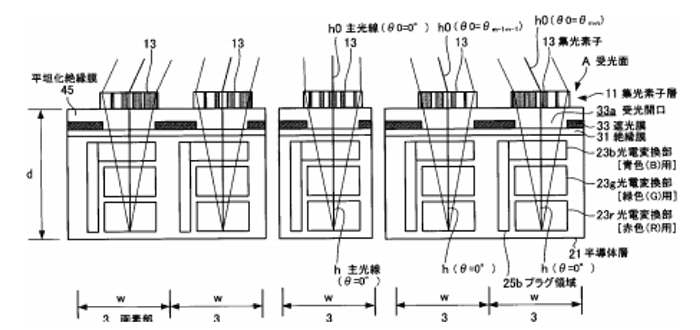
Egami spotted the next Japanese patent disclosing a Sony three layer sensor similar to Sigmas Foveon tech. It’s now many years we such kind of patent and as far as I know Sony still is not ready to launch such a sensor yet. But I am pretty sure Foveon or similar multilayer sensors could come in future because they bring some inherent advantages like:
– Every pixel captures the full color info
– On paper multilayer sensor have bigger pixels compared to Bayer sensors (with both having the same resolution).
More info: Foveon X3 sensor (Source: Wikipedia)
P.S.: Sigma uses the Foveon (3 layer) 46 Megapixel sensor on ompact cameras like:
DP1 with 28mm lens at Amazon, BHphoto and of course on [shoplink 15083 ebay]eBay[/shoplink].
DP2 with 45mm lens at BHphoto and on [shoplink 15084 ebay]eBay[/shoplink].
42 Responses
It has thinner filter array but deeper wells. Could be even worse with the legacy glass, I think.
If you actually thought, you would not have posted such a lame-ass comment.
Admin
This obnoxios troll is posting baseless insults to every commentor here and making absolutely no usefull comments.
This does not belong on SAR.
I would guess that if you checked the other comments made by this individual they would be similar to these.
Oops, wrong thread ~
I do not read Japenese so this is based solely on looking at the picture and could be wrong.
This appears to be based on the flat lens/ metasurface technology currently neing developed at harvard.
The technology at jarvard is geared towards flat apochromatic lenses, but here it is used f poo r flat microlenses.
Nano-anteneas of 3 different specific wavelengths are used instead of microlenses fo direct light to the pixel below, tje configuration varies by location on the sensor.
Since these nanofingers are highly wavelength specific stray light is greatly reduced.
The nanofinger arrays do not cover the entire surface of the sensor and would result in a slower sensor compared to a gapless microlens, but color fidelity would be better.
Most probably Sony has no intention of actually using this technology but is pattenting every idea they can think of…especially sensor related….solely to make it more difficult for the commpetition to develope new technologies, and confuse those following the patents as to Sony’s true intentions.
This technology has great potential for flat lenses, but I am not certain how usefull it will be for sensors.
It is you, therefore you are wrong as you have been hundreds of times before.
What kind of idiotic comment is this…
I may or may not be wrong, as I have claimed, but if you do believe I am wrong then say why and offer some intelligent alternative!
I’ve never seen a great result with a Foveon sensor. Just don’t really like the look. That’s why it never took off. Name a Pro camera with such a sensor.
Great circular logic. But what you said is still stupid, not for the facts or lack of facts, just because it is stupid.
Is there a Pro-grade camera in the line of Nikon D4, Canon 1D with such a sensor? No. If the color rendition, noise ISO were so great, surely 1 pro camera maker would use it. And i don’t find an image shot with this type sensor any better than any APS-C Canon or Nikon. At best it is at par. With all the disadvantages of an unsupported technology in the post processing arena.
hmm while not every image shows up foveon vs bayer, brown things show the biggest difference
but actual detail, real sharpness and micro contrast just way better. and they do give a different look. the dp are great, stupid sharp 😀
That’s true, but for that very same reason they don’t have sports range cameras featuring MF sensors. D4, 1D range are all about speed.
If you don’t like the look, it’s a matter of taste.
If you say that you have never seen great results with a Foveon sensor, I’d say that a sensor alone won’t give a great result.
(Btw, the IQ of my dp2Quattro and dp3Quattro is great)
You have no heart if you don’t love the colors.
https://farm1.staticflickr.com/391/17801263823_cdc02081b5_o.jpg
Wow incredible! This type of sensor I’m looking forward to the most from Sony. I’m most interested in colour of all things. Real accurate and beautiful colour and not fake over the top HDR processed pics.
I’m not sure what the “look” of Foveon is, but it gives decent results only in good light. Boost ISO and suddenly everything looks like cr@p. On top of that the crowbar design of the DP3 Quattro is the most ridiculous thing I’ve seen since the Pentax K01. Try being inconspicuous with the Quattro…
Best photos I have ever take are all with foveon sensor camera, so are the worst, but those goodgood images more than make up for it. The image quality cannot be Replicate on any on any other camera I have tried
2015 has been the rumoured date for the launch of a multilayered sensor, so when can we expect to see this type of Sensor in a Sony camera?
There are some pros that shoot well-lit or stationary subjects (studio and some landscape) with the Sigma Foveon cameras. This is a special-purpose sensor due to the very poor high-ISO performance. Files at ISO 100-400 are very nice. The PITA piece about working with Foveon sensor cameras is that it necessitates a second workflow, because most RAW converters do not handle Foveon files. The 75mm-equivalent DP3 Merrill does an excellent job on close-ups “bare” and a quite good job on 1:1 macro with a high-quality achromat close-up supplementary lens, so I could see some product and food photographers giving it a try, if they haven’t a high quality tilt/shift lens or MF view camera setup already.
So if Sony creates a good Foveon-like sensor in an ILC camera that can be adapted well to T/S lens, I’d be interested. There may be some issue with angle of incidence at the sensor.
At last! I have never achieved results as stunning as from my Sigma Merrills. it is worth putting up with all their limitations (until you *Need* a DSLR) – except for their software: I like Iridient. I have no inclination left to buy any further Bayer camera (whatever the resolution), certainly for landscape purposes etc.. So if Sony will make (soon) a FF A7S Foveon+++ with silent, vibration-free shutter and small, interchangeable lenses, I’ll be the first in the queue. RIP Nikon, unless you wake up!
Notice that the configuration of the nano-antenea vary accordind to thier location on the sensor..I believe this is to compensate for the angle of incedence.
Note also the first layer of pixels located between the stacked layers.
I believe these are simply Black and White pixels.
They would be much more sensitive to varying light levels than the color pixels. This would give greater low light sensitivity, and better dynamic range, but would not give any color information.
By combining the output of the color and BW pixels the processor should be able to create an image superior to either.
I use both the DP 1 and DP2 Merrills and they are exceptional at base ISO. If some company could design a 1:1 sensor with good high-ISO performance, even if it is just up to ISO 1600 or 3200, that would be groundbreaking.
To be honest merrill can be used at those sensitivities for b&w – I have quite a few photos at 1600 and 3200 as b&w.
…as B&W. That’s the key. The files are quite nice, actually – I think back to pushing Tri-X and think – we are lucky nowadays.
If this patent represents the apochromaticc metasurface technologie I think it does than we may see it used for very high quality apochromatic flat lenses, resembing current flat filters.
blah blah blah big word blah blah blah big word blah blah blah be impressed by how smart I am.
If you google those big words even you might understand what I am talking about.
In fact it’s very interesting research.
I’m rather impressed how smart you are!
Yes, it seems the patent is not so much about 3 layers but more about the micro-‘lenses’. IR tried to get deeper: http://www.imaging-resource.com/news/2015/06/04/sony-patent-shows-off-3-layer-sensor-with-shifting-micro-lenses
My description was based on just the picture which appeared like my original description.
The written description describes just a accentric condensor microlens.
It may not be accurate , but my description was a lot more innovative and exciting.
In particular placing BW pixels between the stacked color pixels would provide additional low light/dynamic range and simultaneously block stray light entering the pixels from the sides.
If this sensor uses the same technique as the Foveon, that is it relies on the difference in penetration into silicon of different wavelength photons, then it’s going to suffer the same problem, which is that the colour channels are prone to a great deal of common-mode interference. That is quite a large number of photons are detected in the “wrong” colout channel, as the difference in penetration into silicon is a distribution curve of probabilities that varies by photon wavelength (or energy).
There are techniques to correct for these common-mode interference effects, but they become less effective with fewer photons being detected (in other words, at high ISOs). This leads to the characteristic poor performance of the Foveon sensor at high ISOs with elevated chromatic noise.
The first sensors with a Bayer array looked terrible in terms of color fidelity and dynamic range compared to film. For years many photographers, including me, thought digital imaging could never replace film in terms of IQ. It didn’t need much time to prove us all wrong.
Do you really think a true color sensor, like Foveon, could not be improved and finally surpass the old Bayer sensor? I think not. Remember the “experts” who said over and over, that CMOS could never match CCD in terms of IQ?
People stick to what they know when they get older. Looking forward to change gets harder the older we get. That is one reason why man have to die, in order to make room for the youth, philosophically speaking.
A sensor which detect all colours at each point is one of those holy grails of sensor design. The issue is just with the way that Foveon does it which relies on a statistical distribution in the depth to which different energy (“colour”) photons penetrate into silicon. The problem with that technique is that it’s inevitable that a high proportion of photons get detected in the “wrong” colour channel. The technical articles seem to indicate about that about 7/8ths of the colour information is lost that way. That’s inherent. It’s not really amenable to being corrected improved algorithms as it’s a matter of physics, not computing. It’s OK where there’s lots of light, but much less so when it is lacking.
However, the Foveon is inherently better for monochrome as, with proper processing, luminance information isn’t lost.
There are also some detailed design issues (like the lack pf per-cell buffer amps) which would help somewhat, but it can never compensate for the fundamental shortcomings of the method of colour discrimination. For that, a completely new principle is required. Preferably something like prismatic separation. There are proposals and patents around, but nothing definite. In the meantime Bayer-pattern sensors (and variations) are gradually pushing towards the theoretical limits of their design. Perhaps a stop or so at moderate ISOs, and a bit more at ultra-high ISOs (like the A7S).
There is other bypass, silicon is replaced by molybdenum disulfide or molybdenum diselenide (or Tungsten). The real sensors build with this metamaterials were already lab tested and proved working with much higher photon efficiency. ISO sensitivity of sensors build with this materials is higher by magnitude of 5 in regarding to best ISO performance of Bayer sensors. This sensors are now tested for scientific astrophotography.
Sensors are build with stacked layered technology already, so building Foveon alike MOS2 sensor will not be problematic at all. All works which are done now focus on increasing the speed of data transmisions from rows of photocells, transmision lines are build in silicion substrate, which is an Achilles heel of sensor technology. We already have very sensitive MOS2 photocells which are superior to all tech on the market, but only problem is with data transmision, but this direction is already guided by IBM and INTEL, in 2014 they named MOS2 as a future material for sensors and processors.
Cool.
When this sensor is ready for production this year it may take two to three years befor we see it in a camera in the stores.
With the second generation sensor-shift based high resolution mode (supporting 1/60s shutter speeds) being developed by Olympus likely to be followed by Sony, this type of sensors will hopefully be redundant. I think that would be the best of both worlds: good high-ISO, good DR and accurate colours.
Why when I say the word Foveon does it make me think of Silence of the Lambs?
Admin, what exactly did you mean by “sensor have bigger sensor”?
The artefacts caused by the Bayer filter array (moire, garbled small structures) will never be fully eliminated. In the past, almost anyone, who stated that we don’t need new technologies because the current ones are good enough, have been proved wrong in a long term.
I’m sure, this will happen. To me there is absolutely no doubt, that we will see true color sensors with A7S-like high ISO performance in the future. The question is, when.
How can sensors built with molybdenum disulphide (or the alternative) be 5 times more efficient than silicon? Existing silicon sensors already have quantum efficiencies significantly above 50%. Adding a Bayer pattern matrix (depending on density) reduces this by a factor in the region of 2 to 2.5, but if you are comparing like-to-like it ought to be using the same filtering system.
A Foveon-like sensor using this new material might well be possible, but, inevitably, (like Foveon), there will be a lot of cross-talk between colour channels as the absorption depth penetration profile will be statistical. Until somebody develops a technology whereby different layers absorb photons which are closely controlled to specific photon energy levels then I see this problem continuing.