







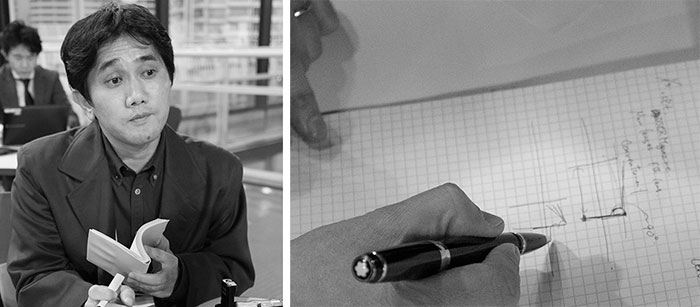
Makoto Kanai from the Sony Lens design department explains the advantages of Sony E-mount (Image by DSLRmagazine).
The Spanish site DSLRmagazine interviewed Akihiro Egawa and Makoto Kanai from Sony. And here are some of the key info:
1) Asked why the new FE lenses are so big the answer was that if you want goo optical quality you cannot reduce the size of the lenses.
2) The interviewer asked if the short flange distance and the limited E-mount diameter is a major limitation for Sony lens designers. The answer was no, for small focal distance lenses this kind of design helps us. The opposite occurs with the classic DSLR mounts. But there is a “But”: Sony said E-mount is maybe challenge when it comes to design longer focal lenses.
3) We only plan to get rid of Anti Aliasing filter on High Resolution Cameras. This because Moirèe tends to become less an issue when the spatial resolution is high.
4) When asked if the current FE lenses can resolve future 50+ Megapixel FF sensor the answer was yes!
Obvisouly…when asked…Sony did not share any information about the new FE lens release or any future possible new FE camera.
276 Responses
Great, now bring out the damn lenses, and not just mundane standard focal length primes.
of course they can…
but,
will be customers satisfied?
(it’s a hole different story)
Well duh, 50MP FF is no tougher than 24MP APS-C…
Yes, at the center.
No, at the corner.
Irrelevant when sony will measure their lenses at the sharpest part of the lens
> “But”: Sony said E-mount is maybe challenge when it comes to design longer focal lenses.
What focal lengths they are talking about??
I guess 300 and above….maybe already 200mm+ lens esp. when you want a prime lens…..so maybe a consumer 70-300mm fe zoom might be the longest lens for fe mount avaiable…but maybe some third party comapanies will use the gap and try to make some money if it is highely seeked and possible to design such lenses at least….
Yeah if the small diameter and the short flange distance doesnt destroy /prevent them for designing those lenses if there wil be a strong demand….
Who knows, but I do know that the rear element of the FE 70-200 is recessed into the lens’ body by an inch or so. I wouldn’t be surprised if Sony’s lens designers feel this is a compromise but a necessary consequence of this challenge, unlike the shorter focal length primes where the rear elements are right at the back of the lens.
It matters little on a lens that is already going to be fairly long though – I’d rather they recessed the rear element if it maximises image quality.
This would make TCs even more challenging.
Not objective/independent–> Sony employee/engineer–> no one would critizise own system/company woking for (fear of getting fired/loose chances for senior/leading postitions etc.)
Short flange distance and small diameter of e mount is a major problem (beside the astigmatism of many lenses and the 11+7 bit raw issue)…
That these issues have a huge impact on esp. longer focal length is already noticeable (evidence!!!) with regard to the 35 1.4 (small diameter have to be big to get all the light) and the 90 2.8 oss macro lens, the latter is longer than canons 100 or even nikons 105 2.8 vr macro lenses despite being in reality only a 90 not an 100 or 105 mm lens….
Indirectly this means if those longer focal lenghts are a problem that there wont be many longer prime and zoom lenses so the fe mount system wont be ever the best system for sport, action and wildlife photographer….
omg, if “sport” and “wildlife” complaints were only allotted their fair share of attention, the amount of whining on the Internet would drop by about 500%.
Aside from being two genres that are on the whole rather boring and niche, most of the demands from these types of shooters are uneducated and unrealistic wishes. The expectation that cameras designed for what the 95% of buyers shoot- not dimly lit football fields and bald eagles- also be capable of feats already available in cameras now- made for those puposes- is ridiculous.
If you want to shoot those things then pony up the money for the 1DX, 7D mkII, or whatever, and quit demanding that every camera in every mount be capable of your particular demands.
Does naked ladies count as ‘wildlife’?
Only those with natural body hair.
Yeah, artificial body hair is kinda creepy.
If you find sports and wildlife photography boring, please do keep your “opinion” to yourself. Do try to respect others preferences, as long focal length photography is not some “uneducated and unrealistic” wish from some people, and actually, is a common feature for any photography system. What’s an absurd is the fact that E-mount supposedly can’t handle long lenses without any image artifact. Photography is not only about fancy primes dude, get real.
Photographers should work in the genres of landscape, architecture, portraits and still life. Street scenes are okay, too. Photography is an art form just like painting, and you don’t see that many sports painters, do you?
I’m not talking about “sports photography” man, what’s your problem? I’m talking about LONG LENGTH LENSES, and even if i did, what’s the matter with sports photos? Lots of people like them AND Countless photographers, around the world make a living with it. All these people – they are inferior then, because they don’t fit into your mediocre standard?
You aren’t a normal person.
So Sony is building its future on a rather crippled base. I thought the future would be a progression not a regression. But I guess for chart photography a A7R IIII with 100mp and 10 axis IBIS would cover the needs of 100% of all tech geeks. This is what will be left of Sony’s customer base. Sad very sad:-(
I do neither sport nor wildlife photography, but I do appreciate both.
I find comments such as yours to be, on the whole, rather boring and niche.
Why would a short flange distance be a challenge for long lenses? Even with long SLR lenses the rear element is forward of the mount, often by a few inches for super telephotos.
maybe the small diameter of fe mount is the bigger problem, to small to get all the light so every longer focal length has to be longer than on classical dslrs other mounts to compensate for the small diameter and less light gathering ….evidence the 90 2.8 oss fe mount lens mentioned below its longet than canons 100 2.8 macro or nikons even 105 2.8 vr lens…
Is that really the case though? You can mount any long A-mount lens using the LA-EA4 adapter and, as far as I know, there are no optical compromises caused by the E-mount’s diameter.
I’m working under the assumption that the flange distance is the issue, and Sony designers feel the need to be disciplined in terms of minimising the length of lenses.
Exactly. People have been experimenting with all sorts of adapted third party lenses of all focal lengths with the A7x bodies. Has there been any reports of 400-500mm or even longer being a problem? I haven’t seen any such reports. I have played a bit with a Sigma 100-300 APO DG f4 A-mount with and without a Sigma 1.4x APO extender (effectively 140-420mm) with LA-EA4 on my A7R without any issues. If the lens mount throat diameter had been too small, I would have seen it.
The Minolta 200/2.8, an excellent A-mount prime, vignettes slightly on the A7 with LAEA4 adapter, even at f/11. It’s the FE mount that blocks the corners. Not a huge deal – you lose 2MP or so in cropping.
This is not nice 🙁
Interesting, thanks.
Have you got any samples of this problem?
Doesn’t look to be a problem when I look here: http://fratkinphoto.blogspot.nl/2014/05/battle-of-200mm-on-a7-minolta-apo-high.html
so please back up the story
I’ve calculated the 90mm macro is approximately 127mm in length. The Canon 100L IS is 123mm in length, given the Canon EF flange is 26mm longer than the E mount this means the front element of the Sony 90mm macro sits 22mm closer to the sensor than the Canon.
That might be the point, as I explained below. I assume the designers’ aim is to get the rear element as close to the mount as possible in order to cut down the size.
Yes, but it’s important people don’t confuse the position of the rear element with the position of the exit pupil. With digital sensors, you want the exit pupil to be a significant distance from the focal plane to minimise corner issues. However, you can do that and still have a rear element much closer to the sensor which does
give the potential for a shorter lens than might be otherwise the case.
So in theory, at least, a short lens registration distance allows for more flexibility of design, even if it still requires a retrofocal design. How much this happens, who knows? The easiest way is still, of course, to adopt proven DSLR designs and just add what amounts to a short extension tube at the rear to compensate for the difference in lens registration distance.
I presume it is the same reason (but in reverse, as it were) why the larger flange distance of an SLR means that short lenses need to be of a retrofocus design.
The bottom line is that there’s no perfect single solution. All camera/lens combinations will be a compromise of some sort.
Personally, I wouldn’t mind not having an especially compact design for a telephoto, even though it negates the advantage of a small body. It’s an expectation of such a lens. At least the body remains small for short lenses, though. The same can’t be true with a DSLR, even if you make a smaller telephoto. The body will still be big and heavy!
They will come out with the new a7rII or a9, shure!? We have to wait…..
“If you want goo optical quality…”? A Freudian slip, perhaps? LOL
(For those who do not speak English as a first language, ‘goo’ is a sloppy mix that has no texture)
“Sony says” … well at least the current FE 35mm 2.8 Wont resolve enough. As tested by DXOmark.com only 20 mpix where as Sigma 35mm art is 30 mpix on a same level 36mpix sensor
While that is likely to be the case, I don’t trust DXOMark scores at all. They artificially inflate Nikon’s scores across the board, when real world performances are lacking on some models.
That’s what happens when you don’t test cameras under real world conditions. Controlled lab tests ignore many variables that may impact results in the real world.
“If you want good optical quality you can’t reduce the size”
Huh? What a crock! Leica have some of the best lenses in the world and they are TINY.
I can’t stand when brands like like this.
1) Asked why the new FE lenses are so big the answer was that if you want goo optical quality you cannot reduce the size of the lenses.
Leica seem to be perfectly able to
The design constraints may be different. Leica’s lenses are designed for a mount with different specifications, they use a different microlens arrangement on the sensor, and they don’t stuff their lenses full of advanced technology for AF, stabilization and whatnot.
Leica designs cost more = less profit.
I’m pretty sure that Leica has a larger profit margin than Sony, considering the price for their lenses. More costly designs, maybe, but Leica compensates for that with their stratospheric prices.
Yes, I meant that Leica can charge those amount but Sony can’t.
No. Leica doesn’t make a 90mm f2.8 macro or any FF OSS AF lens for that matter.
This question is always amusing because I’ve asked the same thing myself and people say “but leica cost more”. For example, someone might say “It’s impossible to make a lens small!” and I say “leica manages it” and then they say “but leica costs more”. The “but leica costs more” argument does not negate the fact that if someone says all swans are white and I find one black swan, regardless of the price of that swan, I’ve still found a black swan thereby proving not all swans are white. Either the discussion is about the price of lenses or the theoretical sizes of the lens.
The next amusing thing is when people say AF MAKES LENSES HUGE!! In a lot of cases, this is not true. Look at a lens cut in half (there are plenty of images provided) and you’ll see that the AF portion doesn’t take up much of the lens space.
Back on topic… Leica lenses are better designed. Even canon lenses are often smaller than zeiss and superior image quality (less CA, sharper image etc) with same gen lenses
“FE lenses can resolve future 50+ Megapixel FF sensor”- what ever that means. Of course you can use FE lenses on a 50 MP FF sensor and it is very likely that the resolution is higher than on a 12 MP FF sensor. But given that there are already some bad critics regarding corner performance of the 16-35 and the 24-70, the statement seems a bit optimistic – at least for these two zoom (which would be the one I need).
OTOH, the 55mm f/1.8 likely can go up to 50Mpix and more.
I think so, too. A very fine lens. My bet is the macro should be great, too.
As a fun note, this lens is also the best of all the lenses I have tested so far for infrared photography in the 1000-1300nm range. 🙂
The Otus 55 1.4 can resolve beyond to 100Mpix. I can only drool…
How do you know it can resolve 100Mpix?
Also, it’s a gigantic and super heavy mammoth of a lens, not to mention the price.
I read it in a dpreview article a while back. Though for the life of me I cannot find it anymore.
It is sufficient to show that at one aperture a resolution of 50MP can be reached in the center 😉 Usually at higher f-stops you run into diffraction and at lower f-stops CAs limit your resolution. If you only use F4 the chance is very high to even cope with higher MP sensors.
When downsamples, the high resolution camera won’t show any more or less signs of diffraction than a low mega pixel camera. The same goes for motion blur. I mention this not because of what you’ve said necessarily but people wrongly assume more mega pixels equals more blur. FOV change equals more blur not mega pixels
Very true. A high MP camera can always be down-sampled to 16MP for example and benefits from more information to perform the interpolation, resulting in slightly higher acuity (as long as noise doesn’t overwhelm the signal). It is just that stopping down to F16 and hoping true 50MP to achieve, won’t work. Instead you are oversampling. Number of pixels in an arc-second is my metric for potential blur, too.
We need only 24mm, 35mm, 50mm, 85mm and 135mm, the correct focal lengths for serious photography. Why not make a lens that have only these focal lengths, like five prime lenses in one? Make it happen, Sony!
You cannot live without 200mm and 300mm prime lenses in the world of serious photography. And without the native SFT lens too.
Yes, you can. If you need longer than 135mm, then you lack photographic skill and knowledge, or you’re working in a genre of photography that is not serious. 200mm and 300mm are incorrect focal lengths.
Nice :))
You must work photographing food or another easy stuff. Do you know that “not so serious photo niche” known as journalism photography? You’re a mörôn.
Your spelling is as incorrect as your photography. If you’re afraid that certain words will get your comments flagged for moderation, then you should use different words.
Classic reportage journalism using normal foca lengths is acceptable, but not sports photography. Although, a serious artist shouldn’t really work for money, in my correct opinion.
“in my correct opinon” xD
This dude is a joke.
You dude, are mentally ill. Photography it’s not only about “art”, it’s about everything in modern era. But you are too smart and superior to understand this. Go on now, lock yourself in a room and touch yourself looking at your crippled pseudo photography system E-mount 😉
Oh no, for heaven’s sake, I’m not a Sony shooter! I’m only here for the entertainment.
Too bad, I thought you are the entertainment…
And with what your highly artistically person shoots, Lomo? Maybe umm… iPhone? Then you use the arty filters of Instagram.
Oh man, talking of being narrow-minded… I still hope you’re joking/trolling.
“If you need longer than 135mm, you’re working in a genre of photography that’s not serious.”
Try shooting the world cup (soccer) with your 135mm lens. Or is one of the biggest sports events in the world not “serious photography”?
Or try shooting a lion in Africa with your 135mm lens on a fullframe camera and show us the pictures (if you ever return alive that is).
Oooooo, serious photography! What a dumbãśś…
You probably missed the memo about the 24-240? Contains all your “correct focal lengths for serious photography” in one lens…
Yes, but it also contains the focal lengths inbetween. That’s not what I want. I want a lens that consists of five prime lenses, so to speak.
Ah, I see. You want the Sony 24-35-50-85-135 f4 Penta-Planar?
Or maybe a rotating turret with the 5 primes mounted on it, the Penta-barrel Gatlling lenson?
Yes! But the former seems more practical than the latter.
So what can we read into this interview
A mount is not dead , just hibernating…it will always be better for sport, nature, macro long lenses.
E mount will allways be just a toy for snapshooters and those too frail to carry a real camera.
And Canon will dominate the mirrorless market by 2017.
Switch to E mount at your own risk.
>E mount will allways be just a toy for snapshooters and those too frail to carry a real camera<
That's what the Speed Graphic boys said to Cartier-Bresson you know……….
its cute how you want to be the voice of the anti e-mount cynics
Canon can’t make a sensor worth half a damn. The 5D Mk II with an Otus can only resolve half of the resolution that the D810 can. “Canon will dominate the mirrorless market” don’t make me laugh…
But Canon is already dominating the DSLR market, despite their sensors. So what’s your point?
Myspace was dominating the social media market until Facebook came along. My point is that of the three companies most likely to dominate the mirrorless market by 2017, Canon is the least likely.
“A mount is not dead , just hibernating…” – George the tortoise on Blue Peter failed to wake up from hibernation one year.
“it will always be better for sport, nature, macro long lenses.” – Wrong, wrong and wrong. How will it always be better when it doesn’t exist in the form of new products? E-mount cameras are already nearly as good for subject tracking – they will take over DSLRs at this within two years, which coincidentally is when Canon will realise their mirrorless domination objective was as much a fantasy as anything you have dreamt up in your sad little life.
“E mount will allways be just a toy for snapshooters and those too frail to carry a real camera.” Ah yes, the well know big/real camera argument, usually made by sad, little, pathetic lonely men.
Switch to Canon at your own risk.
Admin, please just ban this trolling c**t.
Oh and by the way – from an Imaging Resource interview:
DE: Switching to mirrorless: Where do mirrorless systems fit into Canon’s longer-term strategy? Does Canon view mirrorless as primary or exclusively a sub-frame platform? Or do you see it as being more broadly applicable, and appropriate for both sub-frame and full-frame systems? And then the second half of the question is will we see the EOS M line evolve further, or will there be a completely new platform at some point?
Yoshiyuki Mizoguchi/Canon Inc.: Okay. In terms of how we view the role of mirrorless, first it’s within the EOS framework that we’re talking about. There was obviously the need to pursue smaller products that were more lightweight. So we kind of view the EOS mirrorless cameras from that perspective to begin with. It’s not just looking in terms of solely as a mirrorless product, but within the interchangeable lens camera segment. We kind of view it as playing a role within that … sort of an extended view, as a means of achieving a more compact, lightweight product. There was obviously the question of whether or not, within the regular DSLR format, there was a demand for lighter, smaller products. You know, there are various approaches on that, but this is a means for us to address that issue within sort of the EOS universe.
DE: Right. So you see it as being a case of… That’s how you get compact. If someone’s willing to accept larger size, then you go for the existing…
YM: With regard to 35mm full-frame cameras, we’re looking at the advanced amateur user segment, and demand for that level of performance is high among those. But then you begin to say, what features can you do away with [to reduce the size]? Like say, an optical viewfinder or EOS AF. It becomes sort of a search to see where demand falls, and to what degree users are willing to do without certain features [for a smaller camera]. Then there’s the APS-C size frame [where users may accept different trade-offs]. So it depends if users are willing to accept a degradation of image quality [to achieve a smaller size], and where the demand falls. [That is, to what extent are consumers willing to give up some image quality in exchange for a smaller sensor, to have a smaller camera?] So it was through that means for us to respond to the demand within this sort of step-ladder of different users.
DE: Oh, I see.
YM: I can’t go into detail, obviously, about our future plans. But our aim, if the demand is there, is to boost imaging performance while maintaining a compact, lightweight design, to satisfy even higher-end users, or to create demand at a higher level within the same sort of compact format.
DE: Right. So it’ll depend somewhat on the market.
YM: So if there’s no demand, then it doesn’t make sense for us to…
DE: Obviously, right.
YM: So it will depend on whether the demand is there, we will do our best to meet it.
[Ed. Note: My conclusion from all this is that, while Canon would never say “never” to a full-frame mirrorless body/lens system, their current thinking is that “compact” and “full-frame” really don’t belong in the same sentence together. Who knows what the distant future might bring, but for now, I won’t be holding my breath waiting for a full-frame mirrorless system from Canon any time soon.]
Full link to interview: http://www.imaging-resource.co…
You really think Canon will dominate the mirrorless market by 2017? Kn*bhead!
The conclusion that we will not see ff mirrorless was from the intrviewr , not canon.
In fact in this interview Canon refused to answer amy questions about fiture mirrorless products..exept yhat they will respond t poo customer demand.
In other receny interviews Canon execs have predicted they will dominate the mirrorless camera market by 2017.
So I will stick with my prediction that around the end of this year we will hear about a ff Canon mirrorless that can use canon dslr glass.
“poo customer demand” – oh really?
What interview? It was mentioned in a report. Where is the interview?
http://www.canonwatch.com/canon-wants-dominate-mirrorless-market-2017/
Oh and by the way – from an Imaging Resource interview:
DE: Switching to mirrorless: Where do mirrorless systems fit into Canon’s longer-term strategy? Does Canon view mirrorless as primary or exclusively a sub-frame platform? Or do you see it as being more broadly applicable, and appropriate for both sub-frame and full-frame systems? And then the second half of the question is will we see the EOS M line evolve further, or will there be a completely new platform at some point?
Yoshiyuki Mizoguchi/Canon Inc.: Okay. In terms of how we view the role of mirrorless, first it’s within the EOS framework that we’re talking about. There was obviously the need to pursue smaller products that were more lightweight. So we kind of view the EOS mirrorless cameras from that perspective to begin with. It’s not just looking in terms of solely as a mirrorless product, but within the interchangeable lens camera segment. We kind of view it as playing a role within that … sort of an extended view, as a means of achieving a more compact, lightweight product. There was obviously the question of whether or not, within the regular DSLR format, there was a demand for lighter, smaller products. You know, there are various approaches on that, but this is a means for us to address that issue within sort of the EOS universe.
DE: Right. So you see it as being a case of… That’s how you get compact. If someone’s willing to accept larger size, then you go for the existing…
YM: With regard to 35mm full-frame cameras, we’re looking at the advanced amateur user segment, and demand for that level of performance is high among those. But then you begin to say, what features can you do away with [to reduce the size]? Like say, an optical viewfinder or EOS AF. It becomes sort of a search to see where demand falls, and to what degree users are willing to do without certain features [for a smaller camera]. Then there’s the APS-C size frame [where users may accept different trade-offs]. So it depends if users are willing to accept a degradation of image quality [to achieve a smaller size], and where the demand falls. [That is, to what extent are consumers willing to give up some image quality in exchange for a smaller sensor, to have a smaller camera?] So it was through that means for us to respond to the demand within this sort of step-ladder of different users.
DE: Oh, I see.
YM: I can’t go into detail, obviously, about our future plans. But our aim, if the demand is there, is to boost imaging performance while maintaining a compact, lightweight design, to satisfy even higher-end users, or to create demand at a higher level within the same sort of compact format.
DE: Right. So it’ll depend somewhat on the market.
YM: So if there’s no demand, then it doesn’t make sense for us to…
DE: Obviously, right.
YM: So it will depend on whether the demand is there, we will do our best to meet it.
[Ed. Note: My conclusion from all this is that, while Canon would never say “never” to a full-frame mirrorless body/lens system, their current thinking is that “compact” and “full-frame” really don’t belong in the same sentence together. Who knows what the distant future might bring, but for now, I won’t be holding my breath waiting for a full-frame mirrorless system from Canon any time soon.]
Full link to interview: http://www.imaging-resource.com/news/2015/02/16/canon-interview-cp-plus-2015-autofocus-full-frame-mirrorless-5ds-video
You really think Canon will dominate the mirrorless market by 2017? Knobhead.
you are a joke like me.
#1 is BS. Contax produced a superb line of compact AF lenses designed by zeiss called Contax G many years ago. So it can be done… Maybe not f1.4, with OSS and SSM, but definitely with great optics.
Exactly. And Zeiss Loxias are still relatively compact.
MF and F2. Why is the Otus so huge? To correct optically instead of by software requires a different design .
Loxias are also optically corrected, they’re just less perfect than Otus. Otus resolves 100mp.
Agree here. I don’t know how many MP the Otus resolves. It is a lens I wouldn’t buy for myself, too expensive.
Yes but they used symetrical designs with those lenses, something you can’t do with digital sensors with short flange distances #smearing #colorshift.
When it comes to wide angle, yes. But other camera makers such as Leica have found workarounds like optimizing the sensor for short flange and wide angle without issue.
Then you can shoot with a Leica. Most Leica lenses were designed for film. Very few were designed with digital in mind. So Leica had to cheat by using thin sensor filter stack and in camera correction for color cast/vignette. M8, m9 and even the m240 have IR contamination issue. The M9 thin sensor filter stack is having corrosion issue. You pay 6000 for a body and 3000 is around the cheapest you can find for new Leica lenses. I don’t think I need to go on to show you that small FF WA lenses come at price. If you’re willing to pay, I don’t think you’re here saying such a thing.
You assume I don’t shoot Leica, but that’s beside the point. What I’m
saying is that compactness is attainable, even if it means optimizing
the sensor. Stop making excuses for Sony.
Well, yes, it’s possible, but at what price? Releasing a small 4000 35/1.4 manual lens would not help Sony sale either. If it’s so easy to just “optimizing the sensor,” why don’t you show Sony the way? I doubt that you have any inkling idea about optical design, sensor design and the associated cost of such. And seriously, if you’re not happy with Sony camera, why are you here in the first place?
Who said I wasn’t happy with my Sony gear? I love my A7Rs and A99s. All I’m saying is that high quality optics are possible in a compact package and sensor optimization has been done before. Economies of scale would offset the cost of production by now. What bothers me is that those huge hunks of glass don’t balance well at all on the A7R – something that is paramount for a working professional, especially when you have a shoot that spans all day, and not just for taking pics of a cat every now and then. The FE 35mm and 55mm are genius. Just want other focal lengths in the same form factor. Why is that so hard for some of you to grasp??
Pray tell what sensor optimizations that you can think of? Please don’t tell me some sort of cheating, in-camera fixes. Have you considered that if Sony actually optimized on the hardware level, it might mess up the current lens performance (simplest one is to go with a thinner sensor filter stack). If they use a different array of micro-lenses, would you be able grasp that it would mess up your FE 35 and 55 since they were designed for the current set-up? I guess not. On the optics side, you’re talking about economies of scale as if those “tiny” Leica lenses material cost, labor & QC costs are insignificant. Do you really think if Sony can shrink that FE 35/1.4 down to the Lux size or even the new ZM size, they would only ask $1300 for the lens? I’m just being more realistic. And don’t need to pull the “working professional” card, clearly Sony is not targeting this segment. Obviously, you don’t really have any constructive criticism even when you “love” your A7Rs and A99s. It’s easy to talk about optimizing and possibility, but right now it’s just not possible to go small, excellent optics with a reasonable price. It’s not like the Sony optical engineer is not as “clever” as you, it’s just that you can’t grasp the reality. Get real Valentino. And unfortunately, I don’t have any cat (or dog) to take a picture of.
Your argument sounds like an old post regarding high megapixel sensors. “It can’t be done”, “it’s too expensive”. By the way, the new voigtlander heliar 15mm III is Sublime on the A7S. Limits are for ones who dread progress.
Sony does in camera correction of vignetting and distortion as well.
Leica still has issues with many of the lenses that have issues on Sony.
I wouldn’t exactly say “without issue”, referring to the M8 IR contamination debacle and now M9 sensor corrosion.
Sony reduce costs by selling the same sensors to DSLR manufacturers so optimising for short flange isn’t really an option.
So you can have compact lenses (yet untested on 50 megapixel sensors) with a lot of aspherical elements for $4,000 and bear the cost of a Leica body (or two), or bear the additional weight of the FE lenses. It’s your call.
Bullshit. Updated Biogon 35/2 works okay on A7
Those lenses were designed for film and not digital sensors – this makes a difference in designing lenses.
They could optimize the sensor like Leica did. Stop making excuses for Sony.
Don’t care.
E mount lenses are just too expensive, and it seems like the small diameter of the E mount is a problem. 🙁
Why don’t you just make mirrorless A mount cameras?
I don’t have a problem with my A7r and 4 FE lenses along with 20 others using adapters. The A mount is the Minolta mount and can’t be mirrorless unless you want a camera like the Pentax K-01 , the fattest mirrorless on the planet.
There are many pros using the A7 system but it looks like some just don’t have a clue.
Any photographer that is fine with the size and shape of current A-mount cameras, would be fine with the same size and shape in a mirrorless A-mount camera. There are more advantages to mirrorless cameras than just the possibility of a smaller size (which isn’t considered an advantage by everyone, anyway).
Yes.
I would gladly use the laea3 adapter and a mount lenses if the af performance was decent.
Unfortunately, you can only get good af performance with the weirdly designed laea4. I would’t mind the bump so much if it wasnt at the bottom. Make a new version with the bump at the top and i’d probably buy it.
Still, an adapter without a slt would be better. The a7 has pd sensors. Why doesn’t it work? Is it an actual technological limitation or just market manipulation?
So far, we have only seen disadvantages.
I migrated from Fuji system so I know how a small camera feels. The problem with current mirrorless is exactly the small size and ergonomics. At the moment, I own the A99 and I love its ergonomics. I really hope Sony upgrade this camera with the mirror removed. The A mount system is fantastic. Minolta 200mm 2.8 even beats the Canon counterpart. I have no objection to A7 series but the A mount is a joy to shoot with. The A mount has the potential to attract many traditional DSLR shooters. It’s sad that Sony doesn’t recognize the full potential of the system. By the way, I am not speaking in favor of the A mount because I have it. I have recently bought my camera, so I knew the risk that Sony might abandon the system from the beginning.
Sorry buddy if you want fullframe and modern prime lenses that might last you a lifetime you must have the money to buy them. There is more affordable stuff from other brands out there – just buy it and be happy.
The mount is exactly the same mount as the Nikon F mount. I don’t just mean the same diameter, you can use the same extension tubes and body caps between Nikon F and Sony E.
I’m actually an E mount user but (used APSC Alpha A mount in the past though). Now that I made the upgrade to FE I’m sadly disappointed.
That’s great news if you shoot 55mm. Sony thinks full frame and one great prime lens makes a system. Well it does not, for me. And now more delays on the new FE primes…I’m over it! I’m tired of waiting for several fast, sharp primes (and a macro) and it’s seems unlikely that if they do come, and I mean “if” they will not be of the quality of the Zeiss 55FE. So, dumping Sony for now and going over to Olympus where they have there s**t together. The best in-body image stabilization in the industry…PERIOD, retro good looks -inspires me to get out and shoot, some of the best colors, 12 bit RAW files, top notch JPEGS straight out of the camera and a plethora of OUTSTANDING lens choices… See you at 4/3 rumors 🙂 …oh and now we 40MP hi-res mode, soon to be hand-held BOO-YAH!
you really try hard to convince yourself dont you!?
Oh you poor fool. I have an E-M1 and a few ‘outstanding’ lenses, they are not a patch on the FE system. Sorry to burst your sad bubble. See you on the other side…
“dumping Sony for now” ……ok. Please take your ten year old mentality back over to m4/3 rumors where I’m sure you came from.
“…PERIOD”
Why do people put this period crap after a sentence? I’ve seen this done before by an american.
I suggest you try out leica and loxia lenses instead of simply dumping sony
I didn’t know it was only an American thing.
“PERIOD” in America means “end of story, no room for discussion”
40MP hi-res mode provided nothing in the frame moves. Best check the weather forecast before going out shooting…
You can use PhotoAcute on an A6000 to get 96MP. Works the same way, just not in-camera.
With PhotoAcute you have to move the camera yourself, but either way it’s pretty limited if you have objects in motion. It would be nice in the studio to have the process automated.
Well it’s not as limited as the Olympus system which creates all kinds of weird artifacts with no way to suppress them (and no separate RAWs to save the shot). PA at least lets you try to minimize movement artifacts and does so with varying degrees of success depending on the subject.
And btw. PA has a tripod mode which works just fine at least for cameras that use half-mechanical shutters. Haven’t tried with electronic yet.
You can use PhotoAcute on an A6000 to get 96MP. Works the same way as how Olympus procceses its high MP pics, just not in-camera.
According to our findings, even Nikkor 28-80 – crappy zoom from film era – can resolve more than 36 Mp at the center of the frame. Read this:
https://translate.google.ru/translate?sl=ru&tl=en&js=y&prev=_t&hl=ru&ie=UTF-8&u=http%3A%2F%2Fvgrin.host56.com%2Fphoto%2Farticles%2Fpixels%2Findex_r.html&edit-text=
Or in russian:
http://vgrin.host56.com/photo/articles/pixels/index_r.html
***WARNING***WARNING***WARNING***
Master imager=MyOriginalContentSite
Beware of the monster everyone!
The sicko is back! Go away freak!
No, I’m not a terrorist or psychopath or anything like that. And I don’t have a site of my own. I am, however, someone who has mastered, or even perfected, the art of photography. A modern day Rembrandt, one might say.
I wondered how long it would take for the MASTER to return lol
Master master
Master of photos
he’s shooting with films
Using his primes
bashing the teles
Blinded by art you
can’t see a thing
Just use F8 cause
I’ll hear you scream
Master master
Cliff Burton was the best!
What is the definition of ” can resolve 50 Megapixel resolution sensors” ?
How many line pair can it resolve per mm ?
Without specific number, it is meaningless, IMO.
Do you really think that Sony (as the only company in the world that gives a śhït about their customers) would reveal something meaningful to the press before actually launch the lenses, if so? You gonna have to wait for DxO’s benchmark tests.
I think he meant theoretically, how many lp/mm must a lens be able to resolve, in order to resolve 50 MP on a FF sensor?
The truth is that only Canon can resolve 50Mp. The voices of the photo gods in my head told me that. LOL
Easy enough to work out. A 50MP FF sensor has about 240 photosites per mm. Half it, and that means it needs a lens capable of resolving 120 LPM at whatever contrast threshold is considered acceptable in the MTF curve in the relevant part of the image (centre, corner etc.). For it to be useful on modern sensors, that’s something like 15% of what a “perfect” lens would do. So the change between dark/light would look like a variation in brightness. However, that’s very much the limit and a much higher contrast ratio might be what’s wanted. Many MTF charts are only produced up to about 30lp/mm, so that might give a clue a more realistic areas.
The other thing I’ve fudged is lines for MTF charts are often drawn on the diagonal (so the sensor photosite spacings are “coarser” by a factor of about 1.4 – so, on the diagonal, only about 85 lp/mm could be resolved using a 50 MP FF sensor).
There’s also another issue, and that is the pitch of the photosites by colour channel on bayer sensors. For R & B channels, that is twice as coarse in each direction (less so for the G channel). That has a very complex impact on resolution, especially given colour channels have overlapping filter profiles.
Of course there are many sensors out there which go far higher in resolving requirements in terms of lp/mm than a 50mm MP sensor. There is now a Samsung 28MP APS-C sensor which requires about 12% more. The Sony RX100 is something like 66% higher. cameraphone sensors can go much higher again. (However, as a lens for a smaller sensor has a much smaller image circle, it’s easier to design for higher lp/mm).
However, when all is said and done, 120 lp/mm is a very demanding target for lenses designed to cover a 35mm FF sensor. One unexpected side-effect of ultra-high resolution lenses could be the return of moire on very high resolution sensors without AA filters. To an extent, cameras like the A7R are assisted by the relatively low micro-contrast ratios lenses achieve at such high resolutions.
.
Good points. Usually MTF50 is used to judge sharpness, as this correlates with perceived sharpness of human beings (according to experiments, reported at many locations. I once found a link to this, but wasn’t able to find it at the moment). As far as I know, Leica and Zeiss show 40lp/mm MTF maximum for fine detail. It is not easy to construct diffraction limited lenses for f4 or f5.6 for FF. For smaller sensors CA control is easier.
Lenses don’t “resolve” a fixed number of megapixels, they exhibit a
resolution/contrast relationship (as characterized by the MTF curve).
This interacts with the sensor resolution in a non-trivial way meaning
the resolution of your imaging system is dependent on both lens and
sensor, meaning an improvement in either can result in greater system
resolution.
Stop talking sense, that isn’t appreciated around here. 😉
I think 50MP demands lenses to resolve 100lp/mm or higher, correct me if I’m wrong, please!
50MP doesn’t “demand” anything. All existing lenses will yield sharper images when moving up to 50MP.
I still can’t figure out what to do with 16.
I’ve gotten a few cameras since then…
but my broken, 10mp A300 is still a more capable camera than I am a photographer.
I dig 10. I can live with 12 as a standard. M43 and my A7- not much different folks. I pixel peep all day. Been shooting them side by side for months. Not much different. Sad but true. You pay for more bokeh whoreishness and ISO performance.
no more 11+7 please!
My A6000 for me is the best camera ever invented. Very small and light to carry all day and night, 24 mega pix, super fast auto focus, excellent quality video (almost as good as my FX100), small compact lenses to carry in my bum bag, small batteries that last all day, in camera charging via USB, and wireless flash function. LOVE IT. Thank you Sony!!!!!
It’s madness to make huge and monster prime quality lenses because of one 50MP camera! I was considering to go for Sony (after A7 play witch image I really liked) but this stupid Sony trend with bringing bigger and bigger lenses “because they will resolve 50MP camera sensor” forced me to change decision. There is only one interesting and quality AF prime that Sony offers – it’s 55/1.8 ZA, small and resonably fast. 35/2.8 ZA is good but not impresive with its f2.8 for lower light shooting. Nothing else unless you accept MM Loxia or Sony own prime line. 35/1.4 ZA is Giant, try with it to be discreet or shot dynamic street. It is said that new 85mm ZA will be f/1.8, so another monster that will “resolve 50MP”. Sony FE is mayby for studio and landcape photography, but surely not for street, action and dynamic photoreports…. and new ZA Giants will probably come. It seems better to go for small DSLR, like D750 with small – and great – G/1.8 lenses.
Agreed. The only thing that’s keeping me in the system is the lower weight for backpacking landscape work. Otherwise the d750 seems like a better ff option.
D750 with the very good 18-35mm f/3.5-4.5G is only about 50g heavier than Sony a7 with 16-35mm f/4 OSS lens.
So, unless stabilization and/or the extra 2mm in wide range are crucial, you can have almost equal experience.
Adding any additional lens to the set shrinks Sony’s advantage to almost nothing.
Good point. If taking a bath on the sony gear and buying all new wasn’t an issue then that would be the way to go. For now I’ll have to keep enjoying what I have though.
So you prefer a DSLR camera over a mirrorless because of lens size ?
interesting
Such giants mounted on small cams impact more that you may think – handling, operating, fast framing, ballance, AF speed (big glass), shooting pleasure and expericnce, so your images!
I dont have that problem at all. Youre exagerating. There are hugeblens that make dslrs look tiny too. This is just a terrible excuse
He’s kinda got a point, though. When you throw the giant lenses on the A7’s, it’s probably not much smaller as a system than a D750 with a smaller equivalent lens; it’s just the bulk is on the lens side instead of the body side. I’m not saying that’s good or bad, but does look to be a fact. There are advantages to mirrorless beyond just compact size, though, so to me doesn’t negate the concept at all.
An A7 plus 35mm f1.4 (plus adapter for now) is easier to handle than a FF DSLR plus say, 70-200 f2.8. So many poor DSLR users suffering with their “giants” too.
Even a “giant” 135mm f2.0 plus hood handles quite easily on the A7:
https://www.youtube.com/watch?v=QXbCveS3Irc#t=32
Love the exaggerations in these boards.
i know right.. they must have never used a full size dslr in their life lol
Would you prefer poor optics, so that lenses could be shrunk? How about eliminating OSS and autofocus? If you want high quality for daytime photography, while shrinking lens size, then go with a 4/3rd system.
You dont want the better optics buy the cheapo lenses.
Thats why we have choices.
Lenses don’t “resolve” a fixed number of megapixels, they exhibit a resolution/contrast relationship (as characterised by the MTF curve). This interacts with the sensor resolution in a non-trivial way meaning the resolution of your imaging system is dependent on both lens and sensor, meaning an improvement in either can result in greater system resolution.
Exactly. You can read it up and look at measurements, here: http://www.zeiss.com/content/dam/Photography/new/pdf/en/cln_archiv/cln31_en_web_special_mtf_02.pdf.
Hear hear!
The current 16-35, 28-70 and 24-70 can’t even resolve the A7r’s sensor, how could they resolve 50MP? Sure maybe the FE 55 and possibly the FE 35
“The current 16-35, 28-70 and 24-70 can’t even resolve the A7r’s sensor”
Hello. What data do you have to present this conclusion?
It’s pretty well known, look at any review that maps resolution. For example:
http://erphotoreview.com/wordpress/?p=4645
It’s pretty well know that AronTheAssNorris is a troll.
Thank you for the reference.
Sure, we know the 24-70 is kind of a dud what it’s billed as. But from what I’ve read the 16-35 is one of the better WAZ out there. Maybe not the best but up there…
All the lenses mentioned will produce higher resolution results on a higher megapixel sensor. Lenses don’t resolve megapixels, you’re confused.
I believe that these remarks are mis-interpreted, or misunderstood. Wide angle lenses can take advantage of the removal of the extra mount-sensor distance where telephoto can’t, but clearly wide angle lenses require care in controlling peripheral image quality. Just try using film Biogons on your A7 and you will understand this.
telephoto does not necessarily mean that a lens is “long”
We don’t have to guess, we can calculate this by looking at the sharpness results from the a6000, which will have about the same pixel density as a 50 megapixel full-frame sensor.
The sharpest FF lest, the 55mm f1.8, will get 30-33 perceptual megapixels, based on current DxOMark measurements. That’s pretty good.
The 24-70 will only get about 14 perceptual megapixels (out of a theoretical 50). The 70-200 f4 will get about 22 megapixels.
So you’ll get more detail out of the current lenses with a 50 megapixel sensor, but only the 55mm could be considered optimized for that higher resolution.
Even the 35mm lens will have trouble in the corners. It already has with the 36 MP A7r and it will be even more obvious with a higher pixel count (of course results won’t get worse). There is a disconnect between the (potential) Sony sensor performance and the native lenses (despite the Zeiss branding). This is a bad thing when you want to build or need a system. The latest Canon lenses are much more appealing, though the sensors are not (beside the resolution).
I think 36 no AA is about the sweet spot for FF. Any more give me the big boy glass and a 645Z.
Most lenses are not holding up in the border region. The 55/1.8 does. I’m sure stopped down to F4-F5.6 you will have a center region with very high resolution, but the corner performance drops down significantly. My guess is the new macro lens and 35/1.4 will be in a similar ballpark as the 55/1.8. I didn’t see a resolution test of the Loxia primes so far, it could be they fare better than the 35/2.8 or 70-200. Nevertheless, as the system MTF is a product of lens and sensor MTF, you still get a benefit, as was proven via measurement by Zeiss already some time ago.
DxO mark measurement is not always correct.
for you as well, how do you know ? You been to their lab ? you have your own lab ? You’re a professional in this area? or are you just simply saying what you heard somewhere else when you were not happy with their results 🙂 ?
DxOmark isn’t really an accurate way to measure lens acuity.
how do you know ? You been to their lab ? you have your own lab ? You’re a professional in this area? or are you just simply saying what you heard somewhere else when you were not happy with their results 🙂 ?
DXO’s methodology does not measure lens performance in absolute terms, it’s always a lens/body combination rather than using a super high resolution sensor on a calibrated fixture that is traceable to a standard. If you understood measurement metrology that fact would be obvious to you.
This is the answer. Check a lens on the DF and then the D800E and you’ll see how inconsistent the results can be.
Read ‘Real Rap’s’ explanation. Essentially, DxO is testing lens/sensor pairings. Two variables.
Look at what happens when you compare two different sensors and the same lens. It appears the 85G does not quite saturate the DF’s 16.2mp sensor. But then look at it on the 800E, it’s pulling 30mp. How is that?
I don’t need to be an optical engineer to notice that DxO isn’t going to give me real optical measurements or reviews. It’s still a fun site and it can be a useful tool.
Guest : ” How is that?”
The reason is simple, because you are comparing different lens~!!
On the left, it is 85mm F1.8, price at $495
On the right, it is 85mm F1.4, price at $1495
if iam not mistaken, you gave me an example of two different lenses 😀
DXO calculates lens results. Not actually tests them.
I didn’t realize this. I suppose it doesn’t change what I said, however.
By that criteria, each major manufacturer would have about two or possibly three lenses suitable for use on a 50 megapixel sensor. In reality an owner of a 50 mp camera will use all his lenses and get better results resolution wise than on a lesser mp camera. So it’s a moot point and a superfluous question.
Yawn.
I am so sad.
No duh the current crop of FE lenses can resolve 50mp. Give us an organic sensor, and you’ll see that tons of old film glass can out-reseolve a 50mp sensor (especially in the center).
And it’s not the flange distance or throat that is hindering wide-angle lens performance. It’s that stupid, thick sensor glass! Organic sensors will solve this. As will curved sensors. Retrofocal and telecentric wide-angle lenses are on the way out I hope.
It’s gonna take a few more years and it probably won’t not even be a revolution heralded by Sony, but I hope you’re right.
Direct from Sigma USA ….the 150-600MM FOR SONY WILL BE PRODUCED.
As I said the second this rumor was posted….. the entire post was a phony sensationalist false rumor deliberaty allowed to stand only to generate comments for SAR.
Link to the statement?
I have contacted Sigma in Japan yesterday,
Odaka-san, from Sigma Japan CS, told me that 150-600c for a-mount currently is under development.
He can’t tell me when will it be available but he think that we have to wait a longer time behind other mount.
“Under development” is a way of saying, “We have no plans for such a lens, but might some day”
There isn’t exactly much to “develop”.. they already know how to convert their other lenses to A-mount. If they wanted to create an A-mount version of the 150-600, it would take about 5-minutes worth of “developing.”
Under development does not mean it’s coming.
Sigma sucks anyway, f them.
Wow… way to avoid the comment and use it as platform for casting insults… and mock the user name of the original commenter at the same time. Clever devil.
Great life you got there. Real contribution to humanity.
And F you too.
Anddddddd….. how does that refute, correct, or argue with anything barry said? It doesn’t. It just gives you a platform to pooop in public.
I choose not to insult but I will call Bull$hit at every opportunity. Some people spout too much crap and need to be told every now and then.
The B$ is yours because you never said what part of barry’s comment you disagreed with. You just insult and mock.
Pointless geek not happy? pointless geek not read!
I can read all of these insulting comments which completely avoid what barry’s post actually said. You’d realize that if YOU read them.
Tamron already have a 150-600MM for SONY, who cares about Sigma.
Tamron is not as good…especially at 600mm.
I talkefcto Sigma and they indicated that optically the 2 versions are about equal.
This may seem obviose but apparently E mount users can’t. Figure this out on thier own.
HOLD YOUR CAMERA FROM THE LENS NOT THE BODY!!!
Best thing you’ve ever said!
Pictures of this SAR post where taken with the new Sony prototype 24Mp Mirrorless Monochrom ? Hope production will start soon!
The World Press Photo awards have been held and a chart has been posted…petapixel…of the cameras used for every award winning photo.
Not a single one was taken with a Sony camera.
Last years chart was also posted
Not a single one was taken with a Sony camera.
http://www.worldpressphoto.org/sponsors
https://sonyvnikon.wordpress.com/2015/02/17/test-1-a-simple-imatest-comparison/
Must be a snow-day for Anton and his public sector job……………
http://www.newsshooter.com – Now go look what those same photographers are using for their 21st century clients (i.e.. motion work), they’d all be using Canon for that too if only Canon hadn’t dropped the ball after their stellar 5Dll…………….
I guess you better switch to Canon and go away.
a good photo is a good photo. you ask for the name of the photographer and not the name of the tool.
Here, this is your peer-group represented by camera types:
http://luminous-landscape.com/rantatorial/antarctic-expedition-camera-representation/
All lenses can resolve 50mp and more. Some just do it better than others.
“…if you want goo(d) optical quality you cannot reduce the size of the lenses.”
So that was the plan all along then? To create a compact camera with large lenses? Did they know this from the start?
Answer… NO
Because E-Mount was originally designed as compact APS-C only, and NEVER EVER intended as full frame from the beginning. The current cameras are result of happy accident. Now we play make.believe trying to hide the physics limitations behind a system that’s hoping to become what it never can.
It has options to use small and large lens. Youre not limited to all large lens. This is still a fairly new camera so no need to cry. Technology grows step by step and if this ff mirrorless dont become standard then it will at least introduce to us another advancement. So much negativity.
I don’t use Sony cameras to watch technology “grow step by step” when the steps E-Mount takes are backwards from the advancements A-Mount earned the past 25 years.
Pointing out the obvious isn’t negativity. Here’s another obvious truth that demonstrates why E-Mount will NEVER be pro grade because it was NEVER designed to be in the first place…
E-Mount batteries go in FOUR DIFFERENT DIRECTIONS… and depending on which camera used, will be opposite from another. My NEX3 battery fits in opposite direction than a7R… Why? What purpose does inconsistency serve? So in reality there are EIGHT POSSIBLE WAYS for an E-battery to be inserted.
A-Mount batteries are notched and slotted, and can only be inserted on way on every Sony A-Mount camera. Nice for pro working with gloves. A-Mount was designed for pro from the beginning. E-Mount has no clue what the nuances of pro requires.
Would you like me to go on? The list is vast why E-Mount is a play toy chasing pro fakers.
E-mount was created with full-frame in mind too, Sony has said that many times before. It’s protocol is much more advance than A-mount.
You trust anything Sony tells you?
I wouldn’t bet a dime on what Sony says or not. Fact is they have gone E-Mount to force people to buy into a new system. Not more not less
A-mount would be able to provide the base for a A99 R or A 99 S even a A99 II with 5 (3)axis IBIS. But they have decided to use E-Mount which is not the best base imho.
Haha you are funny. Ok first…
HOW are E protocols “much more advanced than A-Mount”?
Second…
Provide a link that states E-mount was created with full frame in mind. Shouldn’t be too hard since you claim “Sony has said that many times before.”… of course, after it was done. I remember Sony claiming they were surprised at E mount success.
Not saying you’re wrong friend. I’m simply asking you to back up your smack.
Very true, but I would not call that accident “happy” 🙂
It seems to be beyond internet “experts” that a failed mount is a failed mount.
I’ll take my cyber hat to you mister. You just said everything IMO.
Folks, There are laws of physics and then there are your wishes … And … I am not sure how these two can come together …
Large format cures all ills.
short sighted idealization…
Have you held an 8×10 slide? You haven’t lived until you have. So sexy, all that natural light just smacking itself off the back of the slide. 10x loop smushed up against your face…all up in it’s business. PERFECTION!
They come together by designing a system from the ground up to be a certain way and fulfill a certain vision. But wishes and physics fall apart when something is conceived in short sighted limited vision and then expected to become something entirely different later on… specifically because the original vision was so visionless in the first place.
I’ll be testing the Otus 55 and 85mm and the Apo-Sonnar 135mm and comparing the Sony A7r and the Nikon D810 using Imatest. Here’s the 70-200 zooms tested on these 2.
https://sonyvnikon.wordpress.com/2015/02/17/test-1-a-simple-imatest-comparison/
I really don’t understand your charts. Perhaps you could explain what the differences are that I’m seeing. I would also offer that you’d get better user experience if time was taken to at least label the photos.
Aside, I’m very pleased with my Otus 55 and 85mm lenses on Sony a7R with Metabones IV adapter. I saw where before you noted that you and others have had issues. I did too at first. But after remounting the Metabones with camera turned off, I haven’t had any issues for months. Works perfectly as described and expected. I do not doubt that the Nikon files have more depth. But my hit rate with an EVF is so much better that I take that as the lesser of two evils, and ensure to light and expose my images properly.
Also, in another forum, you link to Laneir bashing the Metabones AF performance. I wish that someone would make it clear that’s not a fault of the adapter. The Sony LAEA-1 and 3 both suffer the same slow AF with adapted SSM A-Mount lenses. Best to use those adapters with manual focus. The benefit is won by retaining metadata, camera corrections, and stabilization without having to dial it in manually.
A-mount is dead.
Which one?
Lol and e-mount is dead still in the water Too. Nothing new has came out to say wow e-mount is doing great for what I see and my needs. For me Body’s are good but still missing lens. seems both mounts are on the same boat. Sony has just show pictures and speak of the things to come but has not pushed much out on both mounts to say one is doing better then other by a big margin. Just my two cents. Keeps saying amount is dead so glass can go down in price. Last time a bunch of people said that it went way down, then went back up when found out it was not really true 🙂
So after we heard that Sony has been pushing a crippled Mount for the past 15 month can we finally progress and talk about serious things.
1) No need to migrate to the crippled mount.
2) When does Sony announce the A-mount stuff ? February is over soon. When will the A99 II be released?
No good optical quality with smaller lenses? Many Leica lenses with M-mount deliver fantastic optical quality at a very small form factor while being fast. I am not an optical engineer but still I wish Sony would have taken a similar approach and rather developed a sensor that would have allowed for compact and fast primes (maybe with mircro-lenses on the sensor, similar to what Leica does on their M). I am sorry to say it, but while the new FE 35mm /f1.4 may be great optically, it is comically large and defies the the purpose of mirrors cameras, which imho is being compact. For anyone wanting FF-sensor, compact camera body and compact, fast primes (without corner smearing) there seems to be nothing other but going with a Leica M.
Not so fast … Many small sized Leica lenses has been design for film and they do NOT work with DiGi-senser that good. You have to photoshop image from these lenses. Also New generation of Leica lenses specifically design for DiGi-sensor are outrageously expensive and, bigger.
Also I do not see Zeiss lenses for Sony A7 line of cameras that big. I am looking at them as we “speak” and they appear to me perfectly fine.
If you look at Leica S line of lenses they are big, bigger then FF Zeiss Lenses for A7 cameras. So why Leica did not use lenses you are referring to on Leica S camera? Because they will NOT work that good as I have mention earlier. And That is what SONY is saying from beginning but hey, then what SONY engineers know, right?
Thank you for your comment. To my knowledge, Leica solved the problem of corner smearing (with lenses 35mm or wider) for the most part with their micro-lens array in front of the imaging sensor inside the Leica M. I own both, a Leica M and Sony A7 (with FE 35mm /f2.8 and FE 55mm), thus I really have no interest in making one looking superior over the other. In fact, the Sony A7 body is superior in most every technical aspect over the Leica M body, at least in my experience (The loud and vibrating shutter on the A7 being the exception) even though it is a lot more affordable. For my main purposes, street, people and travel photography, having compact and fast prime-lenses is very important. Imho, despite being a very sharp lens, the FE 55mm is already on the large (long side) of things, especially when compared to a Leica Summilux 50mm. The FE 35mm /f1.4 compared to a Leica Summilux 35mm /f1.4 is so much bigger that I just think Sony took the wrong approach here. If one wants to have big and heavy, why not going the DSLR route instead, after all, there are more lens options to be found! Of course, if purchase-price (not resale-value) is the dominant measure to compare the differing approaches of lens and Sensor design, Sony wins hands down. They made FF cameras affordable and I believe that is a great thing in itself. If compactness and resale-value (used Leica lenses went up in price significantly over the last decade) on the other hand are the deciding factors, things begin to look very different.
“the FE 55mm is already on the large (long side) of things, especially
when compared to a Leica Summilux 50mm. The FE 35mm /f1.4 compared to a
Leica Summilux 35mm /f1.4 is so much bigger”
are you comparing MF lenses with AF auto aperture?
Yes I do since I use both systems. The autofocusing and Auto-AF systems in the Sony lenses don’t make them any longer (or shorter), it’s the optical construction that does. There are very short AF-Lenses on the market, e.g. from Olympus for the MFT cameras.
thanks, that is why I love my tiny Leica Elmarit-M 28mm/2.8 🙂
BTW: Olympus is not FF.
Thank you, I said Olympus was MFT and I said Canon had lenses for FF sensors that were short. Do you have problems with your Elmarit in the corners (unsharpness that would not occur on a Leica M 240?)
I used the Elmarit only on the NEX-7.
On the A7R I used the WATE 16-18-21, but with the new Zeiss 16-35 I may prefer this one over the WATE 🙂
I would assume, on the NEX system, due to the crop-sensor, there would not be any corner unsharpness visible? Wow about the 16-18-21 on the A7R ?
I did not notice any corner problems with the Elmarit on the NEX-7 (my NEX-7 is converted to infrared). You may find a series with this combination here:
https://www.flickr.com/photos/dierktopp/sets/72157644985293755/
I invested into the WATE for a good wide angle, but I have the impression, that with the new Zeiss Vario-Tessar 16-35 FE the WATE will stay on my M Monochrom – till Sony offers a A7 monochrome :-))
here are the images with the WATE on A7R and M Monochrom:
https://www.flickr.com/photos/dierktopp/sets/72157637565888603/
I don’t think a mirrorless cameras only purpose is to be small and have small lenses. That may be one of the many reasons to go mirrorless but not the one singular purpose.
I agree. Everyone may have different reasons for choosing mirrorless over e.g. dslr. What are yours? Thank you in advance.
on mirrorless you can adapt almost any lens from DSLR, RF, MF to large format.
Yes you can, and I do so with Leica glass. The problem that occurs is corner smearing, especially from 35mm or downwards.
Very true, but there seem to be problems with the mount size and sensor cover. Both are serious flaws, and make the various A7 little more than toys – together with the other flaws.
this a google translation of the whole interview:
We take our time in Japan because of the CP + 2015 for the first of our meetings , in this case with officials of Sony , to discuss their plans for the growing family present Sony A7 , their CSC with sensors 24×36 mm .
We started our interview talking about the new Sony FE objectives . These, at the moment who are under development, are:
Zeiss Distagon T * EF 35mm f / 1.4 ZA
Sony EF 28 mm f / 2
Sony EF 90mm f / 2.8 Macro G OSS
Sony EF 24-240 mm f / 3.5-6.3 G OSS
Sony makers did not clarify when the final version of them would be available, let alone when it would come to the market; Sony users must therefore wait for the Japanese firm not delay too much like other manufacturers we are accustomed.
Home
Professional
Technical and professional events
CP + 2015 Encounters – The Sony A7 family
Monday, February 16, 2015 9:00 Raphaël Terris
CP + 2015 ENCOUNTERS – THE SONY A7 FAMILY
We take our time in Japan because of the CP + 2015 for the first of our meetings , in this case with officials of Sony , to discuss their plans for the growing family present Sony A7 , their CSC with sensors 24×36 mm .
Akihiro Egawa (Department of Product Design) and Makoto Kanai (Department of Optical Design) by Sony. Raphaël Terris by DSLR Magazine. © Albedo Media SL
We started our interview talking about the new Sony FE objectives . These, at the moment who are under development, are:
Zeiss Distagon T * EF 35mm f / 1.4 ZA
Sony EF 28 mm f / 2
Sony EF 90mm f / 2.8 Macro G OSS
Sony EF 24-240 mm f / 3.5-6.3 G OSS
Sony makers did not clarify when the final version of them would be available, let alone when it would come to the market; Sony users must therefore wait for the Japanese firm not delay too much like other manufacturers we are accustomed.
The new FE targets announced by Sony. Official image © Sony
In general, new goals are quite bulky, especially when compared to the tiny body of the A7 family, forget not housed inside a sensor 24×36 mm. “For now, if you are looking for a good quality optics, it is difficult that the objectives are more compact ” , say at first, but then added that “for certain focus, perhaps it can be reduced” .
We think that the more short registration or “flange distance” of the CSC 24×36 mm Sony can be a problem, because it is a major constraint to the design of these objectives, particularly with respect to . edges of the image “For us, it’s not a problem” ., say from Sony “For purposes of small focal distance, a short distance record helps us, the opposite occurs with the DSLR ® ” . Added, however, that “it can be a problem for longer focal targets” .
On the other hand, a few weeks ago, Canon announced the first DSLR ® 24×36 mm sensor 50 Mpx. market.Is Sony considering a similar solution? “At Sony we seek to maintain a balance between resolution and sensitivity” , and in fact, “our latest moves are on the other hand, the Sony A7S , which maximizes sensitivity ” . (*)
Continuing the theme of the high resolutions, commented that the Sony A7 R filter eliminates low to maximize the potential of the sensor in this aspect of its high resolution 36 Megapixel step. We asked if they use some kind of solution to keep fighting the “moiré” that can not be removed without the AA filter.”No, do not use any specific solution to remove” . However, “only eliminate the AA filter in our captor higher resolution, so the moiré effect is reduced accordingly” . Indeed, the higher the resolution, the more difficult is that the moiré appears, to rely on the corresponding spatial sampling by the captor.
And although it seems Sony has no plans to present the market -at least so immediately a camera with higher resolution than the A7 R , asked about the response capacity of the new targets for FE frame, and whether they would be “appropriate” for a sensor of, say, 50 Mpx … “Yes, there is room” simply answered.In any case, it seems that they are prepared to further increase the resolution if necessary. Finally, we are interested in the latest advances in stabilization introduced by Sony A7 II . “The stabilization system 5-axis is the result of the combination 3 stabilization in the body axis and the two optical axes (yaw and pitch) ” .We inform you of the difference in results we obtained in our benchmark tests with the stabilization system 5 Axis Olympus, where the latter showed better performance (around better step).
Is it possible that having a distance as short registration A7 is the result of this reduced ability to stabilize or is a matter of size sensor? “Indeed, it is rather a question of size, the A7 has a lot bigger than the Olympus “sensor . And you think Sony continue investing in this hybrid stabilization system 3 + 2 axes? “For now, our intention is to maintain this dual stabilization system because for lenses with focal lengths, optical stabilization lens performs better than if all stabilization is found in the body ” .
In summary, we can say that Sony seems to have a fairly clear idea of the directions to be followed. For now, it appears that moving in the right direction, since the presence of the Japanese firm in the professional segment is increasingly evident thanks to his family A7.
(*) No we believe much. According to intelligence sources themselves, Sony presented to not take long, new FE models, one of them at least in high resolution. -a Clear that the japonesa- not lie and say “our latest moves” , ie, a few months or weeks, not today or tomorrow. We Will See.
Thanks for your great advice. I admire people who don’t even bother reading the posts first and then comment. In case you are interested in taking part in the discussion, and leave aside the cost-argument just for a moment: We were discussing Leica M-Mount (digital) bodies vs. Sony A7, not Leica S-Mount, which competes with Hasselblad. Of course a Leica M Camera will be more expensive than a Sony A7 (even more expensive than A7s) but not even close to $ 100.000. If you want to add anything useful to the conversation other than being rude I would very much appreciate it.
Being Rude ? … Ha …. what are U talking about …
I have just outlined reality so do not be ostrich hiding your brain in sand …
By the way. check size of Leica S sensor for starter …
“Rude” should be your first name, indeed. Nevertheless, I followed your advice. Sensor sizes on Hasselblad H5D-50, Pentax 645D and Leica S2 are very similar.
Hasselblad: 49mmx36,7mm
Pentax: 44mmx33mm
Leica: 45mmx30mm
All of them way bigger than FF.
Not sure what you are trying to prove here, but you are plain simply wrong. Again, this thread is not about Leica S2 or medium format.
No wonder they haven’t released anything over 210mm and no teleconverter after 5 years.
me personally it does not bother because i dont need anything beyond 200mm, but I can see some people find these longer lengths important. What I do need is 85mm and 135mm FE mount lenses that are smaller than their A mount counterparts
240mm is coming
Did they define ‘longer focal lengths’? I assume 85mm is already considered long since they are not making that lens.
Not necessarily – they’re releasing a 90mm so I can’t see that being an issue. 85mm is short for a telephoto anyway.
well i am talking about size advantage for mirrorless. obviously 90mm 2.8 has zero advantage in size and weight over any full frame macro lens for Canikon. So I figured at 90mm the ‘short flange distance’ advantage of Sony FE mount is already lost.
good that FE lenses resolve 50mp
i hope that by the time sony realese the 25 FE promised lenses we wont be at 75mp or 100mp bodies
Every lens will give you much more resolution on 100mp than on current sensors. Even pre second war ones. No lens will give worse image on 100mp sensor than on 24 or 36.
Hmm. Current E-mount lenses can resolve 50mp? Hmm. The sharpest current E-mount lens, as far as I know, is the 55mm F1.8 Zeiss, which has a DxOmark of 29mp tested on an A7R. Now, 29 is an impressive number, very close to the mighty Zeiss Otus for a fraction of the price. However, the last I saw, 29 is not 36 (theoretical max resolution of an A7R) and 29 is most certainly not 50.
I wonder if part of the Sony 50mp bag of tricks will be in-camera super resolution interpolation from multiple exposures?
55mm F1.8 Zeiss got 15Mp on 24Mp A6000/Nex7 crop sensor,
Zeiss Otus got 21Mp on 24Mp D7100 crop sensor.
So on a 50Mp FF,
I predict 55mm F1.8 Zeiss will get about 32~34Mp in DXOmark.
while, Zeiss Otus should able to get 42~44Mp in DXOmark.
Lenscore tested the Otus to resolve 107 megapixels on a 200 megapixel sensor. So I do not doubt the 55/1.8 can resolve 50 megapixels on the right sensor. You always have to see the combination of lens and sensor.
DxOMark is being incredibly misleading by attaching “megapixel” values to lenses. That’s just not how optics work, the system resolution is the combination of lens and sensor.
Let’s try this another way. I am old enough to remember when lenses were measured in terms of (gasp!) their optical resolution. In the 70s-80s, a really, really good lens could resolve 100 line pairs/millimeter (and I mean really good, like the Nikon 85mm F1.4 or the 50mm Summicron-M). For a 24*36mm image area, 100 line pairs/mm equals 4800*7200 resolution equals … 36 megapixels.
You understand my skepticism that existing E-mount lenses have native optical resolution which greatly exceeds that of classic, manual focus glass.
All lenses can resolve 100 linepairs/mm at a certain contrast level. It’s was crude approximation to the full resolution characteristic back then and still is.
A 36, or 50 megapixel sensor actually has a lower resolution most of the time than you’d expect from the pixel count as you only sense one colour per pixel and have to interpolate the missing detail.
Finally, no, I don’t understand why a lens built to a new design with sophisticated ray tracing software running billions of simulations of different design parameters couldn’t possibly be sharper than one designed in the 1970s using slide rules.
Not to mention the fact that people using such lenses for years without problems on 24 megapixel APS-C cameras which have pixel densities even higher than a 50MP full frame sensor.
> lenses designed in the 1970s using slide rules.
Lenses from the ’70s and ’80s were actually designed using sophisticated ray tracing algorithms. Yes, we had computers then. We also had multicoating, extended dispersion elements, and the occasional aspherical element just for fun as in the original Leica Noctilux.
The lens designer’s toolbag has not changed all that much in 30 years. As in so much else with photography, customer ease of use has increased with current lens designs but absolute quality isn’t automatically better. See Ken Rockwell’s opinion of the manual focus Nikon 85mm f1.4 versus later autofocus models. The list could go on.
And re: APS-C, I think this would be obvious, but: you are seeing only the cropped center. Optical edge to edge sharpness with a full size sensor is a much higher bar, as you know.
I exaggerate, but you can’t compare the computer power of the 1970s with what is possible today in terms of the number of rays traced, the accuracy of the simulation etc.
The other thing that has changed since then is the desire to make higher resolution lenses. There was no point making lenses that far exceed the resolution of 35mm film. Sony had high resolution sensors in mind for the A7 series and designed lenses to match.
Yes you’re only seeing the cropped centre with APS-C, which further proves my point that you can’t describe the resolution of a lens by quoting a singe lines/mm figure.
any fix lens in the center of the frame resolves the 50 Mp at full frame easily
simply check the results of these lenses at 24Mp crop. you will not notice any difference in resolution.
only borders is something to worry about.
A-mount is dead.
After they screwed up with the new hotshoe thinking that this current inferior hotshoe is somehow better than the superior, previous iIso hotshoe I no longer have confidence in Sony. It’s become very clear that they have absolutely no frickin’ idea what they’re doing or talking about.
dont talk !!! bring a 85 mm tele , a 24 mm wide angle done for me.